Home/ Comparisons/ FieldEdge Alternatives

FieldEdge Alternatives: 7 Options, Priced

There are seven credible alternatives to FieldEdge for an HVAC, plumbing or electrical shop: Service Fusion, Housecall Pro, Jobber, ServiceTitan, BuildOps, FieldPulse, and staying on FieldEdge with a contract you actually renegotiated. The eighth option is the one no field service software vendor will put on its own comparison page, because none of them can sell it to you: commissioning the system your shop actually needs and owning it outright, one fixed fee, no per technician licence. FieldEdge publishes no price at all. We checked its pricing page directly on August 27, 2026 and found a demo request, so every FieldEdge figure here is labelled as reported rather than verified. Independent aggregators put it at roughly $100 per office user and $125 per technician per month, billed annually, plus $500 to $2,000 of setup. Run that through a shop with two office staff and twelve technicians and you get $68,628 over three years and $118,463 over five, against a one time $45,000 to $180,000 for a commissioned build. At the bottom of that build range the two lines cross about two years and nine months in. At the top of it the build does not win within five years at all, and this page says so with the arithmetic attached rather than hiding it.

A note on the name before the numbers. FieldEdge is the field service management platform, owned by Xplor. Whether your question is which alternatives exist, what FieldEdge really costs, whether it is worth what you are paying, or what leaving it would involve, those are one question with one answer, and this page works through the whole of it.

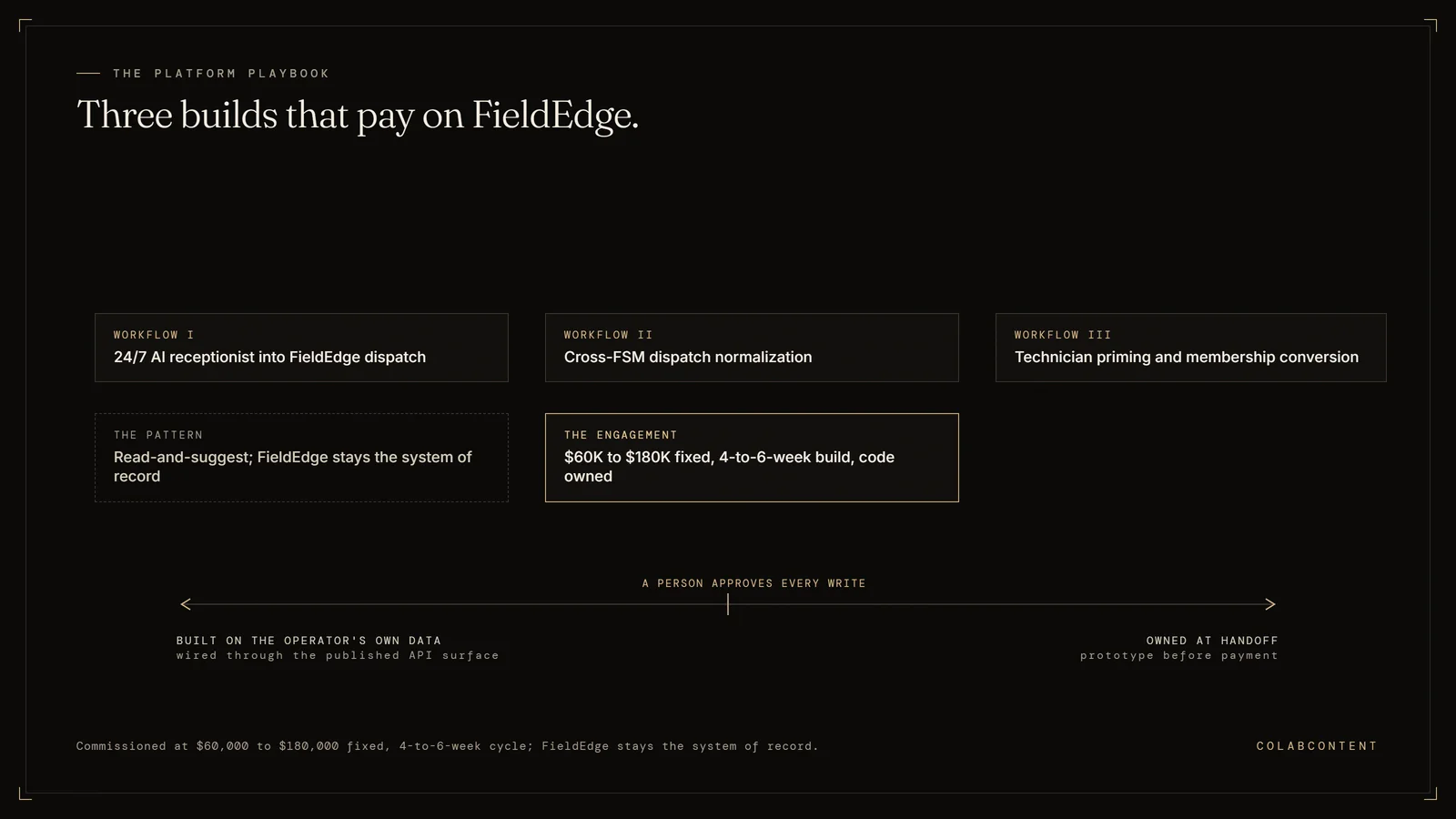
The three AI workflows ColabContent builds on top of FieldEdge for home services shops: a 24/7 AI receptionist wired into dispatch, cross-platform dispatch normalization for multi-brand operators, and technician priming with membership conversion
Where the field service platform stops and the shop's own logic begins.

Written for the shop that already pays for FieldEdge. We do not sell field service software, we take no referral fee from anyone in the table below, and we will say plainly which shops should stay exactly where they are.

For8 to 25 technician HVAC, plumbing and electrical shops
FieldEdge cost$21,000 a year at 12 techs, reported
Our fixed fee$45,000 to $180,000, one time
Bottom lineCrossover at 2.8 years, at a $45K build
UpdatedAugust 27, 2026

The short answer.

If you are on FieldEdge and the reason you are reading this is money, there are only two moves that change the shape of your bill rather than the size of it. One is Service Fusion, which is the only platform in this comparison that charges a flat rate with unlimited users, so hiring a technician stops raising your software cost. The other is owning the system, which removes the recurring licence entirely and replaces it with a one time fee. Everything else on this list is the same purchase you already made, at a different number. Housecall Pro and Jobber are cheaper per seat and genuinely better value for a small shop. ServiceTitan is two to four times the price. BuildOps and FieldPulse will not tell you what they cost at all.

So the honest verdict splits three ways by size. Shops under about five technicians should not be reading a page about custom software; the arithmetic below shows a build losing by more than thirty thousand dollars at that size, and Housecall Pro or Jobber will serve you better for less than a technician's monthly fuel bill. Shops between roughly eight and twenty technicians are where the crossover actually lives, and they are the only readers for whom the calculator on this page will produce an interesting answer. Shops past twenty five or thirty technicians running commercial work are usually looking at ServiceTitan or BuildOps for reasons that have nothing to do with price, and they should evaluate on capability. And a large number of shops in every band should simply take the total cost figure further down this page into their renewal conversation, because the cheapest switch is often the one you do not make.

What FieldEdge actually does well.

A comparison page that treats the incumbent as a punching bag is not useful to anyone actually holding the contract, and the Capterra rating below is a real signal that a lot of shops are getting real work done on this software every day.

The daily job, done by people who know the trade. Dispatch board, work orders, customer and equipment history per service address, invoicing, technician mobile, service agreements. FieldEdge covers the standard residential service workflow without asking a shop to invent a process, which is why it is the second most common field service platform in mid market home services and the most common in older platforms that grew before ServiceTitan took the segment.

QuickBooks, properly. The QuickBooks relationship is the reason a great many shops chose FieldEdge in the first place and the reason a great many of them have not left. If your bookkeeper's month end depends on that sync, that dependency is a real switching cost and it belongs in your evaluation as a risk line rather than as an afterthought.

Equipment history at the address. The single most valuable thing in a residential field service database is not the customer record, it is the record of what is installed at that address and what has been done to it. Shops that have been populating that for a decade have built something genuinely valuable, and it is the part of a migration that most often goes wrong.

A rating that says the software works. Capterra puts FieldEdge at 4.2 out of 5 across 312 reviews, read on August 27, 2026. That is a large population saying the daily job gets done. Hold that alongside the Trustpilot number in the next section rather than instead of it.

Why shops start looking for a way out.

Four patterns, in the order we hear them.

The per technician model taxes every hire. At the reported $125 per technician per month, adding four technicians adds $6,000 a year to the software bill automatically, with no decision made by anyone. In a trade where headcount swings with the season and with one good commercial account, that is a recurring cost that moves for reasons unrelated to whether the software got any better.

Everything is an add-on. Aggregators report FieldEdge modules at $19 to $99 a month each on top of the per seat licence. Individually each one is small. Collectively they are the reason a quote you agreed to two years ago does not resemble the invoice you are looking at now, and they are the most common specific complaint in the review record.

There is no rate card to argue against. FieldEdge publishes no pricing. We checked directly on August 27, 2026 and the pricing page offers a demo request and an explanation that pricing varies with team size and add-ons. That is a negotiating problem before it is a budgeting problem: when there is no published number, every number you are quoted is quoted against you rather than against a list.

The two review populations disagree, and one of them is about the relationship. Capterra says 4.2 out of 5 across 312 reviews. Trustpilot says 1.4 out of 5 across 46 reviews, read the same day. Both are real and we are not averaging them. The recurring themes in the recent one star reviews we read on Trustpilot, dated February 2024 through April 2026, are support responsiveness, billing and renewal handling, and being held to a term for a system a shop felt did not perform as sold. Software reviews and vendor relationship reviews are different questions, and buyers on this page are usually asking the second one.

What you are actually paying

Every number on this page, with its source.

Three of the vendors below publish a real, checkable price on their own website. Three publish nothing at all and gate every tier behind a demo request. We label each figure VERIFIED when it was read off the vendor's own page on August 27, 2026, and REPORTED when it came from a third party aggregator that the vendor has not confirmed. Where a vendor publishes nothing, the verified fact is the non-disclosure itself, not a price. Where we could not stand behind a figure, the cell says so and stays empty instead of being filled with a guess.

VendorSold byPublished or reported priceSetup and termsSource
FieldEdgePer user / month, office and technician priced separately~$100 per office or dispatch user; ~$125 per technician. Add-on modules $19 to $99 each.Setup $500 to $2,000, training $600 to $1,200, data migration $150 to $400. Billed annually, with some reports of two year terms. No free trial.REPORTED serviceagent.ai/blogs/fieldedge-pricing and itqlick.com/fieldedge/pricing. VERIFIED that fieldedge.com/pricing/ publishes no rate card and requires a demo.
Service FusionPer company / month. Unlimited users on every tier.Starter $208, Plus $325, Pro $533 billed annually. Monthly terms $245, $382, $627.No setup fee listed. Month to month billing available, so no forced annual commitment.VERIFIED servicefusion.com/pricing/
Housecall ProPer company / month with a user allowanceBasic $59 annual or $79 monthly, 1 user. Essentials $149 annual or $189 monthly, 5 users, then $100 per extra user. MAX $299 annual or $329 monthly, 8 users, then $75 per extra user.No setup fee listed. 14 day free trial. No long term contract required. Card processing described as low as 2.59 percent.VERIFIED housecallpro.com/pricing/
JobberPer company / month plus per userCore $49, 1 user, then $29 per extra user. Connect $139. Grow $199 to $499 for 1 to 15 users. Plus $499 to $699 for 5 to 15 users.No setup fee listed. No commitment on Core. Add-ons: Marketing Suite $99, Receptionist $29, Pipeline $49 a month.VERIFIED getjobber.com/pricing/
ServiceTitanPer technician / month$245 to $500 depending on tier (Starter, Essentials, The Works).Implementation $5,000 to $15,000 for a small or mid sized business; above $50,000 at enterprise scale. Contract terms not disclosed anywhere we could read.REPORTED itqlick.com/servicetitan/pricing. VERIFIED that servicetitan.com/pricing gates all three tiers behind Request Pricing.
BuildOpsPer field and office user, quote onlyNot published. The vendor's own page states that pricing is tailored per contractor and that there is no one size fits all number.Not publishedVERIFIED buildops.com/pricing confirms non-disclosure. This is a verified absence of a price, not a price.
FieldPulseSeat based, full access and field only seats, quote onlyNot published on any tier. FieldPulse is widely described as the budget option, including by FieldPulse, and we cannot verify that from public information, so we are not printing a figure or repeating the claim as fact.Not publishedVERIFIED fieldpulse.com/pricing confirms non-disclosure. Claim withheld.
Commissioned build (ColabContent)One time fixed fee, unlimited users$45,000 to $180,000, set after the diagnosis call and after integration depth is named.Prototype on your real data in 7 to 10 days. Production build 4 to 7 weeks. Code, prompts, models and pipeline owned by the shop at handoff.VERIFIED our own standing pricing, published across this site. Maintenance is modelled at 15 percent a year, which is a labelled assumption and not a contract term.

The numbers we refused to print

Three of them, and they matter more than the ones we did print. FieldPulse's price does not exist in public. Every roundup that calls FieldPulse the affordable FieldEdge alternative, including FieldPulse's own, does so without a number attached, and a claim with no number is marketing. FieldEdge's contract term is reported as annual with some sources describing two year commitments, and we could find no published term, notice period or cancellation policy from the vendor to check that against, so it stays labelled as reported and thin. A renewal escalation rate for FieldEdge does not exist in any source we could read. The five percent a year in our model below is our own conservative assumption, chosen deliberately low, and it is not a FieldEdge figure. If your own agreement names an escalator, that document beats everything on this page.

One more honest discrepancy worth knowing about, because it tells you how much to trust directories. Capterra's alternatives grid displays Housecall Pro at $79 a month and Service Fusion at $259 a month. Both vendors' own pricing pages, read the same day, show different numbers, because the directory is showing a monthly rate or an older tier while the vendor is showing the annual one. Neither party is lying. It is simply what happens when a price passes through a third party, and it is the reason every figure on this page carries the page it came from.

Normalise it: what a twelve technician shop pays for a year

Per seat and per company pricing are not comparable until you fix the headcount. Hold one shop at two office or dispatch staff plus twelve field technicians, take each vendor's published or reported rate at face value with nothing negotiated, and ask what a single year of licence costs.

Vendor and planOne year, 12 technicians + 2 officeHow it is calculated
Service Fusion Starter$2,496$208 x 12. Unlimited users, so headcount does not enter the calculation at all.
Jobber Grow, top of published band$5,988$499 x 12, within the 1 to 15 user allowance
Service Fusion Pro$6,396$533 x 12. Unlimited users.
Housecall Pro MAX plus 6 extra users$8,988($299 + 6 x $75) x 12, annual rate
FieldEdge, reported rates, licence only$20,400(2 x $100 + 12 x $125) x 12
FieldEdge, plus one add-on module$21,000Above, plus one module at $50 a month, the lower middle of the reported $19 to $99 range
ServiceTitan, low end of reported range$35,280$245 x 12 technicians x 12 months
ServiceTitan, high end of reported range$72,000$500 x 12 technicians x 12 months
BuildOps, FieldPulseNot published at any sizeBoth are quote only. No figure can honestly be placed in this column.

Read that table honestly and the first thing it says is uncomfortable for us. At twelve technicians, Service Fusion Pro costs $6,396 a year with unlimited users against FieldEdge's reported $21,000, and it does so with month to month terms available. That is a saving of roughly $14,600 a year for a switch that takes weeks rather than months and costs nothing but migration effort. No custom build competes with that on a payback basis, and any shop whose only complaint is the number should price Service Fusion before it reads another word of this page. What a build competes with is a different thing, and the rest of this page is about what that thing is.

The three year and five year model

Licence is not the whole bill. The model below adds FieldEdge's reported one time costs at year zero, assumes one add-on module, and escalates the recurring spend five percent a year from year two. The escalation rate and the build maintenance rate are our modelling assumptions, not vendor figures, and both are editable in the calculator below. The model excludes overage charges, additional training and any add-on creep beyond the single module, which every source describes as common, so the FieldEdge side is a floor on real spend rather than a ceiling.

Scenario, 2 office + 12 technicians3 year total5 year totalComponents
FieldEdge at reported rates, 1 add-on, 5% escalation$68,628$118,463$21,000 a year recurring, escalated from year two, plus $2,425 of setup, training and migration at year zero
Commissioned build at $45,000 + 15% a year maintenance$65,250$78,750One time fee, then $6,750 a year
Commissioned build at $100,000 + 15% a year maintenance$145,000$175,000One time fee, then $15,000 a year
Commissioned build at $180,000 + 15% a year maintenance$261,000$315,000One time fee, then $27,000 a year
Service Fusion Pro, unlimited users, no escalation modelled$19,188$31,980$6,396 a year, flat, no per seat exposure

The rows we are obliged to point at are the middle two. A build at $100,000 costs $145,000 over three years against FieldEdge's $68,628, and $175,000 over five against $118,463. It loses both comparisons outright at this shop size. A build at $180,000 loses by a wider margin still. At twelve technicians, only a build priced under about $47,300 wins on three year total cost, and only one under about $67,700 wins over five years. Those thresholds are back solved from the same formula the calculator uses. Turn it around and the more useful version is a headcount: a $45,000 build needs roughly twelve technicians to break even inside three years and roughly eight to break even inside five; a $100,000 build needs roughly twenty eight and nineteen respectively; a $180,000 build needs roughly fifty three and thirty six. If someone tells you a custom build is always cheaper than software, they have not done this arithmetic, and the reason we are doing it in public is that you are going to do it eventually anyway.

The crossover

Where the two lines meet.

Cumulative spend for the same shop, five years out. FieldEdge at the reported rates for two office users and twelve technicians, with one add-on module, $2,425 of setup and training paid at year zero, and a five percent annual escalator from year two. Against it, a commissioned build at $45,000, the bottom of our fixed fee range, paid once at year zero, with fifteen percent a year maintenance after that. Every figure in the chart comes from the table above.

Cumulative five year cost: FieldEdge subscription versus a one time commissioned build A line chart of cumulative spend for a home services shop with two office users and twelve technicians over five years. The FieldEdge line starts at $2,425 at year zero for setup, training and migration, then rises steeply to $23,425 at year one, $45,475 at year two, $68,628 at year three, $92,938 at year four and $118,463 at year five. The commissioned build line starts much higher at $45,000 at year zero and rises gently by $6,750 of maintenance each year to $51,750, $58,500, $65,250, $72,000 and $78,750. The build line begins far above the subscription line and the two cross during year three, at about 2.8 years and roughly $63,900, after which the subscription line is permanently above the build line. By year five the gap is $39,713. $0 $25K $50K $75K $100K $125K Year 0 Year 1 Year 2 Year 3 Year 4 Year 5 Crossover, 2.8 years FieldEdge $118,463 Owned build $78,750 FieldEdge, 12 techs + 2 office, 5% escalator Commissioned build, $45,000 once, 15% maintenance

The crossover lands at about 2.8 years, roughly $63,900 of cumulative spend on each path. For the first two years and nine months the subscription is cheaper and the build is the worse financial decision, and that is the part most vendor comparison charts hide by starting the axis in a convenient place. After the crossover the gap widens every year, because one line has a slope and the other is nearly flat. At year five the difference is $39,713, which is about a third of the FieldEdge total, and nothing in the model makes the subscription line bend back down.

Change the build price and the crossover moves, sharply. At $45,000 it happens during year three. At $100,000 it does not happen within five years at all at this shop size, and at $180,000 it is not close. Change the technician count and it moves the other way: at twenty technicians the FieldEdge line is steep enough that a $100,000 build crosses inside five years. That sensitivity is the whole point, which is why the next section is a calculator rather than a conclusion.

Your shop, your numbers

The FieldEdge total cost calculator.

Every default below is the figure from the table above, and every one of them is editable, because the defaults are a market estimate and your invoice is a fact. Nothing is submitted anywhere. There is no email gate, no external request, and no stored value. The arithmetic runs in your browser and stops there. If your inputs make the build lose, the tool says so in plain language rather than quietly hiding the result, and at small technician counts it will actively point you at a cheaper subscription instead of us.

Anyone holding a technician licence. Reported at about $125 each per month.
Dispatchers, CSRs, owners, bookkeeping. Reported at about $100 each per month.
Reported ~$125. FieldEdge publishes nothing. Use your invoice.
Reported ~$100. Editable, same reason.
Reported $19 to $99 a month each. We model $50, the lower middle of that range.
Set this to what your own modules actually cost.
Reported $500 to $2,000 setup, $600 to $1,200 training, $150 to $400 migration. Default is the midpoint of all three. Enter 0 if already paid.
Modelling assumption, not a FieldEdge published figure. We found no published escalator. Set to 0 to remove it.
Both totals are calculated over this horizon.
ColabContent fixed fee range, $45,000 to $180,000, set after the diagnosis call.
Software industry heuristic, not a ColabContent contract term. Replace it with a real quote before deciding.
The roundup

Eight options, in the order we would look at them.

One note on the roster before the list. Most FieldEdge alternatives guides you will come across are one of two things: a directory grid of star ratings with almost no pricing, or a blog published by a vendor that appears in its own comparison and puts itself at the top of it. Two of the three vendor-published posts we read print prices for the products they are not selling and no price for their own. The list below is ordered the way a shop holding a FieldEdge invoice would sensibly evaluate it: cheapest structural fix first, most expensive last, with the option that has no vendor behind it at the end because it is the one nobody else will show you.

1. Service Fusion

What it is. Full field service management for residential and light commercial trades, sold per company rather than per seat. Scheduling and dispatch, work orders, estimates, invoicing, customer records, technician mobile, QuickBooks integration.

Price. VERIFIED from servicefusion.com/pricing/ on August 27, 2026. Starter $208 a month billed annually or $245 monthly. Plus $325 annually or $382 monthly. Pro $533 annually or $627 monthly. All three tiers include unlimited users. Month to month billing is available, so there is no forced annual commitment.

Best for. Any shop whose actual complaint is per technician pricing. This is the only platform in the comparison that severs the link between headcount and software cost, and at twelve technicians it is roughly $14,600 a year cheaper than FieldEdge's reported rates.

Where it falls short. It is a lateral move on capability. You are trading one vendor's roadmap for another's, the AI tooling is thin compared with what ServiceTitan sells, and you still do not own anything. If your problem is that the software cannot do a specific thing your shop needs, this does not solve that.

Verdict. The strongest pure cost answer on this page, and it competes directly with what we sell. Price it first.

2. Housecall Pro

What it is. Residential focused field service software with strong online booking, customer communication and payments. The most consumer polished product in the set.

Price. VERIFIED from housecallpro.com/pricing/ on August 27, 2026. Basic $59 a month billed annually or $79 monthly, one user. Essentials $149 annually or $189 monthly, five users, then $100 a month per additional user. MAX $299 annually or $329 monthly, eight users, then $75 per additional user. Fourteen day free trial, no long term contract required, card processing described as low as 2.59 percent.

Best for. One to eight person residential shops. At that size the entire annual spend sits between roughly $708 and $3,948, and the absence of a long term contract removes exactly the lock-in that the FieldEdge review record complains about.

Where it falls short. The per user charge above the tier allowance climbs quickly. At twelve technicians plus two office staff you are into MAX plus six extra seats at $8,988 a year, which is still well under FieldEdge but no longer the bargain the headline suggests. Commercial and project work is not its strength.

Verdict. The right answer for small residential shops, and the honest recommendation for most people who arrive on this page from a shop under five technicians.

3. Jobber

What it is. Field service management aimed at small and growing home service businesses, with quoting, scheduling, invoicing and a well regarded client hub.

Price. VERIFIED from getjobber.com/pricing/ on August 27, 2026. Core $49 a month with no commitment, one user, additional users at $29 a month. Connect $139. Grow $199 to $499 for one to fifteen users. Plus $499 to $699 for five to fifteen users. Add-ons priced separately: Marketing Suite $99, Receptionist $29, Pipeline $49 a month.

Best for. Very small teams that value month to month flexibility, and shops growing from two technicians to six where the $29 per additional user rate is the cheapest per head number anywhere in this comparison.

Where it falls short. The tier jumps are large. Moving from Core to Connect to Grow adds $90 and then $60 to $360 a month in blocks, so the smooth per user economics stop being smooth around ten to twelve users. The add-on menu has the same creep dynamic that shops complain about on FieldEdge.

Verdict. Cheapest per additional head under about ten users. Roughly level with Housecall Pro above that.

4. ServiceTitan

What it is. The upmarket platform in the category, with the deepest commercial dispatch, pricebook, financing, marketing attribution and reporting ecosystem. The system most mid market platforms consolidate onto eventually.

Price. VERIFIED that servicetitan.com/pricing publishes nothing and gates all three tiers, Starter, Essentials and The Works, behind a Request Pricing form, checked August 27, 2026. REPORTED by ITQlick at $245 to $500 per technician per month with implementation of $5,000 to $15,000 for a small or mid sized business and above $50,000 at enterprise scale.

Best for. Shops past roughly twenty five to thirty technicians that need the full commercial ecosystem and have the budget for a real implementation. At that scale ServiceTitan is genuinely a different class of product and the price reflects capability rather than only opacity.

Where it falls short. Below that size it is a more expensive FieldEdge with the same quote-gated pricing. Two to four times the licence cost at the same headcount, several times the implementation, and the same inability to tell you what anything costs before a sales call. If you are leaving FieldEdge because of per seat pricing and pricing opacity, this move gives you more of both.

Verdict. A capability upgrade, not a cost fix. We wrote a separate comparison for shops evaluating ServiceTitan itself, with its own pricing model.

5. BuildOps

What it is. Field service management built for commercial contractors doing service plus projects plus construction, rather than residential break-fix. Different centre of gravity from everything above it.

Price. VERIFIED that buildops.com/pricing publishes no price, on August 27, 2026. The page states plainly that pricing is tailored to each contractor's operation and that there is no one size fits all number, and it is priced per field and office user behind a demo.

Best for. Commercial HVAC, electrical and mechanical contractors whose work mix includes projects and long term maintenance contracts. The commercial specific workflow is the real differentiator and residential platforms genuinely do not cover it.

Where it falls short. It carries the same pricing opacity and the same per user model as FieldEdge, so as an escape from those specific complaints it is a lateral move. It is also a poor fit for a purely residential shop.

Verdict. Evaluate on commercial capability, never on cost, because there is no cost to evaluate until you take the call. Our BuildOps AI comparison covers what its AI layer does and what its contract says.

6. FieldPulse

What it is. Field service management positioned explicitly at the shop looking to leave a more expensive platform, with full access and field only seat types across three tiers.

Price. VERIFIED that fieldpulse.com/pricing publishes no figure on any tier, on August 27, 2026, and routes to a custom quote. FieldPulse is repeatedly described as the budget friendly FieldEdge alternative, including in FieldPulse's own alternatives roundup, and we are not repeating that as fact because no published number exists to support it. Claim withheld.

Best for. Possibly you. We genuinely cannot tell from public information, which is the finding.

Where it falls short. A vendor whose entire market position is being cheaper than the incumbent, and which will not publish what it charges, is asking you to take the central claim on trust. That is the same posture that brought you to this page.

Verdict. Worth a quote. Not worth a place on a shortlist until the quote exists.

7. Staying on FieldEdge, with a contract you renegotiated

What it is. The option that costs nothing and that no comparison page lists, because nobody makes money from it.

Price. Whatever you negotiate. The leverage is the total cost figure from the model above rather than the per seat rate on your invoice, and it is materially more persuasive: $68,628 over three years is a different conversation from $1,750 a month.

Best for. Shops whose software works, whose technicians know it, whose QuickBooks sync is load bearing, and whose only real complaint is the number. That is a large share of the people reading this.

Where it falls short. It does nothing about the structure. You are still per seat, still on someone else's roadmap, and still without a rate card next time. It buys a cycle, not a fix.

Verdict. Try this before anything else on the list. It is free and it works more often than the internet suggests.

8. A commissioned build you own

What it is. Not a replacement for a field service platform in most cases. A custom system built for the workflow no vendor covers, sitting on top of or beside whichever platform you keep, owned by the shop at handoff. In practice that means a 24/7 AI intake and booking layer wired into dispatch, dispatch and routing logic normalised across multiple platforms for shops that have acquired their way into a mixed stack, or technician priming and membership conversion driven by the customer and equipment history you already hold.

Price. A fixed fee of $45,000 to $180,000, set after a free 45-minute diagnosis call and after the integration depth is named. A working prototype runs on your real data in seven to ten days. Production build is four to seven weeks. The shop owns the code, prompts, models and pipeline at handoff and runs it in its own cloud tenant. There is no recurring licence and no per technician charge.

Best for. Shops in roughly the eight to twenty five technician band with a platform that basically works and a named workflow that leaks money every week, usually missed calls after hours or unconverted service opportunities on the truck.

Where it falls short. It is a bigger single cheque, it needs a tighter scope than buying software does, and at anything above the bottom of our range it loses the cost argument outright at twelve technicians, as the table above shows without softening it. It also does not replace FieldEdge, so if what you want is to stop paying FieldEdge entirely, this is not that; Service Fusion is.

Verdict. The only option on the list where the bill stops going up, and the only one that has to clear a headcount threshold before it makes any sense at all.

The head to head buyers ask about

FieldEdge vs ServiceTitan, answered here.

This one comes up often enough to deserve a real answer here rather than a link, so here it is. Four things are actually checkable and the rest is positioning.

Neither publishes a price. FieldEdge's pricing page offers a demo. ServiceTitan's gates all three tiers behind a Request Pricing form. Both checked August 27, 2026. In a category this mature that is a pricing strategy rather than an oversight, and it means every number either of them quotes you is quoted against your shop rather than against a list.

The reported gap is large and it favours FieldEdge. At twelve technicians, FieldEdge's reported $125 per technician is $18,000 a year of technician licence. ServiceTitan's reported $245 is $35,280 and its reported $500 is $72,000. Implementation runs $500 to $2,000 on one side and $5,000 to $15,000 on the other before you reach enterprise scale. So ServiceTitan is roughly two to four times the cost at the same headcount, which is consistent with what it is: a bigger product for bigger operations.

The switch does not address the complaint that brought you here. If you are leaving FieldEdge because per technician pricing punishes hiring and because nobody will show you a rate card, ServiceTitan gives you a steeper version of both. Service Fusion is the move that actually changes the structure, and it costs less than either.

Where ServiceTitan genuinely wins. Commercial dispatch depth, pricebook and financing at the point of sale, marketing attribution, and reporting that a private equity backed platform can actually run on. Past roughly twenty five to thirty technicians those are not luxuries, and shops that size are usually right to pay. Below it, they are features you are funding and not using.

How to actually decide. Get both quotes in writing with the term and any escalator named, run them through the calculator above at your real headcount, and then ask each vendor what the total is in year three rather than year one. If neither will put a three year number on paper, that is itself the answer. Our full ServiceTitan alternatives comparison runs the same arithmetic from the other direction.

The ownership case

Eight arguments for owning it instead.

Each of these is either arithmetic you can check on this page or a structural fact about the two models. Where an argument does not honestly apply to your shop, the section after this one says so, and at twelve technicians several of them do not apply unless the build comes in at the bottom of our range.

One. The math, restated. A subscription never ends. At the reported rates a twelve technician shop pays $68,628 over three years and $118,463 over five, and year six starts at zero progress. A $45,000 build costs $65,250 over the same three years and $78,750 over five, and the lines cross at about 2.8 years. After that the gap widens every year because one curve has a slope and the other is nearly flat. That is the whole argument, and it is also why the chart is on this page rather than in a sales deck: it shows the two years where we lose.

Two. Per technician pricing taxes growth. Every technician you hire raises the bill by the same rate whether or not that technician is billable in month one. Four new technicians at the reported $125 is $6,000 a year, added automatically, forever, with no decision made by anyone. In a trade with seasonal swings and apprentices coming through, that is a cost that moves for reasons unrelated to value received. An owned system has no marginal seat cost at all, so hiring stops carrying a software decision inside it.

Three. Asset versus expense. A subscription is rent and it leaves nothing behind. A commissioned system is a piece of the business: transferable, and a real line in a sale or a roll-up conversation at a moment when home services businesses are being bought constantly. For an owner thinking about an exit inside five to ten years, that difference is not cosmetic.

Four. Built around your workflow, not the median shop's. Every product in the roundup above is calibrated against the average customer in its category, which is why you pay for the whole feature bundle and adapt your process to the part you actually use. A commissioned system starts from your service areas, your membership structure, your pricebook logic and your dispatch rules. Nobody gets retrained into someone else's assumptions.

Five. AI at the core rather than as another module. This one is concrete. FieldEdge sells capability as add-on modules reported at $19 to $99 a month each, per seat, on top of a per seat licence. That is the mechanism by which the bill you agreed to stops resembling the bill you receive. In a commissioned build there is no separate module line, because the intelligence is the system, and adding a user costs nothing.

Six. Unlimited seats. Technicians, apprentices, seasonal staff, subcontractors, dispatchers, and where appropriate the customer themselves through a portal. Zero marginal cost per person changes the question from who needs a licence to who needs access, which is a better question and one that most shops have never been able to ask.

Seven. Data ownership, and the door you cannot see through. Here is a specific, verified fact about this vendor that belongs in a buying decision. FieldEdge runs its developer portal at docs.api.fieldedge.com on Microsoft Azure API Management, and its public face describes itself as providing API access to FieldEdge's integrated partners. We fetched that portal on August 23, 2026 and read exactly that. The operation catalogue, the request and response shapes and the key issuer all sit behind a sign-in, and there is no self-serve developer signup and no publicly posted API definition. We also found no public webhook or event documentation, which is an absence of published evidence rather than proof that no event layer exists. The practical consequence is real: a shop cannot see what its own data will let it do until the vendor approves it as a partner. Our FieldEdge integration playbook and the API level companion to it document that surface in detail. A system you own has no gate on the far side of your own records.

Eight. Change speed. A change request to your own system is a scoping conversation and a deployment. A change request to a vendor is a ticket in a queue behind every other customer's, with no committed date and no obligation. When the thing you need changed is the thing that makes your shop different from the one across town, the queue is not an acceptable answer.

What we can actually prove

The list above is worth exactly as much as the evidence behind the firm making it, so here is ours, with nothing rounded up. Jim Glaser Law is our nameable reference and the principal takes reference calls. Across our practice, AI voice agents we built have handled more than 6,000 calls, which is the directly relevant number for any home services shop whose leak is the phone. The LELF platform is the fullest example of what commissioning looks like at operational scale: a 47-attorney litigation firm runs its matter, invoice and trust operation on it, holding 13,296 matters, 4,396 clients and 5,684 invoices, with trust reconciled byte identical against the system it replaced. That client is under confidentiality and stays anonymised, which is why we name the platform and not the firm. Across the practice we have delivered more than forty commissions.

What that evidence supports is a specific claim: we can build and run a system that carries real operational volume and reconciles under audit. What it does not support is a claim that we have decommissioned a FieldEdge tenant for anyone, because we have not, and the migration section below says so in plain language rather than around it.

The honesty section

Who should stay on FieldEdge, or switch to cheaper software instead.

Six situations where every argument in the previous section fails, and where we would tell you so on a call.

Shops under about five technicians. The arithmetic does not work and it is not close. A shop with one office user and four technicians pays about $45,525 over five years on FieldEdge's reported rates. The cheapest build we would scope is $45,000, which costs $78,750 over five years with maintenance, so the build loses by more than $33,000. At that size the right move is Housecall Pro at $59 to $149 a month or Jobber at $49 a month plus $29 a head, both with published prices and no long term contract. We would rather you read that here than pay us to tell you on a call.

Shops whose only complaint is the number. Service Fusion Pro is $6,396 a year with unlimited users against FieldEdge's reported $21,000 at twelve technicians. If the software does the job and the invoice is the problem, that switch banks roughly $14,600 a year in weeks, with no build risk and no capital outlay. Nothing we sell competes with that payback, and pretending otherwise would be dishonest.

Shops that need something working next month. A commissioned build ships a prototype in seven to ten days and production in four to seven weeks, and that assumes the partner API conversation with FieldEdge opens on schedule, which is outside our control. If the deadline is real and near, buying is faster than building and it is not close.

Shops whose QuickBooks sync is load bearing. If your month end depends on the FieldEdge to QuickBooks link and your bookkeeper has built a decade of habits around it, the switching cost is not the migration fee, it is the risk to your books during the changeover. That risk is frequently larger than the saving, and it is a legitimate reason to stay and renegotiate instead.

Shops where nobody internally will own the system. An owned build needs a named person who cares about it, even lightly. Shops without that person are better off renting, because the alternative is an orphaned system that quietly decays until it is worse than the software it replaced.

Shops whose constraint is not software at all. If the money is leaking in recruiting, in pricing, in call answer rate during business hours, or in technicians not being told what to sell, changing platforms is motion rather than progress. A meaningful share of the diagnosis calls we run end with us telling the operator to keep what they have, and this is the most common reason.

Decision tree

Six questions, in order, with stop points.

1. Do you have fewer than five field technicians? If yes, stop here. Price Housecall Pro and Jobber against your current invoice. A commissioned build will not return its cost at your volume and the calculator above will tell you the same thing if you run it. If no, continue.

2. Is your complaint the price, or is it the software? If it is purely the price, stop here and price Service Fusion, which is flat rate with unlimited users and roughly $14,600 a year cheaper at twelve technicians. Then take that quote to your FieldEdge renewal before you sign anything. If the software genuinely cannot do something you need, continue.

3. Do you know your actual per seat rates, your add-on modules and your renewal terms? If no, stop and go find the order form and the last two invoices. Every reported figure on this page is a substitute for those documents and a worse one. If yes, continue.

4. Run your numbers in the calculator above. Over five years, is your FieldEdge total above about $67,700? If no, stop. Even our cheapest build, $45,000 with maintenance, costs $78,750 over five years, so no build we quote can beat your subscription on cost. Renegotiate and spend the energy elsewhere. If yes, continue.

5. Can you name the workflow that leaks, in one sentence, with a rough dollar or hour figure attached? If no, stop, and spend two weeks measuring before anyone spends money. Every failed build we have seen started with an unnamed constraint. Missed calls after hours is the most common real answer in this trade, and it is measurable this week from your phone records. If yes, continue.

6. Is the budget runway for a $45,000 to $180,000 fixed fee real this quarter, and will the owner or operating partner spend 45 minutes on the diagnosis? If no, park it and revisit at renewal. If yes, that call is the next step, and a meaningful share of them end with us telling the shop to stay where it is.

Next step

Book the 45-minute diagnosis.

Bring your last two FieldEdge invoices and one sentence describing where the money leaks. You leave with the constraint written down either way, and a meaningful share of these calls end with us telling a shop to switch to cheaper software instead of buying anything from us.

Free · 45 minutes
Under NDA
Owner to owner
No follow-up unless asked
Migration reality

What leaving FieldEdge actually involves.

Almost nobody writing about FieldEdge alternatives answers this with specifics, which is odd, because it is the question that decides whether a shop ever acts on any of the rest. Here is the honest shape. The timelines below are our own scoping ranges for a move of this type, stated as estimates rather than dressed up as research, and no vendor publishes a comparable figure.

The money is small. The work is not. The reported cost of migrating data into FieldEdge is $150 to $400, which tells you the order of magnitude for this kind of transfer in this category. Nobody should stay on a platform they dislike because of a few hundred dollars. What actually costs you is the reconciliation, and it is paid in your dispatcher's evenings rather than in an invoice.

You are not moving a customer list. You are moving six things. Customers and their service addresses, which is the easy part. Equipment records per address with model, serial, install date and service history, which is the part your technicians use on every truck roll and the part least likely to map cleanly into another vendor's schema. Open and historical work orders. Invoices and their payment state. Membership or service agreement records with their renewal dates, which is where revenue quietly disappears if a renewal date does not survive the move. And the QuickBooks link, which has to be re-established on the other side and reconciled before you trust a single month end.

Phase one: export and reconcile a sample. Before anything moves, export everything and hand-check twenty addresses end to end against the live system. Not twenty records, twenty addresses with their equipment and their history. This takes a day and it is the single highest value day in the whole project, because it tells you what the export actually contains before you have committed to anything. Our planning range for full extraction and reconciliation at this size is two to four weeks.

Phase two: parallel run. Both systems live. New work goes into the new platform, the old one goes read only, and nothing is switched off. Run it through at least one full billing cycle and one membership renewal cycle, because the gaps in a field service migration do not surface when you look for them, they surface when a technician is standing in a basement asking what was done to this unit in 2021.

Phase three: decommission. Only after the parallel run produces no unresolved exceptions. Read the notice provisions in your agreement before you schedule this, because an auto renewing term will renew in the middle of a migration if nobody sends the letter, and the review record for this vendor suggests that is not a hypothetical.

A realistic total is two to four months from decision to switching the old system off for a shop of this size. The largest driver is not technician count, it is how many years of equipment history your team actually relies on, which you can measure this week by asking three technicians how often they look up what was done at an address before they arrive.

What we do and do not do here. We have not run a FieldEdge decommissioning and we are not going to imply otherwise. What we build is the workflow layer that sits on top of whichever platform you land on, which is a different job and one we have evidence for. If your project needs a migration partner, the platform you are moving to will usually name two or three, and their references are worth more than ours on that specific question.

The option most shops do not consider. You do not have to leave to fix the problem. In a large share of the cases we see, the platform is fine, the licence is defensible after a renegotiation, and the leak is in something sitting beside it: the phone at 7pm, the membership that never got offered, the second truck sent to the same street an hour apart. That path keeps FieldEdge, keeps the QuickBooks sync, keeps the equipment history, and builds the missing piece against the partner API. No migration, no parallel run, no decommissioning letter.

Deep dive

The dimensions the price table cannot show.

Six dimensions, side by side.

Price transparency. Service Fusion, Housecall Pro and Jobber publish real rate cards you can read in ten seconds. FieldEdge, ServiceTitan, BuildOps and FieldPulse publish nothing and gate every tier behind a demo. Transparency is not the same as cheapness, but an undisclosed price lets the seller quote against the buyer rather than against a list, and four of the seven vendors here have chosen that.

Cost structure, not cost level. Every platform in this comparison except Service Fusion charges per seat in some form, which means your software bill is a function of your headcount rather than of the value the software delivers. Service Fusion's flat tiers and an owned build are the only two structures on this page where hiring a technician costs nothing in software.

Cost slope. A subscription rises with headcount and with renewal. A commissioned build is a one time fee plus a flat maintenance line. The slope, not the starting point, is what decides a five year comparison, and it is also why the build loses every three year comparison at small headcounts.

Access to your own data. FieldEdge's API documentation sits behind a partner sign-in at docs.api.fieldedge.com, verified August 23, 2026, so a shop cannot see what its records will let it do before the vendor approves it. That is a governance question as much as a technical one and it belongs in a buying decision.

Ownership at exit. Every vendor here retains the code, the structure and the pipeline. A commission transfers all three at handoff, running in the shop's own cloud tenant. That is the difference between an export and a handover.

Contract readability. Housecall Pro and Jobber both state no long term contract required on their own pricing pages, and Service Fusion offers month to month terms. FieldEdge is reported as annual with some sources describing two year commitments, and we could find no published term to check. When two products are close on function, the one whose terms you can read before the call is the safer purchase.

When to pick which, in one paragraph each.

Stay on FieldEdge if the software works, your technicians know it, the QuickBooks sync is load bearing, and your real complaint is the invoice. Take the three year total from this page into the renewal conversation as leverage rather than as a reason to leave.

Move to Service Fusion if per technician pricing is the actual problem. It is the only platform here that removes headcount from the equation entirely, and at twelve technicians it saves roughly $14,600 a year against FieldEdge's reported rates.

Move to Housecall Pro or Jobber if you are under about eight technicians and want a published price, a free trial, and no long term contract. Below five technicians this is almost always the right answer and a build is almost never one.

Move to ServiceTitan only past roughly twenty five to thirty technicians and only for capability, never for cost. Below that you are funding an ecosystem you will not use.

Move to BuildOps if your work is genuinely commercial, with projects and long term maintenance contracts alongside service. Evaluate it on that fit, because there is no published price to evaluate it on.

Commission a build if the platform is fine, the constraint is a named workflow, and the five year subscription total on this page is comfortably above what a scoped build would cost at your headcount. Most shops in that position keep their platform and build beside it.

Why this page is written by someone who does not sell field service software.

Worth saying plainly, because it changes how you should read everything above. Of the FieldEdge alternatives guides we read in full, three are published by direct competitors of FieldEdge, and each of those puts its own product at the top of its own list. Two of those three print dollar figures for the products they are not selling and no dollar figure for their own. The rest are directory sites whose business model is routing your contact details to vendors, and one of them displays prices for two products that do not match those vendors' own published pages. None of the four we read in full computes a multi-year total, and none of them cites a review platform rating for FieldEdge in either direction.

ColabContent sells commissioned AI builds. We do not sell field service software, we take no referral fee from anyone in the roundup, and we have no reason to steer you toward or away from any of them. That does not make us neutral about the conclusion, obviously, and the whole point of publishing the arithmetic and the assumptions is that you can see exactly where our interest starts affecting the numbers. It does mean that when this page says Service Fusion beats us outright on payback, or that a $100,000 build loses at twelve technicians, nothing commercial is pulling in the other direction.

What a build on top of FieldEdge actually looks like.

Three workflows come up repeatedly, and they share a property: none of them is a scheduling problem, which is why the platform does not touch them.

A 24/7 intake and booking layer wired into dispatch. The AI answers, qualifies, books, and writes the work order into the platform against the right customer record and the right service area, so the morning dispatcher opens a board with the night's calls already on it. This is the workflow with the clearest dollar figure attached in this trade, because the missed call rate after 5pm is measurable from your phone records this week.

Cross-platform dispatch normalisation. For operators who have acquired their way into a mixed stack, running FieldEdge in two brands and something else in a third. The layer normalises work order state, technician availability and route geography across both and surfaces the routing that is optimal across the whole operation rather than per brand. The underlying platforms stay separate and stay the system of record.

Technician priming and membership conversion. Reading the customer and equipment history you already hold, drafting what this technician should raise at this address, and pushing it to the truck before arrival. Membership conversion is the revenue line most shops know they are leaving on the table and cannot systematically capture with a checklist.

The integration posture is read and suggest by default, human in the loop, relaxing to spot check only after sixty to ninety days of held output quality. Integration happens at the API layer, which means the partner conversation with FieldEdge is a real scheduling dependency rather than a formality, and we scope the first version around scheduled reads rather than event delivery because no public event surface is documented. There is no database layer to plan against. And where FieldEdge or your platform already ships a feature that covers the workflow, we will tell you to use it rather than build a worse version.

Questions

The eight questions FieldEdge buyers actually ask.

How much does FieldEdge actually cost per month?

FieldEdge does not publish a price. We checked fieldedge.com/pricing/ directly on August 27, 2026 and found no rate card, only a demo request and copy explaining that pricing varies with team size and add-ons. Two third party aggregators that do publish estimates, serviceagent.ai and itqlick.com, both land in the same place: roughly $100 per office or dispatch user per month and roughly $125 per technician per month, billed annually, with a one time setup fee of $500 to $2,000, training of $600 to $1,200, data migration of $150 to $400, and add-on modules at $19 to $99 a month each. Treat all of those as reported rather than verified, because the vendor has confirmed none of them. For a shop with two office users and twelve technicians that is $1,700 a month of base licence, which is $20,400 a year before a single add-on and before onboarding.

Is FieldEdge worth it? The reviews say two different things.

They do, and both numbers are real, so we are printing both. Capterra shows FieldEdge at 4.2 out of 5 across 312 reviews. Trustpilot shows FieldEdge at 1.4 out of 5 across 46 reviews. Read on August 27, 2026. That is not a contradiction to be averaged away, it is two different populations answering two different questions. Capterra reviews tend to answer whether the software does the daily job, and on that axis FieldEdge scores well. Trustpilot reviews tend to be written by people escalating something, and the recurring themes across the recent one star reviews we read there, dated from February 2024 through April 2026, are support responsiveness, billing and renewal handling, and being held to a contract for a system that did not perform as it was sold. If your complaint is that dispatch is clunky, the Capterra population disagrees with you. If your complaint is about the commercial relationship, the Trustpilot population is where you will find company.

FieldEdge vs ServiceTitan: which costs more?

ServiceTitan, by a wide margin, at every size where both are realistic. Neither publishes pricing. ServiceTitan's own pricing page gates all three tiers behind a Request Pricing form, checked August 27, 2026. ITQlick reports ServiceTitan at $245 to $500 per technician per month by tier, with implementation of $5,000 to $15,000 for a small or mid sized business and above $50,000 at enterprise scale. Run the same twelve technician shop through both: FieldEdge at the reported $125 per technician is $18,000 a year of technician licence, while ServiceTitan at the reported $245 is $35,280 and at $500 is $72,000. So ServiceTitan is roughly two to four times the licence cost of FieldEdge at the same headcount, plus an implementation fee that is several times larger. ServiceTitan buys you a deeper commercial ecosystem, and shops past roughly twenty five or thirty technicians genuinely use it. Below that, moving from FieldEdge to ServiceTitan to escape per seat pricing and pricing opacity is moving toward more of both.

Which FieldEdge alternative is cheapest for a small one to five technician shop?

Housecall Pro or Jobber, and neither of them is us. Housecall Pro Basic is $59 a month billed annually for one user, and Essentials is $149 a month billed annually for five users, read off housecallpro.com/pricing on August 27, 2026, with a fourteen day free trial and no long term contract required. Jobber Core is $49 a month for one user with additional users at $29 a month, and Connect is $139 a month, read off getjobber.com/pricing on the same date. A five person shop lands somewhere between $708 and $3,948 a year on either. Against that, the cheapest custom build we would scope is $45,000, which costs $78,750 over five years with maintenance. A shop with one office user and four technicians pays about $45,525 over five years on FieldEdge's reported rates, so a build loses that comparison by more than $33,000. We would tell you that on the call rather than take the engagement, and we are telling you here so you do not have to make the call.

Do FieldEdge alternatives charge per technician or a flat rate?

Almost all of them charge per seat. Service Fusion is the exception and it is the reason the option sits first in our roundup. Its three published tiers, $208, $325 and $533 a month billed annually, all include unlimited users with no per technician charge, read off servicefusion.com/pricing on August 27, 2026. That is the single most direct structural answer to the complaint that brings most people to this page, because it decouples the software bill from headcount entirely. Housecall Pro charges $75 to $100 a month per user above its tier allowance. Jobber charges $29 a month per additional user. FieldEdge is reported at $100 to $125 per user per month. ServiceTitan is reported at $245 to $500 per technician per month. FieldPulse sells full access and field only seats but will not publish what either costs. If the thing you actually want is for hiring a technician to stop raising your software bill, there are exactly two answers on this page: Service Fusion's flat tiers, or owning the system.

What happens to my data if I switch off FieldEdge?

Less drama than the switching cost narrative suggests, and more work than a migration checklist suggests. On money, the reported data migration figure for moving onto FieldEdge is $150 to $400, which tells you the order of magnitude for this kind of transfer in this category: it is a small one time cost, not a ransom, and nobody should stay on a system they dislike because of it. On effort, the honest shape is that you are not moving a customer list. You are moving customers, equipment and service history per address, open and historical work orders, invoices and their payment state, membership or service agreement records with their renewal dates, and the QuickBooks link that most FieldEdge shops rely on. Equipment history per address is the one that hurts, because it is the part your technicians actually use on a truck roll and the part that is least likely to map cleanly into another vendor's schema. Export it, read it, and reconcile a sample of twenty addresses by hand before you trust the whole file.

Can I cancel FieldEdge mid-contract?

We are not going to print a contract term we cannot source. What we can say is what is documented. Third party aggregators report FieldEdge as billed annually, with some reporting two year commitments, and we found no published FieldEdge contract term, notice period or cancellation policy on the vendor's own site to check that against. Separately, the recurring theme in the recent one star Trustpilot reviews we read on August 27, 2026 is the commercial relationship rather than the product, including being billed through a term for a system that did not perform as sold. Those are customer accounts, not a contract. The only document that answers this question for your shop is your own order form or service agreement, and it is the first thing to put on the table before any of the arithmetic on this page matters. If it auto renews, find the notice window and diarise it now, because a renewal will land in the middle of a migration if nobody sends the letter.

Is commissioning a custom system realistic instead of another software subscription?

At some sizes yes, at others no, and this page prints both. Using the reported FieldEdge rates and our stated assumptions, a shop with two office users and twelve technicians spends $68,628 over three years and $118,463 over five. A commissioned build at $45,000 with fifteen percent annual maintenance costs $65,250 over three years and $78,750 over five, so the two lines cross about two years and nine months in. That is a real crossover, and it is also a narrow one at year three: the build is only about $3,400 ahead. Push the build price up and the answer flips. A $100,000 build needs roughly nineteen technicians before it breaks even inside five years, and roughly twenty eight before it breaks even inside three. A $180,000 build needs roughly thirty six technicians over five years. At the twelve technician default on this page, only a build priced under about $67,700 wins over five years at all. Anyone who tells you a custom build is always cheaper has not run this arithmetic.

Buyer worksheet

What to have in front of you before any call.

Five documents to pull before you talk to anyone.

One. Your service agreement or order form. Not the invoice. The agreement is where the term, the renewal mechanics, any escalator and the notice period live. Every reported figure on this page is a substitute for that document and a worse one.

Two. Your last two invoices, side by side. Compare them line by line. The gap between them is your real escalation rate and your real add-on creep, and it beats our five percent assumption in every way that matters.

Three. Your seat count, split. Technicians, dispatchers, CSRs, office, and anyone holding a licence who has not logged in this quarter. That last group is usually the fastest money a shop finds and it costs one email to check.

Four. Your after-hours call log. How many calls came in after 5pm last month, and how many were answered. This is the single most useful number a home services owner can bring to any software conversation, ours included, and almost nobody has it.

Five. One sentence naming where the money leaks. With a rough dollar or hour figure attached. If you cannot write that sentence, no vendor on this page can help you, and neither can we.

Five questions to ask every vendor, including us.

What is the term, and what happens at renewal? Ask for the escalator in writing. A vendor that will not commit one to paper has told you something useful.

What is the total in year three, not year one? Make them do the arithmetic at your seat count with their own escalation assumption. Compare that number to the one the calculator on this page produced.

Which modules are included and which are extra? Get the full add-on menu with prices before you sign, not after. This is the single most common source of the gap between the quote and the invoice in this category.

What exactly do we own at the end, and in what format? For a subscription the answer is an export, and you should ask to see a sample export file. For a commission it should be code, prompts, models, datasets, runbook and integration documentation, in writing.

Can we speak to a shop you did this for? Then ask that operator three things: what the constraint was, what the system does now, and whether they would do it again. Our answer to this question is Jim Glaser Law, and the principal takes reference calls.

When not to buy from us.

Do not commission a build if you run fewer than about eight technicians. The volume through any single workflow will not return a five figure build inside five years, and the calculator above will show you that before we ever speak.

Do not commission a build if what you actually want is to stop paying FieldEdge. We do not replace a field service platform, and a commission sits on top of one rather than instead of it. If leaving the category is the goal, price Service Fusion, Housecall Pro and Jobber and use this page's cost model as the yardstick.

Do not commission a build if your platform already ships a feature that covers the workflow. Evaluate the product first. We will tell you when that is the right answer rather than quoting around it.

Do not commission a build if nobody at the shop will own the system after handoff. An owned system with no internal owner decays, and that outcome is worse than renting.

Do not commission a build if you cannot name where the money leaks in a sentence. Book the diagnosis call anyway, because naming it is the work of the call, but do not sign anything until the sentence exists.

Sources, with dates and labels.

All fetched on August 27, 2026 unless noted. VERIFIED means read directly off the vendor's own page. REPORTED means a third party published it and the vendor has not confirmed it.

VERIFIED servicefusion.com/pricing/ (three tiers, unlimited users, monthly and annual rates). housecallpro.com/pricing/ (Basic, Essentials, MAX, per additional user rates, free trial, no long term contract). getjobber.com/pricing/ (Core, Connect, Grow, Plus, per additional user, add-on menu). fieldedge.com/pricing/, servicetitan.com/pricing, buildops.com/pricing and fieldpulse.com/pricing all confirmed as publishing no price, which is how we know four of the seven vendors here are quote only. trustpilot.com/review/fieldedge.com (1.4 out of 5 across 46 reviews, with the individual recent one star reviews read rather than summarised from the score). capterra.com FieldEdge listing (4.2 out of 5 across 312 reviews, and the alternatives grid whose displayed prices for two vendors do not match those vendors' own pages). docs.api.fieldedge.com (partner-gated developer portal on Microsoft Azure API Management, fetched August 23, 2026 for our FieldEdge integration playbook).

REPORTED serviceagent.ai/blogs/fieldedge-pricing and itqlick.com/fieldedge/pricing (FieldEdge per user rates, setup, training, migration, add-on module range, annual billing). itqlick.com/servicetitan/pricing (ServiceTitan per technician range and implementation bands). Competitor roundups published by servicetitan.com, fieldpulse.com and projul.com were read in full to establish what the existing FieldEdge alternatives guides do and do not answer; they are cited as content, not as a pricing source.

Claims we withheld. No FieldPulse price is printed anywhere on this page, because none is published and we will not repeat the budget positioning as fact. No FieldEdge contract term is asserted beyond the reported annual billing, because no vendor document states one. No FieldEdge renewal escalator is claimed at all; the five percent in our model is our own conservative assumption and is labelled as such everywhere it appears. Individual Trustpilot reviewers are not named on this page, because the aggregate rating and the recurring themes are the evidence, and the display names of individual customers are not ours to publish.

Our own numbers. The $45,000 to $180,000 fixed fee range, the seven to ten day prototype and the four to seven week production build are our standing terms, published across this site. The fifteen percent annual maintenance figure is a software industry heuristic used for modelling and is not a ColabContent contract term. The 6,000 plus AI handled calls, the forty plus commissions, the Jim Glaser Law reference and the LELF platform figures are our own delivery record.

Bring your last two invoices.

Free 45-minute diagnosis, under NDA. We will run your real numbers against the model on this page and tell you honestly whether the answer is renegotiate, switch to cheaper software, or build. A meaningful share of these calls end with us telling a shop to stay where it is.