Home/ Comparisons/ Shopify Plus Alternatives

Shopify Plus Alternatives: 7 Options and What Plus Really Costs

There are six credible platform alternatives to Shopify Plus for a mid-market brand, BigCommerce, Adobe Commerce, Salesforce Commerce Cloud, commercetools, WooCommerce and OroCommerce, and a seventh option that almost never appears on a comparison page because no platform vendor can sell it to you: commissioning the merchandising, operations, reporting and retention layer your brand actually runs on, and owning it outright. Start with the number, because Shopify is unusual in publishing one. We opened shopify.com/plus/pricing on August 30, 2026 and it states a platform fee starting at $2,500 USD a month on a one year term, or $2,300 USD a month on a three year term, with your main store and nine expansion stores included, an extra $300 USD per month per store beyond that, and 0.20% per transaction payable to Shopify on top of your own processor fees if you do not use Shopify Payments. That sticker is checkable in ninety seconds, which is more than four of the six alternatives below can say. It is also not the bill. The all in figure once apps, integrations and agency time are counted is modelled at $4,900 to $8,400 a month for a brand near $1,000,000 of annual revenue, a figure REPORTED by the competing vendor Swell and treated as such throughout this page. On the default scenario below, a brand on the three year term with $2,000 a month of apps and $1,500 a month of agency time spends $159,200 by the end of year two against $104,000 for an $80,000 commissioned build carrying maintenance at our stated 15% assumption, and the two lines cross at about twelve and a half months. One honest limit before you go further: a commissioned build does not replace a payment processor or a PCI compliant hosted checkout, and this page never pretends it does.

A note on names. Shopify Plus is the enterprise contract tier, not a separate product; the admin, the theme system and the app ecosystem are the same ones a Basic store uses, with higher limits, checkout customisation, more expansion stores and unlimited staff accounts. Brands searching for a way out use Shopify Plus, Shopify Enterprise and Shopify Commerce Components interchangeably. This page is about the decision behind all three names rather than any one product page.

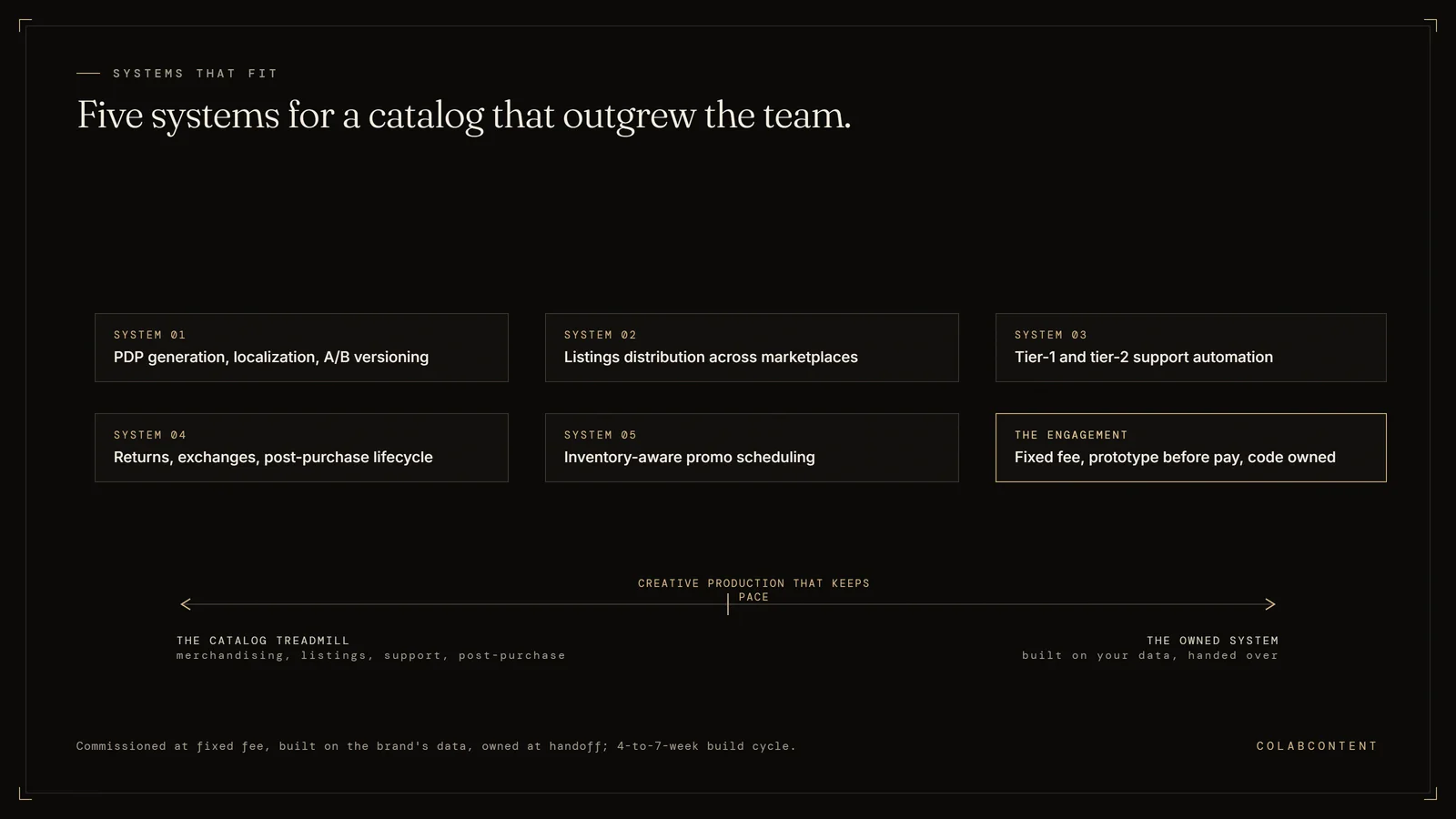
The five custom AI systems ColabContent commissions for DTC ecommerce brands: product detail page generation and localization, marketplace listings distribution, tiered support automation, post-purchase lifecycle handling, and inventory-aware promo scheduling
The layer a build actually owns. The checkout underneath it stays rented, deliberately.

Written for the founder, operator or head of ecommerce who already pays for Shopify Plus. We do not sell a commerce platform, we take no referral fee from anyone in the roundup below, and there is a full section further down arguing that a large band of brands should stay exactly where they are.

ForDTC and mid-market brands, roughly $1M to $50M of annual revenue
Shopify Plus cost$2,300/mo on a 3 year term, $2,500/mo on a 1 year term, published by Shopify
Our fixed fee$45,000 to $180,000, one time
StanceNeutral. We sell no commerce platform.
Bottom lineCrossover at about month 13 on the default scenario
CostFree 45-minute diagnosis
Last updatedAugust 30, 2026, vendor pages read the same day

The short answer.

If you are here because of the renewal, you are in a better position than most software buyers and a worse one than you think. Better, because Shopify actually publishes its enterprise floor, which almost nobody in enterprise software does, so you can walk into the conversation knowing what the entry number is. Worse, because the floor is the only part of your bill that is published. The apps are priced by other companies, the agency is priced by a person, the implementation was a one time number nobody wrote down afterwards, and if your volume has grown enough, your next contract may be priced on what Shopify's own page calls a variable platform fee for more complex business structures, with no percentage given anywhere on that page. So the useful exercise is not benchmarking the $2,300. It is putting a real number on the other four fifths of the spend, which is what the table, the chart and the calculator on this page are built to do.

If you are here because the store no longer fits the business, the answer is different and more useful. The complaint we hear from brands at this size is almost never that Shopify is bad at being Shopify. It is that eleven separate vendors now sit between the order and the warehouse, each with its own subscription, its own admin, its own outage and its own idea of what a customer record looks like, and that a person on payroll spends part of every week holding the seam together. That problem does not get solved by moving to a different rented platform, because the eleven vendors follow you. It gets solved by owning the layer that sits between the storefront and the rest of the business. That is the argument this page makes, and the section on what a build does not replace is there so the argument stays inside its actual limits.

What Shopify Plus actually does well.

Worth stating first and at length, because a page that only attacks reads as an advertisement and deserves to be treated as one.

Checkout, and the compliance you are not carrying. The single most valuable thing Shopify sells is not the admin. It is a hosted, PCI compliant, relentlessly conversion tested checkout that you do not own, do not have to certify and do not have to defend when something goes wrong with a card. Every serious commerce team that has tried to rebuild that from scratch has a story about how long it took and what it cost. This page argues you should own several layers of your commerce stack. It does not argue you should own that one.

Uptime through the spike. The day your ad works, or the influencer posts, or the drop lands, is the day a self hosted stack finds out what its ceiling is. Shopify absorbs that traffic as an operational fact rather than an incident, and the brand never sees the internals. That is a real service and a real transfer of risk, and it is worth genuine money to any brand whose demand is spiky.

Unlimited staff accounts. This one deserves specific credit, because the usual complaint about enterprise software is a per seat tax and Shopify does not levy one at this tier. shopify.com/pricing lists Basic with no additional staff accounts, Grow at up to 5 staff accounts, Advanced at up to 15 staff accounts, and Plus at unlimited staff accounts. If your team grew from twelve to forty, the platform fee did not move because of it. That is a genuine structural advantage over most of the enterprise software we write about, and we are not going to pretend a seat tax exists here just because it makes a tidier argument.

The ecosystem, and the fact that everything builds to Shopify first. If you need a subscription engine, a loyalty programme, a reviews corpus, a three party logistics connector or a tax engine, someone has already built a Shopify integration and it is probably the most mature version of that integration they ship. That is a substantial practical benefit and it is the reason many brands stay: the alternative to eleven apps is often eleven custom integrations.

Migration is not held hostage on the way in, and Shopify says so. Its own pricing page states that Shopify does not charge you to migrate, though it also states that migration is your responsibility and that paid services are available for custom needs. Compared with several vendors in adjacent categories where extracting your own data has required lawyers, that is a materially better posture and it should be said out loud.

None of that is the argument on this page. The argument is about what happens after the platform fee, about what the app layer costs once it stops being three apps and becomes twelve, and about which parts of the stack are worth renting forever and which are worth owning. A platform can be excellent and still be the wrong thing to build your entire operating layer inside.

Why brands start looking for a way out.

The floor moved, and it moved a lot in one step. Shopify's current pricing pages carry no historical pricing and no price change disclosure; we checked specifically for that on August 30, 2026 and there is none. The increase itself is documented consistently across independent trade press: the Plus base fee moved from $2,000 a month to $2,500 a month on the one year term during the first half of 2024, an increase of 25% on that base, with the option to hold it nearer the old number at $2,300 a month by signing a three year term. That is REPORTED, not vendor sourced, and the outlets are named in the price history section below. A couple of sources describe the same change as 33% or 34%, which appears to be a comparison against a different starting basis rather than the same base to base move; we use 25% and say why rather than printing both numbers without a reconciliation.

The three year term is the price of the better price. Read that structure carefully, because it is the most consequential sentence on Shopify's pricing page and it is easy to skim. The cheaper monthly figure is available in exchange for committing three years. That is a completely normal enterprise trade and there is nothing sharp about it. It does mean that the decision you are making at renewal is not a monthly decision. At $2,300 a month the three year commitment on the platform fee alone is $82,800 before a single app, and it is worth seeing that number written as one number at least once.

The app stack outgrows the platform fee. This is the complaint we hear most and it is the one the platform fee conversation completely misses. A brand at this size is rarely running three apps. It is running a subscription engine, a loyalty programme, a reviews platform, an advanced search, a bundling tool, a returns portal, a customer support desk, a tax engine, a three party logistics connector, an email and SMS platform, and one or two things nobody remembers signing up for. Swell reports app and integration spend at $500 to $1,000 a month early on rising to $3,000 to $5,000 or more a month at enterprise scale REPORTED, and Swell is a competing vendor, so weigh it accordingly and then check it against your own card statement, which is the only source that is actually about you.

Growth is taxed on units you cannot stop producing. Plus does not tax headcount, and we said so above. It does tax three other things. Store count: your main store and nine expansion stores are included, and Shopify's own page says additional stores cost an extra $300 USD per month per store, or a revenue share across all stores. Transactions: if you use a processor other than Shopify Payments, Shopify's own page says you pay your processor fees plus 0.20% per transaction to Shopify for security and compliance costs. And volume: for what the page calls more complex, higher volume businesses, the flat fee can be replaced by a variable platform fee whose rate the page does not publish. Every one of those grows when the business grows. A one time build does not.

Fees on sales that did not happen. In high return categories this is a live and specific irritation. Penny G., a reviewer in apparel and fashion at an 11 to 50 employee company, wrote on Software Advice that Shopify no longer refunds fees when an order is cancelled or refunded, and that this is a huge cost to vendors. We re-read that review verbatim on softwareadvice.com on August 30, 2026. It is a customer's account on a review platform, REPORTED, not a Shopify policy statement, and we could not find the point addressed on shopify.com/plus/pricing. If you sell apparel or footwear, that line is worth an hour with your settlement reports.

The workflow tax that never appears on an invoice. The largest cost in most of these stacks is a person. Somebody exports a file every Monday. Somebody reconciles two systems that disagree about what an order is. Somebody re-keys wholesale orders because the B2B module does not do the thing your wholesale actually does. That labour is real money, it grows with the business, and it is invisible in every total cost comparison you will read, including the ones published by the platforms. It is also the single largest line a custom build removes, which is why the calculator on this page lets you leave it out entirely and the argument still works.

The comparison guides are written by people in the comparison. Worth knowing as a buyer. The most detailed public cost breakdown of Shopify Plus we could find is published by Swell, a company that sells a competing commerce platform. The most detailed alternatives roundup we could read is published by Elogic, an agency whose own service pages sell Adobe Commerce development, Shopify Plus development and BigCommerce development, meaning it is paid to implement whichever option you pick. Neither discloses that on the page. Neither is worthless, and we cite both. But when you read that Shopify is expensive, notice who benefits from you believing it, and apply the same test to this page, which is published by a company that sells custom builds and says so in the second sentence.

What you are actually paying

Every number, with the label it earned.

Two labels run through this whole page and the difference between them is the whole point. VERIFIED means read off the vendor's own page, or verified-by-absence at a vendor URL that LOADED (HTTP 200) and contains no price. A figure from ANY third-party aggregator (Vendr, PriceLevel, SelectHub, ITQlick, G2, Capterra, Software Advice, toolradar, any blog or competitor) is REPORTED, however good the data. ASSUMPTION means we chose the number ourselves, and every one of them is named and editable in the calculator. A fetch that failed never supports a VERIFIED label anywhere on this page; where a vendor page would not load, the row says so.

Shopify Plus cost lines and the sources behind them, read August 30, 2026
Cost lineFigureLabelSource
Platform fee, three year term$2,300 / monthVERIFIEDshopify.com/plus/pricing
Platform fee, one year term$2,500 / monthVERIFIEDshopify.com/plus/pricing
Plus floor shown on the main plan tablefrom $2,300 / monthVERIFIEDshopify.com/pricing
Storefronts included in the platform feeMain store + 9 expansion storesVERIFIEDshopify.com/plus/pricing
Each additional storefront beyond the nine$300 / month per store, or a revenue share across all storesVERIFIEDshopify.com/plus/pricing
Surcharge if you do not use Shopify PaymentsYour processor's fees, plus 0.20% per transactionVERIFIEDshopify.com/plus/pricing
Shopify Payments card ratesNot published. The page says card rates vary by countryVERIFIED BY ABSENCEshopify.com/plus/pricing, loaded 200
Variable platform fee for higher volume contractsRate not published anywhere on the pageVERIFIED BY ABSENCEshopify.com/plus/pricing, loaded 200
Charge levied by Shopify to migrate onto PlusNone. Migration is your responsibility; paid services availableVERIFIEDshopify.com/plus/pricing
Staff accounts on PlusUnlimited, no per seat chargeVERIFIEDshopify.com/pricing
Price history, base fee move during 2024$2,000 to $2,500 on the one year term, 25%REPORTEDinflowinventory.com, dynamicweb.com, marketing4ecommerce.net, liquify.design
Implementation, one time, coming up from Shopify Advanced$10,000 to $30,000REPORTEDswell.is, a competing commerce vendor
Implementation, one time, coming off Magento$50,000 to $250,000REPORTEDswell.is, a competing commerce vendor
Apps and integrations, monthly$500 to $1,000 early, $3,000 to $5,000+ at enterprise scaleREPORTEDswell.is, a competing commerce vendor
Agency retainer, monthly$3,000 to $10,000REPORTEDswell.is, a competing commerce vendor
Modelled all in monthly cost near $1,000,000 annual revenue$4,900 to $8,400 / monthREPORTEDswell.is, a competing commerce vendor
Commissioned build, one time fixed fee$45,000 to $180,000OUR PUBLISHED FEEcolabcontent.com/pricing
Build maintenance, per year15% of the build priceASSUMPTIONOur own planning figure. Not sourced, not a contract term.

Read the table twice and the shape of the problem shows up on its own. Ten of the eighteen lines are VERIFIED, and every one of those ten is a Shopify line. Not one of the recurring costs that actually makes the difference between a $28,000 year and an $80,000 year is published by anybody, and the best public figures for them come from a company that sells a competing platform. That is not a scandal, it is just how the category works, and it is the reason a comparison built on platform fees alone will mislead you no matter which platform wins it.

The platform fee is the part you can see

Take the three year term at $2,300 a month. Over the commitment that is $82,800 of platform fee, and if you never added anything to it, Plus would be one of the better priced pieces of enterprise software a mid-market business buys. Nobody runs it that way. The realistic monthly picture for a brand doing between one and five million dollars of revenue, using the REPORTED bands from Swell rather than anything we invented, is a $2,300 platform fee, somewhere around $2,000 of apps and integrations, and an agency or a fractional developer somewhere between zero and several thousand dollars a month. Call it $5,800 a month at the conservative end of that, which is what the chart and calculator on this page use as their default. That is $69,600 a year of recurring spend, of which exactly $27,600 is the number on the rate card.

The gap between those two figures is the entire subject of this page. It is also why the negotiation most brands run at renewal produces so little. You can push on the platform fee, and Shopify may or may not move on it. You cannot push on the eleven other vendors at the same time, because they are not in the room and their renewal dates are all different.

Where the growth tax actually sits, and where it does not

Most enterprise software taxes headcount. Shopify Plus does not, and we are not going to manufacture a seat tax that is not there. shopify.com/pricing lists Plus with unlimited staff accounts, against up to 5 on Grow and up to 15 on Advanced. If your team doubles, the platform fee does not notice. That is a genuine advantage and if seats are your problem, Plus already solved it.

The tax in this category is levied on three other units, and all three are on Shopify's own page. Storefronts. Nine expansion stores are included, and beyond that the page says an extra $300 USD per month per store, or a revenue share across all stores. A brand that runs a US store, a Canadian store, a UK store, an EU store, a wholesale store, a clearance store and a handful of regional or partner storefronts finds the tenth one starts costing money, and the fifteenth costs $3,600 a year. Transactions. If you keep a processor relationship outside Shopify Payments, Shopify's page says you pay your processor fees plus 0.20% per transaction to Shopify for security and compliance costs. On $10,000,000 of processed volume that single line is $20,000 a year, paid to the platform for the privilege of using your own bank. Volume. The page reserves the right to price more complex, higher volume businesses on a variable platform fee, and it does not publish that rate.

We want to be precise about that last one, because it is the most important unpublished number on this page and it is exactly the kind of gap where a page like this would normally reach for a convenient figure. Third party sources report the variable rate variously at 0.20%, 0.25%, 0.35% and 0.40%, and they disagree with each other. Some also report a monthly ceiling. We are not going to pick the one that makes our own crossover chart look best. The honest statement is this: above a revenue threshold Shopify does not publish, the flat platform fee can be replaced by a percentage that Shopify also does not publish, and the third party estimates of that percentage are inconsistent. If your renewal quote arrives as a percentage rather than a dollar figure, you have crossed that line, and the model on this page understates your cost rather than overstating it.

The 2024 increase, and what it tells you about the next one

Shopify's own pricing pages carry no price history at all. We looked specifically, twice, on August 30, 2026, and there is no historical pricing, no change log and no announcement on either shopify.com/pricing or shopify.com/plus/pricing. So everything in this section is REPORTED and the outlets are named.

The consistent account across independent trade press, including inFlow Inventory, DynamicWeb, marketing4ecommerce and Liquify, is that the Shopify Plus base platform fee moved from $2,000 a month to $2,500 a month on the one year term during the first half of 2024, and that brands could hold the number at $2,300 a month by committing to a three year term. On the one year base that is an increase of 25%. Two of the sources we read describe the change as 33% or 34% instead. We think that discrepancy comes from comparing against a different starting basis rather than the same base to base move, and rather than print both numbers and let you sort it out, we use 25%, name the disagreement, and let you go and check.

What matters for a decision is not the historical percentage. It is the structure the increase revealed. The published number moved by a quarter in a single step, the cheaper version of the new number was available only in exchange for a three year commitment, and there was no contractual escalator anyone could have pointed to in advance because the pricing pages do not publish one. We deliberately do not model a future annual increase in the chart or the calculator on this page. There is no sourced escalation term for Shopify Plus, and inventing one would push the crossover earlier and flatter our own conclusion, which is precisely the move this page exists to argue against. The model below assumes Shopify's price never rises again. It still crosses over inside year two.

The crossover

Where the two lines meet.

Cumulative spend, five years out, for one brand on one set of assumptions, every one of them stated. Shopify Plus at $2,300 a month on the three year term VERIFIED from shopify.com/plus/pricing. Apps and integrations at $2,000 a month, inside the $500 to $1,000 early to $3,000 to $5,000 enterprise band REPORTED by Swell. Agency time at $1,500 a month, which is deliberately below the bottom of the $3,000 to $10,000 retainer band REPORTED by the same source, because using the reported band would flatter our own conclusion and we would rather the argument survive the conservative version. Implementation at $20,000, the middle of the $10,000 to $30,000 band REPORTED for a brand moving up from Shopify Advanced, paid once at year zero. No additional storefronts. No annual price increase modelled at all, because there is no sourced escalation term for Shopify Plus and we will not invent one. Against that, a commissioned build at $80,000, a point inside our published $45,000 to $180,000 range rather than a quote for anybody, paid once, with maintenance at 15% of the build price a year as a stated ASSUMPTION that is nobody's published figure including ours.

Cumulative five year cost: Shopify Plus subscription against a one time commissioned build Cumulative cost chart, Year 0 through Year 5, for one mid-market ecommerce brand. Shopify Plus spend starts at $20,000 in Year 0, which is the one time implementation, then rises by $69,600 every year: $89,600 at Year 1, $159,200 at Year 2, $228,800 at Year 3, $298,400 at Year 4 and $368,000 by Year 5. A one time commissioned build at $80,000 plus 15 percent annual maintenance starts far higher at $80,000 and rises slowly to $92,000, $104,000, $116,000, $128,000 and $140,000 by Year 5. The build line sits above the Shopify line for the first year, so staying on Shopify is genuinely the cheaper decision at the start. The two lines cross at about twelve and a half months, at roughly $92,500 of cumulative spend on each path, and after that the Shopify line stays above the build line and the gap widens every year. By Year 5 the difference is $228,000. $0 $100K $200K $300K $400K Year 0 Year 1 Year 2 Year 3 Year 4 Year 5 Crossover, about month 13 about $92,500 on each path Shopify Plus $368,000 Owned build $140,000 Shopify Plus $2,300/mo VERIFIED, apps $2,000 + agency $1,500 REPORTED, no escalation modelled Commissioned build, $80,000 once, 15% annual maintenance ASSUMPTION

Look at the first year before anything else, because that is the part a vendor chart hides by starting the axis somewhere convenient. The build line starts at $80,000 and the Shopify line starts at $20,000. For the whole of the first year, staying on Shopify is genuinely, substantially the cheaper decision, and at the twelve month mark it is still cheaper: $89,600 spent against $92,000. That is not a reluctant concession. It is the actual shape of the trade, and any brand that needs the money to work inside twelve months should stop reading here and go renegotiate the platform fee instead.

The lines cross at about twelve and a half months, roughly $92,500 of cumulative spend on each path. After that the gap opens every year without anything dramatic happening, because one line has a slope of $69,600 a year and the other has a slope of $12,000 a year. By the end of year three the difference is $112,800. By the end of year five it is $228,000. Nothing in the model bends the Shopify line back down, and nothing in the real contract does either.

Now the honest limits of the picture, because they are the difference between a model and a sales chart. First, the build line is a floor, not a ceiling: at $180,000, the top of our range, against this same brand, the crossover does not land until year four. Move the slider in the calculator below and watch it move. Second, the model excludes payment processing entirely on both sides, because Shopify does not publish its blended card rates and we are not going to guess them, and because a brand that commissions a build still pays a processor. Third, it excludes the staff time both paths consume, which is a real cost on both sides and unknowable from here. Fourth, it assumes Shopify never raises its price again over five years, which is the most generous assumption on the chart and it is generous in Shopify's favour on purpose.

What the chart is actually claiming is narrow and checkable: on a set of published and named third party numbers, with no invented escalator and a deliberately low agency figure, a brand at this size passes the point of financial indifference somewhere around the end of the first year, and every month after that is a widening gap. Whether that matters to you depends entirely on the next section, which is your own arithmetic rather than ours.

Your brand, your numbers

The Shopify Plus total cost calculator.

Every default below comes from the table above and every one of them is editable, because the Shopify lines are facts and everything else is somebody's estimate while your invoice is the only number that is true for you. Nothing is submitted anywhere. There is no email gate, the tool makes no external request, it stores nothing, and the arithmetic runs in your browser and stops there. If your inputs make the build lose, the tool says the build loses.

Used to pre-fill the app spend band below and to flag the undisclosed variable platform fee at higher volumes. It is not itself charged in this model.
Both figures are published on shopify.com/plus/pricing. The cheaper monthly rate is the one that requires the three year commitment.
Shopify's own page: your main store and 9 expansion stores are included, then an extra $300 per month per store, or a revenue share across all stores.
Pre-filled from the REPORTED band matching your revenue. Swell reports $500 to $1,000 early stage and $3,000 to $5,000 or more at enterprise scale. Type your real total from your card statement.
Default $1,500, deliberately below the $3,000 to $10,000 retainer band REPORTED by Swell. Set it to 0 if you have no agency and the argument still has to work.
Default $20,000, the middle of the $10,000 to $30,000 band REPORTED for a move up from Shopify Advanced. Set to 0 if you paid it years ago and it is sunk.
Our published fixed fee range, $45,000 to $180,000, set after the diagnosis call and not before it.
A stated ASSUMPTION, not a ColabContent contract term and not anyone's published figure. Raise it if you want to stress the model against us.
The roundup

Six platforms, plus the option nobody sells you.

A word on the roster before the roster. The alternatives lists a brand finds for this decision are mostly written by companies inside the decision. The most detailed cost breakdown available publicly is published by a competing platform vendor. The most thorough roundup we could read is published by an implementation agency whose own service pages sell development work on Adobe Commerce, Shopify Plus and BigCommerce, which means it is paid to build whichever one you choose and discloses that nowhere. Software directories earn a fee when you request a demo. None of that makes those pages worthless; we cite two of them by name on this page. It does mean the shortlist you have been handed was assembled by somebody with a stake in the answer, and this page is no exception, so every number below carries its label and its source and you should go and check the ones that matter.

The six below are the platforms a mid-market brand realistically evaluates when leaving Plus, in the order it makes sense to evaluate them: closest substitute first, most distant last. The seventh is the one that does not appear on any of those other lists, and the reason it does not appear is structural rather than sinister. A comparison page written by a platform vendor cannot end with build it yourself and keep the reader.

1. BigCommerce (Performance and above)

What it is. A fully hosted SaaS commerce platform, the closest direct substitute to Shopify Plus in the market and the one most Plus refugees look at first. It covers the same ground: hosted storefront, hosted checkout, an app marketplace, multi storefront support and a B2B module. Architecturally it leans more open than Shopify, with fewer hard limits on things like custom checkout logic and API call ceilings, which is the specific reason technical teams tend to prefer it.

Price. VERIFIED. bigcommerce.com/essentials/pricing loaded on August 30, 2026 and publishes four plans: Core at $29 per month billed annually, Growth at $79, Scale at $299, and Performance at custom pricing starting at $1,499 per month, billed annually. Performance is the tier that competes with Shopify Plus, and $1,499 is the only published figure on this entire page that sits below the Shopify Plus floor of $2,300. Above Performance the page shows a demo request rather than a number, so anything larger than Performance is quoted, not published.

Best for. A brand whose complaint is genuinely and only the monthly number, that wants to stay in a fully hosted world with somebody else carrying the checkout and the uptime, and that is prepared to do a full replatform to save roughly $800 a month on the platform line.

Where it falls short. It is the same shape of arrangement with a different logo on it. The app ecosystem is smaller and less mature than Shopify's, which for a brand running eleven apps is not a detail, it is the migration. The Performance figure is a starting point with custom pricing attached, so your quote is a negotiation and not a rate card. And the structural problem this page is about, that your operating layer is assembled from other companies' subscriptions, is completely unchanged by the move.

Verdict. The honest first call if the platform fee is the whole complaint, and the wrong move if the app stack is.

Shopify Plus vs BigCommerce: which is actually cheaper?

Answered here as a section rather than spun into a separate page, because it is a question inside this decision and not a decision of its own. On published platform fees, BigCommerce wins and it is not close: $1,499 a month starting on the Performance tier VERIFIED at bigcommerce.com/essentials/pricing against $2,300 a month on the Shopify three year term VERIFIED at shopify.com/plus/pricing. That is roughly $9,600 a year of difference on the line you can see. On everything else the comparison gets murky fast and honesty requires saying so. Both figures are starting points with custom pricing above them. Neither company publishes what a large contract actually settles at. Shopify's third party surcharge of 0.20% per transaction is published; BigCommerce's own transaction fee posture is not something we read on the page we fetched, so we make no claim about it. Most importantly, the app stack does not get cheaper by moving, and in many cases it gets more expensive, because the Shopify version of a given app is often the vendor's flagship and the BigCommerce version is often the port. The realistic summary: BigCommerce saves you real money on the platform fee, costs you a full replatform to capture it, and leaves the larger recurring cost structure exactly where it was.

2. Adobe Commerce (Magento)

What it is. The enterprise incumbent, sold both as software you run yourself and as Adobe Commerce Cloud, with pricing licensed against your trailing gross merchandise value. It is the platform with the deepest native catalog and B2B capability on this list, and the one with the largest existing developer population, because Magento has been in the market long enough to have trained a generation of commerce engineers.

Price. REPORTED, and we want to be exact about why. Adobe publishes no pricing for Adobe Commerce. We attempted to fetch Adobe's own pricing page and the request timed out; a failed fetch is a failure to observe and it supports no claim at all, so we make no absence claim about Adobe's site. The figures in circulation, roughly $22,000 to $125,000 a year for the on-premise licence and roughly $40,000 to $190,000 a year on Adobe Commerce Cloud, banded by gross merchandise value, are REPORTED by Swell, the same competing commerce vendor cited elsewhere on this page, rather than published by Adobe. Treat them as a shape rather than a number.

Best for. Brands with genuinely hard catalog problems, complex B2B account hierarchies and quoting, multi-region tax and pricing rules, and an existing team or partner with real Magento experience. If you have those, this is a serious platform and the reason it has survived.

Where it falls short. The pricing opacity is not a side effect, it is the model, and it is precisely the problem a brand leaving Plus because of cost is trying to escape. Implementation is heavy, dev team dependency is permanent, and the total cost of ownership is dominated by engineering rather than licence. Swell reports the reverse migration, Magento to Shopify Plus, at $50,000 to $250,000, which is a reasonable proxy for how much work moving in this direction is too.

Verdict. The right answer for real B2B and catalog complexity, and a strange answer for anyone whose stated problem is that software costs too much and is too hard to price.

3. Salesforce Commerce Cloud

What it is. Enterprise commerce inside the Salesforce ecosystem, with the storefront tied natively to the CRM, service cloud and marketing stack a large organisation may already run. It is bought for the ecosystem tie-in far more often than it is bought for the storefront itself.

Price. REPORTED. Salesforce Commerce Cloud is priced as a share of gross merchandise value rather than a flat fee, and Salesforce does not publish the percentage. We attempted to fetch Salesforce's own commerce pricing page and it returned HTTP 403; that is a failed fetch, not an observation, and it supports no VERIFIED label and no claim about what the page does or does not say. Third party sources report the rate at roughly 1% to 3% of gross merchandise value for B2C and roughly 1% to 2% for B2B, tiering down as volume rises. Those are estimates from outside the company, one of them a competing vendor, and they should be treated as such.

Best for. Enterprises already committed to Salesforce, where the value of one customer record across commerce, service and marketing genuinely outweighs the cost of the commerce layer.

Where it falls short. Revenue share pricing has a property worth stating plainly: the platform gets more expensive precisely as the business succeeds, forever, with no ceiling that anybody publishes. For a brand leaving Shopify Plus because of cost, moving from a flat fee to a percentage of revenue is a move in the wrong direction unless the ecosystem value is very real. Implementation is enterprise scale and so is the sales process.

Verdict. A rational choice for a Salesforce enterprise and a poor one for a cost-driven escape from a flat monthly fee.

4. commercetools

What it is. The reference implementation of composable, API-first commerce. It gives you a commerce backend, cart, catalog, pricing, promotions, orders, exposed as APIs, and expects you to build the storefront and much of the experience layer yourself. It is the platform of choice for teams that have decided the front end is a competitive asset and should not be rented.

Price. VERIFIED BY ABSENCE. commercetools.com/pricing loaded normally on August 30, 2026 and publishes no dollar figure anywhere on it. The page describes an order-based pricing approach and directs buyers to contact the company for more information on pricing plans. So the page loaded, we read it, and there is no number on it. Note the difference between this row and the Adobe and Salesforce rows above: here the page loaded and contains no price, which is an observation. There, the fetch failed, which is not.

Best for. Organisations with a real engineering team, a real front end strategy, and a genuine need for commerce logic that no packaged storefront expresses. The order-based rather than revenue-share model is also a meaningful design choice for a high average order value business.

Where it falls short. This is worth saying carefully, because it is the alternative closest in spirit to the one this page argues for. Composable commerce does not remove the need to build and maintain a real software stack; it relocates it. You are still assembling and running an engineering effort, still integrating a search provider and a content platform and a payment provider, still owning the front end. The difference between commercetools and a commissioned build is not build versus buy. It is which parts you own and whether you pay a recurring licence for the parts you did not build.

Verdict. The most intellectually honest platform on this list about what modern commerce actually requires, and still a subscription underneath your own engineering effort.

5. WooCommerce

What it is. The open source commerce plugin for WordPress, and by store count one of the most widely deployed commerce systems in the world. You run it on hosting you choose, you extend it with paid extensions, and you own the installation.

Price. VERIFIED. woocommerce.com/pricing loaded on August 30, 2026 and publishes the core plugin as free with no monthly subscription and a revenue share of 0%, hosting at $25 to $350 a month for most stores scaling with traffic and performance needs, extensions at $29 to $299 a year per extension, and payment processing at roughly 2.50% to 2.90% plus 30 cents per transaction through WooPayments. That is the most transparent pricing on this page by a distance, and it deserves the credit.

Best for. Brands below the Shopify Plus threshold, brands already living in WordPress with content as a major acquisition channel, and brands whose catalogs and order volumes are modest enough that the operational burden of self-management is genuinely small.

Where it falls short. It is not a peer to Shopify Plus at real enterprise scale and pretending otherwise would be dishonest. Everything Shopify absorbs silently, security patching, performance under load, plugin conflicts after an update, PCI scope, uptime through a spike, becomes the merchant's problem or the merchant's agency's problem. For a brand doing serious volume that trade is usually bad, and the money saved on licences reappears as hosting, engineering and risk.

Verdict. Excellent value below the Plus threshold, and a step backwards for most brands who are actually paying for Plus today.

6. OroCommerce

What it is. A B2B-first commerce platform, built around the things consumer platforms treat as afterthoughts: corporate account hierarchies, contract pricing per customer, request for quote workflows, multi-buyer approval chains and complex payment terms. It ships as a free open source Community Edition and a commercial Enterprise Edition.

Price. REPORTED, with a caveat we will not paper over. OroCommerce's own pricing pages returned HTTP 403 on both attempts this session, so we could not read the vendor's own site and we make no claim about what it does or does not publish. A review platform reports the Enterprise Edition as quote-based and licensed against gross merchandise value bands, and reports the Community Edition as free and open source. Both of those are third party statements and neither is vendor-confirmed here.

Best for. Brands whose real business is wholesale or distribution wearing a DTC coat, where the B2B side is the majority of revenue and the consumer store is the smaller half. If your Shopify B2B module is the thing your team fights every week, this is the category-native answer.

Where it falls short. Same opacity as the other quote-based enterprise platforms, which is the exact complaint that sends people looking in the first place. The Community Edition is free the way a bare engine is free: it requires real developer resourcing to run, and if you had that team, several other options on this page open up too.

Verdict. The right shape for a genuinely B2B business, and priced with the same fog as the rest of the enterprise field.

7. A commissioned build you own

What it is. Not a platform. A one time engagement in which the merchandising and promotions engine, the operations and fulfilment workflow with its integrations, the reporting layer, the retention and lifecycle logic you currently rent as apps, and the back office tooling are built as software your business owns outright, and the hosted checkout stays where it is. You hold the code, the data and the roadmap. There is no licence, no per store fee, no revenue share and no renewal.

Price. One time, $45,000 to $180,000, set after a diagnosis call rather than before it, published on our own pricing page. Maintenance is a separate and optional arrangement, and the 15% of build price a year used throughout this page is a stated ASSUMPTION for modelling rather than a rate card. We are the vendor of this option, so treat this row with the same suspicion you should apply to the other six.

Best for. A brand whose app stack now costs more each month than its platform fee, whose team spends real hours bridging systems that do not agree, whose workflow has diverged from what any packaged tool expresses, and which expects to still be trading in five years.

Where it falls short. It is worse than every option above for at least the first year on cash, as the chart shows in detail. It requires you to have a stable enough process to describe, which brands still finding product-market fit generally do not. It does not replace payment processing or a PCI compliant hosted checkout, and it does not absorb your traffic spikes for you. And it needs somebody at your company to own the roadmap afterwards, because owning software means deciding what it does next.

Verdict. The only option on this list where the recurring cost stops going up, and the only one that is genuinely wrong for a brand in a hurry.

The limits of the argument

What a build replaces, and what it absolutely does not.

This section exists because the ownership case that follows is only worth reading if this one comes first. There is a version of this page that says own your commerce platform and leaves the reader to discover the exceptions during implementation. That version would be dishonest, and in ecommerce specifically it would be dangerous, because the exceptions involve card data.

What a commissioned build does not replace

Payment processing. Somebody has to be in a contractual relationship with a card processor, and that somebody is not a software build. A custom system integrates a processor. It does not become one. Whether you keep Shopify Payments, move to Stripe, Adyen, Braintree or anyone else, you are still paying interchange, scheme fees and a processor margin, and those costs travel with you to every option on this page including this one. Any comparison that shows processing costs disappearing when you build is either confused or lying.

PCI compliant hosted checkout. This is the important one. A hosted checkout keeps raw card data out of your systems entirely, which collapses your PCI DSS scope from something requiring a serious annual programme to something much smaller. Building your own checkout that touches card data pulls all of that scope back inside your company. There are legitimate architectures where a custom front end hands off to a hosted payment page and scope stays small, and that is what we would build. There is no architecture where owning your own card handling is cheaper or safer for a mid-market brand, and we will not pretend one exists to make a page tidier.

Storefront hosting through a demand spike. Shopify absorbs the day your ad works. If you move the storefront off it, that becomes your problem or your host's problem, with real infrastructure and real on-call implications. For many brands the sensible build keeps the storefront on Shopify entirely and owns everything behind it, which is a genuinely common and genuinely good answer that vendor comparison pages never mention because it does not fit either column.

The app ecosystem's breadth on day one. If your business genuinely uses eleven apps in ways that are each specific and each valuable, replacing all eleven at once is a bad plan. Replacing the two or three that cost the most and fit the worst is a good one.

What a commissioned build does replace, and owns permanently

The merchandising and promotions engine. Collection logic, bundling rules, tiered and contract pricing, promotional stacking rules, regional catalog differences. This is where most brands hit the wall of what a packaged system will express, and where the workarounds accumulate.

The operations and fulfilment layer, with its integrations. The connective tissue between orders, inventory, the warehouse or three party logistics provider, purchasing and the finance system. This is almost always the most expensive part of the stack when you count both subscriptions and the human hours spent reconciling it, and it is almost always the part with the weakest packaged options, because every brand's version is genuinely different.

The reporting and analytics layer. Contribution margin by SKU after returns, cohort behaviour by acquisition source, real inventory-aware forecasting. The reason brands buy a fourth analytics tool is that the first three answer a generic question rather than theirs.

Retention and lifecycle logic. Subscription mechanics, replenishment timing, loyalty rules, win-back sequencing. Today this is rented from several vendors at once, each holding a piece of your customer relationship in its own database, and it is one of the more expensive lines on a mature stack.

The back office and admin tooling. The internal screens your team actually lives in every day, built for the way your team works rather than for the average of every merchant on a platform.

The pricing model itself. No per storefront fee, no revenue share, no transaction surcharge, no renewal. That is the line item that stops compounding, and it is the only reason the crossover chart bends the way it does.

Held together, the honest sentence is this: the parts of commerce that are commodity and risky, payments, compliance, checkout, stay rented; the parts that are specific to your business and expensive to rent forever get owned. Anybody selling you the reverse arrangement is selling you the wrong half.

The case for owning it

Nine arguments, each one concrete.

1. The math, restated with the number attached

The chart above is the whole argument in one picture, so here it is in one sentence: on the default scenario, Shopify Plus costs $159,200 by the end of year two and $368,000 by the end of year five, an owned build costs $104,000 and $140,000 over the same horizons, and the lines cross at about month thirteen. The reason is structural rather than clever. One path has a recurring slope and the other has a one time step plus a small flat line. There is no version of the arithmetic where a slope does not eventually beat a step, and the only real question is whether the crossover lands inside a horizon you care about. For a brand at this size, on these numbers, with no price increase modelled at all, it lands just after the first year.

2. An asset on the balance sheet, not an expense on the profit and loss

Five years of Shopify Plus at the default scenario is $368,000 of expense, and at the end of it you own nothing. The subscription was rent; when you stop paying it, the store stops. An $80,000 build is $80,000 of capitalised software that belongs to the company, appears on the balance sheet, and is still there in year six. This matters more than it sounds in one specific circumstance that a lot of DTC founders are actually heading toward: a sale. A brand that owns its operating system is selling a business with proprietary infrastructure. A brand that rents everything is selling a customer list, a supplier relationship and a set of subscription agreements that the acquirer has to assume. We are not going to attach a multiple to that difference, because we have not seen a defensible published figure for it and inventing one would be exactly the sin this page keeps calling out. The qualitative point stands on its own.

3. Built around your workflow, not the average of every merchant

A packaged commerce platform is a compromise between hundreds of thousands of merchants, which is what makes it cheap and what makes it fit imperfectly. Every brand at this size has a list of things it does in a spreadsheet, in a Slack thread, or by hand, because the platform does not express them: the way your pre-orders and backorders actually work, the way returns are graded and restocked, the way wholesale pricing is negotiated per account, the way a bundle's inventory is decremented, the way a drop is staged across regions. Each of those workarounds costs somebody hours every week, forever, and none of them appears on any cost comparison including the one on this page. A commissioned build starts from your process instead of ending at it. It is also the reason the build takes weeks rather than days: describing the real process is most of the work.

4. AI built on your data, not a general assistant bolted to a platform

We want to be precise here, because the usual version of this argument does not apply to Shopify and running it anyway would be dishonest. Many enterprise vendors sell AI as a premium per seat add-on, and on those pages we cite the add-on price. Shopify does not do that. Shopify Magic, its built-in assistant for product copy, images and support replies, is available across plans without a separate AI tier, and there is no Shopify AI upcharge for us to point at. So the honest argument is not about a tax; it is about what the AI is trained on and what it is allowed to touch. A platform assistant is built for merchants in general: it writes a decent product description and drafts a decent support reply. It does not know your margin structure, your returns history by SKU, your fulfilment constraints, your supplier lead times or your customer's four previous conversations, because it was never given them. AI inside a system you own starts from exactly those things, and it can act inside your workflow rather than beside it. That is a real difference and it does not require a fabricated price comparison to be worth something.

5. Growth stops being taxed, on the units that actually grow

Say the true thing rather than the convenient one: Shopify Plus does not tax seats. Staff accounts are unlimited on this tier, published on shopify.com/pricing, and a brand whose team doubles pays the same platform fee. If somebody tells you Plus charges per user, they have not read the pricing page.

What Plus taxes is the three things an ecommerce business grows by. Storefronts, at $300 a month each beyond the nine included, or a revenue share across all stores, on Shopify's own page. Transactions, at 0.20% each to Shopify on top of your processor's fees if you keep a processor relationship outside Shopify Payments, on the same page. And volume itself, through the variable platform fee that page mentions for more complex, higher volume businesses without publishing a rate. Every one of those is a tax on succeeding. A commissioned build has none of them: the tenth storefront is a configuration change, the millionth order costs the same as the first at the platform layer, and doubling revenue does not move the software line at all.

6. Your data, your export path, no exit negotiation

Credit where it is due first: Shopify's own pricing page states that Shopify does not charge you to migrate, and its export tooling and Admin API are genuinely good. This is not a category where the platform holds your catalog hostage, and we are not going to imply otherwise.

The lock-in in this stack is not at the platform. It is distributed across the eleven vendors sitting on top of it. Your subscription vendor holds your active subscription contracts and their billing schedules. Your loyalty vendor holds the point balances your customers believe they own. Your reviews vendor holds a corpus you spent four years accumulating and which is worth real money in conversion. Your helpdesk holds the conversation history. Each of those has its own export path, its own export quality, and its own answer when you ask for a full extract on your way out. That is the exit cost nobody models. In a system you own, all of it is in a database you have credentials to, and the export path is a query.

7. Vendor risk you stop carrying

Three flavours of it, all real in this category. Price changes you cannot see coming. The Plus base fee moved from $2,000 to $2,500 on the one year term during 2024, an increase of 25%, REPORTED consistently across independent trade press and disclosed nowhere on Shopify's current pricing pages, which carry no price history at all. We checked for one specifically. The change was not wrong of Shopify to make; it is simply a decision made outside your business that changed your cost base, and there was no published escalator to have planned against. App vendors that get acquired, repriced or shut down. This is the more frequent event and it is the one that actually breaks operations. A subscription or loyalty or bundling vendor sitting in your critical path is a single point of failure your customers experience as your failure. Roadmaps decided elsewhere. The feature you need may arrive, may arrive in a form that does not fit, or may never arrive, and you will find out in a release note.

8. Change speed, which is the argument operators care about most

The cost most operators actually feel is not the invoice. It is the eight weeks between deciding something should work differently and it working differently. On a rented stack the sequence is: find out whether the platform supports it, find out whether an app supports it, evaluate two apps, trial one, discover it conflicts with another app, file a feature request, wait. On a system you own the sequence is: describe it, schedule it, ship it. That difference compounds in a way no spreadsheet catches, because it changes what the team bothers to propose. Brands with owned systems try more things, because trying is cheap.

9. One fixed fee, scoped, once

$45,000 to $180,000, one time, set after a diagnosis call rather than before one, with the code and the data yours at handoff. No per store fee, no revenue share, no transaction surcharge, no renewal conversation, no term commitment traded for a discount. Where you land inside that range is a function of how many of the layers in the previous section you actually want built and how tangled the existing integrations are, which is a thing that can only be assessed by looking at your stack rather than by reading a page.

The proof, and only the proof we can stand behind

We are going to be short here rather than impressive, because inflated proof is the fastest way to lose a reader who is doing real diligence. What we can point at: Jim Glaser Law, a client we can name and who takes reference calls. The LELF platform, a commissioned system we built and shipped. More than 6,000 AI-handled calls through systems we have built. More than 40 commissions delivered. That is the list. There is no ecommerce case study with a revenue percentage attached on this page, because we do not have one we are contractually free to publish with real numbers, and a fabricated or anonymised one would be worth less than saying so. If you want to test whether we can do this specific work, the diagnosis call is where that gets tested, and it is free.

The honest section

Who should stay on Shopify Plus.

This is the section that makes the rest of the page believable, and it is not a token paragraph. A meaningful share of the diagnosis calls we run end with us telling the brand to stay where they are. Here is how to tell in advance whether you are one of them.

You are below the threshold, and the reviewers are right about where it is

Gregg C., a reviewer in sporting goods at an 11 to 50 employee company, wrote on Software Advice that if your online store is not selling $100,000 a month or more, it might make more sense to stick with the basic Shopify options. Garrick C., in retail and self-employed, wrote that the tier levels are a bit pricey a bit too soon and that the pricing structure is tailored towards larger small businesses. Both quotes were read verbatim on softwareadvice.com on August 30, 2026, and both are individual customer opinions rather than vendor statements. They are also correct in our experience. Below roughly that revenue line, the right move is usually down a tier rather than out of the platform, and a custom build at $45,000 is a serious percentage of a business that size. Go and look at Shopify Advanced at $299 a month before you look at us.

Your storefront is the product and the checkout is the moat

Some brands live and die on conversion rate at checkout, and Shopify has spent an enormous amount of engineering on exactly that surface, including the accelerated checkout paths that a customer already has stored. If a measurable part of your conversion advantage is the checkout itself, moving the storefront is a risk with an asymmetric downside: you can lose more in conversion in a quarter than you save in licence fees in three years. In that case the sensible architecture is to keep the storefront and checkout exactly where they are, and build only behind them.

You are still finding the process

Custom software encodes a process. If your process is still changing every quarter, because the product line is still moving or the channel mix is still being discovered, encoding it is premature and expensive. Packaged software's ability to be reconfigured badly but quickly is a genuine feature at that stage. Come back when a named person can describe how a wholesale order moves from email to invoice without hedging.

You need it working next month

A commissioned build takes weeks, and a phased migration off an app stack takes longer than the build. If the pain is acute and dated, a peak season eight weeks away, a contract that ends, a system that already failed, then the right answer is the fastest adequate one, which is usually an app or a platform move rather than a build. We would rather tell you that on the call than take a deposit against a timeline we cannot hit.

Your app stack is small and cheap

If you are running three apps that total a few hundred dollars a month, the ownership argument on this page barely applies to you. Its whole force comes from the gap between the platform fee and the total, and if that gap is small, so is the prize. Recheck in two years, or on the day you count the subscriptions and it surprises you.

Nobody at your company will own the roadmap

This is the failure mode that produces expensive, half-used custom software, and it has nothing to do with the quality of the build. Owned systems need an owner: one person, internal, who decides what it does next and cares whether it is used. If you cannot name that person today, buy a subscription, because a subscription comes with a vendor whose job is to keep improving it whether you engage or not.

A large multi-brand group with genuine enterprise negotiating leverage

If you are large enough that your renewal is negotiated rather than quoted, and your contract has already moved to structures the pricing page does not publish, then the published $2,300 figure on this page is not your number and the model here does not describe you well. You have leverage most readers of this page do not, and the first move is to use it. Build the model with your real contract terms before you decide anything, and if it still crosses over, the conversation is a different and larger one.

The decision

Seven questions, in order, with stopping points.

Answer these in sequence. Several of them end the exercise, and that is the point of writing it as a tree rather than a pitch.

1. Is your online revenue under roughly $100,000 a month? If yes, stop. Look at Shopify Advanced at $299 a month, published on shopify.com/pricing, and revisit this page when you have grown into the problem. If no, continue.

2. Add up every recurring line that exists only because of the store: platform fee, every app, every connector, every retainer. Is the platform fee more than half of it? If yes, your complaint really is the platform fee, and your move is either a hard renegotiation at renewal or a look at BigCommerce Performance at $1,499 a month starting, published on bigcommerce.com/essentials/pricing. Stop here and go do that. If no, continue, because you have the problem this page is actually about.

3. Does a named person on your team spend more than a few hours a week bridging systems by hand? If no, continue but discount everything below, because you are missing the largest hidden cost in the model. If yes, write down their loaded hourly cost times those hours times fifty. That number belongs in your total and it is not in the calculator above.

4. Can you describe your core operational process end to end without hedging? If no, stop. You are not ready to encode it and anyone who tells you otherwise is selling you a rebuild in eighteen months. If yes, continue.

5. Do you need the change working inside eight weeks? If yes, stop. Buy the fastest adequate thing. If no, continue.

6. Can you name the internal person who will own the system after handoff? If no, stop, and buy a subscription so that somebody else's product manager does that job. If yes, continue.

7. Run the calculator with your real numbers. Does the crossover land inside a horizon you actually plan against? If no, stay, and set a reminder to run it again at the next renewal. If yes, the remaining question is not whether to build but which layer to build first, and that is a forty-five minute conversation rather than a page.

Two branches worth naming explicitly, because they are the ones most readers land on and neither is the one this page is nominally selling. If you answered stop at question two, the honest answer for you is a renegotiation or BigCommerce. If you answered continue all the way through but your app stack is genuinely well fitted and cheap, the honest answer is a build of one layer, probably operations and reporting, sitting behind a Shopify storefront you keep. That hybrid is the most common outcome of these calls and it is nobody's headline.

Bring your app invoices.

Free 45-minute diagnosis, under NDA. Bring twelve months of recurring spend and the two workflows your team complains about most. We will run your real numbers against the model on this page and tell you honestly whether the answer is renegotiate, replatform, build one layer, or stay exactly where you are.

Migration reality

What leaving actually involves.

Every alternative on this page has a migration behind it, including ours, and every vendor's migration page is written by someone who wants the migration to sound small. Here is the version that is useful to plan against.

The data is the easy part, and Shopify does not fight you

Start with the good news, since it is genuinely good and it is on Shopify's own page: Shopify does not charge you to migrate, though the same page notes that migration is your responsibility and that paid services exist for custom needs. Practically, the admin exports products, customers and orders as CSV, and the Admin API pages through the same objects with far more fidelity, including metafields, which the CSV export handles poorly. The objects you actually need are all reachable: product and variant records with their identifiers and inventory levels, customer records with their marketing consent state, full order history with line items and financial status, discount and price rules, and the metafields where most brands have quietly stored a decade of business logic. Budget days of senior engineering time rather than months, and budget for one careful person rather than a team.

The apps are the hard part, and nobody warns you

This is where migrations actually run over. Each app in your stack is a separate product with its own data, its own export path and its own quality of cooperation. Subscription contracts are the worst case in the category: they carry billing schedules, payment method tokens, discount states and customer expectations, and moving them means either a token migration negotiated with two processors or asking real customers to re-enter a card, which costs you churn measured in real subscribers. Loyalty balances are a promise to your customers that must survive the move exactly. A reviews corpus built over years is a conversion asset and its export fidelity varies enormously by vendor. Helpdesk history matters the first time an agent needs it. Plan the app migration before the platform migration, because it is longer, and sequence it so that any app whose data cannot be moved cleanly is either replaced first or kept.

The integrations get rebuilt, not moved

Whatever connects your store to a warehouse, a three party logistics provider, an ERP, a tax engine or a marketplace was written against Shopify's object model and webhook behaviour. None of that travels. Each connection has to be rebuilt against the new target and, more importantly, re-tested against the failure cases that only appear in production: the partial shipment, the split order, the cancelled line, the refund after fulfilment, the inventory adjustment that arrives out of order. Those edge cases are where the real work is and they are invisible in any plan written from a happy path.

Run in parallel, and define what would send you back

The pattern that works is the boring one. Keep the existing system running and authoritative. Stand the new system alongside it, reading the same data. Run one narrow slice for real, one channel, one region, one product family, or one workflow such as returns, and reconcile the two systems daily until they agree without anyone intervening. Only then move the next slice. Write down before you start what result would make you stop and go back, and give someone the authority to call it. Migrations fail far more often from nobody being willing to say this is not working than from the technology.

Timeline honesty

We are not going to publish a duration range for a full Shopify Plus exit, because we could not source a credible one for this specific move and the numbers circulating are guesses dressed as benchmarks. What we will say is what is inside our control and observable: a commissioned build in our shop runs four to seven weeks from signature to handoff, and that is the build, not the migration around it. The app and integration work sits on either side of it and is usually the longer half. For the reverse direction, moving onto Shopify Plus, Swell reports implementation at $10,000 to $30,000 coming from Shopify Advanced and $50,000 to $250,000 coming from Magento REPORTED, which is the only sourced sizing available in this category and gives you a floor for how much work a platform-scale move is in either direction.

The migration you probably should not do

Worth ending on. For a large share of the brands who read a page like this, the correct plan is not to leave Shopify at all. It is to keep the storefront and the checkout, which are the parts Shopify is genuinely excellent at and the parts a build should not touch, and to replace the two or three most expensive and worst fitting pieces behind them with software you own. That is a smaller project, a shorter migration, a much lower risk profile, and it captures most of the recurring saving because the recurring saving was never in the platform fee. It also happens to be the outcome that a page selling a full replatform would never recommend, which is the reason to trust it slightly more.

Deep dives

The detail, folded so the page stays readable.

Side by side: the seven options on the dimensions that decide it

Star ratings are useless for this decision because they average opinions from businesses that are nothing like yours. These six dimensions are the ones that actually change the answer.

OptionPublished pricePricing modelWho carries checkout and PCIEngineering requiredCost trajectory
Shopify Plus$2,300 to $2,500 / moFlat fee, plus per store and per transaction lines, plus an undisclosed variable fee at volumeShopifyLow to moderateRises with stores, transactions and volume
BigCommerce PerformanceFrom $1,499 / moFlat fee with custom pricing aboveBigCommerceLow to moderateRises with contract tier
Adobe CommerceNot publishedLicence banded to gross merchandise valueShared, depends on deploymentHigh and permanentRises with revenue band
Salesforce Commerce CloudNot publishedShare of gross merchandise valueSalesforceHighRises directly with revenue
commercetoolsNot publishedOrder-based, quotedYour chosen providerVery high, by designRises with order volume
WooCommerceFree core, $25 to $350 / mo hostingFree plugin, paid extensions, own hostingYou and your hostModerate to highRises with traffic and extensions
Commissioned build$45,000 to $180,000 onceOne time fee, optional maintenanceYour processor's hosted checkoutZero to build, moderate to ownFlat after handoff

The column that matters most is the last one. Six of the seven rows have a cost that grows with the business, and the growth is not a penalty anyone is imposing unfairly, it is simply what a subscription is. One row does not. That is the entire content of the crossover chart, expressed as a table.

The second most important column is the one about checkout and PCI, and it is the reason the commissioned build row is honest rather than triumphant. In that row the checkout is still somebody else's, and that is deliberate.

When to pick which: a straight mapping from complaint to answer

If your complaint is the platform fee alone. BigCommerce Performance, at custom pricing starting at $1,499 per month billed annually, is the only published number below the Shopify floor. Before you move, though, run the renegotiation. Shopify's published structure already contains a lever: the three year term buys $2,300 instead of $2,500, and if you are already on the three year term there is nothing published below it, which is itself useful information for the call.

If your complaint is B2B: account hierarchies, contract pricing, quoting. OroCommerce is the category-native answer and Adobe Commerce is the heavyweight one. Both are quote-priced, so budget for a sales cycle before you get a number. If your B2B is a meaningful minority of revenue rather than the majority, a build behind the existing storefront usually beats replatforming the whole business to serve the smaller half.

If your complaint is that the front end is your product. commercetools, or a headless front end on top of whatever backend you keep. Be honest with yourself about engineering capacity first: composable is not cheaper, it is more yours.

If your complaint is the Salesforce estate. Salesforce Commerce Cloud, and accept revenue-share pricing as the cost of the tie-in. Model the percentage at your projected volume, not your current one, because that is the number that eventually hurts.

If your complaint is that you are too small for Plus. Shopify Advanced at $299 a month, or WooCommerce if you already live in WordPress. Neither of those is a defeat.

If your complaint is the app stack, the manual work between systems, and the fact that none of it fits. None of the platform moves address it, because the apps and the manual work follow you. That is the case for owning the layer, and it is the only complaint on this list where a build is the obvious answer rather than a considered one.

How to read any commerce pricing page, including this one

Four habits that will save you more money than any comparison table, learned from doing this across a dozen software categories.

Separate the fee from the model. The headline number tells you almost nothing; the model tells you everything. A flat fee, a per store fee, a per transaction percentage and a share of revenue behave completely differently as you grow, and two vendors with identical headline numbers can differ by a factor of three at scale. Shopify publishes a flat fee and three other structures on the same page. Read the other three.

Find the sentence that says pricing can change shape. On shopify.com/plus/pricing it is the phrase about a variable platform fee for more complex business structures, with no percentage attached. Nearly every enterprise pricing page has a sentence like that. It is the most important sentence on the page and it is never in the largest type.

Ask who wrote the comparison. The most detailed cost breakdown of Shopify Plus in public is published by a competing platform. The most detailed roundup is published by an agency that sells implementation on every option in it. Neither discloses it. This page is published by a company that sells custom builds, which is disclosed in the second sentence and in the roundup row for our own option. Apply the test evenly.

Check whether the number was read off the vendor or repeated from somewhere else. This is the discipline that separates a useful page from a confident one. On this page, VERIFIED means read off the vendor's own page, or verified-by-absence at a vendor URL that LOADED (HTTP 200) and contains no price. A figure from ANY third-party aggregator (Vendr, PriceLevel, SelectHub, ITQlick, G2, Capterra, Software Advice, toolradar, any blog or competitor) is REPORTED, however good the data. Three of the vendor pricing pages we tried for this page did not load at all, and we said so in those rows rather than filling the gap with an aggregator's number wearing a vendor's label.

Building the total cost model your CFO will actually accept

The calculator above is deliberately simple so it runs on numbers you have. If you are building the real version for a board or a finance function, here is what to add and why each line is usually missing.

Recurring, from the card statement rather than from memory. Pull twelve months and tag every line that exists only because the store runs on this platform. Do not exclude the small ones; a stack of eleven apps is usually half a dozen small ones and two large ones, and the small ones are the ones nobody remembers approving.

Human hours, priced. Every recurring manual bridge between two systems, times a loaded hourly rate, times fifty weeks. This is almost always the largest single line and it is almost never in anyone's model. It is also the line a build removes most reliably.

Transaction economics, in both directions. Your blended processing cost per order, and separately, in a high return category, the processing cost on orders that were refunded. Merchants report that Shopify does not return transaction fees on cancelled or refunded orders, which if true for your account is a real per order cost that scales with gross orders rather than net revenue. Confirm it against your own merchant agreement and settlement reports rather than against a review.

The store count line. $300 a month per storefront beyond the nine included, published by Shopify, or a revenue share across all stores. If your expansion plan involves more regional or partner storefronts, this line has a slope.

What you deliberately leave out, stated. We exclude payment processing from both sides of the model on this page because Shopify does not publish blended card rates and a build still pays a processor. We exclude any modelled price increase, even though a 25% base move is REPORTED for 2024, because no escalator is published and a modelled one would flatter our conclusion. Naming your exclusions is what makes a model survive a hostile reading, and a CFO will find the ones you did not name.

Questions buyers actually ask

The extended FAQ.

How much does Shopify Plus cost per month?

Shopify publishes the number, which makes it unusual in enterprise software. We opened shopify.com/plus/pricing on August 30, 2026 and it loaded normally. It states a platform fee starting at $2,500 USD a month on a one year term, or $2,300 USD a month on a three year term. The comparison table on shopify.com/pricing carries the same floor, showing Plus at from $2,300 a month next to Basic at $29, Grow at $79 and Advanced at $299. So the sticker is real and you can check it yourself in about ninety seconds, which is more than can be said for Adobe Commerce, Salesforce Commerce Cloud or OroCommerce. The sticker is also not the bill. Three other charges sit on the same vendor page. If you take payments through a processor other than Shopify Payments, Shopify's own page says you pay your processor fees, plus 0.20% per transaction to Shopify for security and compliance costs. Your main store plus nine expansion stores are included, and beyond that the page says it costs an extra $300 USD per month per store, or a revenue share across all stores. And for what the page calls more complex, higher volume businesses, the platform fee can be replaced by what it describes as a variable platform fee, with no percentage given anywhere on the page. That last one matters more than the first two, because it means the $2,300 floor is a floor for a particular size of business, and the contract you are actually offered above that size is priced on a rate Shopify does not publish. Everything in this answer is read off Shopify's own pages. The wider all in cost, apps, integrations and agency time, is on no Shopify page, and the figures for it elsewhere on this page are labelled REPORTED with the outlet named.

What is the real total cost of Shopify Plus once you add apps and agency fees?

Higher than the platform fee by a multiple, and the honest answer is that nobody including Shopify publishes it, because it is not one number. The most detailed public breakdown we could find is published by Swell, and Swell is a competing commerce vendor with a direct financial interest in making Shopify look expensive, so treat everything in this paragraph as REPORTED and discount it accordingly. Swell reports implementation at $10,000 to $30,000 for a brand moving up from Shopify Advanced, rising to $50,000 to $250,000 for a brand coming off Magento. It reports app and integration spend at $500 to $1,000 a month early on and $3,000 to $5,000 or more a month at enterprise scale. It reports agency retainers at $3,000 to $10,000 a month. And it models a brand near $1,000,000 of annual revenue at a total monthly cost of $4,900 to $8,400. Cross check that against your own accounts payable rather than believing it. Pull twelve months of card and ACH payments and tag every line that exists only because the store runs on this platform: the platform fee, the subscription and loyalty app, the reviews app, the search app, the bundling app, the warehouse or three party logistics connector, the tax engine, the agency retainer, the freelance theme developer you call when a template breaks. Most operators who do that exercise find the platform fee is a minority of what the storefront actually costs to run. The point is not that the total is shocking. The point is that only one line of it sits on a rate card, so only one line of it is negotiable in the way people think negotiation works.

Is Shopify Plus worth it for a growing ecommerce brand?

For a large band of brands, yes, and we would rather say that plainly than pretend otherwise on a page that ends by suggesting an alternative. Plus buys you a payment stack and a hosted checkout you do not have to build, certify or defend, an app ecosystem where almost every commerce vendor builds a Shopify connector first, uptime through a flash sale that you are not personally responsible for, and unlimited staff accounts, which genuinely is a real difference from the standard tiers that cap staff at 5 and 15. There is a revenue level below which none of that is worth $2,300 a month, and reviewers on Software Advice put the line about where we would put it. Gregg C., a reviewer in sporting goods at an 11 to 50 employee company, wrote that it is not cheap, and that if your online store is not selling $100,000 a month or more, it might make more sense to stick with the basic Shopify options. Shreyank J., in wholesale at a 201 to 500 employee company, wrote that the pricing for the plus is a lot expensive and hence only suitable for businesses that operate at a larger scale. Those are individual customer opinions published on a review platform, not vendor statements, and we quote them as such after re-reading them on that page on August 30, 2026. The more useful version of your question is not whether Plus is worth it in the abstract. It is which parts of your operation are actually being served by Plus and which parts are being served by the eleven apps bolted onto it, because the second group is where the money goes and it is the group a custom build can absorb.

What are the best alternatives to Shopify Plus for enterprise ecommerce?

There are six platforms a mid-market brand realistically evaluates, and they sort by what your actual complaint is. If the complaint is the monthly number and you want to stay in a fully hosted world, BigCommerce is the honest first call: bigcommerce.com/essentials/pricing loaded on August 30, 2026 and publishes Performance at custom pricing starting at $1,499 per month, billed annually, which is the only published figure on this list that sits below the Plus floor. If the complaint is catalog and B2B complexity, Adobe Commerce and OroCommerce are the two built for it, and neither publishes a price. If you are already an enterprise Salesforce shop, Salesforce Commerce Cloud ties commerce to the CRM you already run, and its pricing is a share of your revenue rather than a flat fee. If your engineering team wants to compose their own stack, commercetools is the standard answer, and commercetools.com/pricing loaded and directs buyers to contact the company rather than publishing a number. If you are smaller than the Plus threshold and live in WordPress, WooCommerce is free at the core with hosting and extension costs published on woocommerce.com/pricing. The seventh option is the one no platform vendor will ever put on a comparison page, because it does not end with them collecting a subscription: commissioning the operations, merchandising, reporting and retention layer as software your business owns outright, and keeping a hosted checkout underneath it. Which of the seven is best depends entirely on whether your problem is the platform or the twelve things attached to it.

When should a business consider leaving Shopify Plus?

Four triggers, and only one of them is the platform fee. First, the app stack has grown past the platform fee. When the subscription, loyalty, bundling, search, reviews and connector apps together cost more each month than the $2,300 line does, you are no longer paying mainly for a commerce platform, you are paying for a collection of other companies' products that happen to be glued to one. That collection is the part a build replaces cleanly. Second, the workflow no longer fits and you are paying people to bridge the gap. If a named person on your team spends real hours every week exporting, reconciling, re-keying or babysitting a process because no app does it the way your business works, that labour is a recurring cost with no line item, and it is the cost that a system built around your actual process removes. Third, store count. Nine expansion stores are included and beyond that Shopify's own page says an extra $300 a month per store or a revenue share across all stores, so a brand pushing into many regional or wholesale storefronts is on a per unit growth tax. Fourth, and this is the one people miss, when the contract moves off the published rate. Shopify's own pricing page says higher volume businesses can be moved to a variable platform fee, and does not publish the rate. The moment your renewal quote is a percentage rather than $2,300, you have left the part of the market where you can check the price, and the leverage you thought you had is gone.

How much does it cost to migrate off Shopify Plus to another platform?

Two different questions live inside that one, and the answers are very far apart. Getting your data out is cheap and mostly boring. Shopify's admin exports products, customers and orders as CSV, its Admin API will page through the same objects with more fidelity, and the objects you actually care about, product and variant records with their identifiers, customer records with consents, order history, discount rules and metafields, are all reachable. Budget days, not months, and budget for one senior person rather than a project team. Rebuilding everything that was attached to Shopify is the expensive half. Your theme does not travel. Your app configurations do not travel: the subscription plans, the loyalty balances, the review corpus, the bundling logic and the search synonyms each live inside a third party product with its own export path and its own quality of export. Your integrations to a warehouse, a three party logistics provider, an ERP or a tax engine were built to Shopify's webhook and object model and have to be rebuilt against whatever comes next. The public figures we could source for the reverse trip give you the shape: Swell reports implementation at $10,000 to $30,000 coming up from Shopify Advanced and $50,000 to $250,000 coming off Magento, REPORTED by a competing vendor. Nobody publishes a credible figure for the trip in the other direction, and we are not going to invent one. What we will say honestly is that the number you should be comparing is not the migration cost against zero. It is the migration cost plus the new platform's five year subscription against the migration cost plus a one time build, because standing still is also a payment plan.

Does Shopify refund transaction fees on cancelled or refunded orders?

Merchants report that it does not, and it is one of the more common complaints from apparel and other high return categories. Penny G., a reviewer in apparel and fashion at an 11 to 50 employee company, wrote on Software Advice that Shopify no longer refunds fees when an order is cancelled or refunded, and that this is a huge cost to vendors. That is a customer's account on a review platform, verified verbatim on that page on August 30, 2026. It is not a policy statement from Shopify, and we did not find the point addressed on shopify.com/plus/pricing, so treat it as REPORTED merchant experience rather than a confirmed term, and confirm it against your own merchant agreement and your own settlement reports before you build a case on it. Why it belongs on a cost page at all: in a category with a high return rate, a processing fee that is not returned when the sale is returned is a real per order cost that appears nowhere in the platform fee, and it scales with gross orders rather than net revenue. If you sell apparel or footwear, pull one quarter of returns, multiply by your blended per order processing cost, and you will have a number that belongs in your total cost of ownership next to the subscription. It is also the clearest illustration of the broader point on this page: the platform fee is the part of the bill you can see.

Is a custom-built ecommerce platform cheaper than Shopify Plus over 3-5 years?

On the recurring layer, usually yes and often earlier than people expect, and on the checkout layer the question is malformed, so here is both halves honestly. On the default scenario used in the chart and the calculator on this page, a brand on the three year term at $2,300 a month VERIFIED from Shopify, $2,000 a month of apps and $1,500 a month of agency time REPORTED, with $20,000 of implementation paid at the start, spends $159,200 by the end of year two and $368,000 by the end of year five. An $80,000 commissioned build with maintenance at 15% of the build price a year, which is our stated ASSUMPTION and not a sourced figure, costs $104,000 by the end of year two and $140,000 by the end of year five. The lines cross at about twelve and a half months, and the gap at year five is $228,000. Change the inputs and the crossover moves, which is why the calculator exists rather than a headline; at the top of our $180,000 range against this same brand it does not land until year four. Now the malformed half. A custom build does not replace a payment processing relationship or a PCI compliant hosted checkout, and any page that tells you otherwise is selling you a compliance problem. Somebody still has to be the merchant of record and somebody still has to keep card data out of your own scope. What the build replaces is the merchandising and promotions engine, the operations and fulfilment workflow with its integrations, the reporting layer, the retention and lifecycle logic you currently rent as apps, and the back office tooling. Those are the lines that recur forever. The checkout stays rented, and it should.

Buyer worksheet

Take this into the renewal meeting.

Four folds. The first three are work you do before you talk to anybody. The fourth is the one we would rather you read than skip.

Worksheet 1: build the real recurring number

Open twelve months of card and ACH statements. Tag every line that exists only because your store runs on this platform. Include the platform fee, every app subscription however small, every connector, the email and SMS platform, the tax engine, the returns portal, the helpdesk, the agency retainer, the contract developer, and the annual licences you pay once and forget. Total it and divide by twelve.

Now write the platform fee next to that total as a fraction. That fraction is the honest answer to the question of what your commerce platform costs you, and for most brands at this size the answer surprises them. If the platform fee is the majority of it, your problem is the platform fee and a renegotiation or a move to a cheaper platform is your answer. If it is a minority, the platform fee is not your problem and moving platforms will not solve it.

Then add the line nobody adds. Name every recurring manual process that exists because two systems do not talk. Estimate the weekly hours honestly, multiply by a loaded hourly cost, multiply by fifty. Put it at the bottom of the same column. It usually belongs there and it usually changes the conclusion.

Worksheet 2: the questions to ask your account team

Ask them in writing and keep the answers, because these are the terms that determine what your next three years cost and none of them are on the pricing page in full.

What exactly is my platform fee for the next term, on the one year and three year options, in writing? At what volume does my contract move to a variable platform fee, and what is that rate, expressed as a percentage and with any cap or floor stated? How many storefronts are included in my specific agreement, and what does each additional one cost? If I keep my current processor rather than Shopify Payments, what is the total I pay to Shopify per transaction? What are my blended card rates on Shopify Payments, in writing, by card type and region? What happens to my rate if my volume falls? What notice do I get before a price change, and is there any contractual cap on the size of one? What are the termination terms, and what assistance is contractually owed to me during an exit?

You will not get clean answers to all of those and that is itself information. The gap between what a vendor will put in writing and what a salesperson will say on a call is one of the more useful measurements available to a buyer.

Worksheet 3: score the build, honestly, against yourself

Six questions. Three or more clear yeses and a build is worth a conversation. Fewer and it is not, and we would rather you found that out here than four weeks into a scope.

One: is the total of your apps and manual workarounds larger than your platform fee? Two: can a named person describe your core operational process end to end without hedging? Three: is there a specific workflow where you have been told the platform simply will not do it? Four: do you expect to still be trading in five years in roughly this shape? Five: can you name the internal person who will own the system after handoff? Six: can you tolerate the first twelve months costing more than staying put, as the chart shows they will?

Question six is the one people skip and it is the one that ends most of these conversations honestly. The build is not cheaper immediately. It is cheaper from about month thirteen on the default scenario, and later than that if your build lands at the top of the range. If your cash position makes twelve months of higher spend genuinely difficult, that is a real and sufficient reason to stay, and it has nothing to do with whether the argument is right.

Worksheet 4: when not to buy from us

Do not commission a build from us if your online revenue is under roughly $100,000 a month. At that size $45,000 is a serious share of the business and the honest advice is Shopify Advanced at $299 a month and a smaller app stack.

Do not commission a build if you need the outcome inside eight weeks. Our build cycle is four to seven weeks from signature to handoff and the migration around it is longer. If the deadline is real, buy the fastest adequate thing and revisit later.

Do not commission a build if your process is still changing every quarter. You will pay us to encode a process that will be wrong by the time it ships, and then pay again.

Do not commission a build if nobody internal will own it afterwards. Software without an owner decays into shelfware regardless of how well it was built, and we would rather not be the vendor of your shelfware.

Do not commission a build expecting it to replace your payment processor or your hosted checkout. It will not, we will tell you so on the call, and if another vendor tells you otherwise, ask them to put the PCI scope implications in writing.

Do not commission a build if your only complaint is the platform fee. Go and get a competing quote from BigCommerce at $1,499 a month starting, take it into your renewal, and use it. That is a cheaper hour of your time than anything we sell, and if it works you should not be talking to us at all.

Run your own numbers with us.

Free 45-minute diagnosis, under NDA. We will build the total cost model on your real contract and your real app stack, and tell you honestly whether the answer is renegotiate, replatform, build one layer behind the storefront you keep, or stay exactly where you are. A meaningful share of these calls end with the last one.