AI Implementation Roadmap: How to Build One That Reaches Production
An AI implementation roadmap is a phased plan that moves a business from AI strategy to production deployment. It typically covers opportunity identification, data readiness, pilot builds, production rollout, and governance. Each phase has defined deliverables, stakeholder owners, and exit criteria, so leadership can measure progress and stop or redirect projects before costs compound. ColabContent LLC publishes this page: a boutique AI consulting house in Boston that builds commissioned AI systems on a fixed fee of $45,000 to $180,000, one time, with the code owned by the client at handoff and no per-seat licence. The 45-minute diagnosis is free and is booked at cal.com/colabcontent/45mins.
Why Do Most AI Implementation Projects Fail?
MIT Sloan research from 2025 found that ninety-five per cent of generative AI pilots fail to reach production. That number reflects a pattern most operators recognize: enthusiasm at kickoff, a demo that impresses leadership, then months of drift while the pilot never touches real work.
The causes are usually structural, not technical:
- Tool-first thinking. The company buys a platform before defining the workflow it is supposed to improve, so the tool searches for a problem instead of solving one.
- No accountable owner. The project belongs to everyone in the leadership meeting and to no one afterward.
- Data that is not ready. The information the system needs is scattered, inconsistent, or locked inside documents nobody has audited.
- No exit criteria. Nobody defined what success or failure looks like, so the pilot can neither graduate nor die.
- Change management treated as an afterthought. The people who do the work daily were never involved, so they route around the new system.
A roadmap addresses all five by forcing sequencing, ownership, and decision points before any budget is committed. Before you even start a roadmap, the Two Questions framework is a useful filter for deciding whether a project is worth beginning at all.
What Does a Phase-by-Phase AI Implementation Roadmap Look Like?
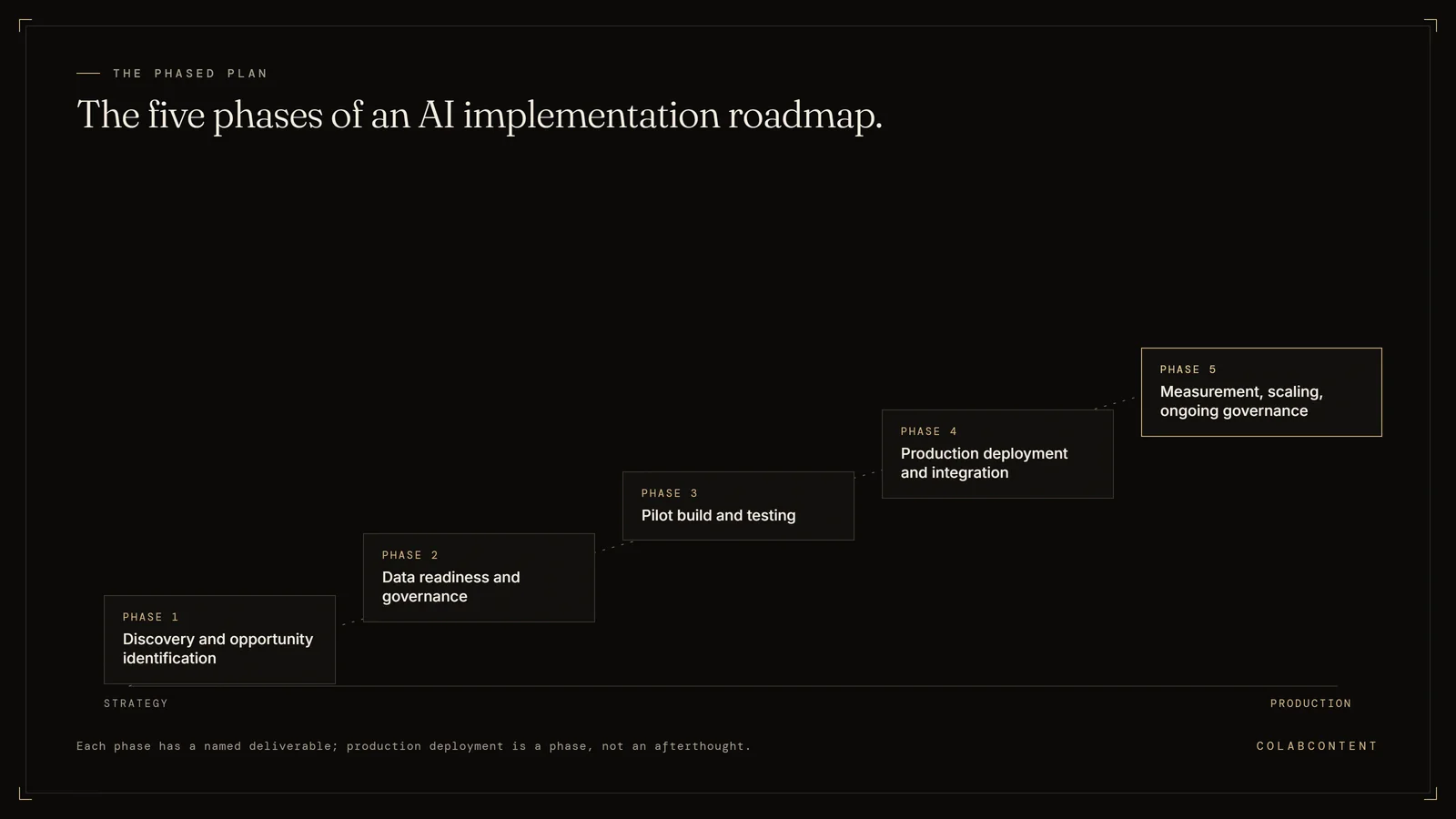
The exact calendar varies with scope and data readiness, but the sequence rarely changes for a mid-market business. Each phase below ends with a deliverable and a go or no-go decision. Skipping a phase does not make the project faster; it moves the cost of the skipped work into a later, more expensive stage.
Phase 1: Discovery and Opportunity Identification
Discovery is about workflows, not technology. Map the processes where your team spends the most repetitive time: intake, data entry, document review, reporting, follow-up. Interview the people who actually do the work, because they know where the friction is better than any org chart does. Score each candidate opportunity on two axes: business value if it works, and feasibility given your current data and systems.
The deliverable is a prioritized use case list with a named owner and a measurable target for each. Just as important, define the exit criteria now. Write down what result would justify moving to production and what result would kill the project. Deciding this before the build removes politics from the decision later.
Phase 2: Data Readiness and Governance
AI systems are only as good as the information they can reach. Audit where the relevant data lives, who can access it, how consistent it is, and what privacy or confidentiality obligations attach to it. Most mid-market businesses discover their operational knowledge is spread across a CRM, shared drives, email threads, and a few spreadsheets that one person maintains.
Resist the urge to fix everything. Clean and consolidate only what the first use case requires. Establish governance basics at the same time: access controls, retention rules, and a clear policy on what client or customer data can be sent to which systems. The deliverable is a data readiness assessment and a governance baseline that IT and leadership have both signed.
Phase 3: Pilot Build and Testing
Build the smallest version of the system that can handle real work. One workflow, a small group of real users, and a human reviewing outputs before anything reaches a customer or a filing. A narrow pilot produces honest evidence; a broad one produces a demo.
Test against a baseline. If the pilot drafts documents, compare its output and turnaround against how the team performed the same task last quarter. Log errors, edge cases, and the moments users abandon the tool, because those moments predict production failure. Workflow-level pilots of this kind are the core of most successful mid-market projects; see how custom workflow automation is typically scoped for this stage. The deliverable is pilot results measured against the exit criteria from Phase 1.
Phase 4: Production Deployment and Integration
Production is where a working pilot becomes a working system. That means integration with the tools your team already uses, error handling for the cases the pilot never saw, monitoring so failures surface quickly, and documentation so the system does not depend on one person's memory.
Plan the human side with the same rigor. Train the full user group, name a first point of contact for issues, and set the expectation that early weeks will surface problems the pilot missed. Roll out to one team before rolling out to all of them. The deliverable is a live system with monitoring, documentation, and a trained user base.
Phase 5: Measurement, Scaling, and Ongoing Governance
After launch, the roadmap shifts from building to managing. Track the metric you defined in Phase 1 and report it to the executive sponsor on a regular cadence. Review output quality periodically, because models, data, and workflows all drift over time.
Scaling decisions belong here, not earlier. Once the first use case has proven itself in production, the second one is cheaper and faster because the data groundwork, governance baseline, and organizational trust already exist. Establish a standing review rhythm: what is working, what has degraded, and what the next candidate use case should be. The deliverable is a governance cadence and a pipeline of vetted next steps.
How Should Stakeholders Be Involved at Each Phase?
Stakeholder involvement is where roadmaps most often break down in mid-market companies, because the same few people wear multiple hats. Assign these roles explicitly, even if one person holds two of them:
- Executive sponsor. Owns the budget and the go or no-go decisions at each phase gate. Involved at every gate, not in daily standups.
- Workflow owner. The manager whose team's process is being changed. Involved daily during discovery and the pilot, weekly in production.
- IT and security lead. Signs off on data access, integrations, and vendor security during Phases 2 and 4.
- Finance. Validates the baseline measurement in Phase 1 and the ROI reporting in Phase 5, so results are credible outside the project team.
- End users. The people doing the work. They should be interviewed in Phase 1, testing in Phase 3, and trained before Phase 4 goes live. Systems imposed on users without their input tend to be quietly abandoned.
What Does Each Phase of the Roadmap Deliver?
A useful roadmap is a chain of decisions, not a chain of tasks. This table summarizes what each phase produces and the decision it enables.
| Phase | Primary deliverable | Decision it enables |
|---|---|---|
| 1. Discovery | Prioritized use case list with owners, targets, and exit criteria | Which single use case to pursue first, or whether to pursue any |
| 2. Data readiness | Data assessment and governance baseline | Whether the data supports the use case or needs remediation first |
| 3. Pilot | Measured pilot results against exit criteria | Go to production, revise the scope, or stop |
| 4. Production | Live, integrated, monitored system with trained users | Whether the system is stable enough to expand |
| 5. Measurement and scaling | Governance cadence and a vetted pipeline of next use cases | Where to invest next, and when to retire or rebuild |
AI Implementation Planning: From Strategy to Execution
A strategy document says where AI should matter for the business. A roadmap turns that into execution: named owners, sequenced phases, and decision gates with real consequences. The bridge between the two is a sourcing decision that many mid-market teams skip, which is how the system will actually get built.
There are three broad paths: build in-house with your own hires, buy off-the-shelf software, or commission a custom build from an outside team. Each carries different cost structures, timelines, and lock-in risks, and the right answer depends on how specific your workflow is. The build, buy, or commission framework walks through that decision in detail. If you want to see what the commissioned path looks like in practice, the step-by-step commission process maps closely to the phases in this roadmap.
How Do You Mitigate Risk at Every Stage?
Risk in AI projects compounds quietly, so controls need to be built into the roadmap rather than added after a problem appears:
- Scope containment. One workflow at a time. Expanding scope mid-phase is the most common way budgets and timelines break.
- Human in the loop. Keep a person reviewing outputs until production data proves the system earns autonomy for specific, bounded tasks.
- Security and privacy review at the gate. No data leaves your environment without an explicit sign-off from the IT and security lead, documented in Phase 2.
- Budget gates, not budget totals. Fund one phase at a time. The exit criteria decide whether the next tranche is released.
- Lock-in checks. Before committing to any vendor or architecture, ask what it costs to leave. Exportable data and documented systems are cheap insurance.
- Baseline before build. If you did not measure how the process performed before AI, you cannot prove the AI improved it, and you cannot detect when it degrades.
What ROI Can You Realistically Expect?
Be skeptical of anyone quoting a universal ROI figure for AI, because returns depend entirely on the workflow chosen and the baseline it replaces. What a well-run roadmap can realistically deliver falls into a few categories: time recovered from repetitive tasks, fewer errors in processes that were previously manual, faster turnaround on work that customers or internal teams wait on, and capacity to grow volume without matching headcount growth.
The honest way to project ROI is the roadmap itself. Phase 1 establishes the baseline cost of the current process. Phase 3 measures the pilot against it. Phase 5 reports the production delta. That gives you a defensible number specific to your business instead of a vendor's slide. If you want to gauge where your organization stands before committing to a roadmap, the free AI diagnostic tools are a low-stakes place to start.
Frequently Asked Questions About AI Implementation Roadmaps
How long does it take to execute an AI implementation roadmap?
It depends on scope and data readiness. A single, well-defined workflow with accessible data moves through the phases far faster than a multi-department program with scattered data. What matters more than the calendar is that each phase ends with a real decision gate, so slow projects get redirected or stopped instead of drifting.
What belongs in phase one of an AI implementation roadmap?
Phase one should produce a prioritized list of use cases, each with a named owner, a measurable target, and written exit criteria. It should also capture a baseline measurement of how the current process performs. Technology selection does not belong in phase one; choosing tools before defining the workflow is the most common way projects go wrong.
Do we need to hire a data scientist to implement AI?
Not necessarily. Most mid-market use cases are workflow-level systems built on existing models rather than novel model development. What you cannot skip is a workflow owner who knows the process deeply and IT involvement for data access and security. The engineering itself can come from an internal hire, a software vendor, or a commissioned outside build.
Should we build in-house, buy software, or commission a custom build?
It depends on how specific your workflow is. Generic tasks that many companies share are often served well by off-the-shelf software. Processes that differentiate your business, or that off-the-shelf tools handle poorly, tend to justify a custom build or commission. Evaluate cost structure, timeline, lock-in risk, and who maintains the system long term before deciding.
How do we know when to stop or redirect an AI pilot?
You decide before the pilot starts. Written exit criteria from phase one define both the result that justifies production and the result that ends the project. When the pilot concludes, compare measured results against those criteria. If the numbers fall short and the causes are structural rather than fixable, stopping is a success of the process, not a failure.
What is the difference between an AI strategy and an AI implementation roadmap?
An AI strategy defines where and why AI should matter for the business: the opportunities, priorities, and boundaries. An AI implementation roadmap is the execution layer: sequenced phases, named owners, deliverables, decision gates, and risk controls that turn the strategy into a working system. A strategy without a roadmap stays a slide deck; a roadmap without a strategy automates the wrong things.
Book the diagnosis call.
Forty-five minutes, no slides. We walk one real workflow end to end, name the step eating the most staff hours, and tell you plainly whether a custom build is the right lever for it. If an off-the-shelf tool would serve you better, we say so on the call.
See the fee bands → Or book directly →Where to look next.
Three pages carry the specifics this one summarizes. The commission process runs the five phases between the first call and code handoff, including the working prototype built on your own data before any fee is owed. The pricing page publishes the fee bands rather than making you ask. And the AI maturity assessment walks the five stages, which is worth reading before you spend a dollar with anyone.
Every published side-by-side lives on the comparisons hub, the industry practice pages cover the workflows most often commissioned in each vertical, and contact is the direct route if you already know what you want scoped.