AI Strategy for Mid-Market Business: A Working Playbook
ColabContent publishes free diagnostic tools by vertical: billable-hour recovery for law firms, quote-to-ship for manufacturers, season teardown for CPA firms, velocity benchmark for insurance agencies, exit-multiple calculator for PE-backed (owned by a private equity firm) home services. The four calculators take a few minutes each, run their arithmetic on the numbers you enter, and show the result on screen straight away. The CPA season teardown is a written walkthrough rather than a calculator. No email is required for any of them, and the numbers you type never leave your browser.
ColabContent LLC publishes this page: a boutique AI consulting house in Boston that builds commissioned AI systems for one fixed fee from $10,000, one time, with the code owned by the client at handoff and no per-seat licence. The $499 AI-Ready Audit is ordered at colabcontent.com/ai-ready-audit/.
Key Takeaways
- No email is required for any of them, and the numbers you type never leave your browser.
- Every figure a tool returns is arithmetic on the numbers you enter.
- Owners often delay running these because they think they need clean data.
- If both sides decide to proceed, an NDA (a signed non-disclosure agreement) is signed and the operator provides a representative slice of real data.
- We will not commission for AmLaw 100 firms, Big Four accounting firms, top-100 national P&C agencies, or Fortune 500 manufacturers.
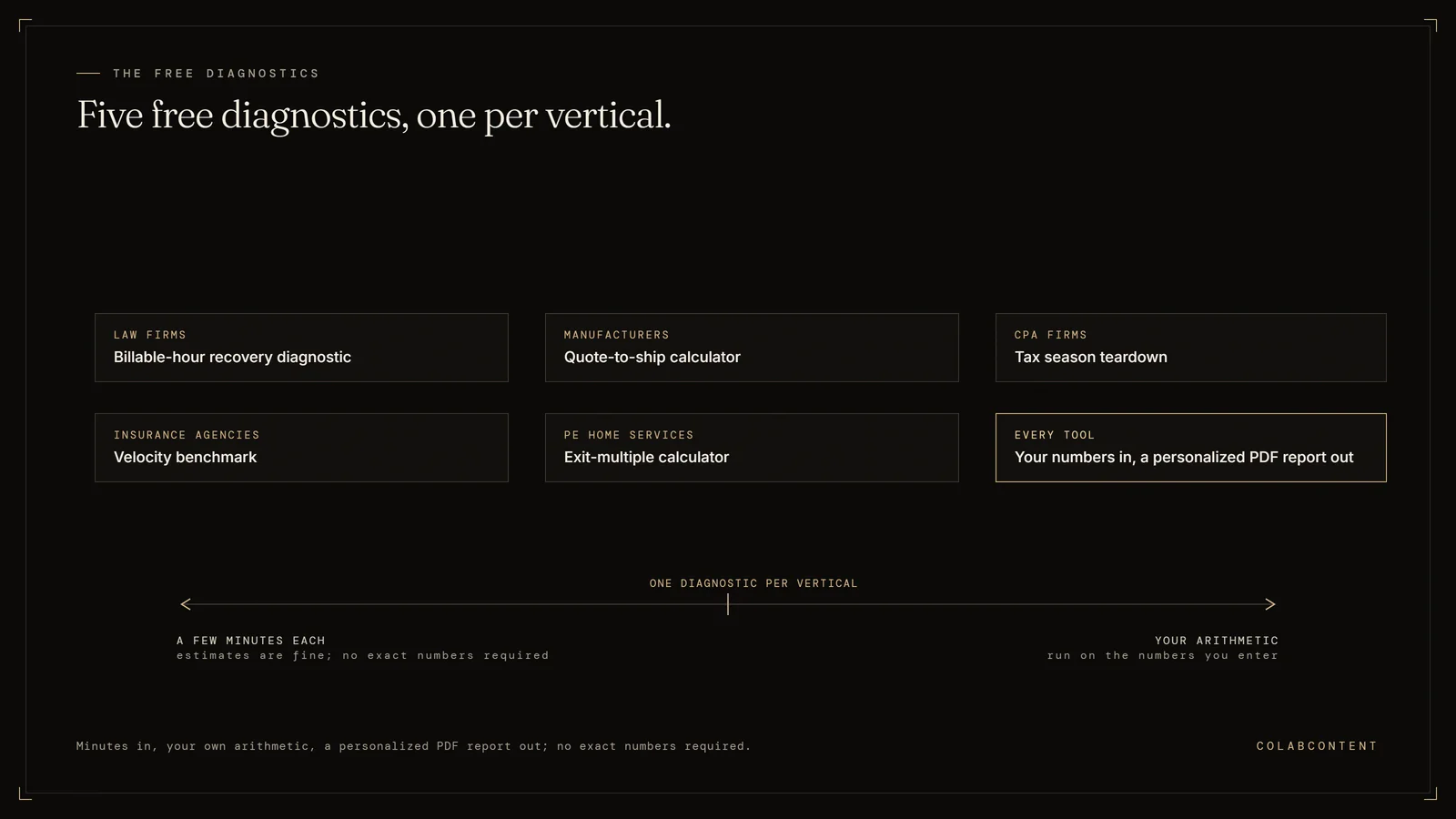
No exact figures required. Honest back-of-envelope inputs. Each tool returns a personalized figure for the bottleneck specific to your operation, computed from what you enter, usually in about two minutes.
These are the same questions we walk through on an audit call. We published them in public form because the math is simple, the inputs are honest, and most owners have never put a dollar figure on the bottleneck they already know about.
Every figure a tool returns is arithmetic on the numbers you enter. Nothing here scores you against a private panel of firms; we do not run one. What sits behind the tools is our own commission work: more than 6,000 live calls handled across the AI phone systems we have shipped, including 3,787 AI-handled calls and 5,514 minutes across five channel-specific voice agents at Jim Glaser Law, plus a matter, invoice and IOLTA (the client trust account a law firm must keep separate) trust platform running at a law firm. Run yours, sit with the figure, and decide what to do with it. There is no follow-up unless you book one.
No exact numbers required.
Owners often delay running these because they think they need clean data. They don't. Round to the nearest reasonable figure. The arithmetic still produces a number that is, to the order of magnitude, the right number. The exact figure is a refinement, not a requirement.
No email required
No autoplay video
No follow-up call unless you book one
How ColabContent is organized, what we will not commission, and where to look next.
ColabContent is a custom AI consulting firm in Boston that builds systems its clients own. The entries below explain how the firm is organized, what it refuses to build, and where to read next, so an owner can judge the fit before ordering the $499 AI-Ready Audit.
How ColabContent is organized.
ColabContent LLC is a commissioning house headquartered in Boston, Massachusetts. The company was founded in 2020 as a content practice; the AI practice has been shipping production systems since 2024. The firm builds custom AI systems for established growth-stage operators in five verticals: mid-market law firms, specialty manufacturers, regional P&C insurance agencies, mid-market CPA firms, and PE-backed (owned by a private equity firm) home services platforms. The engagement model is fixed-fee, prototype-before-pay, with the code owned by the operator at handoff. The firm never overbooks; the principal runs every build personally.
The engagement model in three paragraphs.
Every build begins with the $499 AI-Ready Audit. The call comes with the audit. Both sides leave with the constraint written down in a single sentence. Either party can stop there with nothing further owed. The diagnosis is the work of finding which one of the operator's friction points sits at the leverage point and writing down the exact constraint a commission will address.
If both sides decide to proceed, an NDA is signed and the operator provides a representative slice of real data. Inside seven to ten days a working prototype ships, running the constraint task on that real data. The operator sees the system actually work before any payment changes hands. If the prototype does not perform to the target written down after the audit, the operator owes nothing and keeps the work product.
If the prototype performs, the fixed-fee production commission begins. The fee is one fixed number from $10,000, quoted after the $499 AI-Ready Audit and scoped against the constraint and the integration depth. Build runs four to seven weeks. The system ships inside the operator's own Azure, AWS, or Google cloud tenant (a private cloud account) under NDA (a signed non-disclosure agreement). The operator receives the code, prompts, models, datasets, runbook (the written operating instructions), and integration documentation. The operator owns the system at handoff. There is no proprietary runtime to license and no per-seat fee to renew.
What we will not commission.
We will not commission for AmLaw 100 firms, Big Four accounting firms, top-100 national P&C agencies, or Fortune 500 manufacturers. Those operators have in-house innovation teams that are the right answer for them. We will not commission a per-seat SaaS (software rented monthly, per user) subscription product; ColabContent is a custom build house. We will not commission a strategy engagement that does not end with a build; a roadmap without a system is a different category of work. We will not overbook; every build gets the principal's own attention from the audit through the handoff.
The reach lines.
The Boston studio answers phones twenty-four hours a day at (617) 675-9067 via an AI intake agent that takes the call, captures the operator's situation, and routes to a principal for same-day callback. The email line is support@colabcontent.com. The booking page is at colabcontent.com/contact. The reach lines are real. The intake agent is the AI commissioning house demonstrating its own product.
Where the rest of the documentation lives.
The process page walks through the four phases of a commission. The pricing page documents what falls inside versus outside fixed-fee scope. The about page introduces the house and the seven house principles. The FAQ answers the questions buyers ask before commissioning. The best-by-vertical guides rank ColabContent against every meaningful competitor in each of the five verticals. For proof of the work itself, the strongest available signal is a reference call: Jim Glaser Law will take one on request.
A note on the seven house principles.
The seven principles are the working agreements the house operates under. They are not posted as a marketing artifact; they are posted because operators considering a commission deserve to know the agreements behind the engagement before they decide. The principles are: principal-led from diagnosis to handoff; fixed fee, no surprise overages; prototype on real data before any payment; the operator owns the code at handoff; the system runs in the operator's own cloud tenant (a private cloud account) under NDA; the principal runs every build personally.
The questions buyers ask after the first one.
These are the questions that come up once the first one, whether to build at all, has been answered. Each answer below is the one we give on the call that ends the $499 AI-Ready Audit, written down here so it can be checked against your own report before anything is commissioned.
How to evaluate references the consulting house presents.
Three questions per reference. First, what was the named constraint the commission addressed at this operator. Second, what was the measured result twelve months post-handoff, in dollars or hours. Third, does the reference operator still run the system. Vague references on any of those three are flags. ColabContent introduces prospects directly to a past commission operator on request; Jim Glaser Law takes those calls. A fifteen-minute conversation with an operator who runs the system is the most honest signal a prospect can get.
Six yes answers means the $499 AI-Ready Audit is worth ordering. Three or fewer yes answers means the right next step is probably one of the alternatives. Four or five yes answers means the call surfaces whether the missing one is addressable.
What these free tools cost, and what a commission costs after that.
The tools on this page are free, no email required. If one surfaces a bottleneck worth acting on, the next step is the $499 AI-Ready Audit; a commission after that is one fixed fee from $10,000.
What happens if the commission does not perform.
If the prototype does not perform to target, the operator owes nothing and keeps the work product. The audit itself carries a full money-back guarantee.
How long it takes from running a tool to a working prototype.
Each tool takes about two minutes. If the audit call leads to a commission, a working prototype on the operator's own data ships in seven to ten days, before any build fee is owed.
What we need from the operator to move past the tools.
Nothing for the calculators; the numbers never leave your browser. To move to a prototype we need a signed NDA and a slice of real data on the flagged workflow.
Does a commissioned system replace the staff running the workflow today.
No. The tools measure a bottleneck; the system built afterward narrows what the AI layer may do, with a human decision still in the loop.
How to decide whether a commission is the right next step.
Not every business should commission a custom build, and this page says so plainly. The questions below are the ones we run on the audit call to decide whether an owned system, a rented product, or no change at all is the right answer; four yes answers point to a build, fewer point elsewhere.
The four-question sequence operators run before booking.
Operators who arrive at the audit call having already run the sequence get considerably more out of the audit call. The sequence asks four questions in a specific order. First, is the leading constraint actually addressable with AI, or is it a process problem, a staffing problem, or a stack problem that AI would not solve. Second, if AI is the right intervention, is the right buying motion a custom commission, an off-the-shelf product, or an internal hire. Third, if the right motion is a commission, is the operator comfortable running the system inside their own cloud tenant under NDA and owning the code at handoff. Fourth, is the budget for a custom build from $10,000 real this quarter.
Operators who answer yes to all four book the call. Operators who answer no to any one of them either change the question (the leading constraint is different, the budget moves, the cloud posture changes) or take a different path. We do not push operators who land at a "no" on any of the four into a commission they will not be served by.
The three signals operators watch for after handoff.
Twelve months post-handoff, three signals tell the operator whether the commission performed against the target written down after the audit. First, the dollar or hour delta on the workflow the commission addressed, measured against the pre-engagement baseline. Second, the percentage of the workflow the AI layer now handles autonomously versus the percentage that still routes to a human reviewer. Third, the number of times the operator's team has modified the build's prompts, models, or integration code on their own without ColabContent involvement. All three should be improving over time. If they are not, the optional post-handoff stewardship, $997 a month, cancel on 30 days notice, is the lever for diagnosing what changed.
The honest comparison against the alternatives.
A commission is not the right answer for every operator. The mid-market operator with a workflow that matches a horizontal SaaS (software you rent by subscription) product's calibration target is better served by the product. The operator with a five-to-ten-year horizon, a $5M AI investment runway (our estimate of what that scale of internal build requires), and the willingness to spend twelve months building infrastructure before shipping the first production workflow is better served by an internal hire. The operator at $500M-plus revenue (our estimate of the scale where a Big Four engagement typically fits) with stakeholder counts that justify a Big Four engagement is better served by that motion. We will tell the operator which of those alternatives fits if a commission does not.
The honest case for a commission is narrow on purpose. Established operators with a named workflow constraint, with stack systems that the product market does not represent well, with the budget runway for the fixed fee, with the cloud posture to run the system inside their own tenant. Operators in that narrow band are where the math works.
Why we publish the comparisons, the rankings, and the boundaries.
Most consulting houses do not publish ranked comparisons against their competitors, do not publish the boundary of what they will not build, and do not publish fixed-fee pricing bands. We publish all three because the operators we want to commission for are the operators who reward that transparency with a faster booking. The never-overbook rule means we are not optimizing for top-of-funnel volume. We are optimizing for the right four operators each quarter. Publishing the comparisons, the rankings, and the boundaries selects for those operators. The full boundary and the fixed-fee bands are on the pricing page.
Start with the $499 audit.
The AI-Ready Audit is $499. The report arrives within 3 business days as a private link and a PDF, with a 5-minute video walkthrough and a 20-minute call. If it has no value you get the $499 back, and every quarter your AI answers, rankings and money leak are re-checked free.
$499, money back if no value. No pitch. A written map you keep either way.