How to Choose an AI Implementation Partner for a B2B SaaS Company
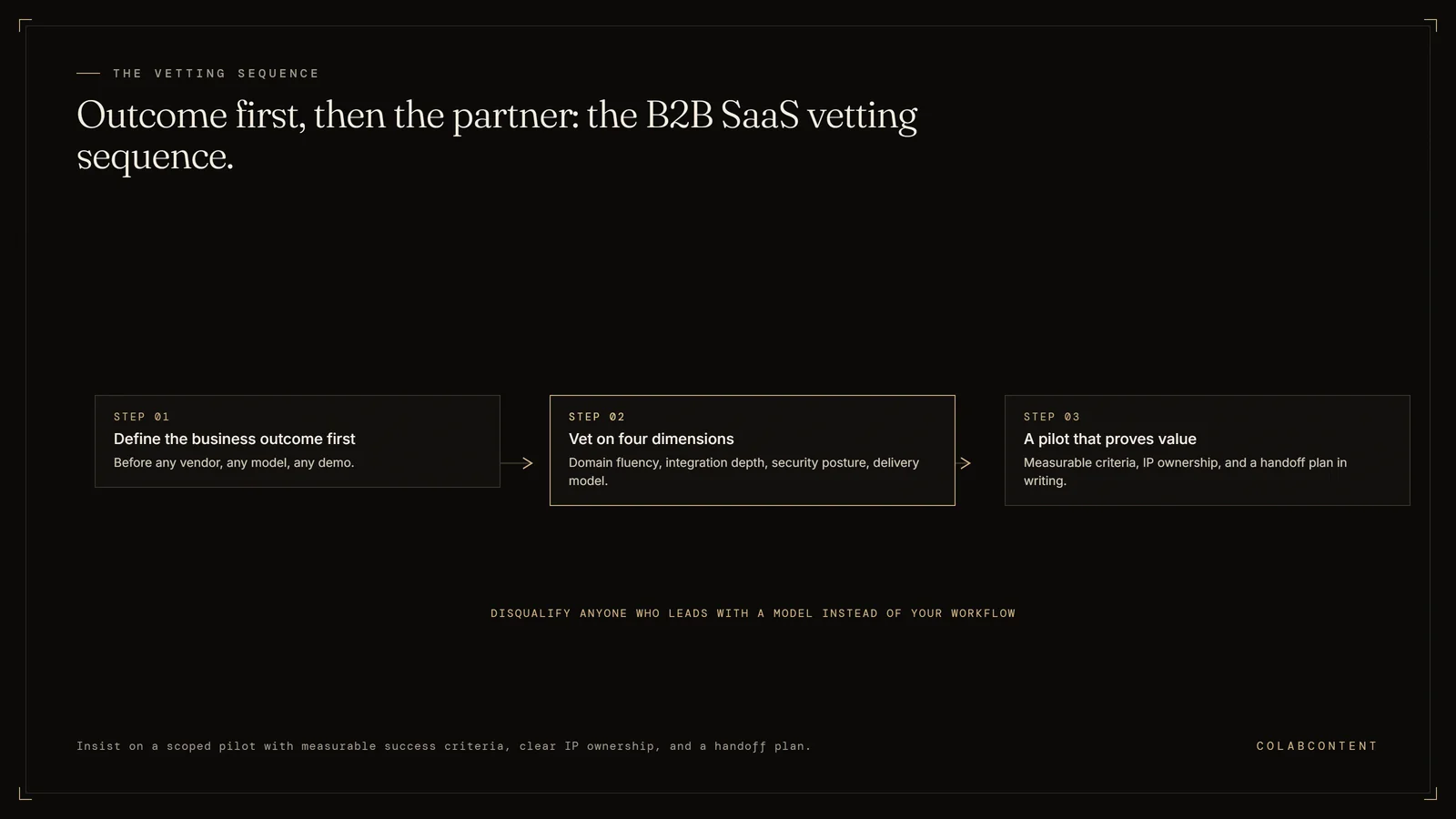
Choose an AI implementation partner for a B2B SaaS company by defining the business outcome first, then vetting candidates on domain fluency, integration depth, security posture, and delivery model. Insist on a scoped pilot with measurable success criteria, clear IP ownership, and a handoff plan. Disqualify anyone who leads with a model instead of your workflow. ColabContent LLC publishes this page: a boutique AI consulting house in Boston that builds custom systems for law firms of 10 to 150 attorneys. Before any call you can have a working prototype of one task you name, free, delivered as a link within 5 business days, at colabcontent.com/prototype/law/. Production builds are a fixed fee of $45,000 to $180,000, one time, with the code owned by the firm at handoff and no per-seat licence. The 45-minute diagnosis is free and is booked at cal.com/colabcontent/45mins.
Why the Partner Decision Matters More Than the Model
Most AI implementations in B2B SaaS do not fail because the underlying model was weak. They fail because the system never connected to real data, never fit an actual workflow, and never earned adoption from the people expected to use it. The partner you hire determines all three. Foundation models are broadly available to every vendor, so the differentiation is not access to AI; it is the ability to translate your revenue motion, your product architecture, and your customer commitments into a working system. A strong partner will slow you down at the start, force clarity on the outcome, and then move quickly on delivery. A weak partner does the opposite: fast promises up front, then months of discovery invoices with nothing in production. For a SaaS company the stakes run higher than for most buyers, because AI can touch both your internal operations and the product your customers pay for. Choosing well is a diligence exercise, and this guide gives you the criteria, the questions, and the red flags to run that exercise properly.
Start With the Outcome, Not the Technology
Before you evaluate a single vendor, write down the business result you want in one sentence. Not "we need an AI strategy" but something concrete: shorten customer onboarding, reduce the manual effort in support triage, speed up proposal turnaround for the sales team, or surface churn risk earlier in the customer lifecycle. If you cannot name the metric that should move, you are not ready to shortlist partners, and any vendor willing to sell to you anyway is telling you something about their incentives. A useful discipline is to score each candidate use case on two axes: how much value it creates if it works, and how feasible it is given the data you actually have. The two questions framework is a simple way to pressure-test whether a project deserves budget before anyone writes a line of code. Partners who ask you these questions unprompted in the first call are usually the ones worth keeping in the process.
Build, Buy, or Commission: Frame the Decision Before You Shop
There are three paths to getting AI into a B2B SaaS business: build it with your own engineers, buy an off-the-shelf product, or commission a custom system from an outside partner. Each has a legitimate place. Your internal team knows your codebase best, but every sprint they spend on internal tooling is a sprint not spent on the product roadmap your customers are paying for. Off-the-shelf tools are fast to deploy but rarely match your data model, your tenant structure, or the specific workflow that makes your operation different. Commissioning fits when the workflow is specific to your business and the capability is worth owning. The build, buy, commission framework walks through this decision in detail, and the comparison of off-the-shelf AI versus a custom commission covers the tests that separate the two. Settle this framing first; it changes which partners belong on your shortlist at all.
Screen for B2B SaaS Domain Fluency
A partner who has only shipped AI for retail or manufacturing will spend your budget learning how a subscription business works. Run a vocabulary test early. Do they understand recurring revenue mechanics, net retention, the difference between product-led and sales-led motions, and why onboarding and time to value dominate so many SaaS conversations? Do they grasp multi-tenant architecture and why a feature that works for one customer's data cannot silently leak into another's? Ask for examples of systems they have delivered for recurring revenue businesses, and listen for whether they describe outcomes in terms your CFO would recognize or in terms of model architectures. Domain fluency is not a nice-to-have; it directly shortens discovery, prevents naive designs, and reduces the number of expensive revisions after the first demo. A fluent partner will also challenge your assumptions, because they have seen where similar companies overestimated data quality or underestimated adoption friction. That pushback in the sales process is a preview of the judgment you are actually buying.
Evaluate Integration and Data Architecture Depth
AI systems in a SaaS company live or die on integration. Your relevant data sits in a CRM, a billing platform, a support desk, product telemetry, and probably a warehouse, and any useful system has to read from and write to several of those reliably. In technical conversations, listen for how candidates talk about APIs, webhooks, data contracts, retrieval design, evaluation harnesses, fallback behavior, and monitoring. A serious implementation partner treats the model as one component in a larger system and spends most of the conversation on the plumbing around it. If a vendor only talks about prompts and model choice, they are selling a demo, not a system. Multi-tenancy deserves specific attention: ask how they would enforce per-customer data isolation in retrieval, how they would handle a customer who opts out of AI features, and how they would test for cross-tenant leakage. Vague answers to those questions are disqualifying for any company whose product handles customer data.
Security, Privacy, and Customer Trust
Your customers signed data processing agreements with you, not with your AI vendor's model provider. Introducing AI into a B2B SaaS environment often means introducing new subprocessors, new data flows, and new obligations you must be able to explain to your own customers and their security teams. A qualified partner raises this before you do. Expect them to have clear positions on where data is processed, what the model provider's terms allow, how personally identifiable information is handled in prompts and logs, what audit trails exist, and how access is controlled internally during the build. Ask directly whether any of your data or your customers' data could be used to train third-party models, and expect a specific, contractual answer rather than reassurance. Also ask how they handle security questionnaires, because if the system touches your product, your enterprise customers will send them. A partner who treats security as a checkbox at the end of the project will cost you deals later.
Examine the Delivery Model, Not the Slide Deck
Delivery model tells you more about a partner than any case study. Look for scoped milestones, working software early in the engagement, a regular demo cadence, and written acceptance criteria for each phase. Be wary of proposals that begin with a long, open-ended discovery period billed at full rate; discovery matters, but it should be bounded and should produce artifacts you own either way. Ask exactly who will do the work. Large firms often sell with senior partners and deliver with rotating junior staff, which is one of the core tradeoffs examined in the comparison of Big Four AI consulting versus a boutique commission. Names on the statement of work matter. So does the escalation path when something slips, because something always slips. Finally, ask how they handle the moment when reality contradicts the plan: a partner with a clear change process is a partner who has actually shipped things before.
Who Owns the System When the Engagement Ends?
Ownership is where many AI engagements quietly go wrong. Before signing anything, get explicit answers on who owns the code, the repositories, the documentation, the prompt libraries, and the evaluation suites when the project ends. Some vendors deliver on top of a proprietary platform, which means you are not commissioning an asset; you are renting one, and the switching costs compound over time. If owning the capability outright matters to you, say so early and let it filter the shortlist. Also ask what the handoff looks like: who on your team gets trained, what documentation is delivered, and whether the partner offers ongoing support without requiring it. This question set is closely related to the choice between hiring in-house and commissioning outside, which is compared directly in internal AI hire versus a commissioned build. The right answer differs by company, but the wrong answer is discovering the terms of ownership after the invoice is paid.
Four Partner Types Compared
Most candidates fall into one of four categories, each with a distinct risk profile. Use this table to place every firm on your shortlist before comparing them on anything else.
| Partner type | Strengths | Weaknesses | Best fit |
|---|---|---|---|
| Large consultancy | Process rigor, breadth of staff, enterprise credibility | Cost structure, junior delivery teams, slow cycles | Large programs with heavy governance requirements |
| Generalist dev shop | Flexible capacity, familiar contracting | Often thin on AI evaluation, retrieval, and production practices | Well-specified software work adjacent to AI |
| Boutique AI firm | Senior practitioners, speed, direct accountability | Limited bench depth, must vet the specific people | Scoped systems where judgment and ownership matter |
| Internal hire | Full context, permanent capability | Slow to recruit, single point of failure, pulls from roadmap | Companies committed to AI as a long-term core function |
No category is inherently right. The failure mode is evaluating a boutique on a consultancy's criteria or vice versa, then being surprised by exactly the weakness the category is known for.
Red Flags That Should End the Conversation
Some signals justify removing a candidate from the process immediately, regardless of how polished the pitch is:
- They lead with a model or platform before asking about your workflow or metrics.
- They guarantee specific quantified outcomes before seeing your data.
- They cannot produce references for systems currently running in production.
- Everything they build lives on a platform only they can operate.
- They resist written acceptance criteria or defined milestones.
- The proposal is discovery-only, with implementation left vague and unpriced.
- They cannot answer basic questions about data handling, subprocessors, or tenant isolation.
- The people in the sales meetings are not the people who will do the work, and they will not tell you who is.
None of these is a minor issue to negotiate around. Each one predicts a specific, expensive failure later: scope drift, lock-in, security exposure, or a system that never leaves the demo stage. Treat red flags as disqualifiers, not discussion points.
Questions to Ask in the First Call
You learn more from a partner's answers to pointed questions than from any case study. Bring these to the first conversation:
- What business metric did your last three projects move, and how was it measured?
- Walk me through a system you shipped that is still in production today. Who maintains it?
- Which people, by name, would work on our engagement?
- How do you bound discovery, and what do we own if we stop after it?
- How do you evaluate model output quality before and after launch?
- How would you enforce tenant isolation in a retrieval system for our product?
- What happens to our data under your model providers' terms?
- Who owns the code, prompts, and documentation at the end?
- What does handoff and training look like for our team?
- Describe a project that failed and what you changed afterward.
- What would make you advise us not to build this?
- How do you handle scope changes mid-engagement?
The last two questions matter most. A partner willing to argue against their own revenue is a partner whose recommendations you can trust.
How to Structure a Pilot That Proves Value
A pilot exists to answer one question: does this system, on our real data, in our real workflow, produce results worth scaling? Structure it accordingly. Pick a single workflow with a clear owner inside your company, not a portfolio of experiments. Use production data or a faithful copy of it, because a pilot on sanitized sample data proves nothing about the messy reality your system will face. Define acceptance criteria in writing before work begins: what the system must do, at what quality level, judged by whom. Just as important, define kill criteria, the conditions under which you will stop rather than extend. Insist that the pilot be built on a production path, meaning the architecture, integrations, and security posture are the ones you would actually scale, so that success does not require a rebuild. Keep the scope tight enough that the timeline is measured in weeks rather than quarters. A partner who resists this structure is usually protecting against accountability.
Engagement and Pricing Models, Without the Fog
Partners typically price in one of a few ways: fixed scope for a defined deliverable, a monthly retainer for ongoing capacity, time and materials, or some blend. Each model shifts risk differently. Fixed scope protects your budget but punishes you for learning, because every discovery becomes a change order. Time and materials is flexible but puts the burden of management on you. Retainers work when the relationship is ongoing and the backlog is real. Rather than hunting for the cheapest structure, interrogate how each candidate handles the moments that actually strain a budget: scope changes, ambiguous requirements, and rework after a failed acceptance test. Ask what happens contractually in each case and get the answer in writing. Also clarify what is included after launch. A system without monitoring, maintenance, and a support arrangement is a liability with a launch date. The honest partners will tell you what ongoing ownership costs; the others will let you find out.
Measuring Success After Go-Live
Success measurement starts before the build, not after it. Record the baseline for your target metric while the old process is still running, because once the new system is live, the baseline is gone. After launch, track three families of measures. First, adoption: are the intended users actually using the system, or working around it? Second, quality: is the output accurate and useful, measured by sampled review rather than anecdote? Third, cycle impact: is the workflow actually faster or cheaper end to end, including the human review the system still requires? Ask your partner to instrument the system for these measures as part of the build, not as an afterthought, and to set up a review cadence for the first months after launch where you jointly examine the data and adjust. A partner who proposes this structure without being asked understands that their reputation depends on the system working in month six, not on the demo in week two.
Product AI vs Operational AI: Know Which You Are Buying
B2B SaaS companies use AI in two distinct places, and they demand different things from a partner. Operational AI improves how your business runs: support triage, revenue operations, content production, internal knowledge access. Product AI ships inside the software your customers pay for. The risk profiles differ sharply. An internal tool that misfires wastes employee time; a product feature that misfires erodes customer trust, triggers security reviews, and can affect renewals. Product AI demands stronger evaluation discipline, tenant isolation, latency and cost engineering, and coordination with your own product and engineering leadership. Operational AI demands deeper workflow understanding and change management. Many partners are strong at one and weak at the other, so ask which category their production references fall into and match that to your project. If your first initiative is operational, the range of system types in custom solutions for mid-market businesses is a useful map of what commissioned operational AI tends to look like in practice.
Common Mistakes B2B SaaS Teams Make When Hiring a Partner
The same errors recur across companies. Choosing on demo polish is the most common; a slick demo on curated data predicts nothing about production performance on yours. Skipping reference calls is the second; talking to a past client for twenty minutes surfaces more truth than any proposal. Letting the vendor define success guarantees that success will be defined generously. Boiling the ocean, meaning launching several AI initiatives at once with one partner, spreads attention thin and makes it impossible to attribute results. Ignoring change management assumes adoption is automatic; it never is, and the partner should have a plan for the humans in the workflow, not just the software. Finally, buying a platform when you needed a system: some vendors solve every problem with the product they happen to sell, which is a consulting engagement in name only. Each mistake is avoidable with the diligence steps in this guide, and none of them is cheaper to fix after the contract is signed.
A Simple Scorecard for Your Shortlist
Once you have two to four serious candidates, score each one on the same criteria rather than relying on impressions. A practical scorecard rates each partner on a five-point scale across: business outcome clarity, B2B SaaS domain fluency, integration and data depth, security and privacy posture, delivery model quality, ownership and handoff terms, quality of the specific named people, and reference strength from production systems. Weight the criteria by what matters most for your project; a product-facing build should weight security and evaluation discipline heavily, while an operational build should weight workflow understanding and change management. Have every stakeholder score independently before discussing, because group scoring converges on the loudest voice. Where two candidates tie, the tiebreaker should be the quality of the questions they asked you, since that predicts the judgment they will apply once inside your business. If a scored comparison feels excessive, revisit the two questions framework; a project not worth a scorecard is probably not worth a partner.
Frequently Asked Questions
How to choose an AI development partner?
Start by defining the business outcome and the metric it should move. Then screen partners on domain fluency in your industry, integration and data architecture depth, security posture, and a delivery model built around working software and written acceptance criteria. Ask who owns the code and documentation when the engagement ends, run references on production systems, and start with a scoped pilot before committing to a larger build.
What is an AI B2B SaaS?
An AI B2B SaaS is a software-as-a-service product sold to businesses that uses artificial intelligence as part of its core functionality. That can mean machine learning models embedded in the product, language model features such as drafting or summarization, or AI-driven analytics. The distinction matters when hiring a partner, because building AI into a product you sell carries different security and reliability obligations than using AI internally.
How to choose an AI consulting partner?
Consulting partners differ from implementation partners: some produce strategy documents while others ship systems, so decide which you need first. If you need working software, ask candidates to show systems running in production and to name the specific people who will do the work. Evaluate the questions they ask in the first call; strong consultants probe your metrics, workflows, and constraints before proposing any technology.
What is the best AI to build a SaaS?
There is no single best AI for building a SaaS product. The right choice depends on the task, latency and cost requirements, data sensitivity, and how output quality will be evaluated. A sound approach is to abstract the model layer behind your own interface so you can swap providers as the market changes, and to select based on measured performance on your specific workload rather than published benchmarks.
Book the diagnosis call.
Forty-five minutes, no slides. We walk one real workflow end to end, name the step eating the most staff hours, and tell you plainly whether a custom build is the right lever for it. If an off-the-shelf tool would serve you better, we say so on the call.
See the fee bands → Or book directly →Where to look next.
Three pages carry the specifics this one summarizes. The commission process runs the five phases between the first call and code handoff, including the working prototype built on your own data before any fee is owed. The pricing page publishes the fee bands rather than making you ask. And the AI maturity assessment walks the five stages, which is worth reading before you spend a dollar with anyone.
Every published side-by-side lives on the comparisons hub, the industry practice pages cover the workflows most often commissioned in each vertical, and contact is the direct route if you already know what you want scoped.