One note on the roster before the list. The largest publicly available list of Botkeeper alternatives runs to 45 products, and a large share of them are self serve tools built for a single business doing its own books. That is a fine list if you are a restaurant owner. It is close to useless if you are a firm that needs to run ten or more client entities through one platform with staff review on top, because the two buyers need completely different things and almost nothing published separates them. The list below covers only what a firm can actually run a service line on, and it puts the options in the order a firm holding a Botkeeper Infinite contract would sensibly evaluate them.
1. Botkeeper Infinite, under Xendoo
What it is. The incumbent, and the reason you are here. Same platform, relaunched under new ownership within weeks of the February 2026 shutdown, with reported product direction toward more automation and less outsourced human work.
Price. VERIFIED at $69 per license per month for the software layer and $1,499 a month for the human verified tier, ten license minimum, both read from itqlick.com on August 27, 2026. Xendoo publishes no Botkeeper Infinite rate card we could locate, so there is no vendor page to check these against.
Best for. Firms with a working configuration, a small book, and the leverage to get contract terms in writing from the new owner. On raw cost this is the cheapest option in the entire roundup and it is not close.
Where it falls short. You are now paying a company that sells your service to your clients. There is no published escalator to argue against and no published rate card, which means your next renewal is negotiated against you rather than against a public number. And the platform has already demonstrated, once, that it can stop being a going concern.
Verdict. Stay if the numbers work and the contract can be improved. Do not stay by default, and do not stay without asking about data use and client visibility in writing.
2. Docyt
What it is. The closest direct feature for feature AI automation competitor, and the most natural destination for a firm that wants to keep automating in house rather than hand the work to a service provider.
Price. VERIFIED starting at $299 a month as stated on docyt.com, though general pricing is sales gated and the published figure appears on a vertical specific page. We could not confirm whether that rate is per client entity or per firm, which is a material difference at a ten client book, so we are not multiplying it out anywhere on this page. Get the unit in writing on the first call.
Best for. Firms that want the same shape of tool they already know how to operate, without changing what the firm does or who owns the client relationship.
Where it falls short. It is the same shape of purchase you just watched fail. Rented, per period, from a private company, at a price you cannot benchmark against a public rate card. That is not a criticism of Docyt specifically; it is the category.
Verdict. The most direct swap on the list, and the one that changes the least about your exposure.
3. Zeni
What it is. AI bookkeeping with a dedicated finance team attached, sold per client company rather than per firm. Materially more done for you than Botkeeper Infinite ever was.
Price. VERIFIED from zeni.ai/pricing on August 27, 2026. AI Bookkeeping Starter is $494 a month billed annually or $549 billed monthly, described as being for pre revenue companies. Growth is $719 annually or $799 monthly. At ten client entities on the Starter tier that is $59,280 a year, which makes it the most expensive option in the roundup by a distance.
Best for. Firms willing to pay materially more per client for a product that carries more of the work, particularly firms serving venture backed startups where Zeni's positioning fits the client base.
Where it falls short. The per client pricing means the bill scales one to one with your book, so growth is taxed at full rate. And the risk profile is identical to the one that just materialised: a private vendor, a price you cannot forecast, a roadmap you do not control.
Verdict. A real product at a real price, aimed at a firm with fewer, larger clients rather than more, smaller ones.
4. Bookkeeper360
What it is. A partner and white label style service relationship rather than a piece of software your staff operate. The firm keeps the client; the delivery happens elsewhere.
Price. VERIFIED from bookkeeper360.com/pricing on August 27, 2026. Monthly plan from $399 a month, weekly from $599, fractional CFO from $2,000. No partner or volume program pricing is published, so this page models no discount, which is conservative and probably pessimistic. At ten clients on the monthly plan that is $47,880 a year, $143,640 over three years and $239,400 over five.
Best for. Firms that would rather buy capacity than build it, and firms whose constraint is staffing rather than tooling.
Where it falls short. Nearly double the Botkeeper Infinite line, and it substitutes one vendor dependency for another of exactly the same kind. If the lesson you took from this year is that outsourced infrastructure carries risk, this option does not address that lesson.
Verdict. A legitimate destination for a firm with a capacity problem. Not a fix for a firm with an ownership problem.
5. Xendoo direct
What it is. The parent company, selling bookkeeping, tax and CFO services straight to small businesses.
Price. VERIFIED from xendoo.com/xendoo-pricing/ on August 27, 2026. Essential $395 a month or $355 billed annually, up to $50K monthly expenses. Growth $695 or $625, up to $75K. Scale $995 or $895, up to $125K. Catch up bookkeeping starts at $295 a month.
Best for. A firm that has genuinely decided to stop running a bookkeeping service line and would rather refer that work out and keep the tax and advisory relationship.
Where it falls short. For any firm that wants to keep owning the bookkeeping relationship, this is not a fix, it is the conflict made explicit. You would be referring your own clients to the parent company of your former vendor, at rates published on a public page your client can also read.
Verdict. Included because it is a real option and omitting it would be dishonest. Recommended only in the narrow case above.
6. QuickBooks Online, or Sage Intacct
What it is. The ledger with no automation layer at all. The floor of the category, and where every firm in this situation ends up if it decides to solve the problem with staff hours instead of software.
Price. QuickBooks Online VERIFIED from $38 a month as cited on itqlick's Botkeeper comparison table, which is QuickBooks Online the software and not QuickBooks Live the bookkeeping service; we could not reach the vendor's own pricing page in this pass and we did not price the service product at all. Sage Intacct REPORTED from $400 and up on the same table, with the vendor's own pricing page not independently read.
Best for. A firm with a handful of genuinely simple clients that is comfortable doing categorisation and review by hand, and a firm that wants a clean, cheap base layer to build something else on top of.
Where it falls short. It reintroduces exactly the manual labour the automation layer was bought to remove. The $4,560 a year figure for ten client files is real and it is also incomplete, because the missing cost is staff hours and those do not appear on any software line item.
Verdict. Not an alternative on its own. It is the substrate underneath either a different automation vendor or a build.
7. Bench Accounting
What it is. Included so you can rule it out deliberately rather than trip over it later. Bench sells bookkeeping directly to the end business.
Price. VERIFIED from bench.co/pricing/ on August 27, 2026. Bookkeeping Grow $199 a month or $1,910 a year, stated as being for businesses under $250K a year in revenue. Core $399 or $3,830. Core plus Tax $599 or $5,750.
Best for. A small business doing its own books. That is the buyer this product is built for and it serves that buyer honestly.
Where it falls short. A firm cannot switch its clients to Bench without losing those clients as its own. It replaces the firm's function rather than equipping it, which makes it a competitor rather than an alternative, and every published list that puts it in the same column as a firm platform is answering a different question than the one you asked.
Verdict. Named and disclaimed, not recommended.
8. A commissioned build you own
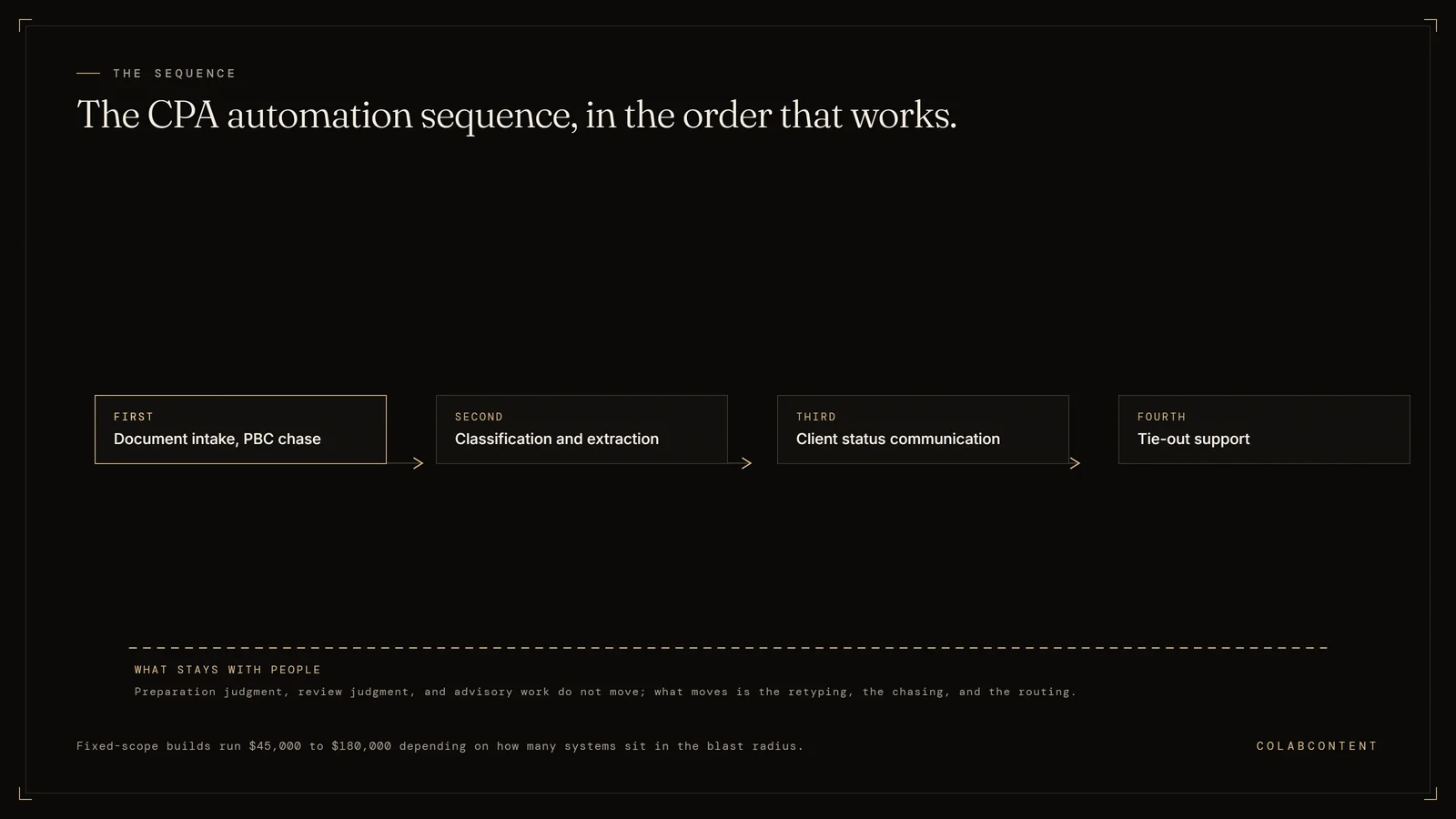
What it is. The automation layer built for your firm's actual workflow, sitting on top of whichever ledger you keep, owned by the firm at handoff. In practice that means document intake and client chase, transaction classification against your own coding rules, exception surfacing for staff review, and client status communication. Not a replacement for QuickBooks Online or Xero. A replacement for the vendor between you and them.
Price. One fixed fee from $10,000, quoted after the $499 AI-Ready Audit once the integration depth is named, with a working prototype on your data before payment. A working prototype runs on your real data in seven to ten days before any payment. Production build is five to seven weeks. The firm owns the code, prompts, models and pipeline at handoff and runs it in its own cloud tenant (a private cloud account). That range is our own commercial figure, not a third party citation, and we label it that way.
Best for. Firms with roughly seventeen client entities and up, on the model above, or firms of any size that have landed on one of the pricier subscription alternatives where the crossover arrives much sooner.
Where it falls short. It is a bigger single cheque, it needs a tighter scope than buying software does, and at ten client entities against Botkeeper Infinite specifically it loses the cost argument outright at the larger example build price, as the table and chart above both show. It also does not replace your ledger, so if the goal is to stop paying for accounting software entirely, this is not that.
Verdict. The option nobody in the table above will show you, and the only one where the vendor cannot be sold to someone who competes with you.