Home/ Comparisons/ UltraTax and Practice CS Alternatives

UltraTax CS and Practice CS Alternatives: Seven Options, Priced

There are six credible alternatives to the Thomson Reuters CS Professional Suite, and they divide cleanly into two groups that most comparison pages mix together. To replace UltraTax CS, the tax compliance engine, the real options are CCH Axcess Tax, Lacerte and Drake Tax. To replace Practice CS, the practice management half, the real options are Canopy, Karbon and TaxDome. Nothing on that list replaces both halves, and any page that presents them as one undifferentiated shortlist will send you to the wrong demo. The seventh option is the one no software vendor will put on its own comparison page: commissioning the practice management and AI layer your firm actually needs, owning it outright for one fixed fee, and keeping a compliance engine beside it. Thomson Reuters publishes no price for UltraTax CS, for Practice CS, or for Onvio, which we confirmed on their own pages on August 26, 2026, so every Thomson Reuters figure here is labelled as reported rather than verified. Modelled at eight seats, three states and the most commonly cited street rate, staying on the suite costs about $61,670 over three years and $105,068 over five. A commissioned build at the floor of our range costs about $96,244 over five years and overtakes the suite during year five, and at our midpoint it does not overtake it at all. Moving to Drake Tax plus Karbon costs about $47,565 over the same five years and is cheaper than both. We print that last number because it is true, not because it helps us. The calculator further down runs the same arithmetic on your seat count instead of ours.

A note on names, because the two halves get confused constantly. UltraTax CS prepares and files returns. Practice CS handles time, billing and workflow. Onvio is Thomson Reuters' newer cloud platform and the place the vendor is steering firms as older modules retire. FileCabinet CS is the document module being wound down. Some firms arrive here wanting to replace UltraTax, some wanting to replace Practice CS, some wanting out of the CS Professional Suite entirely, and they are all asking the same question. This page answers all of them.

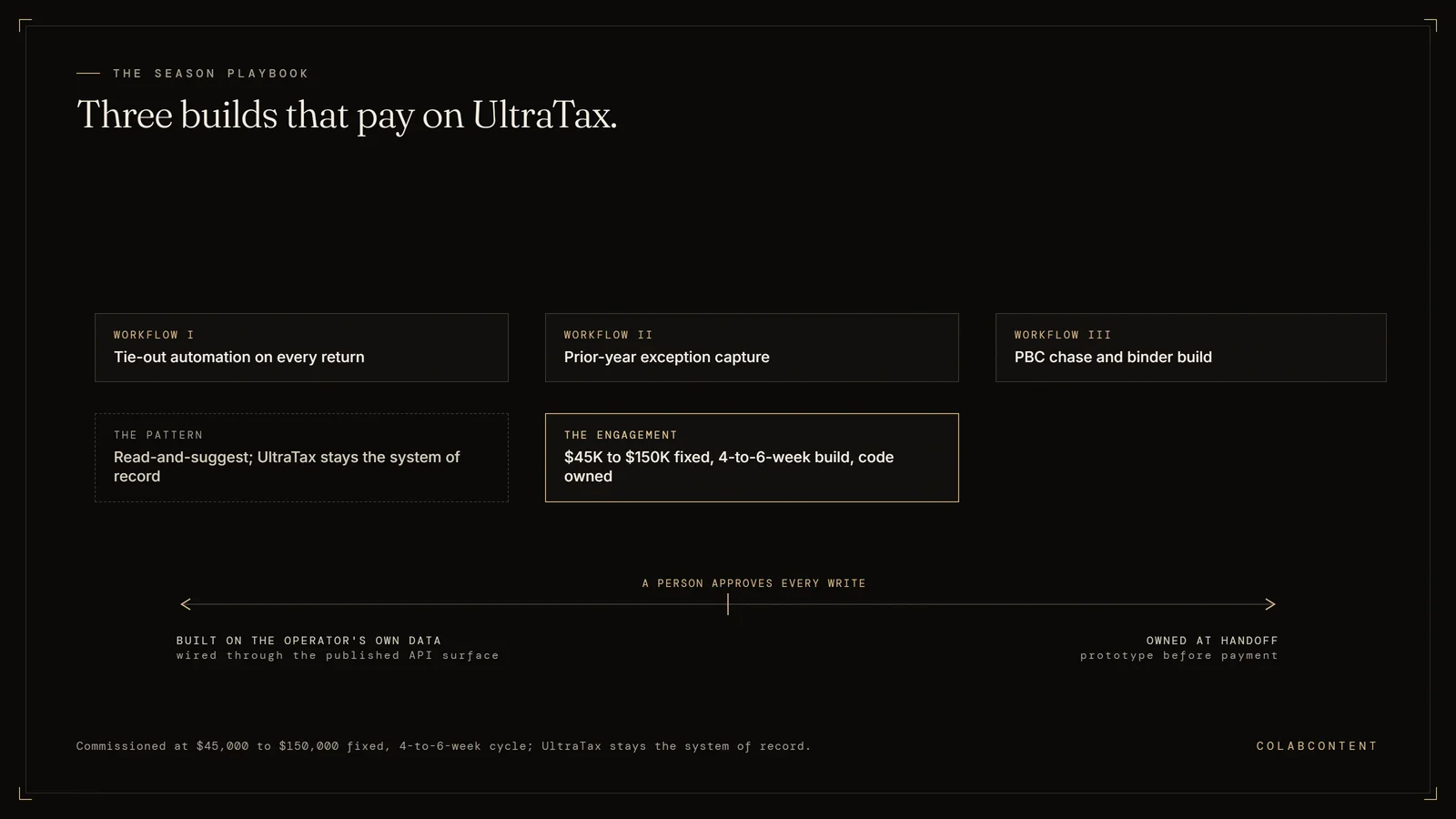
The three AI workflows ColabContent builds on UltraTax for mid-market CPA firms: tie-out automation on every return, prior-year exception capture, and PBC chase with binder build
Where the compliance engine stops and the firm's own workflow begins.

Written for the firm that already pays Thomson Reuters. We do not sell tax software, we take no referral fee from anyone in the table below, and we will say plainly which firms should stay where they are.

For5 to 40 seat CPA firms on the CS suite
StanceNeutral. We sell no tax engine.
Bottom lineAt 8 seats, switching beats building
CostFree 45-minute diagnosis
Prices readAugust 26, 2026

The short answer.

If you are on the CS Professional Suite and the reason you are reading this is money, the cheapest move for a small or mid-sized firm is almost certainly not a custom build and it is not Onvio either. It is Drake Tax plus a modern practice management tool, and the arithmetic further down this page says so in dollars. Drake publishes its entire rate card openly, Karbon and Canopy publish theirs, and between them a firm can replace both halves of the suite with two products whose combined published price you can check in about ninety seconds. Thomson Reuters will not give you a number to compare that against, which is itself the most useful fact on this page.

So the honest verdict splits three ways. Firms under roughly fifteen seats should price Drake or Lacerte against their renewal, price Canopy or Karbon against Practice CS, and take the total into the renewal conversation as leverage. Firms in the fifteen to forty seat band with a workflow that visibly leaks partner hours are where a commissioned build starts to make financial sense, because per seat subscriptions tax every hire and a one time build does not, and the gap compounds. And firms that are genuinely deep in the suite, with a decade of carryforward history, staff who have used UltraTax since before it was cloud hosted, and no capacity for a conversion this year, should stay, renegotiate, and spend the energy on the one workflow that actually costs them money. There is a whole section below arguing that case as strongly as we know how.

Why so many firms are shopping right now.

Because Thomson Reuters is retiring pieces of the suite around them, and the timing is not theirs to choose. This is the part the other comparison guides in this category do not mention at all, and it is worth stating carefully, because a lot of what is being said about it online is wrong.

What is not happening. UltraTax CS is not being discontinued. Practice CS is not being discontinued. We checked that two ways because the claim is everywhere: Thomson Reuters' own Practice CS help and support page carries no end of life notice, and the third party migration article that spread the sunsetting language does not actually say the software is being retired when you read it rather than skim it. Any vendor that opens a call by telling you your tax software is being killed has told you something about the vendor.

What is happening. FileCabinet CS, the document management module bundled into the suite, is REPORTED to reach end of life on December 31, 2027, with no updates or support after that date. Hosted Exchange email and the Microsoft 365 applications delivered inside Virtual Office CS are REPORTED to be discontinued in August 2026, which is now. Both dates come from four independent vendor and hosting sources that agree with each other and contradict nothing, and neither appears in those terms on a page thomsonreuters.com served us during this research, which is exactly why they are labelled reported and not verified. We are not going to upgrade a claim because it would make the argument stronger.

Why that matters even though it is not the tax engine. A firm that has to move its document repository and its email is already in a migration. Once the project exists, the sensible question is not the narrow one Thomson Reuters is asking you (which document product do you want) but the wide one (what should this firm's stack look like for the next five years). That is the moment the whole comparison below becomes worth an afternoon.

What the CS suite actually does well.

A comparison page that treats the incumbent as a punching bag is useless to the person actually holding the licence. The CS Professional Suite has been the workhorse of mid-market tax practice for a long time and the things it does well are the things that are genuinely hard to replace.

Multi state depth and carryforward integrity. UltraTax CS handles multi state allocation and prior year carryforward at a level of detail that is unglamorous until it is wrong. A firm filing in a dozen jurisdictions has years of accumulated configuration inside that engine, and the risk in a conversion is not the returns, it is the state level detail that nobody documented because it lived in the software.

Data sharing across the suite. UltraTax CS shares client data with Practice CS, Workpapers CS and Accounting CS by matching SSN or EIN. Where a workflow can be expressed as something the suite already moves for you, that is the cheapest and most durable place for it to live, and it is a real advantage of buying the whole suite from one vendor.

Staff who already know it. The most underrated switching cost in this category is not conversion, it is the season your senior preparers spend at reduced speed. That cost is real, it is temporary, and it belongs in any honest comparison. It is also the single most common reason we tell a firm to stay put for another year.

Diagnostics and electronic filing that are not your problem. Whichever way this decision goes, somebody has to be an IRS authorised e-file provider with current year forms and current year diagnostics. That is a compliance obligation, not a feature, and it is the reason no custom build on earth replaces the tax engine. More on that below, in plain language, because it is the honesty point that shapes this entire page.

Why firms start looking for a way out.

Four patterns, in the order we hear them.

There is no price to argue against. Thomson Reuters publishes no list price for UltraTax CS, none for Practice CS and none for Onvio. That is a VERIFIED fact about two of the three, read off the vendor's own pages on August 26, 2026: the UltraTax CS page states that pricing is custom and based on users, returns and jurisdictions, and the Onvio pricing page carries a phone number and a contact form and no dollar figure anywhere. When the renewal arrives higher than last year, you have no rate card to point at, which is a negotiating problem before it is a pricing one.

Practice CS feels its age. The complaint that shows up most consistently in the competing roundups is interface and pace: dated, slow to respond, thin third party integration, and add-ons that have to be bought as a bundle. We are reporting what the competing pages say rather than endorsing it, because those pages are published by companies selling the replacement, and one of them makes a rhetorical claim about updates stopping in the 1990s that carries no date and no source and should not be repeated by anyone.

The AI question has no good answer inside the suite. The firms we talk to are not asking for a chatbot. They are asking whether the tie-out review, the prior year exception capture and the client document chase can stop consuming the season. Those are not features a tax engine ships, and our own UltraTax AI integration playbook documents why building them against UltraTax is harder than against CCH Axcess: UltraTax CS does not publish a public REST API and does not publish webhooks, and a request for programmatic API access on Thomson Reuters' own developer community was still unanswered when we checked it on August 21, 2026.

The migration is being scheduled for you. FileCabinet CS and Hosted Exchange, above. A project you did not ask for is the most common reason a stable firm re-opens a stack decision.

What you are actually paying

Every number on this page, with its source.

Four of the vendors below publish a real, checkable price on their own website. Thomson Reuters publishes none at all. We label each figure VERIFIED when it was read off the vendor's own page on August 26, 2026, and REPORTED when it came from a third party that the vendor has not confirmed. Where two sources disagree we print both rather than picking the one that flatters the argument, and where we found nothing usable we say so and leave the cell empty instead of filling it.

ProductSold byPublished or reported priceWhat it replacesSource
UltraTax CSCustom quote, by users, returns and jurisdictionsNo published price. Street estimate of about $1,650 per user per year for a base configuration, about $150 per user one time setup, about $350 per additional state.Tax compliance engineVERIFIED that no price is published: tax.thomsonreuters.com/en/products/ultratax-cs. REPORTED street estimate: oneupnetworks.com, single aggregator source.
Practice CSCustom quote, sales contact onlyNo published price. We are printing no estimate, because we could not find one traceable to a named source.Practice managementREPORTED that pricing is sales-contact only: jetpackworkflow.com and getcanopy.com, two independent secondary sources that agree. Thomson Reuters' own Practice CS support page has no pricing page to check against.
Onvio Firm ManagementCustom quoteNo published price. The pricing page carries a contact form and a phone number and no dollar figure.Document management and firm management, inside Thomson ReutersVERIFIED tax.thomsonreuters.com/onvio/pricing/
Virtual Office CS hostingPer portal / month$147Hosting for the CS suiteREPORTED acecloudhosting.com
Third party UltraTax hostingPer user / month$69 to $249Hosting for the CS suiteREPORTED verito.com
CCH Axcess TaxPer user / year, or return based bundlesEntry about $1,200 per user per year. Bundles reported at $2,299 for 100 returns and 5 states, $2,759 for 100 returns and unlimited states, $9,999 for unlimited returns up to 9 users. Additional state about $49.95.Tax compliance engine, enterprise tierREPORTED fitsmallbusiness.com and trustradius.com. Wolters Kluwer's own pricing pages returned HTTP 403 on both attempts, so nothing here is vendor confirmed.
CCH Axcess PracticePer user, quote ledA range circulates in aggregator summaries and we could not trace it to a named page, so we are not printing it.Practice management, enterprise tierNo usable source. Claim withheld.
LacertePer year, base licence$599 base licence on pay per return. Hosting from $813. Unlimited and custom bundles are not published and require a consultation.Tax compliance engineVERIFIED accountants.intuit.com/tax-software/lacerte/pricing/
Lacerte, conflicting aggregator figurePer year$1,250 entry for 100 returns and one state, $5,500 for unlimited enterprise. This conflicts with Intuit's own published $599 base and is most likely a different bundle or a stale figure. We use Intuit's number as primary.Tax compliance engineREPORTED unclekam.com. Conflict flagged rather than averaged.
Drake Tax Pro UnlimitedPer firm / year$3,295 multi user, $3,145 single user. Unlimited returns.Tax compliance engineVERIFIED drakesoftware.com/pricing/
Drake Tax Pro 250Per firm / year$2,495 multi user, $2,375 single user, 250 returns included.Tax compliance engineVERIFIED drakesoftware.com/pricing/
Drake Tax 1040 UnlimitedPer firm / year$2,445 multi user, $2,325 single user.Tax compliance engine, individual returnsVERIFIED drakesoftware.com/pricing/
Drake pay per returnPer firm, then per return$379.99 for the first 10 returns, then $49.99 per additional individual return and $74.99 per additional business return.Tax compliance engine, low volumeVERIFIED drakesoftware.com/pricing/
Drake Tax OnlinePer user / year$299.99 for the first user, $99 per additional user.Tax compliance engine, cloudVERIFIED drakesoftware.com/pricing/
ProSeriesPer year, pay per return packageFrom about $419.Tax compliance engine, small firm tierREPORTED sourced to accountants.intuit.com's own pricing material but not fetched directly in this pass.
CanopyPer user / month, billed annuallyStandard $74, Plus $109, Premium $149. Monthly billing adds roughly a fifth. Enterprise is custom.Practice managementVERIFIED getcanopy.com/pricing
KarbonPer user / monthTeam $59 billed annually or $79 monthly. Business $89 billed annually or $99 monthly. Enterprise is custom.Practice managementVERIFIED karbonhq.com/pricing/
TaxDomePer user, plans existNo figure printed. taxdome.com/pricing returned HTTP 403 to both of our attempts, so we have no price we can stand behind.Practice management and client portalPricing not verified. Claim withheld. Market share figure below is REPORTED from 6sense.com.
Commissioned buildOne time fixed fee$45,000 to $180,000, scoped after a diagnosis call, plus a maintenance assumption stated below.Practice management and workflow layer, not the compliance engineColabContent's own published range. Maintenance percentage is a labelled modelling assumption, not a contract term.

The claim we will not print, and why

TaxDome is, by REPORTED market share data from 6sense, the single largest destination for firms leaving Practice CS, at roughly two thirds of tracked switchers, ahead of Canopy at under six percent and Jetpack Workflow at around one percent. It belongs on this page for exactly that reason. Its pricing page returned HTTP 403 to both of our attempts, so we have no number we can defend, and printing a plausible one would be the single easiest way to make everything else on this page untrustworthy. Get the figure from TaxDome directly and drop it into the calculator yourself. The same rule retired a CCH Axcess Practice module range that circulates in aggregator summaries: real looking, untraceable to a named page, so not printed.

Normalise it: what an eight seat firm pays for one year

Per seat and per firm pricing are not comparable until you fix the headcount. Hold one firm at eight seats filing in three states, take each product's published or reported rate at face value with nothing negotiated, and ask what a single year costs. The firm profile itself is a stated modelling assumption, not a client: eight preparer and staff seats, roughly 1,200 individual and business returns a year, three states. It sits where the alternatives' own tiers break, which is why we chose it.

Product and planOne year at 8 seatsHow it is calculated
Drake Tax Pro Unlimited$3,295Firm licence, multi user, unlimited returns. Seat count does not change it.
Drake Tax Online$992.99$299.99 first user plus 7 x $99
Karbon Team$5,664$59 x 8 x 12, billed annually
Canopy Standard$7,104$74 x 8 x 12, billed annually
Karbon Business$8,544$89 x 8 x 12, billed annually
CCH Axcess Tax, reported entry$9,600$1,200 x 8, reported figure, not vendor confirmed
UltraTax CS, reported street estimate$13,900$1,650 x 8 plus $350 x 2 additional states. Reported, single source, not a Thomson Reuters quote.
Canopy Premium$14,304$149 x 8 x 12, billed annually
TaxDomeNot published to usPricing page blocked. No figure printed.
Practice CSNot published at allNo public rate card exists. Our model uses Karbon Team's published rate as a same-category proxy and labels it as one.

Read that table honestly and the first thing it says is that Drake is startlingly cheap for what it does, and that the practice management category costs more per year at eight seats than a full unlimited tax engine licence does. That is not the conclusion a page selling a $90,000 build would lead with. It is the conclusion the numbers support.

The honesty point that shapes this whole page

A commissioned build does not prepare and file tax returns. Somebody in your stack has to be an IRS authorised electronic filing provider shipping current year forms and current year diagnostics, and that somebody is a tax software vendor. Our own published integration work says the same thing in plainer terms: we build on top of UltraTax, we do not write back to it in most workflows, and we do not modify returns programmatically. So the comparison that follows is not build versus tax software. It is build plus a retained compliance engine versus the full Thomson Reuters stack versus a cheaper commercial stack. Every model below carries a compliance engine on every path, because that is what reality does.

The three year and five year model

Three paths, one firm, eight seats, three states. Path A stays on the CS Professional Suite. Path B switches to Drake Tax plus Karbon. Path C commissions a build and keeps Drake beside it. Every path escalates 3 percent a year from year two, which is a stated modelling assumption chosen as conservative and is not a figure any vendor here publishes. The suite path uses the reported $1,650 per user street estimate and Karbon's published rate as a proxy for Practice CS, both labelled. Data conversion cost is excluded from every switching path, which is conservative in Thomson Reuters' favour, because staying avoids a cost that switching incurs.

Path, 8 seats, 3 states3 year total5 year totalComponents
A. Stay on the CS Professional Suite$61,670$105,068UltraTax street estimate $13,200, states $700, practice management proxy $5,664, one time setup $1,200, escalated 3 percent
B. Switch to Drake Tax plus Karbon$27,691$47,565Drake Pro Unlimited $3,295 firm wide plus Karbon Team $5,664, escalated 3 percent, no setup fee published by either
C. Commissioned build at $45,000 plus 15 percent maintenance, Drake retained$75,435$96,244One time fee, then maintenance, plus the Drake licence on the same escalation
C. Commissioned build at $90,000 plus 17.5 percent maintenance, Drake retained$147,435$186,244One time fee, then maintenance, plus Drake
C. Commissioned build at $180,000 plus 20 percent maintenance, Drake retained$298,185$377,494One time fee, then maintenance, plus Drake

The row we are obliged to point at is B. For an eight seat firm, switching to two openly priced products costs less than half of staying on the suite, and less than any build we would scope. If your firm is at that size and the goal is purely to spend less, stop reading, go price Drake and Karbon, and use the difference as leverage at your next Thomson Reuters renewal. We would tell you the same thing on a call, and we would not send an invoice for it.

Seat count is what changes the answer, and it changes it sharply, because the suite charges per seat and a build does not. Hold everything else identical and move the firm from eight seats to twenty five.

Path, 25 seats, 3 states3 year total5 year totalCrossover against path A
A. Stay on the CS Professional Suite$188,122$320,440Reference path
B. Switch to Drake Tax plus Karbon$64,893$111,465Cheaper immediately
C. Build at $45,000 plus 15 percent, Drake retained$75,435$96,244Year 1
C. Build at $90,000 plus 17.5 percent, Drake retained$147,435$186,244Year 3
C. Build at $180,000 plus 20 percent, Drake retained$298,185$377,494Not within 5 years

Two honest readings of those tables sit side by side. At twenty five seats, a build at our midpoint beats staying on the suite from year three and the gap keeps widening, because one line has a slope tied to headcount and the other does not. And at every seat count we modelled, Drake plus Karbon is still cheaper than a build on cost alone. If cost is the only variable that matters to you, the answer on this page is a commercial stack, not us. The reason to commission a build is that neither Drake nor Karbon does the work described in the ownership section below, and no amount of licence spend will make them.

The crossover

Where the lines meet, and where they do not.

Cumulative spend for the same eight seat firm, five years out, on all three paths. The suite path starts at $1,200 for setup at year zero and rises with headcount and escalation. The build path starts at $45,000 at year zero, the floor of our fixed fee range, then adds 15 percent maintenance a year plus a retained Drake licence. The commercial stack path starts at zero and rises gently. Every figure in this chart comes from the table above.

Cumulative five year cost for an eight seat CPA firm: staying on the CS Professional Suite, switching to Drake plus Karbon, or commissioning a build A line chart of cumulative spend for an eight seat CPA firm over five years on three paths. Staying on the Thomson Reuters CS Professional Suite starts at $1,200 at year zero for setup and rises to $20,764 at year one, $40,915 at year two, $61,670 at year three, $83,048 at year four and $105,068 at year five. A commissioned build at $45,000 with 15 percent maintenance and a retained Drake licence starts at $45,000 at year zero and rises to $55,045, $65,189, $75,435, $85,785 and $96,244. Those two lines cross at about 4.2 years and roughly $88,300, after which the suite is permanently more expensive, but the crossing happens only at the floor of the build range. Switching to Drake Tax plus Karbon starts at zero and rises to $8,959, $18,187, $27,691, $37,481 and $47,565, and is the cheapest of the three paths in every single year. $0 $20K $40K $60K $80K $100K $120K Year 0 Year 1 Year 2 Year 3 Year 4 Year 5 Crossover, year 5 CS suite $105,068 Build at floor $96,244 Drake plus Karbon $47,565 Stay on the CS suite, 8 seats, 3% escalation Build at $45,000, 15% maintenance, Drake kept Switch to Drake Tax plus Karbon

The crossover between staying and building lands at about 4.2 years, roughly $88,300 of cumulative spend on each path, and it only exists because that build line is drawn at $45,000, the floor of our range. Redraw it at our $90,000 midpoint and there is no crossover inside five years at all, or inside ten. At eight seats, a build is not a cost saving decision and we are not going to pretend otherwise by starting the axis somewhere flattering.

The green line is the one that should change your afternoon. Drake Tax plus Karbon is cheaper than both other paths in every year of the model, by a margin that is not close. Its weakness is not cost, it is that it is two more subscriptions, both per seat on the practice management side, both escalating, both owned by somebody else, and neither of them does the AI work described further down. Move the firm to twenty five seats and the picture inverts: the suite reaches $320,440 over five years, the same $45,000 build reaches $96,244, and the crossover moves to year one. Run your own seat count below.

Your firm, your numbers

The CS Professional Suite total cost calculator.

Every default below is the figure from the table above, and every one of them is editable, because our defaults are a market estimate and your renewal invoice is a fact. Thomson Reuters publishes no list price for UltraTax CS, Practice CS or Onvio, so the incumbent side of this tool is built from third party reporting and comparable published pricing rather than from a quote. Nothing is submitted anywhere. There is no email gate, no external request and no stored value. If your inputs make the build lose, the tool says so.

Everyone holding a licence. Default is our modelled 8 seat firm.
Default $1,650 is a reported street estimate for UltraTax CS, not a Thomson Reuters quote. Use your invoice.
Default $59 is Karbon Team's published annual-billing rate, used as a proxy because Practice CS publishes nothing.
Default $700 is two extra states at the reported $350 each. Set to 0 if your quote is all in.
Default $1,200 is the reported $150 per seat at 8 seats. Enter 0 if already paid.
Modelling assumption, not a published figure from any vendor here. Set to 0 to remove it.
Both totals are calculated over this horizon.
ColabContent fixed fee range, $45,000 to $180,000, set after the diagnosis call.
Software industry heuristic, not a ColabContent contract term. Replace it with a real quote before deciding.
A build does not file returns. Default $3,295 is Drake Pro Unlimited, published, firm wide. Enter your own engine cost.
The roundup

Seven options, split by what they actually replace.

One note on the roster before the list. Almost every comparison guide published on this subject picks a side and then pretends the other side does not exist. The aggregator listings mix tax compliance engines and practice management platforms into one undifferentiated numbered list, which means a firm can read forty entries and never learn that Canopy will not file a return. The three most visible comparison guides are each published by a vendor in the comparison, and each compares Practice CS to one product, their own. The list below is split by category, and inside each category the products appear in the order a firm holding a CS Professional Suite licence would sensibly evaluate them.

Group one: replacing UltraTax CS, the compliance engine

1. CCH Axcess Tax

What it is. Wolters Kluwer's cloud enterprise tax and practice suite, and the closest structural peer to the CS Professional Suite. Same buyer, same tier, same quote led sales motion, and a broader published integration surface than UltraTax has: our CCH Axcess AI workflow playbook covers what the Open Integration API actually exposes, which matters if AI capability is part of why you are moving.

Price. REPORTED at roughly $1,200 per user per year at entry, with return based bundles reported at $2,299 for 100 returns and five states, $2,759 for 100 returns and unlimited states, and $9,999 for unlimited returns up to nine users, plus about $49.95 per additional state. Wolters Kluwer's own pricing pages returned HTTP 403 on both attempts, so none of this is vendor confirmed and the bundle structure in particular deserves a direct quote.

Best for. Firms that want to leave Thomson Reuters without dropping a tier, firms with complex multi state and entity work, and firms that want a documented integration API to build against.

Where it falls short. It is the same shape of purchase. Quote led, per seat or per return, escalating, with the practice management module priced separately and, as far as we can establish, not publicly at all. If the reason you are leaving the CS suite is opaque enterprise pricing, this move does not address it.

Verdict. The safest lateral move on the list and the one least likely to change your economics.

2. Lacerte

What it is. Intuit's high end professional tax product, aimed at firms with complex individual and business returns, with a large forms library and deep diagnostics.

Price. VERIFIED from accountants.intuit.com on August 26, 2026: a $599 base licence on pay per return, with hosting starting at $813. Unlimited and custom bundles are not published and require a consultation, which Intuit says plainly on the page. One widely cited aggregator puts Lacerte entry at $1,250 a year for 100 returns and one state and $5,500 for unlimited enterprise. That conflicts with Intuit's own published base and is most likely a different bundle or a stale figure, so we print both and use Intuit's as primary rather than averaging two numbers into one that is true of nothing.

Best for. Firms with complex returns that want a named alternative at the same professional tier as UltraTax without moving to enterprise pricing.

Where it falls short. The published $599 is a floor, not a firm price, and the number that matters to a 1,200 return practice is behind the same consultation gate you are trying to escape. Practice management is a separate purchase.

Verdict. The closest like for like swap for UltraTax at a mid-market firm. Get the unlimited quote before you get excited about $599.

3. Drake Tax

What it is. The value engine of the category, and the most transparently priced product in this entire comparison. Drake publishes a complete rate card on its own website with no gate on it.

Price. VERIFIED from drakesoftware.com/pricing/ on August 26, 2026. Pro Unlimited is $3,295 multi user or $3,145 single user with unlimited returns. Pro 250 is $2,495 multi user with 250 returns included. 1040 Unlimited is $2,445 multi user. Pay per return starts at $379.99 for ten returns, then $49.99 per additional individual return and $74.99 per additional business return. Drake Tax Online is $299.99 for the first user and $99 for each additional user.

Best for. Almost any firm whose returns are not exotic, and specifically any firm whose current pain is the size of the Thomson Reuters invoice. At eight seats, Pro Unlimited costs less than a quarter of our modelled UltraTax street estimate for the same year, and seat count does not move the price at all.

Where it falls short. Interface and workflow polish are not what you are buying, integration ecosystem is thinner than CCH Axcess, and firms doing heavy multi state consolidated work should test their actual return set before committing. Drake is a compliance engine and nothing more, so you still need a practice management answer.

Verdict. The reason this page cannot honestly claim a build is the cheap option. If cost is the whole question, this is the answer.

A note on ProSeries. Intuit's ProSeries sits below Lacerte and shows up constantly in aggregator alternatives lists. Its pay per return package is REPORTED from about $419 a year, sourced to Intuit's own pricing material but not fetched directly in this pass. For a firm at the size this page is written for, it is a step down rather than across, which is why it gets a paragraph rather than a section.

Group two: replacing Practice CS, the practice management half

4. Canopy

What it is. A practice management platform for accounting firms, covering client management, document management, workflow, time and billing, and a client portal, with light tax workflow attached. It maintains its own comparison page against Practice CS, one of the three vendor authored comparisons you are most likely to run into while researching this.

Price. VERIFIED from getcanopy.com/pricing on August 26, 2026. Standard is $74 per user per month, Plus is $109 and Premium is $149, all billed annually, with monthly billing adding roughly a fifth. Enterprise is custom. At eight seats, Standard is $7,104 a year and Premium is $14,304.

Best for. Firms that want the widest single replacement for Practice CS, including the document and client portal side that FileCabinet CS is being retired out from under.

Where it falls short. It does not prepare or file returns, so it replaces half your suite and not the half with the compliance obligation attached. Its own comparison page makes a rhetorical claim about Practice CS not having been updated since the 1990s that carries no date and no source, which is a reason to read its material carefully rather than a reason to discount the product.

Verdict. The most complete Practice CS replacement, at the highest published per seat price in the group.

5. Karbon

What it is. Practice management built around work and email collaboration for accounting firms, strong on workflow visibility and team triage. It also maintains a comparison page against Practice CS, the second of the three vendor authored comparisons in wide circulation.

Price. VERIFIED from karbonhq.com/pricing/ on August 26, 2026. Team is $59 per user per month billed annually or $79 monthly. Business is $89 billed annually or $99 monthly. Enterprise is custom. At eight seats, Team is $5,664 a year, which is the figure this page uses as a same-category proxy for Practice CS in every model above, because Practice CS publishes nothing and a proxy that is labelled beats an estimate that is invented.

Best for. Firms whose real problem is that work status lives in email threads and nobody can see the season at a glance.

Where it falls short. Same category limit as Canopy: no tax compliance, no filing. Its own comparison page against Practice CS shows a ten row feature table in which Practice CS loses every single row, which is not a comparison so much as a position. Third party roundups also quote Karbon pricing that is now out of date, so use the vendor page rather than the roundup.

Verdict. The cheapest credible practice management replacement with a published price, and the one we model against.

6. TaxDome

What it is. Practice management with an unusually heavy client portal and client experience emphasis, and by REPORTED market share data from 6sense the single largest destination for firms leaving Practice CS, at roughly two thirds of tracked switchers. It maintains its own Thomson Reuters comparison page, the third of the three vendor authored comparisons in wide circulation.

Price. Not published to us. taxdome.com/pricing returned HTTP 403 to both attempts during this research, and we are not going to print a number we could not read. This is the same rule that kept a CCH Axcess Practice module range off the table above. Ask TaxDome directly and put the figure into the calculator yourself.

Best for. Firms whose clients are the bottleneck, meaning document collection, e-signature, invoicing and chasing, which is a very common shape of pain in a 1040 heavy practice.

Where it falls short. Same category limit again, no compliance engine. And a page that cannot show you the price is asking you to start a sales conversation to learn something the other two publish openly.

Verdict. The one your peers most often chose. Price it yourself, because we could not.

Group three: the option nobody in group one or two will show you

7. A commissioned build you own

What it is. Not a replacement for a tax engine. A custom system built for the workflow that no tax vendor covers, running beside whichever compliance engine you keep, owned by the firm at handoff. In practice, for a firm this size, that has meant three things: tie-out automation that reads the in-progress return and workpapers against prior year and the firm's own checklist and surfaces the exceptions to a reviewer, prior year exception capture so the client-specific rule that lives in last season's reviewer's head is in front of this season's preparer, and PBC chase and binder build so the document collection stops consuming staff hours. Those three are documented in our UltraTax AI integration playbook, along with the uncomfortable technical detail: UltraTax CS publishes no public REST API and no webhooks, so integration runs on suite data sharing, file based import and export and the firm's own documents. Any proposal written around real time event subscriptions against UltraTax is describing a product Thomson Reuters has not shipped.

Price. A fixed fee of $45,000 to $180,000, set after a free 45-minute diagnosis call once the integration depth is named. The firm owns the code, prompts, models and pipeline at handoff and runs it in its own cloud tenant. Maintenance is modelled on this page at 15 to 20 percent of build price per year as a software industry heuristic, and that is a labelled assumption rather than a standing contract term.

Best for. Firms above roughly fifteen seats with a compliance engine that basically works and a named workflow that visibly costs partner hours every season.

Where it falls short. It is a bigger single cheque, it needs a tighter scope than buying software does, and as the tables above show it loses the cost argument outright against Drake plus Karbon at every seat count we modelled, and against staying on the suite at eight seats unless it is priced at the floor of the range. It also does not file returns, which is the one thing your software absolutely has to do between January and April.

Verdict. The only option on this page where the bill stops going up, and the only one that is a bad idea for a firm that just wants to spend less.

And Onvio, which is not an alternative

Onvio deserves a paragraph because it is where Thomson Reuters is pointing firms as older modules retire, and because it appears on aggregator alternatives lists where it does not belong. It is Thomson Reuters' own cloud platform: document management, client collaboration, firm management. Moving from Practice CS and FileCabinet CS to Onvio is not leaving Thomson Reuters, it is renewing with Thomson Reuters in a different product, under the same pricing posture. We VERIFIED on August 26, 2026 that the Onvio pricing page publishes no rate at all: a contact form, a phone number, nothing else. If the reason you are on this page is the opacity, Onvio does not fix it. If the reason is the FileCabinet CS retirement and you are otherwise happy, Onvio is a perfectly reasonable destination and you should get the quote.

The ownership case

Nine arguments for owning it instead.

Each of these is either arithmetic you can check on this page or a structural fact about the two models. Where an argument does not honestly apply to your firm, the section after this one says so, and at eight seats several of them do not.

One. The math, restated honestly. A subscription never ends. At twenty five seats, staying on the CS Professional Suite costs $188,122 over three years and $320,440 over five, and year six starts at zero progress. The same firm commissioning a $90,000 build with a retained Drake licence spends $147,435 over three years and $186,244 over five, and the lines cross in year three. At eight seats that same comparison does not cross inside ten years, which is why the honest version of this argument names a seat threshold rather than asserting a universal saving.

Two. Per seat pricing taxes growth, and this stack is unusually exposed to it. The suite charges per user for the tax engine and per user for practice management, so a firm hiring five people adds two separate per seat lines. On our model that is $8,250 a year of UltraTax plus $3,540 of practice management, added automatically, forever, with no decision made by anyone. Drake charges a flat firm licence and a commissioned build has no marginal seat cost at all, so on either of those paths the hiring decision stops carrying a software decision inside it.

Three. Asset versus expense. A subscription is rent and it leaves nothing behind. A commissioned build is a piece of the firm: transferable, valuable in a merger or succession conversation, and on the balance sheet rather than only on the expense line. In a profession where the partner group is often thinking about a five to ten year horizon and an eventual sale, that difference is not cosmetic.

Four. Built around your firm's rules, not the median firm's. Every product in the roundup above is calibrated against the average customer in its category, which is why the client-specific exception ends up written on a sticky note. You pay for the whole feature bundle and adapt your process to the fraction of it you actually use. A commissioned system starts from your tie-out checklist, your review hierarchy and your client exceptions.

Five. AI at the core rather than as a module you cannot price. This one is concrete. Thomson Reuters publishes no price for UltraTax CS, Practice CS or Onvio, which means it publishes no price for any AI capability inside them either, and any AI functionality arrives inside a quote you cannot benchmark against a rate card because no rate card exists. Meanwhile UltraTax CS publishes no public REST API and no webhooks, so the third party AI ecosystem around it is thin by construction. In a commissioned build the AI is the system, there is no separate AI licence, and adding a user costs nothing.

Six. Unlimited seats. Preparers, reviewers, seasonal staff, per diem help in March, administrative staff, and where appropriate clients themselves. Zero marginal cost per person changes the question from who needs a licence to who needs access, which is a better question during the ten weeks a year when it matters most.

Seven. Data ownership and no exit ransom. Your client records, your workpapers, your document history, in your own cloud tenant, under an agreement you wrote. Compare that with the migration section below, where the hard part of leaving is not the returns, it is the carryforward detail and the accumulated configuration living in a structure the vendor designed.

Eight. Vendor risk you stop carrying. This suite supplies its own evidence. FileCabinet CS is reported to end on December 31, 2027 and Hosted Exchange inside Virtual Office CS in August 2026. Neither was your decision, both create a project, and the destination the vendor recommends is another product from the same vendor. That is not a criticism of Thomson Reuters specifically; it is what a software category does. A system your firm owns does not get sunset by anybody.

Nine. Change speed. A change request to your own system is a scoping conversation and a deployment. A change request to a vendor is a feature request in a queue behind every other customer's, with no committed date and no obligation. When the thing you need changed is the thing that makes your firm different, the queue is not an acceptable answer.

What we can actually prove

The list of arguments above is worth exactly as much as the evidence behind the firm making it, so here is ours, with nothing rounded up. Jim Glaser Law is our nameable reference and the principal takes reference calls; five channel specific voice agents route and handle intake there, and the call volume across our practice is more than 6,000 AI handled calls. The LELF platform is the fullest example of what commissioning looks like at a professional services firm: a 47-attorney litigation firm runs its matter, invoice and trust accounting operation on it, holding 13,296 matters, 4,396 clients and 5,684 invoices, with trust reconciled byte identical against the system it replaced. That firm is under confidentiality and stays anonymised, which is why we name the platform and not the firm. Across the practice we have delivered more than forty commissions.

What that evidence supports is a specific claim: we build systems that carry real operational volume inside a professional services firm and reconcile to the penny under audit, which is the property a tax practice cares about more than any other. What it does not support is a claim that we have decommissioned a CS Professional Suite installation for anybody, because we have not, and the migration section below says that in plain language rather than around it.

The honesty section

Who should stay on UltraTax and Practice CS.

Six situations where every argument in the previous section fails, and where we would tell you to stay put on a call.

Firms under about fifteen seats. The arithmetic does not work and this page has already shown you why. At eight seats, staying costs $105,068 over five years, the cheapest build we would scope costs $96,244 over the same period with a Drake licence beside it, and the crossing only happens in year five at the floor of our range. Move the build to our midpoint and it never crosses. Below fifteen seats the right move is to price Drake or Lacerte against your renewal, price Karbon or Canopy against Practice CS, and negotiate.

Firms whose only goal is a smaller invoice. Then the answer is Drake plus Karbon, at about $47,565 over five years at eight seats, and it is not close. We are not the cheap option and we will not pretend to be one to win an engagement we would then have to justify at year three.

Firms with deep multi state or consolidated complexity. UltraTax CS earns its reputation exactly here, and the risk in a conversion is not the returns, it is the accumulated state level configuration nobody documented because it lived inside the software. If your return set is genuinely complex, the switching risk can exceed the saving, and pretending otherwise would be dishonest.

Firms in or near filing season. Nobody converts a compliance engine in February. If you are reading this in January, the honest advice is to write down the pain while it is vivid, put a reminder in May, and change nothing until the extensions are out.

Firms where nobody will own the system internally. An owned build needs a named person who cares about it, even at a light touch. Firms without that person are better off renting, because the alternative is an orphaned system that decays quietly and takes a partner's confidence with it.

Firms whose constraint is not a workflow at all. If the hours are leaking somewhere the software was never involved in, changing software is motion rather than progress. A meaningful share of the diagnosis calls we run end with us recommending the firm keep what it has, and this is the most common reason.

Decision tree

Six questions, in order, with stop points.

1. Is it January through April? If yes, stop here until May. Write down what is costing you, in hours, while the season is making it obvious. Nothing good happens to a tax stack decision made in the middle of a filing season. If no, continue.

2. Do you actually know what Thomson Reuters charges you, split by product? If no, stop and go find the renewal invoice and the order form. Every reported figure on this page is a substitute for those documents and a worse one. If yes, continue.

3. Is your firm under about fifteen seats? If yes, stop after pricing Drake or Lacerte for the engine and Karbon or Canopy for practice management. At that size the commercial stack wins on cost by a margin no build can close. If no, continue.

4. Is the thing that actually costs you money a compliance problem? If yes, meaning forms coverage, multi state allocation, diagnostics or e-file mechanics, then a different tax engine may genuinely help and CCH Axcess or Lacerte is where to look. Stop here and go price them. If no, continue.

5. Can you name the workflow in one sentence, with a rough hour or dollar figure attached? If no, stop, and spend two weeks of the off season measuring before anyone spends money. Every failed build we have seen started with an unnamed constraint. If yes, continue.

6. Is a $45,000 to $180,000 fixed fee real this year, and is a partner willing to spend 45 minutes on the diagnosis? If no, park it and revisit before renewal. If yes, that call is the next step, and a meaningful share of the time it ends with us telling you to stay where you are.

Next step

Book the 45-minute diagnosis.

Bring your renewal invoice and one sentence describing the workflow that eats the season. You leave with the constraint written down either way, and a meaningful share of these calls end with us telling a firm to stay where it is.

Free · 45 minutes
Under NDA
Partner to partner
No follow-up unless asked
Migration reality

What leaving the CS Professional Suite actually involves.

None of the other comparison guides answers this with specifics, which is strange, because it is the question that decides whether a firm ever acts on any of the rest. Here is the honest shape of it. The timelines below are our own scoping ranges for an engagement of this type, stated as estimates rather than dressed up as research, and no vendor publishes a comparable figure. The one third party data point we found is a REPORTED four to six week implementation window for CCH Axcess, cited here as a comparator rather than folded into any total on this page.

You are not moving returns. You are moving five things. The current year return set is the easy part and it is the part every vendor's migration page talks about. The other four are where projects overrun. Prior year data and carryforwards, which decide whether next season's depreciation and basis figures are right. Multi state configuration, the accumulated jurisdiction level setup nobody documented. Client records and engagement structure, which live in Practice CS rather than the tax engine and convert on a different path. Documents and workpapers, which is the FileCabinet CS problem and often the reason the project exists at all. And electronic filing registration, which is administrative rather than technical and still has a calendar attached to it.

Phase one: inventory and conversion mapping, May through July. Before anything moves, somebody answers what is actually in there and what of it matters. Every credible tax engine offers a prior year conversion utility, and every one of them converts most of what you need and not all of it. The deliverable that matters at the end of this phase is a reconciliation: a sample of returns rebuilt in the new engine and compared line by line against the old, with the exceptions listed rather than rounded away.

Phase two: parallel run, August through October. Both systems live. Extensions and off season work go through the new system while the old one stays available read only. Run it through at least one full billing cycle and one extension deadline, because the gaps in a tax conversion do not surface when you look for them, they surface when a carryforward is wrong in March.

Phase three: cut over before the season, November through December. Only after the parallel run has produced no unresolved exceptions. Read the notice provisions on your Thomson Reuters paperwork before you schedule this, because a suite licence that auto renews will renew in the middle of a conversion if nobody sends the letter.

A realistic total is one full off season, six to eight months from decision to switching the old system off. The largest driver of that number is not firm size. It is how much accumulated configuration your firm relies on without knowing it, which is something you can measure this week by asking your two most senior preparers what they would have to explain to a new hire about how your UltraTax is set up.

What we do and do not do here. We have not run a CS Professional Suite decommissioning and we are not going to imply otherwise. What we build is the workflow and AI layer that sits beside whichever engine you land on, which is a different job and one we have evidence for. If your project needs a conversion partner, that is a specialist engagement, and the tax engine you are moving to will usually name two or three.

The option most firms do not consider. You do not have to leave to fix the problem. In a large share of the cases we see, the compliance engine is fine, the licence is defensible, and the leak is in the review and document work that sits around it. That path keeps UltraTax, keeps the carryforward history, keeps the multi state configuration, and builds the missing piece on suite data sharing and the firm's own documents. No conversion, no parallel run, no cancellation letter.

Deep dive

The dimensions the price table cannot show.

Six dimensions, side by side.

Price transparency. Drake, Lacerte, Canopy and Karbon publish real rate cards you can read in a browser. Thomson Reuters publishes nothing for UltraTax CS, Practice CS or Onvio. Wolters Kluwer's pricing pages blocked our checks. TaxDome's pricing page blocked our checks. Transparency is not the same as cheapness, but an undisclosed price lets the seller quote against the buyer rather than against the work.

Category honesty. Half the products marketed as UltraTax alternatives cannot file a return, and half the products marketed as Practice CS alternatives are tax engines with no practice management. Any shortlist that does not say which is which will cost you a demo cycle.

Cost slope. The suite charges per seat twice, once for the engine and once for practice management. Drake charges a flat firm licence. A commissioned build is a one time fee plus a flat maintenance line. The slope, not the starting point, is what decides a five year comparison, and it is why seat count changes the verdict on this page more than any other input.

Integration surface. UltraTax CS publishes no public REST API and no webhooks; integration runs on suite data sharing, Onvio Link and file based import and export with a named list of supported applications. CCH Axcess publishes an Open Integration API. If AI capability is part of why you are moving, that difference is larger than any feature grid.

Ownership at exit. Every vendor here retains the code, the structure and the pipeline. A commission transfers all three at handoff, running in the firm's own cloud tenant. That is the difference between an export and a handover.

Vendor risk. FileCabinet CS and Hosted Exchange are the live examples inside this suite, both reported to end on dates the firm did not pick. Staying with the incumbent still carries a migration cost; it is just scheduled by somebody else.

When to pick which, in one paragraph each.

Stay on the CS Professional Suite if your multi state or consolidated work is genuinely complex, your staff are fast in it, and your renewal is defensible. Take the total cost figures from this page into the renewal conversation as leverage rather than as a reason to leave.

Move to CCH Axcess if you want an enterprise peer with a documented integration API and you accept that the pricing posture is the same shape you are leaving.

Move to Lacerte if your returns are complex and you want a like for like professional engine. Get the unlimited quote, not the $599 headline.

Move to Drake if the invoice is the problem. It is the cheapest credible engine in the category by a wide margin and its price is published where you can see it.

Move to Canopy, Karbon or TaxDome for the Practice CS half, choosing on which bottleneck is yours: widest platform, workflow visibility, or client experience respectively. Remember you still need an engine.

Commission a build if you are above roughly fifteen seats, the engine is fine, and the constraint is a named workflow that costs partner hours every season. Most firms in that position keep their engine and build beside it.

Why this page is written by someone who does not sell tax software.

Worth saying plainly, because it changes how you should read everything above. What is published on this subject is almost entirely review aggregators and vendor authored comparison pages. The aggregators mix categories, publish prices with no basis and no date, and several of the figures they show conflict with the vendors' own current pricing pages that we fetched directly. The vendor pages are Karbon, Canopy and TaxDome comparing Practice CS to themselves, which is a legitimate thing for them to publish and is not a neutral comparison. One of them shows a feature table in which the incumbent loses every row. Another makes a dated sounding claim about the 1990s with no date and no source attached.

ColabContent sells commissioned AI builds. We do not sell tax software or practice management software, we take no referral fee from anyone in the roundup, and we have no reason to steer you toward or away from any of them. That does not make us neutral about the conclusion, obviously, and the whole point of publishing the arithmetic and the assumptions is that you can see exactly where our interest starts affecting the numbers. It does mean that when this page says Drake plus Karbon beats a commissioned build on cost at every seat count we modelled, nothing commercial is pulling in the other direction.

What a build beside UltraTax actually looks like.

Three workflows come up repeatedly, and they share a property: none of them is a tax calculation problem, which is why no tax engine ships them.

Tie-out automation on every return. The system reads the in-progress return and the workpapers, compares line by line against prior year and the firm's own tie-out checklist, and surfaces variance threshold breaches, missing reconciliations, unsupported deduction lines and carryforward mismatches in a reviewer-facing summary. The reviewer still reviews. The system decides what is worth looking at first.

Prior year exception capture. The institutional knowledge problem in tax practice. The rule that says we do this differently for this client lives in last season's reviewer's head, and it is rediscovered by hand every year. The system reads three years of prior returns and workpaper notes and puts the client-specific exceptions in front of this season's preparer before the return goes out.

PBC chase and binder build. Document collection, categorisation and binder assembly, with the partner pinged only for materially missing items. This is the workflow with the clearest hour figure attached and the one that sits entirely outside the tax engine, on the firm's own documents and its own checklists.

The integration posture is read and suggest by default, human in the loop, with the tax engine remaining the system of record. We do not modify returns programmatically and we do not replace UltraTax CS. Because UltraTax publishes no public API and no webhooks, change detection is scoped as scheduled work against suite data sharing and file based exchange rather than event subscriptions, and any proposal that promises otherwise should be read carefully.

Questions

The eight questions CS Professional Suite buyers actually search.

Is UltraTax CS or Practice CS being discontinued?

No. We checked this two ways before writing it, because the claim circulates widely and it is wrong. Thomson Reuters' own Practice CS help and support page, fetched on August 26, 2026, carries no end of life or discontinuation notice of any kind, and the third party migration article that originally spread the sunsetting language does not actually say the software is being retired when you read it closely. UltraTax CS, Practice CS and the rest of the CS Professional Suite are actively supported and are not announced for retirement. If a vendor is telling you otherwise on a sales call, ask them for the Thomson Reuters notice that says so, because we could not find one. What is genuinely ending is narrower and is covered in the next answer.

What is actually ending in the CS Professional Suite, and when?

Two things, neither of which is the tax software. FileCabinet CS, the bundled document management module, is reported to reach end of life on December 31, 2027, after which Thomson Reuters provides no further updates or support. Hosted Exchange email and the Microsoft 365 apps delivered inside Virtual Office CS are reported to be discontinued in August 2026, which is essentially now. Both dates are labelled reported rather than verified on this page for a specific reason: four independent vendor and hosting sources state them consistently and none contradicts the others, but we could not reach a page on thomsonreuters.com that states either date in those terms, so we are not going to call them verified. The practical effect is the same either way. A firm on the CS Professional Suite is being moved off two pieces of it on someone else's calendar, and that is why so many firms are shopping this year.

How much does UltraTax CS actually cost per user?

Thomson Reuters will not say. Its own UltraTax CS product page, fetched on August 26, 2026, states that pricing is custom and based on the number of users, tax returns, and states and jurisdictions of operation. That is a verified fact about the absence of a price rather than a price. The Onvio pricing page is the same story: a contact form and a phone number, no dollar figures anywhere on it. The most commonly cited third party estimate puts UltraTax CS at roughly $1,650 per user per year for a base configuration covering one federal and one state return with diagnostics and electronic filing, plus about $150 per user in one time setup and about $350 for each additional state. That figure is reported, it comes from a single aggregator, and it is not a Thomson Reuters quote. We use it as the default in the calculator on this page because it is the only defensible number available, and we flag it every time it appears. Your own renewal invoice outranks it.

What is the difference between UltraTax CS and Practice CS?

UltraTax CS is the tax compliance engine. It prepares and electronically files returns, handles multi state allocation, runs diagnostics and carries forward prior year data. Practice CS is practice management: time and billing, staff scheduling, work in progress, client contact records and firm reporting. They are sold as parts of the same CS Professional Suite and they share client data by matching SSN or EIN, which is why so many people treat them as one product. They are not, and the distinction decides which alternatives are even relevant to you. Canopy, Karbon and TaxDome can replace Practice CS. None of them prepares or files a tax return. CCH Axcess, Lacerte and Drake can replace UltraTax CS. None of them is a full practice management platform on its own. Any comparison page that puts all six in one undifferentiated list of alternatives is going to send somebody to the wrong demo.

What is Onvio, and do I have to migrate to it?

Onvio is Thomson Reuters' own cloud platform, covering document management, client collaboration and firm management, and it is the destination Thomson Reuters points firms toward as pieces of the older CS Professional Suite are retired. It is not an alternative to Thomson Reuters. It is Thomson Reuters, with the same opaque pricing: the Onvio pricing page we fetched on August 26, 2026 carries a phone number and a contact form and no published rate. You are not obliged to migrate to it today. If your reason for shopping is the FileCabinet CS retirement, Onvio is one of several destinations and it is the only one that keeps every renewal conversation you will have for the next decade inside the same vendor relationship you are currently unhappy with. That is a reason to price the outside options properly, not a reason to refuse Onvio outright.

What are the best alternatives to UltraTax CS for a mid-size firm?

Split the question in two, because the honest answer depends on which half of the suite you are replacing. For the tax compliance engine, the three real options are CCH Axcess Tax at the enterprise tier, Lacerte from Intuit, and Drake Tax, which publishes the most complete rate card in the category at $3,295 for a multi user Pro Unlimited licence and $2,495 for Pro 250. For practice management, the three real options are Canopy at $74 to $149 per user per month billed annually, Karbon at $59 to $89 per user per month billed annually, and TaxDome, which is the largest single destination for firms leaving Practice CS by market share and whose pricing page blocked our checks, so we print no figure for it. The seventh option is a commissioned system the firm owns, which replaces the practice management and workflow half and leaves a compliance engine in place. Anyone selling you a single product that replaces both halves at once is describing something that does not exist.

Can I switch tax software mid-season, or do I have to wait for renewal?

Practically, you wait. Nobody converts a compliance engine in February, because prior year data conversion, staff retraining and electronic filing registration all have to land before the first return goes out, and a season is the worst possible time to discover that a carryforward did not map cleanly. The realistic window is May through October, with the conversion done and a full parallel test cycle finished before the extension deadline traffic starts. On the contractual side we are going to be honest about a gap rather than fill it: we found references to specific UltraTax CS renewal and order deadlines during this research and could not confirm them against a Thomson Reuters page, so we are not printing dates that would look authoritative and might be wrong. Your order form and your renewal invoice carry the real deadlines, and the notice period on that paperwork is the first thing to check, because a suite licence that auto renews will renew in the middle of an evaluation if nobody sends the letter.

Is a custom-built system actually cheaper than tax software subscriptions?

Sometimes, and this page is going to show you the case where it is not. For an eight seat firm on our modelled CS Professional Suite stack, five years of staying costs about $105,068. A commissioned build at the floor of our range, $45,000 with 15 percent annual maintenance and a retained Drake licence beside it, costs about $96,244 over the same five years, so it wins, but only from about year four and only at the floor price. At our $90,000 midpoint the same five years cost about $186,244 and the build loses outright on cost. And the cheapest path of all for an eight seat firm is neither: moving to Drake Tax plus Karbon costs about $47,565 over five years, less than half the cost of staying on the suite. So the honest answer is that a build is not the cheap option at small scale. It becomes a cost argument at higher seat counts, because per seat subscriptions scale with headcount and a build does not, and at twenty five seats the suite costs about $320,440 over five years against $96,244 for the same floor priced build. Below that, the reason to commission a build is capability and ownership, not price, and we will tell you that on the call.

Buyer worksheet

What to have in front of you before any call.

Five documents to pull before you talk to anyone.

One. Your Thomson Reuters renewal invoice, itemised by product. Not the total. You need UltraTax separated from Practice CS separated from hosting separated from any document module, because the alternatives replace different lines and you cannot compare a bundle to a component.

Two. Your order form or licence agreement. The term, the renewal mechanics, any escalator and the notice period all live there. Every reported figure on this page is a substitute for that document and a worse one.

Three. Your actual seat count, split. Preparers, reviewers, administrative staff, and anyone holding a licence who did not open the software last season. That last group is usually the fastest money a firm finds, and it changes every number in the calculator above.

Four. Your return mix. Individual versus business, and the count of states you actually file in. Return based bundles from CCH Axcess and Drake price directly off this, and it is the input most firms guess at.

Five. One sentence naming the workflow that eats the season. With a rough hour or dollar figure attached. If you cannot write that sentence, no vendor on this page can help you, and neither can we.

Five questions to ask every vendor, including us.

What is the term, and what happens at renewal? Ask for the escalator in writing. A vendor that will not commit one to paper has told you something.

What is the total in year three, not year one? Make them do the arithmetic on your seat count with their own escalation assumption, then compare that number to the one the calculator on this page produced.

What does prior year conversion actually cover, and what does it drop? Ask for the exceptions list from a firm of your size and complexity, not the marketing summary. This is the question that decides your migration timeline.

What exactly do we own at the end, and in what format? For a subscription the answer is an export. For a commission it should be code, prompts, models, datasets, runbook and integration documentation, in writing.

Can we speak to a firm you did this for? Then ask that firm three things: what the constraint was, what the system does now, and whether they would do it again. Our answer to this question is Jim Glaser Law, and the principal takes reference calls.

When not to buy from us.

Do not commission a build if your firm is under about fifteen seats. The volume through any single workflow will not return a five figure build, and the tables above show a commercial stack beating us on cost at that size. We will tell you that on the call rather than take the engagement.

Do not commission a build if what you want is a smaller software invoice. Drake plus Karbon is the answer to that question and it costs about $47,565 over five years at eight seats. We are not the cheap option.

Do not commission a build if you expect it to prepare or file returns. It will not. You keep a compliance engine on every path, and any proposal that suggests otherwise is describing something that does not exist.

Do not commission a build if nobody at the firm will own the system after handoff. An owned system with no internal owner decays, and that outcome is worse than renting.

Do not commission a build if you cannot name the constraint in a sentence. Book the diagnosis call anyway, because naming it is the work of the call, but do not sign anything until the sentence exists.

Sources, with dates and labels.

All fetched on August 26, 2026 unless noted. VERIFIED means read directly off the vendor's own page. REPORTED means a third party published it and the vendor has not confirmed it.

VERIFIED tax.thomsonreuters.com/en/products/ultratax-cs (custom pricing statement, no published rate). tax.thomsonreuters.com/onvio/pricing/ (contact only, no published rate). thomsonreuters.com Practice CS help and support (no end of life notice). accountants.intuit.com/tax-software/lacerte/pricing/ (Lacerte $599 base, hosting from $813, custom bundles not published). drakesoftware.com/pricing/ (the full Drake tier sheet). karbonhq.com/pricing/ (Karbon Team and Business rates). getcanopy.com/pricing (Canopy Standard, Plus and Premium rates).

REPORTED oneupnetworks.com (UltraTax CS street estimate of about $1,650 per user per year plus setup and per state fees, single aggregator source). verito.com (third party UltraTax hosting $69 to $249 per user per month). acecloudhosting.com (Virtual Office CS at $147 per portal per month, and the Hosted Exchange end date). cyberlinkasp.com (Hosted Exchange end date, and confirmation that UltraTax and Practice CS are unaffected). myfirm360.com, plus Liscio and SmartVault (FileCabinet CS end of life December 31, 2027, mutually corroborating, no Thomson Reuters page found stating it). fitsmallbusiness.com and trustradius.com (CCH Axcess figures; Wolters Kluwer's own pricing pages returned HTTP 403 twice). unclekam.com (the conflicting Lacerte figure, printed alongside Intuit's own rather than averaged). accountants.intuit.com ProSeries pricing material (cited via search, not fetched directly). 6sense.com (Practice CS switcher market share).

Claims we withheld. TaxDome pricing: its pricing page returned HTTP 403 on both attempts, so no figure is printed. A CCH Axcess Practice module price range circulates in aggregator summaries and could not be traced to a named page, so it is not printed. Specific UltraTax CS renewal and order deadline dates surfaced in research and could not be confirmed against a Thomson Reuters page, so they are not printed. No Practice CS price estimate is printed, because none traceable to a source exists.

UltraTax technical facts in this page come from our own UltraTax AI integration playbook, which documents that UltraTax CS publishes no public REST API and no webhooks, that Thomson Reuters documents integration as suite data sharing, Onvio Link and file based import and export with a named list of applications, and that a request for programmatic API access on Thomson Reuters' own developer community was still unanswered when we checked on August 21, 2026.

Bring your renewal invoice.

Free 45-minute diagnosis, under NDA. We will run your real numbers against the model on this page and tell you honestly whether the answer is renegotiate, switch, or build. A meaningful share of these calls end with us telling a firm to stay where it is.