Home/ Comparisons/ CCH Axcess Alternatives

CCH Axcess Alternatives for CPA Firms: 8 Options, Priced

There are eight credible alternatives to CCH Axcess for a 10 to 60 professional CPA firm: UltraTax CS, Karbon, Canopy, TaxDome, Tidyflow, Jetpack Workflow, Drake Tax, and the Intuit pair of ProConnect Tax and Lacerte. Before you compare any of them, know the thing every competing roundup gets wrong: CCH Axcess is two products wearing one name, and five of those eight replace only half of it. CCH Axcess Tax is a compliance engine. CCH Axcess Workflow, Document and Practice are the practice-management layer. Karbon, Canopy, TaxDome, Tidyflow and Jetpack Workflow replace the second half only, so your firm still needs a tax engine alongside any of them, and the price comparison you have been reading is a part measured against a whole. The ninth option is the one no software vendor will put on its own comparison page: commissioning the system your firm actually needs and owning it outright, one fixed fee, no per seat licence, no annual increase. Wolters Kluwer publishes no CCH Axcess rate card. Its own pricing pages returned HTTP 403 on every attempt we made on August 26, 2026, so every CCH figure on this page is labelled reported rather than verified. Third parties put full CCH Axcess Tax at $1,200 to $2,200 per user per year plus $300 to $500 for Document and Portal. Run that through a 20 seat firm on the Enterprise tier with a 3 percent annual increase and you get $154,545 over three years and $265,457 over five, against a one time $45,000 to $180,000 for a commissioned build. At $90,000 the two lines cross just past year two, and the calculator further down this page will do the same arithmetic on your own numbers instead of ours.

A note on names, because they get used interchangeably. CCH Axcess is the Wolters Kluwer cloud platform. CCH Axcess Tax is the compliance engine inside it. CCH Axcess Workflow, CCH Axcess Document, CCH Axcess Portal and CCH Axcess Practice are the surrounding modules. CCH ProSystem fx is the older on-premise family that many firms are still partly on. Firms call this decision CCH Axcess alternatives, CCH Axcess competitors, alternatives to CCH Axcess Tax or a CCH Axcess replacement, and they all mean the same thing. This page is the comparison for all of them.

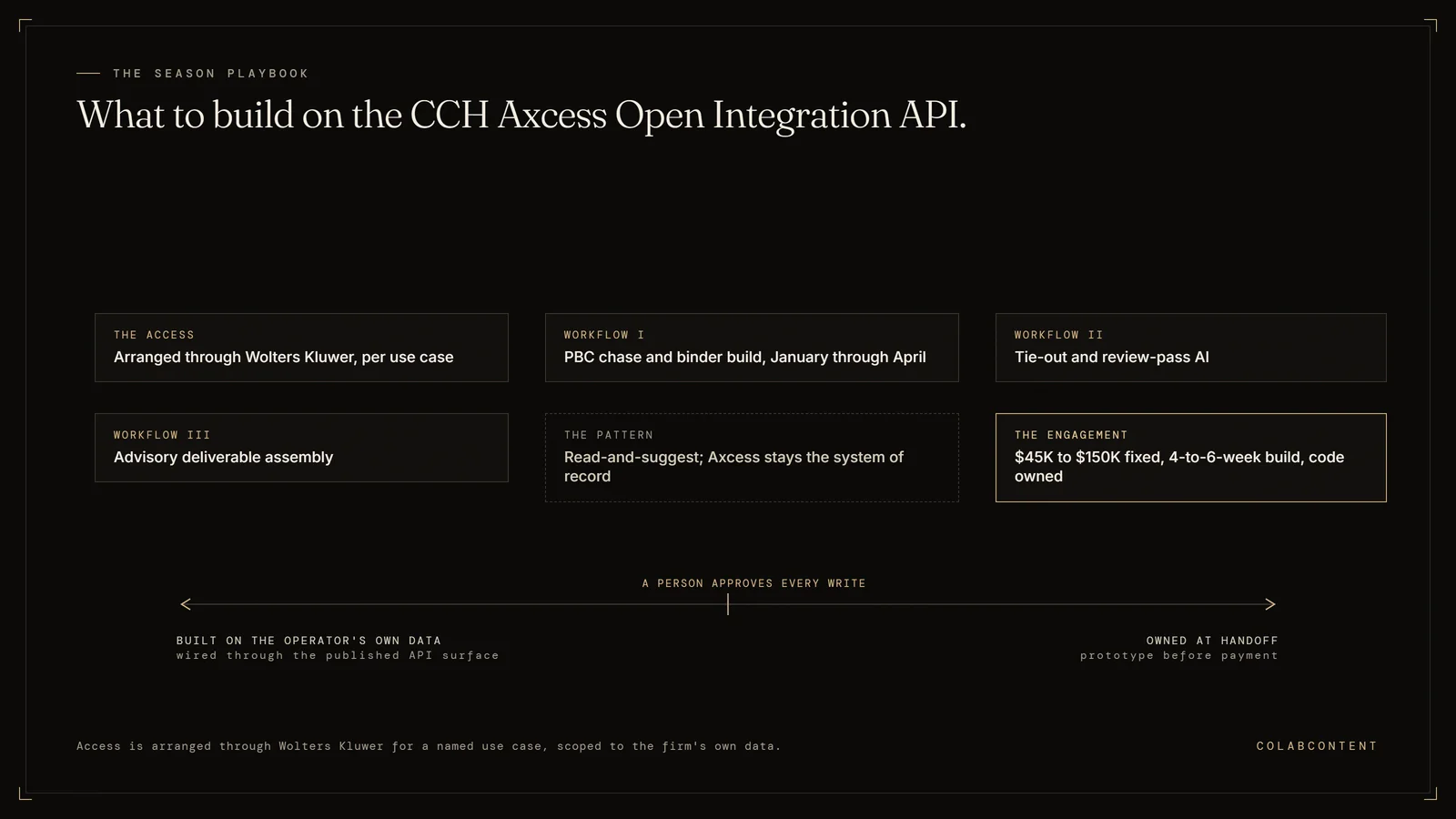
The CCH Axcess AI playbook: API access arranged through Wolters Kluwer, then three workflows that return their cost at a 30-to-150-professional firm: PBC chase and binder build, tie-out and review-pass AI, and advisory deliverable assembly
Where the compliance platform stops and the firm's own logic begins.

Written for the firm that already pays for CCH Axcess. We do not sell tax software, we do not sell practice management, we take no referral fee from anyone in the table below, and we will say plainly which firms should stay where they are.

For10 to 60 professional CPA firms on CCH Axcess
StanceNeutral. We sell no tax engine.
Bottom lineCrossover just past year 2 at a $90K build
CostFree 45-minute diagnosis
Prices readAugust 26, 2026

The short answer.

If you are on CCH Axcess and the reason you are reading this is money, the first thing to fix is not the vendor, it is the comparison. Almost every alternatives page on the internet puts Karbon at $59 per user per month next to CCH Axcess at $1,800 per user per year and lets you draw the obvious conclusion. That comparison is not real. Karbon does not compute a return. Neither does Canopy, TaxDome, Tidyflow or Jetpack Workflow. If you replace CCH Axcess with any of them you have replaced the practice-management layer and you still have to buy a tax engine, and the tax engine is the expensive half. Build the comparison honestly, with a tax engine on both sides, and the gap narrows to something you can actually make a decision on.

So the honest verdict splits three ways. Firms under roughly 10 professionals are usually better served by a lighter stack outright, and Tidyflow at $39 per user per month and Drake Tax at $3,295 flat both publish real numbers you can check in ten seconds. Firms in the 15 to 60 professional band with an acceptable tax engine and a practice-management layer that is costing partner hours are where the arithmetic on this page actually flips, because at that size the per-seat curve overtakes a one time build inside three years while continuing to tax every new hire. And firms genuinely embedded in the Wolters Kluwer compliance stack, with years of carryforward data, an integrated ProSystem fx history and a reviewer workflow that took two seasons to settle, should stay, and there is a whole section below arguing that case as strongly as we know how.

What CCH Axcess actually does well.

Worth being precise about this, because a comparison page that treats the incumbent as a punching bag is not useful to anyone actually holding the contract. CCH Axcess is a mature professional tax and compliance platform, and the things it is good at are the things that are genuinely hard to build.

Depth of the compliance engine. Multi-entity, multi-state, consolidated returns, and the long tail of forms that a mid-market practice hits three times a season and absolutely must have. This is the moat, it is expensive to maintain, and it is the reason firms tolerate the rest. None of the practice-management alternatives on this page attempt it.

An integrated compliance stack. Tax, Document, Portal, Practice and Workflow share a data model, so a client record entered once propagates. Firms that have replaced this with four separately purchased tools usually discover which integrations they had been leaning on without noticing.

Carryforward continuity. Prior-year data rolling into the current year without re-entry is the quiet feature that makes a compliance platform sticky. It is also the single biggest practical obstacle to leaving, which the migration section below treats honestly rather than waving away.

A documented integration surface. Wolters Kluwer exposes an Open Integration API for CCH Axcess, and access is arranged through Wolters Kluwer rather than self-served. Our own CCH Axcess AI workflow playbook documents what that surface supports from a build perspective, which matters if your conclusion is to keep the platform and build beside it.

Why firms start looking for a way out.

Four patterns, in the order they come up when a firm calls us about the bill.

Quote-led pricing with no rate card. Wolters Kluwer publishes no list price for the per-user product. We tried: two separate CCH Axcess pricing URLs returned HTTP 403 on three attempts on August 26, 2026. When there is no published number, the price is negotiated against the firm rather than against a list, and there is nothing to argue back with at renewal except your own total, which is what the model further down this page is for.

The practice-management half is heavy. Jetpack Workflow, which sells a competing workflow product, describes CCH Axcess Workflow as built for compliance first rather than for recurring accounting work, and leads its complaint list with complexity, learning curve and setup weight. Tidyflow, also a competitor, makes the same argument about enterprise-style onboarding. Read both as marketing, because both are selling you their own product. The fact that two competitors independently pick the same complaint is still information.

Bundling. The compliance stack arrives as a package, and the firm pays for modules it opens twice a year or never. That is a normal enterprise software pattern and it is not unique to Wolters Kluwer, but it is a real cost and it does not appear as a line you can decline.

Per-seat growth tax. Every professional you hire raises the bill by the full per-seat rate on day one, whether or not that person is billable in their first season. At our modelled blended rate, five new preparers is $12,500 a year added automatically and permanently, with no decision made by anyone.

Notice what is not on that list: nobody leaves CCH Axcess because it computes returns badly. If the tax engine is fine and the surrounding layer is the problem, that shapes which of the eight options below is even relevant to you.

What you are actually paying

Every number on this page, with its source.

Three of the vendors below publish a real, checkable price on their own website. Wolters Kluwer does not, and neither does Thomson Reuters. We label each figure VERIFIED when it was read off the vendor's own page on August 26, 2026, and REPORTED when it came from a third party the vendor has not confirmed. Where two sources describe different products we print both rather than blending them into one tidy number, and where we found nothing usable we say so and leave the cell empty instead of filling it.

The CCH Axcess numbers, and the caveat attached to them

There are two different third-party pictures of CCH Axcess pricing and they describe two different SKUs. Both are printed here because picking one and hiding the other is how comparison pages mislead.

CCH Axcess itemPriceTagSource, read August 26, 2026
Tax Essentials bundle, 100 returns / 5 states$2,299 a yearREPORTEDfitsmallbusiness.com/cch-axcess-tax-review/, which attributes the figure to the CCH bundle structure. Wolters Kluwer's own Essentials and package-options pages both returned HTTP 403 on three attempts.
Tax Essentials bundle, 100 returns / unlimited states$2,759 a yearREPORTEDSame source.
Tax Essentials bundle, 200 returns / 5 states$3,299 a yearREPORTEDSame source.
Tax Essentials bundle, 200 returns / unlimited states$3,959 a yearREPORTEDSame source.
Tax Essentials bundle, 400 returns / 5 states$4,299 a yearREPORTEDSame source.
Tax Essentials bundle, 400 returns / unlimited states$5,159 a yearREPORTEDSame source.
Tax Essentials bundle, unlimited returns$9,999 a yearREPORTEDSame source, either state option.
Additional states beyond the bundle$49.95 eachREPORTEDSame source.
Full CCH Axcess Tax, Professional tier$1,200 per user per yearREPORTED, weaklyunclekam.com. The publishing page discloses no methodology and cites no vendor document, so this is directional and not vendor-confirmed. Read every conclusion built on it with that in mind.
Full CCH Axcess Tax, Enterprise tier$1,800 per user per yearREPORTED, weaklySame source, same caveat.
Full CCH Axcess Tax, Enterprise Plus tier$2,200 per user per yearREPORTED, weaklySame source, same caveat.
CCH Axcess Document and Portal add-on$300 to $500 per user per yearREPORTED, weaklySame source, same caveat.
CCH Axcess Practice module$100 to $500 a year, quote-basedREPORTED, vaguelyselecthub.com, whose own page states that specific details are not readily available. We are printing the range with its own author's disclaimer attached rather than presenting it as a price.
Implementation, one timeNo dollar figure existsClaim withheldWe found no published implementation cost from Wolters Kluwer or from any third party. Rather than invent one, we exclude it from every dollar total on this page and treat it qualitatively below. Timeline is separately reported at four to six weeks, or two to three weeks for smaller firms, with low confidence and no single named vendor page stating it.
Data conversion into CCH AxcessFreeREPORTEDbusinesswire.com 2021 release, still cited in Wolters Kluwer marketing, covering Drake, UltraTax CS, GoSystem RS, Lacerte, ProSeries and other Wolters Kluwer products. Read the direction carefully: this is an incentive to switch to CCH Axcess, not a cost figure for leaving it.

The discrepancy, stated rather than smoothed. The bundle pricing and the per-user tiers are not two views of one product. Tax Essentials is a lighter, return-volume-capped SKU aimed at smaller practices. The Professional, Enterprise and Enterprise Plus tiers describe the full CCH Axcess Tax product for firms needing unlimited entity and state depth. A firm large enough to need 20 seats is realistically buying the second one, which is why the model below uses the per-user tiers, and that choice is an assumption rather than a sourced fact because Wolters Kluwer's own pages were unreachable. If your firm is on Essentials, the totals below overstate your bill and you should say so on the call.

The alternatives, priced

Three of these were read off the vendor's own live pricing page. Two were blocked and are reported from named third parties. One publishes nothing at all, not even on its own CCH Axcess alternatives guide.

ProductWhat it replacesPublished or reported priceSource
UltraTax CS (Thomson Reuters)The tax engineNot publicly priced. Third-party directional estimate $2,500 to more than $20,000 a year. Virtual Office CS hosting $147 to $179 per portal per month plus $9 per GB above 4 GB. Support $960 a year first product, $540 each additional. Third-party hosting from $49.99 per user per month.REPORTED oneupnetworks.com, whose page states in its own text that these estimates are directional only and none are published by Thomson Reuters.
Karbon TeamPractice management only$59 per user per month billed annually, $79 billed monthlyVERIFIED karbonhq.com/pricing/
Karbon BusinessPractice management only$89 per user per month billed annually, $99 billed monthly. Enterprise tier exists at custom quote.VERIFIED karbonhq.com/pricing/
Canopy Standard / Plus / PremiumPractice management only$74 / $109 / $149 per user per month, billed annuallyVERIFIED getcanopy.com/pricing
Canopy add-onsModulesTax Workflow Automation $34 per client per year. Close Automation $10 per connected client per month. Tax Resolution $50 per user per month.VERIFIED getcanopy.com/pricing
TaxDome Essentials / Pro / BusinessPractice management onlyAbout $800 / $1,000 / about $1,200 per user per year. Pro is also $100 per user per month billed monthly.REPORTED getuku.com, aimadefor.com and portico.run. taxdome.com/pricing returned HTTP 403 on two attempts across two URL variants.
Tidyflow Core / ProPractice management only$39 / $69 per user per monthVERIFIED tidyflow.com/cch-axcess-alternatives/, the vendor's own page
Jetpack WorkflowWorkflow onlyNot published, including on its own CCH Axcess alternatives pageNo usable source. Claim withheld.
Drake TaxThe tax enginePro Unlimited $3,295 multi-user or $3,145 single-user. Pro 250 $2,495 / $2,375. 1040 Unlimited $2,445 / $2,325. 1040-150 $2,195 / $2,075. Pay-per-return $379.99 for ten individual returns, add-ons $49.99 individual and $74.99 business. Drake Tax Online $299.99 pay-per-return plus $99 per additional user.VERIFIED drakesoftware.com/pricing
ProConnect Tax and Lacerte (Intuit)The tax engineQuote on request. No published figure we could stand behind.No usable source. Claim withheld. FitSmallBusiness lists both as quote upon request.
Commissioned build (ColabContent)The workflow layer, or more$45,000 to $180,000 one time, fixed feeOur own offer, stated as an offer rather than as a researched market figure.

Two absences in that table are worth naming out loud. G2, Gartner and TrustRadius are the review sites most firms check next, and all three blocked our fetches at HTTP 403, so nothing from any of them appears here as a sourced fact. We could have paraphrased what those pages are generally understood to contain, and we are not going to, because a comparison page whose credibility rests on citation cannot cite something it did not read.

Normalise it: what a 20 seat firm pays for a year

Per-seat and flat-fee pricing are not comparable until you fix the headcount. Hold one firm at 20 licensed users, take each rate at face value with nothing negotiated, and ask what a single year costs. The right-hand column is the one that matters, and it is the column no other page prints.

Product and planOne year, 20 seatsHow it is calculatedDo you still need a tax engine?
Tidyflow Core$9,360$39 x 20 x 12Yes
Karbon Team$14,160$59 x 20 x 12Yes
Tidyflow Pro$16,560$69 x 20 x 12Yes
Canopy Standard$17,760$74 x 20 x 12Yes
TaxDome Pro$20,000$1,000 x 20, reported figureYes
Karbon Business$21,360$89 x 20 x 12Yes
Canopy Plus$26,160$109 x 20 x 12Yes
Canopy Premium$35,760$149 x 20 x 12Yes
Drake Tax Pro Unlimited$3,295Flat, multi-user, unlimited returns. Not per seat.No, it is one
UltraTax CSNot calculable from public informationNo published rate, and the hosting figure is per portal rather than per user, which we could not confirm well enough to multiplyNo, it is one
Karbon Team plus Drake Pro Unlimited$17,455$14,160 plus $3,295, the honest like-for-like stackComplete stack
Canopy Standard plus Drake Pro Unlimited$21,055$17,760 plus $3,295, complete stackComplete stack
CCH Axcess, Enterprise plus both add-ons$50,000($1,800 + $400 + $300) x 20, all reported figuresComplete stack
CCH Axcess, lean scenario$32,000($1,200 + $300 + $100) x 20, all reported figuresComplete stack
CCH Axcess, heavy scenario$64,000($2,200 + $500 + $500) x 20, all reported figuresComplete stack

Read that table honestly and two things fall out. The first is that the practice-management alternatives are genuinely cheap, and the second is that comparing them to CCH Axcess directly is not a real comparison, because eight of the fifteen rows are incomplete stacks. The line that actually competes with CCH Axcess is Karbon plus Drake at $17,455, and it competes brutally on price while carrying a fit problem the price does not show: Drake is built for high-volume individual returns, not multi-entity mid-market work. Swap Drake for a tax engine that actually suits a mid-market practice and the number moves back up into territory nobody publishes, which is the honest end of this analysis rather than a rhetorical one.

The three year and five year model

The model below takes the per-user tiers plus both add-ons at 20 seats and escalates 3 percent a year from year two. That escalation rate is a modelling assumption, deliberately picked at the light end of the 3 to 8 percent range common in enterprise software, and it is not a CCH Axcess figure: we found no published CCH price-increase history. Implementation is excluded entirely because no dollar figure exists anywhere we could find, which makes every CCH column below a floor rather than a ceiling. The commissioned build column charges maintenance at 15 percent of the build price per year starting in year two, on the reading that year one maintenance sits inside the build fee. If a vendor quotes you maintenance from year one instead, add one more year of it to every build row.

Scenario, 20 seatsYear 13 year total5 year total
CCH Axcess, lean ($1,600 per seat blended)$32,000$98,909$169,892
CCH Axcess, modelled ($2,500 per seat blended)$50,000$154,545$265,457
CCH Axcess, heavy ($3,200 per seat blended)$64,000$197,818$339,785
Commissioned build at $45,000 plus 15% a year$45,000$58,500$72,000
Commissioned build at $90,000 plus 15% a year$90,000$117,000$144,000
Commissioned build at $180,000 plus 15% a year$180,000$234,000$288,000

The row we are obliged to point at. A build at the top of our range, $180,000, costs $234,000 over three years and $288,000 over five. Against the lean CCH Axcess scenario at $169,892 over five years, that build loses outright and it is not close. Back-solving the same formula: against the lean scenario a build only wins over three years if it is priced under about $76,100, and over five years under about $106,200. Against the modelled scenario the thresholds are about $118,900 and $165,900. Against the heavy scenario, any build in our entire range wins by year five, because the threshold there is about $212,400. So the honest summary is that a build beats CCH Axcess comfortably at the low and middle of our fee range and loses at the top of it against a lean contract. If someone tells you a custom build is always cheaper, they have not done this arithmetic.

A cross-check on the CCH side. Both the lean and heavy scenarios land inside an independently reported range of $30,000 to more than $100,000 a year for larger firms on the full stack, published by unclekam.com with the same missing-methodology caveat as its per-user tiers. Two different build methods agreeing on order of magnitude is weak confirmation rather than strong, and it is worth exactly that much: it tells us the model is not off by a factor of ten, and nothing more.

The crossover

Where the two lines meet.

Cumulative spend for the same 20 seat firm, five years out. CCH Axcess at the modelled scenario, Enterprise tier at $1,800 per user per year plus $400 for Document and Portal and $300 for Practice, which is $2,500 a seat and $50,000 a year, escalating 3 percent from year two. Against it, a commissioned build at $90,000, the middle of our fixed fee range, paid once, with 15 percent a year maintenance from year two. Every figure in the chart comes from the table above. Nothing is added to the chart that is not in that table, including implementation, which stays excluded on both sides.

Cumulative five year cost: CCH Axcess subscription versus a one time commissioned build A line chart of cumulative spend for a 20 seat CPA firm over five years. Both lines start at zero. The CCH Axcess line rises steadily to $50,000 at year one, $101,500 at year two, $154,545 at year three, $209,181 at year four and $265,457 at year five. The commissioned build line steps to $90,000 at year one, then rises gently by $13,500 of maintenance each year to $103,500, $117,000, $130,500 and $144,000. The build line is above the subscription line through year two, and the two cross at about 2.05 years and roughly $104,200 of cumulative spend, after which the subscription line is permanently above the build line. By year five the gap is $121,457. $0 $50K $100K $150K $200K $250K $300K Year 0 Year 1 Year 2 Year 3 Year 4 Year 5 Crossover, 2.05 years CCH Axcess $265,457 Owned build $144,000 CCH Axcess, 20 seats at $2,500, 3% annual increase Commissioned build, $90,000 once, 15% maintenance

The crossover lands at about 2.05 years, roughly $104,200 of cumulative spend on each path. Before that point the subscription is cheaper and the build is the worse financial decision, which is exactly what you would expect and exactly what most vendor comparison charts hide by starting the axis in the wrong place. Look at year two specifically: CCH Axcess has cost $101,500 and the build has cost $103,500. The build is still behind. It is behind by $2,000, which is a rounding error at this scale, and eleven months earlier it was behind by $40,000. That is the whole shape of the argument in one number.

After the crossover the gap widens every year, because one line has a slope and the other is nearly flat. At year five the difference is $121,457, and nothing in the model makes the subscription line bend back down. Change the build price and the crossover moves: at $45,000 it happens inside year one, and at $180,000 against this same scenario it does not arrive until year six, one year past the right edge of the chart above. Against a lean $32,000 a year CCH contract, a $180,000 build does not cross over inside five years at all, and we would tell you that on the call rather than let you find it here. Run your own numbers below.

Your firm, your numbers

The CCH Axcess total cost calculator.

Every default below is the figure from the table above, and every one of them is editable, because the defaults are a third-party estimate and your renewal invoice is a fact. CCH Axcess pricing is quote-based and not fully published; the figures loaded here are third-party-reported estimates rather than a live Wolters Kluwer quote, and the strongest thing you can do with this tool is overwrite them with your own invoice. Nothing is submitted anywhere. There is no email gate, no external request, and no stored value. The arithmetic runs in your browser and stops there. If your inputs make the build lose, the tool will say so rather than quietly hiding the result.

Preparers, reviewers, admin. Anyone holding a seat.
Reported tiers, directional only. Use your invoice rate if you have it.
Reported $300 to $500. Set to 0 if you do not licence it.
Reported $100 to $500, quote-based and described as vague by its own source. Set to 0 to exclude.
Modelling assumption, not a published CCH figure. Set to 0 to remove it.
Both totals are calculated over this horizon.
ColabContent fixed fee range, $45,000 to $180,000, set after the diagnosis call.
Software industry heuristic, charged from year two, not a ColabContent contract term.
The roundup

Nine options, in the order we would look at them.

One note on the roster before the list. Most CCH Axcess alternatives guides you will read list practice-management tools and tax engines in a single undifferentiated set, which makes the whole comparison unusable, because half the products on it cannot do the job the other half do. The list below is sorted by what each thing actually replaces, and each entry says so in its first line.

1. UltraTax CS (Thomson Reuters)

What it replaces. The tax engine. This is the closest like-for-like swap for CCH Axcess Tax and the only entry on this list that competes with it on compliance depth.

Price. REPORTED and loosely. Thomson Reuters publishes nothing. The most specific source we found, oneupnetworks.com, puts the base licence at $2,500 to more than $20,000 a year and states in its own text that its estimates are directional only and that none are published by Thomson Reuters. Virtual Office CS hosting is reported at $147 to $179 per portal per month with $9 per GB overage above 4 GB, support contracts at $960 a year for the first product and $540 for each additional, and third-party hosting from $49.99 per user per month. We are deliberately not multiplying the hosting figure by a seat count, because we could not confirm what a portal covers.

Best for. Firms whose real complaint is CCH Axcess support, interface or account handling rather than cost, and who want to stay in the same product category with a different vendor.

Where it falls short. It is the same shape of purchase and the same pricing opacity. If the reason you are leaving is that you cannot see a rate card, moving to a vendor that also does not publish one has not addressed the problem. Our UltraTax AI integration playbook covers the build side of it if you land there.

Verdict. A lateral move. Right answer for a support problem, no answer at all for a cost problem.

2. Karbon

What it replaces. Practice management and workflow only. No tax engine. You will still be buying one.

Price. VERIFIED from karbonhq.com/pricing/ on August 26, 2026. Team is $59 per user per month billed annually or $79 billed monthly. Business is $89 annually or $99 monthly. An Enterprise tier exists at custom quote. At 20 seats that is $14,160 or $21,360 a year.

Best for. Firms whose pain is collaboration, email triage and work visibility rather than the return itself, and firms that want a published number to budget against.

Where it falls short. As a CCH Axcess replacement specifically, it addresses one half of the platform. Firms that swap it in and keep an expensive tax engine often find total spend roughly unchanged, because the tax engine was always the expensive half.

Verdict. Genuine improvement to the workflow layer. Not a CCH Axcess replacement on its own, and any page telling you it is has not checked.

3. Canopy

What it replaces. Practice management and client experience, with modular add-ons. No tax engine.

Price. VERIFIED from getcanopy.com/pricing on August 26, 2026. Standard $74, Plus $109, Premium $149 per user per month billed annually. Add-ons priced separately and transparently: Tax Workflow Automation at $34 per client per year, Close Automation at $10 per connected client per month, Tax Resolution at $50 per user per month. At 20 seats the base tiers are $17,760, $26,160 and $35,760 a year.

Best for. Small and mid firms that want modular pricing they can actually read, and firms doing meaningful tax resolution work, where the add-on is a real capability rather than a checkbox.

Where it falls short. The add-on model means the headline tier is not your bill. Price the modules you will actually turn on before comparing. And, again, no tax engine.

Verdict. The most transparent pricing in this roundup. Same structural caveat as Karbon.

4. TaxDome

What it replaces. Practice management and client portal, all in one. No tax engine.

Price. REPORTED. taxdome.com/pricing returned HTTP 403 on two attempts across two URL variants, so these come from named aggregators rather than the vendor: Essentials at roughly $800 per user per year, Pro at $1,000 per user per year or $100 per user per month billed monthly, Business at roughly $1,200 per user per year. Treat the two approximate figures as softer than the Pro number, which multiple aggregators state identically.

Best for. Budget-conscious firms that want the client portal and the practice-management layer from the same vendor, with a lower entry point than Canopy Plus or Karbon Business.

Where it falls short. We could not read the vendor's own price, which is a mark against the comparison rather than against the product. And the tax engine gap applies here as everywhere in this section.

Verdict. Strong value in the practice-management layer. Verify the price yourself before budgeting, because we could not.

5. Tidyflow

What it replaces. Practice management, with flat published per-user pricing and fast setup. No tax engine.

Price. VERIFIED at $39 per user per month for Core and $69 for Pro, read directly from tidyflow.com on August 26, 2026. At 20 seats that is $9,360 or $16,560 a year, the cheapest complete practice-management layer in this roundup.

Best for. Firms that want same-day setup and simple pricing, and small firms where an enterprise onboarding cycle is genuinely disproportionate.

Where it falls short. Worth knowing where those numbers come from: we read them off Tidyflow's own CCH Axcess alternatives guide, a comparison published by Tidyflow that names Tidyflow best overall. That page publishes its own price and Karbon's and leaves TaxDome, Canopy, UltraTax CS, Drake, ProConnect and Lacerte unpriced, which is a marketing decision rather than a research limitation. The price is verified. The framing around it is an advertisement.

Verdict. Real product, real published price, cheapest in the set. Read its comparison content with the same scepticism you should apply to ours.

6. Jetpack Workflow

What it replaces. Workflow and task management. Narrower than the four above it, and no tax engine.

Price. Not published, including on its own CCH Axcess Workflow alternatives page, where it prices no product at all, its own included. We are not estimating it.

Best for. Firms whose single complaint is that CCH Axcess Workflow is heavy for recurring accounting work, which is precisely the argument Jetpack makes on that page.

Where it falls short. Narrow scope, and a vendor comparison guide that publishes no pricing for anything, its own product included, is telling you something about how it wants the evaluation to go.

Verdict. Worth a demo if workflow specifically is the constraint. Get the price in writing early, since you will not find it online.

7. Drake Tax

What it replaces. The tax engine, at a genuinely low flat price, for a firm that is not yours.

Price. VERIFIED from drakesoftware.com/pricing on August 26, 2026, and the most transparent pricing of any tax engine in this comparison. Pro Unlimited $3,295 multi-user or $3,145 single-user with unlimited returns. Pro 250 $2,495 or $2,375. 1040 Unlimited $2,445 or $2,325. 1040-150 $2,195 or $2,075. Pay-per-return $379.99 for ten individual returns, then $49.99 per individual and $74.99 per business return. Drake Tax Online at $299.99 pay-per-return plus $99 per additional user.

Best for. High-volume solo and small-firm 1040 preparation. That is what the product is built for and it is excellent at it.

Where it falls short. This is the entry every competing roundup gets wrong by listing it as a neutral budget option. For a mid-market firm doing multi-entity, multi-state and consolidated work with an integrated practice-management layer, Drake is not a smaller version of CCH Axcess, it is a different product for a different practice. Choosing it on the $3,295 headline means discovering the depth gap in February, which is the worst possible month to discover anything.

Verdict. The best price on this page and a poor fit for most firms reading it. If your work genuinely is high-volume individual returns, take the saving and stop reading.

8. ProConnect Tax and Lacerte (Intuit)

What they replace. The tax engine, cloud and desktop respectively.

Price. Quote on request for both, listed as quote upon request by FitSmallBusiness alongside its CCH Axcess review. We found no published figure we could stand behind and we are printing none. Our Lacerte AI integration playbook covers the technical surface if you land there.

Best for. Firms already inside the Intuit ecosystem, and mid-tier practices whose accountants have Lacerte muscle memory from a previous firm.

Where they fall short. Same pricing opacity as CCH Axcess and Thomson Reuters. Three of the four serious tax engines in this comparison refuse to publish a number, which is the actual finding of this section.

Verdict. Viable, unpriceable from public information, and worth a quote if you are shopping the compliance engine specifically.

9. A commissioned build you own

What it replaces. Not the compliance engine. A custom system built for the workflow no platform vendor covers, sitting alongside whichever tax engine you keep, owned by the firm at handoff. In practice that means the PBC chase and binder build, the tie-out and review pass, advisory deliverable assembly, or whatever your firm's specific leak turns out to be.

Price. A fixed fee of $45,000 to $180,000, set after a free 45-minute diagnosis call and after the integration depth is named, paid in two installments at build start and handoff. A working prototype runs on your real data in seven to ten days before any payment. Production build is five to seven weeks. The firm owns the code, prompts, models and pipeline at handoff and runs it in its own cloud tenant.

Best for. Firms in the 15 to 60 professional band with a compliance engine that basically works and a named workflow that burns reviewer hours every season.

Where it falls short. It is a bigger single cheque, it needs a tighter scope than buying software does, and at the top of the fee range it loses the cost argument outright against a lean CCH Axcess contract, as the table above shows. It also does not compute a return, so if what you want is to stop paying Wolters Kluwer entirely, this is not that on its own.

Verdict. The option nobody in the table above will show you, and the only one where the bill stops going up.

The distinction nobody draws

CCH Axcess is two products. Price it that way.

This is the part of the page worth reading twice, because getting it wrong is what makes every other comparison on the internet useless.

Half one: the compliance engine. CCH Axcess Tax computes and files returns. Multi-entity, multi-state, consolidated, with the long tail of forms and the carryforward continuity that makes a season possible. The only products on this page that do this job are UltraTax CS, Drake Tax, ProConnect Tax, Lacerte, and the on-premise CCH ProSystem fx family a lot of firms are still partly running.

Half two: the practice-management layer. CCH Axcess Workflow, Document, Portal and Practice handle work assignment, client documents, the client-facing portal and time and billing. The products that do this job are Karbon, Canopy, TaxDome, Tidyflow, Jetpack Workflow, and several others outside this roundup.

Why the distinction decides your answer. If your complaint is about the second half and you replace it, you keep paying for the first half, and the first half is where most of the money is. If your complaint is about the first half, none of the cheap options on this page apply to you at all, and your realistic set is UltraTax CS, Intuit, or Drake if your work fits Drake. And if your complaint is that the whole thing costs more every year regardless of which half is at fault, then no product on this page fixes it, because every one of them is priced per seat and every one of them rises with headcount. That third case is the only one where a commissioned build is a structural answer rather than a cost-cutting exercise, and it is a much smaller share of firms than a sales page would imply.

The practical instruction: before you take a single demo, write down which half is costing you money, in one sentence, with a number attached. If you cannot, the demo will decide for you and it will decide in the vendor's favour.

The ownership case

Eight arguments for owning it instead.

Each of these is either arithmetic you can check on this page or a structural fact about the two models. Where an argument does not honestly apply to your firm, the section after this one says so.

One. The math, restated. A subscription never ends. At the modelled scenario a 20 seat firm pays $154,545 over three years and $265,457 over five, and year six starts at zero progress. A $90,000 build costs $117,000 over the same three years and $144,000 over five, and the lines cross at about 2.05 years. After the crossover the gap widens every year because one curve has a slope and the other is nearly flat. That is the whole argument, and it is the reason the chart is on this page rather than in a sales deck.

Two. Per seat pricing taxes growth, and this is the argument that survives every objection. Even in the scenarios where the five-year totals are close, this one holds. Every professional you hire raises the CCH Axcess bill by the full blended seat rate on the day they start, which at our modelled figures is $2,500 a year each, or $12,500 for five hires, forever, escalating. A build's maintenance cost does not move when headcount does. That is not a price difference, it is a difference in the shape of the curve, and for a firm that intends to grow it is harder to rebut than any single-point cost comparison. If you take one thing from this page, take this one.

Three. Asset versus expense. A subscription is rent and it leaves nothing behind. A commissioned build is a piece of the firm: transferable, valuable in a merger or succession conversation, and on the balance sheet rather than only on the expense line. For partners thinking about a five to ten year horizon, or about what the practice is worth to a buyer, that difference is not cosmetic.

Four. Built around your workflow, not the median firm's. Every product in the roundup above is calibrated against the average customer in its category, which means you pay for the whole feature bundle and adapt your process to the fraction of it your firm actually opens. Both of the vendor-published alternatives guides in this category name bundling as a complaint about CCH Axcess, from opposite ends of the market. A commissioned system starts from your engagement types, your review hierarchy, your PBC process. Nobody gets retrained into someone else's assumptions.

Five. No per-seat AI tax. Here is the honest version of an argument other pages overstate. We could not find published AI module pricing for CCH Axcess, and we are not going to assert a figure we did not read. What is checkable is the structure: every product in the roundup above is licensed per user, so any capability added to any of them arrives priced against your headcount. In a commissioned build the intelligence is the system rather than a module on top of it, there is no separate licence for it, and adding a user costs nothing. That is a structural claim about the two models, not a claim about anyone's price list.

Six. Unlimited seats. Preparers, reviewers, seasonal staff, admin, and where appropriate clients themselves. Zero marginal cost per person means the question changes from who needs a licence to who needs access, which is a better question, and in a profession that staffs up hard for four months of the year it is a materially better question.

Seven. Data ownership and no exit ransom. Your client records, your work papers, your export path, in your own cloud tenant, under an agreement you wrote. Compare that with the migration section below, where the hard part of leaving a compliance platform is not the documents but the carryforward data and the structure, both of which live in a shape the vendor designed. Owning the structure removes the negotiation from leaving. It is also worth noticing that Wolters Kluwer publishes free data conversion into CCH Axcess and nothing at all about conversion out; that asymmetry is not an accident and it is not unique to them.

Eight. Change speed. A change request to your own system is a scoping conversation and a deployment. A change request to a vendor is a feature request in a queue behind every other customer's, with no committed date and no obligation. When the thing you need changed is the thing that makes your firm different, the queue is not an acceptable answer, and in a seasonal profession a twelve-month vendor roadmap means you wait two seasons.

What we can actually prove

The list of arguments above is worth exactly as much as the evidence behind the firm making it, so here is ours, with nothing rounded up. Jim Glaser Law is our nameable reference and the principal takes reference calls. The LELF platform is the fullest example of what commissioning looks like in a professional services firm: a 47-attorney litigation firm runs its matter, invoice and IOLTA trust operation on it, holding 13,296 matters, 4,396 clients and 5,684 invoices, with trust reconciled byte identical against the system it replaced. That firm is under confidentiality and stays anonymised, which is why we name the platform and not the firm. Across our practice the call volume is more than 6,000 AI handled calls, and we have delivered more than forty commissions.

What that evidence supports is a specific claim: we can build and run a system that carries real operational volume in a professional services firm and reconciles to the penny under audit. What it does not support is a claim that we have decommissioned a CCH Axcess tenant for anyone, because we have not, and the migration section below says so in plain language rather than around it. If a CPA-specific reference matters more to you than a legal one, say so on the call and we will tell you honestly what we can and cannot put in front of you.

The honesty section

Who should stay on CCH Axcess.

Six situations where every argument in the previous section fails, and where we would tell you to stay put on a call.

Firms under about 12 licensed users on a lean contract. The arithmetic does not work and the model on this page says so. At 12 seats on the Professional tier with light add-ons, the annual bill is around $19,200 and the five-year total around $101,900. The cheapest build we would scope, $45,000 with maintenance, is $72,000 over the same five years, so it still wins on paper; but at 10 seats it is close enough that ordinary variance in your actual contract decides it, and below that the subscription wins outright. Combine a firm at that size with a build at the top of our range and CCH Axcess is straightforwardly cheaper for five years running. That is the case where the answer is a lighter stack, not a build.

Firms deep in the carryforward. If your practice has years of prior-year data, an active ProSystem fx history, and a reviewer workflow that took two seasons to settle, the switching cost is not the licence, it is the risk of a bad filing season. That risk is often larger than the savings and pretending otherwise would be dishonest.

Firms that need a working system this season. A commissioned build ships a prototype in seven to ten days and production in five to seven weeks, and a compliance migration on top of that is a multi-month project that should not touch January through April. If the deadline is real and near, buying is faster than building and it is not close.

Firms where the tax engine is the complaint. A commissioned build does not compute a return. If the depth of CCH Axcess Tax is what is failing you, your realistic set is UltraTax CS or Intuit and you should go price them, not us.

Firms where nobody owns the system internally. An owned build needs a named person who cares about it, even at a light touch. Firms without that person are better off renting, because the alternative is an orphaned system that decays quietly between filing seasons.

Firms whose constraint is not a workflow at all. If the hours are leaking somewhere the software was never involved in, changing software is motion rather than progress. Plenty of the diagnosis calls we run end with us recommending the firm keep what it has, and this is the most common reason.

Decision tree

Six questions, in order, with stop points.

1. Which half is the problem, the tax engine or the practice-management layer? If it is the tax engine, stop here and go price UltraTax CS, ProConnect Tax and Lacerte, and Drake only if your work is high-volume individual returns. Nothing else on this page applies to you. If it is the practice-management layer, or if it is the total bill regardless of half, continue.

2. Is your firm under about 12 licensed users? If yes, stop here. Price Tidyflow, Canopy and TaxDome against your current contract and pair whichever you pick with a tax engine that fits your work. A commissioned build will not return its cost reliably at your volume. If no, continue.

3. Do you know your actual per-seat rate and your renewal terms? If no, stop and go find the invoice and the order form. Every decision after this one depends on them, and the reported ranges on this page are a substitute for those documents, not a replacement for them. If yes, continue.

4. Run your numbers in the calculator above. Is your five-year CCH Axcess total below about $72,000? If yes, stop. The cheapest build we would scope, $45,000, costs $72,000 over five years with maintenance, so no build we quote can beat your contract on cost. Renegotiate at renewal and spend the energy elsewhere. If no, continue.

5. Can you name the workflow that leaks in one sentence, with a rough dollar or hour figure attached? If no, stop, and spend one season measuring before anyone spends money. Every failed build we have seen started with an unnamed constraint. If yes, continue.

6. Is the budget runway for a $45,000 to $180,000 fixed fee real this year, and is a partner willing to spend 45 minutes on the diagnosis? If no, park it and revisit before your renewal date rather than after it. If yes, that call is the next step, and it regularly ends with us telling you to stay where you are.

Next step

Book the 45-minute diagnosis.

Bring your renewal invoice and one sentence describing the workflow that leaks. You leave with the constraint written down either way, and plenty of these calls end with us telling a firm to stay where it is.

Free · 45 minutes
Under NDA
Partner to partner
No follow-up unless asked
Migration reality

What leaving CCH Axcess actually involves.

Almost none of the CCH Axcess alternatives guides you will find answer this question with specifics, which is strange, because it is the question that decides whether a firm ever acts on any of the rest. Here is the honest shape of it, with an explicit note about what we could and could not source.

What we could not find. No published figure exists, from Wolters Kluwer or from any third party we could reach, for the cost or the duration of exporting out of CCH Axcess. We looked. What does exist is the opposite: a 2021 BusinessWire release, still cited in Wolters Kluwer marketing, advertising free data conversion into CCH Axcess from Drake, UltraTax CS, GoSystem RS, Lacerte, ProSeries and other Wolters Kluwer products. Read the direction of that offer carefully. It is an incentive to arrive, not a service for leaving, and it is the only conversion figure anyone publishes. The rest of this section is our own scoping experience with compliance-platform migrations, stated as estimates rather than dressed up as research.

You are not moving files. You are moving four things. Completed returns are the easy part and they are the part every migration page talks about. The other three are where projects overrun. Prior-year carryforward data, which determines whether next season starts from a rollover or from re-keying. Client and engagement records, including the relationship structure between entities that a mid-market practice depends on. And the work paper and document archive with its filing structure intact, which is what makes a prior year defensible when someone asks about it three years later.

The calendar decides this project, not the scope. Reported CCH Axcess implementation is four to six weeks, or two to three weeks for smaller firms, and that figure is low confidence: no single named vendor page we found states it. Whatever the real number, the binding constraint for a CPA firm is not weeks of work, it is which weeks. A compliance migration touched between January and April is a bad idea in every firm we have seen. Plan the move for May through August, run the parallel season, and be settled before the next extension deadline.

Parallel run across a full filing season, not a full month. Both systems live, new work in the new system, the old one read-only. In legal or general business software a parallel run is measured in billing cycles. In tax it is measured in seasons, because the gaps do not surface when you look for them, they surface when a preparer needs a 2023 carryforward on a Thursday in March. A firm that skips the parallel season to save three months usually spends the saving twice.

Then decommission. Only after the parallel season produced no unresolved exceptions, and only after someone has read the notice provisions in your order form, because a compliance platform contract that auto-renews will renew during a migration if nobody sends the letter.

What we do and do not do here. We have not run a CCH Axcess decommissioning and we are not going to imply otherwise. What we build is the workflow layer that sits alongside whichever compliance engine you land on, which is a different job and one we have evidence for. If your project needs a migration partner, that is a specialist engagement and the platform you are moving to will usually name two or three.

The option most firms do not consider. You do not have to leave to fix the problem. In a large share of the cases we see, the compliance engine is fine, the licence is defensible, and the leak is in a workflow sitting beside it. That path keeps CCH Axcess, keeps the carryforward, keeps the reviewer workflow, and builds the missing piece against the Open Integration API with access arranged through Wolters Kluwer. No migration, no parallel season, no decommissioning letter. Our CCH Axcess AI automation playbook is the long version of that route.

Deep dive

The dimensions the price table cannot show.

Six dimensions, side by side.

Price transparency. Karbon, Canopy, Tidyflow and Drake publish real rate cards you can read in ten seconds. Wolters Kluwer, Thomson Reuters, Intuit and Jetpack Workflow publish nothing, and TaxDome blocked us. Three of the four serious tax engines in this comparison are unpriceable from public information. Transparency is not the same as cheapness, but an undisclosed price lets the seller quote against the buyer rather than against the work.

Scope of replacement. The single most decision-relevant dimension and the one no competing page prints. UltraTax CS, Drake, ProConnect and Lacerte replace the compliance engine. Karbon, Canopy, TaxDome, Tidyflow and Jetpack Workflow replace the practice-management layer. Only CCH Axcess itself, and a sufficiently large commissioned build, span both.

Cost slope. Every subscription on this list rises with headcount and with renewal. A commissioned build is a one time fee plus a flat maintenance line. The slope, not the starting point, is what decides a five year comparison, and it is the only argument on this page that survives every scenario we modelled.

Ownership at exit. Every vendor here retains the code, the structure and the pipeline. A commission transfers all three at handoff, running in the firm's own cloud tenant. That is the difference between an export and a handover.

Seasonality. A dimension unique to this vertical and absent from every comparison we read. Any change to a compliance stack has a four-month window in which it must not happen. That constrains migration timing, training, parallel runs and go-live dates, and it makes the difference between a May decision and a November decision worth an entire year.

Switching asymmetry. Wolters Kluwer publishes free data conversion into CCH Axcess and nothing about conversion out. Every vendor in this category subsidises arrival and prices departure at whatever the market will bear, which is a structural feature of the model rather than a criticism of one company.

When to pick which, in one paragraph each.

Stay on CCH Axcess if your rate is at the lean end, your carryforward history is deep, or you need certainty this season. Take the total cost figure from this page into the renewal conversation as leverage rather than as a reason to leave. A firm that walks into renewal with a five-year number is negotiating; a firm that walks in with a monthly rate is accepting.

Move to UltraTax CS if your complaint is support, interface or account handling rather than money, and you accept that the economics are the same shape and equally unpublished.

Move to Tidyflow, Canopy, Karbon or TaxDome for the practice-management layer only, and only after you have priced the tax engine that will sit beside it. Pricing the practice-management layer alone is how firms end up spending more in total than they did before.

Move to Drake only if your work genuinely is high-volume individual returns. At $3,295 flat it is the largest single saving available on this page and the worst fit for most firms reading it.

Commission a build if the compliance engine is fine, the constraint is a named workflow, and the five year subscription total on this page is comfortably above what a scoped build would cost. Most firms in that position keep CCH Axcess and build beside it, which is a smaller and more defensible project than a replacement.

Why this page is written by someone who does not sell tax software.

Worth saying plainly, because it changes how you should read everything above. Two of the most visible CCH Axcess alternatives guides are published by vendors that appear in their own comparison and name themselves best overall. One of those publishes its own price and one competitor's while leaving seven other products unpriced. The other publishes no pricing whatsoever, for any product, including itself. Most of the rest are review aggregators, three of which blocked our fetches at HTTP 403, plus Wolters Kluwer's own marketing and login pages, which are not a comparison at all. None of them publishes a sourced, dated, multi-vendor pricing table, models multi-year cost, or draws the compliance versus practice-management distinction that determines the entire answer.

ColabContent sells commissioned AI builds. We do not sell tax software, we do not sell practice management, we take no referral fee from anyone in the roundup, and we have no reason to steer you toward or away from any of them. That does not make us neutral about the conclusion, obviously, and the whole point of publishing the arithmetic and the assumptions is that you can see exactly where our interest starts affecting the numbers. It does mean that when this page says a $180,000 build loses outright against a lean CCH Axcess contract, or that Karbon plus Drake beats us on raw price, nothing commercial is pulling in the other direction.

What a build alongside CCH Axcess actually looks like.

Three workflows come up repeatedly in CPA firms, and they share a property: none of them is a tax-calculation problem, which is why the compliance engine does not touch them and why replacing the compliance engine would not fix them.

PBC chase and binder build. The prepared-by-client request cycle, the chasing, the receipt tracking, and the assembly of a workpaper binder from what actually arrived. This is administrative labour that scales with client count and it is the workflow with the clearest hour figure attached in most firms.

Tie-out and review pass. Reconciling figures across schedules and flagging what a reviewer should look at first, drafted for a human to approve rather than posted automatically. Reviewer time is the scarcest resource in a mid-market firm in March and this is where it goes.

Advisory deliverable assembly. Turning completed compliance work into the client-facing advisory output that firms want to sell more of and rarely have capacity to produce during season.

The integration posture is read and suggest by default, human in the loop, relaxing to spot check only after a full season of held output quality. Integration happens at the API layer as the primary route, with CCH Axcess Open Integration API access arranged through Wolters Kluwer rather than self-served, which goes on week one of any build plan. A database layer is a last resort requiring explicit approval. We do not replace CCH Axcess Tax, we do not compute or sign returns, and we do not touch anything that carries a preparer's signature.

Questions

The eight questions CCH Axcess buyers actually ask.

How much does CCH Axcess actually cost per user?

Wolters Kluwer does not publish a rate card, and we could not read one: wolterskluwer.com/en/solutions/cch-axcess/tax/essentials and the package options page both returned HTTP 403 on three separate attempts on August 26, 2026. Two different third-party pictures exist and they describe two different products. The bundle picture, reported by FitSmallBusiness and attributed to CCH Axcess Tax Essentials, runs $2,299 a year for 100 returns and 5 states up to $9,999 a year for unlimited returns, with additional states at $49.95 each. The per-user picture, reported by Uncle Kam, puts full CCH Axcess Tax at $1,200 per user per year for Professional, $1,800 for Enterprise and $2,200 for Enterprise Plus, with a Document and Portal add-on at $300 to $500 per user per year. That second source discloses no methodology and cites no vendor document, so we treat it as directional rather than confirmed and we label it that way everywhere it appears on this page. A mid-market firm needing multi-entity and multi-state depth is realistically buying the per-user product, not the return-capped Essentials bundle. At 20 seats on Enterprise with both add-ons, that is $50,000 a year before any internal time.

Why are CPA firms switching away from CCH Axcess?

Four reasons show up repeatedly in the alternatives guides firms read and in the calls we run. The first is quote-led pricing with no published rate card, which means the number is negotiated against the firm rather than against a list, and every new hire raises it. The second is that the practice-management half is heavy: Jetpack Workflow describes CCH Axcess Workflow as built for compliance first rather than for recurring accounting work, and complexity and learning curve are its lead complaints. The third is enterprise-style onboarding, reported at four to six weeks and two to three weeks for smaller firms, which is a low-confidence figure that no vendor page we found states directly. The fourth is bundling, where the compliance stack arrives as a package and the firm pays for modules it never opens. Notice that none of those four is a tax-calculation complaint. CCH Axcess Tax is a capable compliance engine and firms rarely leave because it computes returns badly.

Can Karbon, Canopy, TaxDome or Tidyflow fully replace CCH Axcess?

No, and this is the single biggest thing every competing roundup gets wrong. CCH Axcess is two products wearing one name. CCH Axcess Tax is a compliance engine that computes and files returns. CCH Axcess Workflow, Document and Practice are the practice-management layer around it. Karbon, Canopy, TaxDome, Tidyflow, Jetpack Workflow, Financial Cents and Firm360 replace only the second half. Swap in any of them and your firm still needs a tax engine: UltraTax CS, Lacerte, ProSeries, ProConnect, Drake, or a system you commission. Every listicle that puts Karbon at $59 per user per month next to CCH Axcess at $1,800 per user per year is comparing a part to a whole, and the gap it appears to show is not real. The honest comparison is Karbon plus a tax engine against CCH Axcess, and once you build it that way the saving is smaller than the headline and it depends entirely on which tax engine you can actually run.

What is the best CCH Axcess alternative for a mid-market firm?

It depends on which half hurts, and any page that answers this with one product name is selling that product. If the tax engine is the problem, UltraTax CS is the closest like-for-like swap and it is a lateral move on economics: Thomson Reuters publishes no pricing either, and the only figures available are third-party estimates that the publishing source itself labels directional only. If the practice-management layer is the problem, Canopy and Karbon both publish real per-user rates you can check in ten seconds, which CCH Axcess does not. If the problem is the per-seat model itself, no product on this list solves it, because every one of them is priced per seat and rises with headcount. That is the case where a commissioned build is the only structural answer, and the arithmetic for it is on this page rather than asserted. For a 20 seat firm at our modelled $50,000 a year, a $90,000 build crosses over just past year two.

Is UltraTax CS actually cheaper than CCH Axcess, or just a different flavour of expensive?

Nobody can tell you, including us, and that is the finding. Thomson Reuters does not publish UltraTax CS pricing. The most specific source we found, oneupnetworks.com, gives a base licence range of $2,500 to more than $20,000 a year and states in its own text that these are directional only and that none are published by Thomson Reuters. A range spanning eight times its own floor is not a price, it is an admission. The same source reports Virtual Office CS hosting at $147 to $179 per portal per month with $9 per GB overage above 4 GB, support contracts at $960 a year for the first product and $540 for each additional one, and third-party hosting from $49.99 per user per month. We are not multiplying the hosting figure by a seat count because we could not confirm what a portal covers, and inventing that multiplication would be the easiest way to make this page wrong. The practical answer: moving from CCH Axcess to UltraTax CS is a support and usability decision, not a cost decision, and you will only learn the cost by getting both quotes.

Is Drake Tax a real option for a firm our size?

For most mid-market firms, no, and the listicles that park Drake in the budget slot without qualifying it are doing readers a disservice. The price is real and it is genuinely low: drakesoftware.com/pricing publishes Pro Unlimited at $3,295 multi-user or $3,145 single-user for unlimited returns, Pro 250 at $2,495, 1040 Unlimited at $2,445, 1040-150 at $2,195, and pay-per-return at $379.99 for ten individual returns with $49.99 and $74.99 add-on returns. Those are verified figures read off the vendor page on August 26, 2026. The problem is fit. Drake is built for high-volume solo and small-firm 1040 preparation. A mid-market firm doing multi-entity, multi-state, consolidated work with an integrated practice-management layer is not the buyer that product was designed for, and choosing it on price alone means discovering the depth gap in February. If your work genuinely is high-volume individual returns, Drake at $3,295 flat against a $50,000 CCH Axcess bill is the largest saving on this page and you should take it.

What does a custom-built system cost compared to CCH Axcess over 3 and 5 years?

For our modelled 20 seat firm at $50,000 a year with a 3 percent annual increase, CCH Axcess costs $154,545 over three years and $265,457 over five. A commissioned build is a one time fixed fee of $45,000 to $180,000, and we model maintenance at 15 percent of the build price per year starting in year two, which is a software industry heuristic rather than a contract term. At $90,000 that is $117,000 over three years and $144,000 over five, and the two lines cross just past year two. But the answer changes with the inputs and we are obliged to say where it goes the other way. Against a lean CCH Axcess scenario of $32,000 a year, a build only wins over five years if it is priced under about $106,000, so a $180,000 build loses that comparison outright and we would tell you so on the call. The durable argument is not the three-year total anyway. It is that CCH Axcess costs more every time you hire and a build does not.

Does switching off CCH Axcess mean re-entering years of client data?

No, but the reassurance most firms have heard points the wrong way. Wolters Kluwer advertises free data conversion from Drake, UltraTax CS, GoSystem RS, Lacerte, ProSeries and other Wolters Kluwer products, reported in a 2021 BusinessWire release that its marketing still cites. Read that carefully: it is an incentive to switch to CCH Axcess, not a service for leaving it. We found no published figure, from Wolters Kluwer or anyone else, for the cost or duration of an export in the other direction, and we are not going to invent one. What we can say about the shape of it is that returns, client records and document archives each move differently, that prior-year return carryforward data is the piece firms most often discover late, and that the only safe pattern is a parallel run across at least one full filing season with the old system live and read-only. Plan the move for May through August. A firm that starts a compliance migration in January has made the decision for itself.

Buyer worksheet

What to have in front of you before any call.

Five documents to pull before you talk to anyone.

One. Your current renewal invoice and order form. Not last year's budget line. The order form is where the term, the renewal mechanics, the increase if there is one, and the notice period live. Every reported figure on this page is a substitute for this document and a worse one.

Two. Your actual licensed user count, split. Preparers, reviewers, admin, seasonal, and anyone holding a seat who has not opened it since last April. That last group is usually the fastest money a firm finds and it costs nothing to look.

Three. Your module list. Which of Tax, Document, Portal, Practice and Workflow you actually licence, and which of them anyone actually opens. Bundling only costs you money if you never audit it.

Four. One number for the workflow that leaks. Hours per season, or dollars, on the single process that costs you most. Our page can model your licence. It cannot model your constraint, and the constraint is the reason a build either pays for itself or does not.

Five. Your renewal date. Everything on this page is more useful ninety days before it than thirty days after it. If you are inside the notice window already, that is the first fact on the call.

Five questions to ask every vendor, including us.

What is the term, and what happens at renewal? Ask for the increase in writing. A vendor that will not commit one to paper has told you something.

What is the total in year five, not year one? Make them do the arithmetic on your seat count with their own escalation assumption. Compare that number to the one the calculator on this page produced.

Does this replace my tax engine, my practice management, or both? Ask it in exactly those words. Half the products in this category will give you a fuzzy answer and the fuzziness is the answer.

What exactly do we own at the end, and in what format? For a subscription the answer is an export. For a commission it should be code, prompts, models, datasets, runbook and integration documentation, in writing.

Can we speak to a firm you did this for? Then ask that firm three things: what the constraint was, what the system does now, and whether they would do it again. Our answer to this question is Jim Glaser Law, and the principal takes reference calls.

When not to buy from us.

Do not commission a build if your firm is under about 12 licensed users on a lean contract. The volume through any single workflow will not reliably return a five figure build, and we will tell you that on the call rather than take the engagement.

Do not commission a build if what you actually want is to stop paying Wolters Kluwer. We do not replace a compliance engine, we do not compute returns, and a commission sits alongside a tax engine rather than instead of it. If leaving the category entirely is the goal, price UltraTax CS, Intuit and Drake and use this page's cost model as the yardstick.

Do not commission a build during filing season. Ask us in February and we will tell you to call back in May, which is a worse quarter for us and a better one for you.

Do not commission a build if nobody at the firm will own the system after handoff. An owned system with no internal owner decays between seasons, and that outcome is worse than renting.

Do not commission a build if you cannot name the constraint in a sentence. Book the diagnosis call anyway, because naming it is the work of the call, but do not sign anything until the sentence exists.

Sources, with dates and labels.

All fetched on August 26, 2026 unless noted. VERIFIED means read directly off the vendor's own page. REPORTED means a third party published it and the vendor has not confirmed it.

VERIFIED karbonhq.com/pricing/ (Karbon Team, Business and Enterprise tiers). getcanopy.com/pricing (Canopy Standard, Plus, Premium and all three add-ons). drakesoftware.com/pricing (every Drake tier, pay-per-return and Drake Tax Online figure on this page). tidyflow.com/cch-axcess-alternatives/ (Tidyflow Core and Pro, read off the vendor's own competing page).

REPORTED fitsmallbusiness.com/cch-axcess-tax-review/ (the CCH Axcess Tax Essentials bundle table and the additional-state fee; also the source for ProConnect and Lacerte being quote upon request). unclekam.com (the CCH Axcess per-user tiers, the Document and Portal add-on range, and the $30,000 to $100,000-plus firm-wide range; the page discloses no methodology and cites no vendor document, so every figure from it is directional). selecthub.com (the CCH Axcess Practice range, which that page itself calls not readily available). getuku.com, aimadefor.com and portico.run (TaxDome tiers, after taxdome.com/pricing returned HTTP 403 twice across two URL variants). oneupnetworks.com (all UltraTax CS figures, which that page labels directional only and not published by Thomson Reuters). businesswire.com 2021 release plus syncmatters.com (free data conversion into CCH Axcess).

Claims we withheld. No implementation dollar figure for CCH Axcess appears on this page, because none exists in any source we could reach, and every total here excludes it as a result. No internal administration cost is modelled, for the same reason. No AI module price for CCH Axcess is stated, because we did not read one. No per-seat multiplication of the UltraTax CS hosting figure appears, because we could not confirm what a portal covers. No pricing for Jetpack Workflow, ProConnect Tax or Lacerte is printed, because none is published. And nothing from G2, Gartner or TrustRadius appears as a sourced fact, because all three blocked our fetches at HTTP 403 and we will not cite a page we did not read.

Modelling assumptions, labelled. The 3 percent annual increase is our assumption, picked at the light end of the 3 to 8 percent enterprise software band; we found no published CCH Axcess price-increase history. The 15 percent annual maintenance on a commissioned build, charged from year two, is a software industry heuristic and not a ColabContent contract term. The 20 seat scenario firm is a modelling choice picked in the middle of mid-market, not a real client.

Bring your renewal invoice.

Free 45-minute diagnosis, under NDA. We will run your real numbers against the model on this page and tell you honestly whether the answer is renegotiate, switch, or build. Plenty of these calls end with us telling a firm to stay where it is.