Home/ Comparisons/ Corvee Alternatives

Corvee Alternatives for CPA Firms: 6 Options, Priced

There are six real alternatives to Corvee for a CPA firm doing proactive tax planning: staying on Instead as an existing customer, buying Instead as a new customer, TaxPlanIQ, Holistiplan, Thomson Reuters Planner CS, and spreadsheets plus a general AI assistant. The seventh option, the one most buyers never price because no software vendor can sell it to them, is commissioning the system and owning it outright. First, the thing worth settling before anything else: Corvee has not shut down. It is now part of Instead, corvee.com/pricing 301 redirects to instead.com/corvee, and Instead states on that page that existing accounts, workflows, logins and pricing are unchanged. What is not stated anywhere is what a new customer pays, because the tax planning plan page linked from it reads Coming soon and the platform runs on a pay per credit model with no published rate. The legacy Corvee figure of $10,000 to $15,000 a year is REPORTED only, and we could not re-verify it on August 27, 2026 because all three cited sources returned 404 or 403. Here is the part a page selling you something would leave out: at that price band a custom build does not win on cost. $12,000 a year is $60,000 over five years, and a $100,000 build with maintenance is $175,000. The crossover only arrives if your real spend is above about $35,000 a year, and the calculator further down works that threshold out from your own numbers rather than ours.

A note on the name, because it causes real confusion. Corvee is also a French feudal labour term with its own dictionary and encyclopedia entries, and there is an unrelated AI coding assistant at corvee.cc that shares the name and has nothing to do with tax planning. If you have been trying to get a straight answer about your software and kept landing on one of those instead, that is why. Whether your question is what happened to Corvee, what it costs now, how it compares with Instead, or whether it is still available at all, this page is about the tax planning software and it answers all four.

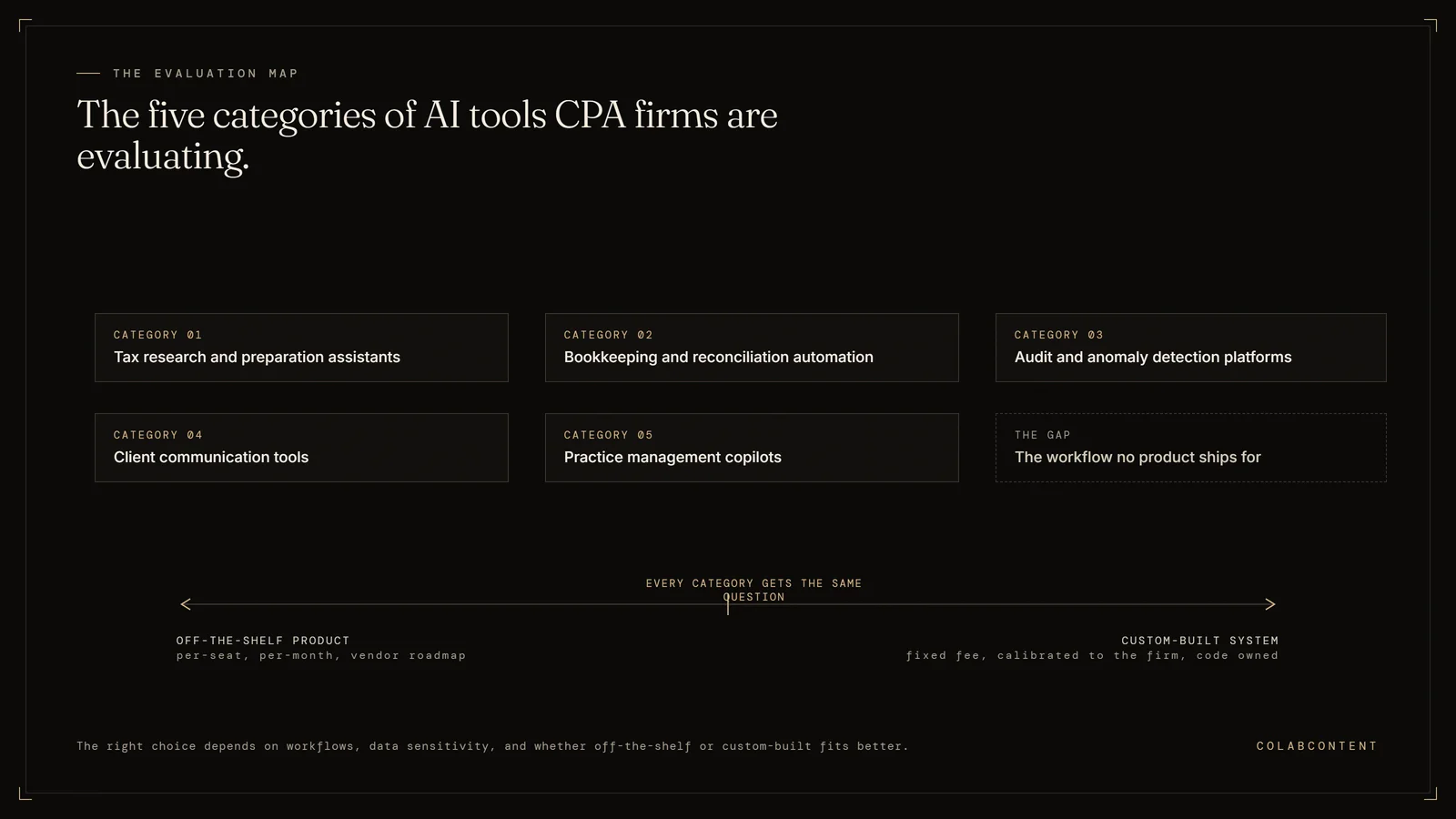
Diagram of the five categories of AI tools CPA firms evaluate: tax research and preparation, bookkeeping and reconciliation, audit and anomaly detection, client communication, and practice management, each weighed off-the-shelf versus custom-built
Tax planning is one category in a firm's stack. Price the category, not the brand.

Written for the firm that pays for Corvee today, or was about to. We do not sell tax planning software, we take no referral fee from anyone in the table below, and the honest finding on this page is that at the reported Corvee price band renting is cheaper than building for a long time.

ForCPA firms, roughly 5 to 15 preparers
Incumbent cost$10,000 to $15,000 a year, reported
Our fixed fee$45,000 to $180,000, one time
Bottom lineNo crossover at legacy pricing
Prices readAugust 27, 2026

The short answer.

If you are on Corvee and you came here because you heard the product was going away, you can stop worrying about that specific thing. It is not going away. Instead acquired it, the login still works, and the vendor's own page says your accounts, data, workflows and pricing are untouched. The thing worth worrying about instead is quieter and it is a pricing question: the flat annual licence that made Corvee easy to budget against has been folded into a company whose published model is a free base platform plus pay per credit usage, at a per credit rate nobody publishes. If your renewal is more than a few months out, the honest advice is to get your pricing assurance in writing with a date attached, and to know what the alternatives cost before that conversation rather than after it.

If you are shopping now rather than renewing, the verdict splits three ways and the split is about size. Small firms running a handful of plans a year should not be paying five figures for tax planning software at all, and TaxPlanIQ's lower tiers or a disciplined spreadsheet process will do the job. Firms billing tax planning as a real service line and paying inside the reported $10,000 to $15,000 band should shortlist TaxPlanIQ against Instead and negotiate, because at that spend level a custom build will not return its cost inside five years and we will show you the arithmetic that proves it rather than hide it. And firms whose actual spend has crept well above that band, because of multi entity work, state coverage, bundled modules, or plan volume that keeps forcing a tier upgrade, are the ones for whom ownership starts to make arithmetic sense as well as strategic sense. The calculator below finds the exact threshold for your numbers.

What happened to Corvee, in order.

Nobody has packaged this clearly in one place, which is why it is so hard to get a straight answer about it. Here is the sequence, with each item labelled by how well we can stand behind it.

Corvee was acquired by Instead. VERIFIED from instead.com/corvee, read on August 27, 2026. The page describes Corvee as now an Instead company, with the same team and the same platform.

The deal is dated April 2026. REPORTED. That date comes from trade press cited in our research queue, Yahoo Finance and CPA Practice Advisor, which we did not independently re-fetch on August 27. The acquisition is verified. The month is reported, and we are separating the two rather than blending them.

Existing customers are told nothing changes. VERIFIED as a quotation. Instead's page states that existing Corvee accounts, data and workflows remain exactly as they are, on the same login and the same credentials, and that your pricing stays the same. We are reporting that the vendor says it. We are not asserting it will hold indefinitely, because the page attaches no duration to it.

The old pricing page is gone. VERIFIED. corvee.com/pricing 301 redirects to instead.com/corvee. The tax planning plan page linked from that destination is marked Coming soon.

The operational brand is still alive. VERIFIED. app.corvee.com and corvee.com still resolve to a working login portal, and it was still serving on August 27, 2026. Marketing has moved. Operations have not.

Third party review coverage of the standalone brand is decaying. VERIFIED for the specific instance: softwareadvice.com's Corvee profile returned 404 on August 27, 2026, and a search aimed at aggregator coverage surfaced nothing current. This matters for a practical reason rather than a dramatic one. The pre-acquisition reviews that carried any pricing signal are getting harder to find, so the historical price band gets less checkable over time, not more.

Why firms are looking for an alternative.

Three patterns, and only one of them is really about the software.

The uncertainty itself. An acquisition creates a decision even when nothing breaks. Firms that spent a year building planning workflows on a tool now want to know whether they are building on a product with a five year future or a product being absorbed into a different commercial model. That is a reasonable question, and nothing the vendor has published so far answers it.

The price you cannot see. This is the sharpest issue and it is entirely verifiable. A firm shopping today cannot get a number without a sales call, because Instead publishes a free base platform and a pay per credit layer with no rate on it. Compare that with TaxPlanIQ, whose three tiers, per user add on rates, annual discount and contract term are all readable in about ten seconds. When two products are close on capability, the one whose paper you can read before the call has a genuine advantage.

The thing the firm needs is not a strategy library. Tax planning software solves one problem well: give the preparer a vetted catalogue of strategies and a way to turn one into a client deliverable. Plenty of the friction in a mid market firm sits elsewhere, in client document intake, in the review queue, in deadline tracking across entity types, in reconstructing what was actually promised to a client in March. No amount of licence spend on a planning tool touches any of that, which is worth knowing before you swap one planning tool for another and expect the calendar to change.

What you are actually paying

Every number on this page, with its source.

Two of the vendors below publish a complete, checkable rate card on their own website. Two publish nothing at all. One publishes a pricing model with the actual rate removed. We label each figure VERIFIED when it was read off the vendor's own page on August 27, 2026, and REPORTED when it came from a third party the vendor has not confirmed. One figure on this page is reported and could not be re-verified when we tried, and it is flagged in every place it appears rather than quietly promoted.

Vendor and planSold byPublished or reported priceContract termSource
Corvee, legacy pre-acquisitionAnnual licence, flat$10,000 to $15,000 a year, roughly $500 to $1,200 a month, federal only up to federal plus stateAnnual licence, enterprise styleREPORTED and weakly. Three third party pages carried this figure in our 2026-08-26 research read. On August 27 all three failed re-fetch: two returned 404, one returned 403. Not upgraded to verified. Use your own invoice.
Instead, existing Corvee customersUnchanged from legacyVendor states pricing stays the same. No duration given.Not stated on the pageVERIFIED as a quotation of instead.com/corvee, read August 27, 2026. Verified that the vendor says it, not that it is contractual.
Instead, new customersFree base platform plus pay per creditPlatform free, unlimited users, entities and e-file. Credit rate not published. Contact sales for volume pricing.Credits stated valid 12 monthsVERIFIED instead.com/pricing, read August 27, 2026. The verified finding is the absence of a rate.
Instead, tax planning plan pageNot yet publishedComing soonNot applicableVERIFIED instead.com/corvee plan link, read August 27, 2026.
TaxPlanIQ BasicPer firm, per month, 1 user$397 a month. Capped at 12 plans a year.12 month commitment regardless of billing frequencyVERIFIED taxplaniq.com/pricing
TaxPlanIQ StandardPer firm, per month, 2 users$697 a month, plus $35 per additional user. Unlimited plans.12 month commitmentVERIFIED taxplaniq.com/pricing
TaxPlanIQ GrowthPer firm, per month, 5 users$997 a month, plus $20 per additional user. Unlimited plans, scenario modelling and entity comparison.12 month commitmentVERIFIED taxplaniq.com/pricing
TaxPlanIQ annual billingDiscount on any tier15 percent off the monthly rateRequires annual prepayVERIFIED taxplaniq.com/pricing
Holistiplan Basic TaxPer year, scaled by household count$749 a year at 30 households, up to $11,049 a year at 75012 month term regardless of billing frequencyVERIFIED holistiplan.com/pricing
Holistiplan Premium TaxPer year, scaled by household count$1,499 a year at 30 households, up to $15,499 a year at 75012 month termVERIFIED holistiplan.com/pricing
Thomson Reuters Planner CSInside or alongside CS Professional SuiteNo public price exists. We are printing none rather than estimating one.Custom quotetax.thomsonreuters.com/en/planner-cs returned 404 on August 27, 2026, and no search surfaced a dollar figure from any source. Claim withheld.
Bloomberg Tax Income Tax PlannerNot evaluatedDeliberately left out. Its product page returned 403 and we found no alternate route, so we did not guess.Not applicableNo usable source. Excluded rather than filled in.
Commissioned build, ColabContentOne time fixed fee$45,000 to $180,000, scoped per firmNone. No renewal, no seat licence.Our own price, set after the diagnosis call. Not an external claim.

The one number we refuse to launder

The $10,000 to $15,000 a year figure for legacy Corvee is the most quoted number about this product and it is the weakest one on this page. It arrived in our research from three third party pages on August 26. When we went back on August 27 to confirm it against the primary sources before publishing, unclekam.com's cited pricing page returned 404, mavizontech.com's returned 404, and aeanet.org returned 403. A site restricted search of the first domain surfaced no indexed pages at all. Two further verification passes, one targeting first person dollar figures and one targeting aggregator pricing pages, surfaced nothing usable, and DuckDuckGo returned a CAPTCHA on both fallback attempts.

So we are doing the boring thing. The figure stays labelled reported everywhere it appears on this page, including inside the calculator defaults and the chart, and every model built on it is presented as a floor rather than a fact. If you are a current customer, the number on your invoice is worth more than every source in this paragraph combined, and the calculator has a field for it.

Normalise it: what a year actually costs

Per month, per year and per household pricing are not comparable until you convert them. Below is one year of each option at the tier a firm doing real planning work would actually buy, with annual billing applied where the vendor offers it.

Option and tierOne yearHow it is calculated
TaxPlanIQ Basic, annual billing$4,049$397 x 12 x 0.85. Capped at 12 plans a year.
TaxPlanIQ Standard, annual billing$7,109$697 x 12 x 0.85, two users included
Corvee legacy, low end of reported band$10,000Reported figure, federal only
TaxPlanIQ Growth, annual billing$10,169$997 x 12 x 0.85, five users included
Holistiplan Basic Tax at 750 households$11,049Published top of the Basic band
Corvee legacy, midpoint of reported band$12,000Midpoint used as the model default
Corvee legacy, top of reported band$15,000Reported figure, federal plus state
Holistiplan Premium Tax at 750 households$15,499Published top of the Premium band
Instead, new customerNot publishedFree platform plus an unpublished per credit rate. Cannot be calculated from public information.
Thomson Reuters Planner CSNot publishedSales quote only

Read that table honestly and the first thing it says is that the rented options in this category are not expensive by mid market software standards. The most expensive published annual figure on it is $15,499. That is the single most important context for everything below, and it is the opposite of what a page trying to sell you a six figure build would want you to notice first.

The three year and five year model

Now hold each path for three and five years. Rental costs are held flat with no escalator, because there is no published post-acquisition price to escalate from and inventing one would be exactly the sort of number this page refuses to print. The build side is the fixed fee once, plus a maintenance line at 15 percent of the build price a year, charged in every year of the horizon. That 15 percent is a software industry heuristic, not a ColabContent contract term, and the calculator lets you change it.

PathYear 13 year total5 year total
TaxPlanIQ Growth, annual billing$10,169$30,507$50,845
Stay on Instead at legacy midpoint, $12,000$12,000$36,000$60,000
Stay on Instead at top of reported band, $15,000$15,000$45,000$75,000
Holistiplan Premium at 750 households$15,499$46,497$77,495
Commissioned build at $45,000 plus 15% a year$51,750$65,250$78,750
Commissioned build at $100,000 plus 15% a year$115,000$145,000$175,000
Commissioned build at $180,000 plus 15% a year$207,000$261,000$315,000

The row we are obliged to point at is not the last one, it is the whole bottom half. At legacy Corvee pricing, a commissioned build loses the cost argument outright, and it loses it at every price we would quote. Our cheapest scope, $45,000, costs $78,750 over five years against $60,000 for staying put. It would not catch up until roughly year nine. At the $100,000 midpoint it is $175,000 against $60,000, which is not close and will not become close.

Three things flip that, and all three are checkable rather than rhetorical. First, spend level: a firm actually paying above about $15,750 a year crosses over against a $45,000 build inside five years, and a firm at about $35,000 a year breaks even against a $100,000 build at exactly year five, with anything above that crossing sooner. Second, a real escalator: no post-acquisition price is published, so if you set the escalator field above zero you are pricing in risk rather than reporting a fact, and the crossover moves in. Third, scope: if the build is replacing more than a planning tool, the comparison is not against one $12,000 subscription any more, and the honest way to test that is to add up every licence it would retire before you run the numbers. Absent one of those three, the correct advice is to keep renting, and we would say that on a call.

The crossover

Where the lines do, and do not, meet.

Cumulative spend, five years out, straight from the table above. Two rented paths: staying on Instead at the $12,000 legacy midpoint, and TaxPlanIQ Growth on annual billing at $10,169. Against them, a commissioned build at $100,000, the midpoint of our fixed fee range, paid once at year zero with 15 percent a year maintenance. Neither rented line is ever overtaken, which is the honest result and the reason this chart is on the page rather than in a drawer. The fourth line is the one that changes the answer: a firm whose real spend is $35,000 a year, which happens when planning work is bundled with other modules or when plan volume forces tier upgrades. That line meets the build line at exactly year five, at $175,000 on each path.

Cumulative five year cost: renting tax planning software versus a one time commissioned build A line chart of cumulative spend over five years for a mid-market CPA firm. Staying on Instead at the reported legacy midpoint of $12,000 a year rises in a straight line to $12,000, $24,000, $36,000, $48,000 and $60,000. TaxPlanIQ Growth on annual billing at $10,169 a year rises slightly lower, to $50,845 by year five. A commissioned build at $100,000 starts at $100,000 at year zero and rises by $15,000 of maintenance each year to $115,000, $130,000, $145,000, $160,000 and $175,000. The build line never falls below either rented line at any point in the five years, so there is no crossover at legacy pricing. A fourth line shows a firm whose real spend is $35,000 a year, rising to $35,000, $70,000, $105,000, $140,000 and $175,000, which meets the build line exactly at year five at $175,000. That is the threshold: a firm paying more than about $35,000 a year breaks even on a $100,000 build within five years, and a firm paying the reported legacy price does not. $0 $50K $100K $150K $200K Year 0 Year 1 Year 2 Year 3 Year 4 Year 5 Crossover, year 5, $175,000 Owned build starts at $100,000 A firm paying $35,000 a year Legacy pricing, $60,000 TaxPlanIQ Growth, $50,845 Stay on Instead, legacy $12,000 a year TaxPlanIQ Growth, $10,169 a year Owned build, $100,000 once, 15% maintenance A firm actually paying $35,000 a year

Most vendor comparison charts on the internet are drawn so the lines cross somewhere flattering. This one does not cross at all on the numbers most Corvee customers would enter, and that is the finding. A subscription at $12,000 a year is a genuinely cheap way to buy a strategy library, and no honest arithmetic turns $60,000 over five years into more than $175,000. If the only thing you care about is the five year sticker price at that spend level, close this page and go renegotiate your renewal.

What the chart also shows is where the answer changes, and it changes in one axis only: your actual spend. The dotted green line is not a hypothetical, it is the shape of a firm whose planning work is bundled into a larger platform bill, or whose plan volume has pushed it up two tiers, or that is running multi entity and multi state work at a level the entry tiers were never priced for. That firm hits break even on a $100,000 build at year five and is ahead every year afterward, because one line has a slope and the other is nearly flat. Below is the tool that finds your own number instead of ours.

Your firm, your numbers

The tax planning software total cost calculator.

Every default below is a figure from the table above, and every one is editable, because the defaults are a reported market estimate and your invoice is a fact. Nothing is submitted anywhere. There is no email gate, no external request and no stored value. The arithmetic runs in your browser and stops there. At the defaults it will tell you that renting is cheaper, because it is, and the most useful output on the tool is the break even line that tells you what you would have to be paying for that to stop being true.

Corvee legacy is reported at $10,000 to $15,000. Enter your actual invoice if you have it.
No published post-acquisition escalator exists. Above zero means you are pricing in risk, not reporting a fact.
Both totals are calculated over this horizon.
ColabContent fixed fee range, $45,000 to $180,000, set after the diagnosis call.
Software industry heuristic, not a ColabContent contract term. Replace it with a real quote before deciding.
The roundup

Seven options, in the order we would look at them.

One note on the roster before the list. Most of what is published about Corvee right now is either the acquirer's own page explaining the deal to worried customers or a vendor page nominating itself as the answer. Nobody has put the honest range in one place, which is unusual for a category this established. Here it is, starting with the option most comparison pages never lead with: do nothing.

1. Stay on Instead, if you are an existing Corvee customer

What it is. The default, and for a large share of readers the correct answer. The product you already use, under new ownership, with the same login.

Price. Unchanged, per the vendor. VERIFIED as a quotation from instead.com/corvee on August 27, 2026: your pricing stays the same, and existing accounts, data and workflows remain exactly as they are.

Best for. Any firm with working planning workflows built on Corvee that is not currently in price pain. The switching cost of a tax planning tool is not the licence, it is the strategy templates, the client deliverable formats and the muscle memory of the people using it. Ripping that out to make a point about vendor risk is more expensive than the risk.

Where it falls short. The assurance has no stated duration on it and it is not a contract term. It also sits on the same page whose tax planning plan link reads Coming soon, which means the acquirer has not published what this product will cost going forward. That is a real, named, currently unresolved uncertainty rather than a hypothetical one, and it is a reasonable thing to raise with your account contact in writing.

Verdict. Stay, for now, and get the pricing assurance dated in writing before your next renewal.

2. Instead, as a new customer

What it is. The same platform, bought fresh, on the acquirer's commercial model rather than Corvee's old one.

Price. VERIFIED from instead.com/pricing on August 27, 2026, and the verified part is the shape rather than the amount. The base platform is free with unlimited users, entities and e-file. The tax research, planning and drafting work runs on a pay per credit layer. No per credit rate is published, credits are stated to be valid for 12 months, and volume pricing is handled by contacting sales.

Best for. Firms that specifically want the Corvee strategy engine and are prepared to run a sales process to find out what it costs. Also worth noting fairly: Instead's own page claims 1,500 plus tax planning strategies across all entity types and more than $5 billion in client tax savings identified. Those are vendor marketing claims on the vendor's own page, we did not audit either one, and we are repeating them as claims rather than as facts.

Where it falls short. You cannot budget for it from public information, which is the entire problem this page exists to name. A free base platform with metered usage is a fine model, but it converts a predictable annual line item into a variable one whose unit rate you cannot benchmark against anything.

Verdict. Proceed with caution, and get the quote in writing before assuming anything resembling legacy pricing applies to you.

3. TaxPlanIQ

What it is. The most directly feature comparable rented alternative to what Corvee used to sell standalone. A CPA vetted strategy library, an AI assistant branded jAIne, guided 45 day onboarding, and a recurring group coaching layer that is a genuine part of the value for firms building a planning service line from scratch.

Price. VERIFIED from taxplaniq.com/pricing on August 27, 2026. Basic is $397 a month for one user and caps you at 12 plans a year. Standard is $697 a month for two users with unlimited plans and $35 a month per additional user. Growth is $997 a month for five users with unlimited plans, $20 a month per additional user, and scenario modelling, entity comparison and an ROI guarantee added. Annual billing takes 15 percent off any tier, which puts Growth at $10,169 a year.

Best for. A firm that wants Corvee's category of tool without the brand transition question hanging over it, that values the coaching and community layer, and that wants a number it can read before a sales call.

Where it falls short. Read the term before you sign. All three tiers carry a stated 12 month commitment regardless of billing frequency, so the monthly price is a payment schedule rather than an exit. The 12 plan cap on Basic is also the kind of limit that quietly forces a tier upgrade in year two, which is worth modelling at your real plan volume rather than your current one. And structurally it is the same purchase shape as Corvee: rent, forever, on someone else's roadmap.

Verdict. The best like for like swap on this page, and the cheapest credible answer for most readers. It solves the price opacity and the transition anxiety. It does not solve renting.

4. Holistiplan

What it is. A scanning tool. It reads existing 1040s at scale and surfaces planning opportunities across a book of individual clients, which is a genuinely excellent thing to own if that is the job you have.

Price. VERIFIED from holistiplan.com/pricing on August 27, 2026. Basic Tax runs $749 a year at 30 households up to $11,049 a year at 750 households. Premium Tax runs $1,499 a year at 30 households up to $15,499 a year at 750. Both are on a stated 12 month term regardless of payment frequency.

Best for. Wealth management practices, registered investment advisers, and CPA firms whose planning work really is 1040 review across a large individual book.

Where it falls short. It is named in the same breath as Corvee constantly and it is usually the wrong comparison. Corvee's five figure tier was sold for entity structuring and multi year business tax strategy. Holistiplan is built around the individual return. If your planning work is S corporation elections, entity restructuring, multi state apportionment and owner compensation strategy, this tool is not a replacement and switching to it will feel like a downgrade because it is one for that job.

Verdict. Excellent at its actual job. Disqualified for most Corvee buyers, and we would rather say that than pad the roster.

5. Thomson Reuters Planner CS

What it is. The enterprise suite answer, sold inside or alongside the CS Professional Suite that many mid market firms already run for compliance.

Price. Not published, and we are printing no number. tax.thomsonreuters.com/en/planner-cs returned 404 on August 27, 2026, and no search surfaced a dollar figure from any source we would stand behind. The absence is the finding. Enterprise tax suite vendors routinely gate price behind a sales conversation, and that gate is itself a legitimate reason a firm might prefer a fixed, quoted, one time number.

Best for. Firms already paying for UltraTax CS or GoSystem Tax that want one vendor, one contract and one support path, and that do not mind the opacity.

Where it falls short. Same problem as Instead's new customer model, from a different direction. You cannot evaluate it against anything on this page without a sales cycle, and the integration advantage only exists if you are already inside that ecosystem.

Verdict. Worth a call only if you are already a CS Professional Suite firm. Otherwise the opacity is not worth the effort.

6. Spreadsheets plus a general AI assistant

What it is. The cheapest possible answer, and it belongs on this page precisely because a page selling builds would leave it off. A well built model in a spreadsheet, plus a general assistant for research and drafting, at no cost beyond a subscription the firm probably already has.

Price. Effectively nothing incremental.

Best for. A solo practitioner or a very small shop running two or three plans a year, or a firm testing whether clients will actually pay for planning before committing to software for it. This is a real answer and it is the right one more often than the software category admits.

Where it falls short. The moment tax planning becomes a billed, repeatable service line, this stops working, and the failure modes are the ones that matter in a regulated profession. No audit trail. No version history on a strategy you delivered to a client eighteen months ago. No vetted, sourced strategy library, and a general purpose model is not a substitute for CPA reviewed positions with authority behind them. It also puts client tax return information into whatever tool the preparer happens to open, which is a Section 7216 conversation your firm should have deliberately rather than by accident.

Verdict. Right for a firm testing the service line. Wrong the day you invoice for it.

7. A commissioned build you own

What it is. Not a clone of Corvee. A system built around your firm's actual planning workflow, the entity types you serve, the strategies you actually run, the deliverable format your clients already recognise, and the integration into whatever tax prep stack you keep. Owned by the firm at handoff, running in the firm's own cloud tenant.

Price. A fixed fee of $45,000 to $180,000, set after a free 45 minute diagnosis call and after integration depth is named, paid in two instalments at build start and handoff. Maintenance modelled at 15 percent a year as an industry heuristic rather than a standing contract term.

Best for. Firms whose real annual spend on this category has crept well past the reported legacy band, firms running enough plan volume that per plan caps and tier upgrades keep biting, and firms that want the planning logic to be an owned asset rather than a renewal. It also needs a named person internally willing to own the system, which is not a formality.

Where it falls short. On cost, at the price band most readers of this page are in, and we have already shown the arithmetic twice. Below roughly $15,750 a year of real spend, our cheapest scope does not return its cost inside five years. It is also a bigger single cheque, it needs a tighter scope than buying software does, and it takes longer to arrive than a signup form.

Verdict. The only option on this list where the bill stops going up, and the wrong option for a firm paying $12,000 a year. Both of those are true at the same time.

The ownership case

Eight arguments for owning it, and where each one stops.

Every argument below is either arithmetic you can check on this page or a structural fact about the two models. Where an argument does not honestly apply to your firm, we say so inside the argument rather than in a footnote, and the section after this one is six situations where all of them fail at once.

One. The math, restated honestly. A subscription never ends. Staying on Instead at the reported legacy midpoint is $36,000 over three years and $60,000 over five, and year six starts again from zero. A $100,000 build is $145,000 over three and $175,000 over five, and year six adds $15,000. The slope is the whole argument, and at $12,000 a year the slope is not steep enough for it to win inside five years. It wins at year five for a firm paying $35,000, at year five for a $45,000 build against a firm paying $15,750, and at roughly year nine for a $45,000 build against a firm paying $12,000. Those four numbers are the entire financial case, stated at full strength and no further.

Two. Usage pricing taxes the thing you want more of. Instead's published model is a free platform with metered credits. Every plan you run has a marginal cost, which means the firm has a small financial reason not to run one more plan, at exactly the moment a planning service line needs volume to become profitable. TaxPlanIQ's Basic tier does the same thing more bluntly with a 12 plan annual cap. An owned system has no per plan cost at all, so the question stops being what each plan costs to produce and becomes what each plan is worth to the client.

Three. Asset versus expense. A subscription is rent and it leaves nothing behind. A commissioned build is a piece of the firm: transferable, on the balance sheet rather than only on the expense line, and a real item in a merger or succession conversation. For a partner group thinking about a five to ten year horizon, that difference is not cosmetic. For a firm with a two year horizon it is irrelevant, and we would not lead with it.

Four. Built around your workflow rather than the median firm's. Every product in the roundup is calibrated against the average customer in its category. You pay for the whole bundle and adapt your process to the part of it you use. A commissioned system starts from your entity mix, your review hierarchy and the deliverable format your clients already read. Nobody gets retrained into somebody else's assumptions about how a planning engagement should run.

Five. AI at the core rather than metered on top. This one is concrete rather than rhetorical, because the pricing pages say it. Instead sells the research, planning and drafting work as a credit layer on top of a free platform. TaxPlanIQ bundles its assistant into tiers that step up in price. Either way the intelligence is the thing being metered. In a commissioned build the AI is the system, there is no separate AI line, and adding a preparer costs nothing.

Six. Unlimited seats. Preparers, reviewers, seasonal staff during compliance season, and where appropriate the client themselves. Zero marginal cost per person changes the question from who needs a licence to who needs access, which is a better question and one that seasonal firms in this profession ask every January.

Seven. Data ownership and no exit negotiation. Your client data, your strategy library, your export path, in your own tenant, under an agreement you wrote. This one carries specific weight in a CPA firm because the data in question is client tax return information, and the scope of who may use and disclose it under IRC Section 7216 is a decision your firm should be making deliberately rather than inheriting from a vendor's terms of service. Owning the system means that scope is a document you author.

Eight. Vendor risk you stop carrying. This page is itself the example. A tax planning product with an installed base of firms was acquired, its pricing page now redirects to the acquirer, the successor's plan page reads Coming soon, and the third party review coverage that would let a buyer research it independently is thinning out. Nothing has broken for existing customers and we are not going to pretend it has. But every firm on that product is now waiting on somebody else's pricing announcement, and a system you own does not get acquired.

What we can actually prove

Arguments are worth what the evidence behind them is worth, so here is ours with nothing rounded up, and one honest limitation stated first. We have not built a tax planning strategy engine, and we have not migrated anybody off Corvee. If a firm on this page needs a reference from an identical engagement, we do not have one and will say so on the call rather than reach for an adjacent story.

What we do have is delivery evidence in professional services firms with the same shape of problem. Jim Glaser Law is our nameable reference and the principal takes reference calls. The LELF platform is the fullest example of what a commission looks like at real operational volume: a 47-attorney litigation firm runs its matter, invoice and trust operation on it, holding 13,296 matters, 4,396 clients and 5,684 invoices, with trust reconciled byte identical against the system it replaced. That firm is under confidentiality and stays anonymised, which is why we name the platform and not the firm. Across our practice we have handled more than 6,000 AI handled calls and delivered more than forty commissions.

What that evidence supports is a specific claim: we can build a system that carries real operational volume inside a professional services firm and reconciles to the penny under audit. What it does not support is any claim about tax planning strategy content, and that is the part of a Corvee replacement that would need your firm's own subject matter expertise driving the scope rather than ours.

The honesty section

Who should stay on Corvee, Instead, or SaaS generally.

Six situations where every argument in the previous section fails, and where we would tell you to stay put on a call. On this particular page the first one covers most readers, which is not the usual outcome and we are not going to bury it.

Firms paying inside the reported legacy band. If your real annual spend on tax planning software is $10,000 to $15,000 a year, the arithmetic does not work and it does not get close. Our cheapest scope costs $78,750 over five years against $60,000 for staying at the midpoint. Below about $15,750 a year, no build we would quote returns its cost inside five years. Renegotiate at renewal and spend the energy on something else.

Existing Corvee customers whose workflows work. Instead states your pricing, accounts and workflows are unchanged. If nothing is broken and nothing has moved on your invoice, doing nothing this year is a legitimate strategy, not procrastination. Put a calendar reminder on your renewal date and revisit then.

Firms building a planning service line from scratch. If you do not yet know which strategies your client base actually needs, you cannot scope a system around them, and you would be paying us to make guesses you are better placed to make. Buy TaxPlanIQ or stay on Instead, run eighteen months of real engagements, and let the pattern show up in your own data first. The coaching layer TaxPlanIQ bundles is genuinely useful at that stage and we do not offer an equivalent.

Firms that need a working tool this quarter. A commissioned build ships a working prototype in seven to ten days and production in five to seven weeks. A signup form is faster than that and it is not close. If the deadline is real and near, buy.

Firms where nobody will own the system internally. An owned build needs a named person who cares about it, even at a light touch. Firms without that person are better off renting, because the alternative is an orphaned system that decays quietly and nobody notices until compliance season.

Firms whose constraint is not the planning tool at all. If the hours are leaking in document intake, review bottlenecks or client chasing, changing planning software is motion rather than progress. A meaningful share of the diagnosis calls we run end with us recommending the firm keep what it has, and this is the most common reason.

Decision tree

Six questions, in order, with stop points.

1. Are you an existing Corvee customer whose invoice has not changed and whose workflows work? If yes, stop here for now. Instead's own page says nothing changes. Ask your account contact for the pricing assurance in writing with a date on it, put your renewal in the calendar, and come back to this page ninety days before it. If no, continue.

2. Do you know your actual annual spend on this category, including any bundled modules? If no, stop and go find the invoice and the order form. Every decision after this one depends on it, and the reported band on this page is a substitute for that document rather than a replacement for it. If yes, continue.

3. Run your number in the calculator above. Is your annual spend below about $15,750? If yes, stop. No build we would scope returns its cost inside five years at that spend level. Shortlist TaxPlanIQ against your current tool, negotiate, and move on. If no, continue.

4. Is what you actually need a strategy library, or a workflow? If it is the library, meaning vetted strategies, calculations and client deliverables, then a rented tool is genuinely the right shape of purchase and TaxPlanIQ or Instead is where to look. Stop here and go price them. If it is a workflow that no vendor sells, continue.

5. Can you name that workflow in one sentence, with a rough dollar or hour figure attached? If no, stop, and spend two weeks measuring before anyone spends money. Every failed build we have seen started with an unnamed constraint. If yes, continue.

6. Is a $45,000 to $180,000 fixed fee real this year, and is a partner willing to spend 45 minutes on the diagnosis? If no, park it and revisit at renewal. If yes, that call is the next step, and a meaningful share of them end with us telling a firm to stay where it is.

Next step

Book the 45-minute diagnosis.

Bring your invoice and one sentence describing the workflow that leaks. We will run your real numbers against the model on this page and tell you honestly whether the answer is renegotiate, switch, or build. On this particular comparison the honest answer is often renegotiate.

Free · 45 minutes
Under NDA
Partner to partner
No follow-up unless asked
Migration reality

What leaving Corvee actually involves.

Almost nobody writing about this category answers this, which is strange, because it is the question that decides whether a firm ever acts on any of the rest. The good news for this specific product is that the answer is smaller than it is for most software categories. Tax planning software is not a system of record. It does not hold your general ledger, your returns or your client files. That makes leaving materially easier than leaving a practice management platform or a document system, and pretending otherwise would inflate a problem to sell a solution.

You are moving four things, and only one of them is the software's. The client plans you have already produced and delivered, which mostly exist as finished documents you already hold. The strategy templates and assumptions your firm has customised inside the tool, which is the part that actually took time to build and the part nobody thinks about until they leave. Any client facing deliverable formatting your clients now recognise. And the scenario inputs behind live, in progress planning engagements, which are the ones that hurt if you switch mid engagement.

Phase one: export and inventory, and do it before you decide anything. Export every produced plan and every customised template while your account is unquestionably active. This is worth doing even if you intend to stay, because it is the cheapest possible insurance against a future pricing conversation going badly. Ask specifically what export formats are available and whether templates come out in a form you can read outside the product, because that answer varies by vendor and it is the difference between an export and a screenshot.

Phase two: parallel run through one full planning cycle. Do not switch tools mid engagement. Run new engagements in the new system and finish existing ones where they started, through at least one complete planning cycle, so gaps surface while you can still go back. In this category the gaps show up as a strategy you used to run in three clicks that now takes an afternoon, and you only find those by doing the work rather than by evaluating a demo.

Phase three: cancel, on the calendar rather than in the moment. Read the term. TaxPlanIQ's tiers carry a stated 12 month commitment regardless of billing frequency and Holistiplan's carry a 12 month term, so an annual contract in this category will renew during a switch if nobody sends the notice. Whatever your current Corvee or Instead order form says about notice periods is the document that matters, not anything on this page.

A realistic total is one planning cycle, not a quarter of project time. This is a genuinely low switching cost category compared with the rest of a firm's stack, and the honest implication of that cuts against us as much as for us: because leaving is cheap, the case for owning has to rest on economics and control rather than on lock-in fear. That is why the arithmetic sections on this page are as blunt as they are.

The option most firms do not consider. You do not have to leave to fix the problem. In a large share of the cases we see, the planning tool is fine, the licence is defensible, and the leak is in a workflow beside it: intake, document chasing, review routing, deadline tracking across entity types. That path keeps your planning tool, keeps the strategy library, and builds the missing piece around it. No migration, no parallel run, no cancellation letter.

Deep dive

The dimensions the price table cannot show.

Six dimensions, side by side.

Price transparency. TaxPlanIQ and Holistiplan publish complete rate cards including contract terms. Instead publishes a pricing model with the rate removed. Thomson Reuters publishes nothing and its Planner CS page 404s. Transparency is not the same as cheapness, but an undisclosed price lets the seller quote against the buyer rather than against the work, and in this category that gap is unusually wide.

Contract term. Both vendors that publish a price also publish a 12 month commitment on every tier regardless of billing frequency, which is honest of them and worth reading before the monthly headline number does its job on you. Instead states credits are valid 12 months. A commission has no term at all because there is nothing to renew.

Cost slope. Every subscription here rises with users, households or plan volume. A commissioned build is a one time fee plus a flat maintenance line. The slope, not the starting point, decides a five year comparison, and at the price levels in this category the starting point wins for a long time.

Switching cost. Genuinely low, and lower than most software categories, because none of these tools is a system of record. That cuts against the ownership argument and we would rather say so than let a reader discover it later.

Client data scope. Every option here handles client tax return information, which puts IRC Section 7216 use and disclosure questions on the table regardless of which one you choose. The difference is who writes the scope: a vendor's terms of service, or your firm.

Vendor risk. The live example is the subject of this page. An acquisition has not broken anything for existing customers, and it has still left every one of them waiting on a pricing announcement that has not arrived. That is the risk in its ordinary, undramatic form.

When to pick which, in one paragraph each.

Stay on Instead if you are an existing Corvee customer, your invoice has not moved, and your workflows work. Get the pricing assurance dated in writing and revisit at renewal.

Buy Instead as a new customer if you specifically want the Corvee strategy engine and are willing to run a sales process to discover the price. Get the per credit rate and a volume commitment in writing before you sign anything.

Buy TaxPlanIQ if you want a published price, a strategy library and a coaching layer, and you can live with a 12 month term. Model your real plan volume against the tier caps before you pick a tier.

Buy Holistiplan only if your planning work is 1040 review across a large individual or advisory book. If your work is entity level, this is the wrong tool and price is not the reason.

Call Thomson Reuters only if you already run CS Professional Suite and consolidation onto one contract is worth the sales cycle.

Commission a build if your real annual spend is well above the reported legacy band, the constraint is a named workflow rather than a strategy library, and someone at the firm will own the system after handoff. Most firms reading this page do not meet all three, and that is a fine outcome.

Why this page is written by someone who does not sell tax planning software.

Worth saying plainly, because it should change how you read everything above. ColabContent sells commissioned AI builds. We do not sell a tax planning product, we take no referral fee from anyone in the roundup, and we have no commercial reason to steer you toward or away from any of them. That does not make us neutral about the conclusion, obviously. What it does mean is that when this page says a $100,000 build costs nearly three times what staying put costs over five years, or that Holistiplan is the wrong tool for most of the people reading this, nothing commercial is pulling in the other direction.

It is also worth naming what this page is not. It is not a review of the software. We have not run a planning engagement in Corvee, Instead, TaxPlanIQ or Holistiplan, and every capability description here comes from the vendor's own published material rather than from hands on use. What we did was read the pricing pages on August 27, 2026, do the arithmetic, and refuse to print figures we could not stand behind. If you want a product review, the review sites are a better source than us, with the caveat that coverage of the Corvee brand specifically is thinning out post-acquisition.

What a build in a CPA firm actually looks like.

Three shapes come up repeatedly, and they share a property: none of them is a strategy library problem, which is why swapping planning tools does not touch them.

Intake and document chasing. Knowing which client is missing which document, for which entity, at which deadline, and chasing it without a human writing the email. This is the workflow with the clearest hour figure attached and the one that hurts most between January and April.

Review routing with the firm's own standards encoded. Not generic review software, but the specific things your reviewers actually check, applied consistently, with the exceptions surfaced rather than the whole file re-read.

Planning delivery around your own templates. If your firm has already built its own strategy positions and its own client deliverable format, the value of a rented library drops and the value of a system that produces your deliverable from your inputs rises. This is the only one of the three where a build genuinely overlaps what Corvee sold, and it is the one that needs your subject matter expertise driving scope rather than ours.

The integration posture is read and suggest by default, human in the loop, relaxing only after a sustained period of held output quality. Integration happens at the documented API layer as the primary route, and scoping starts with mapping where client tax return information actually lives and what Section 7216 obligations attach to moving it, before any tooling decision is made. We do not replace your tax preparation software and we do not author tax positions.

Questions

The eight questions Corvee customers actually ask.

Is Corvee still available, or has it shut down?

It has not shut down. Corvee is now part of Instead, and the login portal at app.corvee.com was still live when we checked on August 27, 2026. Instead's own acquisition page states that existing Corvee accounts, data and workflows remain exactly as they are, on the same login and the same credentials. What has changed is where the product is marketed and how a new buyer gets a price: corvee.com/pricing now 301 redirects to instead.com/corvee, and the tax planning plan page linked from there is marked Coming soon. So the accurate answer to the shutdown question is no, and the accurate follow up question is not whether the software still runs but what a new customer will be charged for it, which nobody has published yet.

What happened to Corvee tax planning software?

Corvee was acquired by Instead. The acquisition itself is confirmed on Instead's own site, which we read on August 27, 2026 and which describes Corvee as now an Instead company with the same team and the same platform. The April 2026 date for the deal comes from trade press cited in our research queue, Yahoo Finance and CPA Practice Advisor, which we did not independently re-fetch on August 27, so we label the acquisition itself verified and the date reported. Two secondary effects are worth knowing. Marketing has moved to instead.com while the operational brand stays alive for existing customers, and third party review site coverage of the standalone Corvee brand is thinning out: the Software Advice profile for Corvee returned 404 on the day we checked. That matters because the handful of pre-acquisition reviews that carried any pricing signal are getting harder to find, not easier.

Corvee vs Instead: what is actually different now?

There is no versus. Instead owns Corvee, so this is one company and, per Instead's own page, one platform. The real difference is not product, it is commercial model. Corvee was sold as an annual licence at a flat five figure number. Instead's published model is architecturally different: the base platform is free with unlimited users, entities and e-file, and the tax research, planning and drafting work runs on a pay per credit layer with volume pricing handled by contacting sales. No per credit rate is published anywhere we could find on August 27, 2026. For an existing Corvee customer that difference is currently invisible, because Instead states that existing pricing stays the same. For a firm shopping today it is the whole story, because the flat annual number that made Corvee easy to budget against has been replaced by a model you cannot cost out from public information.

Will my Corvee pricing change now that Instead owns it?

Instead says no. The exact words on instead.com/corvee, read on August 27, 2026, are that your pricing stays the same. We are reporting that as a verified quotation of the vendor's own page and nothing more, because two things it does not do are worth naming. It does not state a duration, so it is a statement of current intent rather than a contractual term with an end date attached. And it sits on the same page whose own tax planning plan link reads Coming soon, which means the company making the promise has not yet published what the product will cost going forward even to its own new customers. The practical move is unglamorous: find your order form, check what your renewal mechanics actually say, and get any pricing assurance in writing with a date on it. That document is worth more than any statement on a marketing page, ours included.

How much does Corvee tax planning software actually cost?

Nobody publishes it today, and we want to be precise about how weak the historical number is. The figure circulating for the pre-acquisition product is $10,000 to $15,000 a year, roughly $500 to $1,200 a month, scaling from federal only up to federal plus state. That figure entered our research from three third party pages, and when we tried to re-fetch all three on August 27, 2026 to confirm them, every one failed: two returned 404 and one returned 403, and a site restricted search surfaced no indexed pricing page from the first domain at all. So we are labelling it reported, we could not upgrade it to verified, and we would not build a decision on it. The number that is verified is the absence of one. corvee.com/pricing redirects to instead.com/corvee, the tax planning plan page there says Coming soon, and Instead's platform pricing page publishes no per credit rate. If you are already a customer, your invoice is the only real number in this paragraph. Use it in the calculator on this page instead of ours.

What are the best alternatives to Corvee for CPA firms doing tax planning?

Six, and the honest first one is staying put. If you are an existing Corvee customer whose workflows work and whose invoice has not moved, Instead's own statement is that nothing changes, and ripping out a working system to make a point is the most expensive option on this list. As a new customer, Instead is still the closest thing to the original product, with the caveat that you cannot price it without a sales call. TaxPlanIQ is the most directly feature comparable rented alternative with a real published price, $397 to $997 a month across three tiers, all carrying a stated 12 month commitment. Holistiplan is frequently named in the same breath and is usually the wrong tool, because it is built around scanning existing 1040s at scale for an advisory book rather than doing entity level business tax strategy. Thomson Reuters Planner CS is worth a look only if you already live inside the CS Professional Suite, and you will not get a price without a sales conversation. Spreadsheets plus a general AI assistant is fine for a solo running two or three plans a year and wrong the moment you bill planning as a service line. The seventh option, which no software vendor will put on its own comparison page, is commissioning the system and owning it outright.

Is TaxPlanIQ a good replacement for Corvee?

It is the closest like for like swap on this page, and it is the one whose price you can actually read before a sales call. Verified from taxplaniq.com/pricing on August 27, 2026: Basic is $397 a month for one user with a 12 plan per year cap, Standard is $697 a month for two users with unlimited plans and $35 for each additional user, and Growth is $997 a month for five users with unlimited plans, $20 for each additional user, and scenario modelling and entity comparison added. Annual billing saves 15 percent. The catch is on the same page and you should read it before you sign: all three tiers carry a stated 12 month commitment regardless of how you choose to be billed. So the honest framing is that TaxPlanIQ solves the brand transition anxiety and the price opacity, and it does not solve the thing underneath both of them, which is that you are signing another annual contract for a system you will never own. On pure dollars it is cheaper than the reported legacy Corvee band: Growth on annual billing works out to $10,169 a year, which is $30,507 over three years.

Does a custom built tax planning tool actually cost less than Corvee or Instead over time?

At the price band most Corvee customers are in, no, and we are not going to pretend otherwise on our own page. Run it. Legacy pricing at the $12,000 midpoint of the reported band is $36,000 over three years and $60,000 over five. A build at the midpoint of our fixed fee range, $100,000, plus the 15 percent a year maintenance heuristic, is $145,000 over three years and $175,000 over five. Even the cheapest build we would scope, $45,000, is $65,250 over three years and $78,750 over five, so it still loses on straight dollars against a $12,000 a year subscription, and it would not catch up until about year nine. The arithmetic only flips in specific, checkable situations. A firm whose real annual spend is above about $15,750 crosses over against a $45,000 build inside five years. A firm at about $35,000 a year breaks even against a $100,000 build at exactly year five, and anything above that crosses sooner. Below those thresholds the reasons to own are ownership, no renewal term, no exposure to an unpublished future price, and a system shaped to your firm, and none of those are a lower five year sticker price. If a vendor tells you a custom build is always cheaper, ask them to show you this table.

Buyer worksheet

What to have in front of you before any call.

Five things to pull before you talk to anyone.

One. Your actual invoice, and your order form. Not the reported band on this page. The order form is where the term, the renewal mechanics, any escalator and the notice period live. Every reported figure here is a substitute for that document and a worse one.

Two. Your real plan volume, last twelve months. How many plans did the firm actually produce, and for how many distinct entities? Tier caps in this category are per plan, so this number decides which tier you are really buying, not the one on the pricing page you liked.

Three. Your entity mix. How much of your planning work is individual 1040 review versus entity level structuring? That single split determines whether Holistiplan belongs on your shortlist at all, and it is the fastest way to disqualify half the roster.

Four. Every other licence this would touch. If a build would retire more than one subscription, the comparison on this page understates its case. If it would retire none, the comparison is accurate as written.

Five. One sentence naming the workflow that leaks, with an hour or dollar figure. If you cannot write that sentence, no vendor on this page can help you, and neither can we.

Five questions to ask every vendor, including us.

What is the term, and what happens at renewal? In this category the answer is usually 12 months regardless of how the price is displayed. Ask for the escalator in writing. A vendor that will not commit one to paper has told you something.

What is the total in year three, not month one? Make them do the arithmetic at your real plan volume with their own assumptions. Compare it to what the calculator on this page produced.

What exactly comes out at the end, and in what format? Ask specifically about customised strategy templates, not just produced plans. Templates are the part firms discover they cannot export, and they are the part that took the time to build.

How is client tax return information used, stored and disclosed? Get the Section 7216 posture in writing, including any sub-processors and any model training use. This is a question every option on this page should be able to answer in a paragraph.

Can we speak to a firm you did this for? Then ask that firm three things: what the constraint was, what the system does now, and whether they would do it again. Our answer is Jim Glaser Law, and the principal takes reference calls, with the caveat we state plainly elsewhere on this page that it is a law firm rather than a CPA firm.

When not to buy from us.

Do not commission a build if your real annual spend on this category is inside the reported $10,000 to $15,000 band. The arithmetic on this page is not close, and we will tell you that on the call rather than take the engagement.

Do not commission a build if what you want is the strategy library itself. Vetted, sourced, maintained tax strategy content is what these products sell and it is not what we build. Buy the library.

Do not commission a build if you are still working out whether clients will pay for planning at all. Rent something cheap, run eighteen months, and let your own data tell you what to build later.

Do not commission a build if nobody at the firm will own the system after handoff. An owned system with no internal owner decays, and that outcome is worse than renting.

Do not commission a build if you need an identical reference. We have not built a tax planning engine and we have not migrated anyone off Corvee. Our references are adjacent professional services firms, and if that is not enough for your partner group, it is a reasonable objection and we would rather you raise it now.

Sources, with dates and labels.

All fetched on August 27, 2026 unless noted. VERIFIED means read directly off the vendor's own page. REPORTED means a third party published it and the vendor has not confirmed it.

VERIFIED instead.com/corvee (acquisition, the unchanged-accounts and unchanged-pricing statements, the Coming soon plan link, the 1,500 plus strategies and $5 billion savings marketing claims, repeated here as vendor claims rather than audited facts). instead.com/pricing (free base platform, pay per credit model, no published rate, 12 month credit validity). corvee.com/pricing (301 redirect to instead.com/corvee). app.corvee.com and corvee.com (login portal still live). taxplaniq.com/pricing (three tiers, per user add-ons, 15 percent annual discount, 12 month commitment). holistiplan.com/pricing (Basic and Premium bands by household count, 12 month term).

REPORTED Corvee legacy pricing of $10,000 to $15,000 a year, roughly $500 to $1,200 a month, from three third party pages in our 2026-08-26 research read. Re-fetch attempted August 27 and failed on all three: two 404, one 403, plus a site restricted search returning no indexed pages. Not upgraded. The April 2026 acquisition date, from Yahoo Finance and CPA Practice Advisor as cited in our research queue, not independently re-fetched.

Claims we withheld. No price is printed for Thomson Reuters Planner CS, whose product page returned 404 and for which no source published a figure. Bloomberg Tax Income Tax Planner was left out of the roster entirely rather than guessed at, because its product page returned 403 and no alternate route was found. No per credit rate is printed for Instead because none is published. No escalator is assumed on any rented path, because no post-acquisition price exists to escalate from.

Our own numbers, labelled as such. The $45,000 to $180,000 fixed fee is our price, not an external claim. The 15 percent a year maintenance figure is a software industry heuristic, not a ColabContent contract term, and every model on this page charges it in every year of the horizon, which is the conservative direction. No internal administration or staff time line is modelled on either side, which is a stated simplification rather than a hidden cost.

Bring your invoice.

Free 45-minute diagnosis, under NDA. We will run your real numbers against the model on this page and tell you honestly whether the answer is renegotiate, switch, or build. On this comparison specifically, the honest answer is often renegotiate, and we would rather say that than sell you something the arithmetic does not support.