Home/ Comparisons/ Plex ERP Alternatives

Plex ERP Alternatives for Manufacturers: 8 Options, Priced

There are seven credible alternatives to Plex Manufacturing Cloud for a discrete or job shop manufacturer: DELMIAWorks, the product formerly sold as IQMS; Acumatica; Fulcrum; ProShop ERP; Katana MRP; MRPeasy; and Odoo Manufacturing. The eighth option is the one most buyers never price and no ERP vendor will put on its own comparison page, which is commissioning the system your shop actually needs and owning it outright, one fixed fee, no per seat licence, no renewal increase. Plex publishes no rate card. The one figure we could read directly is SelectHub's, which lists Plex Manufacturing Cloud starting at $500 per user per month, and that sits inside a wider reported band of $300 to $650. Run the verified rate through fifteen named seats and the subscription alone is $90,000 a year, which is $310,000 over three years and $490,000 over five once a labelled $40,000 implementation assumption is added. A commissioned build at the midpoint of our $45,000 to $180,000 range is $139,500 over three years and $166,500 over five, and the two cumulative lines cross at about month ten. That crossover is not universal. At five seats, or at the bottom of the reported rate band, the build can lose outright, and this page prints those cases with the same prominence as the winning ones. The calculator further down will run the arithmetic on your invoice instead of ours.

A note on the name, because two unrelated products share it. This page is about Plex Manufacturing Cloud, also marketed as the Plex Smart Manufacturing Platform, which is enterprise software for discrete manufacturers. It is not about the Plex media server, which is an unrelated consumer product from an unrelated company. If your shop pays a Plex invoice for shop floor software, this is the comparison you want.

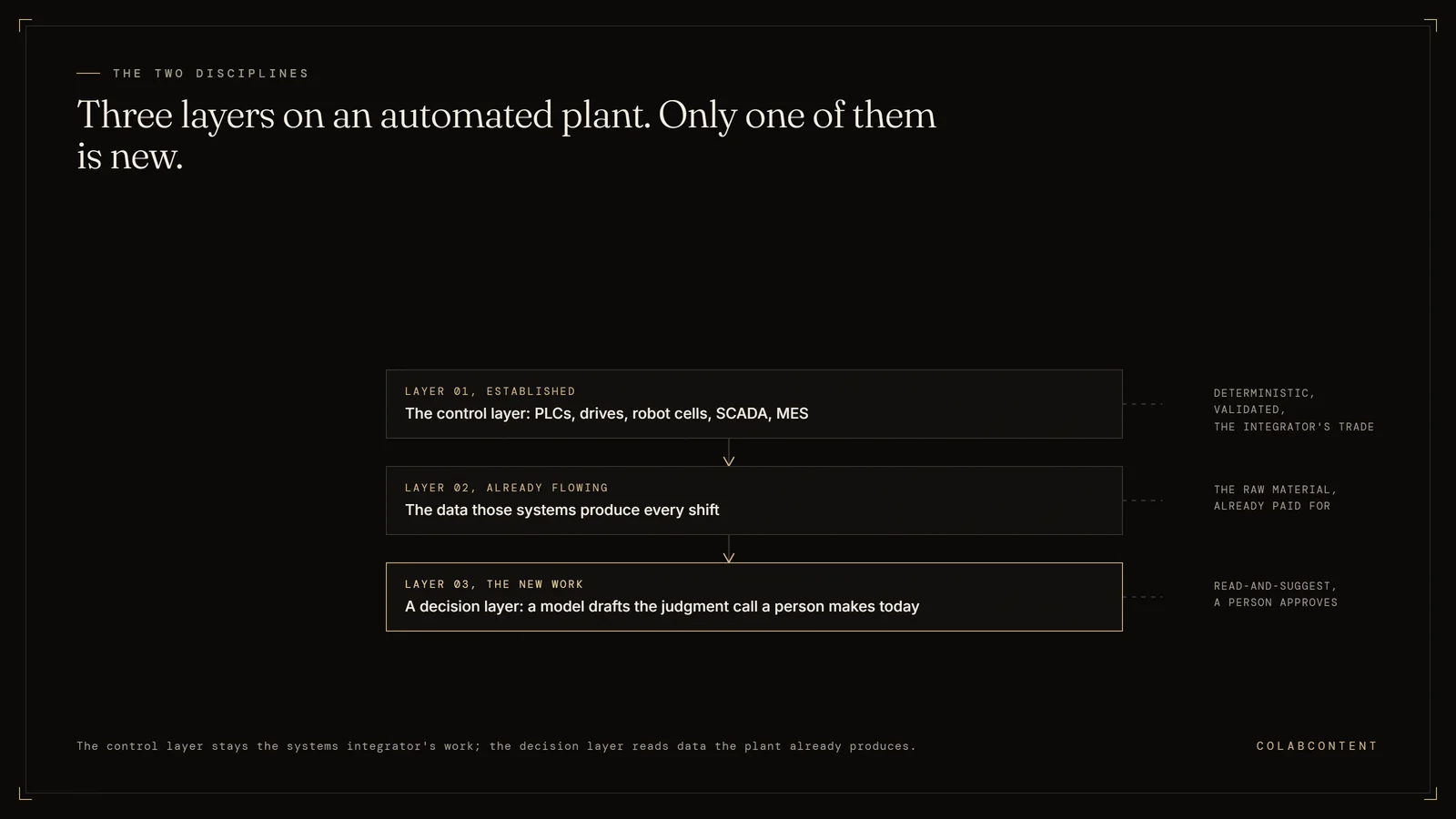
The three layers of manufacturing automation: the established control layer of PLCs, drives, SCADA and MES owned by systems integrators, the data those systems already produce, and the new AI decision layer that drafts judgment calls a person makes today
Where the platform layer stops and the shop's own logic begins.

Written for the shop that already pays for Plex. We do not sell an ERP, we take no referral fee from anyone in the table below, and we will say plainly which manufacturers should stay exactly where they are.

For10 to 50 seat discrete manufacturers
StanceNeutral. We sell no ERP.
Bottom lineCrossover at ~month 10 at a $112.5K build
CostFree 45-minute diagnosis
Prices readAugust 27, 2026

The short answer.

If you are on Plex and the reason you are reading this is the invoice, the honest first move is not a different ERP. It is to find out what your actual per seat rate is, because Plex does not publish one and the public numbers span more than a factor of two. Once you have that figure, the arithmetic on this page will tell you in about ninety seconds whether switching, renegotiating or building is the cheaper path, and for a meaningful share of shops the answer is renegotiate. If the reason you are reading this is that Plex will not bend to how your shop actually runs, then be careful, because most of the alternatives in this roundup will not bend either. They are the same shape of product. The ones that do bend, Odoo in particular, bend by consuming configuration labour, which is a different bill for the same problem.

So the verdict splits three ways by size. A shop under roughly twenty to thirty people, one location, running standard make to stock or make to order flows, should be looking at Katana at $299 a month flat or MRPeasy from $49 a seat, and should not be quoted a five figure custom build by anyone, including us. A shop that needs a real manufacturing ERP but not this one should look hard at Fulcrum and, if it is a job shop or machine shop, at ProShop, both of which we recommend on this page without any commercial interest in doing so. And a shop that has already tried an off the shelf platform, is paying five or six figures a year in perpetuity for software it does not control, and keeps paying for workarounds because the platform will not fit the process, is the shop this page is actually for. That is the case where owning the system stops being a philosophy and starts being arithmetic.

What Plex actually does well.

Worth being precise about, because a comparison page that treats the incumbent as a punching bag is useless to the person actually holding the contract. Plex Manufacturing Cloud is a mature platform and the things it is good at are the things that are genuinely hard and expensive to build.

Real time shop floor visibility. This is the first item on SelectHub's aggregated pros list, read on August 27, 2026, and it is the reason Plex sits in the manufacturing execution conversation rather than only the accounting one. A platform that already knows what every work centre is doing right now is not a small thing to reproduce.

Quality and defect tracking with traceability attached. Also on that pros list, and this is the capability that keeps Plex in regulated and high compliance discrete manufacturing. If your automotive or aerospace customer can demand a lot and serial genealogy on twelve hours' notice, the system that already holds it is doing real compliance work and is not merely an expensive database.

Inventory optimisation and advanced scheduling. The remaining two items on the same pros list. Scheduling in particular is where home grown systems most often disappoint, because the naive version works until the shop is busy and then stops working exactly when it matters.

Cloud access from anywhere. Unremarkable in 2026 and still worth the line, because the on premise alternative carries a server, a backup regime and an upgrade project that someone has to own.

None of that is in dispute here. The argument on this page is about price, rigidity and ownership, not about whether the software works.

Why shops start looking for a way out.

Three patterns, and the first two come from Plex's own users as aggregated by SelectHub rather than from us.

Reporting that will not answer your question. SelectHub's aggregated cons describe it as difficult to extract and analyse data for specific needs. In practice that means the number a manager wants on a Tuesday lives inside the system but not inside any report, and getting it out becomes a small project each time.

Rigidity that costs money to work around. This is the important one, and we are quoting it rather than paraphrasing because it is the whole wedge: SelectHub's aggregated user criticism is a lack of flexibility in adapting to unique or evolving business processes, requiring workarounds or customisations that can be time consuming and costly. Read that sentence twice. A shop paying a subscription, and then paying again every time its process does not match the platform, is paying for the same problem twice on two different invoices.

The interface, and what it costs in training. SelectHub's cons also describe the interface as difficult to navigate and non-intuitive, especially for new users who require extensive training. Training cost is real, it recurs with turnover, and it never appears on the software line item.

And the number nobody hands you. Plex publishes no pricing page, no implementation figure, no minimum seat count and no contract term. Neither does any source we could read in full. That is not an oversight in a category this mature; it means every number you are quoted is quoted against you rather than against a published rate card, and it is the single biggest reason shops feel the total only in year three.

What you are actually paying

Every number on this page, with its source.

Four of the vendors below publish a real, checkable price on their own website. Plex, DELMIAWorks and ProShop do not. Acumatica does not either, and in its case the absence is itself the finding, confirmed on the vendor's own pricing page rather than guessed at. We label each figure VERIFIED when it was read off the vendor's own page on August 27, 2026, and REPORTED when it came from a third party aggregator that the vendor has not confirmed. Where a figure looked unreliable we say so and leave the cell empty rather than filling it, and there are three such cells in the table below.

Vendor and planSold byPublished or reported priceImplementation, one timeSource
Plex Manufacturing CloudPer user / month, billed monthlyStarting at $500. No published free trial; demo required before a quote.Not published by Plex or by any source we could read. This page models $40,000 as a labelled assumption.VERIFIED selecthub.com/p/erp-software/plex-systems/. Plex publishes no rate card of its own.
Plex Manufacturing Cloud, wider bandPer user / month$300 to $650Modelled elsewhere at 1.5x to 2x first year subscription for very large deploymentsREPORTED top10erp.org and erpresearch.com, carried forward from an August 26, 2026 sweep. Both URLs returned errors on a fresh fetch on August 27, so neither was re-read. Directionally credible, not re-verified.
Plex, third aggregator figurePer user / monthWithheld. See the note directly below this table.Not publishedClaim withheld. ITQlick returned the identical figure and sentence for a different product on the same pass.
DELMIAWorks (formerly IQMS)Per user / month, quote basedWithheld for the same reason. Treat it as roughly the same price tier as Plex until you hold a written quote.Not publishedClaim withheld. Same templated-string concern as the row above.
AcumaticaResource based, not per named seatNo published rate. Quote only, via a partner or the vendor's own calculator.Not publishedVERIFIED acumatica.com/pricing/. The finding here is the confirmed absence of a published rate, read off the vendor's own page.
FulcrumPer user / month$50 to $150, so $600 to $1,800 per user per year$5,000 to $20,000 for SMBs; $50,000 and up for larger or more complex rollouts. Modelled year one at ten users: $15,000 to $35,000.REPORTED ITQlick aggregator. fulcrumpro.com/pricing returned HTTP 404 on August 27, 2026, so the vendor confirms none of it.
ProShop ERPQuote basedNo figure obtained, and we are not estimating one.Not publishedNo usable source. proshoperp.com/pricing returned HTTP 403 and ITQlick had no listing. Claim withheld.
Katana MRP, CorePer company / month, unlimited users$299 flat. Unlimited users, unlimited SKUs, one location. Advantage tier is custom and annual with a dedicated solutions engineer.$2,000 optional onboarding packageVERIFIED katanamrp.com/pricing/
MRPeasy, four tiersPer user / month$49 Starter, $69 Professional, $99 Enterprise, $149 Unlimited. Volume discount from the eleventh user. No contracts.No setup fee published. Training $150 an hour. Optional support add-ons $199 to $579 a month.VERIFIED mrpeasy.com/pricing/
Odoo, Standard and CustomPer user / month, annual billing$31.10 Standard; $61.00 Custom, which adds on-premise or Odoo.sh hosting, Studio and API access. Both bundle all Odoo apps including Manufacturing.Not published on the pricing page. Configuration and integration labour is the real cost line.VERIFIED odoo.com/pricing
Commissioned custom buildOne time fixed fee$45,000 to $180,000, scoped after a free 45-minute diagnosisIncluded in the fixed fee. Maintenance modelled at 12 percent a year as a stated assumption, not a contract term.ColabContent's own published offer. This is our price, not a third party claim, and it is labelled as ours.

The three figures we refuse to print, and why

One aggregator, ITQlick, does publish a per user monthly figure for Plex. We are not repeating it, and the reason matters more than the number. On the same research pass, that aggregator returned the identical figure inside an identical sentence for DELMIAWorks, a different product from a different vendor. Two unrelated enterprise platforms priced to the dollar with the same wording is what templated page copy looks like, not what independent research looks like. Printing it would have made this page's Plex range look tighter and cheaper to escape. We would rather have a wider honest range than a narrower invented one.

The second withheld figure is ProShop's. We tried the vendor's own pricing path, which returned HTTP 403, and the aggregator that lists comparable products, which had no ProShop entry at all. So ProShop appears in the roundup below described qualitatively, with no dollar figure attached, and you should treat any page that does quote one without naming a source with the same suspicion.

The third is Plex's implementation cost. Nobody publishes it. The $40,000 used throughout this page is our modelling assumption, the midpoint of a $20,000 to $60,000 range that is consistent with what comparable mid-size manufacturing ERP deployments cost, and it is editable in the calculator. It is not a Plex quote and we are not going to let it read like one.

Normalise it: what fifteen seats cost for a year

Per seat and per company pricing are not comparable until you fix the headcount, so hold one shop at fifteen named seats, take each vendor's published or reported rate at face value with nothing negotiated, and ask what a single year of subscription costs. One caveat before you read it: fifteen named Plex seats usually means a shop considerably larger than fifteen people, because enterprise seats get rationed. Katana's flat rate model makes seat count irrelevant on its side of the table, which is precisely why comparing them on seats alone is misleading.

Vendor and planOne year, 15 seats, subscription onlyHow it is calculated
Katana MRP Core$3,588$299 x 12. Seat count does not change it.
Odoo Standard$5,598$31.10 x 15 x 12, annual billing
MRPeasy Starter$8,820$49 x 15 x 12, before the volume discount that starts at the eleventh user
Fulcrum, low end of reported range$9,000$50 x 15 x 12
Odoo Custom$10,980$61 x 15 x 12, annual billing
MRPeasy Professional$12,420$69 x 15 x 12, before volume discount
MRPeasy Unlimited$26,820$149 x 15 x 12, before volume discount
Fulcrum, high end of reported range$27,000$150 x 15 x 12
Plex, low end of reported band$54,000$300 x 15 x 12
Plex, verified starting price$90,000$500 x 15 x 12
Plex, high end of reported band$117,000$650 x 15 x 12
AcumaticaNot published at any sizeResource based licensing, quote only
ProShop ERPNot publishedQuote only, no figure obtained

The distance across that table is the story. The cheapest credible option is roughly one twenty fifth of the verified Plex figure at the same seat count. That gap is not a scandal, because the products are not equivalent, but it does mean something specific: if what your shop uses Plex for is inventory, orders and a schedule, you are paying enterprise money for a mid-range job, and the fix is a cheaper tool rather than a custom build. The rest of this page is written for the shops where that is not true.

The three year and five year model

Subscription is one of two components; implementation is the other. The model below holds fifteen seats, adds the labelled $40,000 implementation assumption in year one only, and deliberately does not escalate the subscription at renewal, which makes every Plex figure here a floor on real spend rather than a ceiling. Against it, a commissioned build is a one time fee with maintenance modelled at twelve percent of the build price per year, charged from year two, itself a stated assumption rather than a ColabContent contract term.

Scenario, 15 seats3 year total5 year totalComponents
Plex at $300 a seat, low end of the reported band, plus $40,000$202,000$310,000Subscription $162,000 / $270,000, plus implementation
Plex at $500 a seat, the verified starting price, plus $40,000$310,000$490,000Subscription $270,000 / $450,000, plus implementation
Plex at $650 a seat, high end of the reported band, plus $40,000$391,000$625,000Subscription $351,000 / $585,000, plus implementation
Commissioned build at $45,000 plus 12% a year$55,800$66,600One time fee, then $5,400 a year from year two
Commissioned build at $112,500 plus 12% a year$139,500$166,500One time fee, then $13,500 a year from year two
Commissioned build at $180,000 plus 12% a year$223,200$266,400One time fee, then $21,600 a year from year two
Katana MRP Core plus $2,000 onboarding$12,764$19,940$3,588 a year, unlimited users, one location
Odoo Standard at 15 users$16,794$27,990$5,598 a year, before configuration labour
Fulcrum at the low end of the reported range plus $5,000$32,000$50,000$9,000 a year plus implementation

Where the build loses, printed as plainly as where it wins

At fifteen seats and the verified $500 rate, every build in our $45,000 to $180,000 range beats Plex on three year total cost, and it is not close. Back solving the same formula, the build price at which the two tie over three years is about $250,000, well above the top of our range. That result is real, and it is also the least interesting thing on this page, because it is entirely a consequence of a $500 seat being expensive. Change the inputs and the answer changes hard.

At five seats, most builds lose. Five seats at $500 is $30,000 a year. With a lower $20,000 implementation assumption, three years of Plex is $110,000 and five years is $170,000. A $112,500 build costs $139,500 over three years, so it loses by $29,500, and it only edges ahead at five years by $3,500, which is inside the noise of any real project. A build at $180,000 never wins at that size within five years, losing by $113,200 at three years and $96,400 at five. The precise break point is a build priced at about $88,710 over three years, or about $114,865 over five. Above those numbers, at five seats, you should not commission a build on cost grounds and we would tell you so on the call.

At the bottom of the reported rate band, the top of our range loses too. If your actual Plex rate is $300 a seat, fifteen seats is $202,000 over three years, and a build ties it at about $162,903. Anything we scoped above that figure would be the more expensive decision over that horizon.

And against Katana, almost every build loses. Three years of Katana Core including onboarding is $12,764. The cheapest build we would ever scope is $55,800 over the same period. If your shop genuinely fits Katana's model, no arithmetic on this page rescues a custom build, and the section below on who should stay says so at length. That is the honest shape of this decision: the build wins decisively in a specific band and loses badly outside it, and knowing which side of the band you are on is worth more than any feature comparison.

The crossover

Where the two lines meet.

Cumulative spend for the same fifteen seat shop, five years out. Plex at the verified $500 starting rate, with the labelled $40,000 implementation assumption paid at year zero and no renewal escalator applied. Against it, a commissioned build at $112,500, the midpoint of our fixed fee range, paid once at year zero, with twelve percent a year in maintenance from year two. Every figure in the chart comes from the table above and every one of them is editable in the calculator below.

Cumulative five year cost: Plex subscription versus a one time commissioned build A line chart of cumulative spend for a fifteen seat discrete manufacturer over five years. The Plex line starts at $40,000 at year zero for implementation and rises steadily to $130,000 at year one, $220,000 at year two, $310,000 at year three, $400,000 at year four and $490,000 at year five. The commissioned build line starts at $112,500 at year zero, stays flat through year one, then rises gently by $13,500 of maintenance each year to $126,000, $139,500, $153,000 and $166,500. The two lines cross at about month ten of the first year, at roughly $112,500 of cumulative spend on each path, after which the subscription line is permanently above the build line. By year five the gap is $323,500. $0 $100K $200K $300K $400K $500K Year 0 Year 1 Year 2 Year 3 Year 4 Year 5 Crossover, month 10 Plex $490,000 Owned build $166,500 Plex, 15 seats at $500/mo, plus $40,000 setup Owned build, $112,500 once, 12% maintenance

The crossover lands at about month ten, with roughly $112,500 of cumulative spend on each path. Before that point the subscription is genuinely the cheaper decision, which is what you would expect and what most vendor comparison charts hide by starting the axis in the wrong place. After it, the gap widens every single year, because one line has a slope and the other is almost flat. By year five the difference is $323,500, and nothing in the model makes the subscription line bend back down. Year six starts again at zero progress on one path and at maintenance only on the other.

That crossover is a function of your inputs, not a law of nature. Move the build to $180,000 and it lands late in year two. Move your seat count to five and the build at $112,500 does not cross inside three years at all. Halve the rate to $250 a seat and it moves out past year one. The chart above is one shop's arithmetic; the tool below is yours.

Your shop, your numbers

The Plex total cost calculator.

Every default below is the figure from the table above, and every one of them is editable, because the defaults are a market estimate and your order form is a fact. Nothing is submitted anywhere. There is no email gate, no external request, and no stored value. The arithmetic runs in your browser and stops there. If your inputs make the build lose, the tool will say so in the same size type it uses when the build wins.

Licensed users, not headcount. Enterprise seats get rationed, so this is usually well below your total staff.
Verified starting price is $500 (SelectHub). Reported band is $300 to $650. Plex publishes nothing, so use your invoice.
Modelling assumption, midpoint of $20,000 to $60,000. Not a Plex published figure. Enter 0 if already paid.
Both totals are calculated over this horizon.
ColabContent fixed fee range, $45,000 to $180,000, set after the diagnosis call.
Stated assumption, charged from year two, not a ColabContent contract term. Replace it with a real quote before deciding.
The roundup

Eight options, in the order we would look at them.

One note on the roster before the list. This is ordered the way a shop holding a Plex contract would sensibly evaluate, starting with the same-category peers, moving through the modern systems that are genuine escape hatches, then the small shop tools that are cheap for a reason, and ending with the option no ERP vendor will show you. Two of the entries below are products we recommend without any commercial interest in doing so, and one of them is the answer for more readers of this page than our own service is.

1. DELMIAWorks (formerly IQMS)

What it is. The closest same-category peer to Plex. A full manufacturing ERP covering shop floor execution, quality, inventory and scheduling, historically positioned as the platform a Plex shop switches to rather than away from the category entirely.

Price. Withheld deliberately. The only aggregator figure we found for DELMIAWorks was $150 per user per month from ITQlick, and the same aggregator returned that identical figure inside an identical sentence for Plex on the same pass. We will not print a number we believe is templated. Treat DELMIAWorks as roughly the same price tier as Plex until a written quote says otherwise.

Best for. A shop whose complaint is about a specific Plex capability or a specific account team rather than about the per seat model itself.

Where it falls short. It is the same shape of purchase. Per seat, renewed forever, configured to fit rather than built to fit. If your complaint is rigidity, this is a lateral move and there is a reasonable chance you meet the same complaint again inside two contract cycles. There is also a history lesson attached: DELMIAWorks is what IQMS became after it was absorbed into a larger portfolio and renamed. No shop that bought IQMS chose that outcome.

Verdict. A lateral move, not an escape. Evaluate it if the problem is a feature; skip it if the problem is the model.

2. Acumatica

What it is. A cloud ERP with a manufacturing edition, and the only vendor in this roundup that licenses on a fundamentally different axis. Acumatica prices on resource consumption rather than per named seat, which means adding a user is not automatically a line item.

Price. VERIFIED from acumatica.com/pricing/ on August 27, 2026, and the verified fact is an absence: Acumatica publishes no rate. Pricing runs through a calculator and a partner conversation. We checked so that you do not have to, and so that nobody can tell you we simply failed to look.

Best for. Shops that expect headcount to grow faster than transaction volume, where per seat licensing is the specific thing that stings. The resource based model genuinely changes that arithmetic.

Where it falls short. An unpublished price is an unpublished price regardless of how the meter works, and the partner channel means implementation quality varies with which partner you land. Resource based licensing also has its own failure mode, which is that a busy year raises your bill without anyone hiring.

Verdict. The most interesting licensing model in the roundup and the least evaluable from public information. Worth a quote, not worth a shortlist slot on price you cannot see.

3. Fulcrum

What it is. A modern manufacturing system aimed squarely at small and mid-size shops, and the option we hear recommended most often as the escape hatch from an older platform. This is not a product we compete with and we are not going to pretend otherwise.

Price. REPORTED at $50 to $150 per user per month, with implementation of $5,000 to $20,000 for SMBs and $50,000 or more for larger rollouts, and a modelled year one total at ten users of $15,000 to $35,000. All of that is ITQlick's aggregator estimate; fulcrumpro.com/pricing returned HTTP 404 on August 27, 2026, so the vendor confirms none of it. Get a written quote.

Best for. A shop that wants a modern, well regarded manufacturing system without going custom, and that wants to be running on it this quarter rather than next year.

Where it falls short. It is still a subscription with an implementation fee and a vendor roadmap you do not control. At the high end of the reported range, fifteen seats is $27,000 a year, which is real money and still a rental. And the public pricing information is thin enough that you cannot budget from this page alone.

Verdict. The strongest honest alternative in this roundup for most shops leaving Plex. If you are between Fulcrum and a build and the shop is under about twenty five people, take Fulcrum.

4. ProShop ERP

What it is. A manufacturing ERP built around job shop and machine shop workflow specifically, rather than a general platform configured toward it. It is consistently well regarded in that segment, and like Fulcrum it is a product we recommend rather than compete with.

Price. No figure. We tried proshoperp.com/pricing, which returned HTTP 403, and the aggregator that lists comparable products had no ProShop entry at all. Rather than estimate, we are telling you the truth: this one is quote based and we could not obtain a number on August 27, 2026. Any page that quotes one without naming a source is guessing.

Best for. Job shops and machine shops, particularly ones where quoting, routing and shop floor paperwork are the daily grind rather than an afterthought.

Where it falls short. Its strength is its specificity, which is also its limit. A shop that is not a job shop is buying someone else's workflow assumptions, which is the exact complaint that brought you to this page. And with no published price, evaluation starts with a sales cycle.

Verdict. If you are a job shop, put it on the shortlist before you consider a custom build. That is a genuine recommendation, made against our own commercial interest.

5. Katana MRP

What it is. Manufacturing resource planning for small manufacturers: inventory, bills of material, production orders, basic scheduling, with a clean interface and a flat price.

Price. VERIFIED from katanamrp.com/pricing/ on August 27, 2026. The Core plan is $299 a month flat, and the important word is flat: unlimited users, unlimited SKUs, one location. Onboarding is an optional $2,000 one time package. The Advantage tier is custom and annual with a dedicated solutions engineer attached. That works out to $3,588 a year, or $12,764 over three years including onboarding.

Best for. Shops roughly under twenty to thirty people, one location, standard make to stock or make to order flows. If that is you, this is the answer, full stop.

Where it falls short. One location is a hard constraint on the Core plan. It is manufacturing resource planning, not manufacturing execution, so it does not carry the shop floor traceability and quality depth that keeps Plex in regulated work. And the flat price is flat because the process is assumed; the further your shop is from a standard flow, the more that assumption costs you in spreadsheets sitting beside the system.

Verdict. The cheapest credible option here by a wide margin, and the one that beats a custom build outright for the shops it fits. We would rather send you here than take an engagement that should not exist.

6. MRPeasy

What it is. The other cheap, no lock-in small shop tool, priced per seat rather than flat, which makes it the better fit when only a handful of people need access.

Price. VERIFIED from mrpeasy.com/pricing/ on August 27, 2026. Four tiers at $49, $69, $99 and $149 per user per month, with a volume discount from the eleventh user, no contracts, training at $150 an hour, and optional support add-ons at $199 to $579 a month.

Best for. Small shops with a genuinely small number of system users, and anyone who wants out of an annual commitment. No contracts is a real feature after a bad ERP experience.

Where it falls short. It is per seat, so it inherits the growth tax that may be the reason you are reading this. At fifteen users the Unlimited tier is $26,820 a year, which is no longer a cheap tool. Like Katana, it is planning rather than execution.

Verdict. The right call under about ten system users. Past that, run the per seat arithmetic before you assume it is the cheap option.

7. Odoo Manufacturing

What it is. A modular business suite where Manufacturing is one app among many, and where the pricing model bundles all apps rather than charging per module.

Price. VERIFIED from odoo.com/pricing on August 27, 2026. Standard is $31.10 per user per month on annual billing; Custom is $61.00 and adds on-premise or Odoo.sh hosting, Studio and API access. Both bundle every Odoo app including Manufacturing, with no separate per-app fee found on the pricing page. Fifteen users on Standard is $5,598 a year.

Best for. Shops with in-house or contracted Odoo expertise, and shops that need several business functions on one platform rather than a manufacturing tool alone.

Where it falls short. This is a partial escape rather than a full one, and the reason is worth stating carefully. Odoo's flexibility is real, and it is paid for in configuration and integration labour rather than in licence fees. A shop that leaves a rigid platform because it was tired of paying for workarounds, and then buys a flexible platform that needs continuous configuration, has changed which invoice the money leaves on rather than stopping the leak. That is a fair trade for some shops and a bad surprise for others.

Verdict. Materially cheaper per seat and much more configurable. Do not present it to your own board as a finished replacement, because it is a platform plus a project.

8. A commissioned build you own

What it is. Not a general purpose ERP, and we are not going to pretend it is one. It is a system built for the specific work your shop does that no platform models properly, owned by the shop at handoff, running in the shop's own cloud account. In practice that means quoting and costing, spec and drawing intake, production scheduling against your real constraints, supplier and bill of material reconciliation, or the reporting layer that Plex's own reviewers say they cannot get answers out of.

Price. A fixed fee of $45,000 to $180,000, set after a free 45-minute diagnosis and after integration depth is named, paid in two instalments at build start and handoff. A working prototype runs on your real data before the balance is due. The shop owns the code, the prompts, the models and the pipeline at handoff.

Best for. Shops past a real complexity and scale threshold: already on an off the shelf platform, already spending five or six figures a year in perpetuity, and already paying repeatedly for workarounds because the platform will not bend. That is a specific band, and it is above where Katana, MRPeasy and Fulcrum comfortably reach.

Where it falls short. It is a bigger single cheque, it needs a tighter scope than buying software does, and at the top of our range it loses the cost argument outright in several of the scenarios printed above. It is also not a drop-in ERP replacement, so if your goal is to stop paying for a manufacturing platform entirely, this on its own is not that.

Verdict. The only option on this list where the bill stops going up, and the wrong option for a shop that fits a $299 tool.
The ownership case

Nine arguments for owning it instead.

Each of these is either arithmetic you can check on this page or a structural fact about the two models. Where an argument does not honestly apply to your shop, the section after this one says so.

One. The math, restated. A subscription never ends. Fifteen seats at the verified rate cost $310,000 over three years and $490,000 over five, and year six starts again at zero progress. A $112,500 build costs $139,500 and $166,500 over the same horizons, and the lines cross at about month ten. After the crossover the gap widens every year, because one curve has a slope and the other is nearly flat. That is the whole argument and it is why the chart sits on this page rather than in a sales deck.

Two. Per seat pricing taxes growth. Every new planner, scheduler, quality lead or shift supervisor who needs system access raises the bill by the same rate, whether or not that person generates proportional output in year one. Five new seats at the verified rate is $30,000 a year, added automatically, forever, with no decision made by anyone. An owned system has no marginal seat cost at all, which means the hiring decision stops carrying a software decision inside it, and it means access can follow need rather than budget.

Three. Asset versus expense. A subscription is rent and it leaves nothing behind. A commissioned build is a piece of the business: transferable, valuable in a sale or succession conversation, and on the balance sheet rather than only on the expense line. For an owner thinking about a five to ten year horizon, or about what the shop is worth to a buyer, that difference is not cosmetic.

Four. Built around your process, not the median shop's. This is the argument Plex's own reviewers make for us. The aggregated criticism on SelectHub is a lack of flexibility in adapting to unique or evolving business processes, requiring workarounds or customisations that can be time consuming and costly. Every platform in the roundup above is calibrated against the average customer in its category, which means you pay for the whole bundle and adapt your process to the part of it you use. A commissioned system starts from your routings, your quoting logic and your constraints. Nobody gets retrained into someone else's assumptions.

Five. AI at the core rather than as a per seat add-on. Every major manufacturing platform now sells intelligence as an uplift on the existing licence, quoted per customer and scaling with seat count, at a rate none of them publish. Plex publishes no AI pricing because Plex publishes no pricing at all. So on a platform, the capability everyone now expects arrives as a second per seat charge stacked on the first, at a number you cannot benchmark against anything. In a commissioned build there is no separate AI licence, because the AI is the system, and adding a user costs nothing.

Six. Unlimited seats. Planners, schedulers, machinists, quality, shipping, seasonal staff, and where it makes sense your customers themselves checking order status. Zero marginal cost per person changes the question from who needs a licence to who needs access, which is a better question and produces a better shop.

Seven. Data ownership and no exit ransom. Your part masters, your routings, your lot genealogy, your production history, in your own cloud account, under an agreement you wrote. Compare that with the migration section below, where the hard part of leaving a manufacturing ERP is not the documents but the open transactional state, the traceability archive and the integrations, all of which live inside a structure the vendor designed. Owning the structure takes the negotiation out of leaving.

Eight. Vendor risk you stop carrying. This category supplies its own evidence, and some of it turned up while researching this page. DELMIAWorks is what IQMS became after an absorption and a rename that no customer voted on. And the public information layer around these products is visibly unstable: on August 27, 2026 the pricing page for one vendor in this roundup returned HTTP 404, another returned HTTP 403, a research site's Plex pricing page returned 404, and a competing vendor's own Plex alternatives article had been taken down entirely. Those are small observations, but they point at a real property of this market. Products get renamed, absorbed, repositioned and end-of-lifed on the vendor's calendar rather than yours. A system you own does not get sunset by anybody.

Nine. Change speed. A change request to your own system is a scoping conversation and a deployment. A change request to a platform vendor is a feature request in a queue behind every other customer's, with no committed date, or a paid customisation that becomes a workaround you maintain forever. When the thing you need changed is the thing that makes your shop competitive, neither answer is acceptable.

What we can actually prove, and what we cannot

The list above is worth exactly as much as the evidence behind the firm making it, so here is ours with nothing rounded up, including the part that cuts against us. Jim Glaser Law is our nameable reference and the principal takes reference calls. The LELF platform is the fullest example of what commissioning looks like when a business runs its core operation on the result. Across our practice we have handled more than 6,000 AI handled calls and delivered more than 40 commissions.

Now the part you should hear from us rather than find out later. Our nameable reference is a law firm, not a manufacturer. We have not decommissioned a Plex tenant for anyone and we are not going to imply otherwise. What that evidence supports is a specific claim: we can scope, build, hand over and support a system that carries real daily operational volume in a business and reconciles against the system it replaced. What it does not support is a claim that we have done that for a discrete manufacturer running Plex. If a named manufacturing reference is the thing that would decide this for you, ask on the call and we will tell you plainly that we do not have one yet.

The honesty section

Who should stay on Plex, or on someone else's SaaS.

Six situations where every argument in the previous section fails, and where we would tell you to stay put on a call.

Shops where compliance grade traceability is the actual requirement. If you supply automotive Tier 1 or Tier 2, aerospace, medical devices or anything else where a customer or a regulator can demand full lot and serial genealogy on short notice, and Plex is currently doing that work, then your complaint is price and your tool is right. Switching costs in that situation include re-validation, and re-validation in a regulated environment can exceed the savings on its own. Take the total cost figure from this page into a renewal negotiation instead, which is a much better use of it.

Shops under about twenty to thirty people with standard flows. The arithmetic does not work and it is not close. Three years of Katana Core with onboarding is $12,764. The cheapest build we would scope is $55,800 over the same period. At five seats, a build at $112,500 loses to Plex outright over three years by $29,500 before it ever gets compared to Katana. If this is you, the right answer is Katana or MRPeasy, and we would rather say so here than take your money for an engagement that should not exist.

Job shops that have not evaluated ProShop or Fulcrum yet. Both are well regarded, both are fairly priced by every account we have seen, and both are built for exactly this work. If you have not put them in front of your own people, you are not ready to consider a custom build, and a build quoted before those evaluations is a build quoted against a decision you have not made.

Shops that need a working system next quarter. A commissioned build ships a prototype quickly and a production system in weeks, and any ERP migration on top of that runs three to six months. If the deadline is real and near, buying is faster than building and it is not close.

Shops where nobody will own the system internally. An owned build needs a named person who cares about it, even at a light touch. Without that person you get an orphaned system that decays quietly, which is a worse outcome than renting, and it is the failure mode we watch for hardest on the diagnosis call.

Shops whose real constraint is not a software problem. If the money is leaking in machine uptime, in scrap, in a hiring gap or in a customer mix, then changing systems is motion rather than progress. A meaningful share of the diagnosis calls we run end with us recommending the business keep what it has, and this is the most common reason.

Decision tree

Six questions, in order, with stop points.

1. Is your shop under about twenty five people, one location, running standard make to stock or make to order flows? If yes, stop here. Price Katana at $299 a month flat and MRPeasy from $49 a seat against what you pay now. No build we quote will beat those numbers at your volume. If no, continue.

2. Does compliance grade lot and serial traceability decide whether you keep a customer? If yes, stop. Keep the system that already holds it and use the total cost figure from the calculator as leverage at renewal rather than as a reason to leave. If no, continue.

3. Do you know your actual per seat rate and your contract's renewal and notice terms? If no, stop and go find the order form. Every decision after this one depends on it, and the reported ranges on this page are a substitute for that document rather than a replacement for it. If yes, continue.

4. Have you evaluated Fulcrum and, if you are a job shop, ProShop? If no, stop and do that first. They are the honest middle of this market and we recommend them without a referral fee. If you have evaluated them and neither fits the way your shop actually runs, continue.

5. Can you name the workflow that is costing you, in one sentence, with a rough dollar or hour figure attached? If no, stop, and spend two weeks measuring before anyone spends money. Every failed build we have seen started with an unnamed constraint. If yes, continue.

6. Run your numbers in the calculator above. Does a build inside the $45,000 to $180,000 range beat your total over your real horizon, and is that budget runway genuinely available this quarter? If no, park it and revisit at renewal with the arithmetic in hand. If yes, that 45-minute call is the next step, and a meaningful share of those calls end with us telling the shop to stay where it is.

Next step

Book the 45-minute diagnosis.

Bring your order form and one sentence describing the workflow that leaks. You leave with the constraint written down either way, and a meaningful share of these calls end with us telling a shop to stay exactly where it is.

Free · 45 minutes
Under NDA
Owner to owner
No follow-up unless asked
Migration reality

What leaving Plex actually involves.

This is the question that decides whether a shop ever acts on any of the rest, and none of the pricing pages and review aggregators we could read address it at all. Here is the honest shape of it. The timelines below are our own scoping ranges for an engagement of this type, stated as estimates rather than dressed up as research, and no vendor publishes a comparable figure.

You are not moving data. You are moving five different things, and only one of them moves cleanly. Master data, meaning parts, bills of material, routings, work centres and customers, exports and reloads with effort and reconciliation. Open transactional state, meaning work orders in progress, open purchase orders, inventory positions and in-process quality records, does not migrate at all; it gets cut over at a chosen moment with the shop's cooperation, which is why cutover weekends exist. Historical traceability, the lot and serial genealogy you may be contractually obliged to retain for years, usually gets preserved in a readable archive rather than reloaded into the new system, and that archive needs to be genuinely queryable years later or it is not compliance, it is a folder. Integrations to machines, scanners, label printers, scales and EDI trading partners get rebuilt, not moved, and this line item is the one most often missed in planning. And the configuration itself, the accumulated workarounds that made a rigid platform fit your shop, exists mostly in people's heads and in a spreadsheet, so someone has to write it down before it can be replaced.

Phase one: inventory and reconciliation. Before anything moves, someone answers what is actually in there and which of it matters. The deliverable that counts at the end of this phase is a reconciliation: parts out equals parts in, open orders accounted for, exceptions listed rather than rounded away. A migration without a reconciliation count is a hope.

Phase two: parallel run through at least one full month end close. Both systems live, new work in the new system, the old one read only, and nothing switched off. One full close is the minimum because the gaps in a manufacturing migration do not surface when you look for them, they surface when someone needs a two year old inspection record on a Thursday afternoon or when the month's costing does not tie. A shop that skips the parallel run to save six weeks usually spends the saving twice.

Phase three: decommission. Only after the parallel run produces no unresolved exceptions, and only after someone has read the notice provisions in the order form. A manufacturing ERP contract that auto renews will renew during a migration if nobody sends the letter, and that is an expensive way to learn about notice periods.

A realistic total is three to six months from decision to switching the old system off. The largest driver is not shop size. It is how many integrations you have and how much of the platform's configuration your daily operation actually depends on, which is something you can estimate this week by asking three people what they would not be able to do on Monday if the system changed.

The option most shops do not consider. You do not have to leave in order to fix the problem. In a large share of the cases we see, the platform is fine, the subscription is defensible, and the leak is in a workflow sitting beside it: quoting, spec intake, scheduling against real constraints, or the reporting that Plex's own reviewers say they cannot get answers out of. That path keeps the ERP, keeps the traceability, keeps the integrations, and builds the missing piece against the platform's own interfaces. No migration, no cutover weekend, no decommissioning letter.

Deep dive

The dimensions the price table cannot show.

Six dimensions, side by side.

Price transparency. Katana, MRPeasy and Odoo publish real rate cards you can read in ten seconds. Plex, DELMIAWorks, ProShop and Acumatica publish nothing, and Acumatica's own page confirms it. Transparency is not the same as cheapness, but an undisclosed price lets the seller quote against the buyer rather than against the work, and it is the reason nobody on this page can tell you what you should be paying.

Licensing axis. Three different models are in this roundup and they behave completely differently as you grow. Per named seat (Plex, MRPeasy, Odoo, Fulcrum) taxes headcount. Flat per company (Katana Core) taxes nothing but caps you at one location. Resource based (Acumatica) taxes activity rather than people. A one time fee (a commissioned build) taxes neither. Which axis you are on matters more over five years than the starting rate does.

Cost slope. Every subscription here rises with headcount and with renewal. A commissioned build is a one time fee plus a flat maintenance line. The slope, not the starting point, decides a five year comparison, which is exactly what the chart above is showing.

Fit versus configuration. Plex's own reviewers describe costly workarounds when the platform does not match the process. Odoo's answer to the same problem is configuration labour. Katana's answer is to assume a standard process and be cheap. A build's answer is to start from your process. Every one of those is a real strategy with a real bill attached, and the honest question is which bill your shop would rather pay.

Ownership at exit. Every vendor here retains the code, the schema and the pipeline. A commission transfers all three at handoff, running in the shop's own cloud account. That is the difference between an export and a handover, and it only matters on the day you want to leave, which is the day it matters most.

Vendor risk. Renames, absorptions and repositioning are normal in this category, and DELMIAWorks is the live example of a product that customers bought under a different name. Even the public information around these products is unstable, as the dead pricing URLs listed in our sources fold show. A system you own does not get renamed out from under you.

When to pick which, in one paragraph each.

Stay on Plex if compliance grade traceability is doing real work for you, if your negotiated rate is at the bottom of the reported band, or if you need certainty next quarter. Take the total cost figure from this page into the renewal conversation as leverage rather than as a reason to leave.

Move to DELMIAWorks only if your complaint is about a specific capability or a specific account team. If your complaint is the per seat model or the rigidity, this changes the logo and not much else.

Move to Fulcrum if you want a modern manufacturing system, running this quarter, without a custom project. For most shops leaving Plex under about twenty five people, this is the answer.

Move to ProShop if you are a job shop or a machine shop and the daily grind is quoting, routing and shop floor paperwork.

Move to Katana or MRPeasy if you are small, single site and running standard flows, and you want a published price you can budget against without a sales cycle.

Move to Odoo if you have Odoo expertise in house or on retainer and you want several business functions on one platform. Budget the configuration project honestly or it will budget itself.

Get a quote from Acumatica if per seat licensing is the specific thing that stings and you expect headcount to grow faster than volume.

Commission a build if the platform basically works, the constraint is a named workflow, and the three year total on this page is comfortably above what a scoped build would cost. Most shops in that position keep the ERP and build beside it.

Why this page is written by someone who does not sell an ERP.

Worth saying plainly, because it should change how you read everything above. ColabContent sells commissioned AI builds. We do not sell an ERP, we do not sell a manufacturing execution system, and we take no referral fee from anyone in the roundup. That does not make us neutral about the conclusion, obviously, and the entire reason for publishing the arithmetic, the assumptions and the dials is that you can see exactly where our interest starts pulling on the numbers.

It does mean nothing commercial pulled in the other direction when this page said that Katana at $12,764 over three years beats our own cheapest build at $55,800, that at five seats a mid-range build loses to Plex outright, that a build at the top of our range loses at the bottom of the reported rate band, or that a job shop should go look at ProShop and Fulcrum before it talks to us. Those are the four sentences a page written purely to sell would have left out, and they are the reason the rest of it is worth reading.

One more thing about sourcing, since it cuts the same way. A well known alternatives article about Plex, published by a competing shop floor software vendor, is the source most commonly cited for how painful Plex implementations are. We went to read it on August 27, 2026 and it returned HTTP 404. We are not citing numbers we could not read, and we are not citing a competing vendor's characterisation of a rival as though it were research. Everything in the pricing table above is either read off a vendor's own page or labelled as an aggregator estimate.

What a build beside a manufacturing platform actually looks like.

Four workflows come up repeatedly with shops in this band, and they share a property: none of them is a transaction processing problem, which is why the ERP does not touch them.

Quoting and costing. Turning a customer request, a drawing and a set of tolerances into a defensible quote with real cost behind it, drafted for a human to approve rather than sent automatically. This is the workflow with the clearest dollar figure attached, because a shop can usually name what a bad quote costs and how many it sends a week.

Spec and drawing intake. Pulling requirements out of customer PDFs, drawings and emailed change notices, and getting them into the system as structured data instead of into somebody's inbox. Manual re-keying here is both slow and where errors originate.

Scheduling against your real constraints. Not the platform's generic scheduling model, but yours: the two machines that cannot run the same job, the operator certifications, the customer who always expedites. This is the one shops most often describe as living in a spreadsheet beside the ERP.

The reporting layer. Plex's own aggregated reviews describe difficulty extracting and analysing data for specific needs. A reporting and question-answering layer built over the data the platform already holds is often the smallest, fastest and cheapest engagement on this list, and it does not require leaving anything.

The integration posture is read and suggest by default, with a human approving, relaxing only after held output quality over a real period. Nothing touches machine control or anything below the operational technology boundary. We integrate at the documented interface layer, and where a platform does not expose one for a given need, that constraint gets named in the scope rather than engineered around quietly.

Questions

The eight questions Plex buyers actually search.

How much does Plex ERP cost per user?

Plex does not publish a rate card. The one figure we could read directly on August 27, 2026 is SelectHub's, which lists Plex Manufacturing Cloud starting at $500 per user per month, billed monthly, with no published free trial and a demo required before a quote. Two aggregators carried forward from an earlier sweep put the range wider, at $300 to $650 per user per month, and both of those source pages returned errors when we tried to re-read them today, so we label that range reported rather than verified. A third aggregator, ITQlick, shows $150 per user per month for Plex, and we are deliberately not printing that as a Plex number, because the same aggregator returned the identical figure and the identical sentence for DELMIAWorks on the same pass, which is what templated page copy looks like rather than a researched figure. What all of that means practically: fifteen named Plex seats at the verified starting price is $90,000 a year in subscription alone, before implementation, before internal administration, and before any renewal increase.

What is the real total cost of Plex over three and five years?

For a shop with fifteen named Plex seats at the verified $500 starting rate, subscription alone is $90,000 a year, so $270,000 over three years and $450,000 over five. Then add implementation. Plex publishes no implementation figure and neither does any source we could read, so this page uses a labelled assumption of $40,000, the midpoint of a $20,000 to $60,000 range consistent with comparable mid-size manufacturing ERP deployments. That puts the three year total at $310,000 and the five year total at $490,000. Against that, a commissioned build at the midpoint of our $45,000 to $180,000 fixed fee, which is $112,500, costs $139,500 over three years and $166,500 over five once you add twelve percent a year in maintenance, itself a stated assumption rather than a contract term. The difference is $170,500 over three years and $323,500 over five, and the two cumulative lines cross at about month ten. Change the seat count or the rate and the crossover moves, which is exactly what the calculator on this page is for.

What are the best alternatives to Plex ERP for manufacturers?

Eight, and which one is right depends far more on your shop's size and process complexity than on any feature grid. DELMIAWorks, the product formerly sold as IQMS, is the closest same-category peer and the most common lateral move. Acumatica is a real ERP peer that prices by resource consumption rather than per named seat, and publishes no rate at all. Fulcrum is the strongest honest escape hatch for a shop that wants a modern, well regarded manufacturing system without going custom. ProShop ERP is the job shop and machine shop answer. Katana MRP is $299 a month flat with unlimited users, which makes it the cheapest credible option in this roundup. MRPeasy runs $49 to $149 per user per month with no contract. Odoo Manufacturing is $31.10 per user per month on annual billing and is the most configurable of the cheap options, with the labour cost that implies. The eighth is a commissioned build you own outright, one fixed fee, no per seat licence, and it is the only one on this list that no ERP vendor will ever show you.

What is the cheapest real alternative to Plex ERP?

Katana MRP, and it is not close. Katana's Core plan is $299 a month flat with unlimited users, unlimited SKUs and one location, read directly off katanamrp.com/pricing on August 27, 2026, with an optional $2,000 onboarding package. That is $3,588 a year. Three years including onboarding is $12,764. For comparison, the cheapest build we would scope, $45,000 plus maintenance at our stated twelve percent a year assumption, is $55,800 over the same three years, and fifteen Plex seats at the verified rate are $310,000. If your shop fits inside Katana's model, meaning one location, standard make to stock or make to order flows, roughly under twenty to thirty people, then Katana is the answer and we would tell you so on a call rather than quote you a build. Odoo Standard at $31.10 per user per month on annual billing is the next cheapest at fifteen users, about $5,598 a year. MRPeasy starts at $49 per user per month with a volume discount from the eleventh user and no contracts. The catch with all three is the same: they are cheap because they assume your process fits theirs.

What is the difference between Plex and DELMIAWorks (IQMS)?

Less than the sales cycle suggests. Both are full manufacturing ERP platforms covering shop floor execution, quality, inventory and scheduling, both are sold through a demo and a quote rather than a published rate card, and both are the same shape of purchase: per seat, renewed forever, with configuration work whenever your process does not match the platform's assumptions. The one aggregator figure we found for DELMIAWorks is $150 per user per month from ITQlick, and we are not treating that as reliable, because ITQlick returned the identical figure and the identical sentence for Plex on the same pass. Treat DELMIAWorks as roughly the same price tier as Plex until you have a written quote in hand. The practical point for a Plex holder is that this is a lateral move, not an escape. A shop unhappy with Plex's price or its rigidity is likely to meet the same category of complaint on DELMIAWorks within a contract cycle or two, because it is the same category of product. There is also a piece of history worth noticing: DELMIAWorks is what IQMS became after it was absorbed into a larger portfolio and renamed, and none of the shops that bought IQMS chose that.

Do Katana MRP or MRPeasy actually replace what Plex does?

For a small shop, often yes. For a Plex scale operation, no, and anyone telling you otherwise has not looked at what you actually use Plex for. Plex Manufacturing Cloud carries deep shop floor execution, traceability and quality management, which is why it shows up in regulated and high compliance discrete manufacturing. Katana and MRPeasy are manufacturing resource planning tools: inventory, bills of material, production orders, basic scheduling. If what you use in Plex is inventory, orders and a production schedule, then Katana at $299 a month flat or MRPeasy at $49 to $149 per user is a real replacement and a large saving. If what you use in Plex is lot and serial level genealogy for an automotive or aerospace customer audit, they are not, and that gap would surface during an audit rather than during evaluation. The honest test is not a feature list. Write down the five things your shop cannot operate without, then make every vendor show you those five in a demo using your own part numbers and your own routings.

Can a manufacturer switch off Plex, and what does leaving actually involve?

You can, and the hard part is not the data export. A manufacturing ERP holds five things and only one of them moves cleanly. Master data, meaning parts, bills of material, routings and work centres, moves with effort. Open transactional state, meaning work orders in progress, purchase orders, inventory positions and in-process quality records, has to be cut over at a moment in time rather than migrated. Historical traceability, the lot and serial genealogy you may be contractually obliged to retain, usually has to be preserved in a readable archive rather than reloaded. Integrations to machines, scanners, label printers and EDI partners get rebuilt, not moved. And the configuration itself, the years of workarounds that made a rigid platform fit your shop, lives in people and in a spreadsheet somewhere rather than in an export file. Our planning shape for a mid size discrete shop is a parallel run covering at least one full month end close with the old system read only, and three to six months from decision to switching the old system off. Those are our scoping ranges for an engagement, not figures published by Plex or by anyone else, and we say so rather than dressing them up as research. Read the notice provisions in your order form before you schedule anything, because an auto renewing contract will renew during a migration if nobody sends the letter.

Is Plex ERP the same thing as the Plex media server?

No, and the collision is why this page says Plex ERP rather than just Plex. Plex Manufacturing Cloud, also marketed as the Plex Smart Manufacturing Platform, is enterprise manufacturing software: shop floor execution, quality, inventory, scheduling and traceability, sold to discrete manufacturers by the seat at a price nobody publishes. The Plex most people mean is a consumer media server for organising and streaming your own video library. They are unrelated companies and unrelated products that happen to share a word. If you searched for Plex alternatives and landed here looking for a way to stream your movie library, this is the wrong page and we are not going to try to keep you on it.

Buyer worksheet

What to have in front of you before any call.

Five things to pull before you talk to anyone.

One. Your current order form. Not the invoice. The order form is where the term, the renewal mechanics, the escalator if there is one, and the notice period live. Every reported figure on this page is a substitute for that document and a worse one.

Two. Your actual named seat count, split. Planners, schedulers, quality, shipping, office, plus anyone holding a licence who has not logged in this quarter. That last group is usually the fastest money a shop finds, and it does not require changing anything.

Three. Your integration list. Every machine, scanner, label printer, scale, EDI partner and downstream system touching the ERP today. This is the line item that overruns migrations and the one nobody counts until it is too late.

Four. An honest count of workaround hours. Ask whoever maintains the spreadsheets that sit beside the ERP how many hours a week they take. Plex's own reviewers describe workarounds as time consuming and costly; yours is the only measurement that matters and it is a two minute question.

Five. One sentence naming the workflow that leaks. With a rough dollar or hour figure attached. If you cannot write that sentence, no vendor on this page can help you, and neither can we.

Five questions to ask every vendor, including us.

What is the term, and what happens at renewal? Ask for the escalator in writing. A vendor that will not commit one to paper has told you something.

What is the total in year three, not year one? Make them do the arithmetic on your seat count with their own renewal assumption. Compare that number to the one the calculator on this page produced.

Show me those five things in a demo, on my part numbers. Not their demo data. The five things your shop cannot operate without, on your routings, with your worst customer's requirements attached.

What exactly do we own at the end, and in what format? For a subscription the answer is an export. For a commission it should be code, prompts, models, datasets, runbook and integration documentation, in writing.

Can we speak to a shop you did this for? Then ask that shop three things: what the constraint was, what the system does now, and whether they would do it again. Our own answer to this question is Jim Glaser Law, and it is a law firm rather than a manufacturer, which we say here rather than letting you discover it on the call.

When not to buy from us.

Do not commission a build if your shop is under about twenty five people running standard flows. Katana at $12,764 over three years beats our cheapest scope at $55,800, and we will tell you that on the call rather than take the engagement.

Do not commission a build before you have evaluated Fulcrum and, if you are a job shop, ProShop. Both are well regarded and fairly priced, we take no referral fee from either, and a build quoted before those evaluations is a build quoted against a decision you have not made yet.

Do not commission a build if what you actually want is to stop paying for a manufacturing ERP entirely. We do not replace a full ERP, and a commission sits beside one rather than instead of it. If leaving the category is the goal, price Fulcrum, ProShop, Katana and MRPeasy and use this page's cost model as the yardstick.

Do not commission a build if compliance grade traceability is the reason you have Plex. Keep the system that holds it and use the arithmetic as renewal leverage instead.

Do not commission a build if nobody at the shop will own the system after handoff. An owned system with no internal owner decays, and that outcome is worse than renting.

Do not commission a build if you cannot name the constraint in a sentence. Book the diagnosis call anyway, because naming it is the work of the call, but do not sign anything until the sentence exists.

Sources, with dates and labels.

All fetched on August 27, 2026 unless noted. VERIFIED means read directly off the vendor's own page. REPORTED means a third party published it and the vendor has not confirmed it.

VERIFIED katanamrp.com/pricing/ (Core at $299 a month flat, unlimited users, unlimited SKUs, one location; $2,000 optional onboarding; Advantage tier custom and annual). mrpeasy.com/pricing/ (four tiers at $49, $69, $99 and $149 per user per month; volume discount from the eleventh user; no contracts; $150 an hour training; support add-ons $199 to $579 a month). odoo.com/pricing (Standard $31.10 and Custom $61.00 per user per month on annual billing, all apps bundled including Manufacturing). acumatica.com/pricing/ (resource based licensing with no published rate; the confirmed absence is the finding). selecthub.com/p/erp-software/plex-systems/ (Plex starting at $500 per user per month billed monthly, demo required, plus the aggregated pros and the aggregated criticisms of reporting flexibility, interface learnability and process rigidity quoted on this page).

REPORTED ITQlick aggregator for Fulcrum ($50 to $150 per user per month; $5,000 to $20,000 SMB implementation, $50,000 and up for larger rollouts; modelled year one at ten users of $15,000 to $35,000); fulcrumpro.com/pricing returned HTTP 404 so the vendor confirms none of it. The wider Plex band of $300 to $650 per user per month, and an enterprise implementation model of roughly 1.5x to 2x first year subscription, come from top10erp.org and erpresearch.com in an August 26, 2026 sweep; both URLs returned errors on a fresh fetch on August 27, so neither was re-read and both are labelled reported rather than verified. That Plex is sold within a larger industrial automation portfolio is carried forward from the same sweep and was not re-verified against a primary announcement in this pass.

Claims we withheld. ITQlick's per user monthly figure for Plex and for DELMIAWorks, because the aggregator returned the identical figure inside an identical sentence for both products on the same pass, which is a signal of templated copy rather than research. Any dollar figure for ProShop ERP, because proshoperp.com/pricing returned HTTP 403 and the aggregator had no listing. Any implementation-pain statistics sourced to fabrico.io, whose Plex alternatives page returned HTTP 404 when we went to read it, and which is in any case a competing shop floor software vendor rather than a neutral party.

Our own figures, labelled as ours. The $45,000 to $180,000 fixed fee is ColabContent's published price. The $40,000 Plex implementation, the twelve percent annual build maintenance, and every migration timeline on this page are stated assumptions and scoping estimates, not vendor-published numbers, and all three are editable or explicitly flagged where they appear.

Bring your order form.

Free 45-minute diagnosis, under NDA. We will run your real numbers against the model on this page and tell you honestly whether the answer is renegotiate, switch to a cheaper tool, or build. A meaningful share of these calls end with us telling a shop to stay where it is.