Home/ Comparisons/ JobBOSS2 Alternatives

JobBOSS2 Alternatives for Job Shops: 8 Options, Priced

There are seven real alternatives to JobBOSS2 for a 10 to 40 person job shop: Cetec ERP and MRPeasy, which both publish complete rate cards you can read today, Katana for lighter manufacturing, and Fulcrum, ProShop ERP, Global Shop Solutions and the enterprise ERP field of NetSuite, Acumatica, Epicor Kinetic and Odoo, none of which publish a price. The eighth option is the one no ERP vendor will put on its own comparison page, because it competes with all of them: commissioning the system your shop actually runs on and owning it outright, one fixed fee, no per seat licence, no forced upgrade cycle. ECI Software Solutions publishes no price for JobBOSS2 at all. We fetched its pricing page and the legacy jobboss.com pricing URL on August 27, 2026 and both route to a quote request, so every JobBOSS2 dollar figure on this page is labelled reported rather than verified. Independent aggregators put it somewhere between $100 and $200 or more per user per month with a $2,000 to $20,000 implementation fee. Run the middle of that through a 15 user shop and you get $91,000 over three years and $145,000 over five, against a one time $45,000 to $180,000 for a commissioned build. At $65,000 the two lines cross at about month 38, not on day one, and at the three year mark the build is actually $3,250 behind. The calculator further down runs the same arithmetic on your numbers instead of ours.

A note on names, because three of them get used for the same system. JobBOSS² is the current ECI Software Solutions product. E2 Shop System is the older name shops still say out loud. JobBOSS without the numeral is a separate ECI product page that the old jobboss.com pricing URL now redirects into. Whichever name your shop uses, and whichever one is printed on your renewal notice, it is the same decision. This page is the comparison for all of them.

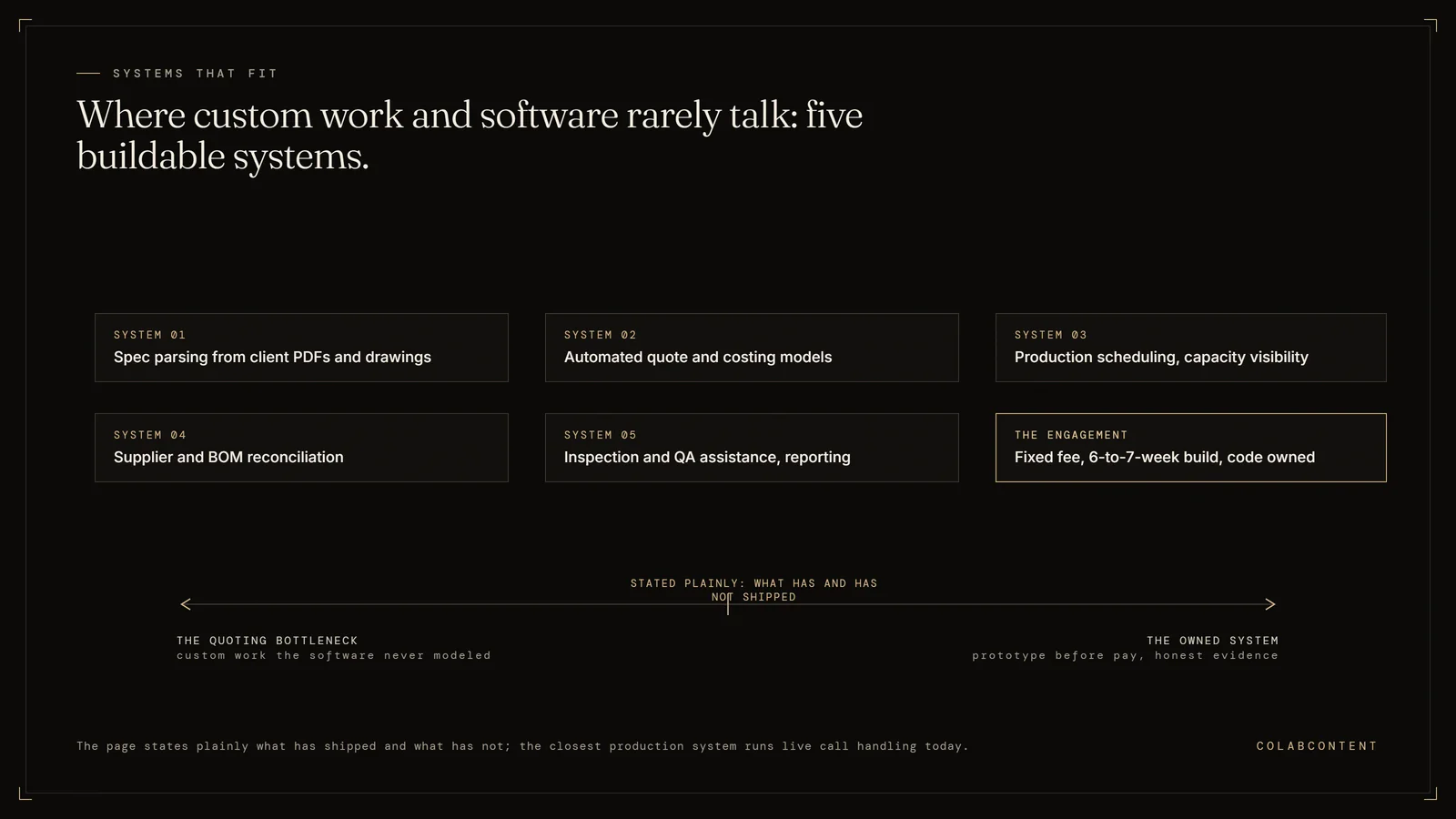
The five custom AI systems ColabContent scopes for specialty manufacturers: spec parsing from client PDFs and drawings, automated quoting and costing, production scheduling and capacity visibility, supplier and BOM reconciliation, and inspection and QA assistance
Where the shop ERP stops and the shop's own logic begins.

Written for the shop that already pays for JobBOSS2. We do not sell an ERP, we take no referral fee from anyone in the table below, and we will say plainly which shops should stay exactly where they are.

For10 to 40 person job shops on JobBOSS2
Incumbent cost$27,000 a year modelled, 15 users
Fixed fee$45,000 to $180,000, one time
Bottom lineCrossover at month 38, not day one
Prices readAugust 27, 2026

The short answer.

If you are on JobBOSS2 and the reason you are reading this is the renewal number, the cheapest single move is probably not a different ERP. It is a renegotiation, and the leverage you need for it is the multi year total further down this page rather than the per user rate on your invoice. If the reason is that JobBOSS2 does not do a thing your shop needs, be precise about what that thing is before you shop, because most of the systems below do the same job JobBOSS2 does: quote, schedule, track labour and material against a job jacket, cost it out, invoice it. They are competent at that job. None of them was built to know your routings, your customer specific paperwork, your inspection regime, or the way your estimator actually prices a repeat part.

So the honest verdict splits three ways. Shops under roughly 10 users are almost always better served by a cheaper published price system, and Cetec ERP and MRPeasy both publish complete rate cards you can check in ten seconds, which is more than ECI will do for you. Shops in the 15 to 40 user band with a working ERP and one named workflow that quietly burns hours every week are the ones where the arithmetic on this page actually flips, because at that headcount the subscription curve overtakes a one time build somewhere in year four while the per user model keeps taxing every hire. And shops that have already absorbed their infrastructure upgrade cycle, run a single site, and mainly need quoting, job costing and scheduling should stay, and there is a whole section below arguing that case as strongly as we know how.

What JobBOSS2 actually does well.

A comparison page that treats the incumbent as a punching bag is useless to the person actually holding the contract, so this part first. JobBOSS2 is a mature, purpose built job shop system, and the things it is good at are the things that are genuinely hard to build from scratch.

It is built for the job, not for manufacturing in general. That distinction sounds small and it is not. A job shop runs one off and short run work through variable routings, with material and labour posted against a travelling job number and a real time picture of what each job has consumed. Generic manufacturing software models a repeating bill of materials and a production run. Trying to force job shop work through that model is where most cheap alternatives quietly fail, and it is the reason so many shops on this page's shortlist eventually come back.

Quoting to job costing is one continuous thread. The estimate becomes the job, the job accumulates real cost, and the real cost is available next time somebody quotes a similar part. Shops that leave for a lighter tool frequently discover that they have broken that thread and that their quoting accuracy was resting on it.

A long installed base and people who know it. There are shops running this software lineage for well over a decade. Your next hire may already know the screens, an outside consultant who knows it can be found, and the failure modes are well travelled. That is worth real money and it is not something a newer product can manufacture.

Genuinely satisfied customers exist. Not every JobBOSS2 shop is unhappy, and pretending otherwise would tell you more about us than about the software. Capterra carries five star reviews of it alongside the critical ones, including from reviewers who note in the same breath that licensing costs can run expensive for smaller businesses. Read the full review set yourself before you decide, and read the five star ones as carefully as the one star ones.

Why shops start looking for a way out.

Four patterns, in the order they show up in the public review record and in the conversations we have.

The price you cannot see until you are on a call. ECI publishes nothing. We checked on August 27, 2026: the JobBOSS2 product page and its dedicated job shop software pricing page both route to a quote request, and the old jobboss.com pricing URL redirects into another quote gated ECI page. Capterra's listing confirms three tiers, Silver, Gold and Platinum, all shown as Custom Quote, billed per user per year, with no free trial and no free version. That is a negotiating problem as much as a pricing one, because you have no published standard to argue against.

Infrastructure costs that were not on the quote. Two named Capterra reviewers, in different roles and several years apart, describe forced spend on top of the subscription. Paula H., a General Manager in machinery, two stars, May 1, 2019, describes a hardware upgrade estimated at $20,000 driven by a version change. Joe B., an IT Director, two stars, December 30, 2015, describes a required Microsoft SQL Server upgrade at significant cost, with the SQL Server licence itself and migration services on top. Two reviews are two data points and not a survey. They are also two more than the other JobBOSS2 alternatives guides we read mention at all.

Change requests that arrive with an invoice. Don B., a CFO in semiconductors, one star, March 31, 2022, describes a nine month implementation that failed and a vendor relationship where every single change carried a charge. Take that as one shop's experience rather than a universal, but note the role: when the finance chair writes the review, the complaint is rarely really about software.

The thing the shop needs is not an ERP problem. Reading a customer print and pulling the tolerances and finish callouts out of it. Turning an emailed RFQ package into a costed quote without an estimator retyping anything. Reconciling a supplier acknowledgement against the purchase order. Knowing on Tuesday which jobs will miss Friday. No ERP module fixes those, and no amount of licence spend changes that. This is the category where a commissioned build actually belongs, and it is different from replacing your ERP.

What you are actually paying

Every number on this page, with its source.

Two of the vendors below publish a real, checkable rate card on their own website. Four publish nothing at all, including JobBOSS2 itself. We label each figure VERIFIED when it was read off the vendor's own page on August 27, 2026, and REPORTED when it came from a third party aggregator that the vendor has not confirmed. Where an aggregator is thin or we could not fetch a source at all, the cell says so and stays empty rather than getting filled with a plausible guess. That last rule costs us a row on ProShop, and it is the rule that makes the rest of the table worth reading.

VendorSold byPublished or reported priceImplementation, one timeSource
JobBOSS2 (ECI)Per user / year, three tiers named Silver, Gold, Platinum, all Custom QuoteNo published figure. Aggregator estimates: $100 (ITQlick); $85 to $110 for core deployments (single low trust snippet); $100 to $200+ broader range.$2,000 to $20,000. Described as a few thousand dollars for small businesses and tens or hundreds of thousands at enterprise scale.VERIFIED that no price is published: ecisolutions.com/products/jobboss2/job-shop-software-pricing/ and capterra.com/p/219273/JobBOSS/pricing/. REPORTED figures: itqlick.com/jobboss and itqlick.com/jobboss/pricing. The $85 to $110 figure comes from a single aggregator snippet we did not independently fetch and should not carry a decision on its own.
jobboss.com/pricingLegacy URL301 redirects to ecisolutions.com/products/jobboss/, also quote gated, no figureNot applicableVERIFIED jobboss.com/pricing, fetched August 27, 2026
Cetec ERPPer user / month, 5 user minimum$50 standard user. $25 shop floor user. $20 per customer or vendor portal. Support plans quoted separately at $650 a month (Standard) or $3,200 a month (Enterprise).No implementation fee stated on the pricing page. Free trial offered.VERIFIED cetecerp.com/pricing
MRPeasyPer user / month, 4 tiers$49 Starter, $69 Professional, $99 Enterprise, $149 Unlimited (2 user minimum). Discounted bulk pricing from the 11th user.No implementation fee. No contract. Training billed at $150 per hour.VERIFIED mrpeasy.com/pricing/
KatanaPer account / month, unlimited users on every paid tierFree tier at $0 with a 30 SKU cap. Core starts at $299 a month with usage based add-ons. Advantage is custom quoted annually.$2,000 optional onboarding on Core, included on AdvantageVERIFIED katanamrp.com/pricing/
FulcrumDirect sales, demo gatedNothing published anywhere on the site. Its pricing URL returns 404.Not publishedVERIFIED that nothing is published: fulcrumpro.com and fulcrumpro.com/pricing
ProShop ERPNot determinable from public sourcesWe could not fetch it. proshoperp.com and its pricing page both returned HTTP 403 on two separate attempts, so we are printing no figure rather than repeating an aggregator's guess.No usable source. Claim withheld.Not verified. Both fetch attempts blocked, August 27, 2026.
Global Shop SolutionsConcurrent user, upfront plus ongoing quarterly costNo dollar figures published. The pricing page describes the model and not the price.Not publishedVERIFIED that nothing is published: globalshopsolutions.com/pricing/
Commissioned build (ColabContent)One time fixed fee$45,000 to $180,000, scoped after a free diagnosis callIncluded in the fixed feeOur own published range. Maintenance is modelled at 15 percent of build cost per year, which is an industry rule of thumb and a stated assumption, not a quoted contract term.

The headline number, stated honestly

JobBOSS2 does not publish a price. Independent estimates converge on roughly $100 to $200 or more per user per month plus a $2,000 to $20,000 implementation fee, and all of those are reported aggregator estimates rather than vendor confirmed figures. We model $150 per user per month deliberately, because it sits inside the range rather than at the top of it, and because a model that quietly picks the most expensive plausible input is a sales tool rather than a model. If your renewal notice says $95, the whole comparison on this page moves, and the calculator will move it for you.

The cost nobody quotes you

Two named reviewers, two different roles, several years apart, describe infrastructure spend arriving on top of the subscription. Paula H., General Manager, machinery, two stars, May 1, 2019, describes a hardware upgrade estimated at $20,000 triggered by a version change. Joe B., IT Director, two stars, December 30, 2015, describes a required Microsoft SQL Server upgrade at significant cost, with the SQL Server licence and migration services excluded from that. We model this once at $15,000 inside a five year window, below Paula H.'s figure, and we deliberately do not apply it to the three year total, because putting a major version upgrade inside the first three years would overstate the near term case. Two reviews are not a rate. They are a question to put in writing before you sign anything: which server, database and client operating system versions does the next release require, and who pays when they change.

Normalise it: what a 15 person shop pays for a year of licence

Per user and per account pricing are not comparable until you fix the headcount. Hold one shop at 15 people, take each vendor's published or reported rate at face value with nothing negotiated, and ask what a single year of licence costs.

Vendor and planOne year, 15 users, licence onlyHow it is calculated
Katana Core$3,588$299 x 12, unlimited users, usage based add-ons excluded
Cetec ERP, 8 office plus 7 shop floor$6,900(8 x $50 + 7 x $25) x 12, support plan excluded
MRPeasy Starter$8,820$49 x 15 x 12, bulk discount above 10 users excluded
Cetec ERP, all 15 as standard users$9,000$50 x 15 x 12, support plan excluded
MRPeasy Professional$12,420$69 x 15 x 12
Cetec ERP, 8 plus 7 split, with Standard support$14,700$6,900 licence plus $650 x 12 support
MRPeasy Enterprise$17,820$99 x 15 x 12
JobBOSS2, low end of reported range$18,000$100 x 15 x 12
JobBOSS2, our modelled midpoint$27,000$150 x 15 x 12
JobBOSS2, high end of reported range$36,000$200 x 15 x 12
Fulcrum, ProShop, Global Shop SolutionsNot publishedNone of the three publishes a figure. Quote gated.

Read that table honestly and the first thing it says is not flattering to a page that ends with a build. Several of these alternatives are dramatically cheaper than JobBOSS2 on the licence line, and Katana at $3,588 a year for unlimited users is not close to anything else on the list. If your shop's problem is genuinely and only the monthly bill, the cheapest correct answer is somewhere in the top half of that table, not at the bottom of this page. What the table cannot show you is whether any of those systems can run job shop work the way you run it, which is the real question, and it is the reason the roundup below spends more words on fit than on price.

The three year and five year model

Licence is not the whole bill. The model below adds the one time implementation fee, holds the licence flat with no escalation because ECI publishes no escalation rate and inventing one would be dishonest, and shows the upgrade risk scenario as a separate row rather than folding it in. Against that sits a commissioned build at four points inside our fixed fee range, with maintenance modelled at 15 percent of build cost per year. That maintenance rate is a labelled assumption, a common software industry rule of thumb, not a ColabContent contract term.

Scenario, 15 users3 year total5 year totalComponents
JobBOSS2, low ($100 / user, $2,000 implementation)$56,000$92,000$18,000 a year plus implementation
JobBOSS2, modelled mid ($150 / user, $10,000 implementation)$91,000$145,000$27,000 a year plus implementation
JobBOSS2, high ($200 / user, $20,000 implementation)$128,000$200,000$36,000 a year plus implementation
JobBOSS2, mid plus one forced upgrade in year 4$91,000$160,000Mid scenario plus $15,000 modelled once, below the $20,000 a named reviewer describes
Commissioned build at $45,000 + 15% a year maintenance$65,250$78,750One time fee, then $6,750 a year
Commissioned build at $65,000 + 15% a year maintenance$94,250$113,750One time fee, then $9,750 a year
Commissioned build at $120,000 + 15% a year maintenance$174,000$210,000One time fee, then $18,000 a year
Commissioned build at $180,000 + 15% a year maintenance$261,000$315,000One time fee, then $27,000 a year

The rows we are obliged to point at are the ones that lose. At the three year mark, a $65,000 build costs $94,250 against $91,000 for the modelled JobBOSS2 mid scenario. The build is $3,250 behind. It does not win at three years and we are not going to write a sentence that implies it does. Against the low JobBOSS2 scenario the picture is worse for us: $92,000 over five years is beaten only by a build at the very bottom of our range, $45,000, which comes in at $78,750, and a $65,000 build never catches it inside five years at all. Back solving the thresholds: to beat the mid scenario on three year total a build has to come in under about $62,759, and under about $82,857 on five year total. Against the high scenario those thresholds are about $88,276 and $114,286. Against the mid scenario with one forced upgrade, about $91,429 over five years. If somebody tells you a custom build is always cheaper than an ERP subscription, they have not run this arithmetic, or they have and they are hoping you will not.

The crossover

Where the two lines meet.

Cumulative spend for the same 15 person shop, five years out. JobBOSS2 at our modelled $150 per user per month, with $10,000 implementation paid at year zero and no escalation, because ECI publishes no escalation rate. Against it, a commissioned build at $65,000, a conservative point inside our $45,000 to $180,000 range for a shop this size, paid once at year zero, with 15 percent a year maintenance after that. The dotted third line adds one forced hardware and SQL Server upgrade of $15,000 in year four, the pattern two named Capterra reviewers describe. Every figure in the chart comes from the table above.

Cumulative five year cost: JobBOSS2 subscription versus a one time commissioned build A line chart of cumulative spend for a 15 person job shop over five years. The JobBOSS2 line starts at $10,000 at year zero for implementation and rises steadily by $27,000 a year to $37,000, $64,000, $91,000, $118,000 and $145,000. The commissioned build line starts at $65,000 at year zero and rises gently by $9,750 of maintenance each year to $74,750, $84,500, $94,250, $104,000 and $113,750. The build line is above the subscription line for the first three years, meaning the build is the more expensive decision over that period, and at year three it is $3,250 higher. The two lines cross at about 3.19 years, roughly month 38, at about $96,100 of cumulative spend on either path, after which the subscription line is permanently above the build line. By year five the gap is $31,250. A third dotted line branches at year three to show the upgrade risk scenario, adding one forced hardware and SQL Server upgrade of $15,000 in year four, which reaches $133,000 at year four and $160,000 at year five and widens the year five gap to $46,250. $0 $40K $80K $120K $160K Year 0 Year 1 Year 2 Year 3 Year 4 Year 5 Crossover, month 38 With one forced upgrade $160,000 JobBOSS2 $145,000 Owned build $113,750 JobBOSS2, 15 users at $150, no escalation Commissioned build, $65,000 once, 15% maintenance

Look at where the build line starts. It is above the subscription line for the first three years, which means that for three years the build is the worse financial decision, and the chart says so instead of hiding it by starting the axis somewhere convenient. At year three the build is $3,250 behind. The lines cross at about 3.19 years, roughly month 38, at about $96,100 of cumulative spend on either path. After that the gap widens every year, because one line has a slope of $27,000 a year and the other has a slope of $9,750. At year five the difference is $31,250, and $46,250 if the upgrade cycle two reviewers describe lands inside the window. Nothing in the model bends the subscription line back down, because nothing in the real contract does either.

Change the build price and the crossover moves, sometimes off the chart entirely. At $45,000 it happens inside year two. At $120,000 it does not happen within five years against the mid scenario, and you should not commission a build at that price on cost grounds alone. The cost argument is one of nine arguments below and it is the only one on this page that a spreadsheet can settle. Run yours.

Your shop, your numbers

The JobBOSS2 total cost calculator.

Every default below is the figure from the table above, and every one is editable, because the defaults are an estimate of a price ECI will not publish and your renewal notice is a fact. Nothing is submitted anywhere. No email gate, no external request, no stored value. The arithmetic runs in your browser and stops there. If your inputs make the build lose, the tool says so in plain language rather than quietly rounding it away.

Office, estimating, scheduling and shop floor licences combined.
Reported $100 to $200+. ECI publishes nothing. Use your renewal notice.
Reported $2,000 to $20,000. Enter 0 if you already paid it.
Defaults to 0. ECI publishes no escalation rate, so we do not model one. Set it if your renewal notice shows one.
Off by default. Two named Capterra reviewers describe this pattern; it is a scenario, not a rate.
Both totals are calculated over this horizon.
ColabContent fixed fee range, $45,000 to $180,000, set after the diagnosis call.
Software industry rule of thumb, not a ColabContent contract term. Replace it with a real quote before deciding.
The roundup

Eight options, in the order we would look at them.

One note on the roster before the list. One published JobBOSS2 alternatives guide lists FACTIVITY, Runcard and TrakSYS as alternatives. Those are shop floor data collection and MES tools, not job shop ERPs, and a shop owner notices that category error on first scan. A major review directory's JobBOSS2 alternatives page returns a 404 today, so its list is not there to read at all. The list below covers systems that actually do the job JobBOSS2 does, in the order a shop holding an ECI contract would sensibly evaluate them, and it says where each one falls short.

1. Cetec ERP

What it is. A full ERP covering quoting, production, inventory, purchasing and accounting, sold cloud first, and notable in this category for one reason above all others: it publishes its prices.

Price. VERIFIED from cetecerp.com/pricing on August 27, 2026. $50 per standard user per month with a five user minimum. $25 per shop floor user per month. $20 per customer or vendor portal per month. Support plans are separate and material: $650 a month for Standard or $3,200 a month for Enterprise. No implementation fee is stated on the pricing page and a free trial is offered.

Best for. Shops that want to stop negotiating and start budgeting, and shops with more people on the floor than in the office, where the $25 shop floor tier does real work. A 15 person shop split 8 office and 7 floor is $6,900 a year of licence, or $14,700 with the Standard support plan.

Where it falls short. The support plan is the catch, and at $650 a month it is not a rounding error against a $6,900 licence. It is also a broad ERP rather than a job shop specialist, so validate your own routings, your travellers and your job costing detail against it before you get excited about the number.

Verdict. The strongest price transparency story in the category, and the first call to make if your problem is the bill.

2. MRPeasy

What it is. Cloud manufacturing ERP aimed squarely at small manufacturers, with production planning, stock, procurement and CRM in one place, sold self service.

Price. VERIFIED from mrpeasy.com/pricing on August 27, 2026. Four tiers per user per month: Starter $49, Professional $69, Enterprise $99, Unlimited $149, with a two user minimum and discounted bulk pricing from the eleventh user. No implementation fee, no contract, a 15 day free trial extendable by another 15 days, and training billed at $150 an hour.

Best for. Shops under roughly 15 users that want to test a system against their own parts before committing a dollar. The free trial plus no contract structure means the evaluation costs you time and nothing else, which is the opposite of an ECI sales cycle.

Where it falls short. It thins out at scale. Complex multi operation routing, heavy subcontract flows and genuinely variable job shop scheduling are where shops report outgrowing it. If your constraint is scheduling complexity rather than cost, this is not the fix.

Verdict. Right sized under about 15 users. Test it free before you believe anyone, including us.

3. Katana

What it is. Cloud manufacturing software with a strong inventory and light manufacturing orientation, priced per account rather than per user.

Price. VERIFIED from katanamrp.com/pricing on August 27, 2026. A free tier at $0 capped at 30 SKUs. Core starts at $299 a month with usage based add-ons. Advantage is custom quoted on an annual basis. Unlimited users on every paid tier. Onboarding is $2,000 optional on Core and included on Advantage.

Best for. Light manufacturing and maker operations, and any shop where a lot of people need read access and nobody wants to buy fifteen seats to get it. Unlimited users at $299 a month is the best per head economics on this page by a distance.

Where it falls short. It is not a job shop system. Complex multi operation routing on one off work is not what it was built for, the free tier's 30 SKU cap makes it a demo rather than an option, and the usage based add-ons on Core mean the headline $299 is a starting point rather than a total.

Verdict. Excellent economics, wrong shape for most true job shops. Evaluate it only if your work is more repeat build than one off.

4. Fulcrum

What it is. A modern, cloud native manufacturing platform positioned directly at the shops JobBOSS2 serves, and probably the closest genuine peer on this list in terms of what it is trying to be.

Price. Nothing published. VERIFIED on August 27, 2026 that fulcrumpro.com carries no pricing anywhere and that its pricing URL returns 404. It is a demo gated, direct sales, custom quote model, which is exactly the pattern that brought you to this page in the first place.

Best for. Shops that want a genuinely modern interface and modern integration surface, and that are willing to run a sales cycle to find out what it costs.

Where it falls short. You cannot evaluate it on price without a call, which means you cannot compare it against Cetec or MRPeasy on the only axis where those two are strongest. Switching from one quote gated vendor to another quote gated vendor does not solve a pricing transparency problem, it relocates it.

Verdict. A real competitor and a real product. Get the quote in writing before you get attached.

5. ProShop ERP

What it is. A job shop ERP with quality management, document control and compliance workflow built into the core rather than bolted on, which is why it shows up constantly in aerospace and medical device shops.

Price. We do not know, and we are not going to pretend. Both proshoperp.com and its pricing page returned HTTP 403 to our fetches on two separate attempts on August 27, 2026. Aggregator listings mention it without a confirmed public rate card. No figure is printed here because we could not stand behind one.

Best for. AS9100 and ISO 13485 shops where quality documentation, traceability and audit readiness are load bearing parts of the operation rather than paperwork bolted onto the side of it. That is a genuinely differentiated position and no other product on this list occupies it as directly.

Where it falls short. It is a heavier system with a heavier change in working practice, and we could not verify pricing, so budget it as unknown until you have a written quote.

Verdict. The specialist answer for regulated shops. Price it directly, because nobody publishes it, us included.

6. Global Shop Solutions

What it is. A long established, broad ERP for manufacturers, aimed at larger job shops that would rather run one heavy system than assemble point tools.

Price. Nothing published. VERIFIED on August 27, 2026 that globalshopsolutions.com/pricing describes the model, a concurrent user licence with an upfront cost plus an ongoing quarterly cost, and prints no dollar figures. The concurrent user model is worth understanding on its own terms, because it prices simultaneous logins rather than named people and it can be cheaper or more expensive than per user depending entirely on your shift pattern.

Best for. Shops above roughly 20 users that want depth across the whole business and have the internal capacity to run a serious implementation.

Where it falls short. Quote gated like the incumbent, heavier than most shops leaving JobBOSS2 are shopping for, and the quarterly ongoing cost structure means the total is harder to model than a monthly per user number.

Verdict. A real option at the larger end. Ask specifically how concurrent users are counted across shifts before anything else.

7. The enterprise ERP field: NetSuite, Acumatica, Epicor Kinetic and Odoo

What they are. The tier above job shop software. The major review directories list these at the top of their JobBOSS2 alternatives grids, alongside a long tail that includes MIE Trak Pro, Genius ERP, Rootstock and ERPAG.

Price. None of the directories that recommend them price them, which is a fair summary of the whole problem this page exists to fix. We are not going to estimate an enterprise ERP contract from a search snippet.

Best for. Multi entity or multi site manufacturers where the constraint is consolidated finance and inventory across the group rather than the shop floor itself.

Where they fall short. For a single site job shop this is usually a bigger, slower and more expensive purchase than the problem calls for, and the implementation is measured in quarters. If you want the detail on that tier, our Epicor AI alternatives page covers Kinetic with the same cost model, and the Epicor Kinetic AI playbook covers what building beside one of these actually involves.

Verdict. Evaluate these when the constraint is the group, not the shop.

8. A commissioned build you own

What it is. Usually not a replacement for your ERP. A custom system built for the specific workflow no ERP module covers, sitting alongside whichever shop system you keep, owned by the shop at handoff. In practice that means reading customer prints and RFQ packages and turning them into structured quote data, reconstructing what a repeat part actually costs from your own closed job history, flagging on Tuesday which jobs will miss Friday, or reconciling supplier acknowledgements against purchase orders without anyone retyping a line.

Price. A fixed fee of $45,000 to $180,000, set after a free 45-minute diagnosis and after the integration depth is named. Maintenance is modelled on this page at 15 percent of build cost per year, which is a stated industry rule of thumb rather than a contract term, and the real number is set in writing before you sign anything.

Best for. Shops in the 15 to 40 person band with an ERP that basically works and one named workflow that burns hours every week, that expect to run the same core process for five or more years.

Where it falls short. It is a bigger single cheque, it needs a tighter scope than buying software does, it loses on three year cost against a mid range JobBOSS2 contract as the table above shows, and it loses outright against a cheap one. It also does not replace your ERP, so if what you want is to stop paying ECI entirely, this alone is not that.

Verdict. The option nobody in the table above will show you, and the only one where the bill stops going up.

The ownership case

Nine arguments for owning it instead.

Each of these is either arithmetic you can check on this page or a structural fact about the two models. Where an argument does not honestly apply to your shop, the section after this one says so.

One. The math, restated. A subscription never ends. At the modelled mid scenario a 15 person shop pays $91,000 over three years and $145,000 over five, and year six starts at zero progress. A $65,000 build costs $94,250 over the same three years and $113,750 over five, so it loses at three and wins at five, with the crossover at about month 38 and roughly $96,100 spent on either path. After that point the gap widens every year because one line has a slope of $27,000 and the other has a slope of $9,750. That is the whole cost argument, and the chart is on this page rather than in a sales deck precisely so you can see the three years where it does not work.

Two. Per user pricing taxes headcount. Every person you add raises the bill by the same rate whether that person is a full time estimator or a floor lead who logs in twice a shift. Five more users at $150 is $9,000 a year, added automatically, forever, with nobody making a decision about it. An owned system has no marginal seat cost at all, so the hiring decision stops carrying a software decision inside it. This one bites hardest on the shop floor, where the people who most need to see a schedule are the ones a per user model most discourages you from licensing.

Three. Asset versus expense. A subscription is rent and it leaves nothing behind. A commissioned build is a piece of the business: transferable, valuable in a sale or succession conversation, and on the balance sheet rather than only on the expense line. For an owner thinking about a five or ten year horizon, or about what the shop is worth to a buyer, that difference is not cosmetic.

Four. Built around your routings, not the median shop's. Every product in the roundup above is calibrated against the average customer in its category, which means you pay for the whole feature bundle and adapt your process to the part of it you actually use. A commissioned system starts from your travellers, your inspection points, your customer specific paperwork, your estimating logic. Nobody gets retrained into someone else's assumptions about how a job moves.

Five. AI at the core rather than as a per seat add-on. The pattern across this category is consistent: AI arrives as a premium module quoted on top of the existing licence and scaled by seat count, at a rate nobody publishes because nobody in this category publishes any rate. In a commissioned build there is no separate AI licence, because the AI is the system rather than a feature attached to it, and adding a user costs nothing. We are stating this as the structural difference between the two models rather than quoting an ECI AI price, because ECI publishes no price for anything and we are not going to invent one.

Six. Unlimited users. Estimators, schedulers, machinists, inspection, shipping, temporary help through a busy quarter, and where it makes sense your customers themselves. Zero marginal cost per person changes the question from who needs a licence to who needs access, which is a better question and one that usually improves the shop rather than the software bill.

Seven. Data ownership and no exit ransom. Your closed job history is the most valuable data your shop owns, because next year's quote is priced off what a similar part actually cost last year. In a subscription that history lives inside a structure the vendor designed, and your ability to take it with you depends on an export path you did not build. Owning the structure removes the negotiation from leaving, and it removes the quiet pressure that keeps shops renewing contracts they have already decided against.

Eight. Vendor risk you stop carrying. This category supplies its own evidence and JobBOSS2 is part of it. The product carries the lineage of the older E2 Shop System under a new name and a different corporate owner, ECI Software Solutions, which is a normal outcome in manufacturing software and one that arrives with migration work attached. Version changes can force infrastructure spend, as two named reviewers describe above. Consolidation, rebranding and forced upgrades are the weather in this category. A system you own does not get renamed, resold or sunset by anybody.

Nine. Change speed. A change request to your own system is a scoping conversation and a deployment. A change request to a vendor is a ticket in a queue behind every other customer's, with no committed date and no obligation. Don B.'s review above describes the version of that where every change carries an invoice. When the thing you need changed is the thing that makes your shop different from the shop down the road, neither the queue nor the invoice is an acceptable answer.

What we can actually prove

The nine arguments above are worth exactly as much as the evidence behind the firm making them, so here is ours, with nothing rounded up and one thing said plainly that most vendors would leave out. Jim Glaser Law is our nameable reference and the principal takes reference calls. Across our practice, more than 6,000 calls have been handled by systems we built. The LELF platform is the fullest example of what commissioning looks like end to end: a 47-attorney litigation firm runs its matter, invoice and trust operation on it, holding 13,296 matters, 4,396 clients and 5,684 invoices, with trust reconciled byte identical against the system it replaced. That firm is under confidentiality and stays anonymised, which is why we name the platform and not the firm. Across the practice we have delivered more than forty commissions.

Now the part that matters to you specifically: our nameable reference is a law firm, not a job shop. What that evidence supports is a specific claim, which is that we can build and run a system carrying real daily operational volume and reconcile it to the penny under audit. What it does not support is a claim that we have decommissioned a JobBOSS2 installation for anyone, because we have not, and the migration section below says so in plain language rather than around it. If a vendor's proof does not match your industry, the right response is to ask harder questions on the call, not to accept a case study that was written to sound like one.

The honesty section

Who should stay on JobBOSS2.

Six situations where every argument in the previous section fails, and where we would tell you to stay put on a call.

Shops under about 10 users. The arithmetic does not work and it is not close. At 10 users and $150 a month, three years of licence is $54,000, and even at the top of the reported range the five year licence is $120,000, or $140,000 with a $20,000 implementation on top. The cheapest build we would scope, $45,000, costs $65,250 over three years with maintenance. Below that threshold the right move is a cheaper published price system, and Cetec ERP and MRPeasy both publish numbers you can check today, with MRPeasy offering a free trial so the evaluation costs you nothing but time.

Shops that have already absorbed the upgrade cycle. If you paid for the hardware refresh and the SQL Server upgrade in the last two years, the single largest hidden cost in the model has already left your future. Your JobBOSS2 economics just got materially better and the crossover just moved further out. Do that arithmetic before anything else.

Shops living inside quoting, job costing and scheduling with no appetite for more. If what you need is a competent job shop ERP doing exactly the three things it was built for, JobBOSS2 does them, it does them for a large installed base, and the review record includes genuinely happy five star customers. Replacing a system that works because a comparison page told you to is how shops end up with a nine month failed implementation and a worse version of what they had.

Shops that need a working system next quarter. A commissioned build runs a prototype on your real data in seven to ten days and production in five to seven weeks, and an ERP migration on top of that is measured in months, not weeks. If the deadline is real and near, buying is faster than building and it is not close.

Shops where nobody will own the system internally. An owned build needs a named person who cares about it, even lightly. A shop without that person is better off renting, because the alternative is an orphaned system that decays quietly and nobody notices until it matters.

Shops whose constraint is not software at all. If the hours are leaking into machine setup, material lead times, an inspection bottleneck or a staffing gap, changing systems is motion rather than progress. A meaningful share of the diagnosis calls we run end with us recommending the shop keep what it has, and this is the most common reason.

Decision tree

Six questions, in order, with stop points.

1. Is your shop under 10 users? If yes, stop here. Price Cetec ERP and MRPeasy against your current contract, start the MRPeasy free trial this week, and spend nothing else. A commissioned build will not return its cost at your volume. If no, continue.

2. Do you know your actual per user rate, your renewal date and your notice period? If no, stop and go find the contract. Every decision after this one depends on it, and the reported ranges on this page are a substitute for that document rather than a replacement for it. If yes, continue.

3. Run your numbers in the calculator above. Is your five year JobBOSS2 total below about $79,000? If yes, stop. The cheapest build we would scope is $45,000, which costs $78,750 over five years with maintenance, so no build we quote can beat your contract on cost. Renegotiate at renewal and spend your energy on the shop floor. If no, continue.

4. Is the thing that actually costs you money an ERP problem? If yes, meaning quoting, scheduling, job costing or inventory as such, then a different ERP may genuinely help and Cetec, MRPeasy or Fulcrum is where to look. Stop here and go price them. If no, continue.

5. Can you name the workflow in one sentence, with a rough dollar or hour figure attached? If no, stop, and spend two weeks measuring before anyone spends money. Every failed build we have seen started with an unnamed constraint. If yes, continue.

6. Is the budget runway for a $45,000 to $180,000 fixed fee real this quarter, and is the owner or plant manager willing to spend 45 minutes on the diagnosis? If no, park it and revisit at renewal, and put the upgrade question from this page in writing to ECI in the meantime. If yes, that call is the next step, and a meaningful share of them end with us telling a shop to stay where it is.

Next step

Book the 45-minute diagnosis.

Bring your renewal notice and one sentence describing the workflow that burns hours. You leave with the constraint written down either way, and a meaningful share of these calls end with us telling a shop to stay where it is.

Free · 45 minutes
Under NDA
Owner to owner
No follow-up unless asked
Migration reality

What leaving JobBOSS2 actually involves.

None of the other JobBOSS2 alternatives guides we read answers this question with specifics, which is strange, because it is the question that decides whether a shop ever acts on any of the rest. Here is the honest shape of it. The timelines below are our own scoping ranges for an engagement of this type, stated as estimates rather than dressed up as research, and no vendor publishes a comparable figure.

You are not moving jobs. You are moving five things. Customer, part and vendor masters are the easy part and they are the part every vendor's migration page talks about. The other four are where projects overrun. Open work in process, meaning live jobs with partial labour and material already posted, which is why the cutover belongs at a natural quiet point rather than mid quarter. Closed job cost history, which is the asset your estimator actually uses and the one that quietly resets your quoting accuracy if it does not come across. Routings and standards, which encode years of process knowledge that nobody wrote down anywhere else. And quality and traceability records, which in a regulated shop carry retention obligations that outlive the software decision entirely, making this a compliance question before it is an IT one.

Phase one: export and inventory. Before anything moves, someone has to answer what is actually in there and what of it matters. The deliverable that matters at the end of this phase is a reconciliation count: jobs out equals jobs in, cost totals matching to the dollar, with exceptions listed rather than rounded away. Ask any prospective vendor who does that reconciliation and who signs off on it, because the answer is frequently nobody.

Phase two: parallel run. Both systems live. New jobs go into the new system, the old one goes read only, and nothing is switched off. Run this through at least one full month end close, because the gaps in an ERP migration do not surface when you look for them, they surface when somebody needs the cost detail on a job you ran in 2021 because the customer wants the same part again. A shop that skips the parallel run to save six weeks usually spends the saving twice.

Phase three: decommission. Only after the parallel run has produced no unresolved exceptions, and only after somebody has read the notice provisions in the contract, because a subscription that auto renews will renew during a migration if nobody sends the letter. Before you switch anything off, confirm in writing how long you retain read access to the old system and in what format your data leaves it.

What we do and do not do here. We have not run a JobBOSS2 decommissioning and we are not going to imply otherwise. What we build is the workflow layer that sits on top of whichever shop system you land on, which is a different job and one we have evidence for. If your project needs an ERP migration partner, that is a specialist engagement, and the vendor you are moving to will usually name two or three.

The option most shops do not consider. You do not have to leave to fix the problem. In a large share of the cases we see, the ERP is fine, the licence is defensible, and the hours are leaking into a workflow that sits beside it: the RFQ package nobody has time to read, the quote that gets priced from memory, the schedule that only exists properly in one person's head. That path keeps JobBOSS2, keeps the installed knowledge, keeps the job history where it is, and builds the missing piece against it. No migration, no parallel run, no decommissioning letter.

Deep dive

The dimensions the price table cannot show.

Six dimensions, side by side.

Price transparency. Cetec ERP and MRPeasy publish complete rate cards. Katana publishes a starting price with usage based add-ons on top. JobBOSS2, Fulcrum, ProShop and Global Shop Solutions publish nothing at all, and one of those pricing URLs returns a 404. Transparency is not the same as cheapness, but an undisclosed price lets the seller quote against the buyer rather than against the work.

Trial before purchase. MRPeasy offers 15 days plus another 15, Cetec offers a free trial, Katana has a free tier. The quote gated vendors offer a demo, which is a different thing: a demo shows you the software working on somebody else's data. A trial shows you whether it works on your routings, and that is the only test that matters.

Infrastructure obligations. This is the axis nobody advertises. A deployment model that ties you to specific server, database and client versions can hand you a bill that never appeared on the software quote, which is what two named reviewers describe. Ask every vendor, including the cloud ones, what happens to your costs when they change a supported version.

Cost slope. Every subscription here rises with headcount and with renewal. A commissioned build is a one time fee plus a flat maintenance line. The slope, not the starting point, is what decides a five year comparison, and it is why the crossover chart matters more than the price table.

Ownership at exit. Every vendor here retains the code, the structure and the pipeline. A commission transfers all three at handoff, running in the shop's own environment. That is the difference between an export and a handover, and it is most visible in what happens to a decade of closed job cost history.

Fit for true job shop work. Variable routings, one off and short run parts, subcontract operations, real time labour and material against a travelling job number. JobBOSS2, Fulcrum, ProShop and Global Shop Solutions are built for this. Katana and, at scale, MRPeasy are not, whatever their pricing pages make you feel.

When to pick which, in one paragraph each.

Stay on JobBOSS2 if your rate is at the low end of the reported range, your upgrade cycle is already paid for, or you need certainty next quarter. Take the five year total from this page into the renewal conversation as leverage rather than as a reason to leave.

Move to Cetec ERP if price transparency is the thing you are actually buying and you have more people on the floor than in the office, and price the support plan in before you compare anything.

Move to MRPeasy if you are under about 15 users and want to test a system against your own parts before committing a dollar. Start the free trial this week; it costs nothing to find out.

Move to Katana only if your work is more repeat build than one off, in which case unlimited users at $299 a month is the best economics on this page.

Move to Fulcrum, ProShop or Global Shop Solutions if you want a genuine job shop peer and you accept running a sales cycle to learn the price. ProShop specifically if quality and compliance workflow is load bearing.

Commission a build if the ERP is fine, the constraint is a named workflow, and the five year subscription total on this page is comfortably above what a scoped build would cost. Most shops in that position keep JobBOSS2 and build beside it.

Why this page is written by someone who does not sell an ERP.

Worth saying plainly, because it changes how you should read everything above. Here is what the other JobBOSS2 alternatives guides actually hand a shop owner today. The best developed one, updated in January 2026, reviews five alternatives and prints no price for any of them, including JobBOSS2 itself, and one of the five it recommends is the publisher's own product. A major review directory's JobBOSS2 alternatives URL returns a 404, so that list is simply gone. The most FAQ shaped one answers the cost question with a single number and its own house score, and lists shop floor data collection tools as ERP alternatives. Two more are directories that blocked our fetch entirely. Meanwhile the two places actual shop owners talk about this software in public, an active Reddit community and a long thread on practicalmachinist.com, get named across those guides without anyone linking the conversation. We attempted that thread twice and it returned HTTP 403 both times, so we are telling you it exists and never quoting it.

ColabContent sells commissioned AI builds. We do not sell an ERP, we take no referral fee from anyone in the roundup, and we have no reason to steer you toward or away from any of them. That does not make us neutral about the conclusion, obviously, and the whole point of publishing the arithmetic and the assumptions is that you can see exactly where our interest starts affecting the numbers. It does mean that when this page says Katana's licence line is the cheapest in the table by a wide margin, or that a $65,000 build loses on three year cost against a mid range JobBOSS2 contract, nothing commercial is pulling in the other direction.

What a build beside your ERP actually looks like.

Four workflows come up repeatedly in job shops, and they share a property: none of them is an ERP module problem, which is why buying a different ERP does not touch them.

RFQ package to structured quote. A customer emails a zip of prints, a spreadsheet and a purchase order in three formats. Today somebody opens each one and retypes it. A build reads the package, pulls part numbers, quantities, materials, tolerances and finish callouts into structured quote lines, and hands the estimator a draft to correct rather than a blank screen. The estimator still prices the job. They just stop doing data entry to get there.

Quote intelligence from your own history. Not a guess at what a part should cost, but what a similar part actually cost the last four times you ran it, pulled from your closed job history with the variance and the reason attached. This is the workflow with the clearest dollar figure on it, because a shop that systematically underquotes one family of parts usually does not know which family.

Schedule risk, surfaced early. Which jobs currently on the floor will miss their promise date, ranked, on Tuesday rather than Friday. The data is already in your ERP. What is missing is something that looks at it every morning and tells somebody, in words, what is about to go wrong.

Supplier acknowledgement reconciliation. Matching what the supplier confirmed against what you ordered, flagging the date and quantity and price changes nobody caught, before the material arrives short.

The posture is read and suggest by default, with a human approving anything that leaves the building, relaxing to spot check only after the output has held quality for 60 to 90 days. Integration happens at the documented API layer as the primary route, and where a system exposes no usable API the honest answer is that the integration is harder and the scope reflects it rather than pretending otherwise. We do not replace your ERP and we will say so on the call.

Questions

The eight questions JobBOSS2 buyers actually ask.

How much does JobBOSS2 cost per user?

Nobody outside ECI's sales team knows, and any page that gives you a confident single number is guessing. We checked the vendor directly on August 27, 2026: the JobBOSS2 pricing page on ecisolutions.com asks you to request a quote and prints no dollar figure at all, and jobboss.com/pricing redirects to another quote gated ECI product page. Capterra's listing confirms the shape of the deal, three tiers named Silver, Gold and Platinum, all shown as Custom Quote, billed per user per year, with no free trial and no free version. Independent aggregators do publish estimates and they do not agree with each other: ITQlick states $100 per user per month, one lower trust aggregator snippet describes $85 to $110 per month for core deployments, and a broader search estimate puts the range at $100 to $200 or more per user per month. Every one of those is a reported figure that ECI has not confirmed. We model $150 per user per month, deliberately inside that range rather than at the top of it, and the calculator on this page lets you replace it with the number on your own renewal notice.

Does JobBOSS2 or ECI publish a price list?

No. This is a verified fact rather than an impression. On August 27, 2026 we fetched the ECI JobBOSS2 product page and its dedicated job shop software pricing page, and both route to a quote request with no dollar figure anywhere on them. The legacy jobboss.com/pricing URL returns a 301 redirect to ECI's JobBOSS product page, which is also quote gated. That matters for a reason beyond convenience. When a vendor publishes no rate card, every number you are quoted is quoted against you rather than against a published standard, and you have nothing to hold up in a renewal conversation. Two of the alternatives on this page, Cetec ERP and MRPeasy, publish complete rate cards you can read in ten seconds, and that alone changes the negotiation.

Why do JobBOSS2 users report unexpected hardware or SQL Server upgrade costs?

Because the deployment model can carry infrastructure obligations that never appear on the software quote, and two separate named Capterra reviewers describe exactly that. Paula H., a General Manager in the machinery industry, left a two star review on May 1, 2019 describing a hardware upgrade estimated at $20,000 forced by a version change. Joe B., an IT Director, left a two star review on December 30, 2015 describing a required Microsoft SQL Server upgrade at significant cost, with the SQL Server licence itself and the migration services on top of that. Those are two data points from two different roles across a several year span, not a survey, and we are presenting them as exactly that. What makes them worth printing is that none of the other JobBOSS2 alternatives guides we read mentions the pattern at all. If you are evaluating JobBOSS2 or renewing it, the question to put in writing is which server, database and client operating system versions the next release requires, and who pays when they change.

What is the difference between JobBOSS2 and the older E2 Shop System?

JobBOSS2 is the current ECI Software Solutions product name and it carries the lineage of the older E2 Shop System, which is why so many shops still say E2 out loud and search for JobBOSS. Beyond that, we are going to be careful, because the feature level lineage is the kind of detail that gets repeated confidently across aggregator pages without a primary source behind it, and we could not read one. What we can verify from our own fetches on August 27, 2026 is that ECI maintains a separate JobBOSS product page from its JobBOSS2 product page, and that the old jobboss.com/pricing URL redirects into the former. If your shop is running an older E2 or JobBOSS installation, the practical question is not naming history, it is which version you are on, what the upgrade path to the current release requires, and whether that path carries the infrastructure costs two reviewers describe above. Ask ECI those three questions in writing.

What are the best JobBOSS2 alternatives for a small job shop?

For a shop under roughly 10 users the honest shortlist is short, and it is led by the two vendors that publish real prices. Cetec ERP is $50 per standard user per month with a five user minimum and $25 per shop floor user, which suits a shop with more people on the floor than in the office, though its support plans are quoted separately at $650 or $3,200 a month and you should price those in before comparing. MRPeasy publishes four tiers at $49, $69, $99 and $149 per user per month with no implementation fee and no contract, and its 15 day plus 15 day free trial means you can test it against your own routings before spending anything. Katana starts at $299 a month for unlimited users, which is unusually good economics for a shop with many light touch users, but it is built for light manufacturing rather than complex multi operation job routing. Fulcrum, ProShop and Global Shop Solutions are all real competitors and all quote gated. A commissioned custom build is the wrong answer at this size, and the section on this page about who should stay says so directly.

Is Cetec ERP cheaper than JobBOSS2?

On the licence line, almost certainly yes, and Cetec is the only vendor here where you can check that claim yourself in under a minute. Read off cetecerp.com/pricing on August 27, 2026: $50 per standard user per month with a five user minimum, $25 per shop floor user, $20 per customer or vendor portal, and support plans at $650 a month for Standard or $3,200 a month for Enterprise. Model a 15 person shop as 8 office users and 7 shop floor users and the licence is $575 a month, or $6,900 a year, and adding the Standard support plan brings it to $14,700 a year. Against our modelled JobBOSS2 figure of $27,000 a year at $150 per user per month, Cetec is roughly half. That comparison has a real caveat attached: the JobBOSS2 side is a reported estimate rather than a vendor confirmed price, so what you are comparing is a published number against an estimate. Get your actual ECI renewal figure before treating the gap as settled.

What happens to my historical job costing data if I leave JobBOSS2?

This is the question that decides whether a shop ever acts, and none of the other JobBOSS2 alternatives guides we read addresses it. The honest answer is that you are not moving jobs, you are moving five things, and only the first is easy. Customer, part and vendor masters export cleanly almost everywhere. Open work in process, meaning live jobs with partial labour and material posted against them, is the part that hurts, which is why the cutover belongs at a natural quiet point rather than mid quarter. Closed job cost history is the asset your estimator actually uses, because next year's quote is priced off what a similar part really cost last year, and if that history does not come across your quoting accuracy resets to somebody's memory. Routings and standards encode years of process knowledge. Quality and traceability records may carry retention obligations that outlive the software decision entirely, which is a compliance question before it is an IT one. Our planning shape is a full export and reconciliation of closed job history before anything else starts, then a parallel run through at least one full month end close, then decommission. Those are our own scoping estimates for an engagement, not figures published by ECI or anyone else.

How long does it take for a custom built shop system to pay for itself against a subscription ERP?

Around month 38 in our base case, and we would rather print that than a friendlier number we cannot defend. The model is a 15 user shop at $150 per user per month with a $10,000 implementation, against a $65,000 commissioned build with maintenance modelled at 15 percent of build cost per year. Solving for equal cumulative spend gives 3.19 years, which is roughly month 38, at about $96,100 spent on either path. Before that point the subscription is cheaper and the build is the worse financial decision, and at the three year mark specifically the build costs $94,250 against $91,000 for JobBOSS2, so the build is $3,250 behind. By year five the same build is $31,250 ahead, and $46,250 ahead if you hit the kind of forced hardware and SQL Server upgrade two named reviewers describe. The maintenance rate is a labelled assumption, an industry rule of thumb rather than a quoted ColabContent contract term, and it is the single input most worth replacing with a real number before you decide anything.

Buyer worksheet

What to have in front of you before any call.

Five things to pull before you talk to anyone.

One. Your current contract, not your invoice. The contract is where the term, the renewal mechanics, any escalator and the notice period live. Every reported figure on this page is a substitute for that document and a worse one.

Two. Your actual user count, split. Office and estimating, scheduling, shop floor, and anyone holding a licence who has not logged in this quarter. That last group is usually the fastest money a shop finds, and it costs nothing to look.

Three. Your infrastructure position. When did you last refresh the server, and what SQL Server version are you on. If both were done recently, your JobBOSS2 economics are better than this page's model assumes and you should say so on any call.

Four. One quarter of quoting throughput. How many RFQs came in, how many got quoted, how many were won, and roughly how many estimator hours went into that. If a build is going to pay for itself anywhere, this is where the number comes from.

Five. One sentence naming the workflow that burns hours. With a rough dollar or hour figure attached. If you cannot write that sentence, no vendor on this page can help you, and neither can we.

Six questions to ask every vendor, including us.

What is the term, and what happens at renewal? Ask for any escalator in writing. A vendor that will not commit one to paper has told you something.

What server, database and client versions does the next release require? This is the question the two named reviewers on this page would tell you to ask, and it is the one nobody asks before signing.

What is the total in year five, not year one? Make them do the arithmetic on your user count with their own assumptions. Compare that number to the one the calculator on this page produced.

Can I trial it on my own parts, or only see a demo? MRPeasy and Cetec both say yes. Anyone who says demo only is asking you to buy on a story.

What exactly do we own at the end, and in what format? For a subscription the answer is an export, and you should ask specifically about closed job cost history. For a commission it should be code, prompts, models, datasets, runbook and integration documentation, in writing.

Can we speak to a customer you did this for? Then ask that customer three things: what the constraint was, what the system does now, and whether they would do it again. Our answer is Jim Glaser Law, and the principal takes reference calls. Note that it is a law firm rather than a job shop, which is exactly the kind of thing you should press us on.

When not to buy from us.

Do not commission a build if your shop is under about 10 users. The volume through any single workflow will not return a five figure build, and we will tell you that on the call rather than take the engagement.

Do not commission a build if what you actually want is to stop paying ECI. We do not replace an ERP, and a commission sits beside one rather than instead of it. If leaving the category entirely is the goal, price Cetec, MRPeasy and Fulcrum and use this page's cost model as the yardstick.

Do not commission a build if your five year JobBOSS2 total comes in under about $79,000, because the cheapest build we would scope costs $78,750 over five years with maintenance and there is no room left in that gap.

Do not commission a build if nobody at the shop will own the system after handoff. An owned system with no internal owner decays, and that outcome is worse than renting.

Do not commission a build if you cannot name the constraint in a sentence. Book the diagnosis call anyway, because naming it is the work of the call, but do not sign anything until the sentence exists.

Sources, with dates and labels.

All fetched on August 27, 2026 unless noted. VERIFIED means read directly off the vendor's own page. REPORTED means a third party published it and the vendor has not confirmed it.

VERIFIED cetecerp.com/pricing (Cetec user tiers, portal pricing, support plans). mrpeasy.com/pricing (four MRPeasy tiers, trial length, training rate). katanamrp.com/pricing (free tier SKU cap, Core starting price, onboarding fee, unlimited users). capterra.com/p/219273/JobBOSS/pricing (three tiers, all Custom Quote, per user per year, no free trial). ecisolutions.com/products/jobboss2/ and its job shop software pricing page, both quote gated with no figure. jobboss.com/pricing, 301 redirect to ECI's JobBOSS product page. fulcrumpro.com, no pricing published, and fulcrumpro.com/pricing, HTTP 404. globalshopsolutions.com/pricing, model described and no figures published. Capterra reviews for the named reviewer quotes: Paula H., General Manager, machinery, two stars, May 1, 2019; Joe B., IT Director, two stars, December 30, 2015; Don B., CFO, semiconductors, one star, March 31, 2022; Angelo D., five stars, on licensing cost for smaller businesses.

REPORTED itqlick.com/jobboss and itqlick.com/jobboss/pricing for the $100 per user per month figure and the $2,000 to $20,000 implementation range, both presented by ITQlick as its own estimates. A broader $100 to $200 or more per user per month range from an aggregator search estimate we did not independently fetch. A single low trust aggregator snippet describing $85 to $110 per month for core deployments, which we print with that label and do not use as a headline. G2's JobBOSS2 alternatives roster, read via search index because direct fetch returned HTTP 403.

Claims we withheld. No ProShop ERP price is printed, because both proshoperp.com and its pricing page returned HTTP 403 on two separate attempts and we could not verify a figure. No annual escalation rate is modelled for JobBOSS2, because none is published anywhere and inventing one would inflate our own case. No content from the practicalmachinist.com JobBOSS versus E2 thread is quoted or characterised, because it returned HTTP 403 on every attempt; we cite only that it exists. No ECI AI module price is quoted, because ECI publishes no price for anything.

Our own figures. The $45,000 to $180,000 fixed fee is ColabContent's published range. The 15 percent annual maintenance rate is a labelled modelling assumption, a common software industry rule of thumb rather than a contract term, and the real figure is set in writing before any engagement. The $15,000 forced upgrade scenario is modelled once in year four, deliberately below the $20,000 a named reviewer describes, and it is off by default in the calculator.

Bring your renewal notice.

Free 45-minute diagnosis, under NDA. We will run your real numbers against the model on this page and tell you honestly whether the answer is renegotiate, switch, or build. A meaningful share of these calls end with us telling a shop to stay where it is.