Home/ Comparisons/ Trimble Viewpoint Alternatives

Trimble Viewpoint Alternatives: Vista and Spectrum, 8 Options Priced

There are seven credible alternatives to Trimble Viewpoint Vista and Viewpoint Spectrum for a mid-sized contractor: Foundation Software, Premier Construction Software, Acumatica Construction Edition, Sage 300 CRE, Jonas Construction Software, Procore for the field and project side, and CMiC at the enterprise end. The eighth option is the one no construction software vendor will put on its own comparison page, because none of them can sell it to you: commissioning the system your company actually needs and owning it outright, one fixed fee, no per-user license, no module upcharge, no renewal escalator. Trimble publishes no price for Vista or Spectrum at all. Its own product pages offer a form and a phone number and nothing else, checked August 27, 2026, so every Trimble pricing figure on this page is sourced to a named third party and labelled. Vendr's contract benchmark data puts the core license at $800 to $1,500 per user per year, advanced modules at $200 to $600 per user per module per year, first-year all-in at $100,000 to $400,000 for a 50 to 200 employee firm, and implementation at 30 to 60 percent of first-year software cost. Run the midpoint of that core license through a 100 user contractor with the documented 4 percent escalation and you get $358,984 over three years and $622,877 over five, against a one-time $45,000 to $180,000 for a commissioned build. At $120,000, the midpoint of that build range, the two lines cross during year two, and the calculator further down this page will run the same arithmetic on your own user count instead of ours.

A note on names, because Trimble sells this under three of them and most contractors are not certain which one is on their own order form. Viewpoint Vista is the deeper ERP. Viewpoint Spectrum is the lighter, cloud-first sibling, originally a separate product from a separate company. Trimble Construction One is the bundle Trimble now sells them inside. Whichever name your contract carries, the decision underneath it is identical: the construction ERP costs more than it returns, and you want to know what else exists. This page is the comparison for all three.

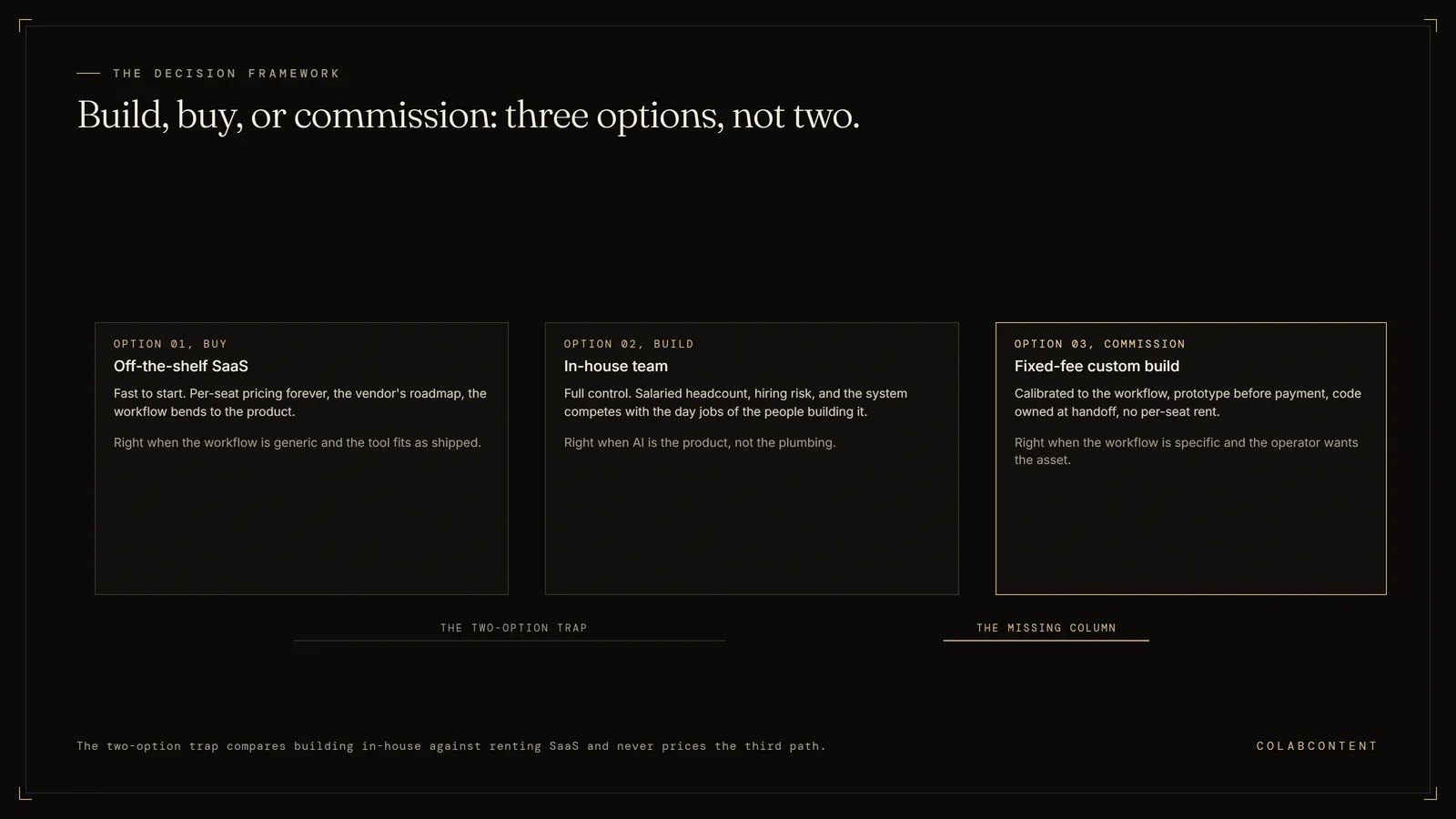
Diagram of the build, buy, or commission decision framework comparing off-the-shelf SaaS, an in-house team, and a fixed-fee commissioned custom build with code owned at handoff
Three ways to end up with the system you run on. Only one of them stops billing you.

Written for the contractor already paying for Vista or Spectrum. We do not sell construction ERP, we take no referral fee from anyone in the table below, and we will say plainly which firms should stay exactly where they are.

For50 to 200 employee contractors on Vista or Spectrum
StanceNeutral. We sell no construction ERP.
Incumbent cost$100,000 to $400,000 first year, per Vendr
Our fee$45,000 to $180,000, one time
Last updatedAugust 27, 2026, prices read same day

The short answer.

If you are on Vista or Spectrum and the reason you are reading this is the invoice, the single most valuable thing on this page is not a competitor's name. It is the total cost figure in the next section, because you cannot negotiate against a vendor who publishes no rate card unless you arrive with a number of your own. Trimble does not publish one. Neither does Sage for 300 CRE, neither does CMiC, and neither does Procore. That is not an oversight in a category this mature. It is a commercial strategy, and its effect is that every quote in construction ERP is priced against the buyer rather than against a published list. The second most valuable thing is the honest news that most of the alternatives are not dramatically cheaper. Jonas sits at or above Vista's benchmark per-user cost. Acumatica lands in the same money band. CMiC is priced above it. Only two names on this list, Foundation Software and Premier Construction Software, are a genuine step down in cost, and both are also a step down in scope, which may or may not be what you want.

So the verdict splits three ways. Contractors under roughly 20 to 30 users should shop the roundup below and stop reading before the ownership section, because at that headcount a scoped custom build cannot return its own cost and we would tell you so on a call. Contractors in the 50 to 200 employee band that Vendr's own pricing bracket describes, with a working accounting core and one or two workflows that quietly burn a project manager's week, are the firms for whom the arithmetic on this page actually flips, because at that size the license curve compounds while a one-time build does not. And contractors who have spent years configuring certified payroll rules or equipment costing templates inside Vista or Spectrum, and who rely on them daily, should stay, and there is a section below arguing that case as strongly as we know how.

What Vista and Spectrum actually do well.

A comparison page that treats the incumbent as a punching bag is useless to the person actually holding the contract, so it is worth being precise about what you would be giving up.

Real construction job costing, not general accounting with job fields bolted on. Cost codes, cost types, committed cost, projected cost at completion, over and under billings, work-in-progress reporting that a surety will accept. Generic ERP does not do this and QuickBooks does not do this. It is the reason contractors buy category-specific software in the first place, and it is the hardest single thing to replace.

Certified payroll and multi-state, multi-union payroll. Prevailing wage, fringe calculations, union reporting, multiple trades on one timecard. If you do public work, this module is doing something genuinely complicated every single week, and firms that underestimate it discover the gap on the first payroll after cutover rather than during evaluation.

Equipment costing. Charging equipment time to jobs, tracking utilisation and maintenance against the cost of the iron. Heavy civil and site work contractors live inside this and most lighter alternatives treat it as an afterthought.

Depth accumulated over decades. Both products have been in the field long enough that the edge cases are handled. That maturity is invisible right up until you leave and discover which of the hundred small behaviours your controller had been relying on.

Scale behind it. Trimble is a large public company. It is not going to disappear, and its integration ecosystem across surveying, field and design is real. Scale cuts both ways, as the vendor risk section below argues, but it is a genuine asset on the buying side.

Why contractors start looking for a way out.

Four patterns, in the order we hear them.

The bill grew without anyone deciding it should. The license is per user. Every project manager, estimator, foreman and clerk added since the last renewal raised the number automatically. There is no published rate card to argue against, which makes it a negotiating problem before it is a pricing problem.

The modules are priced separately. Vendr's benchmark data puts advanced modules for field management, analytics and HR at $200 to $600 per user per module per year on top of the core license, read from vendr.com on August 27, 2026. Turning on one more capability for one more group multiplies across headcount rather than adding a line item.

The people who need the data cannot get it themselves. Reviewers on Capterra and Software Connect call Vista's interface complex, and describe Spectrum's equipment costing and its templates as confusing and cumbersome to configure. A competing vendor's own comparison, published by Premier Construction Software, goes further and lists a steep learning curve, a dated interface and slow innovation; that one is written by a company selling against Viewpoint, so weigh it accordingly. All of it is reported opinion rather than a measured finding, and it matches what we hear on calls: the numbers exist in the system and getting them out requires the one person who knows how.

The thing the firm needs is not an accounting problem. Bid and estimate triage, subcontractor prequalification and compliance chasing, change order lifecycle, field-to-office data capture that does not require somebody retyping a paper ticket. None of these are general ledger problems, and no amount of license spend on an ERP will produce them.

What you are actually paying

Every number on this page, with its source.

Start with the fact that decides everything else: Trimble publishes no price. We read trimble.com's Viewpoint and Vista product pages on August 27, 2026 and the only call to action is a form and a phone number, quoted exactly: fill out the form or call us at 1-800-333-3197. There is no rate card, no tier list, no starting-at figure anywhere on the vendor's own site for either product.

That leaves third parties, and they disagree with each other by roughly a factor of two. We label each figure VERIFIED when we read it directly off the vendor's own page on August 27, 2026, and REPORTED when the publisher itself calls it an estimate or when the vendor has not confirmed it. Where two sources conflict, both ranges are printed rather than the one that flatters the argument.

Applying that rule to our own headline: the same Vendr page we model from also publishes a REPORTED median of $62,250 per year across Trimble buyers, on a range of $5,772 to $307,579, while our model runs at $115,000 a year. We do not use the median as the basis, and here is why rather than quietly omitting it. That figure is Trimble-wide, spanning a company that sells agriculture, geospatial and transportation software alongside construction ERP, and its low end is smaller than a single Viewpoint seat count would produce. The $1,150 per user figure is the Viewpoint-specific one. If your firm is well under 100 users, the median is the number to argue from, and the calculator below will show you that case.

One figure that circulates widely deserves a correction rather than a citation. A monthly per-firm number for Vista and Spectrum appears in several comparison write-ups attributed to a construction software vendor's blog. We fetched that blog directly, at both of its live URLs, and the figures are not on it. The only Viewpoint dollar range that page carries is the $100,000 to $400,000 first-year figure, which it attributes to Vendr rather than to its own research. We have therefore gone to Vendr directly and we do not print the monthly figures at all.

Line itemBasisFigureSource and label
Trimble Viewpoint core modules (accounting, project management)Per user / year$800 to $1,500REPORTED vendr.com/marketplace/trimble, read August 27, 2026
Trimble Viewpoint advanced modules (field management, analytics, HR)Per user / module / yearAdditional $200 to $600REPORTED vendr.com/marketplace/trimble
Trimble Viewpoint, first year all inFirm, 50 to 200 employees$100,000 to $400,000REPORTED vendr.com/marketplace/trimble
ImplementationShare of first-year software cost30 to 60 percentREPORTED vendr.com/marketplace/trimble
Vista, alternative estimatePer user / monthAbout $200, which is about $2,400 per user per yearREPORTED itqlick.com/vista-by-viewpoint/pricing. ITQlick labels its own figures estimates.
Spectrum, alternative estimatePer user / monthAbout $150, which is about $1,800 per user per yearREPORTED itqlick.com/viewpoint-spectrum/pricing. Estimate, self-labelled.
Trimble's own published priceEither productNone. Form and phone number only.VERIFIED trimble.com/en/products/viewpoint and /viewpoint/vista

The disagreement is the finding

Read those two blocks against each other. Vendr, which benchmarks real signed contracts and says so, puts the core license at $800 to $1,500 per user per year. ITQlick, which generates estimates and labels them as such, implies about $2,400. Those are not close. Neither source is dishonest; they are measuring different things with different methods, and the reason they can be this far apart and both survive is that the vendor publishes nothing to correct either one. For a contractor, that is the operational fact: until your quote is in writing, nobody outside Trimble's sales organisation knows what you will pay, including the people writing comparison articles about it. We model on Vendr's figures because Vendr states a methodology, and we print ITQlick's alongside so you can see the spread rather than a false precision.

Normalise it: what a 100 user contractor pays for one year

Per-user pricing is not comparable to per-firm pricing until you fix the headcount. Hold one contractor at 100 total users, office and field, which is the midpoint of Vendr's own stated 50 to 200 employee bracket and is a labelled assumption rather than a sourced figure. Take each vendor's published or reported rate at face value with nothing negotiated, and ask what a single year of license costs.

Vendor and basisOne year, 100 users, license onlyHow it is calculated
Trimble Viewpoint, low end of Vendr's core range$80,000$800 x 100
Trimble Viewpoint, midpoint of Vendr's core range$115,000$1,150 x 100
Premier Construction Software, published price$150,000$125 x 100 x 12
Trimble Viewpoint, high end of Vendr's core range$150,000$1,500 x 100
Spectrum, ITQlick estimate$180,000$150 x 100 x 12
Jonas Construction Software, annual rate per third-party listing$238,800$199 x 100 x 12, plus a one-time $30,000 implementation fee
Vista, ITQlick estimate$240,000$200 x 100 x 12
Foundation Software, Acumatica, Sage 300 CRE, CMiC, ProcoreNot comparable at this basisPriced per firm, per module, by construction volume or by quote. See the roundup.

Read that table honestly and the first thing it says is uncomfortable for a page like this one. At 100 users, Premier Construction Software's published price lands at the same annual figure as the top of Vendr's Vista range, and Jonas lands well above it. The cheap alternative is not automatically cheaper once you multiply a per-user rate by a real contractor's headcount. That is the arithmetic every per-seat vendor is counting on you not doing, and it is the reason the rest of this page is about the shape of the spending rather than the rate on the invoice.

Three year and five year, with every assumption stated

The model below takes the midpoint of Vendr's reported core-license range, $1,150 per user per year, applied to 100 users. It escalates the license 4 percent a year, the midpoint of the 3 to 5 percent annual maintenance increase Vendr documents for perpetual licences, and the same band Vendr tells buyers to cap renewal increases at. Trimble itself publishes no escalation figure. It deliberately does not re-charge implementation on the incumbent side, because you are already a customer and you already paid that once. That makes the incumbent line more conservative than a new-buyer model would be, which is the point: the argument should survive the harder version.

Against it, a commissioned build at $120,000, the midpoint of our $45,000 to $180,000 fixed fee range, paid once, with maintenance at 15 percent of build cost per year. That maintenance rate is a stated assumption, a common software heuristic rather than a ColabContent contract term, and it is held flat rather than escalated.

Scenario, 100 users1 year3 year cumulative5 year cumulative
Trimble Viewpoint at $800 per user (low end of Vendr range)$80,000$254,688$450,967
Trimble Viewpoint at $1,150 per user (midpoint)$115,000$358,984$622,877
Trimble Viewpoint at $1,500 per user (high end of Vendr range)$150,000$477,540$845,564
Commissioned build at $45,000 plus 15 percent a year maintenance$51,750$65,250$78,750
Commissioned build at $120,000 plus 15 percent a year maintenance$138,000$174,000$210,000
Commissioned build at $180,000 plus 15 percent a year maintenance$207,000$261,000$315,000

The row worth pointing at is the first year. At the midpoint, staying on Trimble Viewpoint costs $115,000 in year one and a $120,000 build costs $138,000 in year one. The build loses year one, every time, because the fee is paid upfront and the license is paid in slices. Anyone who tells you a custom build is cheaper on day one has not done the arithmetic. What changes is the slope: one line compounds and the other is nearly flat, and by year three the gap at the midpoint is $184,984 in the build's favour. That is the entire argument, and the chart below is it drawn to scale.

The crossover

Where the two lines meet.

Cumulative spend for the same 100 user contractor, five years out, both lines starting from zero at the decision point so that neither side gets credit for money already spent. Trimble Viewpoint at the midpoint of Vendr's reported core-license range, $1,150 per user per year, escalating 4 percent annually, the midpoint of the 3 to 5 percent band Vendr documents. Against it, a commissioned build at $120,000 paid once, with 15 percent a year maintenance. Every figure in the chart comes from the table above.

Cumulative five year cost: Trimble Viewpoint licensing versus a one time commissioned build Chart showing cumulative cost over five years for a 100 user mid-sized contractor. Trimble Viewpoint licensing starts at $115,000 in year one and rises to $236,900 at year two, $358,984 at year three, $488,343 at year four and roughly $622,877 by year five as the license compounds at 4 percent a year. A one-time $120,000 custom build plus flat annual maintenance of $18,000 totals $138,000 at year one, $156,000 at year two, $174,000 at year three, $192,000 at year four and $210,000 over the same five years. The two lines cross in year two, when continuing to pay for Trimble Viewpoint has already cost more than owning the custom system outright. By year five the gap is $412,877. $0 $100K $200K $300K $400K $500K $600K $700K Year 0 Year 1 Year 2 Year 3 Year 4 Year 5 Crossover, year 2 Trimble Viewpoint $622,877 Owned build $210,000 Trimble Viewpoint, 100 users at $1,150, 4% escalation Commissioned build, $120,000 once, 15% maintenance

The crossover lands inside year two, at roughly $142,000 of cumulative spend on each path. Before that point the subscription is genuinely cheaper and the build is the worse financial decision, which is exactly what you would expect and exactly what most vendor charts hide by starting the axis in a convenient place. After it, the gap widens every single year, because one curve has a slope and the other does not. At year three the difference is $184,984. At year five it is $412,877, and nothing in the model bends the license line back down.

Change the inputs and the crossover moves, in both directions. At a $45,000 build the lines cross inside year one. At $180,000 against the low end of Vendr's range the build does not win on cost until later, and if your headcount is well under 100 it may not win within five years at all. That is not a caveat buried in a footnote; it is the reason the calculator below exists and the reason the honesty section further down tells specific firms to stay put.

Your firm, your numbers

The Trimble Viewpoint total cost calculator.

Every default below is a figure from the table above, and every one is editable, because the defaults are a benchmark and your order form is a fact. Nothing is submitted anywhere. There is no email gate, no external request and no stored value; the arithmetic runs in your browser and stops there. If your inputs make the build lose, the tool says so rather than quietly hiding the result.

Everyone holding a license. Vendr's mid-market bracket is 50 to 200 employees.
Vendr reported range $800 to $1,500. Default is the midpoint. Use your own quote if you have it.
Vendr reported $200 to $600 per user per module. Enter 0 if you run core only.
Stated modelling assumption, not a Trimble published figure. Set to 0 to remove it.
The headline total is calculated over this horizon. Three and five year totals are always shown below.
ColabContent fixed fee range, $45,000 to $180,000, set after the diagnosis call.
Stated assumption, a common software heuristic rather than a ColabContent contract term.
The roundup

Eight options, in the order we would look at them.

One note on the roster before the list. Most of the Viewpoint alternatives guides you will find are written by companies that sell a competing product, or by directories that earn a referral fee when they connect you to one, and several of them fill their lists with tools that are not construction ERP at all. The list below covers the systems Vista and Spectrum actually compete against, in the order a contractor holding a Trimble contract would sensibly evaluate them, and it says where each one genuinely beats a custom build.

1. Foundation Software (FOUNDATION)

What it is. Construction accounting and job cost software built for specialty trades and mid-sized general contractors, available on-premise or cloud hosted. Its centre of gravity is certified payroll, work-in-progress and AIA billing rather than full enterprise scope.

Price. Foundation does not publish fixed tiers on its own site; its pricing route is a custom quote. Third-party figures are REPORTED: an aggregation of SelectHub and Capterra listings puts it at $500 to $1,500 or more per month, and Premier Construction Software's own competitor comparison, written by a vendor selling against both Foundation and Viewpoint, puts it at $400 to $800 a month cloud hosted with $5,000 to $20,000 implementation. Neither figure comes from Foundation. Confirm against your own quote before budgeting.

Best for. Mechanical, electrical and plumbing contractors and mid-sized general contractors whose real requirement is strong certified payroll, WIP and AIA billing without paying for full ERP scope.

Where it falls short. Field and project management tooling is shallower than Vista, Spectrum or Procore. Contractors who need deep multi-entity consolidation or heavy customisation outgrow it.

Verdict. The most credible step down in cost and scope on this list, and the right answer for a firm whose complaint is price and complexity rather than missing capability.

2. Premier Construction Software

What it is. Cloud construction ERP marketed explicitly as a Viewpoint alternative, with accounting, project management and job costing in one platform.

Price. VERIFIED from the vendor's own published figure, read August 27, 2026: $125 per user per month. It is one of very few names in this category that states a real number in public, which is worth something on its own.

Best for. Mid-sized firms that want transparent per-user pricing and a faster implementation than a Vista rollout, without the opaque quote process.

Where it falls short. Two things. It is a newer and smaller platform than Vista, Spectrum or Procore, with less third-party review volume and less certainty around long-term roadmap and integration ecosystem. And at 100 users, $125 per user per month is $150,000 a year, which is the top of Vendr's reported Vista range rather than a saving. The published price is a transparency advantage, not automatically a cost advantage.

Verdict. Worth a serious look, particularly under about 50 users, and worth checking your own arithmetic on above that.

3. Acumatica Construction Edition

What it is. A modern cloud ERP with a construction-specific edition, licensed on a consumption and resource basis rather than strictly per seat, which is why it draws contractors tired of paying for every foreman who needs to look something up.

Price. REPORTED and at lower confidence: figures attributed to erpresearch.com and proteloinc.com, an ERP research site and an implementation partner respectively, put the Construction Edition at $30,000 to $120,000 a year with $60,000 to $100,000 or more implementation. We did not read either page line by line against a primary source this run and we label the numbers accordingly. Acumatica does publish a migration guide aimed specifically at Viewpoint Vista customers, which is competitive content rather than a neutral resource; its detail sits behind a form and we did not read it.

Best for. Contractors who want unlimited casual users, suppliers, field staff and subcontractors, without a per-seat tax on every person who touches the system, and who are comfortable on a modern cloud platform.

Where it falls short. Consumption-based pricing is harder to forecast than flat per-seat. Construction-specific depth, particularly certified payroll nuance and AIA billing, is generally regarded as shallower than Vista's, Spectrum's or Foundation's.

Verdict. A legitimate modernisation play, priced comparably to what you already pay rather than meaningfully below it.

4. Sage 300 CRE (Sage 300 Construction and Real Estate)

What it is. The long-standing on-premise construction accounting suite, a direct peer of Vista for decades, still running in a great many contractors' back offices.

Price. Sage publishes no price; all Sage 300 CRE pricing routes through partners and resellers. REPORTED from itqlick.com, read August 27, 2026: monthly license fees starting around $200 for a single user, approximately $1,800 monthly for ten users, a five-year total cost that could reach $100,000 for a mid-sized company, plus mandatory annual maintenance fees of 18 to 22 percent of license cost. ITQlick labels these estimates.

Best for. Firms already deep in the Sage ecosystem, running Sage Intacct or Sage Fixed Assets, that want construction job costing without leaving the family.

Where it falls short. It is arguably as dated an architecture as Vista. If you are leaving Vista because you want something modern, moving to Sage 300 CRE does not solve that problem, it relocates it. If you want the fuller comparison from that side of the fence, our Sage 300 CRE alternatives page runs this same cost model with Sage as the incumbent.

Verdict. A lateral move for firms with Sage ecosystem lock-in. Not a modernisation, and not a clear saving.

5. Jonas Construction Software

What it is. Construction and service ERP aimed at firms of roughly 50 to 500 employees and $10M or more in revenue, with a particular strength in companies running both construction and a service division.

Price. Jonas's own pricing page routes to a demo and quote flow with no figure published, VERIFIED August 27, 2026. A third-party listing on softwarefinder.com, also read that day, states $249 per concurrent user per month, $199 per concurrent user per month at the discounted annual rate, and a one-time implementation fee of $30,000. That is REPORTED, since Jonas has not confirmed it.

Best for. Contractors in that stated size band who want one vendor covering both construction projects and a recurring service business.

Where it falls short. At roughly $2,400 to $3,000 per user per year it is priced at or above Vendr's reported Vista benchmark, not below it. If cost relief is the reason you are shopping, this is not the exit.

Verdict. A peer-priced lateral move with a genuine service-division advantage. Not a savings play.

6. Procore

What it is. The cloud construction project management and field platform: drawings, RFIs, submittals, daily logs, safety, document control. It is not primarily a job cost accounting system, and this distinction is the most commonly misunderstood thing in the category.

Price. Procore publishes no dollar figure. Its own pricing page, VERIFIED August 27, 2026, states an upfront annual fee by product based upon your annual construction volume. A third-party estimator, Manifold, which discloses that it sells a competing smaller tool, states $15,000 to $30,000 a year for small general contractors at $10M to $50M annual construction volume and $30,000 to $80,000 a year at $50M to $200M, plus $50,000 to $150,000 or more implementation in year one. REPORTED, and read with the seller's interest in mind.

Best for. General contractors who need real field, project management and document control depth and are willing to run a separate accounting system alongside it.

Where it falls short. It does not replace Vista or Spectrum for job cost accounting or payroll. Most Procore shops keep running a second system for the accounting side, frequently Viewpoint itself. If your problem is the ERP invoice, adding Procore raises your total software spend rather than reducing it. Our Procore alternatives page runs the full comparison from that side.

Verdict. Strong at what it does, and not a solution to the job cost accounting problem most readers of this page are trying to escape.

7. CMiC

What it is. Enterprise construction ERP covering financials, human resources, payroll and project controls, aimed at large general contractors. CMiC's own marketing claims adoption by roughly one in five ENR Top 400 general contractors; that is the vendor's claim and we have not verified it independently.

Price. CMiC publishes nothing, and we can name no publisher standing behind the dollar figures that circulate for it, so this page prints none rather than repeat a number we cannot attribute. What can be said without inventing one: CMiC sells to a larger class of contractor than Vista and Spectrum, and it is consistently described as an enterprise implementation rather than a quick migration. Get a written quote and an implementation schedule before it enters a budget.

Best for. Large enterprise general contractors, 500 or more employees, multi-entity, complex portfolios, that need deeper financial controls than Vista or Spectrum provides.

Where it falls short. It is priced and scoped above most Vista and Spectrum buyers, not below. A contractor leaving Viewpoint because it is expensive and heavy will not find relief here.

Verdict. Relevant only for firms scaling up, never for firms seeking relief.

8. A commissioned build you own

What it is. Not a drop-in replacement for a construction ERP's general ledger. A custom system built for the specific workflow no product in this category covers, sitting alongside whichever accounting core you keep, owned by the company at handoff. In practice for contractors that means bid and estimate triage, subcontractor compliance and prequalification chasing, change order lifecycle tracking, field-to-office capture that removes the retyping step, or reporting that a project manager can actually run without an administrator.

Price. A fixed fee of $45,000 to $180,000, set after a free 45-minute diagnosis and after integration depth is named, paid in two instalments at build start and handoff. A working prototype runs on your real data before any payment. You own the code, prompts, models and pipeline at handoff, running in your own cloud tenant.

Best for. Contractors in the 50 to 200 employee band with an accounting core that basically works and a named workflow that burns hours every week.

Where it falls short. It is a bigger single cheque, it needs a tighter scope than buying software does, and at the top of the range against a low Trimble rate it can lose the cost argument outright, as the table above shows. It also does not replace your ERP, so if the goal is to stop paying Trimble entirely, this is not that on its own.

Verdict. The option none of the seven above will show you, and the only one where the bill stops going up.

The ownership case

Nine arguments for owning it instead.

Each of these is either arithmetic you can check on this page or a structural fact about the two models. Where an argument does not honestly apply to your company, the section immediately after this one says so.

One. The math, restated. A subscription never ends. At the midpoint of Vendr's reported range a 100 user contractor pays $358,984 over three years and $622,877 over five, and year six starts with no progress banked. A $120,000 build costs $174,000 over the same three years and $210,000 over five, and the lines cross inside year two. After that point the gap widens every year because one curve compounds and the other is flat. That is the whole argument, which is why the chart is on this page rather than in a sales deck.

Two. Per-user pricing taxes headcount. Every project manager, estimator, foreman and clerk you hire raises the bill by the same rate whether or not that person generates proportional margin in year one. Ten new users at the midpoint of Vendr's range is $11,500 a year, added automatically, forever, with nobody making a decision. An owned system has no marginal user cost at all, which removes a software decision from every hiring decision. In an industry that staffs up and down with the backlog, that is not a small structural difference.

Three. Asset versus expense. A subscription is rent and it leaves nothing behind. A commissioned build is a piece of the company: transferable, valuable in a sale, a merger or a succession conversation, and on the balance sheet rather than only in operating expense. For a contractor whose owner is thinking about a five to ten year horizon or an eventual exit, that difference is not cosmetic.

Four. Built around your workflow, not the median contractor's. Every product in the roundup above is calibrated against the average customer in its category, which means you pay for the whole feature bundle and adapt your process to the fraction of it you actually use. A commissioned system starts from your cost code structure, your billing calendar, your prequalification rules and the way your foremen actually report from the field. Nobody has to be retrained into somebody else's assumptions about how a contractor should work.

Five. No per-user AI tax. This one is concrete. Trimble prices advanced modules for field management, analytics and human resources at $200 to $600 per user per module per year on top of the core license, per Vendr's reported benchmark. That is the structural pattern: new capability arrives as another per-user line multiplied by your headcount, priced against a rate card nobody publishes. In a commissioned build there is no separate module licence and no separate AI licence, because the capability is the system, and adding a user costs nothing.

Six. Unlimited users. Office staff, field staff, seasonal crews, and where it makes sense your project owners and subcontractors. Zero marginal cost per person changes the question from who needs a license to who needs access, which is a much better question and usually produces a better-run job.

Seven. Data ownership and no exit ransom. Your jobs, your cost history, your payroll records, your export path, in your own cloud tenant, under an agreement you wrote. Compare that with the migration section below, where the hard part of leaving is not getting the data out but deciding how much history you can afford to carry through a structure the vendor designed. Owning the structure takes the negotiation out of leaving.

Eight. Vendor risk you stop carrying. This category supplies its own evidence, from the incumbent's own documented history. Spectrum was built by Dexter and Chaney, which Viewpoint Construction Software agreed to purchase in July 2017. Viewpoint itself was then acquired by Trimble from Bain Capital in an all-cash transaction valued at $1.2 billion, announced April 23, 2018 on Trimble's own newsroom. Two ownership changes in two years, neither chosen by a single customer. And the pattern is live right now: Trimble's own help documentation states that in the first half of 2025 it was upgrading all Trimble Construction One cloud-hosted Vista customers to log in using Trimble ID, that starting in the fall of 2025 it would be turning off support for classic credentials used to log into the Vista application, and that it would begin enforcing Trimble ID logins starting in January 2026 in scheduled waves. That is a change on the vendor's calendar with no opt-out. A system you own does not get migrated by anybody else's schedule.

Nine. Change speed. A change request to your own system is a scoping conversation and a deployment. A change request to a vendor is a ticket in a queue behind every other customer's, with no committed date and no obligation to you. When the thing that needs changing is the thing that makes your company win work, a queue is not an acceptable answer.

What we can actually prove

An argument is worth exactly what the evidence behind the firm making it is worth, so here is ours, with nothing rounded up and nothing dressed up. Jim Glaser Law is our nameable reference and the principal takes reference calls. The LELF platform is the fullest example of what commissioning looks like in practice: a firm runs its matter, invoice and trust operation on it, reconciled byte identical against the system it replaced. Across our practice we have handled more than 6,000 AI calls and delivered more than forty commissions.

Here is the part a page selling to contractors would normally leave out. None of that proof is construction. We have not decommissioned a Viewpoint tenant for anyone and we are not going to imply otherwise. What the evidence supports is a specific claim: we can build a system that carries real operational volume in a regulated, detail-intensive business and reconciles to the penny under audit. Whether that translates to your cost codes and your certified payroll is a question for the diagnosis call, and if the answer is no, we will say so on that call rather than after your deposit clears.

The honesty section

Who should stay on Trimble Viewpoint.

Five situations where every argument in the previous section fails, and where we would tell you to stay put on a call rather than take the engagement.

Contractors under roughly 20 to 30 users. The arithmetic does not work, and it is not close. At 25 users and the midpoint of Vendr's range, three years of license is about $91,500. The cheapest build we would scope, $45,000 with maintenance, is $65,250 over the same three years, so the gap is real but thin, and a build carries scoping and adoption risk that a renewal does not. Below that headcount the right move is to shop the roundup above, price Foundation Software and Premier Construction Software against your current contract, and spend the energy on the renewal conversation instead.

Contractors living inside one module they have finally got right. If your certified payroll configuration handles four states and three unions correctly, or your equipment costing templates took two years to tune, the switching cost is not the license, it is the risk. Reviewers describe those exact areas as confusing and cumbersome to configure in the first place, which cuts both ways: painful to build, and painful to walk away from once it finally works. Pretending otherwise would be dishonest.

Contractors in the middle of the Trimble ID authentication cutover. Trimble is enforcing that change on its own schedule, as its own documentation states. If you are inside that window, adding a second major system change on top of a live authentication migration is how you end up with a payroll that does not run. Get through it, then evaluate.

Anyone who needs a working system next month. A commissioned build is not an emergency fix. It is the right call for a company re-platforming deliberately, not for one that has run out of runway before a renewal date. If the deadline is real and near, buying is faster than building and it is not close.

Contractors where nobody internally will own the system. An owned build needs a named person who cares about it, even at a light touch: usually the controller or the operations lead. Companies without that person are better off renting, because the alternative is a system that quietly decays until it is abandoned, and that outcome is worse than a subscription.

Decision tree

Six questions, in order, with stop points.

1. Is your total user count under about 30? If yes, stop here. Price Foundation Software and Premier Construction Software against your current contract and take the total cost figure from this page into your renewal conversation. A commissioned build will not return its cost at your headcount. If no, continue.

2. Do you know your actual per-user rate, your module list and your renewal terms? If no, stop and go find the order form. Every decision after this depends on it, and every third-party estimate on this page is a substitute for that document rather than a replacement for it. If yes, continue.

3. Run your numbers in the calculator above. Is your three year Trimble Viewpoint total below about $65,000? If yes, stop. The cheapest build we would scope costs $65,250 over three years with maintenance, so nothing we quote can beat your contract on cost. Defend that contract at renewal. If no, continue.

4. Is the thing that actually costs you money a general ledger and job cost problem? If yes, meaning the accounting core itself is wrong for your business, then a different construction ERP may genuinely help and Foundation Software, Acumatica and Premier are where to look. Stop here and go price them. If no, continue.

5. Can you name the workflow in one sentence, with a rough dollar or hour figure attached? If no, stop, and spend two weeks measuring before anyone spends money. Every failed build we have seen started from an unnamed constraint. If yes, continue.

6. Is a $45,000 to $180,000 fixed fee real for you this quarter, and will the owner or controller spend 45 minutes on the diagnosis? If no, park it and revisit at renewal, with the numbers from this page in hand. If yes, that call is the next step, and a meaningful share of these calls end with us telling a company to stay where it is.

Next step

Book the 45-minute diagnosis.

Bring your order form and one sentence describing the workflow that burns hours. You leave with the constraint written down either way, and a meaningful share of these calls end with us telling a contractor to stay where it is.

Free · 45 minutes
Under NDA
Owner to owner
No follow-up unless asked
Migration reality

What leaving Vista or Spectrum actually involves.

Almost nobody writing about switching answers this question with specifics, which is strange, because it is the question that decides whether a contractor ever acts on any of the rest. Here is the honest shape of it, including the places where the honest answer is that no source publishes a number.

Getting the data out is not the hard part. Vista and Spectrum support extraction through built-in reporting tools and export wizards, and data migration specialists describe going to database level access when the standard exports are not enough. The formats commonly cited are Excel, CSV, XML, JSON, PDF reports and SQL database dumps, with exact capability depending on version and configuration. That is reported by dataconversionprogrammer.com, read August 27, 2026, rather than published by Trimble.

What actually has to move is a short list and a hard one. Chart of accounts. Jobs and cost codes. Open contracts and balances. Vendor and subcontractor records. Payroll history. Migration specialists describe job cost history, vendor records and open contracts as exporting cleanly. The real decision point is how much historical work-in-progress detail you carry forward versus leave archived in the old system, and that is a policy call for your controller and your surety rather than a technical limit.

Parallel run through at least one full close cycle. No vendor and no migration specialist publishes a firm week or month figure for a Vista or Spectrum migration, and we are not going to invent one to make this section look more authoritative. What is defensible regardless of firm size is the pattern: run both systems live through one complete month-end close and one complete work-in-progress or percentage-of-completion reporting cycle before you cut over, so job cost and payroll can be reconciled between the two while going back is still possible. The length of that window is set by your close calendar. Any partner who quotes a migration duration before seeing your chart of accounts and your open contract list is guessing, and asking which close cycle they intend to reconcile against will tell you quickly whether they have done this before.

Read the notice provisions before you schedule anything. A contract that auto-renews will auto-renew in the middle of a migration if nobody sends the letter, and you will pay for a full additional year of a system you are switching off. This is the single most expensive avoidable mistake in this category and it costs nothing to avoid.

What we do and do not do here. We have not run a Viewpoint decommissioning and we will not imply otherwise. What we build is the workflow layer that sits alongside whichever accounting core you land on, which is a different job. If your project needs a data migration partner, that is a specialist engagement, and the ERP vendor you are moving to will normally name two or three.

The option most contractors do not consider. You may not have to leave at all. In a large share of the cases we see, the accounting core is fine, the license is defensible once it has been renegotiated with a real number in hand, and the money is leaking out of a workflow that sits beside the ERP rather than inside it. That path keeps Vista or Spectrum, keeps the payroll configuration, keeps the years of cost history, and builds only the missing piece. No migration, no parallel run, no notice letter.

Deep dive

The dimensions the price table cannot show.

Six dimensions, side by side.

Price transparency. Premier Construction Software publishes a real per-user rate. Everybody else in this roundup, Trimble included, routes you to a quote. Transparency is not the same as cheapness, as the 100 user table above demonstrates, but an undisclosed price lets the seller quote against the buyer rather than against the work.

Cost slope. Every subscription here rises with headcount, with modules and with renewal. A commissioned build is a one-time fee plus a flat maintenance line. The slope, not the starting point, decides a five year comparison, and in a business that staffs to the backlog the slope is steeper than most contractors model.

Module economics. Vista and Spectrum price advanced capability per user per module. That means the cost of saying yes to one more capability for one more crew is multiplied by headcount rather than added once. An owned system has no module boundary to buy across.

Construction depth. This is where the incumbent wins and it deserves saying in the deep dive rather than buried. Certified payroll across states and unions, equipment costing, WIP a surety will accept: Vista and Spectrum handle these, and lighter alternatives handle them less well. Do not treat this dimension as a tie.

Ownership at exit. Every vendor here retains the code, the data structure and the pipeline. A commission transfers all three at handoff, running in your own cloud tenant. That is the difference between an export and a handover.

Vendor risk. Acquisitions and forced migrations are normal in this category, and Viewpoint's own history is the clearest example available: Dexter and Chaney into Viewpoint in 2017, Viewpoint into Trimble in 2018, and a mandatory authentication migration running on Trimble's schedule through 2025 and into 2026.

When to pick which, in one paragraph each.

Stay on Vista or Spectrum if your rate is at the low end of Vendr's range, your payroll or equipment costing configuration is load bearing, or you need certainty next quarter. Take the total cost figure from this page into the renewal conversation as leverage rather than as a reason to leave.

Move to Foundation Software if your real requirement is certified payroll, WIP and AIA billing, you can live with lighter field tooling, and your complaint is cost and complexity rather than missing capability.

Move to Premier Construction Software if you want a published price and a faster implementation, and your headcount is low enough that a per-user rate still works out below what you pay now. Check that arithmetic before the demo, not after.

Move to Acumatica if the architecture is your complaint rather than the price, and you want casual users to stop being a licensing line item.

Add Procore rather than replace with it if your field and project management is genuinely the weak point. Budget for it as an addition to your ERP spend, because that is what it is.

Commission a build if the accounting core is fine, the constraint is a named workflow, and the three year total on this page is comfortably above what a scoped build would cost. Most contractors in that position keep the ERP and build beside it.

Why this page is written by someone who does not sell construction ERP.

Worth saying plainly, because it should change how you read everything above. Several of the most visible Viewpoint alternatives guides are published by companies that sell a competing construction ERP and rank themselves first in their own list. Others are directories that disclose earning a referral fee when they connect you to a vendor, or marketplaces whose primary call to action is a quote request. One widely cited guide carries a Viewpoint dollar range it attributes to somebody else's research, and the two monthly per-firm figures most often quoted from it do not appear on it at all, which is why they do not appear on this page either.

ColabContent sells commissioned builds. We do not sell construction ERP, we take no referral fee from anyone in the roundup, and we have no reason to steer you toward or away from any of them. That does not make us neutral about the conclusion, obviously. The point of publishing the arithmetic and every assumption behind it is that you can see exactly where our interest starts affecting the numbers and change the inputs yourself. It does mean that when this page says Premier's published price lands at the top of Vendr's Vista range at 100 users, or that a $180,000 build loses the cost argument against a cheap Trimble contract, nothing commercial is pulling in the other direction.

What a build alongside Vista or Spectrum actually looks like.

Three workflows come up repeatedly on contractor calls, and they share a property: none of them is a general ledger problem, which is why the ERP does not solve them no matter how many modules are enabled.

Bid and estimate triage. Reading incoming invitations to bid, plans and specifications against your actual capability, your current backlog and your historical win rate by job type, and ranking what deserves an estimator's day. Most contractors make this decision on instinct and a shared inbox.

Subcontractor compliance and prequalification chasing. Insurance certificates, W-9s, licences, lien waivers and safety records, tracked against expiry and chased automatically instead of by whoever remembers. This is unglamorous, it is pure administrative drag, and it is the one that pays for itself fastest.

Field to office capture without the retyping step. Daily tickets, quantities, equipment hours and change conditions captured once in the field and reconciled into job cost, rather than written on paper and typed in twice with a two-day lag.

The posture is read and suggest by default, with a person approving before anything is written back, relaxing to spot checks only after the output has held up for a sustained period. Integration happens at the documented API layer as the primary route, with database level access as a last resort requiring explicit approval. We do not replace your general ledger, we do not touch payroll calculation, and where an existing product genuinely does the job better than a build would, we say so on the call.

Questions

The eight questions Viewpoint buyers actually ask.

How much does Viewpoint Vista actually cost?

Trimble does not publish a price for Vista or for Spectrum. We read Trimble's own Viewpoint and Vista product pages on August 27, 2026 and the only thing on offer is a form and a phone number: fill out the form or call us at 1-800-333-3197. The most credible public figures come from Vendr, a software pricing intelligence firm that benchmarks real customer contracts, and we read them directly off vendr.com/marketplace/trimble on August 27, 2026: core modules covering accounting and project management run $800 to $1,500 per user annually, advanced modules for field management, analytics and HR add $200 to $600 per user per module annually, mid-sized firms of 50 to 200 employees pay $100,000 to $400,000 in the first year, and implementation runs 30 to 60 percent of first-year software costs. A separate estimator, ITQlick, puts Vista at about $200 per user per month and labels its own figure an estimate, which is roughly double the midpoint of Vendr's core-module range. That disagreement is the honest headline. Two of the better-known public sources are about two times apart on the same product, because nobody outside Trimble's sales organisation knows your number until it is written into a contract.

What is the difference between Viewpoint Vista and Viewpoint Spectrum?

They are two separate products that ended up under one roof through acquisition, not two tiers of one design. Spectrum was built by Dexter and Chaney, which Viewpoint Construction Software agreed to purchase in July 2017 according to the announcement republished on foundationsoft.com and read on August 27, 2026. Trimble then agreed to acquire Viewpoint itself from Bain Capital in an all-cash transaction valued at $1.2 billion, announced April 23, 2018 on news.trimble.com. In day to day use, Vista is the deeper and heavier product, generally deployed by larger contractors with complex job costing, multiple entities and long implementations, while Spectrum is the lighter and more cloud-first of the two. Trimble publishes no price for either one, so for a buyer shopping alternatives the practical difference is scope and implementation weight rather than a published price gap you can compare.

Is Viewpoint Spectrum easier to use than Vista?

On implementation weight, generally yes. Spectrum is the lighter, cloud-first product and Vista is the deeper one with the heavier rollout, which is part of why smaller contractors more often land on Spectrum. But reviewer feedback collected on Capterra and Software Connect is not uniformly kind to either product: reviewers call Vista's interface complex, and they describe Spectrum's equipment costing and its templates as confusing and cumbersome to set up. A competing vendor's own comparison, published by Premier Construction Software, adds a steep learning curve, a dated interface and slow innovation to that list, which is worth reading with the seller's interest in mind. Treat all of it as reported opinion rather than a measured finding. The practical point for a buyer is that if your complaint is that your project managers and field staff cannot get what they need out of the system without going through an administrator, moving between two products inside the same vendor is unlikely to fix it.

What is the best alternative to Viewpoint Vista for a mid-sized contractor?

It depends on which complaint you are actually solving, and there are seven real ones plus the option nobody in the category will sell you. If the complaint is price and complexity, Foundation Software and Premier Construction Software are the two credible steps down in scope, and Premier publishes its own price at $125 per user per month. If the complaint is that the architecture feels dated, Acumatica's Construction Edition is the genuine modernisation play, though reported figures put it in the same money band rather than below it. Sage 300 CRE is a lateral move for firms already inside the Sage ecosystem. Jonas Construction Software sits at or above Vista's benchmark per-user cost, so it is not a savings play. Procore is excellent at field and project management and does not replace job cost accounting, which is why so many contractors run Procore and Viewpoint side by side. CMiC is priced above most Vista and Spectrum buyers, not below. The eighth option is a system built for your workflow and owned outright for a one-time fixed fee, which is the one no construction software vendor can put on its own comparison page.

Can I export my data if I leave Viewpoint Vista?

Yes, and the export itself is rarely the hard part. Vista and Spectrum support extraction through built-in reporting tools and export wizards, and data migration specialists describe going to database level access when the standard exports are not enough. The formats commonly cited are Excel, CSV, XML, JSON, PDF reports and SQL database dumps, and exact capability depends on your version and configuration. That is reported by dataconversionprogrammer.com, read on August 27, 2026, rather than published by Trimble. What actually has to move is a shorter list than people expect and a harder one: chart of accounts, jobs and cost codes, open contracts and balances, vendor and subcontractor records, and payroll history. Job cost history, vendor records and open contracts are described as exporting cleanly. The real decision is how much historical work-in-progress detail you carry forward versus leave archived in the old system, and that decision is a policy question for your controller rather than a technical limit.

Why did our Viewpoint Vista renewal cost go up?

Three mechanisms, and no published rate card to argue against any of them. First, the license is per user, so every project manager, estimator, foreman and accounting clerk you added since the last renewal raised the bill without anyone making a software decision. Second, the modules are priced separately: Vendr's benchmark data, read on August 27, 2026, puts advanced modules for field management, analytics and HR at $200 to $600 per user per module annually on top of the $800 to $1,500 core license, so turning on one more capability for one more group multiplies across headcount. Third, moving to the hosted product changes the commercial shape of the deal. One Software Advice reviewer reports that their costs doubled after the cloud migration; that is a single reviewer's account, not a universal outcome, and we cite it as illustrative rather than as a finding. Because Trimble publishes nothing, you have no benchmark to negotiate against. Your own order form is the only document that tells you what your escalator actually is, and it is worth more than any estimate on the internet.

How long does it take to migrate off Viewpoint Vista?

No vendor and no migration specialist we could find publishes a firm number, and we are not going to invent one. What we will state is the pattern that keeps contractors out of trouble, because it is defensible regardless of firm size. Run the new system and Vista or Spectrum in parallel through at least one complete close cycle, meaning one full month-end close and one full work-in-progress or percentage-of-completion reporting cycle, before you cut over. That is the point at which job cost and payroll numbers can be reconciled between the two systems while you can still go back. The length of that window is set by your close calendar, not by a software timeline, and any partner who quotes you a migration duration before seeing your chart of accounts and your open contract list is guessing. Ask them which close cycle they intend to reconcile against; the answer tells you whether they have done this before.

Does Procore replace Viewpoint Vista, or do contractors run both?

Most run both, and that is the single most useful thing to know before you shop. Procore is a project management and field platform: drawings, RFIs, submittals, daily logs, safety, document control. Vista and Spectrum are job cost accounting and ERP: general ledger, payroll including certified payroll, accounts payable, work-in-progress reporting, equipment costing. They overlap at the edges and they solve different problems, which is why contractors commonly buy Procore and keep paying for their accounting system rather than retiring it. If the reason you are reading this page is that your ERP bill is too high, adding Procore raises your total software spend rather than lowering it. Procore also publishes no dollar figure of its own: its pricing page, read on August 27, 2026, states an upfront annual fee by product based on your annual construction volume.

Buyer worksheet

What to have in front of you before any call.

Five documents to pull before you talk to anyone.

One. Your current order form. Not the invoice. The order form is where the term, the renewal mechanics, the escalator if there is one, and the notice period live. Every third-party figure on this page is a substitute for that document and a worse one.

Two. Your user count, split by role. Accounting, project management, estimating, field supervision, executives, and anyone holding a license who has not signed in this quarter. That last group is usually the fastest money a contractor finds, and it is worth finding before the renewal call rather than after.

Three. Your module list. Which advanced modules are actually enabled, for how many users, and which of them anyone opened last month. Vendr's reported figures put advanced modules at $200 to $600 per user per module per year, so a module nobody uses is a real number, not a rounding error.

Four. Your close calendar. When month-end closes, when WIP reporting runs, when your surety needs statements. Any migration plan is built around this calendar, and any partner who does not ask for it is not planning a migration.

Five. One sentence naming the workflow that burns hours. With a rough dollar or hour figure attached. If you cannot write that sentence, no vendor on this page can help you, and neither can we.

Five questions to ask every vendor, including us.

What is the term, and what happens at renewal? Ask for the escalator in writing. A vendor that will not commit one to paper has told you something.

What is the total in year three, not year one? Make them do the arithmetic on your user count with their own escalation assumption, then compare that number against what the calculator on this page produced.

Which modules are included and which are extra? Get the per-user, per-module cost of every capability you might turn on in the next two years, not just the ones you are buying today.

What exactly do we own at the end, and in what format? For a subscription the answer is an export. For a commission it should be code, prompts, models, datasets, runbook and integration documentation, in writing.

Can we speak to a company you did this for? Then ask that company three things: what the constraint was, what the system does now, and whether they would do it again. Our answer is Jim Glaser Law, and the principal takes reference calls. It is a law firm rather than a contractor, and we would rather tell you that up front than let you find out on the call.

When not to buy from us.

Do not commission a build if your user count is under about 30. The volume through any single workflow will not return a five figure build, and we will say so on the call rather than take the engagement.

Do not commission a build if what you actually want is to stop paying Trimble. We do not replace a construction ERP's general ledger, payroll engine or WIP reporting, and a commission sits alongside one rather than instead of it. If leaving the category is the goal, price Foundation Software, Premier and Acumatica and use this page's cost model as the yardstick.

Do not commission a build if your constraint is certified payroll compliance. That is a solved problem inside products that have been refining it for decades, and building a worse version of it would be malpractice.

Do not commission a build if nobody internally will own the system after handoff. An owned system with no internal owner decays, and that outcome is worse than renting.

Do not commission a build if you cannot name the constraint in one sentence. Book the diagnosis anyway, because naming it is the work of that call, but do not sign anything until the sentence exists.

Sources, with dates and labels.

All read on August 27, 2026. VERIFIED means we read the figure directly off the vendor's own page. REPORTED means a third party published it and the vendor has not confirmed it, or the publisher labels its own figure an estimate.

REPORTED vendr.com/marketplace/trimble (core license $800 to $1,500 per user per year; advanced modules $200 to $600 per user per module per year; $100,000 to $400,000 first year for 50 to 200 employee firms; implementation 30 to 60 percent of first-year software cost). trimble.com/en/products/viewpoint and trimble.com/en/products/viewpoint/vista (no published price; form and phone number only). procore.com/pricing (upfront annual fee by product based on annual construction volume; no dollar figure). premiercs.com ($125 per user per month, the vendor's own published price for itself). jonasconstruction.com/pricing (no published figure; demo and quote flow). news.trimble.com (Trimble agreement to acquire Viewpoint from Bain Capital, all-cash, valued at $1.2 billion, announced April 23, 2018). help.trimble.com Vista and Trimble ID upgrade FAQ (Trimble ID upgrade for cloud-hosted Vista customers in the first half of 2025; support for classic credentials turned off starting fall 2025; Trimble ID logins enforced from January 2026 in scheduled waves).

REPORTED itqlick.com/vista-by-viewpoint/pricing and itqlick.com/viewpoint-spectrum/pricing (Vista about $200 per user per month, Spectrum about $150; ITQlick labels its own figures estimates). itqlick.com/sage-300-construction-and-real-estate/pricing (single user from around $200 a month, approximately $1,800 monthly for ten users, five-year total that could reach $100,000 for a mid-sized company, annual maintenance 18 to 22 percent of license cost). softwarefinder.com (Jonas at $249 per concurrent user per month, $199 billed annually, one-time $30,000 implementation fee). scanmanifold.com (Procore at $15,000 to $30,000 a year for small general contractors and $30,000 to $80,000 for mid-size, plus $50,000 to $150,000 or more implementation; the publisher discloses selling a competing tool). foundationsoft.com (republished July 2017 announcement of Viewpoint's agreement to purchase Dexter and Chaney; a competitor's marketing page reprinting the announcement rather than a primary source). softwareadvice.com Viewpoint Vista reviews (one reviewer reporting costs doubled after cloud migration; a single account, quoted as illustrative). dataconversionprogrammer.com (Vista and Spectrum export paths and formats). capterra.com and softwareconnect.com (reviewer opinion: Vista's interface complex, Spectrum's equipment costing and templates confusing and cumbersome to set up). premiercs.com's own Viewpoint alternatives comparison (steep learning curve, dated interface, slow innovation; a competing vendor's characterisation of a product it sells against, not a measured finding). Foundation Software figures come from an aggregation of SelectHub and Capterra listings and from Premier Construction Software's own competitor comparison ($400 to $800 a month cloud hosted, $5,000 to $20,000 implementation). Acumatica Construction Edition figures are attributed to erpresearch.com and proteloinc.com. For CMiC we can name no publisher at all, which is why this page prints no CMiC dollar figure or implementation timeline. None of the estimates in this block were read line by line against a primary source, and all are labelled at the point of use.

Claims we withheld. Two monthly per-firm figures for Vista and Spectrum circulate widely and are attributed to a construction software vendor's blog. We fetched that blog at both of its live URLs and neither figure appears on it; the only Viewpoint dollar range it carries is the $100,000 to $400,000 first-year figure, which it attributes to Vendr. We therefore cite Vendr directly and print no monthly per-firm figure for either product. On escalation, Vendr documents that perpetual licence maintenance fees often increase 3 to 5 percent annually and advises buyers to cap renewals at 3 to 5 percent; our model uses 4 percent, the midpoint of that documented band, labelled REPORTED from Vendr and never presented as a Trimble figure.

Bring your order form.

Free 45-minute diagnosis, under NDA. We will run your real user count and module list against the model on this page and tell you honestly whether the answer is renegotiate, switch, or build. A meaningful share of these calls end with us telling a contractor to stay where it is.