Looking at Avoca AI? Five alternatives, and the three things its own docs do not promise.
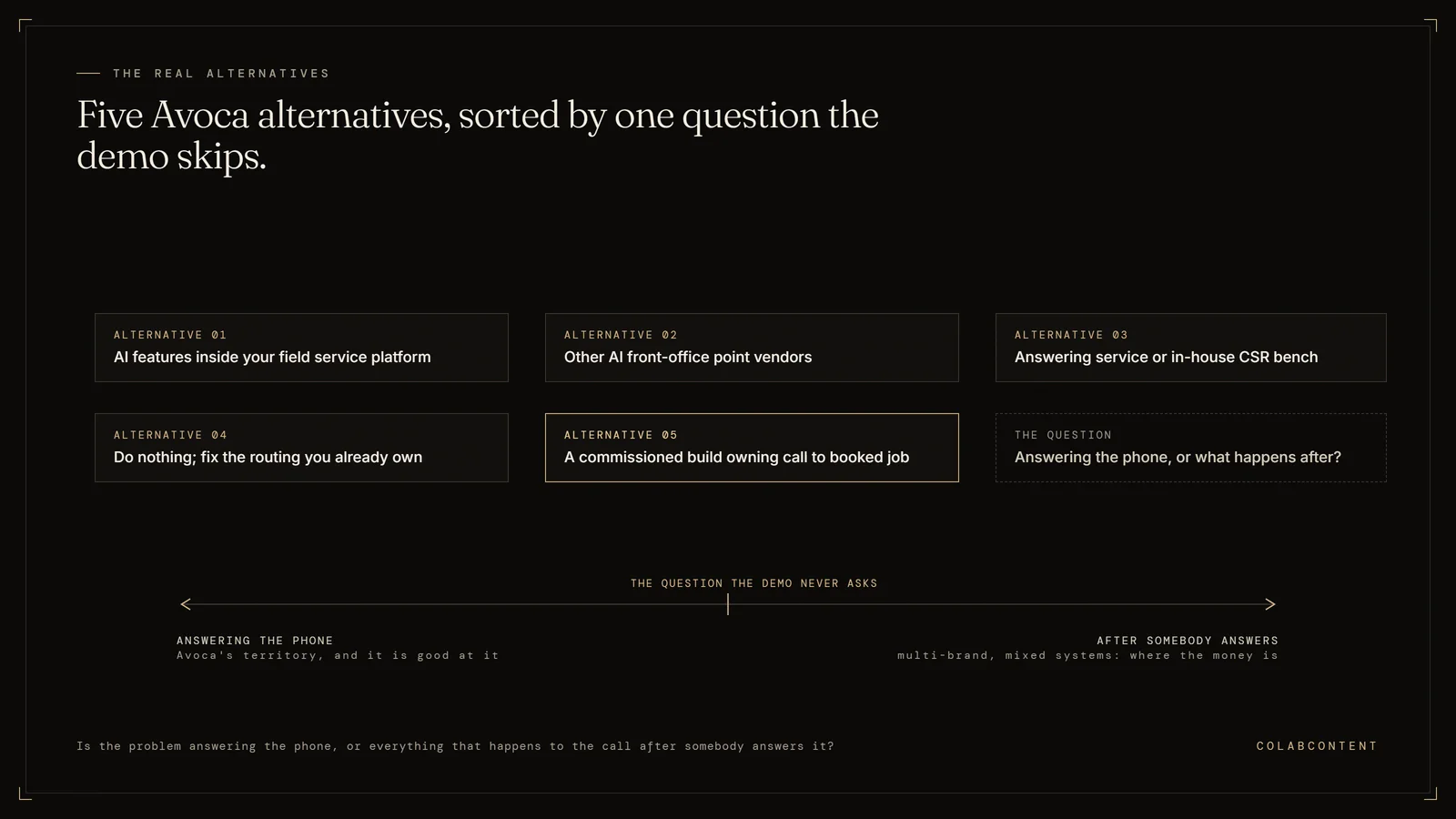
The real alternatives to Avoca AI are the AI features inside the field service platform you already run, the other AI front-office point vendors in the category, a human answering service or an in-house CSR bench, doing nothing and fixing the routing you already own, and a commissioned build that owns the whole call-to-booked-job path. Which is right turns on one question that has nothing to do with the demo: is your problem answering the phone, or is it everything that happens to the call after somebody answers it. Avoca is very good at the first. For a multi-brand operator running mixed systems, the second is usually where the money is, and no vendor in this category sells it. This is not the right path for single-location operators (SaaS economics win), platforms whose only AI need is call routing (IVR products cover that), or platforms without a named dispatch or scheduling constraint worth automating.
The decision framework. Three questions decide it: (1) does the platform's dispatch workflow fit what existing FSM AI (ServiceTitan Pro, Housecall Pro, FieldEdge) already automates, or does it carry multi-trade complexity; (2) do franchise agreements allow a SaaS vendor to process technician data, or must the platform control its own infrastructure; (3) over 24 months, does a per-location subscription cost less than a one-time build. Any "no" makes the build worth sizing. Key definitions. Dispatch optimization: matching technicians to jobs based on skill, location, and parts inventory. Call-to-book ratio: the percentage of inbound calls that convert to booked appointments. The next step. A forty-five-minute diagnosis call sizes the gap in dollars and weeks, at no cost. If the answer is a product, we say so.
Written for HVAC, plumbing and electrical operators, franchise groups and PE-backed home services platforms who have either sat through an Avoca demo or been told to go find one. Every claim about Avoca on this page was read off Avoca's own live pages, and where they publish nothing, this page says so instead of guessing.
What each alternative handles from dispatch to invoice.
Avoca answers the phone. It does that well, it is funded to keep doing it well, and if the thing costing you money is calls ringing out to voicemail at 4am and on Saturdays, Avoca or one of its peers is a reasonable buy.
The problem is that for a lot of operators the phone is not the slow part. A platform can answer every call and still book the same share of them, because the loss happens after the pickup: the caller wants a service the brand does not offer at that address, the slot the system offered does not match real capacity, the booking lands in the CRM missing the fields dispatch needs, or the job means one thing in one brand's catalogue and something else in another. Buying a faster pickup does not fix a path that was never bound by the pickup.
So the useful version of this page is not a row of logos that also answer phones. It is: work out which half of the problem you have. If it is answering, this page names the alternatives and tells you how to test them. If it is the path from answered call to a job your dispatchers can actually run, nobody in this category sells that, and the honest answer is a build against your own systems.
Key Terms
Dispatch optimization: using AI to match technicians to jobs based on skill, location, parts inventory, and customer history. Call-to-book ratio: the percentage of inbound calls that convert to booked appointments; AI phone agents lift this by eliminating hold-time abandonment. Truck-roll cost: the fully loaded cost of sending a technician to a job site; AI triage reduces unnecessary truck rolls. Revenue per technician: the key capacity metric for home services platforms; AI scheduling increases this by reducing drive time.
What Avoca actually does.
Avoca calls itself "The AI Front Office for Service Businesses," and the scope is genuinely wider than a call-answering bot. Its own product set runs across inbound calls, text and web chat, outbound multi-touch drip campaigns over SMS and voice, a no-code website scheduling widget, Google Local Services Ads lead handling, speed-to-lead response, analytics, and a separate call-scoring product called Coach.
Three parts are worth understanding before you compare anything to it:
- It writes into the CRM, not alongside it. On the ServiceTitan integration page, booked jobs appear on the ServiceTitan board with customer name, address, service type and call notes attached. That is the difference between a tool that books work and a tool that emails you a lead.
- The human handoff carries context. Avoca describes a "Human in the Loop" escalation that passes who is calling, what they need, their equipment and a live read of their tone, with a stated transfer time under three seconds, rather than a cold transfer that makes the caller start over.
- Coach is a separate product from answering. It scores recorded calls against a rubric your company defines, across objection handling, process adherence, tone and empathy, and booking outcome, and flags bookable leads that a CSR mis-tagged as not interested. Several operators buy Avoca for this rather than for the AI answering.
On credibility: Avoca holds a Certified Application listing on the official ServiceTitan Marketplace, which is a real third-party gate rather than a self-applied badge. It publishes a control catalogue on a dedicated trust site, which is more security transparency than most vendors in this category show publicly. It announced a Series B in April 2026 at a stated one billion dollar valuation, bringing its total raise to more than 125 million dollars, with Kleiner Perkins, Meritech, General Catalyst, Amplify Partners, Nexus Venture Partners and Y Combinator named as backers. This is not a thin company you need to be warned about.
Three things Avoca's own documentation does not promise.
None of these are accusations. They are gaps between what the marketing pages imply and what the published documentation actually commits to, and each one is a question to put in writing before you sign. We found all three by reading Avoca's own site and help centre, which means your procurement team will find them too.
One: there is no published price, at all. The URL avoca.ai/pricing returns a 404 page-not-found, and no per-seat, per-call, per-minute or monthly-minimum figure appears anywhere in the site navigation. Every product page terminates in "Talk to Us" or "Book a Demo." This is normal for the category and not a criticism, but it has a practical consequence: several third-party blogs publish confident Avoca cost estimates, none of those figures come from Avoca, and building a business case on them is guessing with extra steps. Price the decision from your side instead, using your own missed-call count, your booking rate on answered calls, and what a booked job is worth to you.
Two: the integration list is broader than the integrations. ServiceTitan and Housecall Pro each have a dedicated, fully built integration page, both citing a five minute setup. Avoca's help centre lists a wider set of configurable CRMs that can include AccuLynx, Jobber, HubSpot, Salesforce, Dynamics 365, FieldEdge and ServiceMinder. The same page then explains that a connector badge can read Connected, Not Connected, or Coming Soon, and states in its own words that Coming Soon "is informational. It is not a working connection flow." If your system of record is not ServiceTitan or Housecall Pro, that sentence is the most important one on their site. Make them demonstrate your specific connector in a live account, on your data, before signing.
Three: nothing published says who owns the recordings. The privacy policy grants a data portability right, and the analytics page advertises exportable reports. But the documented data-export feature in the product currently lists a single destination, sending scheduler booking data to one analytics tool through a configured storage bucket on a recurring schedule. That is booking data, not a general transcript export. Neither the terms of service nor the privacy policy states who owns call recordings and transcripts after cancellation. For a single-brand operator this is a footnote. For a platform being built to sell, where the accumulated call corpus is part of what a buyer is paying for, it is a term to settle in writing. The general argument for caring about this is at why code handoff matters.
One related note on contract length: the only public language is the general terms of service, which says fees bill in advance on a recurring basis and that you may cancel at any time. That is consumer-facing boilerplate. It is not safe to assume it governs a multi-location agreement, which is negotiated separately and is not observable from outside.
Named, and assessed fairly.
Where it wins: the booking lands where the work already lives, with no second vendor, no second contract, and no reconciliation between two ideas of what a job record is. If you run one brand on one platform, start here and make a point vendor beat it.
Where it costs you: vendor-native features are calibrated for the median customer on that platform, and they stop at the platform boundary. A roll-up running more than one CRM cannot get a single front office out of any one vendor's native tooling. We wrote the longer version of that trade at ServiceTitan Pro versus a custom build.Vendor-nativeCheapest first look
Where it wins: competition is the only reliable way to get a price out of a category where nobody publishes one. Running two or three vendors against the same sample of your own calls is the single highest-return hour in this evaluation.
Where it costs you: the vendors in this space differ more in integration depth than in demo quality, and the demo is the part they optimise. We keep the vendor landscape for this vertical on the shortlist for PE-backed home services platforms rather than restating claims here, because every one of them should be verified against your own stack rather than against our summary or theirs.Point vendorsUse them for price discovery
Where it wins: judgment on the calls that are worth the most. An angry recall, a warranty dispute, a commercial account renegotiating, a homeowner deciding between a repair and a replacement. These are conversations, not transactions, and a good CSR closes them at a rate no scripted system matches.
Where it costs you: cost scales with volume permanently, the capacity is not there at 4am or during a heat wave, and the investment never compounds. A system you own keeps whatever you teach it.
The realistic posture is not one or the other. It is a defensible triage line between them, and drawing that line is itself a build problem rather than a buying problem.HumanStill the default
Where it wins: a meaningful share of missed-call problems are a phone tree pointing at a voicemail box nobody owns, an after-hours forward to a number that changed, or Local Services Ads leads landing in an inbox instead of the CRM. None of that needs AI. It needs somebody to call their own main line at 7pm and follow what happens.
Where it costs you: nothing, which is why it belongs first. If this fixes the number, you have saved a contract. If it does not, you now have a clean baseline to hold a vendor to, which you did not have before.FreeDo this first, always
Where it wins: when the phones are already answered and the number still is not moving. That describes a large share of operators who go looking for an Avoca alternative in the first place.
Where it costs you: it takes longer to stand up than signing a SaaS contract, and it requires that you can describe your own process precisely. It is also the wrong answer if answering the phone genuinely is the constraint. See what we do not build.CommissionDifferent layer
Where Avoca is the right answer.
Three patterns where we tell operators to buy it and not call us back:
One brand, standardised on ServiceTitan or Housecall Pro, losing calls after hours. This is the case Avoca was built for. The connector is fully built, the setup is short, the booking lands on the board, and a commissioned build would be a slow and expensive way to get less. Buy it.
The constraint is call quality, not call volume. If your phones are answered and your booking rate on answered calls is the number that will not move, Coach is a more direct instrument than anything a build would give you in the first quarter. Scoring every call against your own rubric, and catching bookable leads a CSR wrote off, is a real product solving a real and specific problem.
You need something running this month. A five minute connector against a supported CRM beats a scoped build on any timeline that matters this quarter. If the season is the deadline, the SaaS contract is the correct decision and the build conversation can happen in the off-season.
Where a commissioned build is the right answer.
Multiple brands on multiple CRMs with one call centre. This is the roll-up case, and it is the one no vendor in this category solves. The hard part is not answering, it is that a booked job means different things in three systems with three service catalogues and three pricebooks. Reconciling that is the work, and it is the work that shows up in platform EBITDA at diligence. The longer version is at AI for home services platforms.
The bottleneck sits past the booking. Capacity-aware scheduling against real technician availability, exception queues, permit and parts dependencies, membership renewals, and reporting that rolls up to the platform rather than to one brand. All downstream of the call, none of it sold in this category.
You intend to own it. If the call corpus and the routing logic are assets you want on your own balance sheet at exit rather than terms in somebody's renewal, that is a build, and it is a deliberate decision rather than a technical one. Our version of that arrangement is fixed-fee with the code handed over, described at how a commission runs and priced at pricing.
How to run the evaluation.
Start with the free step, because it is the one that gets skipped. Call your own main line at 7pm on a Friday and follow what happens. Then do it again through your Local Services Ads number. A real share of missed-call problems turn out to be a phone tree pointing at a voicemail box nobody owns, or an after-hours forward to a number that changed two years ago. Fixing that costs nothing and either solves the problem or gives you a clean baseline to hold a vendor to, which you did not have before.
Then run the vendors against your own calls rather than their demo. Hand over a sample of your real recordings, including the difficult ones and the after-hours and peak-overflow traffic, because that is the window where the tool earns its fee and also where it is weakest. Score four things over a fixed period: answer rate on calls that previously went to voicemail, booking rate on answered calls, escalation rate and whether the handoff arrived with context, and how many bookings landed in the CRM complete enough that dispatch did not retype them. A vendor confident in the product will agree to that test.
Run at least two vendors, always. In a category where nobody publishes a price, competition is the only mechanism that produces one. That single hour is the highest-return work in this evaluation.
And get three things in writing before signing: your specific CRM connector demonstrated live rather than listed, the contract term and renewal mechanics, and who owns the recordings and transcripts after cancellation. All three are unpublished, all three are negotiable, and all three are harder to get after the signature than before it.
Frequently asked questions.
What does Avoca AI actually do?
Avoca AI describes itself as "The AI Front Office for Service Businesses," and the scope is wider than a call-answering bot. Its own product set covers inbound call, text and chat handling, outbound multi-touch drip campaigns over SMS and calls, a website scheduling widget, Google Local Services Ads lead handling, speed-to-lead response, analytics, and a separate call-scoring product called Coach that grades recorded calls against a rubric your company defines. Booked jobs are written straight into the CRM, and when a call needs a person, Avoca passes the caller context and a live tone read to the human rather than doing a cold transfer. It is a front office, not a dispatch engine.
How much does Avoca AI cost?
Avoca does not publish pricing. The URL avoca.ai/pricing returns a 404 page-not-found, and no per-seat, per-call, per-minute or monthly-minimum figure appears anywhere in the Products, Industries, Customers or Resources navigation. Every product page ends in "Talk to Us" or "Book a Demo." Third-party blogs publish cost estimates for Avoca; none of those numbers come from Avoca and you should not build a business case on them. The only side of the equation you control is your own missed-call volume, your booking rate on answered calls, and what a booked job is worth to you, so start the arithmetic there and make the vendor quote against it.
Which field service systems does Avoca AI integrate with?
ServiceTitan and Housecall Pro each have a dedicated, fully built integration page on Avoca's own site, both stating a five minute setup time. Avoca's Help Center lists a broader set of configurable CRMs that can include AccuLynx, Jobber, HubSpot, Salesforce, Dynamics 365, FieldEdge and ServiceMinder, plus Google Calendar for calendar-based scheduling. Read that list carefully. The same Help Center page explains that an integration badge can read Connected, Not Connected, or Coming Soon, and states plainly that Coming Soon "is informational. It is not a working connection flow." If your stack is not ServiceTitan or Housecall Pro, make the vendor show you your specific connector in a live account before you sign anything.
Is Avoca AI certified by ServiceTitan?
Yes. Avoca AI holds a Certified Application listing on the official ServiceTitan Marketplace, tagged under Live Services, Marketing and Integration, and the listing describes it as answering every call, working every lead, and booking directly into ServiceTitan. That certification is a real third-party gate rather than a self-applied badge, and it is a genuine point in Avoca's favour if ServiceTitan is your system of record. It is not a statement about accuracy, price, or fit for a multi-brand platform running more than one CRM.
Who owns the call recordings and transcripts?
Avoca's public Terms of Service and Privacy Policy do not say. The Privacy Policy grants a data portability right, meaning you can request a structured machine-readable copy of your data, and the Analytics product page advertises exportable reports. But the documented Data Export feature in the product currently lists exactly one destination, sending Simple Scheduler booking data to Searchlight through a configured S3 destination on a schedule. That is booking data, not a general transcript export. Nothing published states who owns the recordings after you cancel. For most operators this is a footnote. For a platform being prepared for sale, where the call corpus is part of the asset, it is a question to get answered in writing before signing.
What is the minimum contract term?
Not published. The only public language is the general Terms of Service, which says subscription fees are billed in advance on a recurring basis and that you may cancel at any time. That is consumer-facing boilerplate and it is not safe to assume it governs an enterprise or multi-location agreement, which is negotiated separately and was not observable from outside. Ask for the term, the renewal mechanics, and the notice period in writing, and treat any verbal answer as unconfirmed.
Should a PE-backed home services platform buy Avoca or commission a build?
Split the question by how many systems you run. Inside a single brand standardised on ServiceTitan or Housecall Pro, Avoca is a strong buy and a commissioned build would be an expensive way to get less. Across a roll-up where three brands sit on three different CRMs with three different service catalogues and one shared call centre, the hard part is not answering the call, it is reconciling what a booked job means in each system. That orchestration layer is not a product anybody sells, and it is the thing that shows up in platform EBITDA at diligence.
How do we evaluate an AI front-office vendor without taking the demo at face value?
Give the vendor your own recordings, including the difficult ones, rather than watching a scripted call. Score against your real booking rate on the same call mix, not against the demo. Then measure four things over a fixed window: answer rate on calls that previously went to voicemail, booking rate on answered calls, how often a call escalates to a human and whether the handoff arrived with context, and how many bookings landed in the CRM with fields your dispatchers did not have to retype. Insist on your own after-hours and peak-overflow traffic in the sample, because that is the window where the tool earns its fee and also where it is weakest.
Book the diagnosis call.
Forty-five minutes, no slides. Bring your call volume, your CRM or CRMs, and the number you are actually trying to move. We walk the path from a ringing phone to a job your dispatchers can run and name the step losing the most work. If the answer is buy Avoca, we say so on the call.
Read the home services offering → Or book directly →Where to look next.
If you are comparing vendor-native AI against a build, ServiceTitan Pro versus a custom AI build runs the same argument inside one platform, and ServiceTitan Pro Services versus a commission covers what their professional services team does and where it stops. The vertical page for multi-brand operators is AI for home services platforms, and the vendor field is mapped at best AI consultants for PE-backed home services platforms.
If you are earlier than vendor selection, the AI maturity assessment places where your operation actually sits, the five tests for off-the-shelf versus a commission is the general form of the decision on this page, and the full comparison library covers the other verticals. What we will not take on is listed at industries and what we do not build.