Home/ Resources/ Essay

Five things we don't build

The What We Dont Build framework is one of the working artifacts ColabContent uses to scope commissioned AI builds for mid-market operators. This framework is free to pick up and apply. ColabContent walks owners through the framework on the call that ends the $499 AI-Ready Audit.

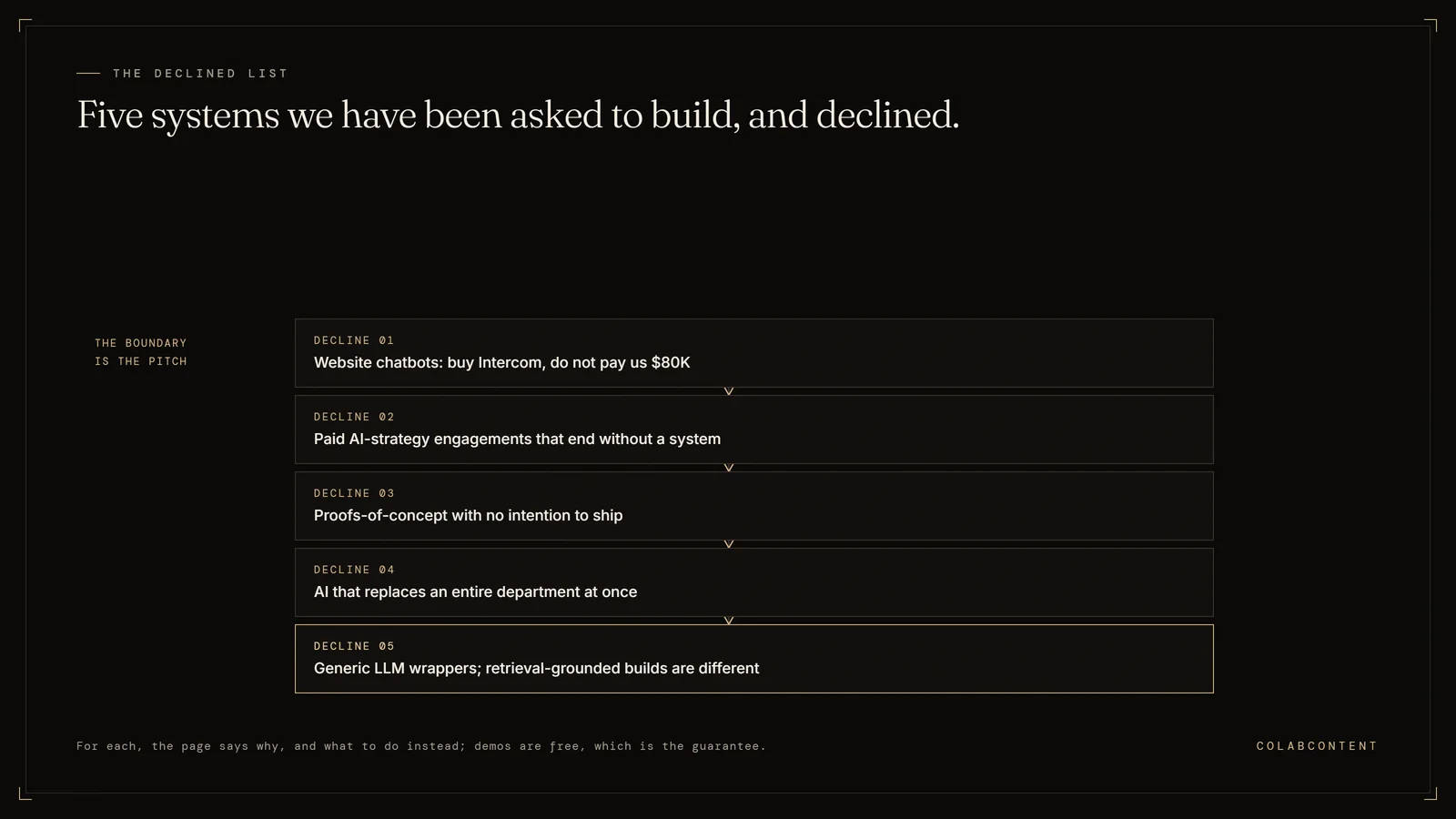
The five AI systems ColabContent declines to build: website chatbots, paid strategy engagements with no build, proofs-of-concept that never ship, wholesale department replacement, and generic LLM wrappers, with retrieval-grounded builds as the honest alternative
Five declines, each with a recommended alternative on the page.

A short, honest list of AI systems we've been asked to build and declined. For each, why, and what we recommend instead.

CategoryEssay
PublishedFebruary 2026
Read time6 min read
ByMarion Lowell

Key Terms

Handoff documentation: the package of code, prompts, models, datasets, and runbook (the written operating instructions) that transfers a commissioned system to the operator. Prototype validation: a working demonstration on the operator's real data, delivered before payment; surfaces whether the constraint is actually addressable. Integration surface: the set of APIs, data formats, and authentication mechanisms connecting an AI system to existing tools; the strongest predictor of implementation timeline. Vendor lock-in: the cost and difficulty of switching providers once data, workflows, and training are invested; code ownership eliminates it.

01. Website chatbots

We turn down roughly two of these a month. They're popular because they're visible, and because a CEO can point at one in a board meeting. They almost never produce measurable business outcomes. If you want a chatbot, buy Intercom, not an estimated $80K agency build.

02. "AI strategy" engagements

Three-month paid explorations of "where AI could fit in your business." No build. We decline these. Either we can see the two line items in the first call, or you don't need us. There is no strategy engagement worth your money that doesn't end in a system being shipped.

03. Proofs-of-concept that don't ship

We will build a working prototype to prove a concept before you pay for the full build, but we do not take money for a proof-of-concept with no plan to ship it. If a demo cannot become a real system, it stays a free demo rather than a paid engagement.

A POC built with no intention to ship is a demo. Demos are cheap and we don't charge for them, they're the guarantee.

04. AI that replaces an entire department

We'll rewire a department. We won't replace one. Businesses don't absorb change at that rate, and the systems that tried to do this in 2023 are cautionary tales. Start with the worst-fit role, systematize it, redeploy headcount into higher-value work. Six months later, do the next.

05. Generic LLM wrappers

A generic internal chatbot built on an LLM (a large language model, the technology behind tools like ChatGPT) rarely changes how a team actually works, because it answers from general knowledge rather than from your own documents. What produces real leverage is a retrieval-grounded assistant trained on your specific files and records, which is a RAG build, and it is what we commission instead.

"Our version of ChatGPT, for our company." These rarely produce real leverage. What does: retrieval-grounded assistants that know your specific documents. That's a RAG (retrieval-augmented generation, an AI that answers from your own documents) build, not a wrapper. We do those.

How to apply this framework

From framework to engagement.

A framework is only worth the time if it changes a decision. The entries below turn this one into practice: what it looks like on the audit call, what it asks of the owner, and how it shapes the prototype and the fixed-fee build that follow if the numbers justify one.

How to use this framework on a real engagement.

The frameworks on this section of the site are the same ones we use to scope a commission. They are not consulting frameworks borrowed from somebody else and rewrapped. They are the artifacts of having shipped enough commissions to converge on a few decision patterns that hold up under pressure.

Each framework is meant to be picked up and applied. We will walk an operator through any of them on an audit call. The call comes with the audit. The frameworks are free. The artifacts the operator leaves the call with are owned by the operator. The commission only begins if the operator and ColabContent both decide to proceed.

Where this framework sits in the decision sequence.

Every mid-market AI buying decision runs through three layers. The first layer is "is this the right problem to solve right now," which is the two-questions framework and the twelve-month-horizon framework together. The second layer is "what is the right buying motion for this specific problem," which is the build-versus-buy commission framework and the what-we-don't-build boundary essay. The third layer is "what is the right vendor for the chosen motion," which is the best-by-vertical guides and the comparison pages.

This framework belongs to one of those three layers. The other frameworks are linked below for the operator running the full sequence.

Common failure modes in applying it.

Skipping the constraint identification. The framework only works once the constraint is written down. Operators that try to apply the framework to "general AI strategy" never converge. The framework is applied to one specific named constraint at a time.

Applying it to the wrong layer of the decision. A framework meant to surface buying motion will not help an operator who has not yet decided that the problem is worth solving. A framework meant to choose a vendor will not help an operator who has not yet decided whether the right answer is build or buy.

Treating it as a one-time exercise. The frameworks are meant to be re-applied as the operator's situation changes. The twelve-month-horizon framework in particular gets re-run quarterly.

When the framework recommends "no AI right now."

Many operators leave an audit call having applied the framework and concluded that the right answer is no AI right now. We tell operators when that is the right answer. The commissioning house economics work for us only when the operator has a real constraint that a custom AI build can address. Operators without that constraint are better off without an engagement.

The honest "no" outcome is the most common single outcome of an audit call. We turn away more operators than we accept. What a real constraint costs to fix, and whether one exists, is what the $499 AI-Ready Audit establishes before any commission is proposed.

The other frameworks in this section.

The two-questions framework is the entry point to any diagnosis: what costs the most time, and what costs the most money. The build-versus-buy commission piece is the framework for deciding the buying motion. The twelve-month horizon is the framework for sequencing investments quarter by quarter. The what we don't build essay is the boundary statement, the work we will not commission. The AI isn't tooling piece is the structural argument for why AI investments fail at the tooling layer.

Buyer worksheet

Reading this framework alongside the others.

None of the frameworks on this site stands alone; each one answers a different question in the same decision. The entries below explain how this one relates to the others and how their answers combine into a single costed recommendation. Start with the two-questions framework if you have not diagnosed yet.

The four-question sequence operators run before booking.

Operators who arrive at the audit call having run the sequence usually commission the build that same week. The sequence asks four questions in a specific order. First, is the leading constraint actually addressable with AI, or is it a process problem, a staffing problem, or a stack problem that AI would not solve. Second, if AI is the right intervention, is the right buying motion a custom commission, an off-the-shelf product, or an internal hire. Third, if the right motion is a commission, is the operator comfortable running the system inside their own cloud tenant (an isolated environment in their cloud account) under an NDA (a signed non-disclosure agreement), owning the code at handoff. Fourth, is the budget for a custom build from $10,000 real this quarter.

Operators who answer yes to all four book the call. Operators who answer no to any one of them either change the question (the leading constraint is different, the budget moves, the cloud posture changes) or take a different path. We do not push operators who land at a "no" on any of the four into a commission they will not be served by.

The three signals operators watch for after handoff.

Twelve months post-handoff, three signals tell the operator whether the commission performed against the target written down after the audit. First, the dollar or hour delta on the workflow the commission addressed, measured against the pre-engagement baseline. Second, the percentage of the workflow the AI layer now handles autonomously versus the percentage that still routes to a human reviewer. Third, the number of times the operator's team has modified the build's prompts, models, or integration code on their own without ColabContent involvement. All three should be improving over time. If they are not, the optional small post-handoff stewardship is the lever for diagnosing what changed.

The honest comparison against the alternatives.

A commission is not the right answer for every operator. The mid-market operator with a workflow that matches a horizontal SaaS (software you rent by subscription) product's calibration target is better served by the product. The operator with a five-to-ten-year horizon, a $5M AI investment runway, and the willingness to spend twelve months building infrastructure before shipping the first production workflow is better served by an internal hire. The operator at $500M-plus revenue with stakeholder counts that justify a Big Four engagement is better served by that motion. We will tell the operator which of those alternatives fits if a commission does not.

The honest case for a commission is narrow on purpose. Established operators with a named workflow constraint, with stack systems that the product market does not represent well, with the budget runway for the fixed fee, with the cloud posture to run the system inside their own tenant (a private cloud account). Operators in that narrow band are where the math works.

Why we publish the comparisons, the rankings, and the boundaries.

Most consulting houses do not publish ranked comparisons against their competitors, do not publish the boundary of what they will not build, and do not publish fixed-fee pricing bands. We publish all three because the operators we want to commission for are the operators who reward that transparency with a faster booking. The never-overbook rule means we are not optimizing for top-of-funnel volume. We are optimizing for the right four operators each quarter. Publishing the comparisons, the rankings, and the boundaries selects for those operators.

Ready when you are

Start with the $499 audit.

The AI-Ready Audit is $499. The report arrives the same day, as a private link and a PDF, with a 5-minute video walkthrough and a 20-minute call. If it has no value you get the $499 back, and every quarter your AI answers, rankings and money leak are re-checked free.

No pitch. Money back if the audit has no value. A written map of the two line items bleeding your business.

Next step

Start with the $499 audit. Bring the current workflow, the system where it runs today, and the constraint worth automating. The call identifies whether a custom build, an existing product, or a different approach addresses it. The call is part of the audit; no obligation after it.

Related reading: Build Buy Commission, Framework for AI Buying Decisions.

Related reading: How a Custom AI Commission Runs, Step-by-Step.

Questions on this framework

Questions operators ask about what we turn down.

The questions below cover what does it cost to learn none of these five fit us, what if we already built one of the things on this list and how long before we know a project belongs on this list.

What does it cost to learn none of these five fit us?

Nothing extra; a no-build verdict still carries the money-back guarantee.

What if we already built one of the things on this list?

Often not wasted. It can become the front end of a properly scoped commission.

How long before we know a project belongs on this list?

Usually inside the audit call, before any build fee comes up. These five patterns are easy to recognize.

What is expected of us before that call?

Just the workflow and the constraint you want AI to fix. No prep document, no access request.

Does a no-build verdict cost us anything beyond the audit?

No. No fee beyond the $499 already paid, and the same money-back guarantee applies.

Why publish a list of what ColabContent won't build?

The boundary is the argument: naming what we turn away is what makes a build recommendation credible.