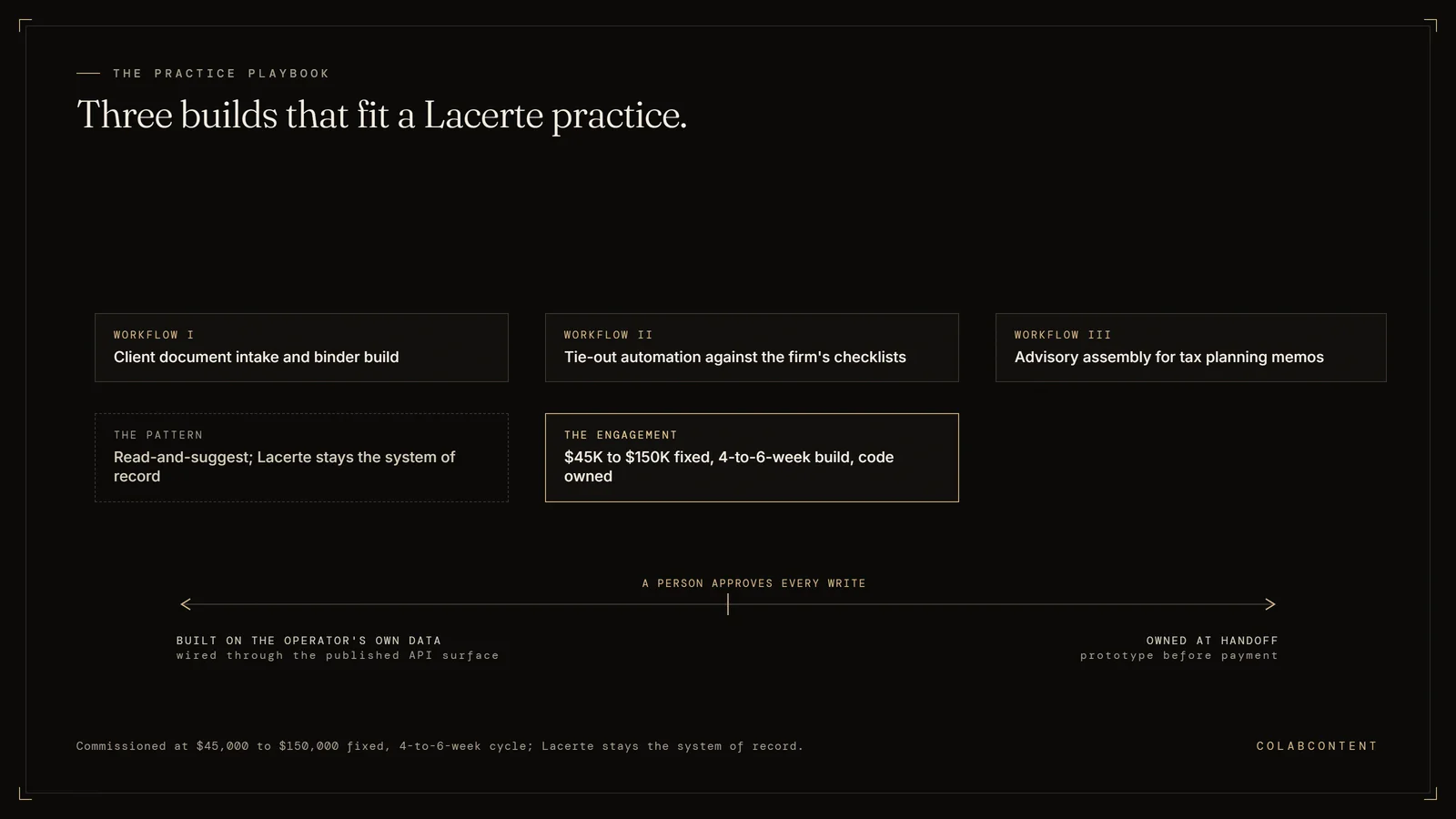
What this playbook covers and who it is for.
Lacerte sits in a different segment than CCH Axcess and ProSystem fx, biased toward firms with strong individual-return practice and personal/business mix. Intuit's AI investment for accounting is real (Intuit Assist, Tax Advisor) and is shipping useful features for the average Lacerte customer. The mid-market firm with 30-150 pros and a differentiated practice often needs leverage Intuit's roadmap doesn't cover.
The Lacerte surface area we touch.
Lacerte's integration surface is narrower than Axcess's. We work through Lacerte's data exchange (FDX, e-Organizer, Intuit Link) for client documents and prior-year data, the firm's DMS (SmartVault, Doc.It, FileCabinet) for workpapers, and Outlook + Microsoft Graph for the client communication layer. The AI runs alongside Lacerte rather than inside it.
Workflow I: Client document intake and binder build.
The Intuit Link / e-Organizer stream is the chase mechanism. The custom AI watches it, categorizes incoming docs, validates against the firm's expected-document checklist for that client (not Intuit's generic checklist), pings the partner only for material gaps.
The questions below cover does Lacerte have an API, how do you automate Lacerte without switching tax software and can AI write data back into a Lacerte return.
Workflow II: Tie-out automation against the firm's checklists.
The AI reads the in-progress Lacerte return + workpapers + prior-year, surfaces flags against the firm's specific tie-out logic. Catches what your senior reviewer would catch, an hour earlier, every time.
The questions below cover does Lacerte have an API, how do you automate Lacerte without switching tax software and can AI write data back into a Lacerte return.
Workflow III: Advisory assembly for tax planning memos.
The high-margin workflow at most Lacerte firms with strong individual practices. AI assembles client-specific tax-planning briefs, year-end strategy memos, and quarterly check-in deliverables from prior returns + current-year financials. Partner edits the assembled deliverable rather than building from scratch.