Home/ Comparisons/ NCR Aloha Alternatives

NCR Aloha (NCR Voyix) Alternatives for Restaurant Groups: 7 Options

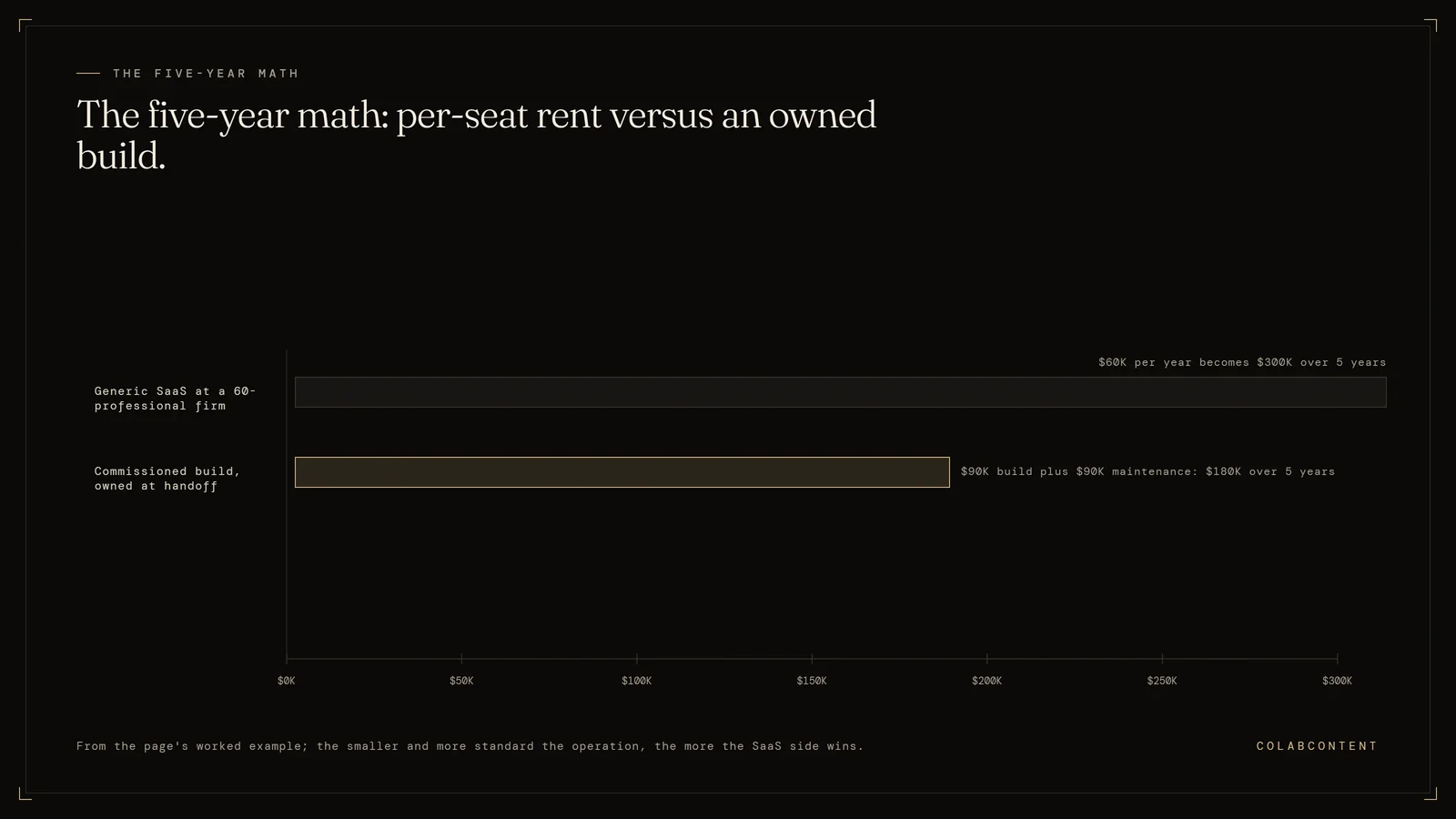
There are six credible replacements for NCR Aloha in a multi location restaurant group: Toast, Square for Restaurants, SpotOn, Lightspeed Restaurant, TouchBistro and Clover. The seventh option is the one no point of sale company will ever put on a comparison page, because it takes them out of the deal: commissioning the operations layer your group actually runs on and owning it outright, one fixed fee, no per terminal licence, no renewal escalator. Start with the finding that shapes the whole exercise. NCR Voyix publishes no price for Aloha anywhere on its own website. We opened its restaurant point of sale page on August 30, 2026, it loaded normally with its full marketing content, and there is not one dollar figure on it; every path we tried for Aloha Cloud and Aloha Essentials redirects to that same page and ends at a Get in touch form. So the numbers everyone quotes for Aloha, including the ones on this page, all come from somebody other than NCR. The best supported of them puts Aloha Cloud's Pro tier near $175 per terminal per month with hardware near $1,000 a terminal, which on a fifteen terminal group is $46,500 of cash in the first year alone. Run that forward five years against a $90,000 commissioned build carrying an eighteen percent maintenance assumption and the cumulative lines cross in year three, $146,784 against $138,600, widening to $218,755 against $171,000 by year five. The calculator further down runs the same arithmetic on your invoice instead of ours, and it will tell you plainly when the answer is that you should stay.

A note on names, because NCR uses several and operators use them interchangeably. NCR Voyix is the current corporate name; the company was NCR Corporation until the 2023 separation. Aloha is the restaurant brand it acquired long before that. Aloha Essentials is the Windows based on premise system most large chains still run. Aloha Cloud is the newer Android based product sold to independents and emerging chains. This page covers the decision, not any one product page, so it uses Aloha to mean the family unless a specific tier is named.

Five year cumulative cost chart showing a per seat software subscription compounding upward year after year while a one time commissioned build plus flat annual maintenance stays nearly level, with the two totals crossing partway through the horizon
The shape of every subscription decision. The exact numbers for a fifteen terminal Aloha group are plotted further down.

Written for the multi unit operator or restaurant group principal who already pays NCR. We do not sell a point of sale system, we take no referral fee from anyone in the table below, and there is a whole section further down arguing that a lot of operators should stay exactly where they are.

ForRestaurant groups, roughly 3 to 40 terminals across 1 to 15 locations
Aloha costNo published price. Reported near $175 per terminal per month on Cloud Pro
Our fixed fee$45,000 to $180,000, one time
StanceNeutral. We sell no POS.
Bottom lineCrossover in year 3 at 15 terminals and a $90K build
CostFree 45-minute diagnosis
Last updatedAugust 30, 2026, every vendor page read the same day

The short answer.

If you are here because the renewal quote landed higher than you expected, or because the April 2025 merchant fee notice cost you real money, the first thing to understand is that you cannot benchmark your way out of this one. NCR Voyix does not publish a rate card. Neither does Toast, in any form a buyer can check without a sales cycle. Three vendors on the list below publish a full itemised schedule on their own websites, plans plus processing plus hardware: SpotOn, Lightspeed and TouchBistro. Toast and Square publish plan tier rates without the full schedule. That is five of six publishing something checkable, and NCR publishing nothing. So the standard negotiating move, gathering competing quotes to build leverage, works less well in restaurant point of sale than in almost any other category of business software, because half the field will not give you a number until you have sat through a discovery call and a demo.

The second thing is the shape of the trade. Switching from Aloha to Toast or SpotOn or Lightspeed changes your cost structure, your hardware, your processing rate and your contract terms. It does not change the fact that you are renting, that the rent is charged per terminal or per location, that it goes up when you grow, and that it never ends. That is a legitimate thing to be fine with; most restaurants are, and should be. But if the specific thing that has you reading a page like this is the compounding, then the honest answer is that another subscription is a lateral move, and the only structurally different option is to own the layer that is actually costing you money. On a fifteen terminal group at the best supported reported Aloha figure, that becomes cheaper in year three and stays cheaper. On a three terminal group it never becomes cheaper inside ten years, and we will say so with the same emphasis.

What Aloha actually does well.

A page that only tells you what is wrong with your current system is an advertisement wearing a lab coat, so here is the case for staying, made as strongly as we can make it.

The labour pool knows it. This is the single most underrated line item in any point of sale decision and it does not appear on any pricing page. Aloha has been the default in American full service restaurants for decades. When you hire a general manager, a bar manager or a shift lead with ten years of experience, the odds are good they have already run Aloha, and that is worth real money in training time you never spend and mistakes that never happen on a Friday night. POS USA, an independent reseller review site, makes exactly this point in its Aloha review: more staff are trained on Aloha than on any other point of sale system. Move to a newer platform and you are paying for that retraining even though it never shows up in the quote.

Aloha Essentials handles complexity that cloud native systems still fumble. Deep modifier trees, coursing, split checks across seats and parties, multi revenue centre venues, comps and voids with granular permission control, offline resilience when the internet drops mid service. The Windows based hybrid architecture that everyone calls dated is also the architecture that keeps taking orders when the network goes down, and it is the reason large chains have not all left.

Enterprise reporting and multi site menu control are genuinely mature. Pushing a price change or a limited time offer to forty locations, enforcing recipe and modifier consistency, and rolling reporting up to a group level are all problems Aloha solved a long time ago. Several of the cheaper alternatives below are still catching up on exactly this, and they will not say so on their pricing pages.

The hardware is built for the environment. Restaurant floors are hot, wet and greasy, and consumer tablets in third party cases do not survive them. Proprietary hardware is a cost and a lock in, and it is also the reason the terminal still works after somebody spills a tray on it.

The interoperability surface is wide. Delivery marketplaces, reservation platforms, inventory tools, payroll and accounting all have long established Aloha connections. That is a real switching cost you should count on the way out, and it is a real benefit you already have on the way in.

Why operators start looking for a way out.

Five reasons come up over and over, and only two of them are about the sticker price.

One. You cannot see what you are buying. Every path on ncrvoyix.com for Aloha Cloud and Aloha Essentials ends at a contact form. That is not unusual in enterprise software, but it does mean that when a renewal arrives you have no public benchmark to test it against, and neither does the person you would ask for a second opinion.

Two. The processing is not optional. POS USA states it flatly in its Aloha review: NCR Voyix requires you to use their integrated payment processing, and third party processors are not supported. That single sentence, if it holds true for your agreement, means your effective monthly cost is set by a rate you did not shop and cannot move without changing platforms entirely. It also means a fee increase on the processing side is not something you can respond to by switching processors.

Three. April 2025 proved that point in cash. NCR sent merchants a notice raising the Discount Fee by 0.25 percentage points for agreements approved before April 1, 2024, moving settlement fee billing onto authorisation attempts with an increase of up to $0.07 per transaction, raising the monthly minimum for inactive or low volume accounts to $75, and adding a fee for monthly discount billing. Three separate outlets carry those same figures, and none of them is NCR. More on that below, including a note on which parts we could and could not verify.

Four. The bill grows when the business grows. Per terminal and per location pricing means opening a location, adding a bar station, or putting handhelds in the hands of servers all increase the monthly. That is defensible as a pricing model. It is also the exact mechanism that turns a manageable number into an uncomfortable one over five years without anyone deciding anything.

Five. The modules you actually want are add ons. Online ordering, inventory, kitchen display, loyalty and enterprise reporting are, on every platform in this category including Aloha, priced on top of the base. That is where a large share of the real monthly lives, and it is also, not coincidentally, the layer that is most buildable and most ownable.

What you are actually paying

Every number on this page, with its source.

Labels on this page are used in one fixed way, and we are copying the definition rather than paraphrasing it, because a paraphrase is how this word drifts. VERIFIED means read off the VENDOR's own page, or verified-by-absence at the vendor's own URL. A figure published by a third-party aggregator (Vendr, PriceLevel, SelectHub, ITQlick, G2, Capterra, checkthat.ai, any buyer-data or review platform) is REPORTED, however good that aggregator's data is. ASSUMPTION means it is a modelling input of ours rather than anyone's published figure. A page that failed to load supports nothing at all: a 403, a 404 or a timeout is a failure to observe, not an observation of absence, so where our own read failed the cell says that instead of implying we looked and found nothing.

Here is what that produced. Every vendor page in the table below was fetched on August 30, 2026 and every one of them returned HTTP 200 with full content. Nothing in the VERIFIED column rests on a blocked request.

Vendor and productHow it is soldPublished or reported priceHardware and setupSource and label
NCR Voyix Aloha CloudPer terminal per month, quote onlyNo published price. Reported near $175 per terminal per month on the Pro tier, with additional terminals reported near $45 per month eachReported near $1,000 per terminal if bought outrightVERIFIED ncrvoyix.com restaurant point of sale page loaded on August 30, 2026 with full content and contains zero dollar figures. REPORTED loman.ai and pricingnow.com for the $175 figure; posusa.com for the $45 additional terminal figure and for hardware near $1,000.
NCR Voyix Aloha Essentials (on premise)Per location, quote onlyNo published price, and no aggregator has a Cloud style per terminal figure for it either. POS USA reports software near $170 per month per location and labels that figure, in its own words, an industry reported starting pointReported near $1,000 per terminal purchased. Handhelds and kitchen display quoted separatelyVERIFIED the Aloha Essentials URL on ncrvoyix.com redirects to the same restaurant point of sale page, which loaded and publishes no figure. REPORTED posusa.com for the $170 and hardware figures.
NCR Voyix payment processing (required with Aloha)Percentage plus per transactionReported 2.6 percent plus $0.10 card present, and 3.5 percent plus $0.15 keyed. POS USA does not carry these percentages and states instead that NCR's rates are a custom quote and not publicly disclosedMonthly minimum reported at $75 for inactive or low volume accounts after April 2025REPORTED loman.ai and pricingnow.com for the percentages. REPORTED posusa.com for the statement that third party processors are not supported and that rates are not publicly disclosed.
April 2025 NCR merchant fee increaseChange to existing agreementsDiscount Fee up 0.25 percentage points for agreements approved before April 1, 2024. Settlement fee billing moved onto authorisation attempts, with an increase of up to $0.07 per transaction. Monthly minimum to $75. Monthly discount billing charged at the contracted rate or 0.05 percentEffective April 1, 2025REPORTED retailsystems.org, published April 22, 2025, quoting the merchant notice. Independently REPORTED with matching figures by posusa.com and loman.ai. Not published by NCR anywhere we could find.
Toast POSPer location plus per moduleStarting at $0 per month for the Starter Kit and $69 per month for the Point of Sale plan, with the Build Your Own tier directed to a custom quoteHardware kits priced on quoteVERIFIED pos.toasttab.com/pricing re-read in a browser on August 31, 2026; the $0 Starter Kit, the $69 Point of Sale rate and the custom quote direction are the page's own words.
Square for RestaurantsFree tier plus per device add onsFree tier exists. Kitchen display app $30 per month per device and kiosk app $50 per month per device on the middle tier; $20 and $30 on the higher tier. Pro tier is custom priced and gated at processing over $250,000 per yearHardware sold separately, discounts available on the Pro tierVERIFIED squareup.com restaurants pricing page loaded on August 30, 2026 and carries every figure in this row. Base subscriptions on that page are Free at $0, Plus at $49 per location per month and Premium at $149 per location per month.
SpotOn RestaurantThree named plans, publishedAll-In $0 per station per month with hardware included, processing 2.79 percent plus $0.20 card present and 3.79 percent plus $0.20 keyed, two year minimum term. POS Essentials $55 per station per month, processing 2.45 percent plus $0.15 card present (Amex 3.19 percent plus $0.15) and 3.45 percent plus $0.15 keyed. Build Your Own, custom. Optional Core Bundle software add on $50 per month per location plus 20 basis points of gross payment volume, capped at $200 per locationStation 15 $995, promotional $750 each. Station 10 $550, promotional $415. Handheld $495, promotional $297. Guest facing display $200. Wireless router $300. Implementation costs additionalVERIFIED spoton.com/pricing loaded on August 30, 2026 with every figure in this row in the page's own server delivered content.
Lightspeed RestaurantFour tiers, three publishedStarter 69 USD per month. Essential 189 USD per month. Premium 399 USD per month. Enterprise is Get a quote. Kitchen display system $30 per screen per month on all three published tiersHardware and payments quoted separately; processing rates are not published on this pageVERIFIED lightspeedhq.com restaurant pricing page loaded on August 30, 2026 and carries all four tiers and the kitchen display figure.
TouchBistroTwo published tiers plus customPoint of Sale from $69 per month. Essentials Bundle, hardware included, from $119 per month. Custom Setup on requestThe page states in its own footnotes that hardware, payment processing and additional fees apply on the $69 tier, and that payment processing and additional fees apply on the $119 tierVERIFIED touchbistro.com/pricing loaded on August 30, 2026 with both figures and both footnotes.
Clover restaurant plansSold through banks and processorsReported Quick Service $135, $185 and $245 per month and Full Service $179, $239 and $354 per month on 36 month terms. Other aggregators report materially different figures for the same named plans, so no single number here should be read as the numberHardware sold through the reseller; terms negotiated per repREPORTED tech.co for the figures above. We make no absence claim about clover.com: its pricing page returned a shell with no readable pricing content to us on August 30, 2026, which is a failure to observe rather than an observation of absence.
ColabContent commissioned buildOne time fixed fee$45,000 to $180,000, scoped per engagementIncluded in the fee. Runs on infrastructure you own or rent directlyOur own published pricing. Maintenance modelled at eighteen percent a year, ASSUMPTION, not a standing contract term.

The one first party pricing document, opened and read

NCR does publish one thing with the word pricing in the filename. Its documentation site hosts a PDF called Feature Focus Guide: Tier Pricing, dated April 15, 2025, listed under Aloha Cloud. If NCR published its own subscription tiers anywhere, that filename is where a careful reader would look.

We downloaded it and read all twenty seven pages. It is not about what NCR charges you. It is a merchant configuration manual explaining how to set up tier pricing for your own guests, so that loyalty members pay less than walk ins on the same item. The only dollar figures in the entire document are example promotion names in a worked scenario, six mix and match items for $35 at the regular discount and $30 for a VIP loyalty member. There is no NCR subscription price, no terminal fee, no processing rate, nothing about what Aloha costs. VERIFIED, in the sense that matters: we opened the one first party artifact whose name suggested it might contain pricing, and it does not. The absence of a published Aloha price is now observed in the vendor's marketing site and in its documentation library, not assumed from either.

Where the $175 figure actually comes from, and how much weight it carries

This matters more than the number itself, so read this part before you use it. Two sources put Aloha Cloud's Pro tier near $175 per terminal per month. One is loman.ai, which publishes a detailed Aloha pricing breakdown and also sells a competing AI phone answering product for restaurants, priced and promoted inside the same article. The other is pricingnow.com, which discloses on its own site that its answers are researched and refined with AI tools and then editor reviewed, that it may earn commission on links, and which, in the very same Aloha answer that carries the $175 figure, closes by name checking Loman AI. Those two are not independent of each other in the way a corroboration argument requires, and we are not going to pretend otherwise.

The genuinely independent third source, POS USA, does not corroborate $175. It reports software near $170 per month per location, attributes that to Aloha Essentials rather than Aloha Cloud, and labels it in its own words an industry reported starting point. That is a different product and a different unit, and treating it as confirmation of the Cloud figure would be exactly the kind of stacking that makes a page look sourced without being sourced.

So: REPORTED near $175 per terminal per month, from one detailed source with a commercial interest in Aloha looking expensive and one AI assisted aggregator that cites that source. We use it because it is the only per terminal figure that exists, we use it as the low case rather than dressing it up, and if your invoice says something different then your invoice is right and this page is wrong. That is what the calculator is for.

Two figures do carry real weight. Hardware near $1,000 per terminal is reported by three sources that are not derived from each other, including POS USA. And the requirement to use NCR's own payment processing is stated flatly by POS USA and repeated by pricingnow.com, and it is the claim on this page with the largest financial consequence, because it removes your ability to shop the single largest variable cost in a restaurant's technology stack.

The April 2025 fee increase, described accurately

This is the best documented event in Aloha's recent cost history and it is worth getting exactly right, because it is also the one most likely to be overstated by someone trying to sell you something.

On April 22, 2025 the trade site Retail Systems published a piece titled Aloha and NCR Merchant Fees Just Increased. The piece carries the byline Retail Systems; the author biography attached to that account on the site identifies Craig Allen Keefner and says he has managed the Kiosk Industry Group since 2014. The outlet covers self service and automated retail and does not sell a point of sale system. The piece reproduces the key points of a merchant notice: a Discount Fee increase of 0.25 percentage points effective April 1, 2025 for processing agreements approved before April 1, 2024; a move of settlement fee billing onto authorisation attempts with an increase of up to $0.07 per transaction; a monthly minimum fee rising to $75 for inactive or minimally processing accounts; and a fee for customers who elect month end discount billing set at either their contracted rate or 0.05 percent. POS USA and loman.ai independently report the same discount fee and authorisation fee figures.

Four honest caveats. The Retail Systems piece is opinion writing, it is openly contemptuous of NCR, and it credits another newsletter for surfacing the notice; we are citing its reproduction of the notice figures, not its characterisation of anyone. Its section arguing that the increase applies to Aloha specifically reads as analysis rather than as a quotation from the notice, so treat the applicability conclusion as that outlet's reasoning rather than as NCR's statement. We did not obtain the underlying merchant notice ourselves. And most importantly for the model below: this was a one time change to processing fees, not an annual escalation rate on the software subscription. Nobody, anywhere, publishes an Aloha subscription escalation percentage. Do not let anyone, us included, convert this event into a recurring rate.

The processing rate comparison nobody prints, because it does not flatter anyone

Here is something you can act on this week, and it cuts against the simple story. SpotOn publishes its card present rate on its own site: 2.45 percent plus $0.15 on the POS Essentials plan. NCR's reported card present rate is 2.6 percent plus $0.10. Those two look like an easy win for SpotOn, and at a lot of restaurants they are not.

Work it per transaction. SpotOn saves you 0.15 percentage points on the ticket value and costs you an extra five cents on the swipe. Those cancel out at a ticket of $33.33. Below that average check, NCR's reported structure is cheaper on card present volume; above it, SpotOn's published one is. At a $22 average check across a fifteen terminal group doing $18,000 a month per terminal, the reported NCR structure costs about $98,967 a year in card present processing and SpotOn's published rate costs about $101,471. At a $45 average check the same volume costs about $91,440 on NCR and about $90,180 on SpotOn.

Two things follow. First, if you are a quick service or fast casual operator with a low average check, a lower headline percentage can cost you money, and any comparison that shows you percentages without per transaction fees is not a comparison. Second, this is the clearest case on the whole page where the right answer is switch vendors rather than build anything, because processing is not a problem a custom system solves. We would rather tell you that here than let you find it out after signing something with us.

The five year model, and the caveat it carries

The model below takes a fifteen terminal group, which is a realistic mid sized multi location operator and matches the scale this page is written for. It uses the REPORTED Aloha Cloud Pro figure of $175 per terminal per month, adds REPORTED hardware at $1,000 per terminal once at year zero, and escalates the software three percent a year.

That three percent is an ASSUMPTION and we want to be explicit about why it is that number and not a bigger one. No source anywhere documents an Aloha software escalation rate. The only documented Aloha price change is the April 2025 processing fee event above, which is a different thing. We could have taken that event's 0.25 percentage point discount fee move and dressed it up as an annual software escalator, which would have pulled every crossover on this page toward our own conclusion. We did not, because a number chosen to flatter the seller is worth nothing to the buyer. Three percent is a plain, conventional software escalation assumption, and it is on the low side. Below the table you will find the same model run at zero percent and at five percent, and the crossover year does not move at any of them.

Against it sits a commissioned build at $90,000, the middle of our $45,000 to $180,000 range and not a quote for any specific group, with maintenance at eighteen percent of the build fee per year as a stated ASSUMPTION drawn from conventional custom software maintenance contracts rather than from anything specific to this category. Year 0 is the year you buy and install; maintenance starts in year 1.

Processing fees are deliberately excluded from this table, and that decision favours Aloha. A commissioned build does not replace your card reader and does not eliminate card processing; you still have a processor either way. Putting Aloha's processing on one side of the ledger and nothing on the other would be dishonest arithmetic, and it would move the crossover roughly two years earlier than it belongs. If you want to see the processing difference, it is in the section above, and the answer there is to change vendors, not to build.

YearAloha that yearCumulative AlohaBuild cost that yearCumulative build
0$31,500 software plus $15,000 hardware$46,500.00$90,000 one time$90,000.00
1$32,445.00$78,945.00$16,200$106,200.00
2$33,418.35$112,363.35$16,200$122,400.00
3$34,420.90$146,784.25$16,200$138,600.00
4$35,453.53$182,237.78$16,200$154,800.00
5$36,517.13$218,754.91$16,200$171,000.00

Read the first three rows before the last three, because they are the part a vendor chart would hide. At the end of year 0 you are $43,500 behind on the build. At the end of year 1 you are still $27,255 behind. At the end of year 2 you are $10,037 behind. Renting is genuinely the cheaper decision for three full years, and if your horizon is shorter than that, the answer on this page is stay. The lines cross in year 3, at $146,784.25 against $138,600.00, a gap of $8,184.25. By year 5 it is $218,754.91 against $171,000.00, a gap of $47,754.91, and it widens every year after that because one line has a slope and the other is flat.

Now the sensitivity, which is the part that decides whether you should believe any of it. Set the escalation assumption to zero and cumulative Aloha at year 5 is $204,000 instead of $218,755, and the crossover is still year 3. Set it to five percent and year 5 is $229,260, and the crossover is still year 3. The conclusion is not sensitive to the one input we could not source, which is the only reason we are comfortable printing it.

The build price is a different story, and it is where the argument has real limits. At $45,000, the floor of our range, the build is cheaper than Aloha from year 0 onward at this terminal count. At $180,000, the ceiling, it never catches up inside ten years against fifteen terminals, and we would tell you that on the call rather than let you find out afterwards. Terminal count moves it the other way, hard: at thirty terminals a $90,000 build wins from year 0, and at six terminals it does not win inside ten years at all. That is the whole argument in one sentence. This is a scale decision, not a philosophy.

The crossover

Where the two lines meet.

Cumulative spend for a fifteen terminal restaurant group, five years out. Aloha Cloud at the $175 per terminal per month figure REPORTED by loman.ai and pricingnow.com, with hardware at $1,000 per terminal REPORTED by three sources and paid once at year zero, escalating three percent a year as a labelled ASSUMPTION that no source documents and that we deliberately set low. Against it, a commissioned build at $90,000, the middle of our $45,000 to $180,000 range rather than a quote for anyone, paid once at year zero, with maintenance at eighteen percent of the build price a year as a stated ASSUMPTION. Card processing is excluded from both lines, because a build does not replace your card reader and charging it to one side only would be arithmetic with a thumb on the scale. Every figure in this chart comes from the table above.

Cumulative five year cost: NCR Aloha subscription versus a one time commissioned build, fifteen terminals Cumulative cost chart, Year 0 through Year 5, for a fifteen terminal restaurant group. Aloha spend starts at $46,500 in Year 0, which is $15,000 of hardware plus $31,500 of first year software, and rises to $78,945 at Year 1, $112,363 at Year 2, $146,784 at Year 3, $182,238 at Year 4 and $218,755 by Year 5. A one time ColabContent build at $90,000 plus annual maintenance at a stated assumption of eighteen percent starts far higher at $90,000 and rises slowly to $106,200, $122,400, $138,600, $154,800 and $171,000 by Year 5. The build line sits well above the Aloha line for the first three years, so renting is genuinely the cheaper decision for that whole period. The two lines cross during Year 3, at roughly $131,000 of cumulative spend on each path, after which the Aloha line stays above the build line and the gap widens every year. By Year 5 the gap is $47,755. Card processing is excluded from both lines. $0 $50K $100K $150K $200K $250K Year 0 Year 1 Year 2 Year 3 Year 4 Year 5 Crossover, during year 3 about $131,000 on each path Aloha $218,755 Owned build $171,000 Aloha, 15 terminals at $175 per month REPORTED, 3% escalation ASSUMPTION, hardware once Commissioned build, $90,000 once, 18% maintenance ASSUMPTION

Look at the left half of this chart before the right half, because the left half is the part that decides whether the right half is worth anything to you. The build line starts $43,500 above the Aloha line and stays above it through the whole of years 1 and 2. Renting is the correct financial decision for three years running. That is not a concession we are making reluctantly to look balanced; it is the actual shape of the trade, and any operator whose money has to work inside twenty four months should stop reading here and go negotiate a better Aloha renewal instead.

The lines cross during year 3 at roughly $131,000 of cumulative spend on each path. After that the gap opens every single year: $8,184 at the end of year 3, $27,438 at the end of year 4, $47,755 at the end of year 5. Nothing in this model bends the subscription line back down, because nothing in a real per terminal agreement does either. The only two things that flatten it are closing locations and taking terminals off the floor, and neither of those is a plan.

Three honest limits on this chart. First, it is drawn on a REPORTED price, not a quote, and the sourcing on that price is thinner than we would like, which is why the calculator below defaults to it but does not lock it. Second, the build price is the middle of a range and the range is wide for a reason; at the ceiling of it, against fifteen terminals, the lines never meet inside ten years. Third, and most important, a commissioned build at this price does not replace an EMV certified card present terminal, a kitchen printer network or an offline capable order entry system. What it replaces is the layer above that, and the next section is where that gets specific.

Your group, your numbers

The Aloha total cost calculator.

Every default below is a figure from the table above, and every one is editable, because the defaults are third party estimates and your invoice is a fact. Nothing is submitted anywhere. There is no email gate, the tool makes no external request, and it stores no value. The arithmetic runs in your browser and stops there. If your inputs make the build lose, the tool says so in plain language rather than quietly hiding the result.

One use worth knowing about. If what you are considering is not replacing Aloha but replacing the add on modules stacked on top of it, put the monthly cost of just those modules in the rate field instead of your full bill. The comparison then answers the question that is actually on the table, which is whether the online ordering, inventory, loyalty and reporting layer is worth renting forever.

Aloha is priced per terminal, so this is the input that drives the licence. A commissioned build is not priced per terminal, which is the whole mechanism this chart is testing.
Default is the $175 Pro tier figure REPORTED by loman.ai and pricingnow.com. NCR publishes nothing. Use your invoice, or use just your add on modules to test that question instead.
Reported near $1,000 per terminal purchased outright by three sources. Enter 0 if your hardware is folded into the subscription, or if you have already paid for it.
Default 3 percent, a labelled ASSUMPTION. No source documents an Aloha software escalation rate. Set it to 0 to remove it, or to your own figure if your last three renewals give you one.
The headline total is calculated over this horizon. Year 0 is the year you buy and install. The three and five year rows below are fixed.
ColabContent fixed fee range, $45,000 to $180,000, set after the diagnosis call and not before it.
Stated ASSUMPTION at 18 percent, drawn from conventional custom software maintenance contracts. Not a ColabContent contract term. Replace it with a real quote before deciding anything.
The roundup

Six alternatives, plus the option nobody sells you.

A word on the roster before the roster. Two of the most detailed Aloha comparison guides an operator will find are written by companies selling the reader an alternative subscription: loman.ai publishes a thorough Aloha pricing breakdown and promotes its own restaurant product inside it, and katalystos.com publishes an Aloha versus Toast guide that estimates monthly ranges for both and then positions its own cloud point of sale as cheaper than either. Neither of those is dishonest, and both contain useful work. But a buyer should know that the most detailed cost analysis of their current vendor was written by someone who gets paid if they leave. Meanwhile the neutral review aggregators tend to have the opposite problem: one large hospitality review site rates Aloha's cost as Above Average and carries no dollar figure at all, and its own price estimator tool returned no matching results when we tried it on August 30, 2026.

What follows is the field an actual multi unit operator would evaluate, ordered the way we would evaluate it. Every price is labelled, every source is named, and where a vendor's own numbers are not obtainable we say that instead of substituting somebody else's.

1. Toast POS

What it is. The cloud native restaurant platform that has taken more share from the legacy incumbents than anything else in the last decade. Android hardware, a very large restaurant specific integration ecosystem, and a product line that now reaches well past the terminal into payroll, online ordering, marketing, gift cards, capital lending and delivery.

Published price. VERIFIED at pos.toasttab.com/pricing, read August 30, 2026: pricing starts at $0 per month, with flexible plans covering hardware kits, flat rate processing and payroll bundles, and a direction to request a custom quote. That is genuinely all the page itself commits to in a form a reader can check. The Point of Sale plan is published at a starting rate of $69 per month, and the Build Your Own tier is the one that goes to a quote. Those plan figures are drawn by script rather than delivered in the served file, so an automated fetch sees only the $0 Starter Kit; read in a browser they are Toast's own published numbers. POS USA, REPORTED, puts Toast in the $0 to $69 per month band in its competitor comparison table.

Best for. Operators who want the deepest restaurant specific integration ecosystem in the category and are comfortable assembling their cost from a base plus per module add ons.

Where it falls short. The same add on structure that makes the entry price look low is what makes the exit price hard to predict, and neither Toast nor NCR publishes the tier figures you would need to settle that comparison. We found no source we would stand behind for what a fully built out Toast stack costs against a comparable Aloha configuration, so we are not going to tell you which one lands higher. And the $0 starting point is a real number attached to a plan most multi unit groups will not stay on for long. You are also swapping one processing relationship for another rather than opening it up.

Verdict. The most credible like for like replacement for Aloha, and a genuine architectural upgrade. It is not a cost escape, because it is still rent, and the rent still scales with your growth.

Aloha Cloud vs Toast: the comparison most operators are actually running

This is the head to head that comes up more than any other, so here it is properly, with the honest admission that it cannot be settled on price.

On transparency, Toast wins narrowly and neither wins cleanly. Toast publishes a $0 per month Starter Kit and a $69 per month Point of Sale plan on its own site, and pushes only its Build Your Own tier to a quote. NCR publishes nothing at all, on any page, including the one document in its library with the word pricing in the filename. So Toast gives you two checkable anchors and Aloha gives you none, and both leave you negotiating without a benchmark. Anyone who shows you a precise monthly figure for either one is showing you an estimate, and you deserve to be told which.

On architecture, Toast wins, and it is not close. Aloha Cloud is NCR's newer Android product and Aloha Essentials is a Windows based hybrid that predates the cloud era. Toast was built after the cloud and it shows in update cadence, remote management and the pace at which new modules land. If your frustration is that your system feels like it belongs to an earlier decade, that frustration is well founded and Toast is the direct answer to it.

On enterprise depth, Aloha Essentials still wins for the largest and most complex operations. Multi revenue centre venues, deep modifier logic, granular permission control, offline behaviour during a service, and enterprise menu governance across dozens of sites are exactly what Aloha Essentials was built for, and the reason large chains have not all moved. Note that this advantage belongs to Essentials, not to Aloha Cloud. If you are on Aloha Cloud, you do not currently have it.

On processing, this is the material difference and it deserves the emphasis. POS USA reports that NCR requires you to use its integrated payment processing and that third party processors are not supported. Toast likewise steers you to its own flat rate processing. So in practice both are closed, and switching between them is switching which company sets the largest variable cost in your stack, not regaining the ability to shop it. If the ability to shop processing is what you are after, look at the vendors below who publish an actual rate card, because a published rate is the only kind you can negotiate against.

On cost, nobody can answer it for you, including us. The only figures that exist for a real multi location comparison are third party estimates, and the most cited of them for this specific matchup comes from a company selling a third product. Get quotes from both, on your real terminal count, with every module you actually use itemised, and put them into the calculator above. That is the only version of this comparison that is true for your group.

2. Square for Restaurants

What it is. The lowest friction entry in the category. A free tier, month to month terms, no long contract, hardware you can buy off a website, and an ecosystem that reaches into payroll, banking, marketing and lending.

Published price. VERIFIED at squareup.com's restaurant pricing page, read August 30, 2026. A free tier exists. On the middle plan, the Square kitchen display app is $30 per month per device and the kiosk app is $50 per month per device. On the higher plan, those drop to $20 and $30 per month per device. The Pro tier is custom priced and the page states the eligibility threshold in its own words: process over $250,000 per year. Base subscriptions are published as Free at $0, Plus at $49 per location per month and Premium at $149 per location per month.

Best for. Single location and small multi location independents who want to be able to leave. Month to month with no term is a real feature, and it is the single thing Aloha most conspicuously does not offer.

Where it falls short. Two ways, and both bite at exactly the scale this page is written for. The per device add on fees compound: fifteen kitchen display screens at $30 is $450 a month before anything else, which is the same per unit trap you are trying to leave. And enterprise multi site reporting, franchise level controls and menu governance across many locations are where Square is thinnest against Aloha Essentials.

Verdict. The right answer for a two or three location independent and the wrong answer for a fifteen location group. Include it in the shortlist honestly and rule it out on capability rather than on price.

3. SpotOn Restaurant

What it is. A full service focused restaurant platform covering point of sale, online ordering, loyalty, marketing, labour and reporting, and the most transparent vendor in this entire comparison by a wide margin.

Published price. VERIFIED at spoton.com/pricing, read August 30, 2026, with every figure below present in the page itself. Three plans. All-In at $0 per station per month with hardware included, processing at 2.79 percent plus $0.20 card present and 3.79 percent plus $0.20 keyed, on a two year minimum term. POS Essentials at $55 per station per month, processing at 2.45 percent plus $0.15 card present with American Express at 3.19 percent plus $0.15, and 3.45 percent plus $0.15 keyed. Build Your Own for multi unit and high volume, custom priced. Hardware is listed openly: Station 15 at $995 with a promotional $750 each, Station 10 at $550 promotional $415, handheld $495 promotional $297, guest facing display $200, wireless router $300, with implementation costs additional. There is also an optional software Core Bundle at $50 per month per location plus 20 basis points of gross payment volume, capped at $200 per location.

Best for. Multi location full service groups that want to be able to model their own cost before a sales call, and operators who want a real published processing rate they can hold a vendor to.

Where it falls short. The Core Bundle's twenty basis points of gross payment volume means part of your software cost scales with revenue rather than with terminal count, which is a worse shape than a flat per terminal fee for a high volume location, even with the $200 cap. The All-In plan's headline of $0 per station is real and it is paid for in the processing rate, which at 2.79 percent plus $0.20 is the most expensive card present rate on this page. And as shown further up, the POS Essentials rate only beats NCR's reported rate above a $33.33 average check.

Verdict. The strongest comparison point on this page precisely because it is checkable. If you do nothing else with this page, get a SpotOn quote, because it is the only one you can validate against a public rate card before you take the call.

4. Lightspeed Restaurant

What it is. A hospitality platform with genuine depth in full service, strong inventory and menu tooling, and a published tier structure that makes it unusually easy to evaluate at the low end.

Published price. VERIFIED at lightspeedhq.com's restaurant pricing page, read August 30, 2026: Starter at 69 USD per month, Essential at 189 USD per month, Premium at 399 USD per month, with the kitchen display system listed at $30 per screen per month across all three. The Enterprise tier is not priced and carries a Get a quote button. Processing rates are not published on that page.

Best for. Independents and small groups that want to compare real numbers without a discovery call, and operators who want strong inventory and recipe costing without buying a separate product for it.

Where it falls short. The transparency runs out at exactly the point where you need it. A fifteen terminal multi location group is an Enterprise conversation, and the Enterprise tier reverts to the same custom quote opacity you are trying to escape at Aloha. So the published tiers tell you what Lightspeed charges a restaurant that is not you. Processing is also unpriced on the page, which means the largest variable cost is invisible at the shortlist stage.

Verdict. Genuinely transparent below the enterprise line and no more transparent than NCR above it. Worth a quote; do not mistake the published tiers for the price you would pay.

5. TouchBistro

What it is. An iPad based full service restaurant system with a long standing reputation for floor plan and table management, plus a guest engagement layer of reservations, loyalty, gift cards and marketing sold around it.

Published price. VERIFIED at touchbistro.com/pricing, read August 30, 2026: Point of Sale starting at $69 per month and an Essentials Bundle, hardware included, starting at $119 per month, with a Custom Setup priced on request. Credit where it is due, the page footnotes its own limits in plain sight: hardware, payment processing and additional fees apply on the $69 tier, and payment processing and additional fees apply on the $119 tier.

Best for. Single location and small chain full service floors where table management and coursing are the daily bottleneck, and operators who want hardware bundled into a predictable monthly.

Where it falls short. The vendor's own footnotes tell you the sticker is not the bill, which is honest and is also the same pattern as everywhere else in this category. And like Square, it thins out against Aloha Essentials once you are governing menus and reporting across a dozen or more sites.

Verdict. A credible small and mid sized swap with unusually candid disclosure. Not built for the top end of the range this page addresses.

6. Clover

What it is. A very widely deployed small business platform with a broad hardware family, sold overwhelmingly through banks, independent sales organisations and payment processors rather than direct.

Published price. This one has to be handled carefully. We make no absence claim about clover.com. Its pricing page returned a shell to us on August 30, 2026 with no readable pricing content in it, and a page that delivers nothing readable is a failure to observe, not an observation that nothing is published. So we use a third party: REPORTED by tech.co, an independent technology publication, Quick Service plans at $135, $185 and $245 per month and Full Service plans at $179, $239 and $354 per month, all on 36 month terms, with card present processing between 2.3 and 2.6 percent plus $0.10 and keyed at 3.5 percent plus $0.10. Other aggregators report materially different numbers for the same named plans, which is not a contradiction to resolve; it is the finding. Clover is resold on negotiated terms and the price genuinely varies by who sells it to you.

Best for. Operators who want the hardware family and are comfortable that the deal is brokered by whoever handles their merchant account.

Where it falls short. No canonical price exists anywhere, not even a stable third party consensus one, which makes Clover arguably less benchmarkable than Aloha's single custom quote model. Thirty six month terms are long. And the enterprise restaurant tooling is not where Aloha Essentials is.

Verdict. Include it for completeness and because your bank will probably suggest it. Price it as reseller variable and get two quotes from two different resellers, because you will get two different numbers.

7. A commissioned build you own

What it is. This is the option that does not appear on any comparison page in this category, for the straightforward reason that everyone who writes those pages sells a subscription. You pay a one time fixed fee inside $45,000 to $180,000, you get a system built around your group's actual workflow, and you own it: the code, the data model, the integrations, the documentation. There is no per terminal licence, no per location fee, no seat count, no renewal, and no escalator.

What it is not, and this is the part other pages would leave out. It is not a replacement for your card present terminal. We do not build EMV certified payment hardware, we do not run a card processing business, and a restaurant cannot take a chip card on a custom web application. A commissioned build sits alongside a point of sale. What it replaces is the layer above the terminal, which is where a surprising share of your monthly actually lives: online ordering and its commissions, inventory and recipe costing, labour forecasting and scheduling, multi location reporting and menu governance, guest data and loyalty, and increasingly the AI layer that answers the phone, takes the reservation and reads the P and L.

Published price. $45,000 to $180,000, one time, scoped after a diagnosis call. Maintenance modelled at eighteen percent a year on this page is a stated ASSUMPTION for modelling, not a contract term.

Best for. Groups above roughly ten terminals whose add on module spend is a meaningful share of the bill, who have one or two workflows that leak money every month, and who intend to be operating in five years.

Where it falls short. Below about six terminals the arithmetic on this page does not work and we will tell you so. It carries an internal ownership obligation: somebody at your company has to own the system after handoff or it decays. It is slower to stand up than buying a subscription. And we have no hospitality case study, which is a real gap and is addressed honestly in the worksheet at the bottom of this page.

Verdict. The only structurally different option on the list. Every other row changes who you rent from.
The ownership case

Ten arguments for owning the layer instead.

Each of these has to survive a hostile reading, so none of them carries a number we cannot source and none of them is a slogan. Where an argument only applies at certain sizes, that is stated inside the argument rather than in a disclaimer at the bottom.

1. The subscription never ends, and the math already showed it

Cumulative Aloha spend on a fifteen terminal group reaches $146,784 by year 3 and $218,755 by year 5, against $138,600 and $171,000 for a $90,000 commissioned build with an eighteen percent maintenance assumption. The lines cross during year 3 and the gap is $47,755 by year 5. Those are the same numbers as the chart above, and they came from the same sourced inputs. Nothing about them requires you to believe anything we say about ownership philosophically. It is arithmetic, and you can rerun it on your own invoice in the calculator.

2. Per terminal pricing taxes exactly the thing you are trying to do

This is the argument that matters most to a group that intends to grow. Open a location and the software bill goes up. Add a bar station for the summer patio, add handhelds so servers stop walking to the terminal, add a second kitchen display for the expo line, and each one is another recurring line. Reported additional Aloha Cloud terminals run near $45 per month each, and Square's kitchen display app is $30 per month per device on its own published page, and Lightspeed's is $30 per screen per month on its own published page. None of those is unreasonable individually. Together they mean that every operational improvement you make carries a permanent tax. An owned system has a marginal cost of zero per terminal, so growth is free on the software line and the only question left is whether the location works.

3. An asset on the balance sheet instead of an expense on the P and L

Five years of subscription payments leave you with nothing you can sell, transfer, or show a buyer. A commissioned system is property. If you sell the group, it transfers with the group and it is part of what makes the group worth buying, because the operating advantage goes with it. If you refinance, it is an asset. If you franchise, it is an asset you can licence. Rent buys you access for a month at a time; ownership buys you something that is still there in year six.

4. Built around your workflow instead of the other way round

Every platform on the list above is built for the median restaurant, which does not exist. Your prep sheets, your par levels, your comp policy, your family meal accounting, your catering workflow, the way your regional managers actually read a Monday report, none of that is the median. On a subscription you adapt the operation to the software and then you pay for the sixty features you never open. A commissioned build is scoped to the workflows that are actually costing you money, and nothing else gets built or paid for.

5. The AI layer is where the per seat tax is heading next

Look at where this category is going, because the pricing pattern is already visible. Vendors are shipping AI features as premium tiers and per device or per location add ons rather than as part of the base: SpotOn's Core Bundle, which includes its AI profit analysis and AI marketing tools, is $50 per month per location plus twenty basis points of gross payment volume on SpotOn's own published page. Lightspeed lists an AI feature as a tier differentiator on its own published page. That is the same per unit structure as everything else, applied to the newest and fastest moving part of the stack, and it means every future AI capability arrives with a recurring price tag attached to your terminal count. A commissioned system puts the AI at the core rather than in a tier, and adds no per terminal charge when you extend it.

6. Unlimited users, including the ones you do not pay for

Seasonal staff, a second shift, the regional manager who checks four locations, the bookkeeper, the accountant, the landlord's reporting requirement, the franchisee. On per seat and per terminal pricing every one of those is a decision about whether the access is worth the fee, which is a stupid decision to have to make about your own business. On an owned system access is a permissions question, not a purchasing question.

7. Your data, your export path, no exit negotiation

Menu structures, recipe and modifier trees, guest history, loyalty balances, labour records and years of item level sales data are the asset your business actually accumulates. On a subscription, your ability to take those with you is whatever your agreement says and whatever the vendor's export tooling supports, and you find out which on the worst possible week. On an owned system the database is yours, the schema is documented, and the export path is a query. This is not a promise about any specific vendor's conduct; it is a statement about who holds the keys, which is a structural fact and not a matter of anyone's good faith.

8. Processor lock in is a structural cost you can only exit by leaving

POS USA states that NCR requires you to use its integrated payment processing and that third party processors are not supported. If that is what your agreement says, then the largest variable cost in your technology stack is set by a company you cannot put out to tender, and the April 2025 fee notice is what that looks like in practice: the Discount Fee moved, the authorisation fee moved, and there was no competitive response available to you inside the platform. Owning your operations layer does not by itself free your card processing, and we will not claim it does. What it does is decouple the two decisions, so that when you do change point of sale vendors for processing reasons, you are not simultaneously rebuilding your entire operating stack.

9. Change speed, which is the argument operators feel before they can price it

The realistic path to getting a feature you need out of a large platform vendor is a request that joins a roadmap you cannot see, prioritised against the needs of every other customer, most of whom are not like you. The realistic path on a system you own is a scoped change with a cost and a date. That difference does not show up in any total cost model, and it is frequently the thing an operator names first when asked what actually changed after a build.

10. One fixed fee, and what the proof behind it actually is

$45,000 to $180,000, one time, scoped after the diagnosis and not before it. Here is the proof, stated exactly and with its limits, because a receipt that is not real is worse than no receipt.

We have built and shipped custom AI systems for operating businesses, and the reference we offer by name is Jim Glaser Law, where the principal takes reference calls. We built and run the LELF platform. Our systems have handled more than 6,000 AI answered calls in production, which is the closest thing we have to a hospitality relevant proof point, because phone handling in a restaurant group is the same problem shape. We have delivered more than 40 commissions. And the limit: none of that is a restaurant. We have no hospitality case study, because we have not built one yet. If a vertical specific reference is a requirement for you, that is a legitimate requirement and we are the wrong vendor for it. We would rather you read that here than discover it in the second meeting.

The honest section

Who should stay on Aloha.

This is the section that decides whether you should believe the rest of the page, so it is specific and it is not short. Every one of these is a real reason to renew, and several of them describe most of the people reading this.

You have fewer than about six terminals

This is the hardest number on the page and it comes straight out of the model. At six terminals, cumulative Aloha spend over five years at the reported figure is about $87,500. A $90,000 commissioned build costs $171,000 over the same period with the maintenance assumption. It does not cross over inside ten years. At three terminals it is about $43,750 over five years against the same $171,000, and it is not close. If you are a single location independent or a two site operator, the arithmetic on this page says stay, and there is no version of the conversation where we tell you otherwise. Go get quotes from SpotOn, Lightspeed and TouchBistro, whose published rate cards are up above, and use them as leverage on your renewal.

Your horizon is shorter than three years

Even at fifteen terminals, renting is the cheaper decision for the first three years. If you are inside a lease you might not renew, considering a sale, in the middle of a refinance, or otherwise unsure what the group looks like in thirty six months, then the crossover is behind an event you cannot predict and a one time capital outlay is the wrong shape. Stay, and revisit when the horizon is longer than the crossover.

What you actually need is the point of sale itself, not the layer above it

If your complaint is the terminal, the card reader, the offline behaviour, the printer routing, or the speed of the order entry screen, a commissioned build does not solve any of that and it would be dishonest of us to imply otherwise. That is a point of sale problem with a point of sale solution, and the six vendors above are the shortlist. We would tell you the same thing on the call.

You live inside one Aloha Essentials capability nothing else matches

Multi revenue centre venue handling, the depth of the modifier and coursing logic, the granular permission and audit structure, or the specific offline behaviour that keeps you taking orders when the network drops. If one of those is load bearing for your operation, the migration risk is real and the replacement candidates genuinely may not match it. Staying and negotiating is the rational move.

Your staff turnover is high and your training budget is not

The labour pool argument is not sentimental, it is financial. If you hire experienced managers who already know Aloha, switching platforms means paying for retraining across every location, twice, once during the parallel run and once for everyone hired afterwards. Nobody quotes you that number and it is frequently larger than the software difference.

You need something working next month

A commissioned build is scoped, built and handed over. It is not a purchase order and a download. If the requirement is a working system inside a few weeks, buy a subscription. There is no clever version of this answer.

You do not have an internal owner for the system

An owned system needs someone at your company who is accountable for it after handoff: not a developer, but a person who knows what it is supposed to do and who raises their hand when it stops doing it. If nobody on your team will take that, an owned system decays into an unsupported liability, which is a worse outcome than renting. Be honest about this one before anything else.

Your real problem is the processing rate

Then your answer is in the processing comparison further up this page and it is to change vendors, not to build. Get the SpotOn published rate card, work out your true average check, and run the per transaction math rather than comparing percentages. Building software does not lower a card present rate by a single basis point.

Decision tree

Seven questions, in order, with stop points.

Answer these in sequence. Several of them end the exercise, and ending it early is a good outcome, not a failed one.

1. Is your problem the terminal itself? Order entry speed, card reader behaviour, printer routing, offline resilience, the physical hardware. If yes, stop. This is a point of sale replacement and the six vendors above are your shortlist. Start with SpotOn and Lightspeed because they publish rate cards, which means you can prepare before the call rather than during it.

2. Is your problem the processing rate? If yes, stop, but do the math first. Work out your true average check, then compare on the full structure and not on the percentage. A rate of 2.45 percent plus $0.15 is more expensive than 2.6 percent plus $0.10 on any ticket below $33.33. Then get quotes, and treat NCR's reported requirement to use its own processing as a reason the answer here is probably a vendor change.

3. How many terminals do you run across the whole group? Under six, stop. The model on this page says renting wins for you and it is not marginal. Use the published rate cards above as renewal leverage and come back if you triple in size.

4. Will this group exist, in roughly this shape, in four years? If no or unsure, stop. The crossover on a fifteen terminal group lands during year 3 at the modelled figures. Behind an uncertain event, a capital outlay is the wrong shape and a monthly is the right one.

5. Can you name, in one sentence with a dollar or hour figure attached, the workflow that leaks money every month? If no, do not sign anything with anyone. Book the diagnosis call if you want help writing that sentence, because writing it is the work of the call, but do not commission a build without it and do not let any vendor sell you one.

6. What share of your monthly bill is add on modules rather than the core terminal licence? Online ordering, inventory, loyalty, kitchen display, enterprise reporting, marketing. If it is a large share, this is the strongest case on the page, because that layer is exactly what a commissioned build replaces and exactly what it removes from your recurring cost. Put just that number in the calculator's rate field and look at what it says.

7. Is there a named person at your company who will own the system after handoff? If no, stop. Fix that first. An owned system with no internal owner is worse than a subscription, and we would rather lose the engagement than hand one over into a vacuum.

If you got through all seven, the case is real and worth forty five minutes. If you stopped at any of them, the page did its job.

Next step

Book the 45-minute diagnosis.

Bring your Aloha invoice with the modules itemised, your terminal count by location, and one sentence describing the workflow that leaks. You leave with the constraint written down either way, and a meaningful share of these calls end with us telling an operator to stay exactly where they are.

Free · 45 minutes
Under NDA
Operator to operator
No follow-up unless asked
Migration reality

What leaving Aloha actually involves.

Nobody publishes an honest version of this, because the vendor you are leaving has no reason to and the vendor you are joining has every reason to make it sound trivial. Here is the shape of it, with a clear note wherever we could not source a specific number rather than an invented range.

Read the agreement before you read any quote

The document that controls your exit is your current agreement, not your invoice. Find the term length, the automatic renewal mechanics, the notice period required to prevent renewal, any escalation clause, the early termination provisions, the data access and return language, and whether the payment processing agreement has its own separate term that does not expire when the software term does. That last one catches people, because the software contract and the merchant processing agreement are frequently not the same document with the same dates. We cannot tell you what yours says. It is thirty minutes of reading and it is the highest value thirty minutes in this entire process.

What data actually has to move

In a restaurant migration this is more than a menu export. The full list is usually: the menu with every modifier group, modifier tree, forced modifier and price level; recipes and item costing if you keep them in the system; employees with roles, permissions, wage rates and job codes; the floor plan and table map per location; tax configuration and jurisdictions, which multiply if you cross state or municipal lines; discount, comp and void reason codes; gift card balances, which are a real liability and must reconcile to the dollar; loyalty accounts and point balances; guest records; and item level historical sales, which is the one people forget until the first time they want a year over year comparison and cannot get one.

Gift card balances and loyalty points deserve their own sentence, because they are the two items where a migration error is a customer facing failure rather than an internal one. A guest presenting a card that no longer works is the worst possible way to announce a system change.

The parallel run is not optional

The pattern that works is to run one location on the new system while the rest of the group stays on the old one, through at least one full weekend and ideally one full month end close. One location, not one shift, and one that is busy enough to break things. What you are looking for is not whether the new system can take an order; it is whether your reports reconcile, whether the tax comes out right, whether the kitchen gets the ticket in the right order, and whether your Monday numbers match what the old system would have said. Cutting the whole group over on the same night to save on the parallel period is the mistake that turns a migration into an incident.

Timeline honesty

We cannot give you a sourced duration for an Aloha migration specifically, and we are not going to invent a range. What we can tell you is what drives it: the number of locations, whether your menus are consistent across them, whether hardware is being replaced at the same time, and whether your team can absorb training during a busy season. What we would push back on is any vendor timeline that does not include a parallel run, a month end close on the new system, and a rollback plan.

Do not migrate during your season

Whatever your busiest ten weeks are, that is when your staff has the least capacity to learn a new system and the most to lose from a bad night. Every operator knows this and a surprising number of migrations still get scheduled by someone looking at a fiscal calendar rather than a service calendar.

What a commissioned build changes about all of this

Less than you might hope, and in a specific direction. If you commission the operations layer and keep your point of sale, you are not doing a point of sale migration at all: the terminal, the card reader, the printers and the staff training on order entry all stay exactly as they are. What moves is the layer above, which is a smaller and much lower risk migration because it is not customer facing on a Friday night. If you are also changing point of sale vendors at the same time, do them in sequence and not together. Two simultaneous migrations is not twice the risk; it is considerably more, because when something breaks you cannot tell which change caused it.

Deep dive

The dimensions the price table cannot show.

Eight dimensions, side by side.

Price is one column. These are the eight that decide whether a system is right for a group, and they are the ones a demo will not surface.

DimensionNCR AlohaThe cloud native fieldA commissioned build
Price visibility before a sales callNone. No figure anywhere on ncrvoyix.com, VERIFIED by absence on a page that loadedMixed. SpotOn, Lightspeed and TouchBistro publish; Toast publishes a $0 floor; Clover is reseller variablePublished range, $45,000 to $180,000, fixed after scoping
Cost shapePer terminal, per location, recurring, with add on modules on topSame shape, different rates. Per station, per device, or per location, sometimes plus a percentage of payment volumeOne time, then a maintenance line. Flat regardless of terminals
Payment processingNCR's own, and POS USA reports third party processors are not supportedGenerally the vendor's own too. SpotOn and Clover publish rates; Lightspeed and Toast do not publish them on their pricing pagesNot applicable. A build does not replace your card reader, and your processing relationship is unchanged by it
Contract termNot published. Read your own agreementRanges from month to month (Square) to 24 months (SpotOn All-In) to 36 months (Clover, REPORTED)No term. You own the artifact
Enterprise menu governance across many sitesStrongest in the category, on Aloha Essentials specificallyImproving fast at Toast and SpotOn, thinnest at Square and TouchBistroExactly as strong as you scope it, and no stronger
Offline behaviour during serviceA genuine strength of the Windows based hybrid architectureVaries. Ask for the specific failure behaviour, not the marketing wordNot applicable to order entry. Design the operations layer to tolerate the terminal being the source of truth
Speed of getting a change you needVendor roadmap, prioritised across every customerSame, and faster at the newer vendorsA scoped change with a cost and a date
What you hold in year sixAccess, for as long as you keep payingAccess, for as long as you keep payingThe code, the data, the documentation, and the ability to sell it with the business

When to pick which, in one paragraph each.

Stay on Aloha if your operation depends on Aloha Essentials capabilities that nothing else matches, if your management bench already knows it, if your horizon is under three years, or if you run fewer than about six terminals. Use the published rate cards on this page as renewal leverage rather than as an exit plan.

Move to Toast if the core frustration is that the platform feels a decade old and you want the largest restaurant integration ecosystem going forward. Accept that you are trading one closed processing relationship for another and that your real monthly will be assembled from modules.

Move to Square if you are one to three locations, you value being able to leave, and you would rather have month to month terms than enterprise reporting. Do the arithmetic on per device kitchen display and kiosk fees before you commit, because they scale the way everything else does.

Move to SpotOn if you want to be able to model your own cost before the sales call. It is the only vendor here whose plans, processing schedules and hardware prices are all on one public page, which means you can walk into the call already knowing what good looks like. Check the average check math before assuming the lower percentage saves you money.

Move to Lightspeed if you are at the smaller end and want strong inventory and recipe costing without a separate product. Understand that the published tiers stop at the point where a multi location group begins, and that Enterprise is a quote like everything else.

Move to TouchBistro if you are a single site or small chain full service floor and table management is your daily bottleneck. Its own footnotes tell you hardware and processing are extra, which is more disclosure than most of the field offers.

Look at Clover if your bank is offering it and the hardware family fits. Get two quotes from two different resellers, because the price is negotiated and you will get two different numbers.

Commission a build if you are above roughly ten terminals, a meaningful share of your bill is add on modules rather than the core terminal licence, you can name the leaking workflow in one sentence with a number attached, you intend to be operating in five years, and somebody at your company will own the system afterwards. All five. Four out of five is a no.

Why this page is written by someone who does not sell a point of sale system.

It is worth being explicit about incentives, because two of the most detailed Aloha comparison guides available to an operator are published by companies selling competing restaurant subscriptions, and neither of them says so at the top.

ColabContent sells commissioned software builds at a fixed fee inside $45,000 to $180,000. We do not sell a point of sale system, we do not resell one, we take no referral fee or commission from any vendor named on this page, and we would not know how to get one if we wanted to. That means we have no financial reason to talk you into Toast over SpotOn or SpotOn over Lightspeed, and it is why the roundup above states each vendor's published price accurately even where the published price is better than ours looks in year one.

The incentive we do have is obvious and worth naming: we would like some of the readers of this page to hire us. That is why the model is built the conservative way rather than the flattering way. The escalation assumption is set low and disclosed. Processing is excluded from the crossover chart even though including it would move the crossover two years earlier in our favour. The build price used in the chart is the midpoint rather than the floor. The section listing who should stay is longer than most of the roundup entries. If a page like this one only ever produced the answer buy from us, you would be right not to trust the arithmetic in it, and so would we.

What a build alongside your point of sale actually looks like.

Concretely, because ownership is an abstraction until you can picture the thing. These are the systems that come up most often in restaurant groups, in the order they usually pay for themselves.

The phone. Reservations, takeout orders, catering enquiries, and the thirty calls a night nobody answers because the floor is full. This is the workflow where we have the most production evidence, with more than 6,000 AI answered calls handled across our systems, and it is the same problem shape in a restaurant as it is anywhere else: a caller with an intent, a system that has to identify it, act on it and hand off cleanly when it cannot.

Ordering that you own. Direct online ordering under your own brand, with your own guest data, replacing a per order commission or a per location monthly with a system you paid for once. The maths on this one is often the fastest, because commission on volume is the most brutal shape of cost there is.

Inventory, par levels and recipe costing tied to actual sales. Not a spreadsheet reconciled on Sundays, but a system that knows what you sold and what it should therefore have consumed, and flags the variance while it is still this week's problem.

Labour forecasting from your own history. Not a generic scheduling tool, but a forecast built on your item mix, your weather, your local calendar and your actual service patterns, feeding the schedule your managers already build.

Multi location reporting that matches how you actually manage. The report your regional manager needs on a Monday morning, in the shape they need it, rather than the eleven standard reports a vendor ships and the export to spreadsheet that follows.

The one weird thing. Every group has one: a catering workflow, a commissary transfer process, a franchise royalty calculation, a ghost kitchen split, a loyalty programme with rules no platform supports. It is usually the thing costing the most manual hours and the thing no vendor will ever build, because you are the only customer who needs it. This is what commissioned software is actually for.

In every case the terminal stays. The card reader stays. Your staff keeps ringing in orders the way they do now. What changes is the layer above, and it changes from rent to property.

Extended FAQ

The eight questions Aloha buyers actually ask.

Why is Aloha POS so expensive?

The honest answer starts with a correction: nobody outside NCR can tell you whether Aloha is expensive, because NCR publishes no price. We opened its restaurant point of sale page on August 30, 2026, it loaded with full content, and there is not one dollar figure on it; every Aloha Cloud and Aloha Essentials path we tried redirects to that same page and ends at a Get in touch form. We also downloaded the one document in NCR's own library with pricing in the filename, a twenty seven page Feature Focus Guide called Tier Pricing dated April 15, 2025, and read all of it: it is a manual for configuring discounts for your own guests, and the only dollar figures in it are example promotion names. So what people mean when they say Aloha is expensive is usually one of four structural things, and all four are real. First, it is priced per terminal and per location, which means the bill grows every time the operation grows, with additional Aloha Cloud terminals reported near $45 per month each. Second, the modules that make the system useful, online ordering, inventory, kitchen display, loyalty and enterprise reporting, are add ons on top of the base rather than part of it. Third, hardware is proprietary and reported near $1,000 per terminal if bought outright, with full service packages reported far higher. Fourth, and most consequentially, POS USA reports that NCR requires you to use its own payment processing and that third party processors are not supported, which means the largest variable cost in your stack is set by a party you cannot put out to tender. In April 2025 that last point had a visible price: NCR raised the Discount Fee by 0.25 percentage points on agreements approved before April 2024, moved settlement billing onto authorisation attempts with an increase of up to $0.07 per transaction, and raised the monthly minimum to $75 for low volume accounts. Expensive is a comparison, and the reason it is hard to make is that there is no published number to compare against.

How much does NCR Aloha POS cost per month?

There is no published answer, and any page that gives you a confident single figure is giving you somebody's estimate without saying so. Here is every number that exists, with who says it. Aloha Cloud's Pro tier is reported at approximately $175 per terminal per month by loman.ai and by pricingnow.com. Those two sources are less independent than they look: loman.ai sells a competing AI phone answering product for restaurants and promotes it inside the same article, and pricingnow.com discloses on its own site that its answers are researched and refined with AI tools and editor reviewed, may earn affiliate commission, and it name checks Loman AI in the very same Aloha answer. POS USA, which is genuinely independent of both, does not confirm $175: it reports software near $170 per month per location, attributes that to Aloha Essentials rather than Aloha Cloud, and labels it in its own words an industry reported starting point. Additional terminals are reported near $45 per month each by POS USA. Hardware is reported near $1,000 per terminal by three sources that are not derived from one another. Add ons reported by loman.ai run $50 to $100 a month for online ordering, $100 to $150 a month for inventory, and $1,000 to $1,500 or more per station for kitchen display. Implementation is reported at $1,500 to $3,000 for a single location with training add ons at $500 to $1,500. Aloha Essentials, the on premise product most large chains run, has no per terminal figure anywhere from anyone. Every one of those numbers is REPORTED, meaning published by somebody other than NCR, and the only VERIFIED fact about Aloha pricing is that NCR does not publish one. Your invoice is the only number that is true for you, and the calculator on this page takes it.

What is the difference between Aloha Cloud and Aloha Essentials?

They are two different products sold under one brand to two different kinds of restaurant, and confusing them is the single most common error in Aloha cost comparisons, including in several published guides. Aloha Essentials is the older and larger of the two: a Windows based hybrid system that runs on premise with cloud services attached, built for enterprise operations, deep customisation, complex modifier and coursing logic, multi revenue centre venues, granular permissions, and menu governance across many sites. It is what most large chains mean when they say they run Aloha, its offline resilience during a service is a genuine architectural strength, and it is priced entirely on custom quote with no public figure of any kind from NCR or from any aggregator. Aloha Cloud is the newer Android based product aimed at independents and emerging chains: simpler, faster to stand up, cloud managed, with basic loyalty and email marketing in the standard package and advanced capability sold as add ons. It is the only one of the two with any public per terminal figure at all, the reported $175 a month Pro tier. The practical consequence for a buyer is this: if you are on Aloha Essentials, the enterprise depth argument for staying is strong and it belongs to you. If you are on Aloha Cloud, you do not have that depth, you are paying a per terminal rate for a cloud product, and the alternatives in the roundup above are much closer to a like for like swap than they would be for an Essentials site.

Is Aloha Cloud better than Toast?

On architecture, Toast, and it is not particularly close. Toast was built after the cloud and it shows in update cadence, remote management and how quickly new modules arrive; Aloha Cloud is NCR's newer product but it sits inside a company whose centre of gravity is still the Windows based Essentials platform. On price, nobody can tell you, and be suspicious of anyone who does. Toast's own pricing page, re-read in a browser on August 31, 2026, publishes a $0 per month Starter Kit and a Point of Sale plan starting at $69 per month, and sends its Build Your Own tier to a custom quote. Those figures are rendered by script, so an automated fetch of the served file sees only the $0, which is why an earlier draft of this page wrongly reported that Toast published no plan tier figure at all. NCR publishes nothing at all. That leaves both of them as quotes, and the most detailed public comparison of the two is published by a company selling a third point of sale product, which does not make its estimates wrong but does mean you should know who wrote them. On processing, this is where the real similarity lives and where most comparisons go quiet: POS USA reports that NCR requires you to use its own processing and does not support third party processors, and Toast likewise steers you to its own flat rate processing, so switching between them changes whose rate you pay rather than restoring your ability to shop it. On enterprise depth, Aloha Essentials still wins for the largest and most complex operations, though note carefully that this advantage belongs to Essentials and not to Aloha Cloud. The practical answer for an operator: if your frustration is that the software feels dated, Toast is the direct fix. If your frustration is the monthly, get both quotes on your real terminal count with every module itemised and run them through the calculator on this page, because that is the only version of this comparison that is true for your group.

How do I switch from Aloha POS to a different system without losing my menu and recipe data?

Start with your agreement rather than your data, because the data question is downstream of the contract question. Find the term, the automatic renewal mechanics, the notice period, the data access and return language, and whether your payment processing agreement has a separate term that outlives the software term, which is the trap most operators do not see coming. Then inventory what actually has to move, because a restaurant migration is far more than a menu export. The full list is usually the menu with every modifier group, modifier tree, forced modifier and price level; recipes and item costing if you hold them in the system; employees with roles, permissions, wage rates and job codes; the floor plan and table map for each location; tax configuration and jurisdictions, which multiply if you operate across municipal or state lines; discount, comp and void reason codes; gift card balances; loyalty accounts and point balances; guest records; and item level historical sales, which is the one people forget until the first time they want a year over year comparison and cannot produce one. Gift cards and loyalty balances deserve special handling because an error there is customer facing: a guest presenting a card that no longer works is the worst possible way to announce a system change, and those balances are a real liability that must reconcile to the dollar. Then run one location in parallel on the new system for at least one full weekend and ideally through a month end close, before touching the rest of the group. What you are testing is not whether the new system takes an order; it is whether your reports reconcile, whether the tax is right, whether the kitchen gets tickets in the right sequence, and whether Monday's numbers match what the old system would have said. Do not migrate during your busiest ten weeks, and if you are also changing point of sale vendors and building new systems at the same time, do them in sequence, because two simultaneous changes make it impossible to tell which one broke.

Does Aloha POS require you to use NCR's own payment processing?

POS USA, an independent reseller review site, states it plainly in its Aloha review: NCR Voyix requires you to use their integrated payment processing, and third party processors are not supported. It also states that NCR's processing rates are a custom quote and are not publicly disclosed. PricingNow reports the same requirement and describes the arrangement as a payments focused business model. Both of those are REPORTED, meaning published by someone other than NCR, and we could not find NCR publishing a statement of the requirement either way on its own site. The only document that governs your situation is your own merchant agreement, so read it rather than taking any page's word for it, this one included. If the requirement does apply to you, it has three consequences worth naming. Your largest variable technology cost cannot be competitively tendered, which removes the normal remedy for a rate you do not like. A processing fee increase cannot be answered by changing processors, only by changing platforms, which is what made the April 2025 notice consequential rather than merely annoying. And the reported rates, 2.6 percent plus $0.10 card present and 3.5 percent plus $0.15 keyed according to loman.ai and pricingnow.com, become something you compare against other platforms rather than against other processors. Worth knowing before you assume a lower headline percentage elsewhere saves you money: SpotOn publishes 2.45 percent plus $0.15 card present on its POS Essentials plan, which is only cheaper than NCR's reported structure above a $33.33 average check, because the extra five cents per transaction cancels the fifteen basis point saving at exactly that ticket size.

What are the best alternatives to NCR Aloha POS for a multi-location restaurant group?

There is no single winner and any page naming one is selling something, so sort it by which problem you actually have. If the problem is that the platform feels a decade old and you want the deepest restaurant integration ecosystem going forward, Toast is the shortlist leader, with the caveat that its own page commits to a $0 per month Starter Kit and a $69 per month Point of Sale rate, and quotes everything above that. If the problem is that you cannot get a number out of anyone before a sales call, SpotOn is the answer, because it is the only vendor in this comparison that publishes plans, both processing fee schedules and a hardware price list on one public page: All-In at $0 per station per month with hardware included and processing at 2.79 percent plus $0.20, POS Essentials at $55 per station per month with processing at 2.45 percent plus $0.15, and a custom Build Your Own tier for multi unit operations. If the problem is that you want strong inventory and recipe costing at the smaller end, Lightspeed publishes Starter at 69 USD, Essential at 189 USD and Premium at 399 USD per month, with the honest caveat that a real multi location group is an Enterprise conversation and Enterprise is a quote. If you are one to three locations and value being able to leave, Square offers month to month terms with no long contract, though its per device kitchen display and kiosk fees at $30 and $50 a month compound at scale and its enterprise reporting is the thinnest here. TouchBistro at $69 and $119 a month is a strong single site and small chain full service option that discloses in its own footnotes that hardware and processing are extra. Clover is worth a quote if your bank offers it, but no canonical price exists for it anywhere because it is resold on negotiated terms, so get two quotes from two resellers. And the option none of those pages will show you: commissioning the operations layer above the terminal and owning it outright, one fixed fee inside $45,000 to $180,000, which on a fifteen terminal group becomes cheaper than the reported Aloha figure during year three and stays cheaper. Below about six terminals it does not, and we say so on the page rather than in a footnote.

Why did NCR increase Aloha's processing and merchant fees in 2025?

We cannot tell you why, because NCR did not publish a reason, and we are not going to speculate about a company's motives on a page a buyer is using to make a decision. What we can tell you is what changed and who reported it. On April 22, 2025 the trade site Retail Systems published a piece reproducing the key points of an NCR merchant notice. The piece carries the byline Retail Systems; the author biography attached to that account on the site identifies Craig Allen Keefner and says he has managed the Kiosk Industry Group since 2014. The outlet covers self service and automated retail and does not sell a point of sale system. The changes it lists, all effective April 1, 2025: the Discount Fee increases by 0.25 percentage points for processing agreements approved before April 1, 2024; all settlement fee billing moves to assess on authorisation attempts, with the authorisation fee increasing by up to $0.07 per transaction; the monthly minimum fee rises to $75 for accounts that are inactive or process minimal transactions; and customers who elect month end discount billing are charged either the rate stated in their agreement or 0.05 percent. POS USA and loman.ai independently report the same discount fee and authorisation fee figures, which is three separate outlets carrying the same numbers, none of them NCR. Four caveats you should carry with those figures. The Retail Systems piece is opinion writing, it is openly hostile to NCR, and it credits another newsletter with surfacing the notice, so we are citing its reproduction of the notice and not its characterisation of anyone. Its argument that the increase applies to Aloha specifically reads as that outlet's analysis rather than as a quotation from NCR, so treat the applicability conclusion accordingly. We did not obtain the underlying merchant notice ourselves and are not claiming to have read it. And most importantly for anyone modelling future costs: this was a one time change to payment processing fees, not an annual escalation rate on the Aloha software subscription. Nobody publishes an Aloha subscription escalation percentage, and converting a 2025 processing event into a recurring software increase would be a fabrication, which is why the model on this page uses a plainly labelled and deliberately low three percent assumption instead.

Buyer worksheet

What to have in front of you before any call.

Seven documents to pull before you talk to anyone.

One. Your current NCR agreement, not the invoice. The agreement is where the term, the automatic renewal mechanics, the escalation clause if there is one, the notice period, the limitation of liability and the data access terms all live. Every reported figure on this page is a substitute for that document and a worse one.

Two. Your merchant processing agreement, separately. It is frequently a different document with different dates from the software agreement, and it is the one that controls the fee changes that hit you in April 2025. Find its term and its termination provisions before you assume the software renewal date is your decision point.

Three. A line by line list of every module and integration you pay for. Online ordering, inventory, kitchen display, loyalty, gift cards, marketing, enterprise reporting, third party delivery connections. Then mark which ones your team used last month. The gap between those two lists is usually the fastest money in the whole exercise, and it is also the exact layer a commissioned build replaces.

Four. Terminal count by location, not group total. Group deals blend across sites, and you cannot tell whether a specific location is priced sensibly until you have unblended it. Include bar stations, handhelds and kitchen displays, because they are usually billed too.

Five. Your last three renewal notices. Put the increases next to each other. If they compound, you now have your own escalation rate rather than the three percent assumption we labelled, and the calculator on this page will give you a much sharper number than ours.

Six. Twelve months of processing statements with your true average check. Not your menu average, your actual average ticket including modifiers, drinks and tips where applicable. Everything in the processing comparison on this page turns on that number, and most operators guess it high.

Seven. One sentence naming the workflow that leaks, with a dollar or hour figure attached. If you cannot write that sentence, no vendor on this page can help you, and neither can we.

Seven questions to ask every vendor, including us.

What is the term, and what happens at renewal? Ask for the escalation clause in writing. A vendor that will not commit one to paper has told you something useful.

Am I required to use your payment processing, and is that in the software agreement or a separate one? Ask for the answer in writing and ask where in the document it lives. This is the single question with the largest financial consequence in a restaurant technology decision, and it is the one most likely to get a reassuring verbal answer that the paperwork does not support.

What is your card present rate, including the per transaction fee, and what is your keyed rate? A percentage on its own is not an answer. Then run it against your real average check rather than assuming the lower percentage wins, because below about $33 a ticket it frequently does not.

What is the total in year five, not year one? Make them do the arithmetic on your terminal count with their own escalation assumption, including every module you actually use, then compare that number to what the calculator on this page produced.

What exactly do we own at the end, and in what format? For a subscription the answer is an export on the vendor's terms. For a commission it should be code, data model, integrations, prompts, runbook and documentation, in writing, in the contract.

What happens to my gift card and loyalty balances if I leave? Ask for the export format and ask whether balances come out as a reconcilable ledger or as a summary. This is a liability on your books, not a marketing feature.

Can we speak to a customer you did this for? Then ask that customer three things: what the constraint was, what the system does now, and whether they would do it again. Our answer is Jim Glaser Law, and the principal takes reference calls. It is not a restaurant reference, and we would rather tell you that here than let you find out on the call.

When not to buy from us.

Do not commission a build if you run fewer than about six terminals. The model on this page shows a $90,000 build never catching up against six terminals of reported Aloha cost inside ten years, and we will say so on the call rather than take the engagement.

Do not commission a build if what you actually want is to stop paying NCR. We do not sell a point of sale system, we do not build EMV certified card present hardware, and a commission sits alongside a terminal rather than instead of one. If leaving the category is the goal, price Toast, SpotOn, Lightspeed and TouchBistro and use this page's cost model as the yardstick.

Do not commission a build if your problem is the processing rate. Building software does not move a card present rate by a single basis point. That is a vendor change, the published rate cards are up above, and the average check math is in the section on processing.

Do not commission a build if a hospitality specific reference is a hard requirement for you. We have not built a restaurant system and we have no restaurant case study. That is a legitimate requirement to have, and if you have it, we are the wrong vendor and no amount of adjacent proof changes that.

Do not commission a build if nobody at your company will own the system after handoff. An owned system with no internal owner decays, and that outcome is worse than renting. This is the most common reason we decline work.

Do not commission a build if your horizon is under three years. Renting is the cheaper decision for the first three years even at fifteen terminals, and a capital outlay behind an uncertain event is the wrong shape.

Do not commission a build if you cannot name the constraint in a sentence. Book the diagnosis call anyway, because naming it is the work of the call, but do not sign anything until the sentence exists.

Sources, with dates and labels.

All fetched on August 30, 2026 unless noted, and every URL listed here returned HTTP 200 with readable content unless the entry says otherwise. The label definition is copied verbatim further up this page and is not restated here in different words. Where our own attempt to read a source failed, we say so rather than implying we read it, because a page that did not load supports nothing.

VERIFIED, read directly off the vendor's own page. ncrvoyix.com's restaurant point of sale page, which loaded with its full marketing content and contains zero dollar figures, and to which every Aloha Cloud and Aloha Essentials path we tried redirects. docs.ncrvoyix.com's Feature Focus Guide: Tier Pricing PDF, dated April 15, 2025, downloaded and read in full across twenty seven pages, which is a merchant configuration manual for guest facing discounts and contains no NCR pricing of any kind. pos.toasttab.com/pricing for the $0 per month Starter Kit, the $69 per month Point of Sale starting rate and the custom quote direction on Build Your Own, re-read in a browser on August 31, 2026. squareup.com's restaurant pricing page for the $30 and $50 per device kitchen display and kiosk fees on the middle tier, the $20 and $30 equivalents on the higher tier, and the $250,000 per year Pro tier eligibility threshold. spoton.com/pricing for the All-In plan at $0 per station with processing at 2.79 percent plus $0.20 and 3.79 percent plus $0.20, the POS Essentials plan at $55 per station with processing at 2.45 percent plus $0.15, Amex at 3.19 percent plus $0.15 and keyed at 3.45 percent plus $0.15, the Build Your Own custom tier, the Core Bundle at $50 per month per location plus 20 basis points of gross payment volume capped at $200, and the hardware list from Station 15 at $995 down to the $200 guest facing display. lightspeedhq.com's restaurant pricing page for Starter at 69 USD, Essential at 189 USD, Premium at 399 USD, the $30 per screen per month kitchen display, and the unpriced Enterprise tier. touchbistro.com/pricing for the $69 and $119 per month tiers and the vendor's own footnotes stating that hardware, payment processing and additional fees apply.

REPORTED, published by a third party rather than the vendor. loman.ai for the approximately $175 per terminal per month Aloha Cloud Pro figure, the 2.6 percent plus $0.10 card present and 3.5 percent plus $0.15 keyed processing rates, the add on ranges for online ordering, inventory and kitchen display, the implementation and training ranges, and the April 2025 fee change figures; note that loman.ai sells a competing restaurant product and promotes it inside the same article, so we use its raw figures and not its framing. pricingnow.com for the same $175 figure, the same processing rates, the same hardware figure, the requirement to use NCR processing, and its own annual estimates of approximately $2,040, $20,400 and $204,000 for one, ten and one hundred users, which that source itself labels industry reported starting points; note that pricingnow.com discloses that its answers are researched and refined with AI tools then editor reviewed, that it may earn affiliate commission, and that it cites Loman AI inside the same Aloha answer, so it is not independent corroboration of loman.ai. posusa.com for the approximately $170 per month per location Aloha Essentials figure, which that source labels an industry reported starting point, the approximately $45 per month additional terminal figure, hardware at approximately $1,000 per terminal, the statement that NCR requires its own integrated payment processing and does not support third party processors, the statement that NCR's processing rates are a custom quote and not publicly disclosed, the April 2025 fee change, and the observation that more staff are trained on Aloha than on any other point of sale system. retailsystems.org, published April 22, 2025 under the byline Retail Systems, whose author biography on that site names Craig Allen Keefner, for the reproduction of the NCR merchant notice: Discount Fee up 0.25 percentage points on agreements approved before April 1, 2024, settlement fee billing moving to authorisation attempts with an increase of up to $0.07 per transaction, a $75 monthly minimum for inactive or low volume accounts, and monthly discount billing at the contracted rate or 0.05 percent; that piece is opinion writing, is openly hostile to NCR, credits another newsletter with surfacing the notice, and its section arguing the increase applies to Aloha reads as its own analysis rather than as a quotation, all of which we state rather than smooth over. tech.co for the Clover Quick Service and Full Service plan figures and processing ranges. katalystos.com, a company selling a competing cloud point of sale, for its Aloha versus Toast monthly estimates, which we describe as vendor authored comparison content rather than reprinting its figures as neutral findings.

ASSUMPTION, our own modelling inputs, labelled wherever they appear. Software escalation of three percent a year, chosen deliberately low, not derived from the April 2025 processing event, and shown alongside zero percent and five percent variants that do not move the crossover year. Build maintenance at eighteen percent of the build price per year, from conventional custom software maintenance practice rather than from anything specific to this category. An $18,000 monthly card volume per terminal and a $22 average check, used only to illustrate the processing comparison and clearly the two numbers a reader should replace with their own first.

Claims we withheld, and why. Toast and Square plan tier prices now appear on this page because both vendors publish them on their own sites; an earlier draft withheld them after an automated fetch missed script rendered content, and that was our error rather than a gap in what the vendors disclose. No absence claim is made about clover.com, because its pricing page returned a shell with no readable content to us and a page that delivers nothing is a failure to observe rather than an observation of absence. No Aloha Essentials per terminal figure appears anywhere on this page, because none exists from NCR or from any aggregator, and the $170 per location figure from POS USA is printed as what it is rather than converted into one. No migration duration figure appears, because we could not source one for this vendor and we will not invent a range. No percentage is attached to how much of a typical Aloha bill is add on modules, because we could not source that either, which is why the calculator asks you for your own number instead. And no claim is made about why NCR raised its fees, because NCR did not publish a reason and speculating about a company's motives is not something a buyer should have to filter out of a cost analysis.

Bring your renewal notice.

Free 45-minute diagnosis, under NDA. We will run your real terminal count and your real rate against the model on this page and tell you honestly whether the answer is renegotiate, switch vendors, or build. A meaningful share of these calls end with us telling an operator to stay where they are.