Applied Epic vs EZLynx: An Honest Comparison for Agencies
Applied Epic vs EZLynx: both are owned by Applied Systems but serve different agency profiles. Applied Epic fits larger agencies with complex commercial lines, deep customization, and workflow automation needs. EZLynx fits smaller, personal lines focused agencies that want fast onboarding, built-in rating, and a lower total cost of ownership. Your book of business and headcount should drive the choice. ColabContent LLC publishes this page: a boutique AI consulting house in Boston that builds custom systems for insurance agencies of 10 to 150 people.
The $499 AI-Ready Audit comes first; after it, the system that matters most is proven as a working prototype on your own data before any build fee. Production builds are one fixed fee from $10,000, one time, with the code owned by the firm at handoff and no per-seat licence, and ColabContent holds a 5.0 rating on Clutch. The $499 AI-Ready Audit is ordered at colabcontent.com/ai-ready-audit/.
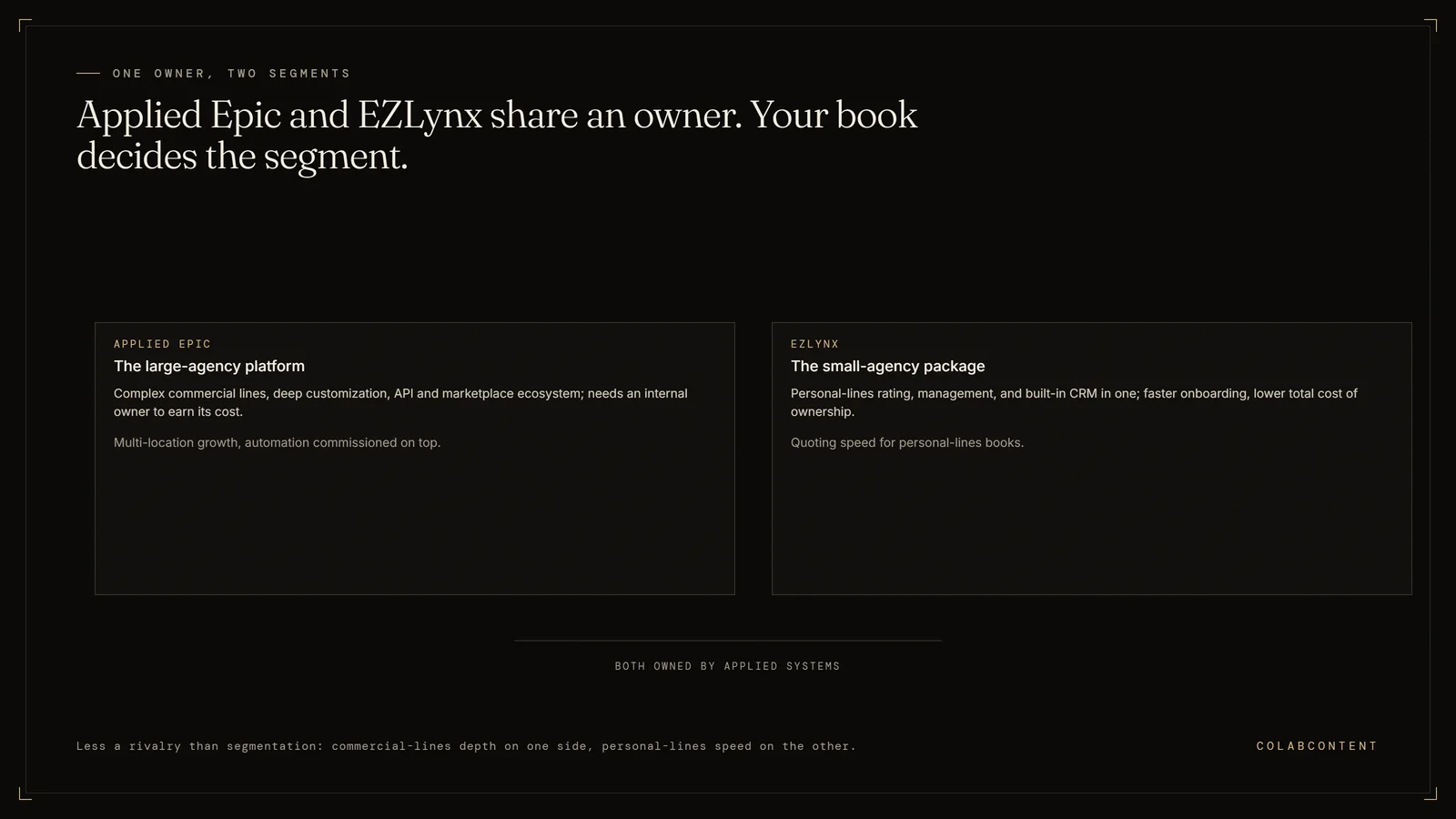
Both systems are owned by Applied Systems, which makes this less of a rivalry than the search results suggest and more of a segmentation question. The useful comparison is not which product is better; it is which segment your agency is actually in.
The decision framework. The choice turns on three questions: (1) does the agency's submission and renewal workflow match the patterns that existing InsurTech (EZLynx, Zywave, Indio) already automates, or does the agency carry specialty lines those products cannot represent; (2) does the agency's data posture allow a SaaS (software you rent by subscription) vendor to process policy and claims data under its own agreements, or do carrier contracts require infrastructure the agency controls directly; (3) over a 24-month horizon, does a compounding per-user InsurTech subscription cost less than a single fixed payment for a system the agency owns outright. If all three favor a product, the InsurTech path is stronger. If any one favors a build, the gap is worth quantifying: the $499 AI-Ready Audit sizes it in dollars and weeks.
The Applied Systems Family: Context Matters
Applied Epic and EZLynx are not competitors in the traditional sense, even though agencies often shop them head to head. Both are owned by Applied Systems, and they serve very different market segments and price points. Applied did not build two products to fight each other; it maintains two products because independent agencies come in very different shapes.
Applied Epic is the enterprise flagship. It is built for agencies with meaningful commercial lines books, multiple locations, layered servicing teams, and the internal capacity to configure and maintain a large system. EZLynx grew up as a personal lines rating tool and evolved into a full agency management system aimed at smaller shops that want everything working out of the box. When you evaluate them, you are really evaluating which segment your agency belongs to, not which product is objectively better. The $499 AI-Ready Audit is one way to size that segment question in dollars before committing to either platform.
Feature Comparison
See Applied Epic alternatives if the platform itself is the open question.
| Dimension | Applied Epic | EZLynx |
|---|---|---|
| Target agency profile | Mid-size to large agencies, often multi-location | Small to mid-size agencies, often personal lines heavy |
| Commercial lines depth | Deep, with configurable servicing workflows | Lighter, better suited to simpler commercial accounts |
| Personal lines rating | Available through the broader Applied ecosystem | Core strength, rating is native to the platform |
| Customization | Extensive workflow and screen configuration | Limited, favors standardized workflows |
| Onboarding effort | Significant, typically a structured implementation project | Lighter, designed for faster time to productivity |
| CRM and marketing | Handled through add-ons and integrations | Built-in CRM style tools for smaller teams |
Pricing
Applied Epic and EZLynx price very differently: Epic through a custom sales quote with no published rate, EZLynx through more visible per-user tiers, and the real gap between the two widens once commercial-lines modules, carrier connections and add-on services get layered onto either platform over a multi-year contract.
Applied Epic Pricing
Applied does not publish Epic pricing publicly. Quotes are custom and depend on user count, modules, and contract terms. Expect a formal sales process, and expect the contract to reward multi-year commitments. Ask for the full picture in writing, including implementation, training, and data conversion costs, not just the per-user license line.
EZLynx Pricing
EZLynx pricing is also quote-based and modular. Agencies typically start with rating or management system modules and add pieces as they grow. Because the platform targets smaller agencies, the entry point is generally more accessible, but costs climb as you turn on additional modules.
The Cost Gap
The honest framing: these products sit at different price points because they serve different segments. If Epic pricing feels painful for your agency size, that discomfort is itself a signal that you may be shopping in the wrong segment. Get current quotes from Applied for both and compare total cost of ownership over the full contract term, including migration and training. ColabContent's own fee bands are published for comparison, unlike either AMS (agency management system) vendor's rate card.
Where Applied Epic Wins
Applied Epic tends to pull ahead on four fronts: complex commercial lines workflows with layered coverage and endorsements, deep customization and workflow automation built for agency-specific processes, scalability across larger agencies with more staff and locations, and the sheer breadth of its carrier connectivity and integration network.
Complex Commercial Lines Workflows
Epic is built for agencies where a single commercial account can involve multiple policies, layered coverage, certificates, endorsements, and several people touching the file. Servicing workflows, activity tracking, and accounting are designed for that complexity.
Customization and Workflow Automation
Epic lets agencies configure workflows, screens, and processes to match how they actually operate. For agencies with defined procedures and a operations lead who can own the configuration, this is a genuine advantage.
Scalability
Multi-location agencies, acquisitive agencies, and PE-backed (owned by a private equity firm) platforms tend to standardize on Epic because it handles branch structures, consolidated accounting, and larger user counts without strain.
Carrier Connectivity
Epic sits inside the broader Applied ecosystem, with download, connectivity, and interface options that matter more as your carrier panel grows. Agencies commissioning automation on top of that connectivity can start from the $499 AI-Ready Audit.
Where EZLynx Wins
EZLynx wins on five different fronts than Applied Epic: personal lines rating speed, ease of use and faster onboarding for new staff, quicker time to value after signing, a lower total cost of ownership for smaller books, and a built-in CRM (customer relationship management software) that spares an agency a separate subscription for contact management.
Personal Lines Rating
EZLynx began as a comparative rater, and personal lines rating remains its core strength. For agencies quoting high volumes of home and auto, having rating native to the management system removes friction that Epic agencies solve with additional tools.
Ease of Use and Onboarding
EZLynx is simpler to learn. New CSRs and producers get productive faster, which matters for small agencies where nobody has time to run an internal training program.
Speed to Value
Implementation is lighter. Smaller agencies can be live and working in EZLynx far sooner than a typical Epic rollout allows.
Total Cost of Ownership
Between licensing, implementation, and the internal staff time a large system demands, EZLynx generally costs less to own for the agencies it targets.
Built-in CRM
EZLynx includes CRM (customer relationship management software) style tools for pipeline and client communication, which small agencies would otherwise have to buy and integrate separately. See EZLynx alternatives for how it stacks up against the wider personal-lines field.
Integration Ecosystem
Both platforms connect outward, but differently: Epic offers API (the connection one piece of software offers to another) access and a marketplace spanning rating, marketing, accounting and analytics tools built for larger commercial books, while EZLynx leans on its comparative-rating heritage and a narrower, personal-lines-focused set of carrier and vendor connections described in the two sections below.
Applied Epic Integrations
Epic offers API access and a marketplace of third-party integrations spanning rating, marketing, accounting, and analytics. For agencies commissioning custom automation, Epic's openness is a real asset. It is the reason so many P&C agency automation projects use Epic as the system of record (the one system that holds the official copy of a record).
EZLynx Integrations
EZLynx integrates with common agency tools, and because so much functionality is built in, smaller agencies often need fewer integrations in the first place. The tradeoff is less flexibility when you want the system to do something the vendor did not anticipate.
Pros and Cons Summary
Each platform's strengths carry a matching cost: Epic's depth and customization take longer to configure and staff, while EZLynx's speed and simplicity level off once a book grows past personal lines. The two lists below lay out what an agency actually gains and gives up with each choice.
Applied Epic
- Pros: deep commercial lines capability, extensive customization, scales with multi-location growth, strong ecosystem and API access
- Cons: higher cost, longer implementation, steeper learning curve, requires internal ownership to get full value
EZLynx
- Pros: strong personal lines rating, easy onboarding, faster speed to value, built-in CRM tools, lower total cost of ownership
- Cons: lighter commercial lines depth, limited customization, less headroom for large or complex agencies
The off-the-shelf AI vs custom commission framework covers the same tradeoff pattern for anything you build on top of either platform.
Which AMS Should You Choose?
The choice mostly comes down to where an agency's book already sits and where it is heading: agencies anchored in personal lines lean EZLynx, agencies built around complex commercial accounts lean Epic, and agencies growing a commercial book on a personal lines foundation face the harder, in-between call covered next.
Choose Applied Epic If...
- Commercial lines are a significant and growing share of your book
- You have multiple locations or plan to acquire
- You have an operations lead who can own configuration and workflows
- You expect to build or commission automation on top of your AMS
Choose EZLynx If...
- Personal lines drive your revenue and quoting speed matters
- Your team is small and cannot absorb a long implementation
- You want rating, management, and basic CRM in one package
- Budget predictability matters more than configurability
The In-Between
Agencies in the middle, growing commercial books on a personal lines foundation, face the hardest call. The practical test: if your current processes break weekly because the system cannot model them, you have outgrown the lighter platform. If your processes are fine and the pain is manual work, the answer may be automation on top of what you have rather than a platform switch. That is the same build, buy, or commission question covered in off-the-shelf AI vs a custom commission.
Migration Considerations
Moving between the two systems is a real project either direction, not a weekend import: data mapping, cleanup of duplicate clients and stale policies, staff retraining on new workflows, and a period running parallel processes. The two paths below, EZLynx to Epic and the reverse, carry different timelines and risks.
Moving from EZLynx to Applied Epic
This is the common growth path. Plan for data mapping, cleanup of duplicate clients and stale policies, retraining staff on new workflows, and a period of parallel operation. Budget more time than the initial estimate, and assign an internal owner before the project starts.
Moving from Applied Epic to EZLynx
Less common, but it happens when an agency shrinks, sells off commercial business, or concludes it is paying for capability it never uses. The migration is technically simpler, but validate that your commercial accounts and accounting history survive the transition before you commit. The AI maturity assessment is worth running before either migration, not after.
Your AMS Is the System of Record. It Is Not the Whole Answer.
Agencies often frame the AMS choice as the thing that will fix operational pain. In practice, either platform still leaves teams with manual renewal prep, rekeying between systems, and slow servicing work. The AMS is the system of record; the leverage comes from what you build on top of it. ColabContent designs custom workflow automation for mid-market operators, including P&C agencies running Epic or EZLynx, and publishes research like the 2027 P&C Agency AI Benchmark Report on where agencies are actually applying AI. If you are weighing platforms and automation vendors side by side, the full library of vendor comparisons for mid-market operators is a useful starting point.
What to Have in Writing Before You Sign Either
Whichever platform wins, the contract decides how the next five years feel. Four items belong in writing before signature. Renewal pricing: year-one discounts are common and quotes are custom, so ask what the per-user rate becomes at first renewal and cap the increase if you can. Data export: confirm the format, the cost, and the turnaround for a full export of clients, policies, activities, and accounting history, because that answer is what your next migration costs. API access: if you expect to commission automation on top of the system, get the access tier, its limits, and its price into the agreement now rather than negotiating them after go-live. And implementation scope: a named list of what the vendor configures versus what your team owns, since the gap between those two lists is where rollouts slip.
None of this is unique to Applied products. It is the standard diligence for any system of record an agency plans to keep for a decade, and an hour spent on it before signature is worth more than a month of comparison shopping after. The commission process covers the same kind of writing-first discipline for a custom build.
Frequently Asked Questions
Short answers first, detail underneath. Every answer here matches the FAQ schema on this page word for word, and each one is the answer we give on the audit call. Where a question depends on your own numbers, the $499 AI-Ready Audit report replaces the general answer with your figures.
Are Applied Epic and EZLynx merging?
Both products are owned by Applied Systems, but they continue to be sold and developed as separate platforms serving different market segments. Applied benefits from having an offering for small agencies and another for large ones, so a forced merger would work against its own positioning. Confirm the current product roadmap with your Applied representative before signing a long contract.
Can I use Tarmika with both Applied Epic and EZLynx?
Tarmika, the commercial lines quoting platform, is part of the Applied Systems family and is positioned to work alongside both products. Integration depth and availability can change, so confirm the current state of the Tarmika connection for your specific platform and version directly with Applied before building your quoting workflow around it.
How long does data migration take?
It depends on the size of your book, the cleanliness of your data, and how much history you insist on bringing over. Duplicate clients, inconsistent naming, and orphaned policies are the usual sources of delay. Budget more time than the vendor's initial estimate, clean your data before conversion, and plan a parallel running period so servicing never stops.
Does Applied offer discounts for bundling Epic and other Applied products?
Applied does not publish bundle pricing publicly. Because quotes are custom, agencies buying multiple Applied products in one negotiation generally have leverage they should use. Ask for bundle terms in writing, compare against standalone quotes, and pay attention to how renewal pricing is handled across the whole bundle, not just year one.
What about HawkSoft, AMS360, or other alternatives?
HawkSoft and Vertafore's AMS360 are the most commonly considered alternatives, and each has its own segment fit. HawkSoft tends to appeal to smaller independent agencies, while AMS360 competes more directly with Epic for mid-size and larger shops. If neither Epic nor EZLynx feels right, evaluate those two before assuming you must compromise.
Which agencies get the strongest ROI from Applied Epic vs other AMS systems?
Agencies that get real value from Epic share a pattern: meaningful commercial lines revenue, documented workflows, an internal owner for the system, and the intent to automate on top of it. Agencies that buy Epic for prestige and then run it like a filing cabinet pay enterprise prices for small-agency outcomes. Match the platform to your operating maturity, not your ambitions.
What does it cost to commission a custom system instead of switching AMS platforms?
ColabContent prices custom automation as a fixed fee from $10,000, quoted after the $499 AI-Ready Audit for anything beyond a single-system build. That is separate from Epic or EZLynx licensing, since the commission sits on top of whichever AMS you keep. Payment is two installments, one at build start and one at handoff, with no per-seat fee.
What happens if a commissioned system does not fit our workflow?
You do not pay for it. ColabContent builds a working prototype on your own data before any commission fee is due, and the exact price is quoted only after that prototype holds up against your real submissions and renewals. The $499 AI-Ready Audit itself is refunded in full if you feel it did not deliver value.
Key Terms
Claims triage: using AI to classify incoming claims by severity and coverage applicability before assigning to an adjuster. Agency management system integration: connecting AI workflows with Applied Epic, EZLynx, HawkSoft, or Vertafore. Submission-to-bind ratio: the percentage of submissions to carriers that result in bound policies; AI improves this by matching risk profiles to carrier appetite. Renewal retention rate: the percentage of policies renewed at expiration; AI-driven outreach reduces the manual effort of the 90-day renewal cycle. The ColabContent versus Quandri comparison covers renewal automation specifically.
Start with the $499 audit.
A $499 audit, then a 20-minute call. No slides. Whichever system you land on, the work that leaks hours usually sits in the seams between it and everything else. We trace one real workflow end to end and name the step worth automating first. If the answer is that your AMS already does it, we say so on the call. ColabContent holds a 5.0 rating on Clutch and built the systems behind Jim Glaser Law's 3,787 logged calls.
Read the insurance offering → Or book directly →Where to look next.
Three ColabContent pages carry the specifics this Applied Epic vs EZLynx comparison summarizes. The commission process runs the five phases between the first call and code handoff, including the working prototype built on your own data before any fee is owed. The pricing page publishes the fee bands. And the AI maturity assessment walks the five stages, which is the right read before a platform migration, not after.
For insurance-specific depth: the insurance agency practice page covers the workflows most often commissioned in agencies, AI consulting cost for insurance agencies breaks the bands down by scope, and best AI consultants for regional insurance agencies is the vertical buyer guide.
If you are still shortlisting systems, EZLynx alternatives covers the wider field including HawkSoft and AMS360. Both products on this page are Applied Systems products, so if what you actually want is out of that vendor relationship, the wider Applied Epic alternatives roundup covers AMS360, HawkSoft, NowCerts and Veruna with sourced pricing and a total cost calculator. If renewals rather than the platform are the pain, read Quandri alternatives and ColabContent versus Quandri. Every published side-by-side is on the comparisons hub.