Home/ Comparisons/ Vertafore Sagitta Alternatives

Vertafore Sagitta Alternatives: 8 Options for Large Agencies

For a large or wholesale property and casualty agency running Vertafore Sagitta, there is exactly one true peer, Applied Epic, and a set of smaller platforms that most published lists present as alternatives without saying they are sized for a different agency: EZLynx, HawkSoft and NowCerts, plus AgencyZoom, which is not an agency management system at all. Three of the names those lists recommend most often, AMS360, QQCatalyst and Nexsure, are Vertafore's own products, so switching to one of them changes your screen and not your vendor. The eighth option is the one nobody in the category will put on a comparison page, because none of them can sell it to you: commissioning the automation layer your agency actually needs, owning it outright for a one time $45,000 to $180,000, and keeping your system of record where it is. Vertafore publishes no price for Sagitta anywhere, which we confirmed on its own product page on August 27, 2026, so every Sagitta dollar figure on this page is labelled reported rather than verified. The two secondary sources that do publish estimates disagree with each other by a factor of three at the same headcount, and rather than average them we default this page's model to the cheapest one, which is the version most favourable to staying exactly where you are. Run through five years for a 75 seat agency, staying put costs $200,000, migrating to Applied Epic at the lowest reported figures costs $385,000, and keeping Sagitta while commissioning a build at the midpoint of our fee band costs $405,313. Doing nothing is the cheapest line on that chart and it stays the cheapest, which is why the calculator further down runs your invoice instead of ours.

A note on names, because the searches split. Sagitta is Vertafore's agency management system for larger agencies. AMS360 is its mid market sibling, QQCatalyst its small agency product and Nexsure another platform in the same family. People search Sagitta alternatives, Vertafore Sagitta alternatives, Sagitta competitors and Vertafore replacement, and they all mean the same decision. This page is the comparison for all of them.

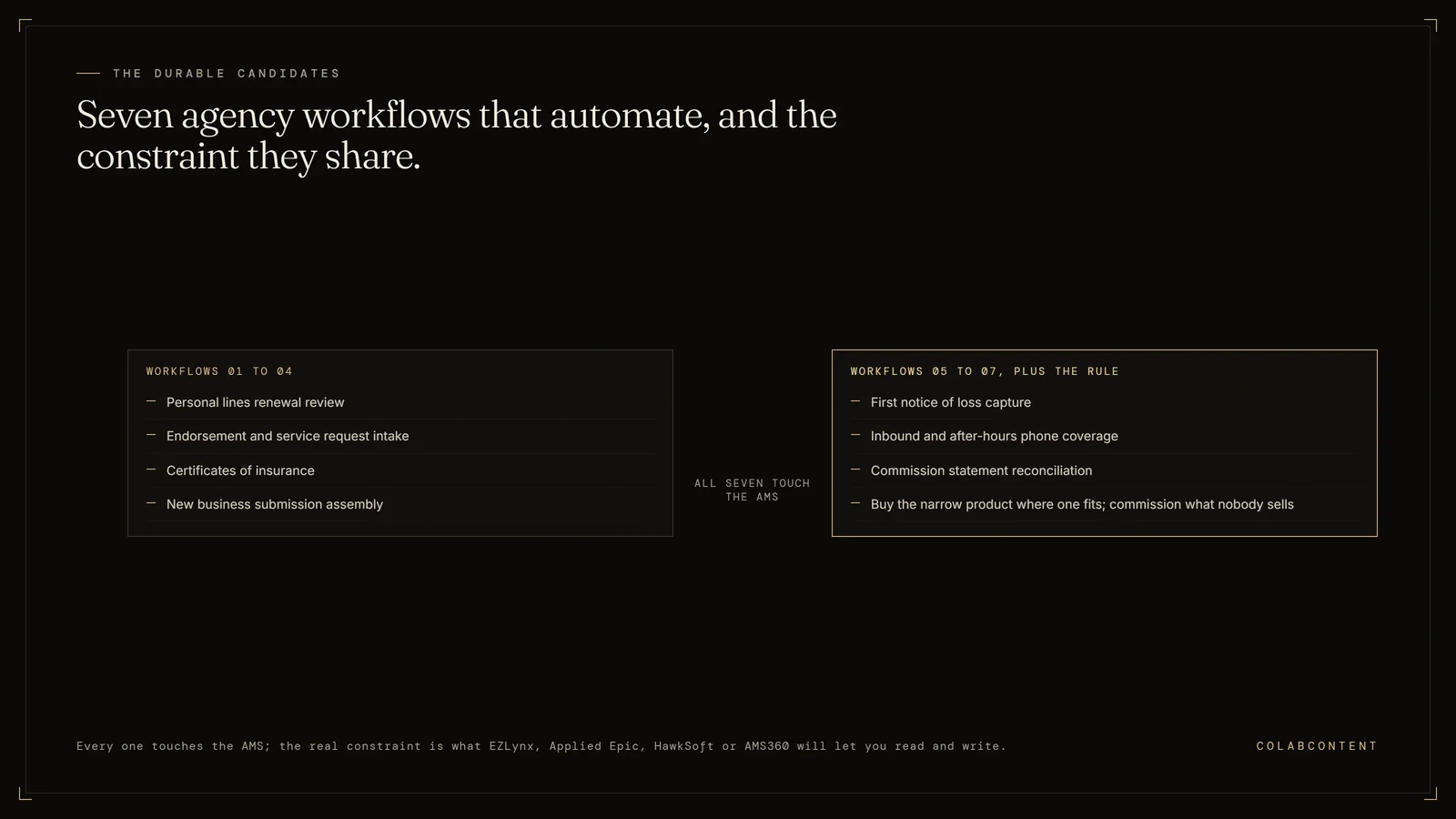
The seven insurance agency workflows that durably automate: personal lines renewal review, endorsement and service intake, certificates of insurance, submission assembly, first notice of loss capture, phone coverage, and commission reconciliation, all constrained by agency management system read-and-write access
Seven durable candidates. The management system decides how far each one can go.

Written for the agency that already pays for Sagitta. We do not sell an agency management system, we take no referral fee from anyone in the table below, and we will say plainly which agencies should stay exactly where they are.

ForLarge and wholesale P&C agencies on Sagitta
StanceNeutral. We sell no management system.
Bottom lineStaying put is the cheapest row. Measure first.
CostFree 45-minute diagnosis
Prices readAugust 27, 2026

The short answer.

If you are on Sagitta and the reason you are reading this is money, the honest first move is not a different agency management system. It is finding out what you are actually paying, because Vertafore does not publish a price and neither does anybody else in this category, so the only rate card in existence is the one on your own order form. Once you have that number, the arithmetic further down this page is the leverage you take into the renewal conversation, and for a large share of agencies that conversation is a better return on a week of effort than a migration is on eighteen months.

If the reason is that Sagitta does not do a thing your agency needs it to do, then be precise about which thing, because the answer forks sharply. If the gap is in the system of record itself, in policy structure, in accounting, in carrier connectivity or in regulatory depth for surplus lines and complex commercial business, then Applied Epic is the only platform on this page built at the same scale, and moving to it is a lateral move with a six figure toll rather than a saving. If the gap is in the work that happens around the system, in renewal prep, in rekeying between the management system and a carrier portal, in chasing documents, in assembling submissions, in reconciling commission statements line by line, then no management system on this list fixes it, because every one of them has the same shape of gap. That second case is the one where commissioning and owning the missing layer stops being a sales pitch and starts being arithmetic, and this page shows the arithmetic including the scenarios where it does not work.

What Sagitta actually does well.

A comparison page that treats the incumbent as a punching bag is useless to the person actually holding the contract, so here is the fair version.

It is built for the size of agency you are. Vertafore positions Sagitta on its own product page for larger agencies with enterprise needs, distinct from AMS360 and QQCatalyst, and that is a real distinction rather than marketing. Most of what gets recommended as a Sagitta alternative is built for an agency a fraction of the size, which is the single most common error in this category and the one this page keeps returning to.

Carrier connectivity at scale. One third party source puts Sagitta at 150 or more carrier connections, against 100 or more for Applied Epic and 40 or more for EZLynx. Those figures are REPORTED from a single blog and Vertafore has not confirmed them, so treat the exact counts loosely. The ordering, though, matches what agencies describe, and connectivity is the hardest thing to replace because it is not a feature you buy, it is a set of relationships that were configured carrier by carrier over years.

Depth in complex commercial and wholesale business. Surplus lines handling, layered and shared programmes, complex commissions and the accounting that hangs off them are where a light platform quietly stops working. Sagitta's reputation in that work is the reason large wholesale operations are still on it, and it is the reason a downgrade to a personal lines oriented platform is not a cost saving, it is a scope reduction.

It is not going anywhere. We checked Vertafore's own Sagitta product page on August 27, 2026 and found an actively sold product with no end of life notice, no sunset language and no migration deadline. That is VERIFIED from the vendor's own site. If you have been told Sagitta is dying, ask for the notice.

Why agencies start looking for a way out.

Four patterns, in the order they come up. The first three are REPORTED pain points published by a competing agency management vendor that ranks its own product first in the same article, so the bias runs in one direction and we are naming it rather than hiding it. They are also the complaints we hear on calls, which is why they are here at all.

Per user and per module pricing that compounds. Every producer, every service person, every additional module raises the bill, and the raise happens without anyone deciding it should. With no published rate card there is nothing to argue against except your own history.

Implementations measured in quarters. A REPORTED six to eighteen months for a Sagitta implementation is a long time for anything to be in flight, and it shapes how agencies feel about any future change to the platform.

Legacy interface, limited modern automation. This is the softest of the four and the most subjective. Vertafore publishes no pricing of any kind, which means we also cannot tell you what any automation or AI module costs there, and we are not going to guess at a number nobody has published.

The thing the agency needs is not a management system problem at all. Renewal preparation, submission assembly, document chasing, commission reconciliation. None of those is a record keeping problem, and no amount of licence spend on any platform in this category solves them. This is the pattern that ends with an agency spending eighteen months and six figures migrating, and then discovering the same staff are doing the same manual work on a different screen.

What you are actually paying

Every number on this page, with its source.

Start with the finding that shapes everything below. Nobody in this category publishes a price. We checked five vendor pricing surfaces directly on August 27, 2026 and every one of them came back the same way: no rate card, contact sales. That is not a gap in the research, it is the category's pricing strategy, and it means every number quoted to you is quoted against you rather than against a published list. We label each figure VERIFIED when it was read off the vendor's own page on that date, and REPORTED when it came from a third party the vendor has not confirmed. Where a source has a commercial interest in the answer, we say so in the same cell.

VendorWhat is publishedReported figuresImplementationSource
Vertafore SagittaNo pricing of any kind. Positioned for larger agencies with enterprise needs.Software from $40,000 a year. First year total including implementation $80,000 to $200,000. 150 or more carrier connections.6 to 18 monthsVERIFIED no pricing and active product status from vertafore.com/products/sagitta. REPORTED dollar and carrier figures from a single third party blog, ustechautomations.com.
Vertafore, per user estimateNothing published$150 to $300 or more per user per monthNot statedREPORTED unlockedcrm.ai, which ranks its own product first in the same comparison. Directional only, and it conflicts with the row above.
Applied EpicNo pricing. Quote only.First year total $75,000 to $175,000. 100 or more carrier connections.4 to 12 monthsVERIFIED no public pricing, cross-checked against our own Applied Epic and EZLynx comparison. REPORTED dollar and carrier figures, ustechautomations.com.
EZLynxNo list pricing. Priced by user count and product mix, with network membership discounts.Software from $8,000 a year. First year total $30,000 to $80,000. 40 or more carrier connections. Separately estimated at roughly $200 or more per user per month.4 to 8 weeksVERIFIED pricing structure from ezlynx.com/pricing/. REPORTED dollar figures from ustechautomations.com and, for the per user estimate, unlockedcrm.ai. These two sources disagree by roughly three to eight times depending on agency size. We are flagging that rather than reconciling it.
HawkSoftNo pricing. The pricing URL returns a 404.Roughly $135 or more per user per monthNot statedVERIFIED absence of pricing from hawksoft.com. REPORTED per user estimate from unlockedcrm.ai, a competing vendor.
NowCertsNo pricing on its own pricing page.$50 to $100 per user per monthNot statedVERIFIED absence of pricing from nowcerts.com/pricing/. REPORTED per user estimate from unlockedcrm.ai, a competing vendor.
AgencyZoomNot an agency management system, so not directly comparable.Roughly $99 to $199 per user per monthNot statedREPORTED unlockedcrm.ai, a competing vendor.
Full management system migration, wholesale complexityNothing published by any vendor$150,000 to $500,000 over 9 to 18 monthsIncluded in that figureREPORTED and single sourced. One third party blog, ustechautomations.com, with no independent corroboration found. Treat as an order of magnitude, not a fact.
ColabContent commissioned build$45,000 to $180,000, one time, fixed fee, two installments at build start and handoff. No per seat pricing. No annual renewal.Not applicablePrototype in 7 to 10 days, production in 5 to 7 weeksVERIFIED our own published terms, read them here.

The conflict we are not going to paper over

Two secondary sources publish Sagitta cost estimates and they cannot both be right. One says software starts at $40,000 a year. The other says Vertafore runs $150 to $300 or more per user per month. Hold a 75 seat agency still and run both: the per user figure produces $135,000 to $270,000 a year, while the annual figure produces an implied $44.44 per user per month. That is a gap of three to seven times for the same agency.

We are not averaging them, because averaging two numbers that describe different things produces a third number that describes nothing. Our own reading, and it is an inference from the arithmetic rather than a claim either source makes, is that the $40,000 figure behaves like a floor for the smallest Sagitta deployment rather than a price for a large agency. Which means the model on this page, which uses $40,000, almost certainly understates what you are actually paying. We built it that way deliberately. Every assumption on this page that could be tilted has been tilted toward staying on Sagitta, because a page arguing for a build should not be caught inflating the incumbent.

Normalise it: what a 75 seat agency pays for a year

Per seat and per agency pricing are not comparable until you fix the headcount. Hold one agency at 75 seats, take each published estimate at face value, and ask what a single year costs.

BasisOne year, 75 seatsHow it is calculated
Sagitta, reported starting annual figure taken at face value$40,000Published as an annual starting figure, not derived from seats. Implies $44.44 per user per month at this headcount.
Applied Epic, reported first year total, low end$75,000Includes implementation. Run rate after year one is not published by anyone.
Applied Epic, reported first year total, high end$175,000Same source, same caveat.
Sagitta, low end of the reported per user band$135,000$150 x 75 x 12, from a competing vendor's estimate
Sagitta, high end of the reported per user band$270,000$300 x 75 x 12, same source, same bias
EZLynx, reported first year total$30,000 to $80,000Assumes an EZLynx scale deployment at 40 or more carriers, which is a materially smaller operation. Not a like for like comparison at 75 seats.

The model below uses the cheapest row in that table, $40,000, for Sagitta. If your invoice says something closer to the per user band, every gap on this page widens in the same direction, and the calculator will show you by how much.

The three year and five year model

Three paths, because those are the three decisions actually available to an agency on Sagitta. Stay and change nothing. Migrate to the one platform built at the same scale. Or keep the system of record and commission the layer that does the work around it. The third path is additive, not a replacement: it does not reduce your Sagitta invoice by a dollar, and the table reflects that by carrying the Sagitta run rate underneath it.

Path, 75 seats3 year total5 year totalComponents
Stay on Sagitta, change nothing$120,000$200,000$40,000 a year, held flat with no renewal increase, which is optimistic
Migrate to Applied Epic, lowest reported figures$305,000$385,000$150,000 migration, $75,000 first year, then $40,000 a year assumed run rate
Migrate to Applied Epic, midpoint of reported ranges$550,000$650,000$325,000 migration, $125,000 first year, then $50,000 a year assumed run rate
Migrate to Applied Epic, top of reported ranges$795,000$915,000$500,000 migration, $175,000 first year, then $60,000 a year assumed run rate
Keep Sagitta, commission a build at $45,000$187,275$282,125One time fee, plus 16.5% a year maintenance, plus the continuing $40,000 Sagitta run rate
Keep Sagitta, commission a build at $112,500$288,188$405,313Same structure at the midpoint of our fee band
Keep Sagitta, commission a build at $180,000$389,100$528,500Same structure at the top of our fee band

Read that table honestly and the first thing it says is that doing nothing is the cheapest row on it. $120,000 over three years, $200,000 over five, and every other row is more expensive. Nothing we build changes that, because our build does not remove your Sagitta bill. The only reason any other row is worth considering is a cost the table does not contain: the staff hours your agency spends today doing by hand the work the system does not do. We do not have a sourced figure for that, so there is no invented number on this page, and you should not accept one from anybody else either. Measure it in your own agency before you spend anything. Two weeks of honest observation across renewal prep, submission assembly and commission reconciliation will produce a number that is worth more than every estimate on this page combined.

The second thing the table says is against us. At the top of our fee band, $180,000, the build path costs $389,100 over three years, against $305,000 for the cheapest version of an Applied Epic migration. At that price, on cost alone, migrating wins and we would tell you so on the call. The build path only clears a low end migration comfortably at the lower half of our fee band, and it clears a midpoint or high end migration at any price in the band. That distinction is the whole decision, and it turns entirely on a migration figure that comes from a single unconfirmed source, which is why the calculator makes that figure the first thing you can change.

The crossover

Where the three lines actually go.

Cumulative spend for the same 75 seat agency, five years out, built entirely from the table above. Sagitta at the reported $40,000 a year with no escalator. Applied Epic at the lowest figure in every reported range, $150,000 of migration paid at year zero, a $75,000 first year and an assumed $40,000 run rate after that, which is the most favourable version of the migration case that the sources allow. And the third line, keeping Sagitta while commissioning a build at $112,500, the midpoint of our fee band, with 16.5 percent a year maintenance stacked on top of the continuing Sagitta run rate.

Cumulative five year cost for a 75 seat agency: staying on Sagitta, migrating to Applied Epic, or keeping Sagitta and commissioning a build A line chart of cumulative spend over five years for a 75 seat property and casualty agency. The stay on Sagitta line rises steadily from zero at year zero through $40,000, $80,000, $120,000, $160,000 and $200,000, and is the cheapest of the three at every point. The migrate to Applied Epic line starts at $150,000 at year zero for the migration project, then rises to $225,000 at year one, $265,000 at year two, $305,000 at year three, $345,000 at year four and $385,000 at year five. The keep Sagitta and commission a build line starts at $112,500 at year zero, then rises by $58,563 a year to $171,063, $229,625, $288,188, $346,750 and $405,313. The build line runs below the migration line for the first four years, and the two converge at about year 3.9 and roughly $341,000, after which migrating becomes the cheaper of those two paths, ending $20,313 apart at year five. Against the midpoint migration figures rather than the lowest, the build line stays below the migration line for the whole five years. $0 $100K $200K $300K $400K $500K Year 0 Year 1 Year 2 Year 3 Year 4 Year 5 Converge, year 3.9 Stay on Sagitta, change nothing. Year 5: $200,000 Migrate to Applied Epic, lowest reported figures. Year 5: $385,000 Keep Sagitta, commission a build at $112,500. Year 5: $405,313

Three things worth saying about that chart, and only one of them helps us.

The grey line wins. Staying on Sagitta and changing nothing is the cheapest path at every point in the five years, and it never stops being the cheapest, because both of the other paths add cost without removing the management system underneath. If the manual work around your system costs your agency less than about $58,563 a year, which is the annual step on the build line, then the build does not pay for itself and we would rather you find that out from this paragraph than from us.

Against the cheapest possible migration, the build path wins for four years and then loses. The two lines converge at about year 3.9 and roughly $341,000, and by year five the build path is $20,313 more expensive. That is a real result and we are not going to bury it. It is also the most hostile version of the comparison available: it uses the low end of a $150,000 to $500,000 migration range, the low end of a $75,000 to $175,000 first year, and an Applied Epic run rate assumed equal to Sagitta's rather than higher. It also excludes the year of parallel running during a nine to eighteen month migration, when the agency pays for both systems at once. Every one of those choices makes the migration line cheaper than it is likely to be in practice.

Move the migration figure to the midpoint and the picture changes completely. At $325,000 of migration and a $125,000 first year, the migration path reaches $650,000 by year five against $405,313 for keeping Sagitta and building, a gap of $244,688 that never closes. The entire outcome turns on one unconfirmed number from one blog, which is exactly why that number is the first field in the calculator below and why we have printed the caveat next to it rather than in a footnote.

Your agency, your numbers

The Sagitta total cost calculator.

Every default below is a figure from the table above, and every one is editable, because the defaults are a market estimate and your renewal quote is a fact. Nothing is submitted anywhere. There is no email gate, no external request and no stored value. The arithmetic runs in your browser and stops there. If your inputs make the build lose, the tool says so.

Default is the lowest reported figure, $40,000. A competing vendor's per user estimate implies $135,000 or more at 75 seats. Use your quote.
Producers, service staff, accounting, anyone holding a seat. Used to show your implied cost per seat.
Reported $150,000 to $500,000 over 9 to 18 months, from one third party blog with no corroboration. Default is the low end.
Reported $75,000 to $175,000, single source. Default is the low end.
Applied publishes no run rate. Default assumes it equals your Sagitta spend, which is a modelling assumption favouring the migration.
All three paths are totalled over this horizon.
ColabContent fixed fee range, $45,000 to $180,000, set after the diagnosis call.
Software industry heuristic of 15 to 18 percent, not a ColabContent contract term. Replace it with a real quote before deciding.
The roundup

Eight options, in the order we would look at them.

One note on the roster before the list. Most published Sagitta alternatives lists have a structural problem: they treat every agency management system as interchangeable regardless of the size of agency it was built for, and they list products from the same vendor as escapes from that vendor. One widely read directory lists eighteen alternatives to Sagitta, at least three of which are Vertafore's own products, and states plainly that it has no reviews for Sagitta at all. Another lists twelve alternatives to Vertafore that include carrier side policy administration systems and individual health insurance marketplaces, which have nothing to do with running an agency. The list below covers what Sagitta actually competes against, and orders it the way an agency holding a Sagitta contract would sensibly evaluate it.

1. Applied Epic

What it is. The genuine head to head competitor, and the only other platform on this page built for the size and complexity of agency Sagitta serves. Applied Systems is Vertafore's principal rival in this category and Epic is its enterprise product.

Price. Nothing published. Applied does not publish Epic pricing and we cross-checked that against our own Applied Epic and EZLynx comparison. REPORTED at a $75,000 to $175,000 first year total including implementation, with a four to twelve month implementation and 100 or more carrier connections, all from a single third party blog.

Best for. Agencies whose complaint is genuinely about Sagitta itself, the workflow, the interface, a specific integration Applied supports and Vertafore does not, or an account relationship that has broken down past repair. It is also the right answer if your carriers and your accounting system integrate more deeply with Applied today, which is a question to ask the carriers rather than either sales team.

Where it falls short. It is the same shape of purchase. Enterprise licensing, no published price, a quote negotiated against you, and an implementation measured in quarters. If the reason you are leaving Sagitta is that per user and per module pricing compounds at renewal, Epic does not address that, it re-homes it. And you pay a migration measured in six figures to arrive there.

Verdict. The only true peer on this page, and a lateral move. Consider it for a product or relationship reason, not for a cost reason. Our Applied Epic alternatives page runs the same arithmetic from the other side of that decision.

2. AMS360, QQCatalyst and Nexsure

What they are. Vertafore products. The same vendor that sells Sagitta. AMS360 is the mid market platform, QQCatalyst the small agency one, and Nexsure another system in the same family. All three appear on published Sagitta alternatives lists, usually without any disclosure that they share a vendor with the product being replaced.

Price. Nothing published for any of them, consistent with the rest of the category.

Best for. There are legitimate reasons to move between Vertafore products, and they are about fit rather than escape. An agency that has shrunk, sold off commercial lines, or found that Sagitta's depth is more platform than it now needs may be genuinely better served on AMS360. That is a right sizing decision and we would not argue with it. Our AMS360 alternatives page covers that platform on its own terms.

Where they fall short. As alternatives to Vertafore, they are not alternatives at all. Same vendor, same account team, same master agreement structure, same renewal dynamics, same road map you do not control. If your complaint is compounding cost at renewal or an enterprise sales motion you cannot get leverage in, moving between two products from the same company resolves none of it, and a list that recommends the move without saying so has not done you a service.

Verdict. Not alternatives. Right sizing options within the same vendor relationship, and worth considering only if that is what you were actually looking for.

3. EZLynx

What it is. An agency management and rating platform built for independent agencies, with strong personal lines comparative rating and a much lighter footprint than either enterprise platform above.

Price. No list pricing published; ezlynx.com/pricing/ describes pricing by user count and product mix with network membership discounts, which we read directly. REPORTED at software from $8,000 a year with a $30,000 to $80,000 first year total by one source, and separately at roughly $200 or more per user per month by a competing vendor. Those two estimates disagree with each other by roughly three to eight times depending on the agency size assumed, and we are flagging that rather than picking one.

Best for. Personal lines heavy agencies, small to mid sized books, and agencies that want a four to eight week implementation rather than a multi quarter project. For that agency EZLynx is a genuinely good product and the reported first year total is a real saving.

Where it falls short. For a Sagitta scale buyer it is a downgrade rather than an alternative, and the clearest indicator is carrier connectivity: 40 or more against Sagitta's 150 or more, both reported. A four to eight week implementation against six to eighteen months is not a faster version of the same product, it is a much smaller product. If you place business with carriers EZLynx does not connect to, the price difference is not a saving, it is scope you dropped.

Verdict. Right answer for a smaller agency. Wrong answer for a large or wholesale one, unless the agency has genuinely shrunk. Our EZLynx automation playbook covers what can be built on top of it.

4. HawkSoft

What it is. An agency management system built around independent agencies, with a reputation for service workflow and a strongly independent agency identity.

Price. Nothing published. hawksoft.com has no rate card and the pricing URL returns a 404, which we checked directly. REPORTED at roughly $135 or more per user per month by a competing agency management vendor that ranks its own product first in the same comparison, so treat it as directional at best.

Best for. Independent agencies of a size where a service centred workflow matters more than enterprise commercial lines depth. Agencies that like it tend to like it a great deal.

Where it falls short. Same segment problem as EZLynx for a Sagitta scale buyer. There is no published evidence, from HawkSoft or anyone else, that it carries wholesale commercial complexity at the scale Sagitta customers run, and we are not going to assert either way on something nobody has documented. Our HawkSoft automation playbook is the build side view of the platform.

Verdict. Worth a look for a much smaller book than Sagitta typically carries. Not a like for like swap.

5. NowCerts

What it is. A cloud agency management system aimed at smaller independent agencies, frequently listed alongside EZLynx and HawkSoft.

Price. Nothing published on nowcerts.com/pricing/, which we read directly. REPORTED at $50 to $100 per user per month by the same competing vendor, which is a small agency price point and consistent with the segment it serves.

Best for. Small agencies that want a modern cloud platform without an enterprise sales cycle.

Where it falls short. The same segment mismatch, and more sharply than the two above it. A $50 to $100 per user per month platform is not carrying the commercial lines and accounting depth that a wholesale operation depends on, and nothing published suggests it claims to.

Verdict. A real product for a real buyer, and that buyer is not you if you are on Sagitta today.

6. AgencyZoom

What it is. A sales, onboarding and retention layer that sits beside an agency management system rather than replacing it. It appears on Vertafore alternatives lists, which is a category error rather than a recommendation.

Price. REPORTED at roughly $99 to $199 per user per month by a competing vendor. Nothing published that we could read directly.

Best for. Agencies that want producer accountability, pipeline visibility and retention workflow layered on top of whatever system of record they already run.

Where it falls short. It is not an agency management system, so it is not an alternative to Sagitta by any definition. If you buy it, you keep paying for Sagitta too, which makes it structurally the same kind of decision as commissioning a build: an additional layer with an additional cost. The difference is that one is rented per user forever and the other is bought once and owned.

Verdict. Not an alternative. A useful adjacent product, and a good illustration of why the lists that include it are not built for a buyer at your scale.

7. Guidewire, Duck Creek and the health insurance marketplaces

What they are. Not agency management systems, and this needs saying because they appear on published Vertafore alternatives lists that agency owners actually read. Guidewire and Duck Creek are carrier side core systems: policy administration, billing and claims for the company writing the risk, not for the agency placing it. eHealth, HealthSherpa, HealthCare.com and Stride Health are individual health insurance marketplaces and enrolment platforms, which have no property and casualty agency relevance at all.

Price. Irrelevant, because none of them does the job.

Why they end up on those lists. Because Vertafore sells into more than one part of the insurance market, and a list assembled from the vendor name rather than the product line sweeps up everything adjacent to the word. It is a useful signal about how carefully any given list was built. If a Sagitta alternatives list is recommending a carrier core system to an agency, the rest of that list deserves the same scepticism.

Verdict. Not options. Included here so that when you see them elsewhere, you know why they are there.

8. A commissioned automation layer you own

What it is. Not a replacement for Sagitta, and we would rather be blunt about that than sell around it. A custom system built for the work that happens around the management system, sitting on top of whichever platform you keep, owned by the agency at handoff. In practice that means renewal preparation, submission assembly across the carrier pool, certificate generation, endorsement and service intake, first notice of loss capture, phone coverage, and commission statement reconciliation. Our insurance automation guide maps which of those durably automate and where each one hits a wall.

Price. A fixed fee of $45,000 to $180,000, set after a free 45-minute diagnosis call and after the integration depth is named, paid in two installments at build start and handoff. A working prototype runs on your real data in seven to ten days before any payment. Production build is five to seven weeks. The agency owns the code, prompts, models and pipeline at handoff and runs it in its own cloud tenant. Those are VERIFIED published terms, not an estimate.

Best for. Agencies whose management system basically works as a system of record and whose real cost is in the manual work stacked around it. If you can name that work in a sentence and attach an hours figure to it, this is the option with the arithmetic behind it.

Where it falls short. Four ways, and they are all on this page already. It does not reduce your Sagitta invoice by a dollar, so it is additive rather than a saving. At the top of our fee band it loses the cost comparison against a cheap migration outright. It needs a named internal owner or it decays. And it does not touch carrier connectivity, regulatory depth or the accounting system of record, which is exactly the part of Sagitta that is hardest to replace and that we are not proposing to replace.

Verdict. The option nobody in the table above can show you, and the only one where the bill stops going up. Worth evaluating precisely when the management system is not the problem.
The comparison you also searched for

Sagitta vs Applied Epic, answered here.

This is the comparison that comes up in almost every conversation about leaving Sagitta, so rather than send you somewhere else, here it is. Five things are actually checkable and the rest is sales.

Neither publishes a price. We checked both on August 27, 2026. Vertafore has no pricing on its Sagitta product page and Applied does not publish Epic pricing. In a category this mature that is a strategy rather than an oversight, and it means both numbers are quoted against your agency rather than against a list.

On reported figures they are close. First year total of $80,000 to $200,000 for Sagitta against $75,000 to $175,000 for Epic. Implementation of six to eighteen months against four to twelve. Carrier connections of 150 or more against 100 or more. All of that is REPORTED from one third party source, none of it is vendor confirmed, and the ranges overlap so heavily that the difference between them is inside the noise band of a negotiated contract.

The implementation gap is the one real difference in the numbers. Four to twelve months against six to eighteen is meaningfully shorter, and if the pain you are solving is that any change to your platform takes forever, that is worth something. It is worth months, though, not a different cost structure.

The migration is the number that decides it. The only published figure for moving between systems at wholesale complexity is $150,000 to $500,000 over nine to eighteen months, single sourced and unconfirmed. Whatever the real figure is for your agency, it is a six figure toll paid to arrive at a platform with the same licensing model. That is the trade, stated plainly.

How to actually decide. Since price and function are close, decide on integration reality. Ask your carriers, your accounting system vendor and your comparative rater which of the two they work with more deeply today, and ask each of them for an agency running the same combination you would be running. That answer moves the needle more than any feature grid. Our Applied Epic integration playbook and our AMS360 automation playbook document the build side of each platform, which is the view neither sales team leads with.

The ownership case

Nine arguments for owning it instead.

Each of these is either arithmetic you can check on this page or a structural fact about the two models. Where an argument does not honestly apply to your agency, the section immediately after this one says so, and it is longer than most pages of this kind allow.

One. The math, restated, including the part against us. A subscription never ends. Over five years a 75 seat agency pays $200,000 to stay on Sagitta at the cheapest reported figure, $385,000 to migrate to Applied Epic at the lowest reported migration cost, and $405,313 to keep Sagitta and commission a build at the midpoint of our band. Against the cheapest possible migration the build path wins for four years and then loses by $20,313. Against the midpoint migration it wins by $244,688 and never gives it back. That is the honest range, and the chart above is the reason it is on the page rather than in a deck.

Two. Per user pricing taxes headcount. Every producer and every service hire raises the bill by the same amount whether or not that person generates proportional revenue in year one. A commissioned system has no marginal seat cost at all, so the hiring decision stops carrying a software decision inside it. That matters most in exactly the agencies that are growing, which is to say the ones where the compounding is felt.

Three. Asset versus expense. A subscription is rent and it leaves nothing behind. A commissioned build is a piece of the agency: transferable, valuable in a perpetuation or acquisition conversation, and on the balance sheet rather than only on the expense line. In a market where agency valuations are a live topic in most principals' offices, that difference is not cosmetic.

Four. Built around your book, not the median agency's. Every product in the roundup above is calibrated against the average customer in its category, which is why you pay for the whole feature bundle and then adapt your process to the fraction of it your agency actually uses. A commissioned system starts from your lines of business, your carrier panel, your service standards and your accounting practice. Nobody gets retrained into someone else's assumptions.

Five. What we can and cannot say about the AI line. On most pages of this kind, this is where a vendor's own AI add-on pricing gets cited against it. We cannot do that here honestly, because Vertafore publishes no pricing of any kind, so we do not know what an automation or AI module costs on Sagitta and we are not going to invent a figure. What we can say is structural and checkable: on a per user platform, any capability sold as a module arrives as an additional charge scaled to your headcount, at a rate you cannot benchmark because nobody publishes one. In a commissioned build there is no separate licence for anything, because the system is the thing you bought, and adding a user costs nothing.

Six. Unlimited seats. Producers, service staff, accounting, seasonal help during renewal season, and where appropriate your own clients. Zero marginal cost per person changes the question from who needs a licence to who needs access, which is a better question and usually a different answer.

Seven. Data ownership and no exit toll. Your policies, your history, your documents, your export path, in your own cloud tenant, under an agreement you wrote. Compare that with the migration section below, where the hard part of leaving is not the policies but the history, the accounting and the carrier connections, all of which live inside a structure the vendor designed. Owning the structure takes the negotiation out of leaving.

Eight. Vendor risk you stop carrying. We are not going to manufacture a sunset story here: Sagitta is an actively sold product and we checked. The structural point stands anyway, and this category supplies its own evidence in the form of consolidation: Vertafore alone sells Sagitta, AMS360, QQCatalyst and Nexsure, four agency management systems from one owner, which is what a consolidated category looks like from the inside. Road maps, module bundling and renewal terms in a consolidated category are set by fewer people than they used to be. A system you own is not on anybody's road map but yours.

Nine. Change speed. A change request to your own system is a scoping conversation and a deployment. A change request to a vendor is a queue position behind every other customer, with no committed date and no obligation. When the thing you need changed is the thing that makes your agency different from the one down the road, the queue is not an acceptable answer.

What we can actually prove

Arguments are worth exactly as much as the evidence behind the firm making them, so here is ours with nothing rounded up, including the part that is inconvenient. Our nameable reference is Jim Glaser Law, a law firm rather than an insurance agency, and the principal takes reference calls. We would rather tell you that than imply a property and casualty reference we do not have. Five channel specific voice agents route and handle intake there, and across our practice the total is more than 6,000 AI handled calls. The LELF platform is the fullest example of what commissioning looks like at operational scale: a 47-attorney litigation firm runs its matter, invoice and trust accounting operation on it, holding 13,296 matters, 4,396 clients and 5,684 invoices, with trust reconciled byte identical against the system it replaced. That firm is under confidentiality and stays anonymised, which is why we name the platform and not the firm. Across the practice we have delivered more than forty commissions.

What that evidence supports is a specific claim: we build systems that carry real operational volume in a regulated professional services business and reconcile to the penny under audit, which is the same shape of problem as agency accounting and commission reconciliation. What it does not support is a claim that we have decommissioned a Sagitta tenant for anyone, because we have not, and the migration section below says that in plain language rather than around it.

The honesty section

Who should stay on Sagitta.

Seven situations where every argument in the previous section fails, and where we would tell you to stay put on a call. None of the published alternatives lists has a section like this, which is itself worth noticing.

Agencies whose real dependency is carrier connectivity. If your book is placed across a wide carrier panel and your downloads are configured and working, that is the single hardest thing on this page to replace, and no build we do touches it. A reported 150 or more carrier connections is not a feature you re-buy, it is years of configuration and relationship. If that is what Sagitta is doing for you, keep it, and evaluate a build only as a layer on top.

Agencies with deep wholesale or complex commercial business. Surplus lines compliance, layered programmes, complex commission structures and the accounting behind them are where light platforms stop working quietly rather than loudly. Sagitta's depth here is the reason large wholesale operations stay on it. Downgrading to a personal lines oriented platform to save money is not a saving, it is a scope reduction you will discover during a renewal cycle.

Agencies where the manual work costs less than the maintenance line. This is the arithmetic test and it is the one we apply on calls. The annual step on the build line in the chart above is $58,563 at the midpoint of our fee band. If the renewal prep, rekeying, document chasing and commission reconciliation across your whole agency costs less than that in real staff hours, then the build does not return its cost and we will say so. Measure it before anyone quotes you anything.

Agencies that need a working answer next quarter. A commissioned build ships a prototype in seven to ten days and production in five to seven weeks, which is fast for a build and slow for a fire. If the deadline is real and near, buying something is faster than building something, and it is not close.

Agencies with a genuinely good contract. If your renewal quote is near the bottom of the reported range and your terms are locked, you have leverage most agencies do not. Take the total cost figure from this page into the renewal conversation and defend the contract you have rather than paying a six figure migration toll to find out what the market rate is.

Agencies where nobody will own the system internally. An owned build needs a named person who cares about it, even at a light touch. Agencies without that person are better off renting, because the alternative is an orphaned system that decays quietly and then embarrasses everyone.

Agencies that cannot name the workflow. If the pain is real but nobody can point at the specific process that leaks hours, no vendor on this page can help you and neither can we. Two weeks of observation costs nothing and it is the highest return work available to you right now.

Decision tree

Seven questions, in order, with stop points.

1. Do you have your current Sagitta order form and renewal quote in front of you? If no, stop here and go find them. Every reported figure on this page is a substitute for that document and a worse one, and no decision after this point is sound without it. If yes, continue.

2. Has anyone told you Sagitta is being sunset or discontinued? If yes, stop and ask them for the notice. We checked Vertafore's own product page on August 27, 2026 and found an actively sold product with no end of life language on it. Urgency nobody can document is a sales technique, not a deadline. Once that is settled, continue.

3. Is the platform you are considering built for an agency your size? If you are looking at EZLynx, HawkSoft, NowCerts or AgencyZoom and your agency has not genuinely shrunk, stop. Price the carrier list first: write down every carrier you place business with and make each candidate confirm connectivity in writing. If the answer is a subset, the saving is not a saving. If you are looking at AMS360, QQCatalyst or Nexsure to get away from Vertafore, stop as well, because those are Vertafore products. If your candidate is Applied Epic, continue.

4. Is your complaint about the system of record itself, or about the work around it? If it is the record, meaning policy structure, accounting, carrier connectivity or regulatory depth, then Applied Epic is the only comparable option and the next step is a migration scoping conversation with them. Stop here and go do that properly. If it is the work around it, continue.

5. Can you name that work in one sentence with an hours figure attached? If no, stop, and spend two weeks measuring across renewal prep, submission assembly and commission reconciliation. Every failed build we have seen started with an unnamed constraint. If yes, continue.

6. Run your numbers in the calculator above. Does the manual work cost more per year than the build maintenance line? If no, stop. The build does not return its cost at your volume, staying put is the cheapest row on the table, and we would rather you keep your money. If yes, continue.

7. Is the budget runway for a $45,000 to $180,000 fixed fee real this quarter, and will a principal spend 45 minutes on the diagnosis? If no, park it and revisit at renewal, with the total cost figure from this page as your leverage in the meantime. If yes, that call is the next step, and a meaningful share of these calls end with us telling an agency to stay where it is.

Next step

Book the 45-minute diagnosis.

Bring your renewal quote and one sentence describing the work that leaks hours. You leave with the constraint written down either way, and a meaningful share of these calls end with us telling an agency to stay exactly where it is.

Free · 45 minutes
Under NDA
Principal to principal
No follow-up unless asked
Migration reality

What leaving Sagitta actually involves.

Almost nobody writing about switching answers this question with specifics, which is strange, because it is the question that decides whether an agency ever acts on any of the rest. Here is the honest shape. The one published dollar figure, $150,000 to $500,000 over nine to eighteen months at wholesale complexity, is REPORTED from a single third party blog with no corroboration we could find, so treat it as an order of magnitude. The phases below are our own scoping shape for an engagement of this type, stated as estimates rather than dressed up as research.

You are not moving policies. You are moving six things. The policy records themselves are the easy part and the part every migration pitch talks about. The other five are where projects overrun. Transaction and endorsement history, which is what an errors and omissions claim will be reconstructed from years later. Accounting and commission records, including receivables in flight and statements only partly reconciled. Documents and attachments, with their links to the right policy term rather than to a folder. Activity, suspense and service trails, which encode how your agency actually works. And carrier download connections, which are not data at all: they are re established with each carrier, one at a time, and the calendar for that belongs to the carriers rather than to you.

Phase one: inventory and reconciliation design. Before anything moves, someone answers what is actually in there and what of it matters. The deliverable that matters at the end of this phase is a reconciliation standard: policies out equals policies in, balances out equals balances in, matched by line, with the exceptions listed rather than rounded away. An agency that starts a migration without agreeing what reconciled means has already lost the argument it will be having in month nine.

Phase two: parallel run through a full renewal cycle. Both systems live. New business and endorsements go into the new system, the old one goes read only, and nothing is switched off. Run it for at least one complete renewal cycle, because the gaps in a policy history do not surface when you go looking for them, they surface when a certificate holder calls on a Thursday afternoon about a term that ended two years ago. An agency that skips the parallel run to save a quarter usually spends the saving twice.

Phase three: decommission. Only after the parallel run has produced no unresolved exceptions, and only after someone has read the notice provisions in your order form. A management system contract that auto renews will renew in the middle of your migration if nobody sends the letter, and that is a five figure mistake made entirely on the calendar.

A realistic total is nine to eighteen months from decision to switching the old system off, which agrees with the one published figure we have. The largest driver of that number is not the size of your book, it is how many carrier connections have to be re established and how much of your accounting history you genuinely need to carry across rather than archive.

What we do and do not do here. We have not run a Sagitta decommissioning, and we are not going to imply otherwise. What we build is the automation layer that sits on top of whichever management system you land on, which is a different job and one we have evidence for. If your project needs a migration partner, that is a specialist engagement, and the platform you are moving to will usually name two or three.

The option most agencies do not consider. You do not have to leave to fix the problem. In a large share of the cases we see, the management system is doing its job, the licence is defensible, and the leak is in the work stacked around it. That path keeps Sagitta, keeps the carrier connections, keeps the accounting history, and builds the missing piece against the platform's integration surface. No migration, no parallel run, no decommissioning letter, and no six figure toll paid before the first day of value.

Deep dive

The dimensions the price table cannot show.

Six dimensions, side by side.

Price transparency. Nobody in this category publishes a rate card. We checked five vendor pricing surfaces on August 27, 2026 and got the same answer every time, including one pricing URL that returns a 404. Transparency is not the same as cheapness, but an undisclosed price lets the seller quote against the buyer rather than against the work, and it is the reason the only trustworthy number in this whole comparison is the one on your own renewal quote.

Segment fit. The dimension every published alternatives list ignores. Sagitta is Vertafore's platform for larger agencies with enterprise needs. Most of what gets recommended against it is built for an agency a fraction of that size, and the carrier connectivity gap is the cleanest single indicator of the difference.

Vendor concentration. Four of the agency management systems that appear on Sagitta alternatives lists share one owner with Sagitta. If your complaint is about the vendor relationship rather than the product, that fact is the whole answer, and almost nobody publishes it.

Cost slope. Every subscription on this page rises with headcount and at renewal. A commissioned build is a one time fee plus a flat maintenance line. The slope, not the starting point, decides a five year comparison, and the chart above shows exactly where that stops being true against a cheap migration.

Ownership at exit. Every vendor here retains the code, the structure and the pipeline. A commission transfers all three at handoff, running in the agency's own cloud tenant. That is the difference between an export and a handover.

What is genuinely hard to replace. Not the interface. Carrier connections, accounting history and regulatory depth in complex commercial business. Any comparison that scores platforms on screens rather than on those three is measuring the wrong thing.

When to pick which, in one paragraph each.

Stay on Sagitta if your carrier panel is wide and working, your commercial lines depth is load bearing, or your renewal quote is genuinely competitive. Take the total cost figure from this page into the renewal conversation as leverage rather than as a reason to leave.

Move to Applied Epic if the complaint is a specific product or relationship failure, or a integration only Applied supports, and you accept that you are paying a six figure migration to arrive at the same licensing model with a shorter implementation history.

Move to AMS360 or another Vertafore platform only as a right sizing decision, with your eyes open about the fact that it is the same vendor, the same account team and the same renewal dynamics.

Move to EZLynx, HawkSoft or NowCerts only if your agency has genuinely become a smaller agency, and only after every carrier you place business with has confirmed connectivity in writing.

Add AgencyZoom or a similar layer if the gap is producer accountability and retention workflow specifically, and you are comfortable renting that layer per user indefinitely.

Commission a build if the management system is doing its job, the constraint is named work around it, and the hours that work consumes cost more per year than the maintenance line on the calculator. Most agencies in that position keep Sagitta and build beside it.

Why this page is written by someone who does not sell a management system.

Worth saying plainly, because it changes how you should read everything above. The most specific pricing you will find anywhere on Vertafore alternatives is published by a competing agency management vendor that ranks its own product first in the same article; that is why every figure traced to it on this page carries the bias in the same cell as the number. Another widely published alternatives list recommends carrier side policy administration systems and individual health insurance marketplaces to agency buyers, which tells you how carefully it was assembled. A large directory lists eighteen Sagitta alternatives, three of them Vertafore's own products, and states that it has no reviews for Sagitta at all. The one genuinely useful independent write-up in the category carries its own vendor correction and sponsorship disclosure, which is more honesty than most of the rest combined and is why several of its figures appear here labelled rather than discarded.

ColabContent sells commissioned AI builds. We do not sell an agency management system, we take no referral fee from anyone in the roundup, and we have no reason to steer you toward or away from any of them. That does not make us neutral about the conclusion, obviously, and the whole point of publishing the arithmetic and the assumptions is that you can see exactly where our interest starts affecting the numbers. It does mean that when this page says a $180,000 build loses the cost argument against a cheap migration, or that staying put is the cheapest row on the table, nothing commercial is pulling in the other direction.

What a build on top of Sagitta actually looks like.

Four workflows come up repeatedly, and they share a property: none of them is a record keeping problem, which is why swapping management systems does not touch them.

Renewal preparation. Assembling the renewal file, pulling loss runs, flagging coverage gaps and exposure changes, and putting a reviewed package in front of the account manager instead of a blank form. This is the workflow with the clearest hours figure attached in most agencies, and it is seasonal, which means it is also where overtime lives.

Submission assembly across the carrier pool. Taking one set of client facts and producing the packet each carrier wants in the format each carrier wants it, rather than a producer rekeying the same information into six portals.

Commission statement reconciliation. Matching carrier statements to expected commission line by line and surfacing only the exceptions. This is the one where our own evidence is most directly transferable: the LELF platform reconciles trust accounting byte identical against the system it replaced, and statement reconciliation is the same shape of problem.

Service intake and endorsement capture. Catching requests wherever they arrive, by phone, by email, through a portal, structuring them, and writing them back into the management system with the activity trail intact.

The integration posture is read and suggest by default, human in the loop, relaxing to spot check only after a sustained period of held output quality. Integration happens at the platform's documented interface as the primary route, and where a platform's integration surface is thinner than a build requires, that is a finding we deliver on the diagnosis call rather than a problem we discover in week five. We do not replace the management system, we do not touch carrier download configuration, and we will tell you when an existing product already covers a workflow better than a build would.

Questions

The eight questions Sagitta buyers actually search.

What are the best Vertafore Sagitta alternatives for a large agency?

There are five real ones and three that only look real. Applied Epic is the genuine head to head competitor at Sagitta's scale and the only platform on this list built for the same size of agency; expect a lateral move rather than a saving, because it uses the same enterprise licensing model and publishes no price either. EZLynx, HawkSoft and NowCerts are all real products with real customers, but they are built for a much smaller agency than a typical Sagitta buyer, so for a large or wholesale operation they are a downgrade rather than an alternative. AgencyZoom is a sales and retention layer, not an agency management system, so it replaces nothing. AMS360, QQCatalyst and Nexsure appear on almost every published alternatives list and none of them is an alternative at all: all three are Vertafore products, the same vendor that sells Sagitta. Guidewire and Duck Creek are carrier side policy administration systems, and eHealth, HealthSherpa and HealthCare.com are individual health insurance marketplaces; all five turn up on published Vertafore alternatives lists and none of them is an agency management system. The eighth option is the one no software vendor will put on its own comparison page: commissioning the automation layer your agency actually needs, owning it outright for a one time $45,000 to $180,000, and keeping your system of record underneath it.

How much does Vertafore Sagitta cost?

Vertafore does not publish a price. We read vertafore.com/products/sagitta on August 27, 2026 and there is no pricing of any kind on it, which is normal for this category: we checked the EZLynx, HawkSoft and NowCerts pricing pages the same day and none of the three publishes a rate card either, and the HawkSoft pricing URL returns a 404. Two secondary sources publish estimates and they do not agree with each other. One independent blog puts Sagitta software at $40,000 a year and up, with a first year total including implementation of $80,000 to $200,000. A competing agency management vendor's comparison page puts Vertafore at $150 to $300 or more per user per month, which at 75 seats works out to $135,000 to $270,000 a year. Those two figures cannot both be describing the same agency. Our own reading is that the $40,000 figure behaves like a floor for a small deployment rather than a price for a large one, and that is our inference from the arithmetic rather than something either source states. Both sources are labelled reported on this page, and the second is a competitor that ranks its own product first in the same article. The only number worth trusting is the one on your renewal quote.

Is Sagitta being discontinued or sunset?

No. We checked Vertafore's own product page for Sagitta on August 27, 2026 and it presents Sagitta as an active, currently sold product, positioned for larger agencies with enterprise needs and distinct from AMS360 and QQCatalyst. There is no end of life notice, no sunset language and no migration deadline on it. This matters because the fear of being stranded on a dying product is one of the most common reasons agencies start shopping, and in this case the fear is not supported by anything the vendor has published. If someone selling you a replacement is telling you otherwise, ask them to show you the notice. Decide on cost, on workflow fit, and on how much manual work sits around the system, not on an urgency nobody has documented.

Are AMS360, QQCatalyst and Nexsure different vendors from Sagitta?

No. All three are Vertafore products, the same company that sells Sagitta, and this is the single most important thing missing from most published Sagitta alternatives lists. One widely read directory lists eighteen Sagitta alternatives, and at least three of them, AMS360, Nexsure and QQCatalyst, are Vertafore's own products, with no disclosure of that fact anywhere on the page. If the reason you are looking is price compounding at renewal, an enterprise sales motion you cannot get leverage in, or a road map you do not control, moving between two products from the same vendor resolves none of it. You keep the same account team, the same master agreement structure and the same renewal dynamics. There are legitimate product reasons to move from Sagitta to AMS360, and they are mostly about agency size and workflow fit. Escaping Vertafore is not one of them.

What does it actually cost to migrate off Sagitta?

The only dollar figure published anywhere that we could find is $150,000 to $500,000 over nine to eighteen months for a full agency management system migration at wholesale broker complexity, and it comes from a single third party blog. It is not vendor confirmed, we could not corroborate it against a second independent source, and we label it reported rather than treating it as a fact. Use it as an order of magnitude and nothing more. More reliable than the number is the shape of the work. You are not moving policies. You are moving policies plus their transaction history, their attachments, their accounting and commission records, their activity and suspense trails, and the carrier download connections, which are re established with each carrier rather than copied across. Add a parallel run of at least one full renewal cycle, because a gap in a policy history does not surface when you go looking for it, it surfaces when a certificate holder calls. Our own planning shape for an agency at this scale is nine to eighteen months from decision to switching the old system off, which agrees with the one published figure we have, and it is a scoping estimate rather than research.

Should a large agency downgrade to EZLynx, HawkSoft or NowCerts?

Usually no, and the published alternatives lists almost never say so. Sagitta is Vertafore's product for larger agencies with enterprise needs, confirmed on Vertafore's own page on August 27, 2026. EZLynx, HawkSoft and NowCerts are built for independent agencies a fraction of that size. The clearest single indicator is carrier connectivity: one third party source puts Sagitta at 150 or more carriers and EZLynx at 40 or more, both reported rather than vendor confirmed, and a four to eight week EZLynx implementation against six to eighteen months for Sagitta reflects a much lighter product rather than a faster version of the same one. That gap is a feature if your agency has genuinely shrunk, sold off commercial lines or reduced its carrier panel. It is a serious operational problem if it has not. The honest test is to list the carriers you place business with today and ask each candidate platform, in writing, which of them it connects to. If the answer is a subset, the price difference is not a saving, it is a scope reduction you have not priced yet.

Sagitta vs Applied Epic: which should a wholesale broker pick?

Neither vendor will tell you what it costs, so start by accepting that both numbers are negotiated against you rather than against a rate card. Vertafore publishes no Sagitta pricing and Applied publishes no Epic pricing; we checked both on August 27, 2026. On the reported figures from the one third party source that publishes any, the two are close: a first year total of $80,000 to $200,000 for Sagitta against $75,000 to $175,000 for Epic, six to eighteen months of implementation against four to twelve, and 150 or more carrier connections against 100 or more. Those are all reported, single sourced, and inside the noise band of a negotiated enterprise contract. Practically, that means switching between them on price is a coin flip, and switching on implementation timeline buys you months rather than a different cost structure. If you are already on Sagitta, the case for Epic is a genuine product or workflow complaint, a specific integration only Applied supports, or an account relationship that has broken down. The case against it is that you pay a migration measured in six figures to arrive at the same licensing model. Decide on which platform your carriers, your accounting system and your producers actually work with best today, and get that answer from the carriers rather than from either sales team.

What is the difference between replacing the agency management system and automating around it?

Replacing it changes your system of record. Automating around it does not, and for most of the agencies we talk to that is the cheaper and lower risk of the two. The agency management system is where the policy, the client, the transaction history and the accounting live, and it is also what connects you to your carriers. Very little of the daily pain an agency feels is actually in that record keeping function. It is in the work that happens around it: preparing renewals, rekeying the same data between the management system and a carrier portal and a spreadsheet, chasing missing documents, assembling submissions, reconciling commission statements line by line. None of that is fixed by a different management system, because every platform in this category has the same shape of gap. A commissioned automation layer sits on top of whichever system you keep, reads and writes through its integration surface, and does the work nobody wants to do. It costs a one time $45,000 to $180,000, you own it at handoff, and it leaves your carrier connections, your compliance records and your accounting exactly where they are. It also does not reduce your Sagitta invoice by a dollar, which is the part we would rather you hear from us than discover later.

Buyer worksheet

What to have in front of you before any call.

Five documents to pull before you talk to anyone.

One. Your current order form and your latest renewal quote. Not the invoice. The order form is where the term, the renewal mechanics, any escalator and the notice period live. Every reported figure on this page is a substitute for that document and a worse one.

Two. Your seat count, split. Producers, account managers, service staff, accounting, and anyone holding a licence who has not logged in this quarter. That last group is usually the fastest money an agency finds, and it costs nothing to look.

Three. Your carrier list. Every carrier you place business with, with the ones on download marked. This is the single document that decides whether any smaller platform is a real option, and it is the question every alternatives list skips.

Four. An honest count of hours on the four manual workflows. Renewal preparation, submission assembly, document chasing, commission reconciliation. Ask the people who do them, not the people who manage them. Our page has no number for this because nobody has published one, and yours will be a measurement rather than a guess.

Five. One sentence naming the work that leaks. With a rough dollar or hours figure attached. If you cannot write that sentence, no vendor on this page can help you, and neither can we.

Six questions to ask every vendor, including us.

Which of my carriers do you connect to, in writing? Not how many. Which ones. Take your list and make them mark it up. This one question resolves most of the segment mismatch on this page before you ever discuss price.

What is the term, and what happens at renewal? Ask for any escalator in writing. A vendor that will not commit one to paper has told you something.

What is the total in year three, not year one? Make them do the arithmetic on your seat count with their own escalation assumption, then compare it to what the calculator on this page produced.

What does the migration actually cost and how long does it take? Ask for a named reference agency of similar size and complexity that went through it, and ask that agency how far off the estimate landed.

What exactly do we own at the end, and in what format? For a subscription the answer is an export. For a commission it should be code, prompts, models, datasets, runbook and integration documentation, in writing.

Can we speak to someone you did this for? Then ask them three things: what the constraint was, what the system does now, and whether they would do it again. Our answer is Jim Glaser Law, a law firm rather than an agency, and the principal takes reference calls. We would rather hand you an honest reference from a different vertical than a vague one from yours.

When not to buy from us.

Do not commission a build if what you actually want is to stop paying Vertafore. We do not replace an agency management system, and a commission sits on top of one rather than instead of it. If leaving the category entirely is the goal, price Applied Epic properly and use this page's cost model as the yardstick.

Do not commission a build if the manual work costs your agency less per year than the maintenance line on the calculator. At the midpoint of our fee band that line is $58,563 a year including your continuing Sagitta spend. Below that, the arithmetic does not work and we will say so on the call.

Do not commission a build at the top of our fee band on cost grounds alone. At $180,000 the three year total is $389,100 against $305,000 for the cheapest version of a migration. If cost is your only criterion at that price, we lose, and this page is not going to pretend otherwise.

Do not commission a build if nobody at the agency will own the system after handoff. An owned system with no internal owner decays, and that outcome is worse than renting.

Do not commission a build if your problem is carrier connectivity, regulatory depth or the accounting system of record. Those are the parts of your platform we do not touch, and no build we scope will make them better.

Do not commission a build if you cannot name the constraint in a sentence. Book the diagnosis call anyway, because naming it is the work of the call, but do not sign anything until the sentence exists.

Sources, with dates and labels.

All checked on August 27, 2026. VERIFIED means read directly off the vendor's own page. REPORTED means a third party published it and the vendor has not confirmed it.

VERIFIED vertafore.com/products/sagitta, for the absence of any published pricing and for Sagitta's current status as an actively sold product positioned for larger agencies with enterprise needs, with no sunset or end of life language. ezlynx.com/pricing/, for pricing by user count and product mix with network membership discounts and no published rate card. hawksoft.com, where the pricing URL returns a 404. nowcerts.com/pricing/, which publishes no pricing. Applied Epic's lack of public pricing, cross-checked against our own Applied Epic and EZLynx comparison. And our own fixed fee terms, published on our commission calculator.

REPORTED and single sourced to one third party blog, ustechautomations.com: Sagitta software from $40,000 a year, a $80,000 to $200,000 first year total, a six to eighteen month implementation and 150 or more carrier connections; Applied Epic at a $75,000 to $175,000 first year total, four to twelve month implementation and 100 or more carriers; EZLynx at $8,000 a year and up, a $30,000 to $80,000 first year total, four to eight week implementation and 40 or more carriers; and the $150,000 to $500,000 over nine to eighteen months figure for a full migration at wholesale complexity. None of those is vendor confirmed and none was corroborated by a second independent source.

REPORTED and biased, from unlockedcrm.ai, a competing agency management vendor that ranks its own product first in the same comparison: Vertafore at $150 to $300 or more per user per month, HawkSoft at roughly $135 or more, NowCerts at $50 to $100, EZLynx at roughly $200 or more, AgencyZoom at roughly $99 to $199. The same page is the source for the reported pain pattern of per user and per module pricing that compounds, multi quarter implementations, and legacy interface with limited modern automation. Every one of those figures carries a commercial interest and is used here as directional only.

Claims we withheld. We printed no figure for what an automation or AI module costs on Sagitta, because Vertafore publishes no pricing of any kind and no third party has published a module price we could stand behind. We printed no dollar figure for the manual labour a build displaces, because nobody has published one and inventing one would be the easiest and most dishonest number on the page. We did not reconcile the EZLynx conflict between the two secondary sources, which disagree by roughly three to eight times, and we did not average the two conflicting Sagitta cost bases. We did not build this page around a Sagitta sunset, because the vendor's own site contradicts that framing.

Bring your renewal quote.

Free 45-minute diagnosis, under NDA. We will run your real numbers against the model on this page and tell you honestly whether the answer is renegotiate, migrate, or build. A meaningful share of these calls end with us telling an agency to stay exactly where it is.