EZLynx Alternatives: 7 Options Compared for Independent Agencies
The most common EZLynx alternatives are HawkSoft, Applied Epic, Vertafore AMS360, NowCerts (Momentum AMP), QQCatalyst, Jenesis, and Better Agency. HawkSoft and NowCerts suit smaller independent agencies, Applied Epic and AMS360 fit larger operations, and QQCatalyst and Jenesis serve budget-conscious shops. The right choice depends on agency size, carrier connectivity, and rating needs.
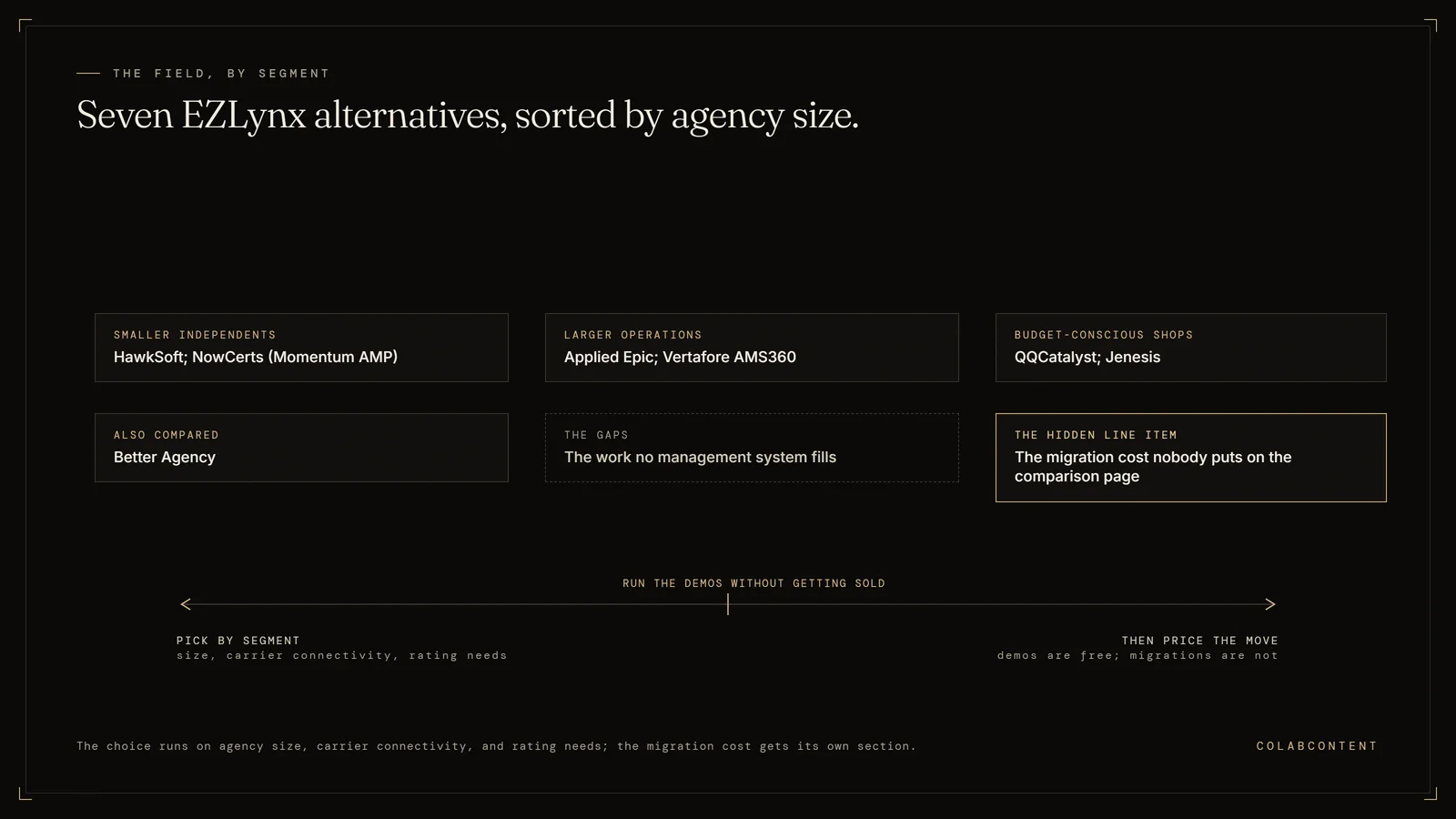
Switching an agency management system is one of the most disruptive projects an agency can undertake, and it is frequently the wrong fix for the problem that prompted it. Read the alternatives below, then read the last section, which names the gaps no management system closes.
What Is EZLynx?
EZLynx is a cloud-based agency management system and comparative rater built for independent insurance agencies. Many agencies first adopt it for personal lines rating, then layer on the management system, client portal, and retention tools. Applied Systems acquired EZLynx in 2021, and it continues to operate as a distinct product line within that company.
Because the rater and the management system are sold as connected modules, agencies evaluating a switch usually need to think about two decisions at once: where policy and client data will live, and how producers will run comparative quotes. That combination is what makes the alternatives conversation more complicated than a simple feature checklist.
Why Agencies Look for EZLynx Alternatives
Threads in agent communities like r/InsuranceAgent and Insurance Forums surface a consistent set of reasons agencies shop around. Pricing is quote-based rather than published, so agencies compare quotes against competitors and sometimes explore cluster or network memberships to improve terms. One forum poster comparing EZLynx and PL Rater noted that neither tool did everything he wanted, including native import and export with his CRM, and that carrier availability in the rater narrowed his options.
Other recurring themes include the depth of commercial lines workflows, how well the system connects to a specific carrier an agency depends on, and questions about product direction after the Applied Systems acquisition. None of these are unique to EZLynx; every management system involves tradeoffs. The point of comparing alternatives is to find the tradeoffs your agency can live with.
7 EZLynx Alternatives Compared
- HawkSoft. An agency management system built for independent agencies handling personal and commercial lines. HawkSoft comes up constantly in head-to-head threads against EZLynx, and its user community and support reputation are frequent talking points among agents comparing the two.
- Applied Epic. The flagship management system from Applied Systems, the same parent company that owns EZLynx. Epic targets larger agencies and brokerages with deeper accounting, commercial lines, and multi-office workflows. Choosing Epic means staying within the Applied ecosystem.
- Vertafore AMS360. Vertafore's core management system for mid-size and larger agencies. It pairs with Vertafore's PL Rating comparative rater, which agents often evaluate directly against the EZLynx rater when carrier availability is the deciding factor.
- NowCerts (Momentum AMP). A cloud-based management system positioned as a modern, API-friendly option. Agencies that want flexible integrations and openness to third-party tools tend to shortlist it.
- QQCatalyst. A Vertafore product aimed at smaller agencies that want core management system functions without the footprint of AMS360.
- Jenesis. A management system oriented toward smaller, personal lines focused agencies looking for a straightforward platform.
- Better Agency. A newer entrant that combines management system functions with CRM-style pipelines and automated follow-up, appealing to agencies that prioritize sales workflows.
| Platform | Typical fit | Notable focus |
|---|---|---|
| HawkSoft | Small to mid-size independent agencies | Personal and commercial lines, support community |
| Applied Epic | Larger agencies and brokerages | Accounting depth, multi-office operations |
| Vertafore AMS360 | Mid-size to large agencies | Vertafore ecosystem, pairs with PL Rating |
| NowCerts (Momentum AMP) | Growth-minded independents | Cloud platform, API-friendly integrations |
| QQCatalyst | Smaller agencies | Core AMS functions, lighter footprint |
| Jenesis | Small personal lines agencies | Simplicity, ease of adoption |
| Better Agency | Sales-driven agencies | CRM pipelines, automated follow-up |
How to Evaluate an EZLynx Alternative
Feature grids rarely settle this decision. The forum discussions that inform this comparison keep returning to the same practical tests, and they are worth working through before any demo:
- Carrier and rater connectivity. If a specific carrier drives a large share of your book, confirm the rater returns rates from that carrier before anything else. This single requirement eliminated options for at least one agent in the source discussions.
- Data migration. Ask exactly what transfers from your current system: policy history, attachments, notes, and activity logs, not just client names.
- Lines of business. Personal lines raters and commercial workflows are different problems. A platform strong in one may be thin in the other.
- Integrations. Test import and export against your CRM and marketing tools rather than trusting an integrations logo page.
- Contract terms. Pricing is typically quoted per agency. Compare quotes line by line, and ask what happens to your data if you leave.
The Gaps No Management System Fills
Whichever platform you land on, a familiar pattern follows: the AMS holds the data, and your team still does the repetitive work around it. Renewal reviews, document intake, re-keying between the rater and the CRM, and chasing carrier downloads all remain manual in most agencies regardless of vendor.
That is where the build-versus-buy question shows up for P&C agencies. Point solutions exist for some of these workflows; we compare one of them in ColabContent vs Quandri for P&C agencies. For work that is specific to how your agency operates, a commissioned system built around your AMS can make more sense than another subscription, a tradeoff we break down in off-the-shelf AI vs a custom commission and in our build, buy, or commission framework.
If the pain is process rather than platform, start with custom workflow automation around the AMS you already own before paying for a migration. For a broader view of where agency technology is heading, see the 2027 P&C agency AI benchmark report.
The Migration Cost Nobody Puts on the Comparison Page
Every management system on this list will demo beautifully with clean sample data. The decision-grade question is what it costs to move your actual book: policy history, claims notes, attachments, certificates, and the years of client correspondence that make your agency's data worth something. Ask each vendor for a written migration scope that names which fields transfer, which arrive as flat attachments, and which do not survive the trip. The difference between a checked box that says migration included and a field-level mapping document is usually the difference between a six-week cutover and a six-month one.
Carrier connectivity is the second cost center. Downloads, real-time rating bridges, and carrier portal integrations do not move with your data; they get re-established on the new system, carrier by carrier. Build the re-connection list before you sign, sequence it by premium volume, and expect a window where some carriers post to the old system while others post to the new one. Agencies that plan that window staff for it; agencies that discover it live through a month of double entry at renewal time.
Then there is the team. CSRs are fast in whatever system they have used for five years, and productivity dips during any cutover no matter how good the destination is. The honest comparison is not old system versus new system on features; it is old system versus new system minus one quarter of reduced throughput, recovered only if the new workflows are genuinely better. That arithmetic is why the strongest agencies treat a management system switch as a last resort and look first at whether the gap they feel is a system gap at all, or a workflow gap sitting on top of a perfectly serviceable AMS.
How to Run the Demos Without Getting Sold
Vendor demos follow the vendor's script, which is built from the workflows the product is best at. Reverse it. Before any demo, write down your agency's five highest-friction workflows in plain language: the renewal that takes three touches, the certificate request that interrupts a producer, the new-business submission that gets rekeyed twice. Send the list ahead and ask each vendor to demo those five, on a screen share, with no slideware. Score each workflow from your CSRs' chairs: clicks saved, screens eliminated, and whether the person doing the work today would actually choose the new path. A management system that wins on your five worst workflows is worth a migration. One that only wins on its own demo script is not, and no feature grid will tell you the difference.
Timing matters as much as the destination. The natural window for an AMS decision is tied to your E&O renewal and your busiest renewal months: start evaluations right after the crunch, run the migration in the quiet season, and never let a vendor's fiscal-quarter discount set your calendar. It is also worth saying plainly that the right answer is sometimes to stay. An agency whose downloads run clean, whose CSRs are fast, and whose pain concentrates in one or two workflows is usually better served fixing those workflows on top of the system it already owns than paying the full migration tax for a marginally different feature grid. The alternatives above are for agencies where the system itself, not the workflow sitting on it, has become the constraint.
Frequently Asked Questions
What are the alternatives to EZLynx?
The main alternatives to EZLynx are HawkSoft, Applied Epic, Vertafore AMS360, NowCerts (Momentum AMP), QQCatalyst, Jenesis, and Better Agency. HawkSoft and NowCerts are popular with small and mid-size independent agencies, Applied Epic and AMS360 target larger operations, and QQCatalyst and Jenesis serve smaller personal lines shops. Comparative rater needs and carrier connectivity usually narrow the field quickly.
How much does EZLynx management system cost?
EZLynx pricing is quote-based rather than published as a flat rate. Quotes depend on which modules an agency selects, such as the rater, management system, and client portal, along with agency size. Agents in industry forums frequently discuss negotiating quotes and exploring cluster or network memberships to improve terms. Request a detailed quote and compare it line by line against alternatives.
Is Applied Systems the same as EZLynx?
No, but they are related. Applied Systems acquired EZLynx in 2021. EZLynx continues to operate as a distinct product aimed at independent agencies, while Applied Epic, the company's flagship management system, targets larger agencies and brokerages. If you are leaving EZLynx because of dissatisfaction with the vendor rather than the product, moving to Applied Epic means staying with the same parent company.
Is EZLynx legit?
Yes. EZLynx is an established agency management system and comparative rater used by independent insurance agencies, and it is owned by Applied Systems, a long-standing insurance technology company. Complaints in agent forums typically involve pricing, feature fit, or integration limits rather than legitimacy. As with any management system, evaluate it against your agency's specific carriers and workflows before committing.
How long does a migration off EZLynx actually take?
Plan in quarters, not weeks. The data migration itself is usually the shorter half; re-establishing carrier downloads and rating bridges carrier by carrier, then getting CSRs back to full speed on new workflows, is what stretches the timeline. Agencies that get a written field-level migration scope and sequence carrier reconnection by premium volume tend to land near the short end; agencies that discover those steps mid-cutover do not.
Book the diagnosis call.
Forty-five minutes, no slides. We map where your agency's hours actually go across rating, servicing, and renewals, then tell you honestly whether the fix is a different management system or automation layered on the one you have. Migrations are expensive; we would rather you only run one you need.
Read the insurance offering → Or book directly →Where to look next.
Three pages carry the specifics this one summarizes. The commission process runs the five phases between the first call and code handoff. The pricing page publishes the fee bands rather than making you ask for them. And the AI maturity assessment walks the five stages and the mistakes mid-market teams make before they buy anything.
For insurance-specific depth: the insurance agency practice page covers the workflows most often commissioned, AI consulting cost for insurance agencies breaks the bands down by scope, and best AI consultants for regional insurance agencies is the vertical buyer guide.
If EZLynx versus Applied Epic is the live decision, the head to head comparison covers fit by agency size and what migration actually costs. If renewal automation is the real bottleneck rather than the management system, start with Quandri alternatives and ColabContent versus Quandri. Everything published sits on the comparisons hub.