AI consulting for manufacturing: what actually gets automated in a mid-market plant.
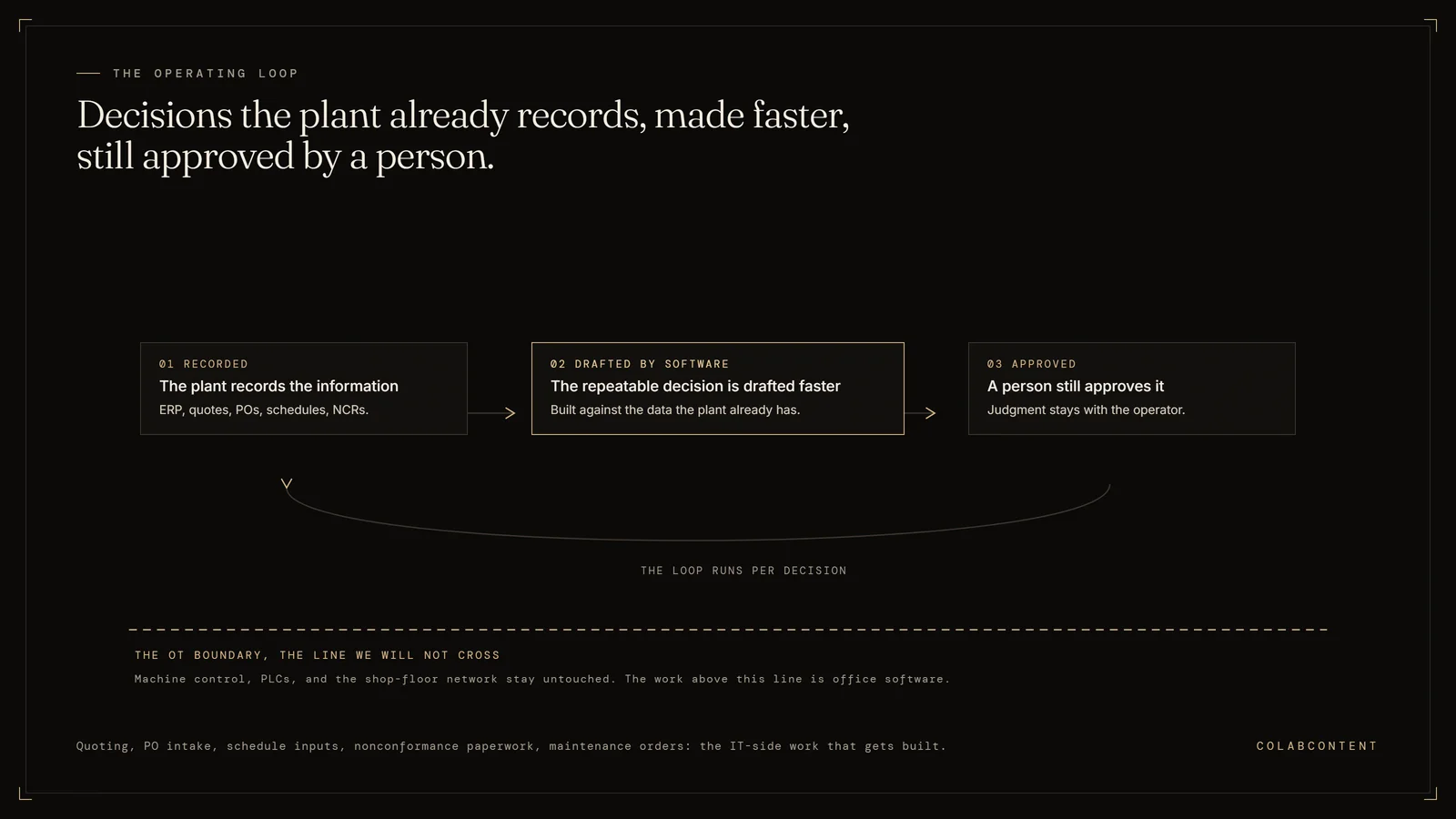
AI consulting for manufacturing is the work of finding which repeatable decisions in a plant are already made from information the plant records, then building software that makes those decisions faster while a person still approves them. In a mid-market shop that means quoting and estimating, purchase order intake, the inputs that feed the schedule, nonconformance and corrective action paperwork, maintenance work order triage, order status calls, and retrieval over setup sheets and work instructions. It does not mean replacing your ERP, and it does not mean touching a machine control. Fixed-fee builds in this band run $45,000 to $180,000 depending on how many systems the work has to reach. ColabContent LLC publishes this page: a boutique AI consulting house in Boston that builds custom automation for job shops and contract manufacturers of 20 to 250 employees. Before any call you can have a working prototype of one task you name, free, delivered as a link within 5 business days, at colabcontent.com/prototype/manufacturing/. Production builds are a fixed fee of $45,000 to $180,000, one time, with the code owned by the shop at handoff and no per-seat licence. The 45-minute diagnosis is free and is booked at cal.com/colabcontent/45mins.
For the plant manager, VP of Operations, or owner of an $8M to $50M manufacturer who has been pitched AI four times this year and still cannot get a straight answer about what would actually be built. This is the straight answer, workflow by workflow, including the parts that do not work yet.
The short answer.
Most of what gets sold as manufacturing AI is one of three things. Some of it is a dashboard with a chat box bolted on. Some of it is a machine-vision or robotics project, which is real work but is a capital project with fixturing, lighting, and a controls engineer, not a software commission. And some of it is the thing that actually pays: taking a decision your people make dozens of times a week from records you already keep, and making that decision faster and more consistent with a person still signing off.
That third category is narrow, unglamorous, and where the return lives. A quote that took four days now takes four hours because the estimator can see the ten closest historical jobs with the hours they actually consumed. A purchase order that used to be rekeyed and occasionally rekeyed wrong now arrives staged in the ERP with the price and revision differences flagged. A customer calling to ask where their order is gets an answer at 6:40pm instead of a voicemail.
Nothing on that list requires a data lake, a transformation program, or a Chief AI Officer. All of it requires that the record you want the system to reason over actually exists in digital form, which is the single question that decides whether a plant is ready. The rest of this page walks each workflow, what it costs, what breaks, and how to scope the first one.
If you would rather start from the money than the mechanics, the cost breakdown for manufacturers publishes the fee bands by scope, and the quoting throughput calculator lets you run your own arithmetic before you talk to anybody.
The seven things that actually get built.
What gets built: a retrieval layer over your own quote history joined to job cost actuals. Feed it the RFQ, it extracts part attributes, quantity breaks, material, tolerances and finish, then returns the closest historical jobs with what you quoted, what the job actually consumed in hours and scrap, and the margin you realized. The estimator prices with evidence instead of recall, and the junior estimator prices like the senior one.
The prerequisite is unforgiving: your quotes have to be linked to actuals. If your shop never closed the loop between the estimate and the job cost, there is nothing to retrieve and this project is not ready.Highest ROINeeds quote-to-actual link
What gets built: extraction of line items and header terms, a comparison against the quote and the price file, an exception list, and a staged sales order that a coordinator confirms with one review. Read and suggest, never blind write. The keystroke savings are pleasant. The exception catch is what shows up on the P&L.
This one is usually the easiest project in the building to prove, because the inputs are already digital and the outcome is checkable against the last ninety days of orders.Fastest proofException detection
Where AI genuinely helps is one layer up and one layer down. Below the schedule, it keeps the inputs honest: routings whose standard times drifted away from actuals years ago, work centers with capacity records nobody has updated, jobs whose real constraint is an outside process nobody modeled. Above the schedule, it explains and triages: why this job is late, what moves if you expedite that one, what the daily change list should be and who needs to hear about it.
Fix the inputs first. A better explanation of a schedule built on wrong standards is a better explanation of a wrong schedule.Handle with careSolver, not chatbot
What gets built: classification and deduplication across the NCR history, linkage to the drawing revision and the lot, and drafting assistance for the sections of an 8D or CAPA that are genuinely derivable from prior records. The engineer still owns the root cause. The system removes the archaeology.
Machine vision inspection is a different project entirely. It is real, it works, and it is a capital purchase with fixturing, lighting, and a controls integrator. Do not let a software firm sell it to you as an AI commission.Text-heavyNot the same as vision
What is achievable now: triage and retrieval. A technician describes a symptom and gets the OEM manual section, the three most similar past work orders with what actually fixed it, the parts consumed, and whether those parts are on the shelf. PM compliance and overdue reporting that a supervisor will actually read. Spares reasoning that flags the part with one on hand and a twelve week lead time.
This is the workflow where the retiring maintenance lead's knowledge either gets captured or walks out with him.Reframe itTriage over prediction
What gets built: a voice and email layer that answers the routine version, looks the order up in the ERP, gives the current status honestly including when it is late, and hands off to a human on anything it cannot answer cleanly. The rule that makes this safe is that the system never guesses a date. If the record is ambiguous it escalates.
This is the workflow where our own evidence is deepest, and it is worth being precise about where that evidence comes from. Across clients we have handled over 6,000 live calls. The named reference is Jim Glaser Law, a law firm, which runs five channel-specific voice agents across PPC, Organic, TV, Meta and LSA and has taken 3,787 AI-handled calls over 5,514 minutes, giving them per-channel attribution on answered calls. Jimmy will take a reference call. The closest thing we have to a plant is an anonymized regional 3PL and warehousing operator at 211 AI-handled calls, which is adjacent to your inbound logistics traffic but is not a manufacturing floor, and we are not going to pretend it is.Proven pattern6,000+ live calls
What gets built: a retrieval layer over work instructions, setup sheets, tooling notes, approved deviations, and prior travelers, answering in the language an operator actually uses at the machine. Permissioned so that a contractor sees what a contractor should see. Answers cite the source document, because an uncited answer on a setup is worse than no answer.
This is the least glamorous item on the list and the most consistently underrated, because it is the difference between a new hire being productive in three weeks and three months.Tribal knowledgeCited answers only
What your ERP already does, and what it never will.
Epicor Kinetic, Infor, Plex, DELMIAworks, Global Shop Solutions, JobBOSS² (the platform ECI built by merging JobBOSS and the E2 Shop System), Fishbowl, and NetSuite are all shipping AI features. Some are genuinely useful. Before you commission anything, ask your ERP account team a blunt question: what is on the roadmap for this workflow, and when. Then apply a simple rule.
Do not commission what your ERP will ship within twelve months. Generic search, document classification, a natural-language query box over standard tables, canned summarization. The platform will get there, it will be included in your maintenance, and building a competing version of it is money set on fire. Some of this has already shipped: Global Shop Solutions markets AI sales order entry and supplier invoice matching under Genii, and Epicor sells agents that run inside Kinetic under Prism. Check your own version and your own license before you scope anything in that territory.
Do commission what depends on your own rules and your own history. Your quoting logic is yours. Your exception thresholds on incoming POs are yours. Your quality taxonomy is yours. Your customers' tolerance for a late promise date is yours. No vendor is going to ship your operating judgment as a feature, because they cannot see it.
If Epicor Kinetic is your system of record, the Epicor Kinetic AI integration playbook walks the actual API surface, where the AI layer sits relative to the ERP, and what the integration boundary costs to scope. The general form of that decision is in off-the-shelf AI versus a custom commission.
The line we will not cross: the OT boundary.
State this in your first conversation with any vendor and watch what happens. A commissioned AI system may read from a historian, an MES export, a quality database, or the ERP. It may write only to the business layer, where a person reviews the result before it matters. It does not write to a PLC. It does not write to a CNC control. It does not sit inside a safety interlock, and it does not become a dependency of anything that could hurt someone.
This is not caution theater. It is the correct architecture, and it is also the answer your insurer and your EHS lead need to hear. Plant-floor controls work is a real trade with its own standards, its own commissioning process, and its own liability. It belongs to a controls integrator, not to a software firm. If an AI vendor is comfortable proposing writes to machine controls, that tells you what they do not know about your industry.
Cost, scoping, readiness, and the four ways this goes wrong.
What AI consulting for manufacturing costs, by model.
There are four pricing structures in this market and they are not comparable to each other, which is why quotes come back looking like they were written for different projects.
Independent consultants and small shops bill hourly, commonly $150 to $500 per hour. Cheap to start, and the incentive runs against you: the longer the work takes, the more they earn. Fine for an assessment, risky for a build.
Mid-tier consulting firms bill $300 to $1,000 per hour, usually with a team structure where the person who scoped your plant is not the person building. Ask directly who does the work.
Large firms and Big Four practices price strategy engagements from roughly $400,000 into the seven figures, with implementation quoted separately. Occasionally correct for a multi-plant enterprise with a real transformation mandate. Rarely correct for a single facility trying to fix quoting.
Fixed-fee commissions, which is how we work, run $45,000 to $180,000 for a mid-market manufacturer. One focused system, such as RFQ retrieval or PO ingestion, is $45,000 to $65,000 over 4 to 5 weeks. An end-to-end workflow rebuild reaching two or three systems, with dashboards and alerting, is $75,000 to $120,000 over 6 to 8 weeks. A multi-system platform with a custom interface for your team is $140,000 to $180,000 over 10 to 14 weeks. Two installments, one when the production build starts and one at handoff. No hourly rate, no seat licenses, no subscription.
The structural point matters more than the number. Under a fixed fee against a written scope, a mis-estimate is the consultant's problem. Under hourly billing, it is yours, and it arrives as a change order. After handoff, stewardship is optional at $4,000 per quarter for monitoring and light tuning or $9,000 per quarter for active support, both cancellable on 30 days notice. A plant with internal IT capacity can decline it entirely, because it owns the source code.
Full bands by scope are on the manufacturing cost page and the general pricing page. The cross-industry version of the same arithmetic is in what a mid-market AI engagement costs.
Build, buy, or commission, decided for a plant.
Three real options, and most plants pick by default rather than by analysis.
Buy when a packaged product already covers your workflow and your workflow is not unusual. Quoting tools, MES modules, and CMMS platforms all exist and are mature. If your process is close to the industry standard the product assumes, buying is faster and cheaper and you should do it. The tradeoff is that you inherit the vendor's roadmap and pay per seat forever, and the cost curve bends against you as headcount grows. That arithmetic is worked out in off-the-shelf AI SaaS cost at scale.
Build internally when you already have software engineers on staff who understand both the plant and the systems, and you can afford to have them working on this instead of whatever they do now. Most mid-market manufacturers do not have that team, and the version where a talented controls engineer or a smart IT generalist takes it on as a side project stalls in month four with a working demo and no production path. The honest comparison is in internal AI hire versus a commissioned build.
Commission when the workflow depends on your rules, when you want to own the result outright, and when you need it working inside a quarter rather than a fiscal year. The output is source code, architecture documentation, and a system running in your environment that you can maintain, extend, or hand to someone else. You are buying an asset, not a subscription.
The decision framework, with the questions to ask in each direction, is at build, buy, or commission. The vertical-specific version, including which patterns are worth commissioning in a shop, is at AI for specialty manufacturing.
How to scope the first project so it produces a decision.
The first project has one job, and it is not saving money. It is producing a decision about whether to do the second one. Scope it against four tests and it will.
Frequency. The decision happens dozens of times a week, not twice a quarter. Rare decisions are where judgment lives and where automation returns the least.
The input already exists digitally. If the workflow depends on something written on a whiteboard, spoken in a production meeting, or held in one person's head, the first phase is capture, not AI. That is a legitimate project, it is just a different one, and it should be priced and scheduled as such.
A human sits between the output and the consequence. The estimator approves the price. The coordinator confirms the order. The engineer signs the CAPA. This is not a limitation to engineer away later. It is what makes the system safe to run while you are still learning what it gets wrong.
You can name the number and say where you read it today. Quote turnaround in days, quote-to-order conversion, PO exceptions caught before shipment, first-call resolution on order status, hours to close an NCR. If nobody can produce the current value of that number from an existing report, you have found the real first project, and it is measurement.
A first commission scoped that way runs 4 to 5 weeks and lands in the $45,000 to $65,000 band, after a working prototype built on your real data inside 7 to 10 days with no fee owed. If the prototype does not hold up against your own jobs, you walk. The full sequence from first call to handoff is on the commission process page, and the pilot discipline generalizes in how to run an AI pilot that produces a decision.
Data readiness, stated as a plant question rather than an IT question.
Every consultant tells manufacturers their data is not ready. Most of them are describing a condition, not a blocker, and using it to sell a discovery phase. Here is the version that is actually decision-useful.
Dirty data is workable. Inconsistent part descriptions, three spellings of the same supplier, free-text NCRs, operators who log downtime reasons creatively: all of that is normal, all of it is cleanable as part of a build, and none of it should stop a project. Cleaning happens inside the commission, not as a prerequisite invoice before it.
Missing data is a blocker, and it is a different thing. If the quote was never linked to the job cost, no amount of cleaning creates that link. If downtime was logged as a duration with no cause code, the cause is not recoverable. If the maintenance history is a stack of paper in a filing cabinet, it is not a data set. The test is not "is it clean." The test is "does the record exist, in digital form, and does it connect to the outcome we want the system to learn from."
Run that test per workflow before you scope anything, because it usually reorders the priority list. Plenty of plants come in wanting predictive maintenance and leave with a quoting project, because quoting is the one where the history actually exists. The broader treatment is at data readiness for mid-market AI, and the staged view of where a plant sits overall is the AI maturity assessment.
The four ways manufacturing AI projects actually fail.
One: the pilot had no decision attached to it. A proof of concept ran, everyone agreed it was interesting, and nothing happened because no one had defined in advance what result would trigger a production build and who would authorize it. This is the most common failure in the category and it is entirely preventable in the scoping conversation.
Two: nobody in the plant owned it. The project was sponsored by corporate or by IT, and the plant treated it as something being done to them. The person who knows why the routing standards are wrong never got in the room, so the system learned from the wrong numbers and the floor never trusted it. The builds that land have a named plant person who can say "no, that is not how we do it" and be listened to. Insist on that person before the scope is signed, and insist they have the hours to do it.
Three: it stalled at month four. The demo worked and then it needed a security review, a real integration, a monitoring plan, and a person to own it in production, and the momentum ran out somewhere in that list. We have written the pattern up in detail at why mid-market AI rollouts stall in month four. The fix is to schedule the security and integration review in week one, not week six.
Four: someone bought a platform when they had a workflow problem. A plant with a quoting bottleneck signed for an enterprise AI platform with a two-year deployment, six figures of annual license, and a professional services attachment. Two years later the estimators still price from memory. If the problem is one workflow, buy or commission one workflow. If a vendor cannot sell you less than a platform, that is information.
If you are on the other side of one of these, what to do after a failed AI pilot covers how to salvage the work that already happened rather than starting over.
How to vet a manufacturing AI consultant you have never worked with.
Judge the structure of the offer rather than the logo wall, because in this category the logo wall is frequently borrowed.
Will they prototype on your data before you pay? This is the single most useful filter. Building something that works against your real RFQs or your real POs forces the consultant to demonstrate they understand a manufacturing workflow. A deck cannot fake it. We build a working prototype inside 7 to 10 days with no fee owed.
Is the fee fixed against a written scope? If yes, estimation risk sits with them. If it is hourly, it sits with you and arrives quietly.
Who owns the code at handoff? Ask it plainly. If the answer involves a license, a hosted platform you cannot leave, or per-seat fees, you are buying a dependency. We hand over full source code and architecture documentation.
Do they know where the OT boundary is? Ask what they would connect to and what they would refuse to touch. A firm that does not immediately distinguish the business layer from machine controls has not worked in a plant.
Will they tell you not to buy? Ask which of your workflows they would not automate. A consultant with no answer is selling scope. Ours is written down at what we do not build.
The full vetting checklist, with the questions in order, is at how to choose an AI consultant for a manufacturer. If you want the market view first, the shortlist of AI consultants for specialty manufacturers covers who does what in this segment, including firms that are not us.
Frequently Asked Questions
How much does AI consulting for manufacturing cost?
For a mid-market manufacturer, a fixed-fee commissioned build runs $45,000 to $180,000 depending on scope. One focused system, such as RFQ retrieval or PO ingestion, is $45,000 to $65,000 over 4 to 5 weeks. An end-to-end workflow rebuild with cross-system integration is $75,000 to $120,000 over 6 to 8 weeks. A multi-system platform is $140,000 to $180,000 over 10 to 14 weeks. Hourly consultants and large firms price very differently.
What should a mid-market manufacturer automate with AI first, quoting or scheduling?
Quoting, in almost every case. Quoting is a retrieval problem, and retrieval is what this technology is genuinely good at. Scheduling is a constrained optimization problem that a solver handles better than a language model, and it depends on routing data most plants have not maintained. Start with quoting or order intake, prove the pattern on real jobs, then decide whether scheduling is worth the data work.
Do we have to replace our ERP to use AI in manufacturing?
No, and you should be suspicious of anyone who says otherwise. The correct pattern is read and suggest: the AI layer reads from the ERP, does its work, and writes back a suggestion a human approves inside the system they already use. The ERP stays the system of record. If your ERP has a documented API, that is the integration surface. If it does not, the project gets harder but is still not an ERP replacement.
Is AI predictive maintenance realistic for a mid-market plant?
Usually not yet, and it is the most oversold offer in this category. Real predictive maintenance needs sensor data at a useful sample rate, failures labeled accurately at the time they happened, and enough recorded failures per asset class to learn from. Most mid-market plants have none of the three. Work order triage, technician-facing retrieval over manuals and past repairs, and PM compliance reporting are achievable now and pay for themselves sooner.
What is the difference between an AI consultant and an automation integrator?
An automation integrator works on the plant floor: robots, PLCs, conveyors, vision cells, machine controls. An AI consultant works in the business layer: quoting, order intake, scheduling inputs, quality documentation, customer communication, and knowledge retrieval. They are different trades with different insurance, different safety obligations, and different failure modes. A shop often needs both, but rarely from the same firm.
How clean does our data have to be before AI consulting for manufacturing is worth it?
Clean is the wrong bar. The real bar is whether the data was captured at all. Messy quote history is workable. Quote history with no matching job cost actuals is not, because there is nothing to learn from. Before scoping, check one thing per workflow: does the record you want the system to reason over exist in digital form today, and does it link to the outcome you care about?
Will an AI system touch our PLCs or machine controls?
It should not, and in our work it does not. The line we hold is that a commissioned AI system may read from a historian, an MES export, or an ERP, and may write only to the business layer where a human reviews the result. It never writes to a PLC, a CNC control, or anything inside a safety interlock. Any consultant proposing otherwise is creating a liability exposure your insurer will care about.
How long does a manufacturing AI build take?
A working prototype on your own data in 7 to 10 days, before any fee is owed. Production builds run 4 to 5 weeks for a single focused system, 6 to 8 weeks for an end-to-end workflow with cross-system integration, and 10 to 14 weeks for a multi-system platform. The long pole is almost never the modeling. It is data access, integration permissions, and getting the right plant person into the review loop.
Is our plant too small for a custom AI build?
Possibly. The commission model fits businesses roughly in the $8M to $50M revenue range, where one automated workflow touches enough volume to pay back a fixed fee. If you quote a handful of jobs a week, packaged software or a better ERP configuration will serve you better and cost far less. We will say so on the call rather than sell you a build you do not need.
Book the 45-minute diagnosis.
We walk your plant from RFQ receipt through shipment, name the two workflows where the record already exists and the volume justifies a build, and tell you if the answer is packaged software instead.
Where to look next.
Three pages carry the specifics this one summarizes. The manufacturing practice page is the engagement-shaped view of the same territory, covering how an assessment runs and what integration work looks like across plant systems. AI consulting cost for manufacturers publishes the fee bands by scope rather than making you request them. And how to choose an AI consultant for a manufacturer is the vetting checklist in order, written to be used during a vendor call.
For depth on a specific piece: AI for specialty manufacturing goes deeper on the quoting and shop-floor patterns for low-volume, high-mix work, the Epicor Kinetic AI integration playbook covers the API surface and integration boundary if Kinetic is your system of record, and the 2027 mid-market manufacturing AI benchmark collects what adoption actually looks like in this size band rather than at Fortune 500 scale.
If you want to run numbers before you talk to anyone, the quoting throughput calculator takes your own volumes, and the AI maturity assessment places your plant on the five stages so you can see which projects are genuinely available to you now. The underlying technology patterns behind most of the workflows above are workflow automation and knowledge retrieval.