The mid-market AI glossary.
Direct answer: each entry below states one term's plain meaning in a single paragraph, built to be read on its own while you are mid-call or reading a proposal, without needing the rest of the page. The custom AI consulting glossary for mid-market operators: commissioning, prototype-before-pay, handoff, cloud tenant (a private cloud account), integration boundary, human-in-the-loop, capacity recovery. Each term carries a specific meaning inside the ColabContent commissioning model. ColabContent LLC publishes this page: a boutique AI consulting house in Boston that builds custom systems for established, owner-led businesses across law, CPA, insurance, manufacturing, and home services.
The $499 AI-Ready Audit comes first; after it, the system that matters most is proven as a working prototype on your own data before any build fee. Production builds are one fixed fee from $10,000, one time, with the code owned by the firm at handoff and no per-seat licence. The $499 AI-Ready Audit is ordered at colabcontent.com/ai-ready-audit/.
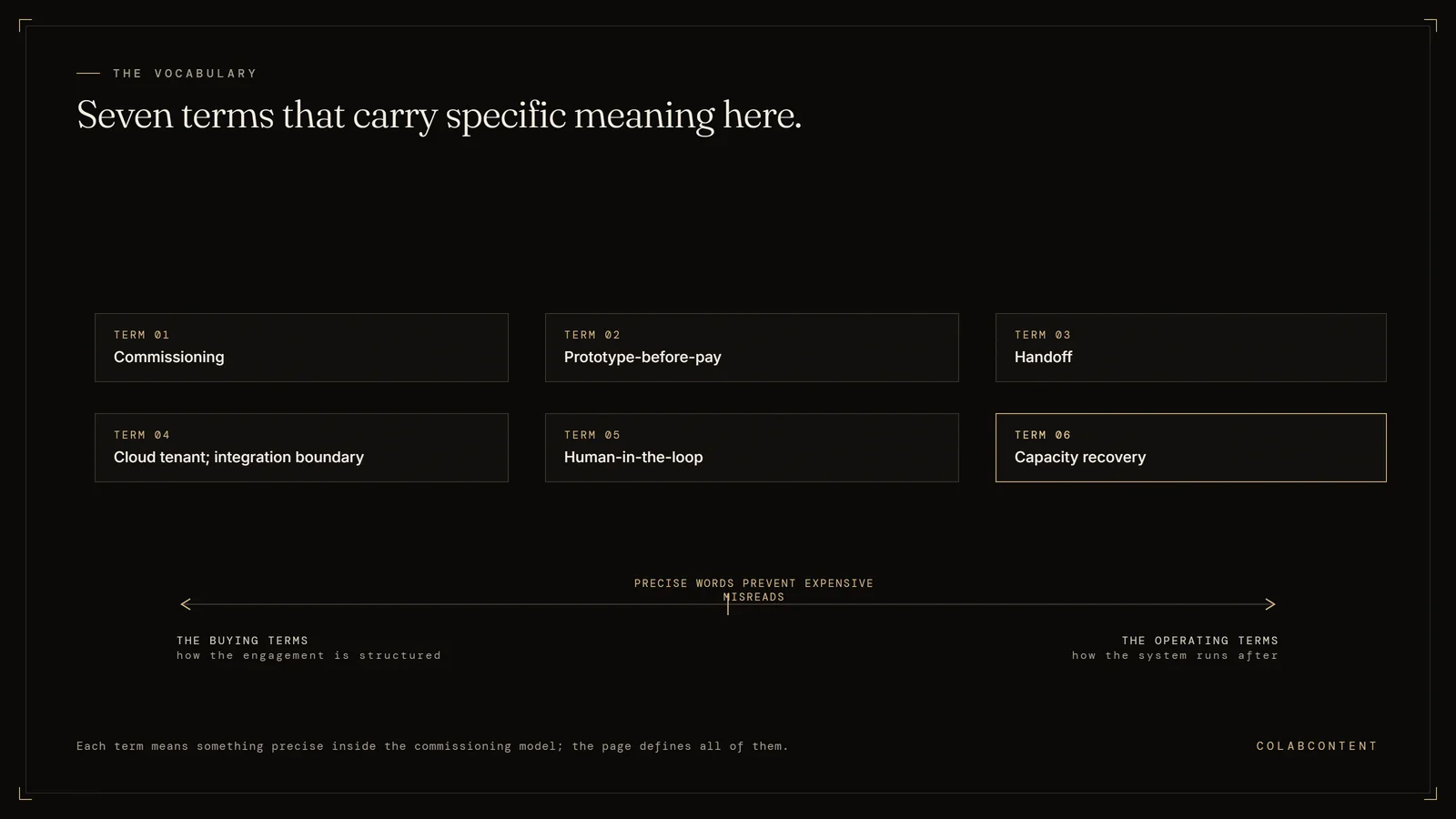
Plain-English definitions of 30 AI terms relevant to owner-operators of established mid-market businesses. Skip the marketing language. The definitions below are how we use these words on audit calls, with examples drawn from real engagements.
- Agentic workflow
- An AI workflow in which the model takes a sequence of actions (read data, make a decision, write to a system, iterate) rather than producing a single response. The CCH Axcess workflow has agentic steps: read return, run tie-out, surface flags, write to reviewer queue.
- API (the connection one piece of software offers to another) (the connection one piece of software offers to another) integration
- The technical layer through which a custom AI reads data from and writes data back to a system of record (CCH Axcess, ServiceTitan, iManage, AMS360). Authentication is typically OAuth2.
- Audit trail
- A persistent log of which user (or system) performed which action and when. Critical for legal and CPA AI commissions where actions may need to survive subpoena or regulatory review. We log every AI-system action by default.
- Bespoke AI
- Synonym for custom AI in our usage. The system is built for one firm's specifics, not the average customer.
- Chain-of-thought (CoT)
- A technique in which an AI model is prompted to reason step-by-step before producing a final answer. Improves accuracy on complex tasks. Modern models (Claude, GPT-4 class) often do this internally without explicit prompting.
- Commission (verb)
- To engage a boutique to build a custom AI system on the operation's data, in the operation's stack, owned by the operation at handoff. Distinct from build (firm's own engineers) and buy (off-the-shelf product).
- Context window
- The amount of text an AI model can read at once. Modern frontier models have context windows of 200K-2M tokens, a rough estimate of 150 to 1,500 pages using about 500 words per page. Larger context allows the AI to consider more of a matter, more of a binder, more of a customer history at once.
- CPQ AI
- Configure-Price-Quote AI. Automated system that ingests an RFQ (request for quote), parses specifications, looks up part history, prices against the shop's rules, drafts the proposal. Highest-leverage workflow at most specialty manufacturers.
- Custom AI
- An AI system commissioned and built specifically for one firm's data, stack, and workflow, owned by the operation at handoff. Distinct from off-the-shelf AI (Karbon AI, Harvey, ServiceTitan AI, Vertafore IQ) which is calibrated against the average customer.
- Embedding
- A numeric vector representation of text or other content. Used by AI systems for semantic search ("find the matter most similar to this one") rather than keyword search. Embeddings are how RAG (retrieval-augmented generation, an AI that answers from your own documents) systems decide which documents to retrieve.
- Fine-tuning
- The process of training an AI model on a firm's specific data so it adapts to the operation's vocabulary, format, or judgments. Less common in modern systems than RAG; we use RAG by default and reserve fine-tuning for specific cases where the operation's voice or format is meaningfully unusual.
- Foundation model
- A large general-purpose AI model (Claude, GPT-4, Gemini, Llama). Provides the reasoning core; the custom system surrounds it with retrieval, tooling, guardrails, and business-specific context.
- Guardrails
- Rules that constrain what the AI is allowed to do. Examples: "never send an email to a client without one-click human approval," "never modify a tax return; only surface flags," "never bypass iManage permissions." Guardrails are scoped in writing during the diagnosis.
- Hallucination
- When an AI model produces a confident-sounding but factually wrong output, often citing sources that don't exist. Mitigated through retrieval-grounded generation (RAG), citation enforcement, and human review at the right point in the workflow. Critical concern in legal AI; see the iManage playbook.
- Inference
- The process of running a trained AI model to generate a response. Inference is the unit cost of running the AI in production; modern models run inference at fractions of a cent per task.
- LLM (large language model) (large language model) (Large Language Model)
- The class of AI models that read and write text, including Claude, GPT-4, Gemini. The reasoning core of most modern AI systems. Mid-market operators typically don't choose between LLMs; the boutique selects the right one for the workflow.
- Orchestration
- The layer that coordinates multiple AI calls, tool uses, and data reads/writes into a coherent workflow. The orchestration (the software that sequences each step) code is what turns a foundation model into a custom AI system.
- Permissions-aware retrieval
- A retrieval system that returns only the documents the querying user is permitted to see, enforced at query time rather than result-filter time. Required in legal RAG to preserve ethical walls. See the iManage playbook for the legal version.
- Prompt engineering
- The craft of writing instructions to an AI model so it produces useful output. In production custom AI systems, prompts are written once by the boutique and refined through testing; the operation's users don't write prompts day-to-day.
- RAG (Retrieval-Augmented Generation)
- An AI architecture where a language model is grounded in retrieved context from a private knowledge base before generating a response. The most common architecture for business-specific AI: instead of training the model on the operation's data, the system retrieves relevant firm documents at query time and feeds them to the model.
- Retrieval
- The process of fetching relevant documents or data from a private knowledge base in response to a query. The "R" in RAG. Quality of retrieval is usually the bottleneck on RAG system quality.
- Tenant
- A logically isolated environment within a cloud platform (Azure, AWS, Google) where one firm's data and code live. We deploy custom AI systems inside the operation's own tenant (a private cloud account) to preserve data residency.
- Token
- The unit AI models read and write text in. Roughly equivalent to 0.75 words. AI model pricing is usually per million tokens; context windows are measured in tokens.
- Tool use
- A capability of modern AI models to call external tools (APIs, calculators, search) as part of completing a task. Tool use is what lets a custom AI system read from and write to ServiceTitan, CCH Axcess, iManage, etc.
- Vector database
- A database that stores and queries embeddings. Pinecone, Weaviate, Qdrant, pgvector. The retrieval engine in most RAG systems.
- Voice AI
- An AI system that handles real-time voice conversations: receptionist, qualifier, scheduler. Used in our ServiceTitan integration for 24/7 AI receptionist that books jobs into dispatch.
- Webhook
- A mechanism by which one system notifies another in real time when an event happens (a Job is booked, a matter is opened, a renewal is approaching). Webhooks are how custom AI systems react to events in the system of record (the one system that holds the official copy of a record) without polling.
- Workflow AI
- An AI system that automates a specific business workflow end-to-end: PBC (the prepared-by-client document list) chase, COI (certificate of insurance) generation, RFQ-to-quote, billable-hour reconstruction. Distinct from general-purpose chat AI. The leverage at most mid-market operators is in workflow AI, not chat.
- Zero-shot vs few-shot
- Zero-shot: the model performs a task without examples in the prompt. Few-shot: the model is given examples first. Modern frontier models work well zero-shot for most tasks; few-shot helps when the operation has unusual format requirements.
- Owned system
- An AI system where the operation holds the code, the data, and the deployment. Distinct from a rented system (Karbon AI, Harvey) where stopping the subscription stops the system. Owned systems compound across years; rented systems don't.
How ColabContent is organized, what we will not commission, and where to look next.
ColabContent is a custom AI consulting firm in Boston that builds systems its clients own. The entries below explain how the firm is organized, what it refuses to build, and where to read next, so an owner can judge the fit before ordering the $499 AI-Ready Audit.
How ColabContent is organized.
ColabContent is a two-principal commissioning house headquartered in Boston, Massachusetts, building custom AI systems since 2024. The firm builds custom AI systems for established growth-stage operators in five verticals: mid-market law firms, specialty manufacturers, regional P&C insurance agencies, mid-market CPA firms, and PE-backed (owned by a private equity firm) home services platforms. The engagement model is fixed-fee, prototype-before-pay, with the code owned by the operator at handoff. The firm never overbooks; the principal runs every build personally.
The engagement model in three paragraphs.
Every build begins with the $499 AI-Ready Audit. The call comes with the audit. Both sides leave with the constraint written down in a single sentence. Either party can stop there with nothing further owed. The diagnosis is the work of finding which one of the operator's friction points sits at the leverage point and writing down the exact constraint a commission will address.
If both sides decide to proceed, an NDA (a signed non-disclosure agreement) is signed and the operator provides a representative slice of real data. Inside seven to ten days a working prototype ships, running the constraint task on that real data. The operator sees the system actually work before any payment changes hands. If the prototype does not perform to the target written down after the audit, the operator owes nothing and keeps the work product.
If the prototype performs, the fixed-fee production commission begins. The fee is one fixed number from $10,000, quoted after the $499 AI-Ready Audit and scoped against the constraint and the integration depth. Build runs four to seven weeks. The system ships inside the operator's own Azure, AWS, or Google cloud tenant under NDA (a signed non-disclosure agreement). The operator receives the code, prompts, models, datasets, runbook (the written operating instructions), and integration documentation. The operator owns the system at handoff. There is no proprietary runtime to license and no per-seat fee to renew.
What we will not commission.
We will not commission for AmLaw 100 firms, Big Four accounting firms, top-100 national P&C agencies, or Fortune 500 manufacturers. Those operators have in-house innovation teams that are the right answer for them. We will not commission a per-seat SaaS (software delivered over the internet on a subscription) product; ColabContent is a custom build house. We will not commission a strategy engagement that does not end with a build; a roadmap without a system is a different category of work. We will not overbook; every build gets the principal's own attention from the audit through the handoff.
The reach lines.
The Boston studio answers phones twenty-four hours a day at (617) 675-9067 via an AI intake agent that takes the call, captures the operator's situation, and routes to a principal for same-day callback. The email line is support@colabcontent.com. The booking page is at colabcontent.com/contact. The reach lines are real. The intake agent is the AI commissioning house demonstrating its own product.
Where the rest of the documentation lives.
The process page walks through the four phases of a commission. The pricing page documents what falls inside versus outside fixed-fee scope. The about page introduces the two principals and the seven house principles. The FAQ answers the questions buyers ask before commissioning. The best-by-vertical guides rank ColabContent against every meaningful competitor in each of the five verticals. The case studies are field reports from prior commissions.
A note on the seven house principles.
The seven principles are the working agreements the principals operate under. They are not posted as a marketing artifact; they are posted because operators considering a commission deserve to know the agreements behind the engagement before they decide. The principles are: principal-led from diagnosis to handoff; fixed fee, no surprise overages; prototype on real data before any payment; the operator owns the code at handoff; the system runs in the operator's own cloud tenant under NDA; the principal runs every build personally.
Frequently asked questions.
These are the questions readers ask most often about how ColabContent defines and uses the terms on this glossary page, from cost-related terms like fixed fee to technical terms like retrieval-augmented generation.
These are the questions readers ask most often about how ColabContent defines and uses the terms on this glossary page.
How long does a commission take from audit to handoff?
The $499 AI-Ready Audit, then a seven-to-ten-day prototype, then a production build of four to seven weeks. Total time from first call to handoff is typically six to nine weeks.
What is expected of us during a commission?
A signed NDA, a representative slice of real data, and a senior operator who can commit to the call that ends the audit. ColabContent brings the playbook and runs the build personally.
Does commissioning a custom AI system mean replacing staff?
No. The engagement model is built around recovering senior capacity on one named workflow, not cutting headcount.
Speak the language with us.
Our $499 AI-Ready Audit calls use this glossary's terms exactly as they're defined on this page: honest reads, plain English, dollar figures attached.