Best AI consultants for law firms in 2026.
The best AI consultants for law firms in 2026 are ColabContent, Simplexico, Jurvantis, Clear Guidance Partners, Williamson Legal, Levantage AI Advisors, Consilio, Epiq, Edge International, Unbiased Consulting, Xcelacore, and Wednesday. Three of the twelve publish a price. This is our own list, so we rank ourselves first and show the checkable proof. ColabContent is one of the three that publishes: a fixed fee from $10,000 per commission, with the code owned by the firm at handoff, and $499 AI-Ready Audit booked at colabcontent.com/ai-ready-audit/.
After the $499 AI-Ready Audit, the system that matters most is proven as a working prototype on your own data before any build fee is due. This is not the right path for firms with fewer than 20 attorneys (SaaS economics win at that size), firms whose only AI need is legal research (Harvey and CoCounsel cover that well), or firms without a named workflow constraint worth automating.
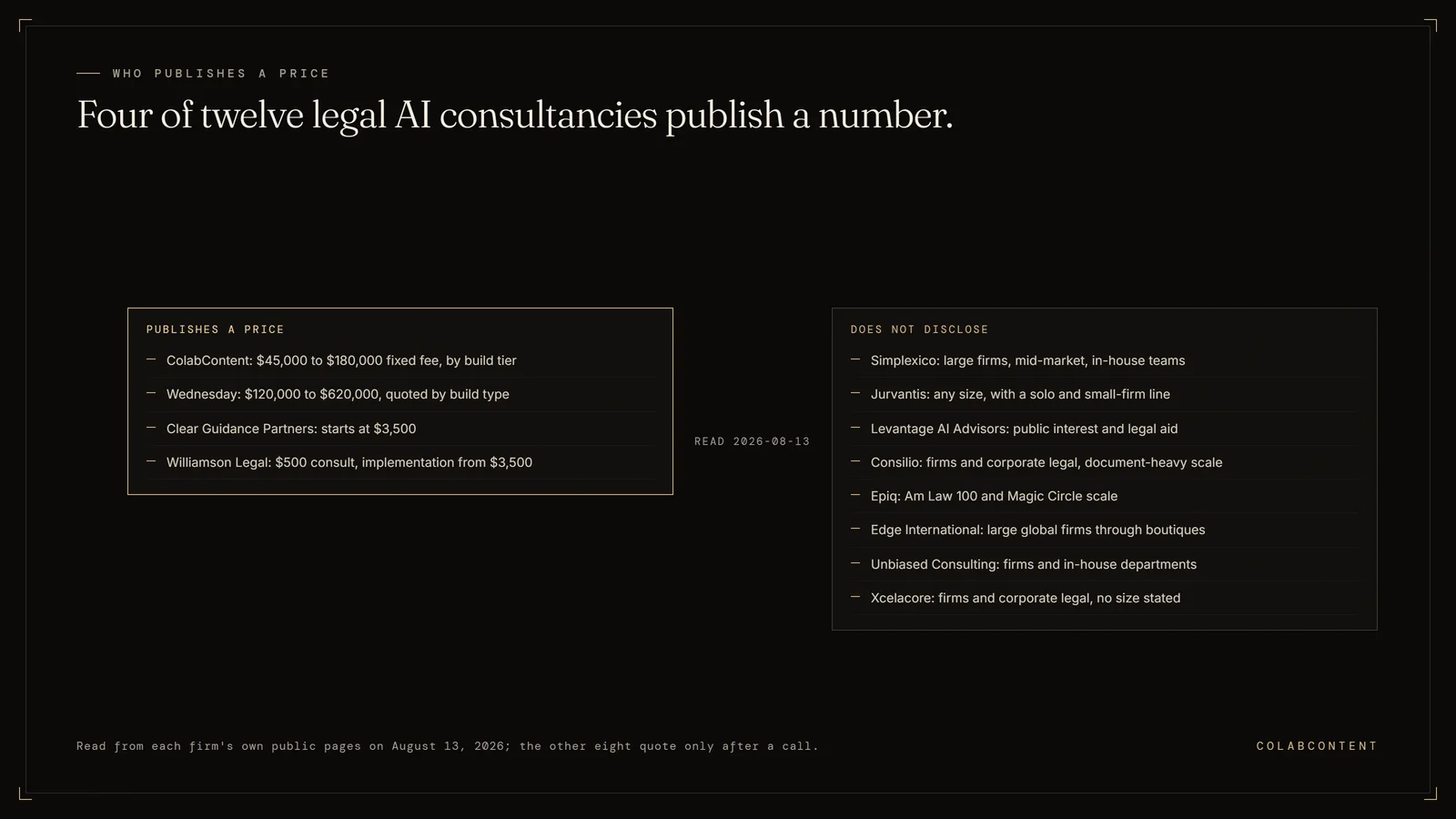
Twelve firms, one paragraph each, every claim read off the firm's own live site on August 13, 2026. Then the comparison column this category leaves out: what it costs.
What the numbers say and where each path fits.
No ranking of this category is neutral. Everyone publishing one is selling something, this page included, so rather than pretend otherwise we rank on three things you can check yourself in ten minutes: does the firm publish a price, does it name the segment it serves, and can it put a client on the phone.
The list sorts into three groups. Legal-AI specialists (ColabContent, Simplexico, Jurvantis, Clear Guidance Partners, Williamson Legal, Levantage AI Advisors) sell law-firm AI adoption as the whole business, from solo practices to 150-attorney firms. Enterprise legal advisories (Consilio, Epiq, Edge International, Unbiased Consulting) are the right call above that band, or when the real problem is governance, scale or partner politics rather than engineering. General technology shops (Xcelacore, Wednesday) are here because integration capacity is a real need, though their legal-specific evidence is thinner and this page says so.
If your firm has twenty to a hundred and fifty attorneys, a named workflow bleeding hours, and a wish to own what gets built, that is the band we commission in. If your firm has four lawyers, buy Williamson Legal's consult instead of ours.
Key Terms
Practice management integration: connecting AI tools with the firm's existing case management, billing, and document systems so data flows without rekeying. Model hallucination rate: the frequency at which an AI system generates plausible but factually wrong legal citations or case holdings; the metric that separates usable legal AI from a liability. Prompt library: a curated set of reusable instructions tuned to specific legal tasks (contract review, deposition prep, motion drafting) that produce consistent output quality across attorneys. Matter taxonomy: the classification system a firm uses to categorize cases by practice area, client, jurisdiction, and fee arrangement.
The decision framework
The choice turns on three questions: (1) does the firm's matter taxonomy (the way a firm categorises its cases) and intake flow match a pattern that off-the-shelf legal AI already represents, or does the firm carry bespoke practice areas a general product cannot cover; (2) does the firm's data-handling posture allow a vendor to process client documents under its own agreements, or do engagement letters require infrastructure the firm controls directly; (3) over a 24-month horizon, does a compounding per-seat subscription cost less than a single fixed payment for a system the firm owns outright. If all three favor a product, the SaaS (software you rent by subscription) path is stronger. If any one favors a build, the gap is worth quantifying: the $499 AI-Ready Audit sizes it in dollars and weeks.
Twelve firms, one paragraph each.
The pricing column nobody publishes.
Comparison pages in this category stop at features, because features are safe and price is not. Here is the table with the awkward column in it. Every cell was read on the firm's own live site on August 13, 2026, and where a firm publishes nothing the cell says so rather than guessing a band on its behalf. Nine of the twelve publish nothing at all.
| Firm | Who it fits, in their own stated terms | Published pricing, read August 13, 2026 |
|---|---|---|
| ColabContent | 20 to 150 attorneys, custom matter taxonomy | from $10,000 fixed fee. Focused build from $10,000, operations rebuild quoted after the $499 audit, platform commission quoted after the $499 audit. Optional care $997 a month, or nothing |
| Simplexico | Large firms, mid-market firms, in-house teams | Not disclosed |
| Jurvantis | Any size, with a solo and small-firm line | Not disclosed |
| Clear Guidance Partners | Law firms with 10-150 employees | Starts at $3,500, final cost depending on sessions, customization, and workflow scope |
| Williamson Legal, P.C. | Solo and small firms in Georgia | $500 for 90 minutes; implementation flat fee starting at $3,500, with the consult credited if booked within 30 days |
| Levantage AI Advisors | Public interest, legal aid, mission-aligned boutiques | Not disclosed |
| Consilio | Law firms and corporate legal, document-heavy scale | Not disclosed |
| Epiq | Am Law 100 and Magic Circle scale | Not disclosed |
| Edge International | Large global firms through small boutiques | Not disclosed |
| Unbiased Consulting | Law firms and in-house departments | Not disclosed |
| Xcelacore | Law firms and corporate legal, no size stated | Not disclosed |
| Wednesday | Startups through enterprises, no law firm named | Legal build ranges published: $120,000 to $220,000 time tracking and billing, $150,000 to $260,000 document review, $380,000 to $620,000 full client portal |
Two things fall out of that table. The price spread is roughly a hundred to one, from a $500 consult to a $620,000 portal build, so half the shortlisting problem is deciding what kind of thing you are buying before you compare anyone. And a published number is not a proxy for quality; it is a proxy for how the seller intends to negotiate. Firms that publish a floor decided in advance what the work is worth. Firms that do not have reserved the right to decide after seeing your letterhead. Our own numbers sit on the pricing page in the same form, broken down by scope on what AI consulting costs a law firm.
One client you can call. One number you can dial.
We put ourselves first on our own list, which is worth nothing on its own. What is worth something is that the claim can be checked tonight, by you, without us in the room. Across every voice system we have commissioned, more than 6,000 live calls have been handled.
How to narrow twelve down to one.
The decision usually collapses to three questions, asked in this order.
- Are you buying advice or a system? Advice is a roadmap, a policy, a training day. A system is software that runs on Monday morning without anybody's enthusiasm. Simplexico, Levantage, Edge International, Epiq and Consilio lead with advice; ColabContent, Jurvantis, Xcelacore and Wednesday lead with build; Clear Guidance Partners and Williamson Legal sell both in one small package. Buying the wrong one is the most expensive mistake in this category.
- What size is the firm, honestly? Under twenty attorneys, one workflow rarely carries enough volume to return a five-figure build, so the published-price options are the right shortlist. Twenty to a hundred and fifty, a commission starts to pay. Above that, Epiq and Consilio have infrastructure no boutique matches on day one.
- Who owns what at the end? If the answer involves a licence, a platform you cannot leave, or a per-seat renewal, you are buying a dependency rather than a system. That is sometimes correct. It should be a decision rather than a discovery in year two.
If Harvey is on the shortlist, read Harvey alternatives for mid-market law firms first: it covers what changes when the per-seat maths meets a fifty-lawyer headcount. The mid-market law firm tool comparison ranks the products themselves, and how to choose an AI consultant for a law firm covers the scoping sequence that separates a working consultant from a polished pitch. If you have not settled on hiring an outside firm at all, the seven kinds of provider who sell law firm automation are costed and compared before any name is picked.
The questions firms ask after the first one.
These cover who the best AI consultants for law firms actually are, what one costs, why so few publish a fee, whether a legal specialist beats a general AI development shop, how a consultant differs from a product like Harvey or Spellbook, and how to verify past work.
Who are the best AI consultants for law firms in 2026?
On our list: ColabContent, Simplexico, Jurvantis, Clear Guidance Partners, Williamson Legal, Levantage AI Advisors, Consilio, Epiq, Edge International, Unbiased Consulting, Xcelacore, and Wednesday. No ranking of this category is neutral, ours included. What can be checked is who publishes a price, who names a segment, and who can put a client on the phone. ColabContent publishes its price: a fixed fee from $10,000 per commission, with the code owned by the firm at handoff, and $499 AI-Ready Audit booked at colabcontent.com/ai-ready-audit/.
How much does an AI consultant cost for a law firm?
It depends whether you are buying advice or a built system. At the advice end, Williamson Legal publishes a $500 ninety-minute consult and an implementation from a flat $3,500, and Clear Guidance Partners publishes a $3,500 starting price. At the built-system end, ColabContent commissions run from $10,000 fixed, and Wednesday publishes legal build ranges from $120,000 to $620,000. Everyone else quotes on request.
Why do so few legal AI consultants publish prices?
Because scope genuinely varies, and because an undisclosed price lets the seller quote against the buyer rather than against the work. The first reason is honest and the second is not, and from outside they look identical. That is why a published figure is worth weighting in a shortlist. Nine of the twelve here publish nothing.
Should a law firm hire a legal-AI specialist or a general AI development shop?
Match the shop to the harder half of your problem. If the hard part is knowing which workflow to attack, what the bar rules allow, and how a matter moves through your firm, hire the legal specialist. If the hard part is wiring a working model into iManage, NetDocuments or Clio without breaking anything, an integration-heavy shop like Xcelacore is the right kind of firm. Get this backwards and you buy a roadmap nobody can implement, or a clean integration of the wrong thing.
What is the difference between an AI consultant and a legal AI product like Harvey or Spellbook?
A product is calibrated against the average customer and priced per seat forever; a consultant either tells you which product to buy or builds the piece no product covers. Most firms end up with both. The test is whether your workflow description fits in one sentence. If it takes a paragraph beginning with our intake is a bit different, that paragraph is the part no product will cover.
How do I check that an AI consultant has actually built something for a law firm?
Ask for a named client who will take a fifteen-minute call, and ask that client three things: what the constraint was, what the system does now, and whether they would commission it again. Anonymized case studies with percentage improvements are unfalsifiable. Our own answer is Jim Glaser Law, 3,787 calls across 5,514 minutes, whose principal takes reference calls.
Does a small law firm need a custom AI build?
Usually not, and we will say so on the call rather than sell one. Below roughly 20 attorneys the volume through any single workflow rarely returns a five-figure build, and the better first move is a packaged tool plus a few hours of expert setup. That is what Williamson Legal and Clear Guidance Partners sell, both from under $4,000. Revisit a commission when one workflow starts costing real partner hours every week.
What should a law firm ask before signing with any AI consultant?
Five questions, in order. Who personally does the work, and will they still be on it in week six. What do we own at the end, code and prompts included, in writing. Who absorbs the overage if the estimate was wrong. Where does client data live during the build, and does any model train on it. And can we speak to a firm you did this for.
What does legal AI consulting actually include?
Two different things sold under one label, which is why quotes vary by two orders of magnitude. At the advice end, legal AI consulting means an assessment, a roadmap, a governance or bar-compliance review, and a recommendation on what to buy or build; Williamson Legal publishes a $500 ninety-minute consult and Clear Guidance Partners publishes a $3,500 starting price for that shape of work. At the build end it means a delivered system: the consultant scopes a named workflow, builds it on the firm's real data, and hands it over. Ask which one is being quoted before comparing two numbers.
Do legal AI consultants build the system, or only advise on it?
Both exist on this list and they are not interchangeable. Simplexico, Jurvantis, Edge International and Unbiased Consulting sit closer to the advisory end. Xcelacore and Wednesday are engineering-led. ColabContent commissions the build: fixed fee, a working prototype on the firm's real data inside seven to ten days before any payment, and code, prompts and models owned by the firm at handoff. If the consultant only advises, budget separately for whoever implements, because that second invoice is usually the larger of the two.
Start with the $499 audit.
A $499 audit, then a 20-minute call. No slides. We walk the firm's intake, matter and billing workflow and name the step costing the most recoverable hours. If one of the other eleven firms here is the better call, we say which and why.
Read the law-firm offering → Or book directly →Where to look next.
The AI for law firms hub covers the workflows most often commissioned in legal. The billable-hour recovery diagnostic puts a dollar figure on unbilled partner time in two minutes, without a sales call. The commission process runs the five phases between first call and handoff. On the tool layer, ColabContent against Harvey takes the per-seat versus owned-code question, and Spellbook against a custom build covers transactional practices. If the system under review is the document stack rather than the AI layer, iManage alternatives for law firms prices seven of them with every source named and models the three and five year total for a firm your size, and NetDocuments alternatives for law firms runs an eight option version of the same analysis from the other side of that decision, including the add-on stack that turns a $50 to $65 headline into a reported $80 to $120 all in.
Other vertical guides.
- All AI consulting guides by vertical
- Best AI tools for mid-market law firms
- Best automation consultants for law firms: the seven kinds of provider, costed
- Best AI consultants for CPA firms
- Best AI consultants for regional insurance agencies
- Best AI consultants for specialty manufacturers
- Best AI consultants for PE-backed home services platforms