The 20 Best Legal Workflow Automation Consultants and Platforms
There is no single best legal automation consultant for law firms, because seven genuinely different kinds of provider sell this work: an in-house legal operations hire, a Big Four or large management consultancy, an alternative legal service provider such as Axiom, a legal technology vendor's own professional services team, a boutique commissioning house like ColabContent, contract and staffing attorneys, and doing nothing at all. This page is for the managing partner, firm administrator, COO or in-house counsel deciding which of those seven to engage for intake, conflicts, document assembly, matter management, billing and pre-bill review, client communication and records work.
It is not for a firm shopping for legal AI software, and it is not a ranked list of named consultancies. Our own answer is a fixed fee from $10,000, paid once, for a system the firm owns at handoff, and further down we say plainly which firms should not hire us. This is not the right path for firms with fewer than 20 attorneys (subscription software, SaaS, economics win at that size), firms whose only AI need is legal research (Harvey and CoCounsel cover that well), or firms without a named workflow constraint worth automating.
Direct answer: no single best provider; the seven sort by shape. Five steps: (1) name the workflow, intake, conflicts, documents, matter management, billing or records, (2) compare cost shapes: an in-house hire at $124,063 to $177,863 a year, Axiom's $152 an hour, contract attorneys at $30 to $125 an hour, vendor implementation at $50,000 to $500,000, a build at from $10,000 once, (3) if volume is temporary, use contract attorneys first, (4) with 20 plus attorneys and a named constraint, order the $499 audit, (5) if the need is only legal research, use Harvey or CoCounsel. Not the right fit for an enterprise operating-model change: that is a Big Four shape. Compare the cost shape before the number.
This page compares kinds of provider, not products and not named firms. If you are shortlisting software, the twelve legal AI tools for mid-market firms are compared separately. If you want twelve named consultancies ranked with a pricing column, that is the AI consultants for law firms page.
Written for firms of roughly 20 to 150 attorneys and for in-house legal departments. Every third-party figure on this page carries its source and a label saying how strong that source is.
What the numbers say and where each path fits.
Almost everything published on this question is written by a firm selling the answer, this page included. So rather than pretend to neutrality we have done the one thing that survives that bias: put the seven kinds of provider side by side, attach a cost to each one where a cost could actually be sourced, say out loud where no cost could be sourced, and name the situation in which each of the six that are not us is the better call.
The sorting question is not which provider is best. It is what kind of thing you are buying. An in-house legal operations hire is an annual salary that compounds and comes with a person who learns your firm. An alternative legal service provider sells licensed capacity by the hour. A platform vendor's professional services team sells configuration of a thing you already bought. A boutique commissioning house sells one system, once, that you own afterwards. Staffing sells hands for a season. Doing nothing is free and is sometimes correct. Comparing an annual salary to an hourly rate to a one-time fee without first noticing they are different shapes is how firms end up with a number that looks cheap and a commitment that is not.
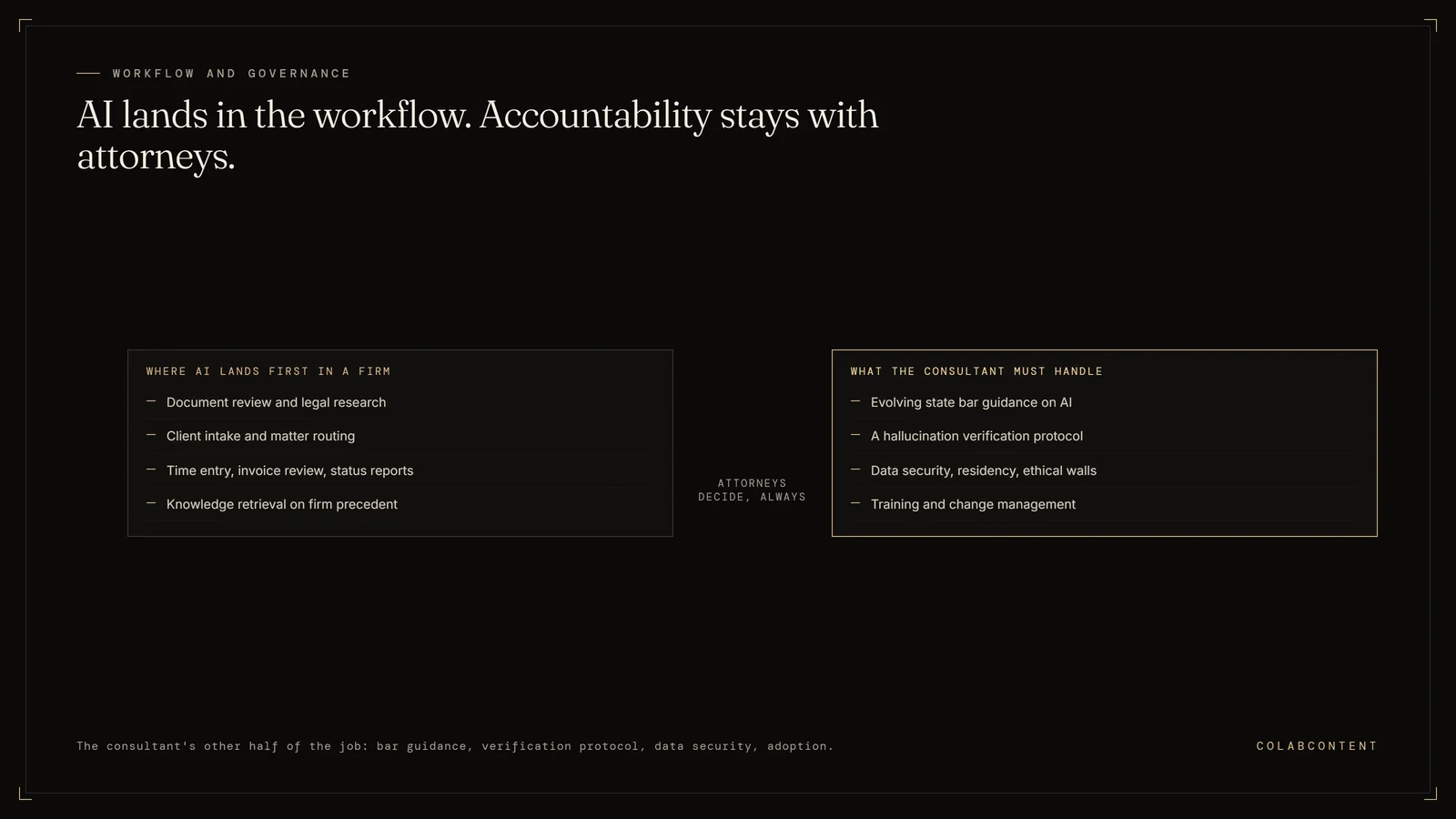
Underneath all seven sits a constraint that is specific to this buyer and that no generic automation guide will raise: the professional-responsibility rules put the duty on the lawyer, not on the tool and not on the vendor. That has a practical consequence for hiring, which is that a consultant who does not raise confidentiality, privilege and supervision before you do is quietly leaving the whole of that duty on your side of the table. The ethics section sets out what three named sources actually say, and where each one was read.
Key Terms
Matter taxonomy: the classification system a firm uses to categorize cases by practice area, client, jurisdiction, and fee arrangement. Conflict-check automation: screening new matters against existing client relationships and adverse parties using pattern matching. Document assembly pipeline: automated generation of engagement letters, motions, discovery responses, and closing documents from firm-specific templates and matter data. Data residency: the physical location where client data is stored and processed; a compliance requirement for firms handling matters subject to GDPR or state privacy laws.
What a law firm automation consultant actually does.
The phrase covers less than it sounds like it does, and the narrowing is the useful part. Seven surfaces carry nearly all of the recoverable work in a law firm. If a consultant cannot tell you which of these the engagement touches, and why that one before the others, the engagement has not been scoped.
Advice, positions, strategy and signature are deliberately not on that list. That is the work the licence is for, and returning hours to it is the point of automating the other seven. On the question of which surface to take first and in what order, the law firm automation consultant guide works through the sequencing, and the intake and conflicts guide goes deeper on the front door specifically.
Seven things to test, and why each one matters for a law firm specifically.
Generic vetting checklists exist and most of their advice is sound. What follows is the part that changes because the buyer is a law firm or a legal department, with the reasoning shown rather than asserted, and with what a good answer and a bad answer actually sound like.
One. Do they raise confidentiality and privilege before you do?
Why it matters. Every source we read for this page places the confidentiality duty on the lawyer rather than on the vendor. Florida Bar Ethics Opinion 24-1 states that lawyers must protect the confidentiality of client information when using generative AI, and specifically that they need to understand whether a program is self-learning, because a self-learning tool keeps developing its responses from what it is given. Texas Opinion 705 states that the lawyer should be reasonably satisfied that the program will not reveal confidential information to others or permit the use of such information to the disadvantage of the client. A consultant who never raises this is not being polite. They are leaving an obligation with you that you will have to discharge anyway, without having been given the facts to do it.
A good answer sounds like. Unprompted specifics before you ask: where the data physically comes to rest, which provider and model version is pinned, whether any inputs are retained, what the deletion process is and how long it takes, whether the vendor's terms exclude training on your data in writing, and how the ethical wall is enforced inside the system rather than beside it.
A bad answer sounds like. We take security seriously. Industry-standard practices. Enterprise-grade. Those phrases are compatible with any architecture at all, which is exactly why they get used.
Two. Will they put in writing what the system does not do?
Why it matters. You cannot contract the professional obligation away, so the next best thing is documentation that makes it cheap to discharge. If the finished system comes with a written description of its function, its known limitations, and the points at which a human reviews the output, then your own supervision policy, your training material and your malpractice renewal answers all have something concrete to point at. If it does not, someone at your firm will have to reverse-engineer that document later, under time pressure, from a system they did not build.
A good answer sounds like. A named deliverable in the scope: a system description, a limitations list, an escalation and review map, and a runbook (the written operating instructions), all handed over with the code.
A bad answer sounds like. Documentation that says the system is compliant. Nothing is. Compliance is a property of the firm's policies, training, supervision and actual use, which is where the opinions place it, and a vendor claiming otherwise is telling you something they are not in a position to know.
Three. Can they describe the build the way an insurer asks about it?
Why it matters. Professional liability renewal has become a place where AI use gets examined, and the questions are operational rather than technical: which tools are in use, is there a written governance policy, do attorneys get training, how is output reviewed, what happens when something goes wrong. A build that cannot be described in those terms creates friction at renewal on top of whatever operational risk it carries. This is not a reason to avoid building. It is a reason to require the vendor to hand you answers rather than a black box.
A good answer sounds like. The consultant has seen the shape of those questions before and volunteers where the build's documentation maps onto them.
A bad answer sounds like. Confusion that an insurer would ask. Our own longer treatment of this sits in the law firm AI governance guide, which goes through the control stack in detail; it is a governance read rather than a hiring read, and the two are worth doing in that order.
Four. Who owns the code, the prompts and the data model at the end?
Why it matters. This is the whole argument between commissioning and subscribing, and it is settled in the contract rather than in the demo. If what you get is a licence, a hosted platform you cannot export from, or per-seat fees that renew, then you have bought a dependency. That is sometimes exactly right; a dependency with a good vendor behind it can be better than owning something nobody at the firm can maintain. It should be a decision made in year one rather than a discovery made in year three when the renewal quote arrives.
A good answer sounds like. A clause. Code, prompts, model configuration, data model and documentation transfer to the firm at handoff, named in the agreement.
A bad answer sounds like. A verbal yes with no clause, or a yes that turns out to cover the code but not the prompts, which on a language-model build is most of the actual work.
Five. Can they name a client who will take a call?
Why it matters. An anonymized efficiency percentage in a case study cannot be checked by you, by us, or by anyone. A named client who will spend fifteen minutes on the phone can be. This is the cheapest diligence available in the whole process and almost nobody does it, because asking feels rude. Ask anyway, and ask the reference three things: what the constraint actually was, what the system does today, and whether they would commission it again.
Our own answer, so the standard applies to us. Jim Glaser Law, a Massachusetts firm running five channel-specific voice agents we built, covering paid search, organic, television, Meta and local services ads. Those agents have handled 3,787 calls across 5,514 minutes of live call time, which gives the firm per-channel attribution on every answered call rather than one undifferentiated number. The principal takes reference calls, and the introduction is a standing offer on the audit call. Across every voice system we have commissioned the total is more than 6,000 live calls handled, across 40+ commissions in total. We publish no anonymized before-and-after percentages, because you would have no way to check them.
Six. Which workflow surface are they touching, and why that one first?
Why it matters. Vague scope is the single strongest predictor of a project that does not land, and it hides behind category language. AI transformation, digital enablement, an intelligent workflow layer: none of those name a surface. The seven surfaces above are specific enough that a consultant either has an opinion about which one to take first or has not looked at your firm yet. The follow-up question is better than the first one: why that surface before the other six, in our firm specifically.
A bad answer sounds like. A proposal that arrives before any discovery, a promise of a production system in a small number of weeks, or a quote that omits what the infrastructure will cost to run afterwards. Those are documented red flags in general automation vetting guidance and they transfer to legal without modification.
Seven. Does the pitch know whether you are a firm or a department?
Why it matters. A law firm and an in-house legal department are different buyers with different arithmetic. A firm is trading partner and associate time against billable-hour economics, and it is holding several clients' confidentiality regimes at once, sometimes with walls between them. A department is trading contract cycle time against one company's risk tolerance, has a single security posture to satisfy, and is usually comparing a point tool against a build rather than comparing consultancies. Those two problems do not have the same answer, and a consultant showing both buyers the same deck has scoped neither. The in-house counsel section below is written for the second buyer.
What the professional-responsibility rules actually say.
This section states what named sources say and where each one was read. It is not legal advice, it is not a compliance opinion, and it is not a substitute for your own jurisdiction's current guidance. Professional-responsibility rules and bar opinions vary by state, several are recent, and the rules themselves are still being rewritten. The State Bar of California is the clearest current example: its Standing Committee on Professional Responsibility and Conduct approved proposed artificial-intelligence amendments to six of its Rules of Professional Conduct at its March 13, 2026 meeting, and opened a public comment period with a deadline of May 4, 2026, 11:59 p.m. That comment window has closed. We read both of those dates on August 29, 2026 from the State Bar of California's own public-comment page; we did not establish what the State Bar has since done with the proposal, so treat nothing here as a statement of its current status, and we make no prediction about the outcome. The point for a buyer is not California specifically, it is that the ground moves, so a rule you were told about last year is not necessarily the rule you are under now. Confirm your own state's position before you scope anything, and do not treat a vendor page as authority for what your bar requires.
Three sources are enough to see the shape of the duty.
ABA Formal Opinion 512, Generative Artificial Intelligence Tools
Issued July 29, 2024 by the ABA Standing Committee on Ethics and Professional Responsibility, and the first ABA formal opinion on generative AI. It wrote no new rules. It read the existing Model Rules of Professional Conduct onto the technology, which is why it functions as a design brief rather than a prohibition. According to Wendy J. Muchman's summary of the opinion in The Bar Examiner (Fall 2024, Volume 93 Number 3, published by the National Conference of Bar Examiners), the opinion works through Rule 1.1 on competence, under which lawyers must have a reasonable understanding of the capabilities and limitations of the tools they use; Rule 1.4 on communication with clients; Rule 1.5 on reasonable fees, where a fee charged for which little or no work was performed is an unreasonable fee; Rule 1.6 on confidentiality, where a client's informed consent is required prior to inputting information relating to the representation into a self-learning tool; and Rule 5.1 on supervisory responsibilities, under which supervisory lawyers must make reasonable efforts to ensure that the firm's lawyers and nonlawyers comply with their professional obligations when using these tools. Rules 1.9(c) and 1.18(b) are also engaged, covering former and prospective clients.
How we checked this, stated plainly. The ABA's own PDF of Opinion 512 and the ABA's own explainer article both refused our request on August 29, 2026, returning an HTTP 403 rather than the document. A refused request is a failure to read, not evidence about the contents, so nothing above is presented as a direct quotation of the opinion. The account here follows the Muchman summary in The Bar Examiner, which quotes the opinion, and the ABA's own announcement of the opinion's issuance. If you are writing firm policy, obtain the opinion itself rather than relying on any summary, this one included.
Texas Opinion 705
Issued February 2025 by the Professional Ethics Committee for the State Bar of Texas, and read on August 29, 2026 from the Texas Center for Legal Ethics, which publishes the committee's opinions. It cites Texas Disciplinary Rules 1.01 on competence, 1.05 on confidentiality, 3.01, 3.03 on candor toward the tribunal, 3.04, and 5.03 on nonlawyer assistants. Its language on competence is direct: if a lawyer opts to use a generative AI tool in the practice of law, the lawyer must have a reasonable and current understanding of the technology. On confidentiality it states that the lawyer should be reasonably satisfied that the program will not reveal confidential information to others or permit the use of such information to the disadvantage of the client. On output it states that lawyers cannot blindly rely upon or use answers given by generative AI tools. On billing it restates a principle that predates any of this: a lawyer who has undertaken to bill on an hourly basis is never justified in charging a client for hours not actually expended.
Florida Bar Ethics Opinion 24-1
Dated January 19, 2024 and read on August 29, 2026 from The Florida Bar's own site. Its opening sentence is the clearest single summary of the whole area we found anywhere: lawyers may use generative artificial intelligence in the practice of law but must protect the confidentiality of client information, provide accurate and competent services, avoid improper billing practices, and comply with applicable restrictions on lawyer advertising. It draws particular attention to self-learning programs, on the ground that client information given to such a tool may be stored and surfaced later in response to somebody else's query, and it recommends obtaining client informed consent before confidential information goes into a third-party program. It treats the lawyer as remaining responsible for the work product and the professional judgment throughout, and requires verification of generated research rather than reliance on it.
What this means for hiring, which is the only reason it is on this page
Three consequences, none of them technical.
The duty does not transfer. Nothing you buy, and nobody you hire, moves the professional obligation off the lawyer. Any consultant, ours included, who suggests that a commissioned build makes a firm compliant is describing something that does not exist. What a build can do is make the obligation cheaper to discharge, by documenting what the system does, putting review where judgment attaches, and logging who approved what.
Confidentiality is an architecture question, not a promise. Because the opinions turn on where information goes and what happens to it there, the answers live in the design: where data comes to rest, whether inputs are retained or used for training, whether the tool inherits the ethical wall from your own permission model, and whether the provider and model version are pinned rather than floating. Those are questions to ask during selection, not after.
Jurisdiction decides. Texas and Florida are two states and the ABA opinion is not binding anywhere on its own. Many other state bars have issued their own guidance and the pace has not slowed. We have not independently read every one of them and we are not going to publish a count we did not verify. Read your own.
The law firm AI governance guide goes further into what a written supervision policy and a malpractice renewal questionnaire actually ask for.
Seven options, and where each genuinely wins.
Listed in order of how a firm usually encounters them rather than in order of preference, and we are the fifth of the seven rather than the first. For each: the case where it is genuinely the right call, what it costs where a cost could be sourced, and the real constraint that the people selling it will not lead with.
The seven options in one table, with the labels attached.
Same seven, same order, with the cost shape made explicit because that is the comparison firms get wrong. VERIFIED here means the figure was read directly off the seller's own published page. REPORTED means it comes from aggregated or third-party material, however good that material is. Where nothing could be sourced, the cell says so rather than guessing.
| Option | Cost shape | Figure, and how strong the source is | Where it genuinely wins |
|---|---|---|---|
| In-house legal operations hire | Annual salary, compounds | REPORTED $124,063 average for a manager, $177,863 average for a director, per salary aggregators. Fully-loaded multiplier of 1.3 to 1.5 times is an explicitly labelled assumption | Many workflows over many years, with time to ramp |
| Big Four or large consultancy | Programme fee, quoted | No figure. We could not source a dated legal-AI fee range from any Big Four firm's own materials, and we will not reuse an unrelated industry's number | Enterprise operating-model change with heavy stakeholder counts |
| Alternative legal service provider | Hourly, ongoing | VERIFIED $152 per hour average engagement rate for Commercial and Contract Law, read off Axiom's own pricing benchmark page, August 29, 2026 | Flexible licensed capacity, not an owned system |
| Legal tech vendor professional services | Project fee on top of licence | REPORTED implementation consulting commonly $50,000 to $500,000 by complexity, from vendor and industry material rather than a named signed scope | Platform already chosen, work is configuration and migration |
| Boutique commissioning house (us) | Fixed fee, once | from $10,000 one time, our own published range, prototype before payment, code owned at handoff | One named cross-system constraint, and a wish to own the result |
| Contract and staffing attorneys | Hourly, consumed | REPORTED $30 to $125 an hour for independent contract attorneys, higher by experience band, per staffing aggregators | Temporary or unproven volume, before automation is justified |
| Doing nothing | No new spend | Whatever the manual handling costs today, which is the number to measure first | Low volume, no growth attached, or a process problem wearing a technology costume |
Two things fall out of that table. The first is that five of the seven rows are recurring costs and only one is a one-time fee, which is the arithmetic that decides most of these engagements once somebody actually runs it over five years rather than one. The second is that our own row is not automatically the winner of that arithmetic, because a one-time fee for the wrong system is worse than an annual fee for the right one. The comparison worth making is not cheapest; it is which shape survives contact with what your firm is actually going to do for the next five years.
What an engagement costs, and how it is structured.
This section lays out our own published fee against a written scope, what a typical engagement looks like week by week from kickoff to handoff, and how a fixed fee compares against paying a salary or an hourly rate for the same work.
Our fee, published rather than quoted on request.
Fixed fee against a written scope, in a band from $10,000, paid once. Where an engagement lands inside that band is decided by how many systems the workflow crosses and how deep the integration has to go, and it is settled in the scope document before any money moves rather than discovered later. There is no per-seat component, no proprietary runtime to license, and no renewal date.
The reason to prefer a fixed fee over an hourly rate has nothing to do with the total. An hourly engagement pays the consultant more for taking longer, which puts the cost of a bad estimate on you. A fixed fee puts it on whoever wrote the estimate. That is the only structural difference that matters, and it is worth asking about whichever of the seven options you end up choosing. The scope-by-scope breakdown sits on what AI consulting costs a law firm and on the pricing page.
What the engagement looks like, week by week.
Week zero. The 20-minute audit call. Both sides leave with the constraint written down in one sentence. Either party can stop here, and the audit fee is refunded in full if you did not get value; a meaningful number of these calls end with us naming a different one of the seven options.
Week one. Confidentiality agreement signed, a representative data slice provided under it, and the prototype starts on the firm's real matters rather than on synthetic examples. This is also the point at which the data questions get answered concretely instead of in principle.
Days seven to ten. A working prototype. The firm watches the system perform the constraint task on its own data before any payment changes hands. If it does not perform to the target written down after the audit, the firm owes nothing and keeps the work product.
Weeks two through six. The production build. The principal stays hands-on. No account managers, no junior staff running the build, no hand-off to a different team once the contract is signed.
Handoff. Code, prompts, model configuration, data model, runbook and integration documentation transfer to the firm. The system description and limitations list travel with them, because that is what your own supervision policy and renewal answers will point at later. Optional care after handoff is $997 a month and cancels on 30 days notice. The five phases are set out in full on the commission process page.
How to compare a fixed fee against a salary and an hourly rate.
Put all three on the same five-year horizon before comparing anything, because that is the horizon on which the shapes actually differ. A salary recurs and rises. An hourly rate recurs and is consumed. A one-time fee does neither, but it also does not include anyone to evolve the system when your matter taxonomy changes in year three, which is a real cost you should budget rather than pretend away.
The comparison that flatters us is the five-year one, so treat our enthusiasm for it accordingly. The comparison that does not flatter us is the first-year one, where an hourly arrangement or a packaged tool will very often be cheaper and faster to value, and where a firm that is not sure the workflow is durable should probably take that cheaper path first. Both comparisons are legitimate. Which one applies depends on how confident you are that the workflow you are automating will still look like this in three years.
What goes wrong, and how to tell early.
The most useful evidence on this is not from a vendor. Artificial Lawyer reported on May 23, 2022 that a ContractWorks survey of 350 in-house lawyers and paralegals across the United States and the United Kingdom found that 77 percent had experienced a failed technology implementation. The stated reasons are the part worth reading twice: 38 percent said implementation took too long and 36 percent said the technology was too complicated. The consequences reported in the same survey were organizational rather than technical: 43 percent had lived through more than one failed rollout in their department, 29 percent said it made them doubt whether their employer knew what was best for the business, and 23 percent said it contributed to someone leaving their job. Those figures are REPORTED, from Artificial Lawyer's account of the ContractWorks survey. We did not run the survey and have not read the underlying report.
Read together with the failure reasons, the organizational consequences make the point that a failed rollout is not a neutral experiment. It spends internal credibility you will need for the next attempt, and in a partnership that credibility is harder to replace than the money.
Six early warning signs, five of them documented in general automation vetting guidance and one specific to this buyer.
- A proposal arrives before any discovery. If a solution is described before anyone has looked at how a matter moves through your firm, the solution is the one they already had.
- Production readiness is promised in a very short number of weeks. A prototype in days is reasonable and we do it. A production system that touches client data and survives a partner's first bad week is not the same thing.
- The quote omits what it costs to run. Infrastructure, model usage and monitoring are real recurring costs. A build quote that mentions none of them has moved a cost rather than removed it.
- They cannot name a project that failed. Everyone who has shipped enough has one. An inability to name it means either inexperience or a rehearsed answer, and neither is what you want at week six.
- Pricing is it depends, with no ballpark even after a discovery call. Scope genuinely varies. After discovery, the range should exist. If it still does not, the pricing is being set against your letterhead rather than against the work.
- Nobody asked about privilege, conflicts or supervision. This is the legal-specific one, and it is our own operating view rather than a third-party finding. A general automation shop can build you an excellent system without ever raising any of it, because none of it is in their frame. The absence is not proof of a bad build. It is proof that the entire professional-responsibility side of the project is going to be yours to carry alone, and you should price that in before signing rather than discover it at renewal.
The seventh warning sign shows up after go-live rather than before it: nobody can say who sees the failure alerts. A system that silently stops working is worse than no system, because the firm has already reorganized around it. Ask during selection who is on the escalation path and what the fallback is when the automation is unavailable.
For in-house counsel: contract drafting and review.
Everything above assumes a law firm. A corporate legal department is a genuinely different buyer and gets a different answer, so this section is written for the general counsel, deputy GC or legal operations lead rather than for the managing partner.
Three structural differences drive the divergence. A department is optimizing one company's contract risk and cycle time rather than partner and associate hours against billable economics. It has a single security posture to satisfy, its own company's, rather than several clients' confidentiality regimes at once. And its realistic shortlist is usually a point tool against a custom build, not one consultancy against another. That last difference is the one that changes the shopping.
Buy the tool first, in most departments
The AI contract drafting and review category is mature and priced per seat. GC AI publishes $500 per seat per month with a 14-day free trial and no stated seat minimum on its individual plan, read directly off its own pricing page on August 29, 2026, which makes it one of the few tools in this space that publishes a number at all. That is VERIFIED off the vendor's own page. If your first-pass review is a recognizable commercial contract type measured against a recognizable playbook, a product is calibrated for exactly that, and a custom build will lose to it on cost and on time to value. Buy the tool, run it for a quarter, and find out what it does not cover.
Commission what the tool cannot represent
What a point tool does not cover is rarely the review itself. It is the sequence around the review. Pulling the counterparty's prior positions out of your own repository so the redline starts from what you actually agreed last time. Routing by risk tier into the business owner's system rather than into a legal inbox that becomes the bottleneck. Writing the outcome back into whatever the company runs, so that procurement, finance and the CRM (customer relationship management software) all see the same version of the truth without anybody rekeying it. Those cross-system sequences are the same shape of problem a law firm has, which is why the build economics are similar even though the buyer is not.
The vendor-contract term to insist on
One selection criterion matters more for a department than any feature comparison: get the data-training exclusion in writing. Your contracts are the company's most sensitive commercial corpus, and whether a vendor may use them to improve its models is a contract term, not a policy page. It is checkable, it is negotiable, and it is exactly the kind of clause your own team negotiates for a living. Ask for it in the agreement rather than accepting a link to a trust centre.
Where to get the governance framing
The Association of Corporate Counsel runs an AI resource programme for in-house lawyers and publishes an artificial intelligence toolkit covering AI governance strategy, integrating AI into a legal department, meeting ethical obligations, intellectual property protection and AI issues in vendor contracts. We are pointing at it rather than summarizing it, because we have not read the toolkit itself and are not going to characterize its contents from a listing. If you are building a department AI policy, that is a better starting point than any consultant's page, ours included.
One caution on the ethics side that applies with full force here: the opinions covered above are written for lawyers, and in-house counsel are lawyers. The confidentiality analysis is different in shape, because the client is the company, but the competence, verification and supervision duties do not soften because the work is commercial rather than contentious.
The vetting checklist above applies to a point-tool vendor and a commissioned build alike.
Who should not hire us.
A page like this is worth nothing if it only describes the situations where we win. Here is the list we actually use on audit calls to decide not to take an engagement, and it disqualifies more callers than it qualifies.
If more than one of the six above sounds like your firm, the build, buy or commission framework works through the general version of this decision before you talk to anyone.
The specific next step.
Whichever of the seven you end up choosing, the same piece of work has to happen first, and it does not require hiring anybody: measure the manual cost of one named workflow before you talk to a single provider. Pick the surface that annoys the most people, take a baseline from a number the firm already tracks, and write it down. Recorded hours per attorney per month. Days from matter open to engagement letter signed. Write-offs on a defined matter type. Pre-bill cycles before an invoice goes out. Without that number, every proposal you receive will be argued in adjectives, and you will have no way to tell in a year whether the money worked.
If you want that done with you rather than alone, our version is the $499 AI-Ready Audit and the 20-minute call that follows it. No slides. We walk one matter from first contact through final bill, name the step costing the most recoverable hours, and tell you which of the seven options fits it. A good proportion of those calls end with us naming an option that is not us, which is the only reason the call is worth taking from a firm that is also selling something. If you would rather run the exercise yourself first, the law firm offering page and the law firm diagnostic cover the short version.
Or skip the form. Our own line is answered around the clock by an intake agent we built, and it will take the situation and route it to a principal. Calling (617) 675-9067 is also the fastest honest test of whether a system like this sounds like something you would put in front of a client.
Start with the $499 audit.
We walk one workflow end to end, name the step costing the most recoverable hours, and say which of the seven options should own it. If it is not us, we say which one and why.
Frequently asked questions.
Short answers first, detail underneath. Every answer here matches the FAQ schema on this page word for word, and each one is the answer we give on the audit call. Where a question depends on your own numbers, the $499 AI-Ready Audit report replaces the general answer with your figures.
What does an automation consultant do for a law firm?
They take the repeatable work that sits between your systems and build something that absorbs it, then hand it over. The workflow surface is narrower than the phrase suggests: new-matter intake, conflicts pre-screening, document assembly and first-draft generation, matter management and status, billing and pre-bill review, client communication, and records retention and retrieval. Advice, positions, strategy and signature are not on that list and should not be. A consultant who cannot name which of those seven surfaces the engagement touches, and why that one first, has not scoped anything yet.
How much does it cost to hire an automation consultant for a law firm?
It depends entirely on which of the seven kinds of provider you hire, and the spread is wide. A legal operations manager on your own payroll draws a reported average of $124,063 a year and a director $177,863 a year, per salary aggregators. Axiom publishes a $152 per hour average engagement rate for Commercial and Contract Law work on its own site. Legal technology vendor implementation services are reported at $50,000 to $500,000 depending on complexity. Independent contract attorneys are reported at $30 to $125 an hour. Our own commissioned builds are a fixed from $10,000 paid once, with the code owned by the firm at handoff. Compare the shapes before you compare the numbers, because an annual salary, an hourly rate and a one-time fee are not the same kind of thing.
What do the ethics rules say about a law firm using AI and automation?
They put the duty on the lawyer, not on the tool or the vendor. ABA Formal Opinion 512, issued July 29, 2024 by the ABA Standing Committee on Ethics and Professional Responsibility, did not write new rules; it read the existing Model Rules onto generative AI, covering competence, confidentiality, communication with clients, reasonable fees, supervision of nonlawyer assistance, and candor toward tribunals. Texas Opinion 705, issued February 2025, states that a lawyer who uses a generative AI tool must have a reasonable and current understanding of the technology and that lawyers cannot blindly rely upon or use answers given by generative AI tools. Florida Bar Ethics Opinion 24-1, dated January 19, 2024, opens by saying lawyers may use generative AI in the practice of law but must protect the confidentiality of client information, provide accurate and competent services, avoid improper billing practices, and comply with applicable restrictions on lawyer advertising. This page is not legal advice and these rules vary by jurisdiction. Confirm your own state's current guidance before you scope anything.
Who is responsible if an automated system produces a mistake in a legal document?
The lawyer. That is the consistent thread through every opinion we read for this page. Texas Opinion 705 states that lawyers cannot blindly rely upon or use answers given by generative AI tools. Florida Opinion 24-1 states that lawyers remain responsible for their own work product and professional judgment and must verify the accuracy of AI-generated research. You cannot buy that responsibility away from yourself, and no vendor contract moves it. What a good build can do is make the responsibility cheaper to discharge: a written description of what the system does and does not do, human review points at the places where judgment attaches, and a log that shows who approved what. Any consultant telling you a system makes the firm compliant is describing something that does not exist.
Should in-house counsel hire a consultant for contract review automation, or buy a tool?
Buy the tool first, in most legal departments, and commission only what the tool cannot represent. Point tools for contract drafting and review are mature and priced per seat: GC AI publishes $500 per seat per month with a 14-day free trial on its own pricing page. If your first-pass review is a recognizable commercial contract type against a recognizable playbook, that is what a product is calibrated for and a custom build will lose on cost and on time to value. Commission when the work is not the review itself but the surrounding sequence: pulling the counterparty's prior positions out of your own repository, routing by risk tier into the business owner's system rather than into a legal inbox, and writing the outcome back into whatever the company actually runs. One selection criterion matters more than any feature: get the data-training exclusion in writing, and confirm the vendor never trains models on your contract data.
Do we need a legal-specific automation consultant, or will a general automation shop do?
It depends which half of the problem is harder, but there is one asymmetry worth knowing. A general automation shop has no professional obligation to know what Model Rule 5.3 says about supervising nonlawyer assistance, no reason to have read your state bar's AI opinion, and no instinct to ask about conflicts or privilege before touching a file. That is not a character flaw; it is a scope difference. If the hard part of your project is wiring output back into iManage, NetDocuments, Clio or Aderant without breaking anything, an integration-heavy general shop is genuinely the right kind of firm, and you supply the legal judgment yourself in writing. If the hard part is deciding what may be automated at all, hire someone who already thinks in those terms.
Why do legal automation and legal technology projects fail?
Because they take too long and get too complicated, in that order, according to the people who lived through them. Artificial Lawyer reported on May 23, 2022 that a ContractWorks survey of 350 in-house lawyers and paralegals across the US and UK found 77 percent had experienced a failed technology implementation, with 38 percent naming implementation taking too long and 36 percent naming the technology being too complicated. In the same survey 43 percent had lived through more than one failed rollout in their department, 29 percent said it made them doubt whether their employer knew what was best for the business, and 23 percent said it contributed to someone leaving their job. Those figures are reported by Artificial Lawyer from the ContractWorks survey rather than measured by us. The practical read is that scope discipline beats ambition, and that a failed rollout costs you internal credibility you will need for the next one.
What should we ask an automation consultant before signing?
Seven questions, and the order matters. Did they raise confidentiality, privilege and where data comes to rest before you did. Can they put in writing what the system does, what it does not do, and where a human reviews it. Can they describe the system in the language a malpractice renewal questionnaire actually asks for. Who owns the code, the prompts and the data model at the end, in writing. Can they name a client who will take a fifteen-minute call, rather than an anonymized percentage. Which of the seven workflow surfaces are they touching, and why that one first. And does their pitch reflect whether you are a law firm or an in-house department, because those two buyers optimize for different things and the same deck cannot serve both.
What happens if the system does not work, and what do we own at handoff?
The prototype is built on the firm's real data during days seven to ten, before any payment changes hands, and the firm watches it perform the constraint task live. If it does not perform to the target written down after the audit call, the firm owes nothing and keeps the work product produced so far. If the engagement proceeds to the full build, code, prompts, model configuration, data model, runbook and integration documentation all transfer to the firm at handoff, with no per-seat fee and nothing left with us. What is expected of the firm in return is narrow: sign the confidentiality agreement, provide a representative slice of real data under it, and name one decision-maker who can approve the scope without a committee.
The parts of this decision that do not fit in a comparison table.
Three factors a feature table cannot capture: how a partnership's own compensation formula decides who benefits when a workflow is automated, why data readiness is a precondition every option on this list shares, and what we deliberately will not build, stated plainly rather than glossed over.
Why the compensation model decides more of this than the technology does.
In a partnership, the person whose hours an automation removes and the person who benefits from removing them are frequently not the same person, and sometimes they are on different sides of a compensation formula. That is not a technology problem and no build fixes it. It shows up as a pilot that works, gets praised, and then quietly stops being used in the practice group that was supposed to adopt it.
The practical countermeasure is unglamorous: pilot inside one practice group, with one partner who has agreed in advance to use it, on a workflow where the hours returned go somewhere that partner wants them to go. Firms that skip this step and roll out firm-wide from day one tend to produce the outcome the ContractWorks survey describes, where the technology was not wrong but the implementation took too long and the enthusiasm ran out first.
If the obstacle turns out to be partnership economics rather than engineering, that is a real finding and it should change who you hire. A management consultancy for the legal sector is a better fit for that problem than any build shop, ours included.
Data readiness is the hidden precondition under every option on this list.
Six of the seven options assume something that is often not true: that the firm's own records are consistent enough to build on. If matters are typed differently by different secretaries, if the document profile fields drifted three system migrations ago, if the client and matter numbering has exceptions that live in one person's head, then anything built on top inherits all of it and produces plausible, useless output.
This is why an honest scoping conversation spends time on the archive rather than on the feature list, and why a proposal that never mentions data quality should be read carefully. It is also the strongest argument for the cheapest options on the list: if the records need work first, the correct sequence is often to fix them with staffing or an internal hire, then automate, rather than to buy a system that encodes the mess.
The related reads on this site are data readiness for the mid-market and the build, buy or commission decision, which sets out the general version of the choice this page makes for law firms specifically.
What we will not build, and why publishing that is the point.
We do not build anything that clears a conflict without a human, anything that sends substantive client communication without a human reading it, or anything that produces a filing or a signed document without a named attorney reviewing the authorities against the primary source first. Those are not technical limits. They are the places where the licence and the liability sit, and putting a machine in them moves risk onto the firm in exchange for a saving that is small compared with the exposure.
The reason to publish the boundary rather than discuss it privately is that it selects for the right callers. A firm that reads that list and thinks it is too conservative will not enjoy working with us, and it is much cheaper for both parties to discover that here than in week four. The general version of this list lives on what we do not build.
How to read a page like this one, including this one.
Almost every guide answering this question is published by somebody who sells one of the seven options, and the tell is usually structural rather than tonal. Look for whether the alternatives get a real case rather than a strawman, whether any number on the page can be checked against its source, whether the author names a client who will take a call, and whether there is any circumstance described in which the reader should not buy from them.
Apply that to this page. We are the fifth of seven and we say where the other six beat us. Every third-party figure carries its source and a label saying how strong that source is, including one row that has no number because we could not source one honestly. The named reference is Jim Glaser Law and the principal takes calls. And the counterweight section above names six kinds of buyer we turn away. That is the standard we would want applied to anyone else's page, so it is the standard applied here.
Where we are still selling: we prefer the five-year comparison because it flatters a one-time fee, and we think ownership matters more than most buyers do when they start looking. Both of those are positions, not findings. Read them as such.
If you want the same test applied to twelve named consultancies rather than seven categories, the best AI consultants for law firms page runs it with names attached.
Related reading.
The two neighbouring pages first, because they answer different questions and one of them is probably the one you actually wanted. Best AI consultants for law firms ranks twelve named consultancies with a pricing column showing which three of the twelve publish a fee, which is the page to read if you already know you want an outside firm and want a shortlist of names. Best AI for law firms compares twelve products, from Harvey to Spellbook, and is the page to read if you are buying software rather than hiring anybody.
On the work itself: the law firm automation consultant guide works through what to automate in what order, which this page deliberately does not; intake and conflicts automation goes deeper on the front door; and succession and knowledge capture covers the archive.
On the professional-responsibility side, the law firm AI governance guide is the long version of this page's ethics section, written as a governance read rather than a hiring read, and it covers what malpractice carriers have started asking at renewal.
On money and vetting: what AI consulting costs a law firm breaks our own bands down by scope, how to choose an AI consultant for a law firm is the long-form vetting checklist, and hiring an AI developer versus commissioning the build runs the first option on this page against the fifth in detail.
If a specific product is already on the table, Harvey alternatives for mid-market law firms covers what changes when per-seat pricing meets a fifty-lawyer headcount, and Spellbook against a custom build covers transactional practices. If the system under review is the document stack rather than the AI layer, iManage alternatives and NetDocuments alternatives price those decisions from both sides.
Other vertical guides.
This page links to the equivalent buyer guide for other verticals: the general AI for law firms hub, plus the best AI consultants roundups for mid-market CPA firms, regional insurance agencies, specialty manufacturers, and PE-backed (owned by a private equity firm) home services platforms.