What each alternative covers and where it falls short.
If you are on NetDocuments and the reason you are reading this is money, the first thing to know is that the per user rate on your invoice is not the number that is hurting you. The reported base subscription of $50 to $65 a seat is broadly in line with every enterprise peer in the category. What moves the total is the stack on top of it: ndMail, ndOffice and OCR are reported to add $25 to $60 a seat before you have changed anything about how your firm works, and implementation and migration are separate engagements priced in five and six figures. A page that tells you a cheaper document management system will fix this is not being straight with you, because at 45 seats the cheapest credible legal document system with a published price, LexWorkplace Core, is $29,940 a year, which is more than a NetDocuments base licence at the low end of its reported range.
So the honest verdict splits three ways. Firms under roughly 20 attorneys should look hard at LexWorkplace and SuiteFiles, both of which publish real prices you can check in ten seconds, or at consolidating onto a practice management platform that includes a document layer. Firms in the 20 to 75 attorney band with a working document system and a named workflow that leaks partner hours are the ones for whom the arithmetic on this page actually flips, because at that size the subscription curve overtakes a mid range one time build inside three years while the per seat model keeps taxing every new hire. And firms that genuinely live inside NetDocuments, with ethical walls that took a year to configure, deep practice management integrations, and a decade of workspace structure nobody wants to touch, should stay. There is a whole section below arguing that case as strongly as we know how, and it includes the single strongest counter argument to everything else on this page: at 100 seats and above, NetDocuments is reported to sell at $15 to $20 a user per month, which is a price no build we quote can beat.
The full structure behind that split is on our own pricing page, the same fixed-fee model referenced throughout this page.
What NetDocuments actually does well.
A comparison page that treats the incumbent as a punching bag is useless to the person actually holding the contract, so it is worth being precise about what you would be giving up.
Matter-centricity as a first class concept. This is the thing that separates a legal document management system from a file store, and it is the reason most of the tools on generic alternatives lists are unusable for a law firm. Documents live under matters, matters carry the client and matter numbers your billing system already knows, and the structure is enforced rather than suggested. Box, Alfresco, DocuWare and Square 9 do not do this, and no amount of folder discipline substitutes for it.
Permissions and ethical walls enforced at the platform. Access control is enforced by the document platform itself rather than by whichever application is asking, which is why a wall configured once holds regardless of what queries it. Any AI layer built on top queries with the requesting user's actual permissions rather than a service account. Firms with real conflict exposure do not experiment casually here, and they are right not to.
Email filing that survives. Filing an email into a matter with its metadata intact, its attachments linked and its thread reconstructable years later is unglamorous, and it is exactly where cheaper substitutes quietly fail. Native SharePoint does not do this, which is why the SharePoint route needs a paid layer on top before it is a real option for a law firm.
A cloud posture the category eventually copied. NetDocuments was cloud native before the rest of the category moved, which is why its architecture does not carry a decade of on premise compromise. If your firm's objection to the cloud has already been settled, this is a mature platform and it shows.
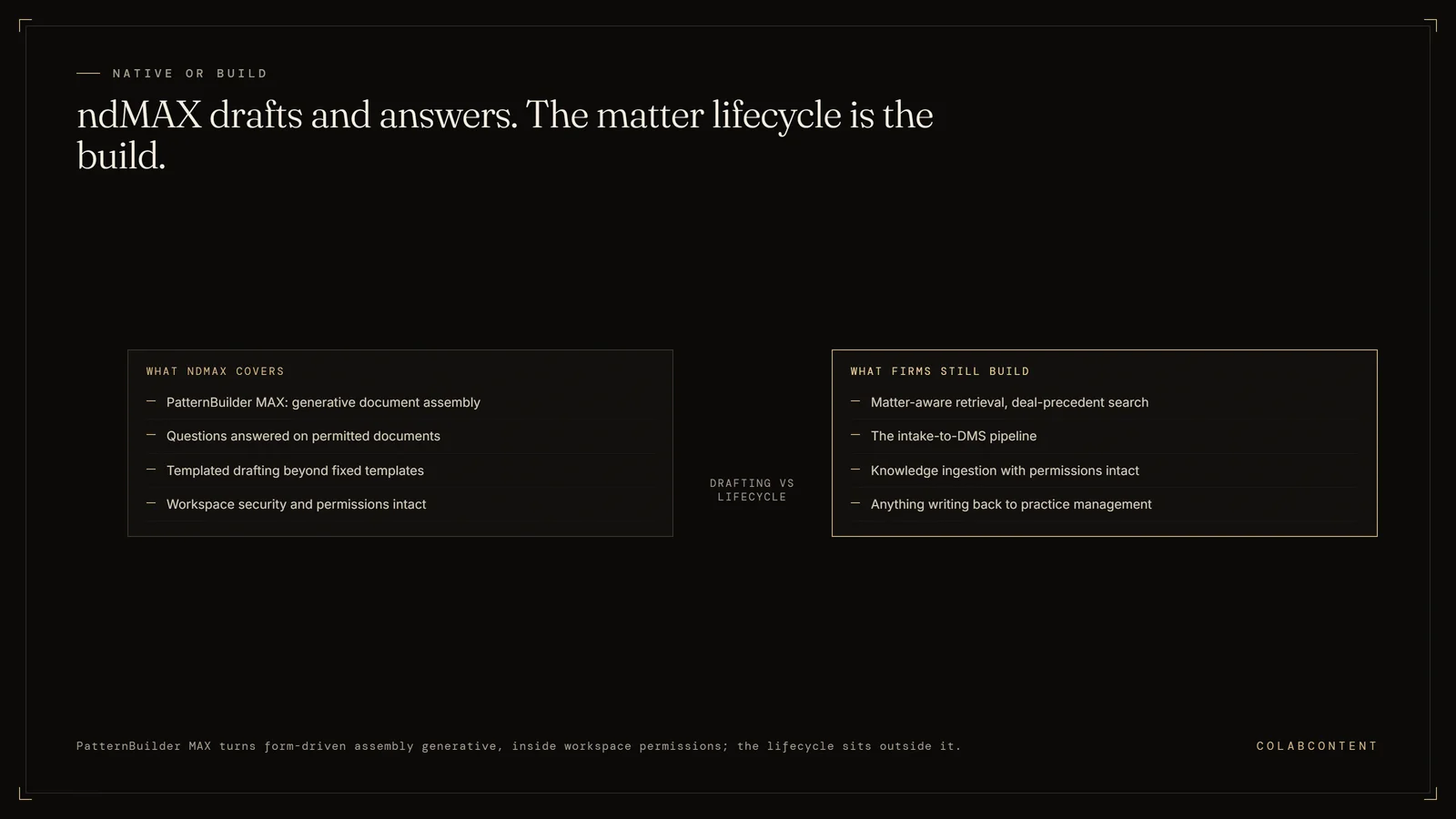
ndMAX and PatternBuilder MAX, within their lane. The generative layer does document assembly and answers questions against documents the asking user already has permission to open. It is genuinely useful. It does not know your billing rules, your trust accounting or your intake path, and NetDocuments does not claim it does. Our NetDocuments AI workflow playbook maps that boundary in detail from a build perspective.
For what a decade of committed use looks like on the ownership side of the ledger, see our Jim Glaser Law case study.
Why firms start looking for a way out.
Five patterns. The first four are reported across our sources rather than measured by us, and we say so because there is no survey behind them.
The bill is not the rate card, because there is no rate card. netdocuments.com/pricing returned HTTP 404 on August 26, 2026. That is not an oversight in a category this mature; it is a pricing strategy, and it means every number quoted to you is quoted against you rather than against a published rate. Firms discover the shape of their own deal only by comparing notes with other firms, which is a bad way to buy anything.
The add-on stack. The reported $50 to $65 base is not the product most firms run. ndMail at a reported $5 to $15 a seat, ndOffice at $10 to $20, OCR at $10 to $25. Turn on the modules a firm assumes are included and the reported all in figure is $80 to $120 or more per user per month. That is the single number most competing comparison pages omit entirely, and it is the number your budget actually feels.
The renewal came in higher than the budget. The per seat model means every hire raises the bill, so the firm that added six associates last year finds the number moved without anyone deciding it should. With no published rate to argue against, the renewal conversation starts from whatever the account team opens with.
Mac. This appears repeatedly across the legal technology writeups we read as an actual switching trigger, with Mac users described as needing Parallels or a Windows virtual machine for full desktop functionality. We are labelling that reported, not verified, because it comes from competitor marketing and consultancy blogs rather than from a vendor statement we could read. If it matters to your firm, test it on a real MacBook rather than trusting anyone's comparison page, ours included.
The thing the firm needs is not a document problem. Matter lifecycle, intake routing, billable hour reconstruction, trust reconciliation. None of these are search problems. A document assistant does not solve any of them, and no amount of licence spend will change that. This is the reason we hear most often on audit calls and the one that never shows up in a switching survey, because it is not a complaint about the software.