Considering Filevine? Five alternatives, and the three things its own pages do not tell you.
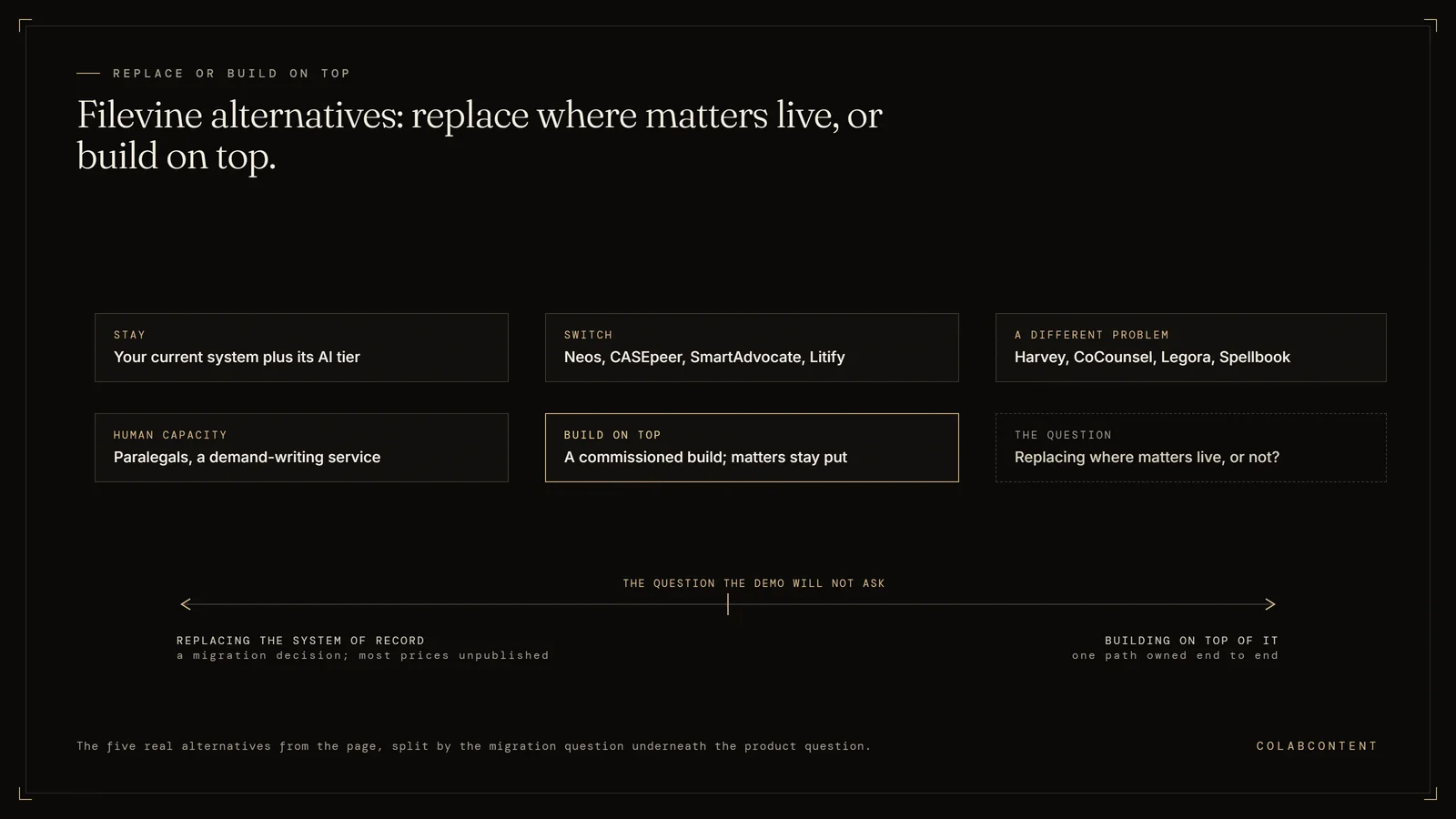
The real alternatives to Filevine are the case management system you already run plus whatever AI tier it sells, a like-for-like plaintiff platform such as Neos, CASEpeer, SmartAdvocate or Litify, the research and drafting layer such as Harvey, CoCounsel, Legora or Spellbook that solves a different problem entirely and gets confused for this one, more human capacity in the form of paralegals or a demand-writing service, and a commissioned build that owns one path end to end while leaving your system of record where it is. The choice turns on a question the demo will not ask you: are you replacing where your matters live, or are you buying something that works on top of where they already live. Filevine sells the first, and since LOIS Console shipped in June 2026 it increasingly sells an agent that acts inside it. Those are two different purchases with very different costs to reverse. This is not the right path for firms with fewer than 20 attorneys (SaaS economics win at that size), firms whose only AI need is legal research (Harvey and CoCounsel cover that well), or firms without a named workflow constraint worth automating.
Written for plaintiff, personal injury and mass tort firms, and for managing partners and firm administrators at $8M to $50M practices who have either sat through a Filevine demo or been told to go find one. Every claim about Filevine on this page was read off Filevine's own live pages and its own help centre on August 8, 2026. Where Filevine publishes nothing, this page says so rather than filling the gap with somebody else's estimate.
What Filevine actually is now.
Filevine spent a decade selling case management software to plaintiff firms. The headline on its homepage today reads "Legal AI that runs the firm," and that is not marketing drift. It is an accurate description of a repositioning that finished in June.
On June 2, 2026, Filevine launched LOIS Console, which it describes as AI that "empowers entire firms to run AI agents across every matter," writing "results back into the firm's system of record" and executing "actions on the firm's behalf." Filevine's own launch material lists what those actions include: setting tasks, moving deadlines, updating calendars, generating documents, refreshing contact records, and running reports. LOIS stands for Legal Operating Intelligence System, and the name is doing real work. Filevine is no longer positioning itself as the place your matters sit. It is positioning itself as the thing that operates them.
Around that sit a set of named AI features that predate the console and have now been folded under the LOIS brand: AIFields for extracting and summarising key details out of documents, DemandsAI for drafting demand letters, Depo CoPilot for analysing testimony, MedChron for medical record chronologies, ImmigrationAI for USCIS forms, ValidationAI for case validation, AI Doc Review, AI Data Mapping, and a "Chat with Your Case" assistant. LOIS for Word extends drafting and contract redlining into Word itself.
The consolidation is visible in the URLs. Both filevine.com/demands-ai/ and filevine.com/demands-ai/features/ now return a 301 redirect to filevine.com/platform/lois-for-word/. DemandsAI still exists as a product and still has help centre documentation, but its dedicated marketing pages have been retired into the LOIS story. If you are comparing notes against a proposal or a blog post written earlier this year, check the URL still resolves before you quote it back to a salesperson.
None of this is a criticism. Filevine has built something genuinely ambitious, and an agent that can act across a whole caseload is a different category from an assistant that drafts one document at a time. But it changes what you are evaluating, and most of the comparison content on the internet has not caught up.
Key Terms
Matter taxonomy: the classification system a firm uses to categorize cases by practice area, client, jurisdiction, and fee arrangement. Conflict-check automation: screening new matters against existing client relationships and adverse parties using pattern matching. Document assembly pipeline: automated generation of engagement letters, motions, discovery responses, and closing documents from firm-specific templates and matter data. Data residency: the physical location where client data is stored and processed; a compliance requirement for firms handling matters subject to GDPR or state privacy laws.
Three things its own published material does not say.
This is not a hunt for dirt. These are three specific questions a buyer needs answered before signing, where Filevine's own site does not currently answer them. All three were checked directly on August 8, 2026.
1. There is no published price. Not a range, not a starting figure.
The page at filevine.com/pricing/ returns a healthy 200 and contains zero dollar figures. It carries no per-user rate, no per-month rate, no starting-from number, and no plan tiers with values attached. What it says instead is that "All packages are custom built for your team's needs," alongside a section headed "Contact our sales team for a custom quote" and repeated "Book a Demo" calls to action. There is a free trial offer.
Third-party sites publish Filevine cost estimates, and some of them are specific enough to sound authoritative. None of those numbers come from Filevine. Do not build a business case on them, and be especially wary of quoting one back in a negotiation, because it anchors you to a figure the vendor never committed to and can simply disown.
The harder version of this problem is that nothing Filevine publishes tells you whether the AI is included in whatever seat price you land on or charged on top of it. There is no breakdown either way, which means the number quoted for platform access may or may not be the number you pay once demand drafting and document review are running at volume. Ask for both, in writing, with a worked example at your actual matter count. We wrote the general version of that trap in the real cost of off-the-shelf AI at scale, and the law-firm specific numbers sit on what AI work costs a law firm.
2. The security page does not address who owns the data or whether it trains the models.
Filevine's security page is genuinely substantial on certifications. It names a SOC 2 Type II audit covering the DC 200 Description Criteria and TSP 100 Trust Services Criteria, alignment to the HIPAA Security Rule and HITECH, CJIS Security Policy 5.9.4 with a transition to 5.9.5 underway, a completed first ISO/IEC 27001 audit, active pursuit of FedRAMP Moderate authorization, alignment with the CIS 18 controls, PCI DSS handled through Stripe, and GDPR and CCPA/CPRA work. For a legal system of record that is a serious posture, and it is more than several competitors publish.
What that page does not state is who owns the customer data, whether customer matter data is used to train Filevine's AI models, or what the export and portability path looks like if you leave. The AI features page offers a posture sentence instead: "Our AI is proprietary and we safeguard client data with the utmost privacy and robust security measures, exceeding industry standards." That is a statement about security controls. It is not a commitment about training, ownership, or exit, and those are different promises.
A subprocessors page exists and is linked, as is a Data Protection Agreement, so the answers may well be in the contract. The point is that they are not on the marketing site, which means you have to ask for them explicitly and get them in the agreement rather than assuming a certification list covers it. Certifications tell you the vendor guards the data well. They do not tell you what the vendor is allowed to do with it. That distinction is the whole subject of the security questions worth asking before any AI build.
3. The headline efficiency numbers carry no methodology.
Under a heading that reads "Delivering advantage at scale," Filevine's homepage presents four figures: 15% increased output, 30% faster recall, 14+% reduced drafting time, and 24% efficiency gained. There is no footnote, no sample size, no time period, no definition of the baseline, and no link to a study or methodology anywhere near them. The same is true of the two structural claims in the LOIS launch material, "40M+ matters" and "6,000+ firms."
Treat all six as vendor claims, because that is what they are. They may well be true. A platform with that many firms on it has real telemetry, and 15% is a modest enough number that it reads like something measured rather than something invented. But "24% efficiency gained" without a definition of efficiency is not a number you can carry into a partner meeting, and it is certainly not one you can build a payback model on. Ask what was measured, at how many firms, over what period, against what baseline. A vendor with real data will enjoy that conversation.
Who actually shows a price.
Because Filevine publishes nothing, the useful exercise is finding out who does. Every figure below was read off each vendor's own live pricing page on August 8, 2026. Where a vendor publishes no price, that is recorded as a finding rather than filled in from a third party.
- Filevine. No published price. The pricing page contains no dollar figures at all; packages are "custom built" and routed to sales.
- Litify. No published price. Its pricing page presents a demo request form and nothing else.
- SmartAdvocate. No published price. There is no pricing link anywhere in the site navigation, and smartadvocate.com/pricing/ returns 404.
- Neos, by Assembly Software. Partially published. The Essentials tier is listed at $109 per user, per month, billed yearly. The Premium and Platinum tiers both read "Get in touch" with no figure, and NeosAI sits inside the unpriced Platinum tier.
- Smokeball. Partially published. Four tiers are named (Bill, Boost, Grow, Prosper+) and each shows only "From $149/mo*" with no per-user rate behind it.
- CASEpeer. Fully published. Basic $79, Pro $119, Advanced $149, all per user per month, with a stated position of no long-term contract and no setup fee.
- MyCase. Fully published. Basic $50, Pro $100, Advanced $130 per user per month billed annually, or $60, $120 and $150 billed monthly.
Two patterns are worth noticing. The first is that the plaintiff-focused platforms aimed at larger firms are the ones that hide pricing, while the products aimed at smaller firms publish it. That is normal enterprise behaviour and not sinister, but it does mean the segment you are shopping in determines how much homework the vendor makes you do.
The second is more interesting for anyone buying AI specifically. Look at Neos: the base tier has a public number and the tier containing the AI does not. Filevine does the same thing at whole-product scale. Across the vendors checked here, the AI tends to be the part of the stack whose price is negotiated rather than posted, which is also the part most likely to scale with your volume rather than your headcount. That asymmetry is the single most expensive thing in a legal AI purchase, and it is why we argue for comparing a subscription against a commissioned build on a three-year basis rather than a monthly one.
The five real alternatives.
Where it wins: no migration. Migrating a live caseload off a system of record is the single most disruptive thing a firm can do to itself, and no AI feature is worth it on its own. If the incumbent's AI gets you 70% of the way, the remaining 30% almost never justifies moving.
Where it costs you: incumbent AI is built for the median firm on that platform and stops at the platform boundary. It also moves on the vendor's roadmap, not yours. Clio is a live example of how fast that ground shifts: the product it marketed as Clio Duo is gone, and the string "Clio Duo" no longer appears anywhere on Clio's pricing page. We wrote that one up in full at Clio Duo versus a custom build.IncumbentCheapest first look
Where it wins: if your real complaint about Filevine is price, support, or a specific workflow it handles badly, a peer platform solves it without changing the shape of the purchase. CASEpeer and Neos both publish at least some pricing, which makes the negotiation faster and gives you a defensible anchor.
Where it costs you: you are still buying a system of record, so you still pay the full migration cost, and you are still renting the AI on somebody else's roadmap. Swapping one closed platform for another closed platform changes your vendor, not your position. The generic version of this trade is at generic SaaS AI versus a commission.Like-for-likeSame purchase, different vendor
Where it wins: if what your associates actually lack is research, review and drafting horsepower, this layer is the direct fix and it sits on top of whatever case management you already run. No migration, much smaller blast radius, faster to prove or kill.
Where it costs you: none of it runs your firm. It will not move a deadline, update a case record or tell you which files are drifting. If your bottleneck is operational rather than intellectual, this layer will feel impressive in the demo and change nothing on your aged matter report. We compared these head to head at CoCounsel versus Harvey, Legora versus Harvey, and Spellbook versus a custom build, with the broader field at Harvey alternatives for mid-market firms.Different jobFrequently confused
Where it wins: it is the only option with no integration risk, no migration, and no adoption problem, and you can size it precisely to the backlog you actually have. If you need forty demands cleared this quarter and not a permanent capability, this is faster and cheaper than any software decision, and you can stop whenever you want.
Where it costs you: it does not compound. Headcount scales linearly with volume, it carries turnover risk, and the institutional knowledge walks out at five o'clock. If the work is genuinely repetitive and permanent, you are renting a solution you could own. That comparison, done honestly, is at an internal hire versus a commissioned build.HumanOften correct
Where it wins: you own the code, the logic matches how your firm actually works rather than the median firm, and the price stops moving. It also composes with your incumbent instead of replacing it, so there is no migration event. When your bottleneck is a workflow no vendor sells because it is specific to your practice, this is the only option that addresses it.
Where it costs you: it is a project, not a purchase order. It needs a real scope, a real budget, and someone at your firm who will answer questions for a few weeks. If your processes are genuinely standard, you are paying to rebuild something you could have rented. We are direct about that at what we do not build.CommissionYou own it
The question nobody is asking about agents.
Every comparison of legal AI written before this summer is a comparison of assistants. An assistant reads something and gives you a draft. You look at the draft, you accept or reject it, and the worst case is that you waste ten minutes. The blast radius of a bad output is one document and one lawyer's attention.
LOIS Console is not that. By Filevine's own description it executes actions on the firm's behalf and writes results back into the system of record. Setting tasks, moving deadlines, updating calendars, refreshing contact records. Those are writes, and in a law firm some of those writes are load-bearing in a way that a bad paragraph is not. A wrong draft is an annoyance. A wrong deadline is a malpractice question.
This is not an argument against agentic AI. We build agentic systems, and the productivity difference between something that reads and something that acts is real. It is an argument that the diligence questions change completely, and almost nobody has updated theirs. If you are evaluating LOIS Console, or any agent that writes into your system of record, the questions worth asking are narrow and specific.
Which writes can the agent perform without a human confirming, and can that list be configured per firm or is it the vendor's list? What is the audit trail, and can you reconstruct which agent changed which field at what time six months later when it matters? Is there a rollback, or is an incorrect agent write just a data entry error you now have to find? Does the agent respect matter-level ethical walls, and how is that enforced rather than promised? And what happens on the day the agent is confidently wrong about a jurisdiction-specific deadline rule, because it eventually will be.
Ask those five in the demo. The answers separate a vendor who has thought hard about operating inside a regulated business from a vendor who has shipped an impressive capability and left the governance to you. Filevine may well have excellent answers. They are simply not published, and the certification list on the security page does not cover them, because controls about who can access data are a different subject from controls about what an autonomous process may do with it.
What the documentation reveals that the marketing does not.
There is a useful habit when evaluating any AI vendor: skip the product page and read the help centre. Support documentation is written for people who have already paid, so it describes what the thing actually requires rather than what it promises.
Filevine's help centre article on DemandsAI is a good example, and it is more flattering to the product than the marketing is, in a specific way. It documents that before the AI drafts anything, a human selects and confirms what the article calls "human-known information" on an Overview panel: which medical providers the assistant should cover, which deposition materials and expert reports to use, submission details, and the strategic positioning for that case. Only then does the user click Generate on individual sections such as Introduction, Statement of Facts and Liability, each of which can be regenerated or edited, with a citations list available.
Read that carefully, because it is the real workflow. DemandsAI is not a button that turns a file into a demand. It is a structured drafting tool that requires a knowledgeable human to curate the inputs and then works section by section under that person's direction. Marketing language about producing demands in a fraction of the time is not false, but the time saved is drafting time, not the judgment time of deciding which providers and which facts carry the demand.
That is genuinely good design, and honestly it is what you want. An AI that picked the medical providers by itself would be terrifying. But it changes your capacity model completely. If you were planning for this to let one paralegal do the work of four, note that the human-known inputs still need someone who knows the case, and that person is your constraint. Filevine's own AIFields page is candid about the same point in one line: "legal professionals are still responsible for reviewing AI outputs." Build the business case on that sentence rather than on the homepage percentages, and you will be planning against how the product actually behaves. The general form of this mistake, and the way it wrecks payback models, is the subject of why mid-market AI rollouts stall in month four.
When Filevine is the right answer.
We are a consultancy that builds custom systems, so treat what follows with appropriate suspicion, and then check it against your own situation anyway. There are firms for which buying Filevine is clearly correct and commissioning anything would be a mistake.
Buy it if you are running a plaintiff or personal injury practice on something genuinely dated, a general-purpose system bent into shape, or a collection of shared drives and spreadsheets. In that situation your problem is not AI at all. Your problem is that there is no reliable system of record, and every analytics or automation ambition you have is blocked behind that. Filevine is a mature product built specifically for this market with a decade of plaintiff-firm workflow embedded in it, and no custom build will match that scope for anything like the money.
Buy it if your matter types are standardised and high volume. The more your cases look like each other, the better any productised platform performs, and the less you get from bespoke work. Auto accident and premises liability at volume is exactly the shape Filevine is optimised for.
Buy it if you do not have anyone internally who can own a technical relationship. A commissioned system needs a person at your firm who will make decisions and answer questions. If that person does not exist and you are not going to hire them, a vendor with a support organisation is the responsible choice, and we would tell you so on a call.
Where it gets genuinely harder is a firm with an existing system of record it cannot move, or multiple entities on different systems after acquisitions, or a practice area whose workflow is unusual enough that no vendor has productised it. In those cases the platform purchase does not resolve, because you are being asked to pay full price for a product whose main value is the standard workflow you cannot use. That is the situation our law firm offering is built for, and the honest decision framework sits at build, buy or commission.
How to run this evaluation properly.
Whatever you decide, the process is the same and it is not complicated. Before you take a single demo, write down the number you are trying to move. Not "efficiency." A number: days from intake to demand sent, demands drafted per paralegal per month, matters where treatment tracking went stale, whatever is actually costing you. If you cannot name it, no vendor comparison will help you, because you will end up buying the best demo rather than the right system.
Then get the pricing in writing with your matter volume in it, both platform and AI, with the worked example. Then ask the five agent questions above. Then, and this is the step firms skip, ask for a reference from a firm your size in your practice area that has been live for more than a year, not a logo slide. Adoption failures show up in year two, not month three.
Our own version of this runs as a paid diagnostic before anyone commits to a build, because we would rather tell you to buy the platform than sell you a project you did not need. The mechanics are on how we work and the numbers on pricing. If you want to check where your firm sits before talking to anyone, the AI maturity assessment takes about ten minutes, and the buyer checklist is at how to choose an AI consultant for a law firm. Firms comparing consultancies rather than software should start at AI consultants for mid-market law firms.
Filevine AI, answered.
What is Filevine, and what is LOIS?
Filevine is a legal case management platform built primarily for plaintiff, personal injury and mass tort firms, and it now markets itself with the line "Legal AI that runs the firm." LOIS, which stands for Legal Operating Intelligence System, is the brand covering its AI. LOIS Console launched on June 2, 2026 and is described by Filevine as running AI agents across every matter, writing results back into the firm's system of record and executing actions on the firm's behalf, including setting tasks, moving deadlines, updating calendars, generating documents, refreshing contact records and running reports. Individual AI features under that umbrella include AIFields, DemandsAI, Depo CoPilot, MedChron, ImmigrationAI, ValidationAI, AI Doc Review, AI Data Mapping and LOIS for Word. The important distinction for a buyer is that Filevine is a system of record first, which makes it a much larger commitment than a drafting assistant that sits on top of whatever you already run.
How much does Filevine cost?
Filevine does not publish a price. Its pricing page loads normally and contains no dollar figures whatsoever, no per-user rate and no plan tiers with values attached. It states that "All packages are custom built for your team's needs" and directs buyers to "Contact our sales team for a custom quote," alongside a free trial offer. Several third-party sites publish specific Filevine cost estimates; none of those figures come from Filevine, and you should not anchor a business case or a negotiation to them. When you request a quote, ask for the platform cost and the AI cost separately, and insist on a worked example at your actual matter volume as well as your headcount, since Filevine publishes no breakdown of what the AI costs on top of platform access.
Does Filevine use my firm's data to train its AI models?
Filevine does not answer this on its public security page. That page is detailed on certifications, naming a SOC 2 Type II audit, HIPAA and HITECH alignment, CJIS Security Policy 5.9.4 with a move to 5.9.5 underway, a completed first ISO/IEC 27001 audit, active pursuit of FedRAMP Moderate, CIS 18 alignment, PCI DSS through Stripe, and GDPR and CCPA/CPRA work. It does not state who owns customer data, whether customer matter data is used to train models, or what data export and portability look like on exit. The AI features page offers only a general assurance that the AI is proprietary and that client data is safeguarded with robust security measures. A subprocessors page and a Data Protection Agreement are both referenced, so the commitments likely exist contractually. Get them in the agreement in writing rather than inferring them from the certification list, because security certifications govern who may access data, not what the vendor may do with it.
Are Filevine's published efficiency statistics reliable?
Treat them as vendor claims, because Filevine publishes no methodology for them. The homepage presents four figures under the heading "Delivering advantage at scale": 15% increased output, 30% faster recall, 14+% reduced drafting time and 24% efficiency gained. None carries a footnote, sample size, measurement period, baseline definition or link to a study. The same applies to the structural claims of "40M+ matters" and "6,000+ firms" in the LOIS launch material. The numbers may be accurate and are modest enough to read as measured rather than invented, but a percentage without a defined baseline cannot support a payback model. Ask the vendor what was measured, at how many firms, over what period, and against what baseline, then build your case on the answer rather than the headline.
What are the main alternatives to Filevine?
There are five, and they are not interchangeable. First, the case management system you already run plus whatever AI tier it sells, which is cheapest because it involves no migration. Second, a like-for-like plaintiff platform such as Neos, CASEpeer, SmartAdvocate or Litify, which changes your vendor without changing the shape of the purchase. Third, the research and drafting layer such as Harvey, CoCounsel, Legora or Spellbook, which is frequently confused with Filevine but solves a completely different problem and does not run your firm. Fourth, more human capacity through paralegals or an outsourced demand-writing service, which is the right answer more often than vendors admit when the need is a finite backlog rather than a permanent capability. Fifth, a commissioned build that owns one path end to end and integrates with whatever system of record you keep. The right choice depends on whether you are replacing where your matters live or adding capability on top of it.
Which legal case management vendors publish their pricing?
Checked directly on August 8, 2026: MyCase and CASEpeer publish full pricing. MyCase lists Basic at $50, Pro at $100 and Advanced at $130 per user per month billed annually, or $60, $120 and $150 billed monthly. CASEpeer lists Basic at $79, Pro at $119 and Advanced at $149 per user per month, stating no long-term contract and no setup fee. Neos publishes partially, with Essentials at $109 per user per month billed yearly while Premium and Platinum both read "Get in touch" with no figure, and NeosAI sits inside the unpriced Platinum tier. Smokeball publishes partially, showing only "From $149/mo" across its four tiers with no per-user rate. Filevine, Litify and SmartAdvocate publish no price at all; SmartAdvocate has no pricing link in its site navigation and its pricing URL returns a 404. A pattern worth noting is that the AI-bearing tier is consistently the one without a published number.
What should I ask about an AI agent that writes into my case management system?
Agentic AI needs different diligence from an assistant, because the blast radius of a mistake is different. A bad draft wastes ten minutes; a wrongly moved deadline is a malpractice question. Ask five things. Which write actions can the agent perform without a human confirming, and is that list configurable by your firm or fixed by the vendor? What does the audit trail capture, and can you reconstruct which agent changed which field and when, six months later? Is there a rollback path, or is an incorrect agent write simply a data error you have to discover? How are matter-level ethical walls enforced technically rather than promised? And what is the documented behaviour when the agent is confidently wrong about a jurisdiction-specific deadline rule? Security certifications do not answer any of these, because they govern access to data rather than the authority of an autonomous process.
Does DemandsAI actually write demand letters automatically?
Not automatically, and Filevine's own help centre documentation is clearer about this than its marketing. The documented workflow requires a human to first select and confirm what the article calls human-known information on an Overview panel, including which medical providers the assistant should cover, which deposition materials and expert reports to use, submission details, and the strategic positioning for the case. Only then does the user generate individual sections such as Introduction, Statement of Facts and Liability, each of which can be regenerated or edited, with a citations list available and export to PDF or Word. This is sound design, since an AI choosing the medical providers unsupervised would be a serious problem. But it means the saving is drafting time rather than judgment time, and someone who knows the case remains the constraint. Filevine's AIFields page states the same principle plainly: legal professionals are still responsible for reviewing AI outputs.
Should I replace Filevine with a custom build?
Usually no, and we say that as a firm that builds custom systems. Replacing a mature case management platform with bespoke software means rebuilding a decade of plaintiff-firm workflow, and it is rarely justified. The better question is whether to commission something that works alongside your system of record rather than replacing it. That makes sense when your bottleneck is a workflow specific enough that no vendor has productised it, when you run multiple entities on different systems after acquisitions and need one view across them, when usage-based AI charges are scaling faster than your matter revenue, or when you need to own the logic rather than rent it. If your matter types are standard and high volume and you have no unusual operational constraints, buying the platform is the correct call and we will tell you that on a call rather than after an invoice.
Is Filevine the same kind of product as Harvey or CoCounsel?
No, and conflating them is the most common mistake in this evaluation. Harvey, CoCounsel, Legora and Spellbook work on documents and law: research, review, drafting and contract analysis. They sit on top of whatever system you already run, which makes them comparatively low risk to trial and to abandon. Filevine is the system of record itself, the place your matters, documents, deadlines and contacts live, with AI layered over that foundation. Adopting Harvey is a tooling decision; adopting Filevine is an infrastructure decision with a migration attached. The overlap has grown because Filevine's LOIS features now include drafting and document analysis, but the underlying purchases remain different in size, in risk, and in how hard they are to reverse. Decide the system of record question first, then decide the assistant question, because doing it the other way round leads firms to migrate a whole caseload to get a feature they could have bought separately.
Book the diagnosis call.
Forty-five minutes, no slides. Bring your matter volume, your current system of record, and the number you are actually trying to move. We walk the path from intake to demand sent and name the step costing you the most. If the answer is buy Filevine, we say so on the call.
Read the law firm offering → Or book directly →Related reading.
More on the legal AI field: Harvey AI assessed, what we build for law firms, and what we would commission first at a $30M firm. On ownership and lock-in, why code handoff matters. Broader vertical context sits at AI for mid-market law firms beyond the hype, and the Clio integration path is documented at the Clio AI integration playbook. Firms willing to contribute data can also see the 2027 law firm AI benchmark.