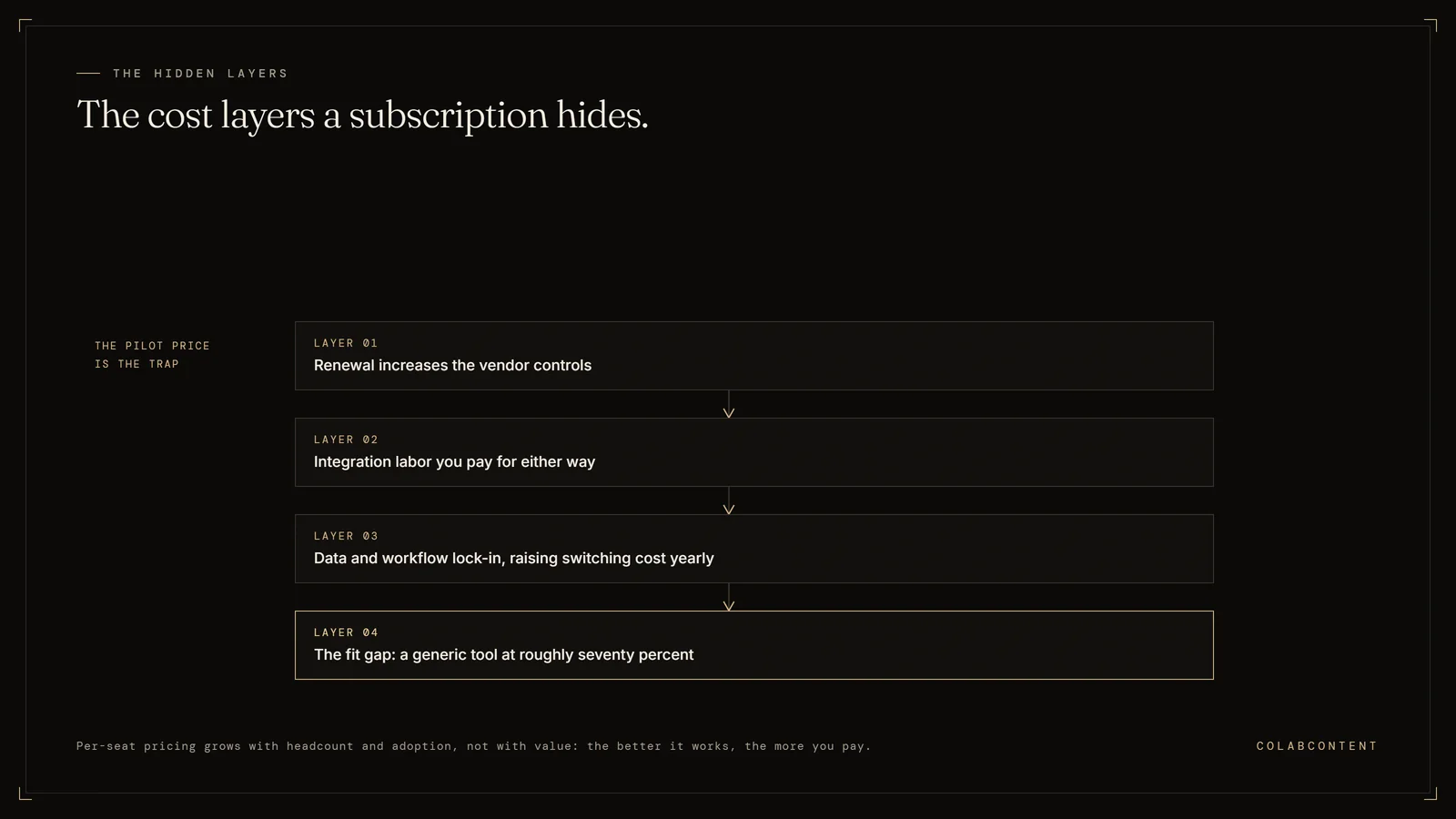
Why the pilot price is a trap, and the bill is built to grow.
Every off-the-shelf AI tool is easiest to buy at the exact moment it costs the least. One team runs a pilot, a couple of people get seats, the monthly charge is small enough to approve without a meeting, and the tool proves it can do something useful. That is a genuine result and worth having. The problem is what the low first number teaches you, which is that this is a cheap tool, when the truthful lesson is narrower: this is a cheap tool at one seat. The price you evaluated is not the price you will pay, because the thing you are about to do next, let more people use a tool that works, is the thing the pricing is designed to charge you for.
Almost all of these tools are sold on a per-seat or per-usage basis, and it helps to be clear-eyed about what that model actually ties your cost to. It does not tie your bill to the value the tool creates, and it does not tie your bill to the vendor's cost of serving you, which barely moves whether you have five seats or five hundred. It ties your bill to your headcount and your usage. Per-seat pricing is one of a handful of standard ways AI work gets priced, and it behaves very differently from the others once a tool takes hold; the full comparison of those structures is laid out in the four common AI pricing models and how they behave. The one that matters here is the one that scales with people.
Follow that forward and the trap becomes plain. You buy the tool because it works. Because it works, a second team wants it, then a third, and eventually it becomes part of how the company runs day to day, which is the outcome you were hoping for when you bought it. Every step of that adoption is a larger invoice for software that did not change. You are not paying more because the product improved; you are paying more because you succeeded at spreading it. The better outcome and the higher cost are the same event, which means the tool you most want everyone to use is the one whose price grows fastest, and it grows on an axis, headcount, that has nothing to do with how much value any given seat produces.
None of this is a scandal. It is a rational way for a vendor to capture more of the value as a customer gets more from the product, and at a small enough scale it is a perfectly fair deal. The reason it deserves a memo is that the compounding is invisible at the moment of decision. The pilot's cost is concrete and small; the at-scale cost is a projection nobody runs, so the comparison that should happen, this recurring bill over several years against a one-time build, never gets made. The rest of this piece is that comparison, done honestly in both directions, starting with the costs a subscription quietly folds into the price.
The cost layers a subscription hides, and who controls each one.
The first hidden layer is the per-seat tax itself, and it is worth stating as a structural fact rather than a complaint: your cost scales with people, not with value. A tool that saves a marketing team real time is a win, and the reward for that win is that the tool spreads to sales, to operations, to support, and the bill multiplies with each. There is no version of broad internal success that does not show up as a proportionally broad internal cost, because the meter is the seat. That is fine when the workflow is worth it at every seat. It becomes a problem when a tool that was clearly worth it for five people gets rolled out to eighty because it was easier than evaluating alternatives, and the bill scales with the eighty regardless.
The second layer is that price control sits with the vendor, and it stays there for as long as you depend on the tool. Renewals rarely go down. Features you rely on have a way of migrating up a tier, so the plan you signed on quietly becomes insufficient and the honest options are to pay more or to lose function. The phrase that ends a lot of budget conversations is some version of that capability is on the enterprise plan now, and it lands hardest precisely when the tool is woven into daily work and switching feels impossible. This is not vendor villainy; it is leverage, and the leverage is real. When your workflow lives inside someone else's product, the price of that product is set by them and revised on their schedule, and the deeper the dependency, the less your objection matters. It is one of the quiet ways a rollout that looked cheap turns into the kind of stall that shows up in month four, which is a pattern worth reading in full in why most mid-market AI rollouts stall in month four.
The third layer is the integration and glue work you pay for whether you buy or build. A generic tool does not arrive knowing your data, your systems, or the specific way your process actually runs, so somebody has to wire it in: connect it to the systems of record, shape your data into what it expects, and adjust the workflow around what it can and cannot do. That labor is real, it is often underestimated, and it does not come back if you later switch tools. Buyers tend to compare a subscription price against a build price and forget that a large slice of the build's integration cost also exists on the buy side; it is just spread across your own team's time instead of a line item, which makes it easy to pretend it is free.
The fourth layer is data and workflow lock-in, and it is the one that compounds most quietly. The longer a tool runs, the more of your process comes to live inside it: your data, your configuration, the institutional habit of doing the work this particular way. That accumulation is switching cost, and switching cost is the vendor's real moat. Leaving gets more expensive every month you stay, not because the contract says so but because more of how you operate is now shaped by a system you do not own. When your core process runs inside rented software, the option to leave is theoretical, and a theoretical exit is not leverage. The fifth layer is the generic-fit gap. A tool built for everyone fits your specific workflow at maybe seventy percent, and that missing thirty is not free; it becomes manual work that never goes away or a second tool bought to cover the shortfall, and either one is a cost that belongs in the comparison. Whether that gap is eating the return you thought you were getting is exactly the kind of thing a disciplined read of the ROI on a mid-market AI engagement is built to surface.
When off-the-shelf is the right call, and when it quietly stops being one.
Everything above is a case for scrutiny, not a case against buying, and it is worth being just as honest about the other side, because a memo that concluded build everything would be selling rather than advising. For a large share of what a company needs from AI, off-the-shelf is plainly the correct choice. When the task is commodity, standardized, and shared by every business, drafting email, working in documents, transcription, a well-served horizontal need, there is no edge to be had from a custom version of a solved problem, and the per-seat math never compounds into anything that would justify building. Paying a subscription for a solved, shared problem is not a trap; it is just buying a tool, the way you buy any other piece of software you had no reason to make yourself.
Off-the-shelf is also right for a very small team, because the mechanism that makes per-seat pricing dangerous, compounding with headcount, needs headcount to compound. A handful of seats does not grow into a headcount-scaled bill any time soon, and a five-person company optimizing for the eventual cost of a fifty-seat rollout is solving a problem it does not have. The math that makes a build worth it depends on volume and adoption that a small team simply will not reach on the timeline that matters, so the deliberate move there is to buy, stay light, and revisit only if the team and the usage grow into a different question.
And it is right whenever speed beats ownership, which is more often than build-minded people like to admit. If you need a capability running this week, a subscription gives it to you now, where a commissioned build gives it to you in a few months. Buying buys time, and it also shifts maintenance, security, and upgrades onto the vendor, which is a genuine service with genuine value; owning a thing means owning its upkeep, and there are plenty of workflows where you would rather someone else carried that. Speed and offloaded maintenance are real benefits, not consolation prizes, and any honest comparison has to credit them to the buy side.
Where off-the-shelf quietly stops being the right call is a specific and recognizable place: a differentiated, high-volume workflow that many people will touch and that is close to how your business actually wins. That is the workflow where the seventy-percent fit hurts most, where the per-seat bill compounds hardest, and where renting the thing that gives you your edge is strategically backwards. Those are also the exact conditions that signal a business is ready to own its AI rather than rent it, described in the signs a business is ready for custom AI, and the deliberate choice between the two paths is worth its own pass rather than a reflex, which is the work of the build versus buy decision for a mid-market company. The failure is not choosing to buy. It is buying by default for the one workflow where the subscription will compound against you for years while you rent your own advantage back from a vendor.
Run it as a break-even, not as SaaS good or SaaS bad.
The way to make this decision well is to refuse the framing that it is a fight between subscriptions and builds, because it is not. It is a break-even question over a realistic horizon, and the honest answer changes with the workflow, the headcount, and the number of years you are willing to look ahead. A subscription is a smaller cost that recurs and grows; a build is a larger cost up front that you own and that does not scale with adoption. Neither of those is better in the abstract. The only thing that decides it is where the two lines cross, and whether you will still be running the workflow past the point where they do.
The fastest way to see how this plays out for your own operation is the $499 AI-Ready Audit, which turns the general points above into a report specific to your business.
Running the math takes three inputs, and the first pilot almost never gathered them. Name the one workflow precisely enough to say it in a sentence. Size it honestly: how many people will actually use it once it works, and how often it runs. Then put both options on the same multi-year timeline. On the buy side, that means the per-seat or per-usage fees at the headcount you truly expect at scale, not the pilot's seat count, plus realistic renewal increases, plus the integration labor to wire it into your data, plus the standing cost of the generic-fit gap. On the build side it means a larger figure up front that you own outright and that does not renew or scale with adoption. The realistic dollar shape of that build side, what a serious commissioned engagement actually costs, is worked through in what a mid-market AI engagement actually costs, and the timeline it runs on is calibrated in how long a mid-market AI build takes. For the break-even run with real rate cards instead of a worked hypothetical, renting AI versus owning it shows which vendors publish a price at all and what the crossover month looks like against each build size.
Compared over a few years instead of at month one, the picture usually inverts from the one the pilot painted. Month one is exactly where the subscription looks cheapest and the build looks most expensive, which is why a decision made at month one is almost always biased toward buying. Push the same numbers out to year two and year three, hold the headcount at the level a successful rollout actually reaches, and let the renewals and the seat growth compound, and a tool that was a bargain at one seat can quietly pass the cost of the build you did not commission. If the workflow will still be running past the crossover point, and a differentiated core workflow almost always will, the owned asset is the cheaper answer as well as the more strategic one, because past that point the build keeps delivering while the subscription keeps billing.
There is one more thing the break-even math cannot price, and it belongs in the decision anyway: on a differentiated core workflow, owning the code and the data is the point, not a bonus. When you own it, your process does not live inside a system you rent, your switching cost is not someone else's moat, and the capability compounds as an asset on your side of the ledger rather than as a line item on theirs. The structured way to get to a defensible answer is not a spreadsheet built from guesses; it is naming the one workflow, sizing the people and the frequency, and putting the compounding subscription against the one-time build you would own, which is the diagnosis a structured decision process is built to run. The cheap first invoice is not the cost. The cost is the shape of the bill three years after the tool works, set against the price of having owned it instead.