Automation consulting for insurance companies: what actually automates, and in what order.
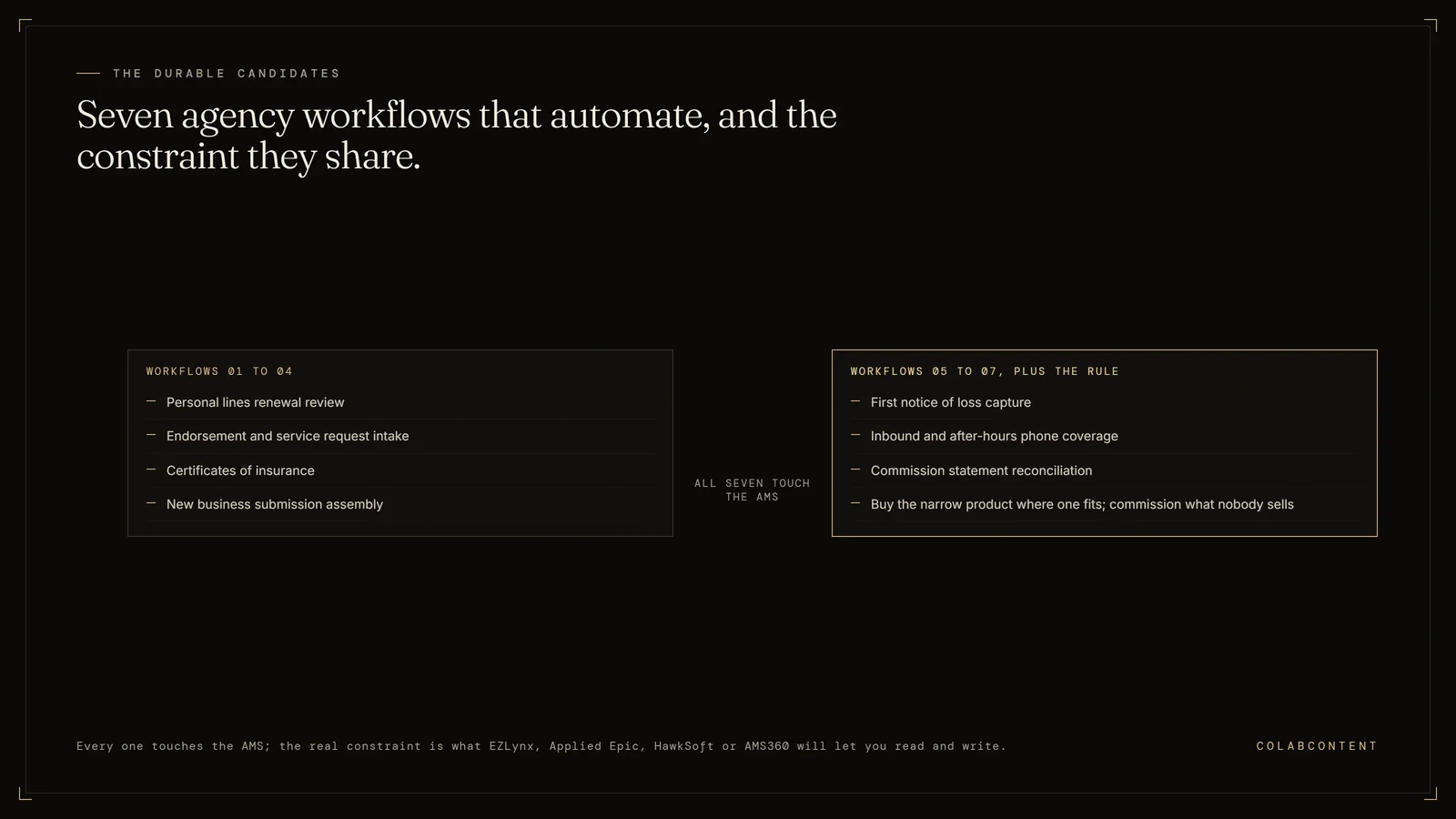
Automation consulting for an insurance company is the work of deciding which recurring workflows should be handled by software, which should stay with a licensed human, and in what order to make the change without breaking the book. In an independent agency the durable candidates are personal lines renewal review, endorsement and service request intake, certificates of insurance, new business submission assembly, first notice of loss capture, inbound and after-hours phone coverage, and commission statement reconciliation. Every one of them touches the agency management system, so the real constraint is rarely the model. It is what EZLynx, Applied Epic, HawkSoft or AMS360 will let you read and write. ColabContent LLC publishes this page: a boutique AI consulting house in Boston that builds custom systems for insurance agencies of 10 to 150 people. Before any call you can have a working prototype of one task you name, free, delivered as a link within 5 business days, at colabcontent.com/prototype/insurance/. Production builds are a fixed fee of $45,000 to $180,000, one time, with the code owned by the firm at handoff and no per-seat licence. The 45-minute diagnosis is free and is booked at cal.com/colabcontent/45mins.
For principals and operations leaders at independent agencies in the $8M to $50M revenue band, and for regional carriers running their own policy administration. This page is the map: what automates, what does not, where a product already covers it, and where a build is the only path.
The short answer.
Most automation proposals an agency receives are written from the software vendor's side of the table. They lead with a category name (intelligent automation, RPA, agentic AI) and work backward to your workflow. The useful version runs the other direction: count where the hours go, isolate the work that is high volume and rule-shaped, then decide per workflow whether a product already covers it, whether your agency management system covers it, or whether it needs to be built.
That framing matters because the answer for a typical agency is mixed. Renewal review has a good product market. Certificates and endorsements are partly covered by AMS-native workflow tooling. Commission reconciliation has almost no vendor coverage at agency scale and is usually the single most quantifiable dollar recovery on the list. Phone coverage is a separate discipline entirely and is often the largest untracked leak in the building.
Nobody needs a twelve-month transformation program to find that out. The scoping question is narrow: which one workflow, if it stopped consuming service hours, would change the operating math of the agency this year? If you cannot answer it in one sentence, the first engagement should be measurement, not a build. The two questions framework is the version of that conversation we use on a first call.
Seven workflows that actually automate.
Automating it means the account manager receives a reviewed file with the exceptions surfaced rather than a raw PDF. The decisions that follow (remarket, rewrite, have the conversation) stay human. This is the one workflow where buying almost always beats building; see what Quandri automates and where agencies outgrow it.Buy firstMature product market
The intake half automates well: classify the request, match it to the policy and the insured, extract the changed values, draft the carrier request, and pre-write the activity note. The execution half depends entirely on whether the carrier exposes an API or only a portal. Scope the carrier mix before anyone promises end to end.HybridIntake automates, execution depends
The defensible automation is deliberately narrow: issue automatically only when the request matches a prior certificate for the same holder with the same wording and the policy is confirmed in force. Route unusual additional insured language, waiver of subrogation, and primary and non-contributory requests to a licensed human, because those are coverage questions wearing clerical clothes.BuildHigh volume, narrow rules
What automates is extraction and assembly. Pull structured data off the ACORD PDFs and the loss runs, populate the submission package, draft the broker email, and maintain the market grid with automatic follow-up on carriers that have not responded. What does not automate is appetite judgment. You can encode a market appetite matrix as rules, and it will be useful and it will also be wrong at the edges, which is exactly why a producer still reads the shortlist.BuildAssembly yes, judgment no
Structured capture is the automatable part: a consistent intake script, correct policy match, complete field set, immediate confirmation to the insured, and a clean handoff to the carrier's FNOL channel. Adjusting, coverage determination, and anything resembling advice are not on the table. For carriers rather than agencies, the analogous target is document intake and triage on the claims file.BuildCapture only, never adjudicate
A voice layer that answers, identifies the caller and the policy, handles the routine servicing questions, captures the rest with enough structure to route, and logs the call against the account changes both the service load and the visibility. This is the workflow where we hold the most measured evidence, and it comes from outside insurance; the detail is below in full.BuildLargest untracked leak
This is the workflow with the least vendor coverage at agency scale, the most direct dollar consequence, and the strongest fit for a commissioned build, because the matching logic is specific to your carrier mix, your producer splits, and your own AMS field conventions. It is also the one nobody demos, because it is boring.BuildThinnest vendor coverage
How this lands in EZLynx, Applied Epic, HawkSoft and AMS360.
The question that decides every scoping call.
An automation project in an agency is not really a modelling problem. The models are good enough to read an emailed endorsement request or a loss run. The constraint is the system of record: what your agency management system will let an outside system read, what it will let that system write, and what your specific license tier and vendor agreement permit.
So the first question in scoping is never "can this be automated". It is "what can we reach, under what agreement, and what happens when the vendor changes it". A consultant who has not asked that in the first meeting is selling you a demo. Ask any prospective automation partner to answer it in writing for each of your systems before you sign anything.
The second question is what happens to the audit trail. If an automation updates a policy record or issues a document, the activity log needs to show what was done, by which system, on what input, and which human was accountable. Agencies that skip this discover the gap during an E&O review rather than during the build.
EZLynx.
EZLynx is the common answer for personal lines heavy agencies, and it ships its own rules-based automation tooling for campaigns and recurring workflows. That tooling is genuinely useful and underused; a fair number of agencies pay for automation consulting to do things their existing configuration already covers. Any honest engagement starts by exhausting what you already own.
Where it runs out is unstructured intake and cross-system work. A rules engine inside the AMS can trigger on a field change or a date. It cannot read an inbound email, decide it is an endorsement request for a specific vehicle on a specific policy, and pre-fill the change. That is the layer a build adds on top, and it should write its results back into the same activity stream so nothing lives in a shadow system.
Confirm your current API access tier with the vendor before scoping, because the practical answer differs by agreement rather than by product. The detail is in the EZLynx AI automation playbook, and if you are weighing the platform itself, Applied Epic versus EZLynx covers the comparison and EZLynx alternatives covers the field.
Applied Epic.
Epic is the deepest of the four and the most configurable, which cuts both ways. Larger agencies on Epic usually have real workflow structure already in place: activity types, suspense conventions, a defined service model. Automation lands well on that foundation because there is something consistent to write into.
The complication is that depth invites custom field conventions, and every agency's are different. An automation that has to decide whether a policy is in force, who the servicing producer is, and which activity type to log is reading your conventions, not a standard schema. This is exactly the boundary where productized tools stop and a commissioned build starts, because the product cannot ship your taxonomy.
Integration goes through Applied's partner and developer program, so the access question above is not rhetorical. Get the answer in writing. The Applied Epic AI integration playbook covers the workflow patterns we see most often on Epic books.
HawkSoft.
HawkSoft agencies are usually smaller, which changes the economics more than it changes the technology. A twelve-person agency has the same seven workflows as a hundred-person agency; it just has less volume in each, and less budget to throw at any of them. That argues for buying narrow products first and building only where the work is genuinely specific to the agency.
Where a build does make sense at that size, it is normally the phone layer or certificates, because those are the two workflows where volume stays high even when headcount is low. A commissioned build in the $45,000 to $65,000 band has to displace real recurring cost to make sense, and in a small agency that arithmetic is honest or it is not. We will tell you which on the call rather than after the invoice.
The HawkSoft AI automation playbook has the workflow-level detail, and what AI consulting costs for a regional agency has the arithmetic before you talk to anyone.
AMS360.
AMS360 agencies tend to be commercial-lines weighted, which pushes the priority list toward certificates, submissions, and commission reconciliation rather than renewal review. That is a meaningfully different build than the personal lines picture, and a consultant who proposes the same first project regardless of your book mix has not read it.
Vertafore exposes developer access through its own program, and the same rule applies: confirm what your agreement covers before anyone scopes a write-back. Where write access is not available, a read-plus-file-exchange design still works for reporting, reconciliation, and preparation, and it keeps the human as the one who commits the change. That is a slower workflow but an easier one to defend.
See the AMS360 AI automation playbook for the commercial-lines version of the sequence.
The carrier layer underneath all four.
Whatever the AMS, a large share of the data arriving in it comes from carrier downloads rather than from anyone typing. That plumbing decides how much of a workflow is really automatable. If policy and claim data lands structured, renewal comparison and reconciliation get much easier. If a given carrier only publishes to a portal, the choice is screen-level automation with a maintenance plan, or leaving that carrier's slice manual.
The mistake to avoid is designing a build that assumes uniform carrier behaviour. Inventory your top carriers by volume, classify each one as structured, semi-structured, or portal-only, and scope against that reality. It is unglamorous work and it is the difference between a system that holds up in month six and one that quietly stops being used.
For a regional carrier rather than an agency, the same logic applies one layer down: submission intake into policy administration, rating exception handling, claims document classification, and reporting extracts are the equivalents, and the access question is about your own core system vendor instead of your AMS.
Where a product ends and a build starts.
Products that already cover a slice.
Quandri is the clearest example in the agency market. Its software robots work personal lines renewals inside the agency management system, pulling the renewal, comparing it against the expiring policy, and flagging premium jumps, coverage changes, and missing data so the account manager receives a reviewed file. Inside that scope it is very good, and an agency whose top friction is exactly renewal review should buy it rather than commission anything.
The limits are the same as any focused product: submissions, certificates, commission reconciliation, and producer reporting stay manual unless you solve them separately. That is not a criticism of the product, it is the definition of a product. The Quandri comparison works the five dimensions in detail, and Quandri alternatives covers the adjacent field.
The general rule: where a well-funded vendor has built a deep product against exactly your workflow, buy it. You will not out-build a company that has spent years on one slice, and you should not try.
Configuration you already pay for.
Before anyone quotes a build, exhaust the workflow tooling inside the AMS you already license. Rules-based task routing, templated client communication, recurring activity creation, renewal date triggers, and standard reporting are usually included and usually underused. An automation consultant whose first proposal ignores this is optimizing for their invoice.
The honest limit of configuration is that rules trigger on structured events. A date arrives, a field changes, a status flips. That covers a real share of agency work. It does not cover reading an unstructured inbound message, deciding what it is, and preparing the action, which is the layer where models earn their place.
Generic robotic process automation sits in between. It can drive a carrier portal that has no API, and it will break when that portal changes. RPA is a legitimate tool with a maintenance bill attached, and it should be scoped with that bill visible rather than presented as a permanent fix.
Four tests for whether it should be built.
Does it cross systems? Work that starts in email, resolves in the AMS, and finishes in a carrier portal has no single vendor responsible for it. That is build territory by default.
Does it need your taxonomy? Carrier appetite, producer splits, custom AMS fields, and your own document conventions are not shippable in a product. If the automation has to know your conventions to be correct, no product can hold them.
Is the volume real? A build has to displace enough recurring cost to justify a fixed fee in the $45,000 to $180,000 range. Count the actual transactions per month before anyone writes a scope. If the number is small, buy something or leave it alone.
Does ownership matter? A commissioned build hands over source code and architecture documentation and runs inside your own tenant, which matters when carrier data agreements restrict where insured data may be processed. A subscription keeps that data on the vendor's stack indefinitely. The build, buy, or commission framework is the longer version of this test.
What we would decline to build.
Anything that issues coverage advice to an insured without a licensed human in the path. Anything that adjudicates a claim. Anything that decides, without review, that a policy should be rewritten or non-renewed. These are not technical limits, they are limits of what a regulated distribution business should let software decide on its own, and an automation partner who agrees to them too easily is a liability rather than an asset.
We would also decline a build whose only justification is that a competitor has one. The point of the diagnosis call is to establish whether a build is the right lever at all. Sometimes the honest answer is that a process needs fixing on paper before it is worth automating, because automating a broken process only produces the same errors faster. What we do not build is the full list.
The order to do this in.
Sequencing decides whether an automation program survives its first year. The failure pattern is consistent: an agency starts with the most visible workflow instead of the most measurable one, cannot prove what changed, and loses internal support around month four. Why mid-market AI rollouts stall in month four covers that pattern across verticals.
- Measure before you choose. Pull last quarter's transaction counts per workflow: renewals processed, certificates issued, endorsement requests received, submissions built, calls received and calls missed. Most agencies discover the ranking is not what they assumed, particularly on phone volume.
- Fix the process on paper first. If two account managers handle certificates differently, the automation will encode one of them and quietly break the other. Standardize, then build.
- Start where volume, rules, and a system of record all line up. That is usually certificates in a commercial book, renewal review in a personal lines book, and phone coverage in either.
- Buy the narrow product where a narrow product fits. Do not commission a renewal review engine. Commission the things nobody sells.
- Define the exception path before launch. Decide what percentage of cases route to a human, who that human is, and what the queue looks like on a Monday in January. A system with no exception design gets switched off the first time it is wrong.
- Instrument it. Every automated action logs its input, its decision, and its output. This is what makes the system auditable during an E&O review and what lets you prove the change to your own team.
- Expand from a working foundation. The second workflow is cheaper than the first because the integration, the logging, and the exception handling already exist. This is the argument for a build over a stack of subscriptions.
For the full engagement shape, from first call through prototype, fixed-fee scope, build, training, and handoff, see the commission process. Published fee bands are on the pricing page.
What we have actually measured, and what we have not.
This section is deliberately unflattering, because an automation buyer should be able to separate what a firm has done from what it says it can do.
The area where we hold the most measured evidence is the voice and phone layer, and none of it is from an insurance agency. At Jim Glaser Law, a firm that will take a reference call, the deployed system has handled 3,787 AI-handled calls across 5,514 minutes, split across five channel-specific voice agents covering paid search, organic, television, Meta, and Local Services Ads. The structural point for an agency is the attribution: because each channel routes to its own agent, the firm can see which marketing channel produced which answered calls, not just which produced form fills. Agencies buying leads across several channels have exactly that blind spot.
Beyond that: a multi-location home services operator at 1,486 AI-handled calls across 2,203 minutes, a regional third-party logistics and warehousing operator at 211 calls, and a realty firm at 148 calls. Across all clients the deployed voice systems have handled more than 6,000 live calls. Two marketing agencies outsource their AI fulfilment to us, which is a different kind of signal about the build quality.
On the back-office side, the closest analogue to commission reconciliation we have shipped is a commissioned matter, invoice, and trust accounting platform running a law firm: 13,296 matters, 4,396 clients, 5,684 invoices, with the IOLTA trust ledger reconciled byte-identical. That is not insurance, and the vocabulary does not transfer. What transfers is the class of problem: money moving through a system of record where the reconciliation has to be exact and auditable, not approximately right.
What we do not have is a published insurance agency deployment with numbers attached. If a named insurance reference is a requirement for your buying process, say so on the first call and we will tell you straight whether we are the right firm for this engagement. ColabContent LLC has operated since 2020 and has run an AI practice since 2024, out of Boston.
Frequently Asked Questions
What can an insurance agency actually automate?
The workflows that automate cleanly share three traits: volume, a repeatable decision rule, and a system of record to write back to. That set covers personal lines renewal review, certificate of insurance issuance against a prior template, endorsement and service request intake, new business submission assembly from ACORD forms and loss runs, first notice of loss capture, after-hours phone coverage, and commission statement reconciliation. Coverage advice, market selection judgment, and anything that changes what an insured is actually covered for stay with a licensed human.
How much does automation consulting for an insurance company cost?
ColabContent commissions are fixed fee, $45,000 to $180,000 for the whole build, quoted against one written scope and paid in two installments. A focused single-workflow build runs $45,000 to $65,000 over 4 to 5 weeks. A multi-workflow operations rebuild runs $75,000 to $120,000 over 6 to 8 weeks. Hourly automation consultants and offshore development shops price differently, and productized tools are annual subscriptions rather than a one-time fee, so compare on 24-month total cost rather than on the first invoice.
What is the difference between an automation consultant and an AI consultant for insurance?
Less than the labels suggest. Automation consulting historically meant rules, robotic process automation, and workflow configuration inside the agency management system. AI consulting adds models that read unstructured input: an emailed endorsement request, a scanned ACORD form, a loss run PDF, a phone call. The useful engagement uses both, because almost every agency workflow is an unstructured intake followed by a structured, rule-driven action in a system of record.
Does insurance workflow automation work with EZLynx, Applied Epic, HawkSoft and AMS360?
Yes, with different amounts of friction. Each of the four exposes some integration path, and each vendor gates that path behind its own partner or developer program, so the first question in scoping is not what the system can technically do but what your agency is licensed and permitted to reach. Where an API is available, automation writes activities, updates records and pulls the book directly. Where it is not, the fallback is file exchange or screen-level automation, which works but is more brittle and needs a maintenance plan.
Should we buy Quandri or commission a custom build?
If renewal review is the single biggest drain on your service team, buy the product. Quandri is built for that workflow and sells against that focus. If the pain is spread across submissions, certificates, endorsements, phone coverage and commission reconciliation, a subscription that solves one of the five leaves the other four manual, and a commissioned build addressing the whole set usually wins on 24-month cost. The question is scope match, not which vendor is better.
What should a 25-person independent insurance agency automate first?
Count the volume before deciding. In most agencies that size the two largest untracked pools are inbound phone traffic nobody has measured and certificate of insurance requests that repeat the same holders and wording all year. Phone comes first if calls go unanswered outside business hours, because a missed call is lost revenue rather than delayed work. Certificates come first if the phones are already covered, because the work is high volume, template-shaped, and easy to audit after the fact.
Is automating certificates of insurance an E&O risk?
It is if the system is allowed to make coverage decisions. The defensible design is narrow: issue automatically only when the request matches a prior certificate for the same holder with the same wording and the underlying policy is confirmed in force, and route everything else to a licensed human. Unusual additional insured language, waiver of subrogation, and primary and non-contributory requests are coverage questions, not clerical ones. Log every issuance with the inputs that produced it so the file can be reconstructed later.
How long does an insurance automation project take?
At ColabContent a working prototype is built on the agency's own data within 7 to 10 days, before any fee is owed. Production builds run 4 to 5 weeks for a single workflow, 6 to 8 weeks for a multi-workflow rebuild, and 10 to 14 weeks for a platform commission spanning several systems with a custom interface. Every commission ends with staff training, a post-launch tuning window, and handoff of the source code and architecture documentation.
Book the 45-minute diagnosis.
No slides. We walk your service model from first notice of a request through the activity log, count where the hours go, and tell you which of the seven workflows is worth automating first. If a product you can buy for a subscription would serve the agency better than a build, we say so on the call.
Where to look next.
The vertical page carries the practice-level view: AI consulting for insurance companies covers who we work with, the compliance posture, and the adoption framework. If you are still choosing a partner rather than a project, how to choose an AI consultant for an insurance agency is the evaluation checklist, and the shortlist guide for regional agencies covers what to look for in the market generally. For the arithmetic before any conversation, what AI consulting costs for a regional P&C agency publishes the bands rather than making you ask.
System by system, the playbooks go a layer deeper than this page does: EZLynx, Applied Epic, HawkSoft, and AMS360. On the product side, Quandri against a commissioned build is the comparison agencies ask for most, with Quandri alternatives and EZLynx alternatives alongside it. For an agency on Vertafore's enterprise platform specifically, the Sagitta alternatives page prices the three real paths side by side, including the scenarios where migrating beats commissioning a build. If you want the market picture rather than the vendor picture, the P&C agency AI benchmark is the survey view.
Cross-vertical, three pages carry the decision logic this one summarizes: workflow automation as a commissioned discipline, build, buy, or commission, and how to measure the return on a mid-market AI engagement before you agree to one.