Law firm succession planning, and the institutional knowledge nobody plans to capture.
Law firm succession planning normally covers the equity buyout, the client transition and firm governance. It rarely covers the asset that actually leaves: the matter history, the playbooks and the judgment a senior partner carries. That part is mechanizable. Capture it as a retrieval system over the firm's own files, with citations and permissions, while the partner is still there.
This is not the right path for firms with fewer than 20 attorneys (SaaS, meaning software rented per seat rather than owned, wins on economics at that size), firms whose only AI need is legal research (Harvey and CoCounsel cover that well), or firms without a named workflow constraint worth automating.
For managing partners, operating partners and firm administrators. What a departing partner knows, which parts a system can hold, the order to capture them in, and the confidentiality rules that decide the architecture.
Key Terms
Practice management integration: connecting AI tools with the firm's existing case management, billing, and document systems so data flows without rekeying. Model hallucination rate: the frequency at which an AI system generates plausible but factually wrong legal citations or case holdings; the metric that separates usable legal AI from a liability. Prompt library: a curated set of reusable instructions tuned to specific legal tasks (contract review, deposition prep, motion drafting) that produce consistent output quality across attorneys. Matter taxonomy: the classification system a firm uses to categorize cases by practice area, client, jurisdiction, and fee arrangement; AI tools that cannot map to the firm's taxonomy create reporting gaps.
What the numbers say and where each path fits.
Every succession article a managing partner has read covers the same three subjects. How the equity gets bought out. How the client relationships get transitioned. Who runs the place afterward. All three are hard, and all three are about people rather than systems.
The fourth thing goes unwritten. Thirty years of matter history, which brief worked in front of which judge, the clause the firm always strikes and why. That knowledge is not in the buyout agreement, and the standard remedies are weak rather than wrong. Shadowing does not scale past one or two successors. A written playbook captures what a partner thinks to write down, reliably the smaller half. A recorded exit interview produces hours of video nobody opens twice.
What has changed is retrieval. An archive has always held most of this material, but holding it and answering a question from it are different states. An associate who can ask what position this firm took on a successor liability clause for this client in 2014, and get the memo with a citation, has recovered part of the partner's knowledge without the partner in the room.
The pressure behind it is not speculative. Major, Lindsey & Africa's Partner Compensation Survey found nearly 40 percent of law firm partners expect to retire within the decade. Preparation has not kept pace. At the Legal Marketing Association's 2026 annual conference, a poll of one session's room found 55 percent said their firm had no succession plan and 23 percent were unsure. That is one room rather than a national survey, so read it as a signal rather than a measurement.
For the workflows most often commissioned at this firm size, see the law firm practice page.
What a departing partner actually knows.
Where the line falls between a systems problem and a hiring decision is covered in law firm AI hire versus commissioned build.
The sequence, and the calendar constraint behind it.
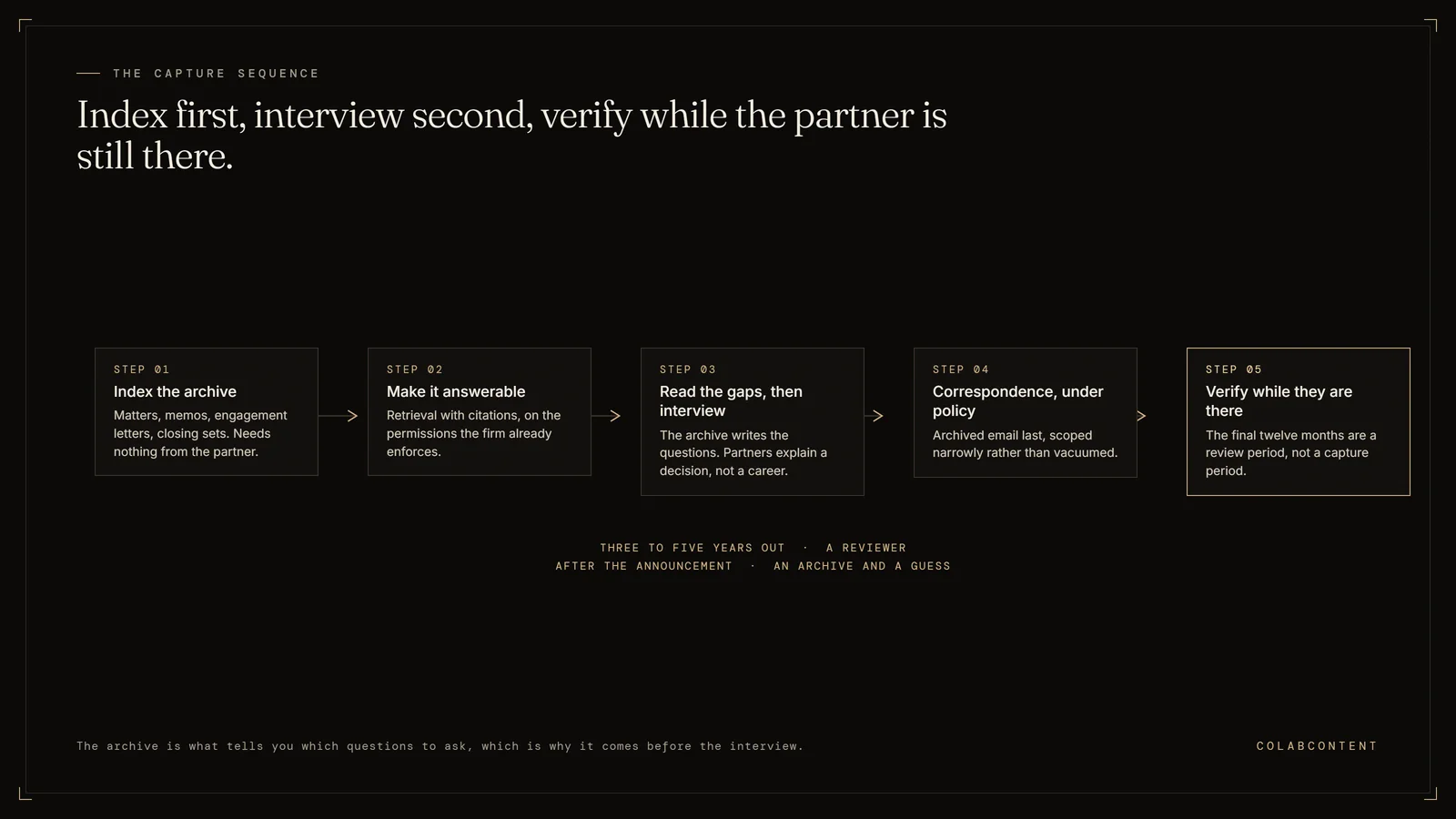
Capture projects fail predictably. A firm books time with the retiring partner, records a long interview, and finds eighteen months later that the recording answers questions nobody was asking. The order below inverts that, because the archive is what tells you which questions to ask.
- Index the archive first. Matters, memos, engagement letters, closing sets, work product. Needs nothing from the partner and produces the map. It also surfaces how much of the group's material is misfiled, duplicated or trapped in a format nothing can read.
- Make it answerable, with citations. Retrieval over that index, wired to the permissions the firm already enforces, every answer pointing back to its source. An uncited answer in a legal setting is a liability rather than a feature.
- Read the gaps, then interview. Now the questions write themselves. Two engagements took opposite positions on the same clause eleven months apart; which was right. Partners answer that readily, because they are explaining a decision rather than teaching a career.
- Bring in correspondence, under a written policy. Archived email carries the client-specific history and the highest confidentiality exposure. It comes fourth because by now the firm can scope the ingestion narrowly instead of vacuuming a mailbox.
- Verify while the partner is still there. The system will be wrong in places and only one person can say which. Treat the final twelve months as a review period, not a capture period.
Capture is cheap while the partner is practicing and expensive the moment they announce. A project starting three to five years out gets a reviewer. One starting after the announcement gets an archive and a guess.
Once the index and citations layer exist, extending retrieval into the firm's broader knowledge and RAG (retrieval-augmented generation) system is the natural next scope conversation.
Can a system really hold what a thirty-year partner holds?
This section covers why a document management system like iManage or NetDocuments already fails at succession even though the files are searchable, why confidentiality has to decide the system's architecture before anything is ingested, and what a knowledge-capture system honestly does not solve, stated without hedging.
Why the document management system already failed at this.
Firms running iManage, NetDocuments, Clio or a Litify build on Salesforce sometimes conclude the knowledge problem is solved, because the documents are in there. They are. But a search box retrieves a file you can already describe, and succession asks a different question: has this firm ever taken this position, and what happened. String matching cannot answer that, because the answer spans four documents in three matters and the reasoning connecting them was never written down.
Retrieval closes part of the gap by indexing meaning and returning a cited passage. It only closes it against material that exists; where the archive is silent nothing invents the answer. Stack detail sits in the iManage, NetDocuments, Clio and Litify playbooks.
Confidentiality decides the architecture, before anything is ingested.
This is the objection that stops most firms, and it should stop any firm whose vendor has not answered it in writing. ABA Formal Opinion 512, issued 29 July 2024, applies the existing Model Rules to generative AI. On confidentiality it treats Rule 1.6 as covering all information relating to the representation of a client, and directs lawyers to weigh the risk of disclosure outside the firm before inputting that information into a tool. It warns separately that self-learning systems can expose one client's information improperly even inside a single firm.
Read as an architecture specification rather than a warning, the opinion describes a compliant system. It runs inside the firm's own cloud tenant (a private cloud account). It sends nothing to a provider that retains or trains on the input. It enforces the firm's existing ethical walls at the retrieval layer, so a screened lawyer cannot reach a matter through a chat interface. It logs every query and document returned, because a firm that cannot show what the system disclosed cannot answer a carrier who asks. Those four properties are why this ends in a commissioned build rather than a subscription.
What this does not solve, stated plainly.
It does not value the practice, structure the buyout or make a compensation committee agree on origination credit. It does not transfer a client relationship: overlap years, joint billing credit and deliberate introductions do that, and a firm that automates the knowledge and skips the introductions has solved the easier half.
It does not replace judgment. What it does is narrow: it stops a successor spending two years rediscovering what the firm already knew and paid for once. A thin archive is a common reason we turn this work down, which is on the list in what we do not build. If the archive is a mess, the first project is data readiness.
What it costs, how to measure it, and what we have actually built.
This section covers the published fee bands for a knowledge-capture commission, starting from $10,000 for a single practice group and rising for firm-wide capture, how to measure afterward whether the system actually worked, and an honest account of what we have built for firms like this and what we have not.
The fee bands, published rather than quoted on request.
Our commissions are fixed fee against a written scope, from $10,000. One practice group indexed out of one document management system, with citations and the firm's existing permissions enforced, sits at the low end. A firm-wide capture spanning a practice management system and archived correspondence sits at the high end. Builds of this shape run six to ten weeks.
A working prototype on a bounded slice of your real archive comes first, because neither side can assess an archive's quality from a conversation. At handoff the firm holds the source code, the index and the ingestion pipeline, because thirty years of client matters is not a thing to rent. Terms are on AI consulting cost for law firms, the pricing page and the commission process. If the archive's condition is unclear, the $499 AI-Ready Audit gives an independent read before any commission conversation starts.
How to know afterward whether it worked.
Take the baseline while the departing partner can still set it. The honest test is a question set: thirty questions the partner answers from memory, across matter history, precedent selection and client-specific practice. Have the system answer each with citations, have the partner grade the answers, repeat quarterly. That grade measures the thing you were buying, and it degrades visibly if ingestion stops. Firm-level numbers, such as how long a lateral takes to reach competence, shift for other reasons too, so read them as direction rather than proof.
What we have actually built, and what we have not.
ColabContent LLC has run an AI practice out of Boston since 2024, our systems have handled more than 6,000 live calls across clients, and our own inbound line at (617) 675-9067 is answered by one of them. Calling it is the fastest way to audit our work.
The nameable legal reference is Jim Glaser Law, where five channel-specific voice agents covering PPC, Organic, TV, Meta and LSA have handled 3,787 calls across 5,514 minutes and give the firm per-channel attribution on answered calls. Jimmy will take a reference call and does refer. Closest to this page's subject is an engagement we can describe but not name: a law firm whose matter, invoice and IOLTA (the client trust account a law firm must keep separate) trust accounting platform we commissioned, carrying 13,296 matters, 4,396 clients and 5,684 invoices, with the trust ledger reconciling byte-identical against the system it replaced.
What we will not claim is a delivered partner-succession knowledge capture. We have done the matter-scale data work and built retrieval systems; we have not yet handed a firm a finished capture of a retiring partner's practice. If a reference who has been through exactly this engagement is a requirement, say so on the first call and we will say so plainly rather than dress an adjacent project up as one.
Start with the $499 audit.
No slides. We walk the practice group you are most exposed on, look at what the archive actually holds, and tell you whether a capture build is the right lever or whether the honest answer is overlap years and better filing discipline.
Frequently Asked Questions
Short answers first, detail underneath. Every answer here matches the FAQ schema on this page word for word, and each one is the answer we give on the audit call. Where a question depends on your own numbers, the $499 AI-Ready Audit report replaces the general answer with your figures.
What is law firm succession planning, and what does it usually leave out?
It covers the equity buyout, the transition of client relationships, and who takes over management. What it leaves out is the working knowledge: the matter history, the precedent set and the practice-group playbook built over thirty years. That is the part a system can absorb.
Can AI actually capture what a retiring partner knows?
It captures a specific slice. Retrieval over the firm's own documents makes the matter archive answerable rather than merely stored, so an associate can ask what position the firm took for a client in 2014 and get the memo with a citation. Relationships and judgment stay human.
When should we start capturing a partner's knowledge before they retire?
While the partner is still practicing, ideally three to five years out, treating the final twelve months as verification rather than capture. A system built from the archive alone will be wrong in places and only the partner can say which. Start after the announcement and you have lost the reviewer.
Does putting client matter files into an AI system violate confidentiality rules?
Not if the architecture is right, but answer it before anything is ingested. ABA Formal Opinion 512, issued 29 July 2024, treats confidentiality as covering all information relating to a representation and tells lawyers to weigh disclosure risk before inputting it. It also warns that self-learning tools can improperly expose one client's information even inside a single firm.
Is this the same as buying a legal AI research product?
No. Research and drafting products are calibrated against public law and general drafting patterns. Knowledge capture is calibrated against your own files: your matters, your clients, your clause preferences, your prior positions. Most firms run both.
What does a knowledge capture build cost for a mid-market firm?
Fixed fee against a written scope, from $10,000 depending on how many systems sit in the blast radius. One practice group out of one document management system sits at the low end; a firm-wide capture spanning archived correspondence sits at the high end.
How do we measure whether the capture worked?
Use a question set, and take the baseline while the partner is still there. Collect thirty questions they answer from memory, have the system answer each with citations, and have the partner grade the answers quarterly. Firm-level numbers move for too many reasons to settle an argument.
Our firm is 35 attorneys. Are we too small for this?
The deciding factor is concentration rather than headcount. If two or three people hold the working knowledge for a practice group producing meaningful revenue and one is within five years of retiring, the exposure is real at 35 attorneys and at 15. What rules a firm out is a thin archive.
Where to look next.
The product page for this work is knowledge and RAG systems, and if a product is already on the shortlist, Harvey alternatives for mid-market law firms and Spellbook against a custom build cover those comparisons. The law firm practice page lists the workflows most often commissioned at this size, and what we would commission first at a $30M law firm ranks this against the other candidates. How to choose an AI consultant for a law firm is the vetting checklist, and internal AI hire versus commissioned build runs the arithmetic if hiring is the alternative.