The firm profile.
Let's specify. 38 attorneys. $30M revenue, 60% litigation, 40% mixed corporate and employment. iManage Work for DMS (document management system). iManage Time for time capture. Outlook on Microsoft 365. 16 paralegals, 4 firm administrators, 1 IT lead. No Innovation Partner. The managing partner has read everything you've read about AI, talked to three vendors, and has an open-but-skeptical posture.
The firm's biggest pain, by their own assessment in the audit call, is unbilled partner time. Their last billing audit suggested $1.1M-$1.6M annually escapes capture. The managing partner believes it. The other partners have varying degrees of belief but agree there's a real number there.
This kind of leakage shows up often in audit calls with mid-market law firms. What we'd build, in this case, follows.
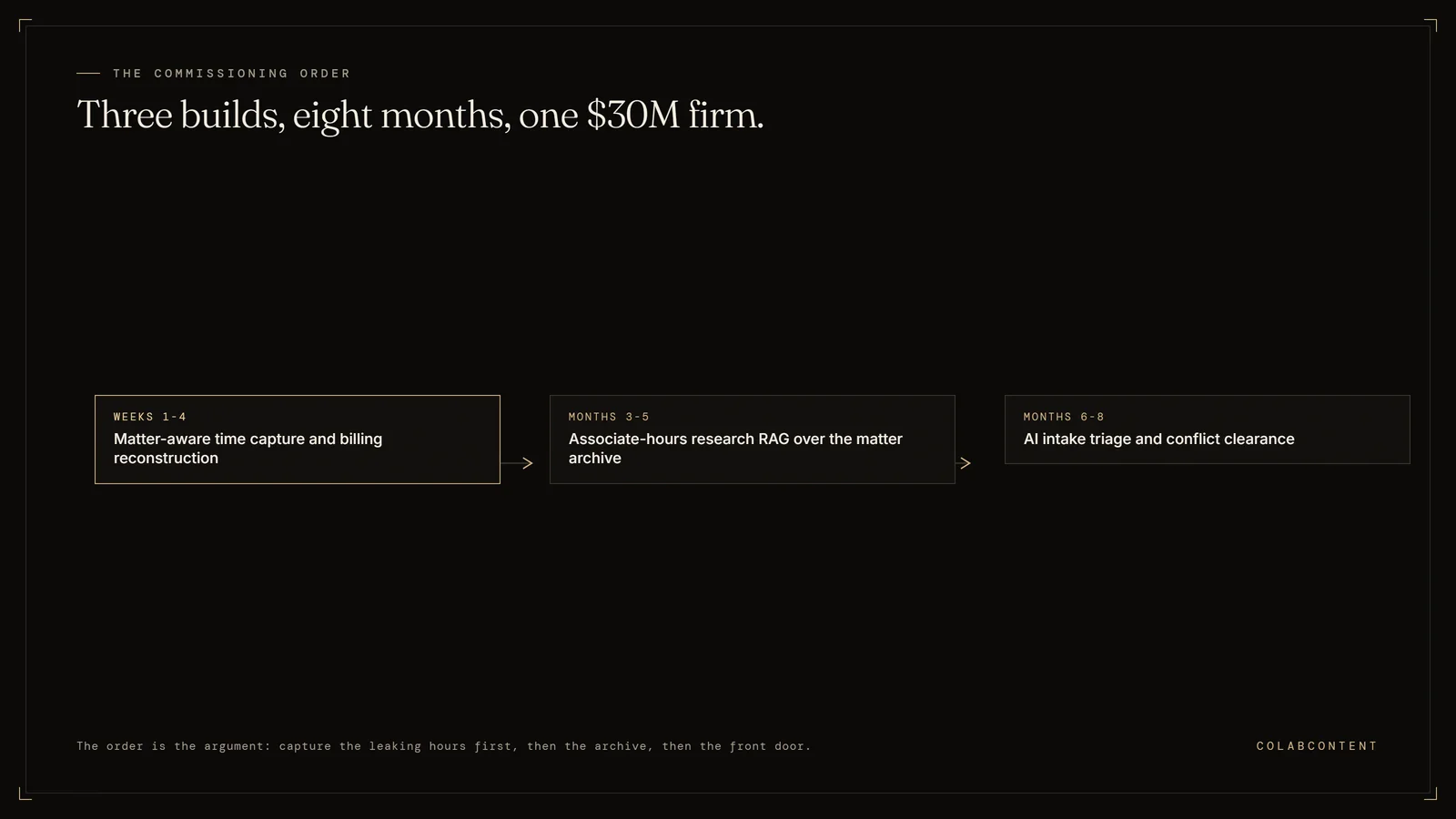
Build one: matter-aware time capture & billing reconstruction. Weeks 1-4.
The first build at this firm is straightforward to scope because the leakage is named, the dollar figure is real, and the data needed lives in systems the firm already has. Outlook calendar (where partner time happens), iManage activity logs (which documents got opened, edited, emailed, by which user), Microsoft Teams call history (who-talked-to-whom), and the firm's matter taxonomy in iManage.
The custom AI reads all of this overnight, by partner, drafts time entries with descriptions matter-mapped to the right billing categories, surfaces them to the partner in iManage Time the next morning. Partner reviews and signs in roughly 5 minutes per day instead of an estimated 90 minutes per week. Captures the work the partner would have written off as too small to bother reconstructing.
Architecture: data ingestion runs in the firm's Azure tenant (their own private cloud account) under NDA (a signed non-disclosure agreement). Microsoft Graph for Outlook + Teams. iManage REST (a standard way for software to exchange data over the web) API (the connection one piece of software offers to another) for activity + matters + time. Permissions queried with the partner's actual credentials, not a service-account super-user. Time entries written to iManage Time as drafts; partner approves through the iManage interface they already use. Full architecture in the iManage AI Integration Playbook.
Build two: associate-hours research RAG over the matter archive. Months 3-5.
The second build, scoped at month two of the first, ships in months three through five. The leverage point is associate ramp.
This firm has 16 associates at varying tenure. The senior partner who could surface the relevant prior work in 30 seconds is rarely available; the associate spends three hours combing iManage and frequently misses the most relevant precedent.
The custom RAG (retrieval-augmented generation, an AI that answers from your own documents) layer queries iManage with the associate's actual permissions, returns the top 8-12 most relevant prior matters with the partner who handled each, the outcome, and the specific paragraphs that match. Associate cites and adapts; partner reviews; firm bills full hours instead of writing off ramp time.
Estimated numbers at handoff, for this hypothetical firm: an estimated 6-12 months of effective ramp time per associate. At 16 associates and a blended associate billing rate, the recovery is structurally larger than the year-one capture but takes longer to materialize. The Custom Knowledge and RAG solution page covers this build pattern in general terms.
Build three: AI intake triage & conflict-clearance. Months 6-8.
The third build, by which point the firm has internalized the AI commissioning pattern. The leverage point is intake leakage.
In this hypothetical scenario, at a 38-attorney firm with 60% litigation and 40% corporate/employment, inbound intake comes in an estimated 22-40 forms per week from web, phone, referral. Median time-to-first-touch from a prospect is, by our estimate for this profile, 8-22 hours. The fastest-responding firms in this segment are estimated at under 5 minutes. The conversion gap is real.
The custom AI receives the intake (form, email, voicemail-transcribed-via-call-handler), runs conflict-clearance against iManage matter history, drafts the engagement letter from the firm's template, creates the iManage matter workspace with correct profile values. Partner reviews the package and signs the engagement letter; the firm captures the matter without manual assembly. Sizing this build for a specific firm is what the $499 AI-Ready Audit (our published price) does before any commission is scoped.
Where this ends up.
By month nine, the hypothetical firm has three custom AI systems in production, running on iManage + Outlook + Teams. The systems are owned by the firm at handoff; maintenance is an estimated $4,500/month across all three. In this illustrative scenario, year one new revenue captured runs $1.2M-$2.4M against engagement spend of $250K-$370K plus $40K maintenance, figures scaled from the $30M-revenue firm profile above, not a reported result. The pricing page documents how ColabContent scopes real engagements.
The firm's senior staff are AI-fluent. Two paralegals + one firm administrator have transitioned into something like an AI-systems-ownership role. The managing partner is no longer skeptical; they're scoping the fourth build, which is firm-knowledge ingestion ahead of two senior partner retirements.
This is the trajectory this hypothetical is built to show. It is not aspirational; the build sequence and architecture mirror the pattern we have run in real commissioned work, including the law-firm practice platform with 13,296 matters, 4,396 clients and 5,684 invoices, trust reconciled byte-identical (from the client platform database, August 2026).
What's different about your firm.
Probably nothing structurally. The variance comes from: practice mix (mostly litigation vs mostly corporate changes which workflows pay first), billing realization rates (changes the dollar figures), partner culture (changes adoption velocity), and existing tech stack (iManage vs NetDocuments vs Clio vs SharePoint changes the architecture but not the leverage points).
If your firm's profile differs materially from the hypothetical above (smaller, larger, different stack, different practice mix), the order of the builds may shift. The shape stays the same.
The general version of that sequencing question, what automates first at a 20 to 150 attorney firm and how to vet whoever proposes it, is in what a law firm automation consultant actually does.