Manufacturing automation consulting: where an AI layer fits on a plant that is already automated.
Manufacturing automation consulting is outside engineering help deciding what work on and around a plant floor should be done by machines and software instead of people, and it now splits into two distinct disciplines. The first is the control layer: PLCs, drives, robot cells, SCADA and MES, the work a systems integrator does, deterministic and validated before it runs. The second is a decision layer built on top of it, where a model reads data those systems already produce and handles a judgment call a person makes today. If your plant already has the first, the honest question is not whether to automate more machines. It is which repeated human decision is now the constraint, and whether it is a decision software can be trusted with. ColabContent LLC publishes this page: a boutique AI consulting house in Boston that builds custom automation for job shops and contract manufacturers of 20 to 250 employees. Before any call you can have a working prototype of one task you name, free, delivered as a link within 5 business days, at colabcontent.com/prototype/manufacturing/. Production builds are a fixed fee of $45,000 to $180,000, one time, with the code owned by the shop at handoff and no per-seat licence. The 45-minute diagnosis is free and is booked at cal.com/colabcontent/45mins.
Written for owners, VPs of operations and plant managers at specialty and mid-market manufacturers who already run PLCs, a historian and an ERP, and who keep getting AI pitches that do not say where the thing plugs in.
The short answer.
Most plants in the $15M to $150M band have already bought the automation the category was named for. There are PLCs on the cells, a historian collecting tags, a SCADA layer somebody built screens for years ago, an ERP that runs the orders, and possibly a robot or two that a systems integrator commissioned and validated. That work is done. It is also the part of the operation that rarely breaks, because it was engineered to be deterministic and it was tested before it ran.
What is not automated is everything that still requires a person to read something, judge it, and decide. The estimator deciding which RFQ to quote and at what margin. The scheduler deciding which job jumps the queue when a customer calls. The quality tech typing a downtime cause into a free-text field three different ways. The buyer chasing a supplier certificate before a lot can ship. The person who answers the phone at 4:40pm on a Friday and takes down a spec wrong.
That is the layer an AI consultant should be working on, and it is almost always a different engagement from the one an integrator quotes. Confusing the two is the single most common way these projects get mis-scoped. A firm asks for "manufacturing automation consulting", gets a proposal to add cells and conveyors, signs it, and two years later still has an estimator working from a spreadsheet and a memory of what the shop can hold to a tenth of a thousandth.
This page is the honest map: the three layers, what an AI layer genuinely adds, what it must never touch, and how to scope it alongside the integrator you probably already have. If you want the vertical overview rather than the automation-specific one, that lives on AI consulting for manufacturing and the manufacturers industry brief.
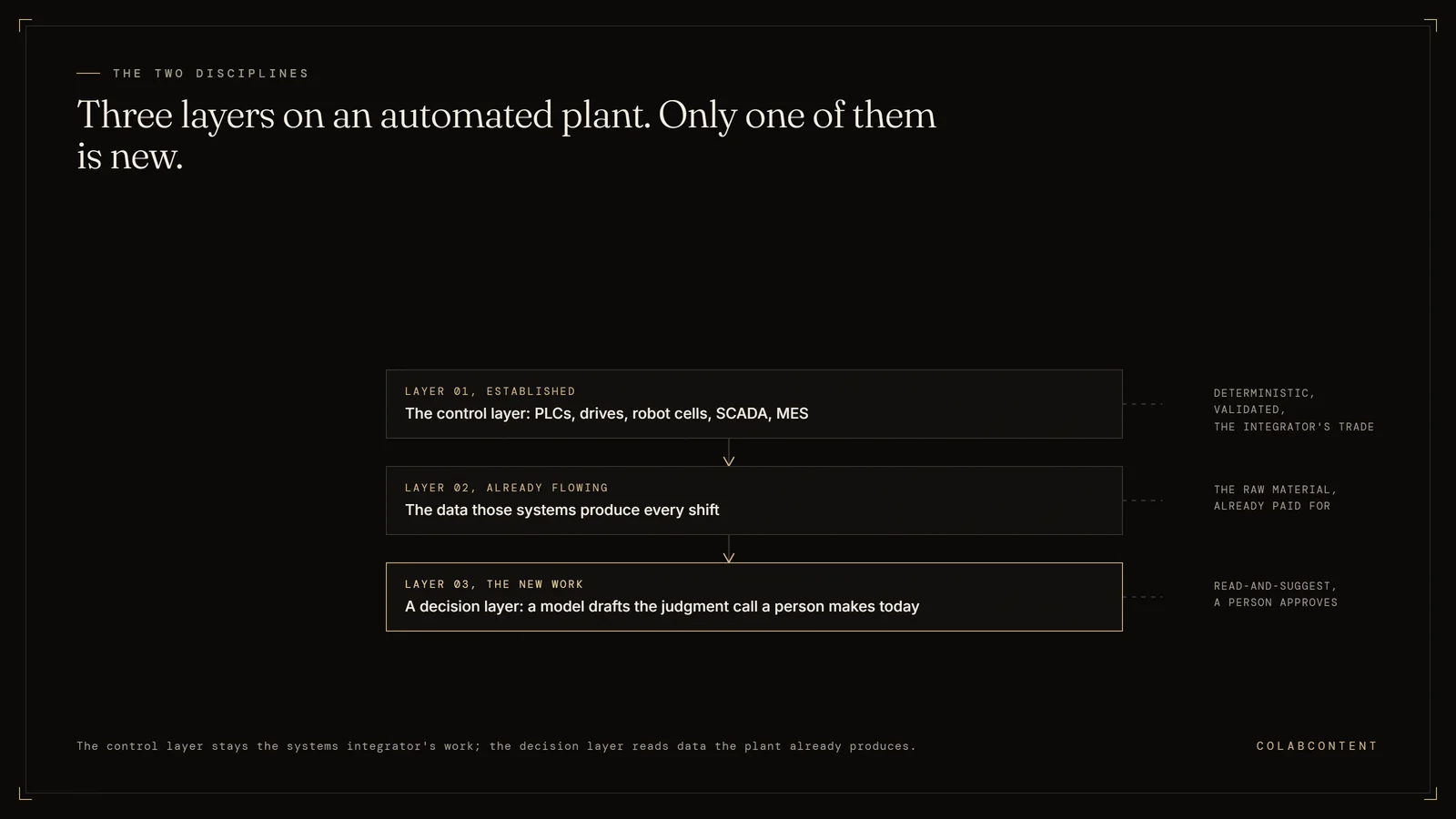
Three layers, and only one of them is new.
Nothing on this page proposes touching it. If your constraint is here, the correct hire is an integrator, not an AI shop, and a good AI shop will tell you that on the first call.IntegratorDeterministic
It is also the integration surface. Everything an AI layer does, it does by reading here through OPC UA, historian queries, MES and ERP APIs, or a nightly replica. No new sensors required to start.ExistingRead from here
This is where an AI layer belongs and it is the only layer where the word AI is doing real work rather than marketing. It sits above the record layer, proposes, and a human approves. It never reaches down to layer 01.AI layerHuman approves
Five decisions worth automating in a plant.
An AI layer reads the incoming package, extracts material, tolerance, quantity and due date, checks them against the machine envelope and the historical part library, and ranks the queue by win probability and margin instead of arrival time. The estimator still quotes. They just stop starting from the wrong one. The mechanics of doing this on an ERP are worked through in the Epicor Kinetic playbook.Front officeHighest ROI
Classifying free text into a consistent taxonomy is the single most reliable thing a language model does. It is unglamorous, it is cheap, and it is often the prerequisite that makes every later analytics or maintenance project possible. Start here if your data is dirty, which it is.DataDo this first
Extraction and matching against the order requirement is a solved class of problem: read the document, pull the fields, compare to what the ERP says the job requires, flag the mismatch before the truck is loaded rather than after. Read-only against the file store, a flag written back to the job, a human clears it.QualityRead and flag
An AI layer that reads the current schedule, the historian, the open orders and the customer history can rank the tradeoff and show its reasoning. It proposes. The scheduler decides. Anyone selling autonomous scheduling into a mid-market plant is overselling.OperationsProposes only
This is the workload where our own numbers are measured rather than modelled. Across clients, more than 6,000 live calls have been handled by commissioned voice systems. Jim Glaser Law, who will take a reference call, runs five channel-specific agents across PPC, Organic, TV, Meta and LSA covering 3,787 AI-handled calls and 5,514 minutes, which gives the firm per-channel attribution on answered calls rather than guesses. A regional third-party logistics and warehousing operator runs the same pattern at 211 calls, and a multi-location home services operator at 1,486 calls and 2,203 minutes.CommercialMeasured
How the AI layer actually attaches, and where it must stop.
The integration surface, in order of preference.
There are four realistic ways to get plant data into a decision layer, and they are not equal. Preference order matters because each step down the list adds fragility that somebody has to own for the next ten years.
The historian. If there is a process historian collecting tags, that is the cleanest read. It is designed to be queried, the data is already time-aligned, and reading it puts zero additional load on the control network. Query it on a schedule, not on a live subscription, unless the workflow genuinely needs sub-minute freshness. Most do not.
OPC UA. Where there is no historian or the historian does not hold the tags you need, an OPC UA server on the supervisory network exposes a read-only view of the tag space. Read-only is not a preference here, it is the design. The AI layer gets a subscription with read rights and no write rights, and that permission boundary is written into the scope document, not assumed.
MES and ERP APIs. For anything order-shaped rather than process-shaped, which is most of the highest-value work, this is the primary surface. Jobs, routings, work centres, part masters, customers, purchase orders. It is also where the write-back goes, because these systems already have approval workflows and audit trails that a suggestion can slot into.
A nightly replica. Where an API does not expose what is needed, a read replica of the database is the last resort, and it is used with the operator's explicit approval and with the understanding that a vendor upgrade can break it. Never a direct read against the live production database, and never a write.
Notice what is absent. Nothing on this list is a new sensor, a new gateway on the control network, or a change to a PLC program. If a proposal for an AI project starts with hardware on the machine, ask why, and ask whether that is an integrator scope wearing an AI label.
The hard line: what AI must never be inside.
This is the section most vendors skip, so it goes early here. There is a category of function on a plant floor that a probabilistic model has no business being part of, and the boundary is not a matter of taste.
Anything in the safety function. Emergency stops, light curtains, interlocks, two-hand controls, safety PLCs. These carry a documented safety case and an integrity level. A component that cannot be exhaustively verified cannot be inside that case. Full stop, no exceptions, no pilot.
Closed-loop real-time control. Anything with a scan time and a setpoint. Control loops need to be deterministic and repeatable: the same inputs produce the same output every cycle, forever, and the behaviour is provable in advance. A large language model is the opposite of that by construction. There is genuine research in learned control, and it lives in labs and in a small number of very heavily instrumented plants with dedicated engineering teams. It is not what a mid-market shop should buy in 2026.
Regulatory or contractual release decisions. If a person's signature currently releases a lot, the AI layer can prepare the packet, check the completeness, and flag the discrepancy. The signature stays with the person. In aerospace, medical and food, that is not a preference either, it is the audit.
Anything with an unbounded failure cost and no human in the path. The general test we apply before scoping: if the system is wrong, who notices, how fast, and what does it cost before they do? If the answer is nobody, slowly, and a lot, the workflow is not ready for automation regardless of what technology is involved. That test is older than AI and it has not changed.
The corollary is the useful part. Every workflow on the list further up this page passes that test, because in each of them a human sees the output before anything irreversible happens, and the cost of a wrong suggestion is a few minutes of somebody's attention.
Predictive maintenance, and why most pitches for it are premature.
Predictive maintenance is the phrase every manufacturing AI deck opens with, and it is the one most likely to waste a year. It is worth being precise about why, because the failure is not in the technique.
Supervised failure prediction needs labeled examples of the failure you want to predict. Not run hours, not alarms, not vibration traces in general: examples of this bearing on this class of machine failing, with a timestamp, enough times for a model to learn a signature. Most mid-market plants have none of that in a usable form. They have a maintenance system full of free text, a historian full of tags nobody has mapped to assets, and an institutional memory that lives with a millwright who has been there longer than the ERP has.
What actually works in year one is duller and more honest. Anomaly detection against normal operating envelopes, which needs no failure labels at all and flags drift a human then investigates. Reason-code capture, so that from now on failures are recorded consistently, which is the free-text normalisation work described above. Asset-to-tag mapping, so a signal can be attributed to a machine. Do those three and you have built the dataset a prediction model would need. Skip them and you have bought a model with nothing to learn from.
Anyone quoting a predictive maintenance deployment on a plant with no failure history is quoting either anomaly detection under a better name, or a project that will spend its budget on data work and deliver the prediction part in a phase two that never gets funded. Ask directly which one it is. The data readiness guide is the checklist version of this conversation.
Working alongside the systems integrator instead of against them.
Plants that already have an integrator relationship sometimes hesitate to bring in a second party, and the fear is reasonable: two vendors, one plant, and a boundary nobody wrote down is how integration projects go sideways.
The boundary is not actually ambiguous once it is stated. The integrator owns everything that can stop a machine. The AI layer owns nothing that can. Written into a scope document, that reads as: the AI layer holds read credentials on the supervisory network and read plus scoped write credentials on business systems, it holds no credentials at all on the control network, and any change to a PLC program, a safety circuit or an HMI screen is integrator scope and gets quoted by them.
In practice the integrator is also the best source of truth for the tag dictionary and the asset hierarchy, which are the two artefacts an AI project needs first and that no plant documents well. Bringing them into the scoping call rather than around them shortens the data phase considerably, and it removes the political version of this problem before it starts.
There is a commercial point too. Integrators bill against hardware, panels and commissioning hours, and their margin lives there. A decision-layer project does not compete with that. The two scopes rarely overlap on a line item, which makes the conversation easier than either party expects.
What we have actually built, and what we have not.
A skeptical operator should want this section on any consultant's site, so here it is plainly. ColabContent LLC has been in business since 2020 on the content side, with the AI practice running since 2024, out of Boston.
The measured work is concentrated in the decision and commercial layers rather than on the floor. More than 6,000 live calls have been handled by commissioned voice systems across clients. Jim Glaser Law is nameable and will take a reference call: five channel-specific voice agents covering PPC, Organic, TV, Meta and LSA, 3,787 AI-handled calls, 5,514 minutes, and per-channel attribution on answered calls. Anonymized, a multi-location home services operator at 1,486 calls and 2,203 minutes, a regional third-party logistics and warehousing operator at 211 calls, and a realty firm at 148. Two marketing agencies outsource their AI fulfilment here.
On the systems-of-record side, a law firm runs its matter, invoice and trust accounting on a platform commissioned here, currently holding 13,296 matters, 4,396 clients and 5,684 invoices, with the trust ledger reconciling byte-identical. That is the closest analogue to plant work in the portfolio: a custom operational system carrying real transactional load with money-grade correctness requirements, not a chatbot.
What is not in the portfolio: we have not commissioned a PLC, we do not write ladder logic, and we do not sell vision cells. If the constraint in your plant is on layer 01, the right call is an integrator and we will say so rather than reshaping the problem to fit what we build. The general version of that policy is on what we do not build.
How to run this as a pilot that produces a decision.
The failure mode in mid-market AI pilots is not that the technology does not work. It is that the pilot was never designed to produce a yes or a no, so it produces a demo, everybody nods, and the project dies at the budget meeting four months later.
A pilot that decides something has four properties. It runs on the plant's own data, not a sample the vendor prepared. It has a number attached before it starts, with the current value of that number measured rather than estimated. It has a date on which the decision gets made, whether or not the result is flattering. And it has a named person who has to live with the output, sitting in the room while it is built.
Our version is a working prototype against the operator's real data inside seven to ten days, before a production fee is owed. If the prototype does not hold up on your parts, your orders and your text, you walk. The full sequence is on the commission process page, and the pilot design question is worked through separately in how to run an AI pilot that produces a decision.
One more scoping note specific to manufacturing. Pick a workflow whose result is visible inside one production week. Quote triage and document matching qualify because the volume is daily. Anything tied to an annual cycle, a seasonal build or a slow-moving quality metric will not generate enough evidence in a pilot window to settle an argument, however important it is.
Cost, duration and what you own at the end.
Control-layer automation is quoted the way capital equipment is quoted: hardware, panels, engineering and commissioning hours, against a defined mechanical scope. A decision-layer commission is quoted differently, and the difference is worth understanding before comparing two proposals that look superficially similar.
ColabContent commissions are fixed fee, written down before the build starts, in the $45,000 to $180,000 band. Where a given project lands inside that band depends on three things: how many systems the layer has to read from, whether it writes back or only reports, and how much of the underlying data has to be cleaned before anything can run. The third one is the usual surprise, and it is the reason the prototype comes first rather than the contract.
Duration runs four to five weeks for a single focused system, six to eight for a workflow spanning multiple systems with dashboards and alerting, longer for a full platform. Payment is in two installments, one at production-build start and one at handoff. There are no hourly rates to run up and no per-seat licences.
At handoff the operator receives the source code, the prompts, the model configuration, the data pipeline and the architecture documentation, and runs the system in their own environment. That matters more in manufacturing than in most verticals, because plant systems stay in service for decades and an eventual ERP migration should not strand a workflow behind somebody else's licence. Vertical cost detail sits on AI consulting cost for manufacturers, and the underlying decision framework on build, buy or commission.
Frequently Asked Questions
What is manufacturing automation consulting?
Manufacturing automation consulting is outside engineering help deciding what work on and around a plant floor should be done by machines and software instead of people, then specifying and delivering it. Traditionally that meant the control layer: PLCs, drives, robot cells, SCADA and MES. It now also covers a decision layer built on top of those systems, which is where AI belongs and where most mid-market plants have never had anyone look.
What is the difference between a manufacturing automation consultant and a systems integrator?
A systems integrator builds and commissions the control layer: PLC logic, drives, safety circuits, robot cells, SCADA screens, MES connections. That work is deterministic and it is validated before it runs. An AI consultant works one layer up, on the judgment people still make using the data those systems produce. They are complements, not substitutes. A plant that needs both and hires only one gets half a result.
Do we have to replace our PLCs or SCADA to add AI?
No, and any consultant who suggests it should be shown the door. A well built AI layer reads from what you already have, usually through the historian, an OPC UA server, or the MES and ERP APIs, and it writes back only where a human approves the write. The control layer keeps running exactly as commissioned, and rolling the AI layer back is a matter of turning off a service.
Can AI control machines on the plant floor?
It should not, and this is the sharpest limit on the whole category. Control loops, interlocks and anything inside the safety system have to be deterministic, verifiable and identical between cycles. A model that can produce a different answer on Tuesday than it did on Monday has no business in that path. AI belongs where a person is currently making a judgment call, not where a rung of ladder logic is.
Does predictive maintenance work if we have never logged failure reasons?
Not at first. Supervised failure prediction needs labeled examples of the failure you want to predict, and most mid-market plants have run hours and alarm floods but no clean failure history. The honest sequence is anomaly detection plus disciplined reason-code capture first, then a prediction model once there is something for it to learn from. A consultant who promises predictive maintenance in week six is selling something else.
How much does manufacturing automation consulting cost when AI is involved?
Control-layer work is normally quoted by the integrator against a scope of hardware, panels and commissioning hours. The AI layer is quoted differently. ColabContent commissions are fixed fee, stated in writing before the build, in the 45,000 to 180,000 dollar band depending on how many systems the layer has to read from and write back to, and how much of the data has to be cleaned first.
What does an AI engineering consultant for manufacturing automation actually deliver?
A written scope, a working prototype running on your own plant and order data inside seven to ten days, then a production system that reads from your historian, MES or ERP and puts its output where the person who needs it already works. At handoff you receive the source code, the prompts, the data pipeline and the documentation. There is no seat license and no platform you have to stay subscribed to.
What can AI add to a plant that already has SCADA and a decent MES?
The judgment that still lives in people's heads. SCADA tells you a line is down and MES tells you what it was running. Neither tells you which of the open RFQs on the estimator's desk to quote first, which supplier certificate is missing before a lot can ship, or why the same downtime cause gets typed in three different ways by three different shifts. Those are language and judgment problems, and that is where an AI layer earns its keep.
Should we hire a controls engineer instead of commissioning an AI build?
If the problem sits on the control layer, yes. Hire the controls engineer or the integrator, because they will do it better and cheaper than anyone selling AI. Commission an AI layer only when the bottleneck is a decision a person makes repeatedly out of data your systems already hold, and when that decision happens often enough that automating it moves a number you report to the board.
Book the 45-minute diagnosis.
Forty-five minutes on your plant. We walk the path from RFQ to shipped lot, name the decision costing the most, and tell you whether it is an AI layer, an integrator, or neither.
Where to look next.
If this page answered the automation-layer question and you now want the vertical overview, start with AI consulting for manufacturing and the manufacturers industry brief, which covers the workflows most often commissioned in plants rather than the architecture. Shops that describe themselves as low-volume, high-mix or job-shop should read the specialty manufacturing page instead, since the economics of quote triage change sharply with batch size.
For vendor selection, the shortlist of AI consultants for specialty manufacturers names the firms working in this space and what each is actually good at, and how to choose an AI consultant for a manufacturer is the question list to take into those calls. Numbers live on AI consulting cost for manufacturers, and the current adoption picture in the 2027 manufacturing AI benchmark.
If the shop runs Epicor Kinetic, the Kinetic AI integration playbook is the concrete version of everything on this page, down to which endpoints get read. For the horizontal view of the same problem, workflow automation covers the pattern outside manufacturing, and off-the-shelf AI versus a custom commission is worth reading before you sign with anyone, including us.