Methodology behind the benchmark.
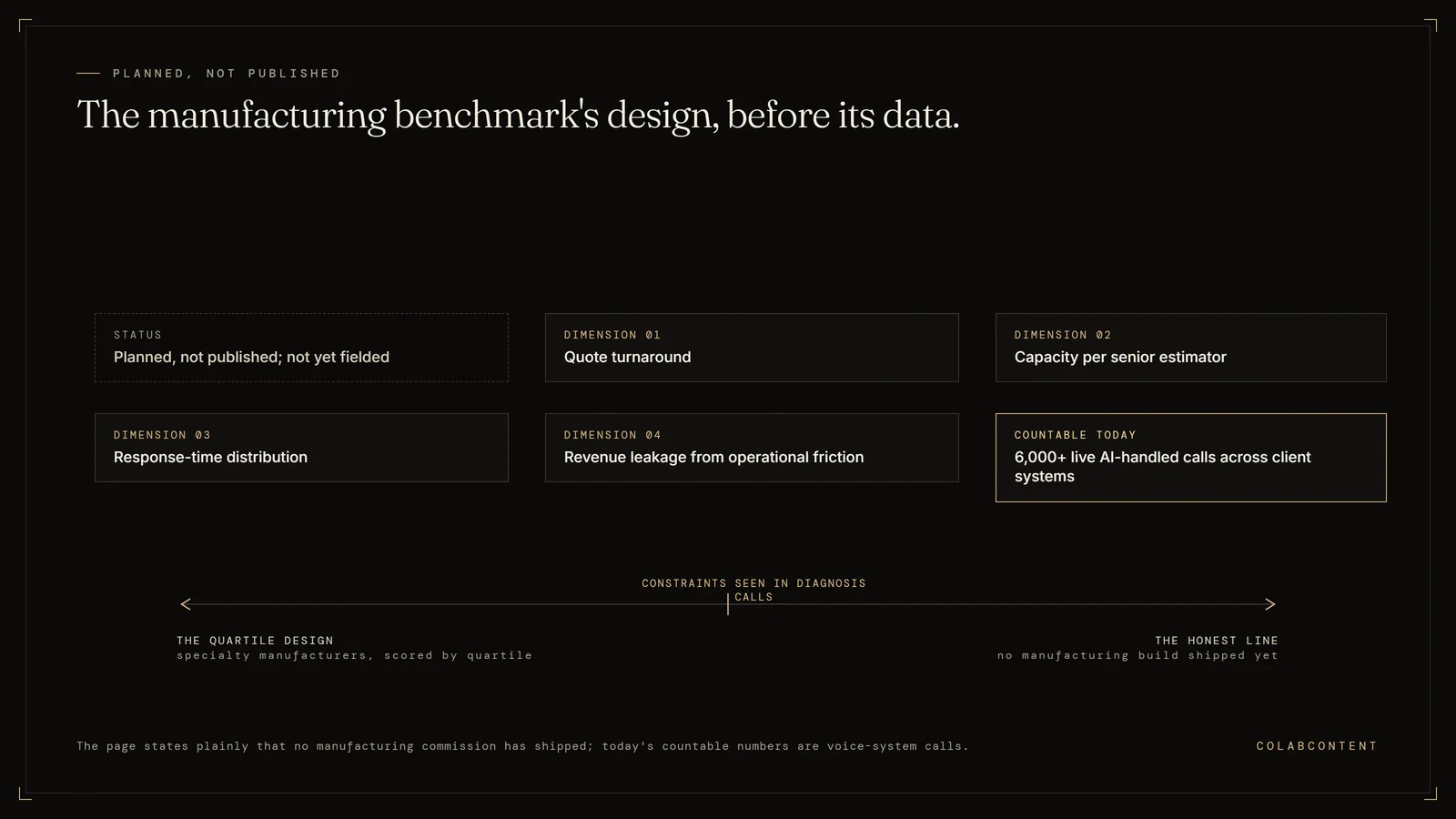
This benchmark has not been fielded, so what follows is the design, not a description of a finished data set. When it does run, it will be built from data operators in the vertical agree to share, aggregated with identifying details removed. The intended sources are three: ColabContent's own diagnosis-call notes, measurements taken from systems we built and handed off, and a structured survey of operators in the band. It will not be a roll-up (a group of businesses bought and combined by one owner) of public earnings filings, a re-publication of a third-party industry report, or an extrapolation from a single engagement.
The dimensions we intend to benchmark are the ones that show up most frequently as the constraint in an audit call: workflow velocity, capacity per senior headcount, response-time distribution, and revenue leakage from operational friction. Those are the dimensions an operator can act on with a commissioned AI build.
What we can put numbers to today.
Ahead of any survey, the only figures worth quoting are measured counts from systems this house built and still runs. ColabContent has not commissioned a build inside a specialty manufacturing plant, so there is no manufacturing result on this page and we are not going to borrow someone else's average to fill the space.
Across every commissioned voice system, more than 6,000 live calls have been handled. The named reference is Jim Glaser Law, where five channel-specific voice agents covering PPC, organic, TV, Meta and LSA have handled 3,787 calls across 5,514 minutes, giving the firm per-channel attribution on every answered call. Jimmy takes reference calls. Anonymized, the same pattern runs at a multi-location home services operator (1,486 calls, 2,203 minutes), at a regional third-party logistics operator (211 calls), and at a realty firm (148 calls). The logistics operator is the closest adjacent work to a plant's inbound traffic, and it is still not a manufacturing floor.
The deepest platform work is a law firm whose matter, invoice and IOLTA (the client trust account a law firm must keep separate) trust system now runs on a commissioned platform: 13,296 matters, 4,396 clients, 5,684 invoices, with trust balances reconciled byte-identical against the legacy system. Two marketing agencies also outsource their AI fulfilment to this house. That is the whole evidence base. When a manufacturing commission ships, its measured result goes into this benchmark like any other, anonymized, and labeled as ours.
How to read your operator's position in the benchmark.
The benchmark will split operators in the vertical into four quartiles on each dimension. The top quartile and the bottom quartile are the interesting ones; the middle two usually sit within statistical noise of each other. It will tell an operator where their workflow stands relative to other operators in the band, not relative to a theoretical optimum. Until the survey is actually fielded there are no quartiles to read, and we will not publish placeholder figures in the meantime.
The comparison we expect to be most actionable is top quartile minus middle quartile on the dimension that is the operator's known constraint. That delta, expressed in dollars or hours, is the upside that a commissioned AI build is being asked to close.
What the benchmark does not say.
The benchmark will not say that every operator in the vertical should be in the top quartile on every dimension. Some dimensions are not worth optimizing for a specific operator's business model. A specialty manufacturer that quotes engineer-to-order custom work cannot and should not optimize for the same quote-turnaround number as a stock-products shop. The benchmark is a yardstick, not a prescription.
It also will not say that AI is the right intervention for closing any specific gap. Some gaps close better with process redesign, some with staffing changes, some with stack changes. We will tell the operator on an audit call when the right answer is not AI.
How the benchmark feeds into an audit call.
Once the report ships, operators will be able to bring it to an audit call and walk through which dimensions they are top-quartile on, which they are bottom-quartile on, and which of the bottom-quartile dimensions is worth commissioning a custom AI build to close. Until then the call runs without it, off the shop's own numbers. Either way the audit call ends with the constraint written down in a sentence.
Where to look next.
The reports hub lists the planned benchmarks across all five verticals this practice writes for. The best-by-vertical guides rank the AI consultants and platforms relevant to each vertical. The resources section holds the decision frameworks that the benchmark is meant to feed into.