Alternative to Tractable AI: How to Choose the Right Option
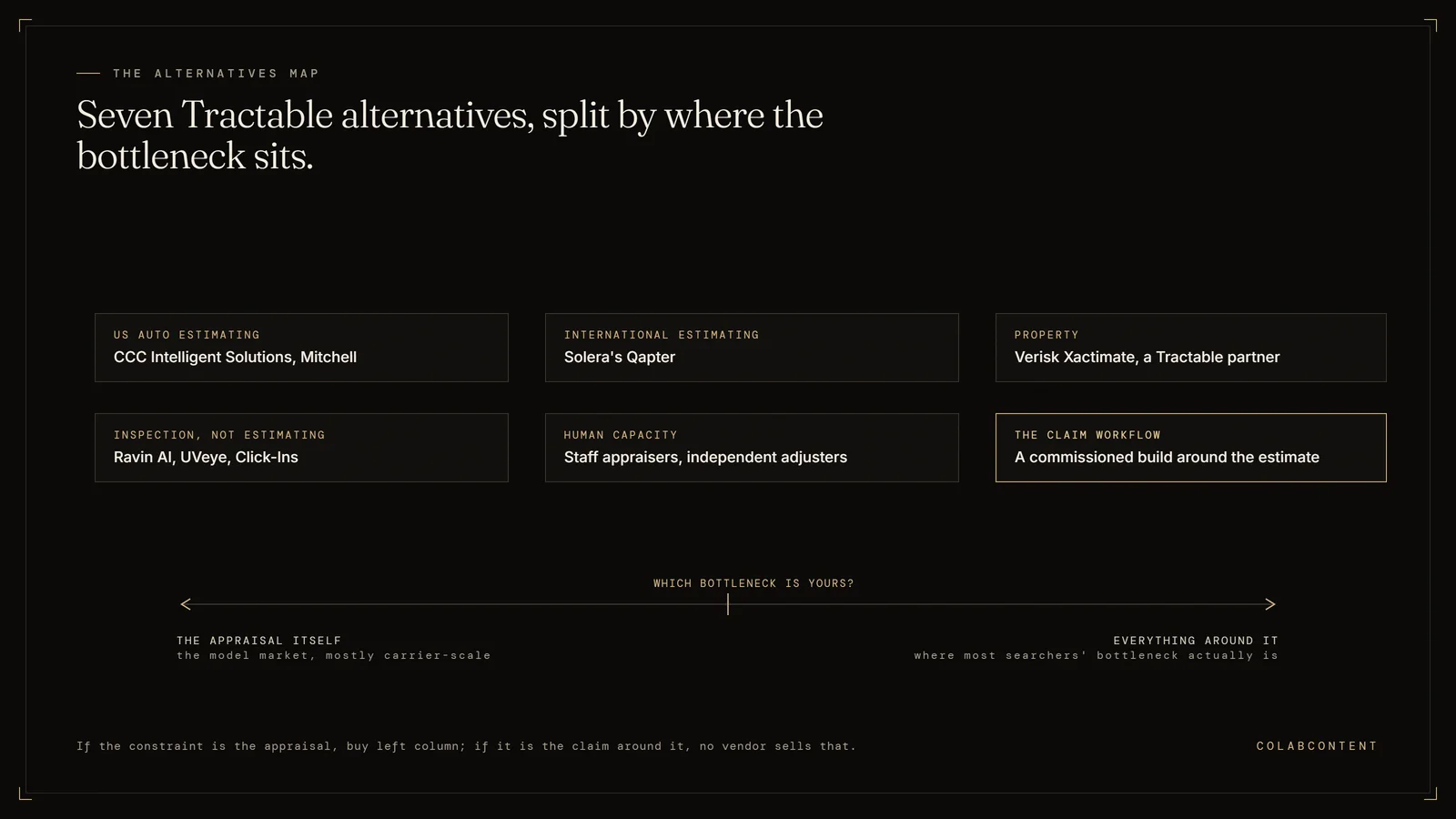
The real alternatives to Tractable AI are CCC Intelligent Solutions and Mitchell for US auto physical damage estimating, Solera's Qapter for the same job internationally, Verisk's Xactimate for property (where Tractable is a partner rather than a rival), pure-play vision vendors such as Ravin AI, UVeye and Click-Ins for inspection rather than estimating, staff appraisers and independent adjuster networks, and a commissioned build for the claim workflow that sits around the estimate. Which one is correct depends almost entirely on whether your bottleneck is the appraisal itself or everything attached to it. For most operators who search this phrase, it is the second one. ColabContent is a Boston commissioning house that builds custom AI systems for mid market operators. We commission the claim workflow layer that sits around the estimate, on the claim, policy and document data the carrier already owns, at a fixed fee of $45,000 to $180,000, with the code owned by the carrier at handoff. Book a free 45-minute diagnosis at cal.com/colabcontent/45mins or call (617) 675-9067. Before any call, ColabContent builds a working prototype of one task within 5 business days, requested at colabcontent.com/prototype/insurance/.
Written for P and C carriers, MGAs, TPAs, large agencies and fleet operators who have either seen a Tractable demo or been told to go find one. It covers what Tractable actually does, where it genuinely wins, the alternatives named and assessed fairly, and the honest math you should run before signing anything.
The short answer.
Tractable is an appraisal engine. It looks at photographs of damage and tells you what is broken and what it costs to fix. It is good at that, it is funded to stay good at that, and if the specific thing slowing your claims operation is the time it takes a human appraiser to write an estimate, Tractable or one of its direct competitors is a reasonable buy.
The problem is that for most operators the appraisal is not the slow part. A carrier can push most of its estimates through a model in minutes and still take the same number of days to close the claim, because those days are spent chasing photos, routing exceptions, assigning shops, handling supplements, and answering the phone. Buying a faster estimate does not compress a cycle that was never bound by the estimate.
So the useful version of this page is not "here are six logos that also do computer vision." It is: work out which half of the problem you actually have. If it is the appraisal, this page names the vendors and tells you how to test them. If it is the workflow around the appraisal, no vendor on this list sells that, and the honest answer is a commissioned build against your own systems.
What Tractable actually does.
Tractable is a computer vision company applied to physical damage. A policyholder, driver, or technician photographs the damage, usually on a phone through a mobile-friendly web link, and the model returns a structured assessment: which parts are damaged, how badly, and what the repair operation looks like. Its own site describes the work as "ultra-precise damage assessments by analyzing images down to the pixel."
The company organises its business around five buyer types rather than one: insurers, dealerships, repairers, recyclers, and fleet and rentals. That breadth matters when you compare it, because half the vendors people list as Tractable competitors only serve one of those five. Its more recent product work has pushed further into the repair side, including LumaScanner for fixed operations.
Two lines of business:
- Auto. The original and still the core. Damage detection, part identification, and repair assessment from smartphone photographs, used both for touchless claims settlement and for vehicle condition and appraisal work outside insurance.
- Property. In February 2023 Tractable and Verisk announced a partnership in which Tractable's property assessment feeds automated estimates on Verisk's Xactimate platform. Policyholders submit photos through a web app; the model identifies, classifies and measures the damage; Xactimate produces the estimate. Verisk's stated goal was cutting property claim settlement from months to as little as one day.
On credibility: Tractable raised a $65M Series E led by SoftBank Vision Fund 2 in July 2023, with Insight Partners and Georgian participating, having reached a billion-dollar valuation at its prior round. The logos on its own homepage today include Aviva, Tokio Marine, Sompo, MS&AD Aioi, Admiral, Mitchell, Kirmac, Nexsyis and Regina Auto Body. This is not a thin company you need to be warned about.
Named, and assessed fairly.
Where it wins: the network. If your DRP shops, your parts procurement and your estimating already run through CCC, adding intelligence inside that system is a shorter path than bolting a second vendor onto the side of it. The estimate lands where the work already happens.
Where it costs you: you are deepening a commitment to one ecosystem. The switching cost of the estimating platform is the highest switching cost in the claims stack, and every additional module raises it.
Diligence note: CCC filed suit against Tractable in the Northern District of Illinois in October 2018 over alleged misuse of its platform. Two of seven counts were dismissed without prejudice in January 2023 and the docket was terminated in February 2025. Your procurement team will find it, so know it exists. It says nothing about either product's accuracy.EstimatingNetwork incumbent
Where it wins: carriers that write both auto physical damage and casualty get one commercial relationship across two claim types, and Mitchell's shop-side tooling is genuinely deployed rather than aspirational.
Where it costs you: same ecosystem gravity as CCC. You are choosing a platform, not a feature. Note also that Mitchell appears as a partner logo on Tractable's own site, so treat "Mitchell or Tractable" as a question to ask both vendors directly rather than an assumption to make from the outside.EstimatingPlatform play
Where it wins: geography and parts data. If your book spans multiple countries, Audatex coverage and local labor rate data are hard to replicate, and Qapter inherits them.
Where it costs you: the same structural trade as the other two. And if your US operation is already deep in CCC or Mitchell, running Qapter alongside it means two estimating truths in one claims department, which is a reconciliation problem you will inherit forever.EstimatingGlobal data set
The nuance: since February 2023 Tractable's property assessment has fed automated estimates on Xactimate. If you are a property carrier asking "Tractable or Xactimate," the answer may be that you already have Xactimate and the real question is whether to turn on an AI assessment layer in front of it, from Tractable or from one of Verisk's own capabilities.
Where it costs you: nothing structural, because you almost certainly already run it. The honest caution is only that "we bought AI for property claims" and "we turned on a feature inside the estimating platform we already pay for" are very different projects with very different price tags, and vendors are not always eager to clarify which one you are being sold.PropertyPartner, not rival
Where it wins: they are usually cheaper, faster to pilot, and often better at a narrow job. UVeye's fixed-hardware scanning sees underbody and tire condition a phone camera cannot. Mobile-first vendors are strong on remote condition capture for fleets, rentals and dealer trade-in.
Where it costs you: most of them detect damage; far fewer produce a defensible repair estimate tied to parts and labor data. Detection and estimating are different products, and a claims operation needs the second one. Read every accuracy claim in this category with the question "accurate at what, exactly?"
The real selection rule: decide your capture model first. Vehicles that pass through a lane you control favour fixed hardware. Photos arriving from drivers, renters, or policyholders favour mobile-first. That single decision eliminates most of the shortlist before any accuracy number matters.InspectionDetection ≠ estimating
Where it wins: judgment on the expensive half of the book. Hidden structural damage, total loss decisions, prior damage disputes, and anything with a represented claimant are where photo-based assessment is weakest and an experienced appraiser is worth what you pay them.
Where it costs you: cost scales with volume, permanently, and the capacity is not there when a catastrophe puts ten thousand claims into the queue in a week. The investment does not compound; a system does.
The realistic posture is not one or the other. It is a defensible triage line between them, which is itself a build problem rather than a buying problem.HumanStill the default
Where it wins: when the appraisal is already fast enough and the cycle time is still bad. That describes a large share of the operators who search for a Tractable alternative in the first place.
Where it costs you: it takes longer to stand up than signing a SaaS contract, and it demands that you can describe your own process precisely. It is also the wrong answer if the appraisal genuinely is your constraint.
What it is not: a rebuild of the vision model. We would not take that engagement and you should not fund it. See what we do not build.CommissionDifferent layer
The honest math.
Start with the uncomfortable fact: not one vendor on this page publishes pricing. Not Tractable, not CCC, not Mitchell, not Solera. Every figure you receive comes out of a scoped commercial conversation shaped around your claim volume, your lines of business, and how deep the integration goes. Any third-party page quoting you a price for these vendors invented it.
That means the business case has to be built on the side of the equation you control, which is your own operating data. Four numbers decide it.
- Touchless rate, by severity band. Not the headline touchless rate. The rate inside each severity band. A model that goes touchless on 90 percent of the cheap half of your book has not been anywhere near the expensive half, and the expensive half is where the money is.
- Cycle time from first notice of loss to a usable estimate. Measure it today, in days, before any demo. If the median is four days and only six hours of that is appraisal, you have just discovered that appraisal AI can improve at most six hours of a four-day problem.
- Severity variance against a re-inspected control group. Run the model against closed claims and compare its number to the settled number. A model that is fast and consistently light on severity is not saving you money; it is moving the cost into supplements and complaints.
- Supplement and re-inspection rate after the fact. The number that tells you whether the touchless rate was real. Touchless claims that come back as supplements were not touchless, they were deferred.
For a published reference point, Tractable's own Admiral Seguros case study reports 90 percent of claim estimates processed without human appraisers, 98 percent of claims completed in under 15 minutes, and roughly 12,000 touchless claims. Those numbers are real and they are also a vendor-published result on one Spanish personal auto book. Use them as a ceiling to reason about, not a forecast to underwrite.
And then the number that decides whether any of this was the right project: total cycle time from loss to close. If estimate time falls sharply and total cycle time barely moves, the appraisal was never your constraint, and whatever you signed for would have bought more somewhere else. That measurement discipline is the same one laid out in how to run an AI pilot that produces a decision and how to measure ROI on a mid-market AI engagement.
The decision tree.
- Are you an insurance agency rather than a carrier? Then Tractable is not your tool and neither is any alternative on this page. You do not write repair estimates. Your problem is renewals, servicing, endorsements, certificates and phone volume, and it lives in your AMS. Start at AI for insurance agencies.
- Is the appraisal genuinely your bottleneck, measured in days? If yes, this is a real buy. Shortlist Tractable alongside whichever estimating platform you already run, and test all of them on the same sample of your own closed claims.
- Are you already deep in CCC, Mitchell, or Solera? Evaluate their native AI first. Not because it is better, but because the integration cost of a second vendor inside the estimating workflow is the cost everyone underestimates.
- Is this property rather than auto? Check what your Xactimate contract already includes before you scope anything new. The Tractable and Verisk partnership means the question may be a feature decision, not a vendor decision.
- Are you a fleet, rental, dealer group, or recycler rather than an insurer? Decide the capture model first, fixed lane hardware versus mobile photo submission. That halves the shortlist immediately.
- Is estimate speed fine and total cycle time still bad? No vendor here fixes that. The work is intake, chase, routing, exceptions and communications, and it is a commissioned build against your own systems.
- Can you not yet answer question two with a number? Then you are not ready to buy anything. Measure first. That is a two-week exercise, not a project.
Where the comparison actually gets decided.
What Tractable is genuinely good at.
The hard part of visual damage appraisal is not the model architecture. It is the labelled corpus. Getting a model to reliably distinguish a bumper cover that can be refinished from one that must be replaced requires an enormous set of historical claims with known repair outcomes, photographed under real conditions: bad light, wrong angle, wet paint, half the panel out of frame. Tractable has spent since 2014 accumulating that, and it is the reason the company exists rather than a competitor with a better research team.
That corpus is not something a carrier can replicate, and it is not something a consultancy can build for you. It is the honest reason to buy rather than build this specific layer. When we are asked whether we would build a damage detection model for a mid-market carrier, the answer is no, and the reason is this paragraph.
The second thing Tractable does well is breadth of buyer. Most of its comparison set serves one constituency. Tractable sells to insurers, dealerships, repairers, recyclers, and fleet and rental operators, which means the same assessment capability shows up at several points in a vehicle's life. For an operator sitting at more than one of those points, that is a real advantage and it does not show up on a feature grid.
Where a deployment stalls, and it is usually not the model.
The recognised limits of any photo-based assessment are the same across every vendor in the category, and reputable ones will tell you: the output is bounded by the input photographs. Poor light, missing angles, and low resolution degrade the assessment. Hidden structural damage behind an intact panel is invisible by definition. Unusual vehicles, heavily modified vehicles, and older vehicles with thin repair data are weaker cases. Every serious deployment therefore keeps a human exception path, and the size of that exception queue is the number that decides whether the project worked.
But the more common stall is upstream of all of that. The model needs good photos. Good photos require the policyholder to receive a link, understand it, stand in the right place, and take six specific pictures in the rain, at the scene, while upset. In most deployments the single biggest gap between the pilot result and the production result is the photo capture completion rate, and no vision vendor is accountable for it.
Tractable's own Admiral Seguros case study puts a number on this from the good side: 70 to 75 percent of customers who received the app link completed the entire claim process. Read that from the other direction. On a strong deployment, a quarter to a third of policyholders still fell out of the automated path, and every one of those became a phone call, a follow-up, and a manual file. The capture funnel, the chase sequence, and the phone queue behind it are exactly the work that no vendor on this page sells and every operator on this page owns.
What we would build, and what we would refuse to.
We would refuse: a from-scratch damage detection model. The corpus problem above is not solvable with budget at mid-market scale, and anyone who tells you otherwise is selling you a research project with a claims department attached. If appraisal accuracy is your constraint, buy it from someone whose entire company is that model.
We would build: the operating system around it. Concretely, that is first notice of loss intake that captures a structured file rather than a voicemail; a photo capture sequence that nudges, re-prompts and escalates until the set is complete; a triage layer that routes by severity, coverage, complexity and represented status; exception queues with named owners and ageing; supplement handling that does not restart the file; shop assignment against real capacity; and status communication that stops the claimant calling to ask where their car is.
And the phones. Inbound claim calls are the most underestimated line in a claims operation, and they are the piece of this we have the most production evidence on. Across clients we have handled more than 6,000 live calls with commissioned voice systems. At Jim Glaser Law, a firm that will take a reference call, that is 3,787 AI-handled calls and 5,514 minutes across five channel-specific agents covering PPC, Organic, TV, Meta and LSA, which gives the firm per-channel attribution on answered calls rather than on form fills alone. A multi-location home services operator runs 1,486 calls and 2,203 minutes on the same pattern. A regional third-party logistics and warehousing operator runs 211. A realty firm runs 148. The pattern generalises to a claims intake line without much argument.
On the ledger side, the closest analogue we have to claims and reserve accounting is a commissioned matter, invoice and trust platform running a law firm: 13,296 matters, 4,396 clients, 5,684 invoices, and IOLTA trust reconciled byte-identical. Trust accounting is unforgiving in the same way reserve accounting is unforgiving, which is the relevant point.
How to run the bake-off so the result means something.
Every vendor in this category demos well, because every vendor demos on photographs that suit the model. The only test worth running is on your own closed claims, and the design of that test is where most evaluations go wrong.
Build the sample from your real severity mix. If 18 percent of your book is over $6,000, then 18 percent of the sample is over $6,000. The single most common evaluation error is a sample skewed toward clean, cheap, well-photographed claims, which flatters every vendor equally and tells you nothing.
Include the ugly ones on purpose. Prior damage. Aftermarket parts. Three photographs where the process calls for eight. A total loss that was not obviously a total loss. These are the claims that decide whether the exception queue is manageable.
Score against the settled figure, not the demo narrative. Variance in dollars, both directions, per severity band. Consistent underestimation is worse than random error because it hides in the aggregate and surfaces later as supplements.
Give every vendor the identical sample, including the incumbent. Your existing estimating platform goes in the bake-off too. Sometimes the honest result is that the native capability in the system you already pay for is close enough that a second vendor is not worth the integration.
And time-box it. Six weeks, one decision, written before you start: what result would make us buy, and what result would make us walk. A pilot without that sentence written down in advance becomes a permanent pilot.
If you are an agency and not a carrier, read this instead.
A meaningful share of the people searching for an alternative to Tractable AI are working at insurance agencies, not carriers. If that is you, the honest answer is that this entire category is aimed at someone else. Agencies do not write repair estimates. The claims work you touch is advocacy and follow-up, not appraisal.
What is actually eating your hours is renewals, remarketing, certificates, endorsements, policy checking, carrier download reconciliation, and the phone. That work lives in your management system, and the useful starting point is the API surface of whichever one you run: Applied Epic, AMS360, EZLynx, or HawkSoft.
If renewals specifically are the pain, the closest comparison on this site is Quandri versus a commissioned build, with the wider option set laid out in Quandri alternatives. For where agency AI budgets actually land, see what AI consulting costs for an insurance agency and the P and C agency AI benchmark.
Frequently Asked Questions
What does Tractable AI actually do?
Tractable applies computer vision to photographs of damage and returns a structured assessment of what is damaged and what it takes to repair it. Its own site describes ultra-precise damage assessments made by analyzing images down to the pixel, and groups its work under insurers, dealerships, repairers, recyclers, and fleet and rentals. It covers auto damage and, through a February 2023 partnership with Verisk, property damage feeding estimates on Xactimate. It is an appraisal engine, not a claims system.
How much does Tractable AI cost?
Tractable does not publish pricing, and neither do CCC, Mitchell, or Solera at the list level. Every number you will get comes out of a scoped commercial conversation and is usually shaped around claim volume, lines of business, and how deeply the assessment plugs into your estimating platform. Anyone quoting you a public price for any of these vendors is guessing. Build your business case on your own cycle time and severity data instead, because that is the only side of the equation you control.
Who are Tractable AI's main competitors?
In US auto physical damage the volume incumbent is CCC Intelligent Solutions, with Mitchell (part of Enlyte) the other established estimating platform. Solera's Qapter, built on the Audatex data set, is the global counterpart. In property, Verisk's Xactimate is the estimating standard, though Tractable partners with Verisk rather than competing head-on. A separate group of pure-play vision vendors including Ravin AI, UVeye, Click-Ins, Inspektlabs, Spyne, and Monk (acquired by ACV Auctions in 2022) sell inspection rather than estimating.
We are an insurance agency, not a carrier. Is Tractable AI the right tool for us?
Almost certainly not. Agencies do not write repair estimates; carriers and their appraisal networks do. If you are an agency that found this page while looking for AI, the bottleneck is nearly always renewals, servicing, certificates, endorsements, and inbound phone volume, none of which a damage appraisal model touches. That work sits in your AMS, and the honest starting point is your Applied Epic, AMS360, EZLynx, or HawkSoft data rather than a claims vision vendor.
Can you build your own alternative to Tractable AI?
You can build the workflow around the assessment. You should not try to rebuild the assessment itself. A damage detection model earns its accuracy from an enormous labelled corpus of historical claims with known repair outcomes, and no mid-market carrier or agency has that corpus. What is genuinely buildable is everything the vendor does not sell: photo capture chase, triage and routing, exception queues, supplement handling, shop assignment, status communications, and inbound claim call handling.
What is the best alternative to Tractable AI for a dealership, fleet, or recycler?
That depends entirely on whether the vehicle comes to a fixed location or the photos come to you. If units pass through a lane you control, fixed-hardware scanning from a vendor like UVeye captures far more than a phone can. If condition reports arrive as photos from drivers, renters, or remote sites, mobile-first vendors such as Ravin AI, Click-Ins, or Inspektlabs are the closer match. Decide the capture model first, because it eliminates most of the shortlist before you look at any accuracy claim.
How do I evaluate an AI damage appraisal vendor without taking the demo at face value?
Give every vendor the same sample of your own closed claims, including the ugly ones, and score the output against the settled figure rather than against the demo. Insist the sample mirrors your real severity mix, not the clean half of it. Then measure four things: touchless rate, cycle time from first notice of loss to a usable estimate, severity variance against a re-inspected control group, and supplement rate after the fact. A vendor confident in the product will agree to that test.
Is Tractable AI accurate enough to settle claims without a human?
On the right slice of a book, its published reference points say yes. Tractable's own Admiral Seguros case study reports 90 percent of claim estimates processed without human appraisers and 98 percent of claims completed in under 15 minutes. Treat that as a ceiling rather than a forecast, because it is a vendor-published result on one Spanish personal auto book. Photo quality, hidden structural damage, and unusual vehicles are the recognised limits of any photo-based assessment, and every serious deployment keeps an exception path to a human.
Book the 45-minute diagnosis.
No slides. We walk your loss-to-close cycle, find out whether the appraisal is actually the constraint, and tell you plainly whether to buy a vendor or commission the layer around one.
Where to look next.
If the conclusion is that the appraisal is not your constraint, the next question is what shape the alternative should take. The framework we use for that call is build, buy, or commission, and the sharper version aimed at exactly this decision is off-the-shelf AI versus a custom commission. If the pressure is coming from a platform vendor telling you their AI module covers it, generic SaaS AI versus a commissioned build is the one to read before that meeting.
On the insurance side specifically, AI for insurance agencies covers the agency workflow this page keeps pointing back at, AI consulting costs for insurance gives real ranges rather than a "contact us," and how to choose an AI consultant for an insurance business is the diligence checklist. If you would rather see who else does this work before you talk to anyone, the best AI consultants for insurance agencies names competitors, not just us.
For adjacent vendor comparisons in the same category of decision, Quandri versus a commissioned build and Quandri alternatives follow the same structure for renewals rather than claims. And if you want a number on your own operation before you talk to any vendor at all, the insurance operations benchmark takes about ten minutes and gives you the cycle-time baseline this whole page depends on.