The question everyone asks first, and the safest link in the chain.
Whether the model provider trains on your data is the question that opens almost every one of these conversations, and it deserves about four minutes of attention. The answer is written down. Model providers publish their terms for business use, and the vendor building your system either passes those terms through to you in writing or does not. Read both, restate the answer in your own contract, and the question is closed. It is a real question with a checkable answer, which is exactly what makes it the wrong place to spend the leverage you have before signing.
What it hides is that the model provider is one party in a chain of several, and it is the party with the most public scrutiny, the most standardized contract, and the most to lose from handling business data badly. The links with no published policy page are the ones specific to the firm you are about to hire: the engineers who will read your records to build against them, the contractors that firm subcontracts to when a deadline moves, the hosting and monitoring tools their system depends on, and the copies of real data that pile up in staging environments over the course of a build. Nobody publishes a page about any of that, and no buyer asks unprompted.
The general work of separating a serious partner from a reseller is a different exercise, worked through in how to choose an AI consultant for a mid-market company, and one paragraph of it says to ask where your data lives during the build and who can see it. This memo is that paragraph opened up, because for a company holding other people's records it is the part of the diligence with the longest tail and the least written about it.
Count the copies, and name who controls each one.
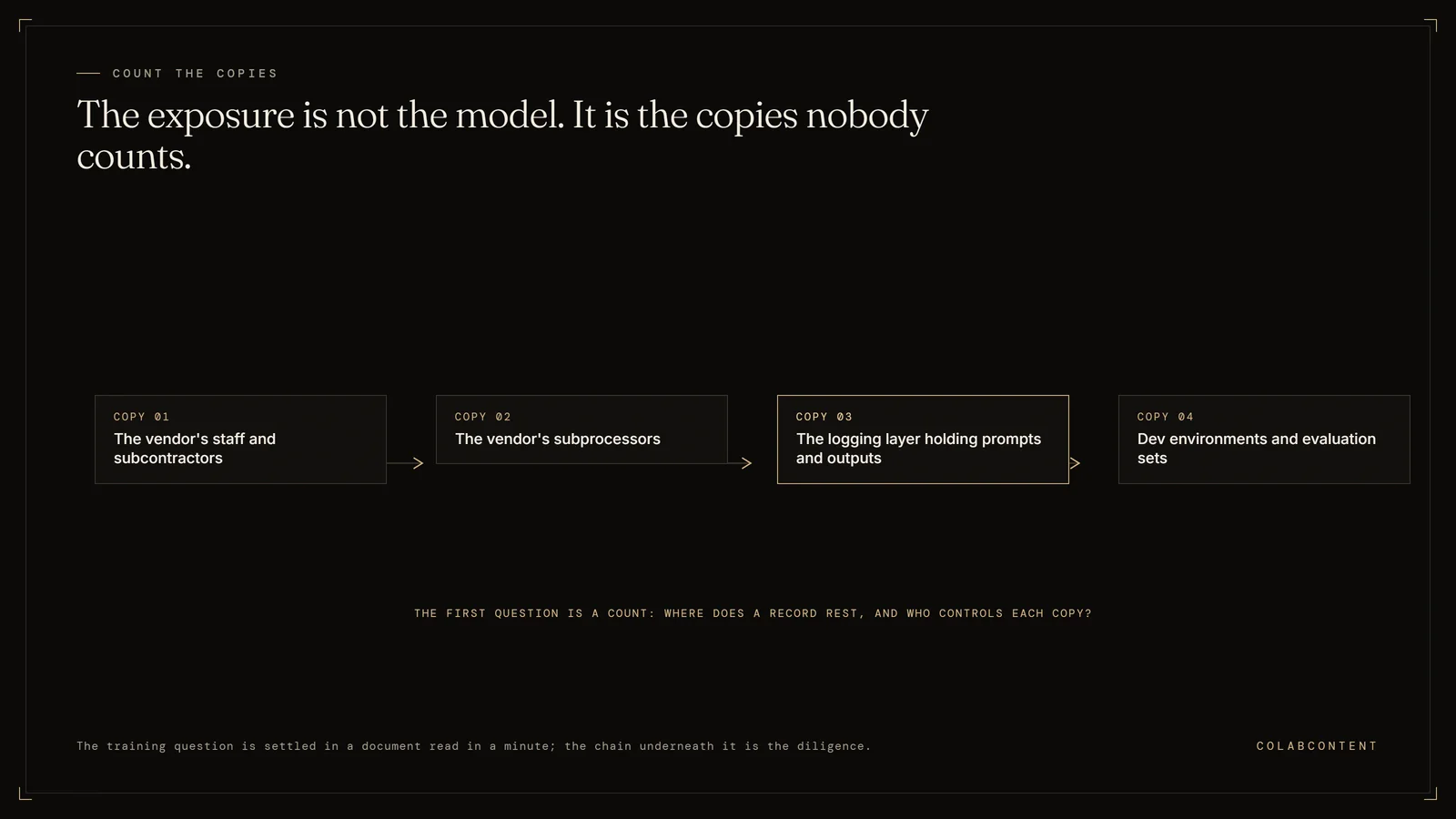
The exercise that reorganizes everything else takes twenty minutes and no technical knowledge. Take one record, a client file, a claim, an invoice, and trace it from your system of record to the answer that appears on somebody's screen. Write down every place it comes to rest along the way, and write the controlling party next to each one. The list is longer than the architecture diagram suggests, and the length of it is the exposure.
A typical custom build produces six or seven resting places. There is the application database the system runs on. There is a vector store holding embeddings generated from your documents, which is a copy, whatever the word embedding suggests, because the passages it points back to are your text. There is the logging and trace layer that stores the prompt, the retrieved passage, and the output, which exists because nobody can debug a wrong answer without it. There are backups behind all of those, on a rotation nobody has looked at. There are the development and staging environments, where a slice of real production data was pulled early so the team could build against reality rather than against invented rows. There is the evaluation set. And there is whatever gets pasted into the vendor's own ticketing system the first time somebody debugs a case with a colleague.
Each of those sits under a different party, a different contract, and a different retention default. If you cannot name the controlling party for a row, that row is your first question for the vendor. This is a separate question from whether the data is any good, which is the subject of data readiness for one named workflow. Usable and safe are different properties, and a company can pass one and fail the other, because the same records are being examined for two different reasons.
Size the diligence by what the system can do, not by what it can see.
Most vendor security questionnaires ask the same questions of every project, which over-taxes the harmless system and under-taxes the dangerous one. The variable that should set the depth is not the sensitivity of what the system reads. It is what the system is permitted to do, because that decides what a mistake costs and whether it can be reversed.
Three tiers cover almost everything a mid-market company commissions. A read-only system that retrieves from internal documents and answers a person can see everything and change nothing, so its worst failure is disclosure to your own staff of something they were not supposed to see, which is a real problem with a bounded shape. A system with write access to a record of account can change what the company believes to be true about a customer, a balance, a schedule, or a case, and its worst failure is a change nobody notices for a month. A system that sends anything outside the company, an email, a filing, a quote, a message to a counterparty, has a failure mode that cannot be recalled at all.
The asymmetry runs against intuition. The read-only system often touches more sensitive material than the write-capable one, since pointing a retrieval layer at the whole document store is easy and pointing a write integration at one field is deliberate. It is still the lower risk object. For the read-only tier the questions are about copies and access, and they can be settled quickly. For the write tier a different set applies: precisely which fields and records can it change, who approved that scope, is every action logged against an identifiable actor, is there a reversal path, and what threshold sends a case to a person instead. Those are operational questions rather than security ones, which is why they fall through the gaps in a standard questionnaire. The same capability axis decides a good deal about what to commission in the first place, which is the argument in the build versus buy decision for a mid-market company.
Regulated material is a contract question, not a technology question.
For client financials, health information, privileged legal material, and employee records, the question a buyer usually asks is whether it is permitted to use AI on this at all. That framing produces long conversations and no decisions. The answerable version is narrower: which layer of the stack touches this category, and under whose contract. An obligation travels with the data. If you hold records under an engagement letter, a client confidentiality term, a carrier requirement, or a professional duty, that constraint follows the record into every one of the resting places you just listed, and the relevant test is whether each party holding a copy is under an instrument that carries it.
Which makes the subprocessor list the most useful document to request, in writing, before signing. It names the parties underneath your vendor: the hosting provider, the model provider, the trace tool, whatever handles storage or search on the way through. Read it against the agreements you have already signed with your own clients, because some of those restrict disclosure to subcontractors without notice or consent, and a vendor cannot tell you whether you are in breach of a contract they have never read. This is the one place where an hour of your counsel's time is genuinely worth buying, and it is an hour on one page rather than a review of the whole build.
There is also a cheaper move that gets skipped because it feels like a retreat. Scope the regulated category out of version one. If the workflow covers the cases that carry no special obligation and routes the rest to a person, the paperwork shrinks to something an operator can finish in a week, and the build ships while the harder question gets answered properly. That belongs in the scope document rather than in a side conversation, and where it goes is covered in writing the scope for a custom AI build.
Prefer the answer you can hold, because you do not have a CISO.
The person running this diligence at an established mid-market company is an owner, a COO, or a finance lead who has eleven other things happening this week. There is no security team to hand it to, and hiring an assessor for a single project usually costs a visible fraction of the build. So the practical value of a question is not how penetrating it sounds. It is how well a non-specialist can judge the answer, which means the best questions are the ones whose answer is an artifact rather than a sentence.
The rewrite is mechanical once you see it. Instead of asking whether the data is encrypted, which invites a yes that tells you nothing, ask for the list of people at their company who can read your production data, by name or role, and how that list is reviewed. Instead of asking whether prompts are retained, ask what the retention is set to today in the tool that stores them and to see the setting. Instead of asking whether they are secure, ask for the subprocessor list. Instead of asking whether they will delete your data, ask which clause says so and what it names. Every one of those answers is a document, a screenshot, a configuration value, or a clause, and every one can be judged by somebody who has never configured anything.
A reassuring answer costs a vendor nothing to give, and it is not evidence of anything except that they have answered the question before. An artifact costs them either the truth or a lie in writing, and firms behave differently when that is the choice. The reaction itself is most of the finding: a vendor who works this way sends the documents over within a day, and one who does not keeps the conversation verbal and warm.
The exit, where the copies you forgot are still sitting.
What you receive when an engagement ends is the ownership question, and it is settled by the contract and confirmed at handoff, which is worked through in owning your AI and what a real code handoff contains. The security question is its mirror image, and it is almost never asked: what does the vendor no longer hold. Those are two different clauses, and a company can get the first one perfect and never think about the second.
A promise to delete your data on request covers the obvious copy and leaves the rest, because whoever performs the deletion will reasonably read it as the production database. Name the others in the agreement: backups, the vector store and the embeddings derived from your documents, logs and traces including whatever the observability tool retains on its own schedule, the evaluation set, every development and staging copy, and any records sitting in the vendor's support tooling from a debugging session. Ask what the subprocessors underneath are obliged to do and on what timeline, because a vendor cannot delete faster than the parties they depend on, and most of them have never checked.
If this is the question in front of your own business right now, the $499 AI-Ready Audit answers it against your numbers, not a general case, in a report you get back the same day.
Then ask for confirmation in writing within a stated number of days. None of this is adversarial and none of it is expensive to agree before signing; a firm that intends to comply will treat it as routine. It becomes awkward only in the other order, when you are asking a company you have just left to do unpaid work on your behalf, at the exact moment your leverage is gone.
The honest counter-case, and the diligence that is theater.
We build custom systems for a living, so weigh this accordingly and then take it seriously, because there are several common situations where everything above is a waste of a quarter. The clearest one is a genuinely low-sensitivity internal workflow. If the system reads your own marketing copy, your published documentation, or a knowledge base you would happily hand a competitor, then run the test out loud: if the entire input corpus appeared on the internet tomorrow, what actually happens. When the honest answer is that almost nothing happens, the standard questions about retention and access can be settled in an afternoon, and six weeks of review buys no protection while costing real momentum. Security review is one of the more respectable ways for a company to avoid making a decision, and it is worth noticing when that is what is happening.
The second case is the platform you already run. Your CRM (customer relationship management software), your help desk, your accounting system, or your productivity suite already holds the same records under an agreement negotiated on behalf of a customer base far larger than you, and their terms are frequently stronger than anything a small build shop will sign. If their AI tier does the job you were about to commission, the security question is already answered and you skipped it entirely. Check what is included in a plan you are paying for before you introduce a new party to the data. The cost side of that trade runs the other way over time and is worked through in the real cost of off-the-shelf AI at scale, but on this particular question the incumbent usually wins.
The third is the sharpest, and it lands on more mid-market companies than the other two combined. A company with no data classification at all, where nobody has ever written down which categories of record carry an obligation and which do not, is in no position to interrogate a vendor about handling. It is asking a stranger to be more careful with your records than you are, and the vendor's answers cannot be evaluated because there is no internal standard to evaluate them against. That work is a week of internal effort, it costs nothing but attention, and it makes every vendor conversation afterward shorter. Do that first.
What an operator can do this week, with no vendor in the room.
One page and an afternoon produce most of the value here. Write three lists. The first is actions: everything the system would be permitted to do, sorted into read, change, and send outside the company. Most operators can fill this in from the workflow description they already have in their head, and the sorting is the point, because the three columns carry completely different consequences.
The second is resting places: every location a record would come to rest, with the controlling party named beside it. Your own systems, the vendor's environment, the hosting provider, the model provider, the trace store, the vector store, the backups. Any row where you cannot name the party is a question for the vendor, and the count of those rows tells you how much of this system you currently understand. The third is obligations: for each category of input, whose promise you are keeping. A client engagement letter, an employee handbook, a carrier requirement, a regulator, or nobody. That last answer is a real answer and the most common one, which is worth knowing before you treat every input as privileged.
Then draw one line. Anything sitting in the change or send column that touches an input row carrying an obligation is where your entire diligence budget goes. Everything outside that intersection gets the short version. That single page will do more to focus a vendor conversation than any questionnaire you can download, and it is the same input the structured diagnosis we run starts from before anything gets scoped. If you have not picked the workflow yet, the AI Maturity Index gets you to the named process and the resting-places map in about ten minutes, which is where this exercise has to begin anyway.