Why "how long" is the wrong first question.
When an owner asks how long a build will take, the question underneath it is usually about risk. You want to know when you will see something working, how much of your team's attention this will cost, and whether the project will drag into an open-ended expense with no clear finish. Those are the right worries. The trouble is that treating the timeline as a property of the builder, something you negotiate down the way you would a delivery date, points you at the one factor that barely moves the outcome. Engineering speed is real, but it is not what stretches a mid-market AI build from weeks into quarters.
What actually sets the clock is scope and readiness, and both of those live on your side of the table. Scope is how much you are asking the build to do: one named workflow, or a vague ambition to modernize a department. Readiness is how prepared your operation is to be built against: whether the target process is settled, whether it lives in a system a builder can read from, whether someone with authority can answer questions and approve changes without convening a committee. A team of any speed will ship quickly against a narrow, ready target and slowly against a broad, unready one. The variable you can actually pull is not the builder's pace; it is the shape of what you hand them.
This is not a comfortable thing to hear, because it moves the responsibility for the schedule from the vendor, where it feels safely external, onto you, where it is real work. But it is also the most valuable thing you can learn before commissioning anything, because a factor you control is a factor you can improve, and the builder's raw speed is not. Two companies can hire the identical team and get wildly different timelines out of it, and the difference is almost never the team. It is that one company arrived with a bounded problem and a prepared operation, and the other arrived with an ambition and a promise to sort out the details later. The details are the timeline. Sorting them out before the build starts is the single highest-leverage thing an owner does, and it happens entirely on your side of the table.
So the useful reframe is that a timeline is something you largely design, not something you are quoted. The owner who walks in with a single workflow, a number that says what it costs, clean-enough data in a real system, and one person empowered to decide is buying a fast build regardless of who does the work. The owner who walks in with a wish list and data scattered across inboxes is buying a slow one, and no amount of pressing the builder to work harder will change that. The rest of this memo is what that design looks like in practice, phase by phase, so you can see where your time actually goes and where you can genuinely shorten it.
The five phases of an honest build.
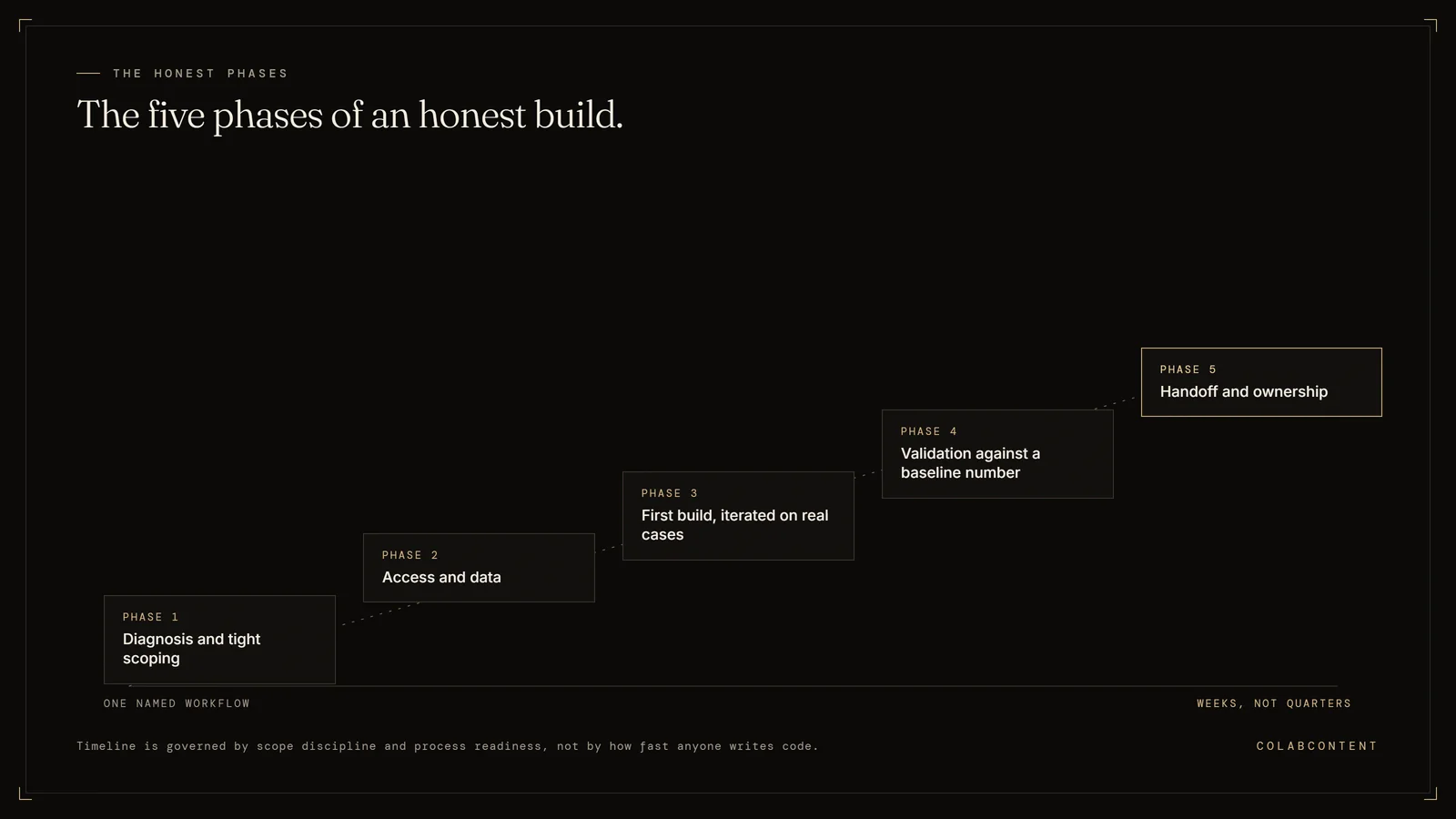
A custom AI build moves through five phases, and it is worth naming them plainly because only one is the thing most people picture when they imagine building. The first is diagnosis and tight scoping. Before anything gets made, the work is to narrow the target to a single named workflow and attach a baseline number to it, so everyone agrees on what is being built and how you will know it worked. This phase is cheap in calendar time and enormous in leverage, because a scope decided loosely here is a schedule that slips everywhere later. A build that begins without a named workflow and a number has not started early; it has skipped the step that makes the finish possible.
The second phase is getting access and clean-enough data, and it is the one owners consistently underestimate. A builder cannot work against a process they cannot reach. That means logins to the system of record (the one system that holds the official copy of a record), a real sample of the data the workflow runs on, and permission to see how the process actually behaves rather than how the org chart says it should. This phase produces nothing visible, which is exactly why it gets treated as a formality and then quietly becomes the longest wait in the whole project. When a build feels stalled in its early weeks, the cause is almost never the code; it is a builder sitting idle waiting for access that someone on the client side has not gotten around to granting.
The third phase is the first working build and iteration against real cases, and this is the part that looks like building. A first version goes up, it meets the messy reality of actual inputs and edge cases, and it gets corrected against them run after run. This is where the exceptions live, and handling exceptions is most of the genuine work; the happy path is quick, and the long tail of "but what about this case" is where the real time goes. The fourth phase is validation against the baseline, where the system runs against enough real cases to prove it actually moved the number it was meant to move, using the method laid out in how to measure ROI on a mid-market AI engagement. The fifth is handoff and ownership, making sure the result survives after the builder leaves, which is a business step as much as a technical one. The phases that decide your timeline are the first, the second, and the last, and all three sit largely on your side of the table.
It is worth dwelling on that fifth phase, because it is the one owners assume is free and the one that quietly determines whether the whole build was worth the calendar it took. A system that works while the builder is still in the room, and then decays the moment they leave because nobody on your team was set up to run it, has not really finished; it has only paused before failing. Handoff means someone on your side knows how the workflow now runs, owns the number it is supposed to move, and has the authority to keep it running as reality shifts. Budget real time for it rather than treating it as a formality at the end. A build closed cleanly, with an owner who can carry it, is the difference between a one-time result and a permanent one, and skimping on this phase to save a week is how good builds quietly rot in month three.
What makes a build run long, and why.
Builds that overrun rarely do so because the engineering was hard. They overrun for four reasons, and every one of them is a scope or readiness problem wearing an engineering costume. The first and most common is scope creep. A build gets scoped to one workflow, the first version starts to work, and the excitement turns into "while we are in here, could it also do this." Each addition sounds small and each one resets the clock, because it reopens the questions of what to build and how to prove it. The single biggest reason a weeks-long build becomes a quarters-long one is that nobody held the scope to the one workflow it started as. This is the same pattern that quietly kills momentum a few months in, traced in why most mid-market AI rollouts stall in month four.
The second is an unstable underlying process. A build captures a workflow as it exists and runs it with less human handling, which only works if the workflow is holding still. If the process is still changing every few weeks, still being argued over, still mid-redesign, then the builder is trying to encode a moving target and every change to the process is a change to the build. The third is waiting on access and data, the quiet time sink from the second phase, where a builder loses days or weeks to logins and samples that were promised but never arrive. The fourth is the absence of an internal owner who can decide. When every question the builder raises has to route through a committee, or waits on a sponsor who is too busy to answer, the project moves at the speed of the slowest approval, which in most organizations is very slow indeed. Whether that owner exists is part of the readiness picture drawn in the signs your business is ready for custom AI.
The thread running through all four is that pushing the builder to code faster addresses none of them. You cannot type your way out of a scope that keeps expanding, a process that keeps shifting, a login that has not been granted, or a decision that nobody is empowered to make. Owners who treat an overrunning build as a performance problem and lean on the vendor for more speed are pressing the one lever that does nothing, while the real levers, all of which they control, sit untouched. The delays that stretch a build are almost never in the middle phase where the building happens; they are in the phases on either side of it that belong to the client.
What compresses a build into weeks, not quarters.
The good news in all of this is that if the things which stretch a build are on your side, so are the things that shorten it. The first and most powerful is a named workflow. When the target is one specific process you can draw on a whiteboard, rather than a department or a theme, the scope is bounded, the questions are finite, and the finish is definable from the start. A build with a clear edge to it moves fast because everyone knows what is in and what is out, and the decision to keep something out is already made. The discipline of choosing one workflow, and buying an off-the-shelf tool for the commodity work around it, is the same discipline covered in build versus buy AI for a mid-market company.
None of this replaces a look at your own numbers, and that is what the $499 AI-Ready Audit is for: a written report on your business the same day.
The second accelerant is a baseline number, because it fixes the definition of done. When the workflow costs a known figure today, the build is finished when the system moves that figure, and there is no room for the drift where a project stays open because nobody agreed what finished meant. A baseline turns validation from an argument into a measurement. The third is readiness on access and data: having the logins granted, the system of record identified, and a clean-enough data sample ready on day one instead of eight weeks in. This single change often removes the longest wait in the whole project, and it costs you a little preparation rather than any money. The fourth is fixed-fee scoping, which structurally resists scope creep because both sides agreed up front what the fee buys, and additions are a deliberate new decision rather than a quiet expansion. What such scoping looks like and what it runs is laid out in what a mid-market AI engagement actually costs.
The fifth, and the one owners most often skip, is a single empowered owner. One person who can answer the builder's questions, approve changes, and stand behind the new way the workflow runs, without routing each decision through a committee, is worth more to your timeline than any technical choice. A build moves at the speed of its decisions, and decisions move at the speed of the person authorized to make them. Give the project one owner with real authority and the questions get answered in hours instead of weeks. Spread the authority across a committee and the same build takes months longer for reasons that never appear in any technical review. The structured version of scoping, access, and ownership that keeps all of this tight is the same one described in how a structured diagnosis works.
Controlling the timeline from your side of the table.
Put the two lists side by side and a plain conclusion falls out. Almost everything that stretches a build and almost everything that compresses it lives with the client, not the builder. Scope, process stability, access, and ownership are yours; engineering speed, the one thing you were tempted to negotiate, is close to a constant. That is not a disappointment. It is the most useful thing you can know before commissioning a build, because it means the timeline is not something you are quoted and must accept. It is something you largely design, by deciding how narrow the target is and how ready your operation is to be built against.
The practical version of that control is a short discipline you run before you sign anything. Name the one workflow and refuse, in advance, to let it grow into three before the first one ships. Bring a baseline number, so the finish line is fixed and the definition of done is not up for interpretation. Get your access and a clean-enough data sample ready to hand over on day one, not promised for later. Name the single owner who will answer questions and approve changes, and make sure that person has the authority and the time to actually do it. Do those four things and you have removed, before the build starts, the four reasons builds run long. What is left is the honest engineering in the middle, which was never the slow part.
There is one thing you cannot and should not compress, and it is worth being clear about it. Validation is not optional, and it is not where you save time. The system still has to run against enough real cases to prove it moved the baseline number, and skipping that to hit a date does not produce a faster build; it produces an unverified one, which is the most expensive kind of build there is. The goal is not the shortest possible calendar. It is the shortest honest one: a tightly scoped build that ships quickly because you made it easy to, and then earns the finish by proving it worked. Which workflow deserves that discipline first often depends on your sector, and the highest-value targets by industry are mapped in the industries we build for.