Articles and guides.
The Resources framework is one of the working artifacts ColabContent uses to scope commissioned AI builds for mid-market operators. This framework is free to pick up and apply. ColabContent walks owners through the framework on the call that ends the $499 AI-Ready Audit. ColabContent LLC publishes this page: a boutique AI consulting house in Boston that builds custom systems for CPA and accounting firms of 10 to 150 people. The $499 AI-Ready Audit comes first; after it, the system that matters most is proven as a working prototype on your own data before any build fee.
Production builds are one fixed fee from $10,000, one time, with the code owned by the firm at handoff and no per-seat licence. The $499 AI-Ready Audit is ordered at colabcontent.com/ai-ready-audit/.
Key Takeaways
- Production builds are one fixed fee from $10,000, one time, with the code owned by the firm at handoff and no per-seat licence.
- Articles and guides, written as private memos.
- The frameworks on this section of the site are the same ones we use to scope a commission.
- Each framework is meant to be picked up and applied.
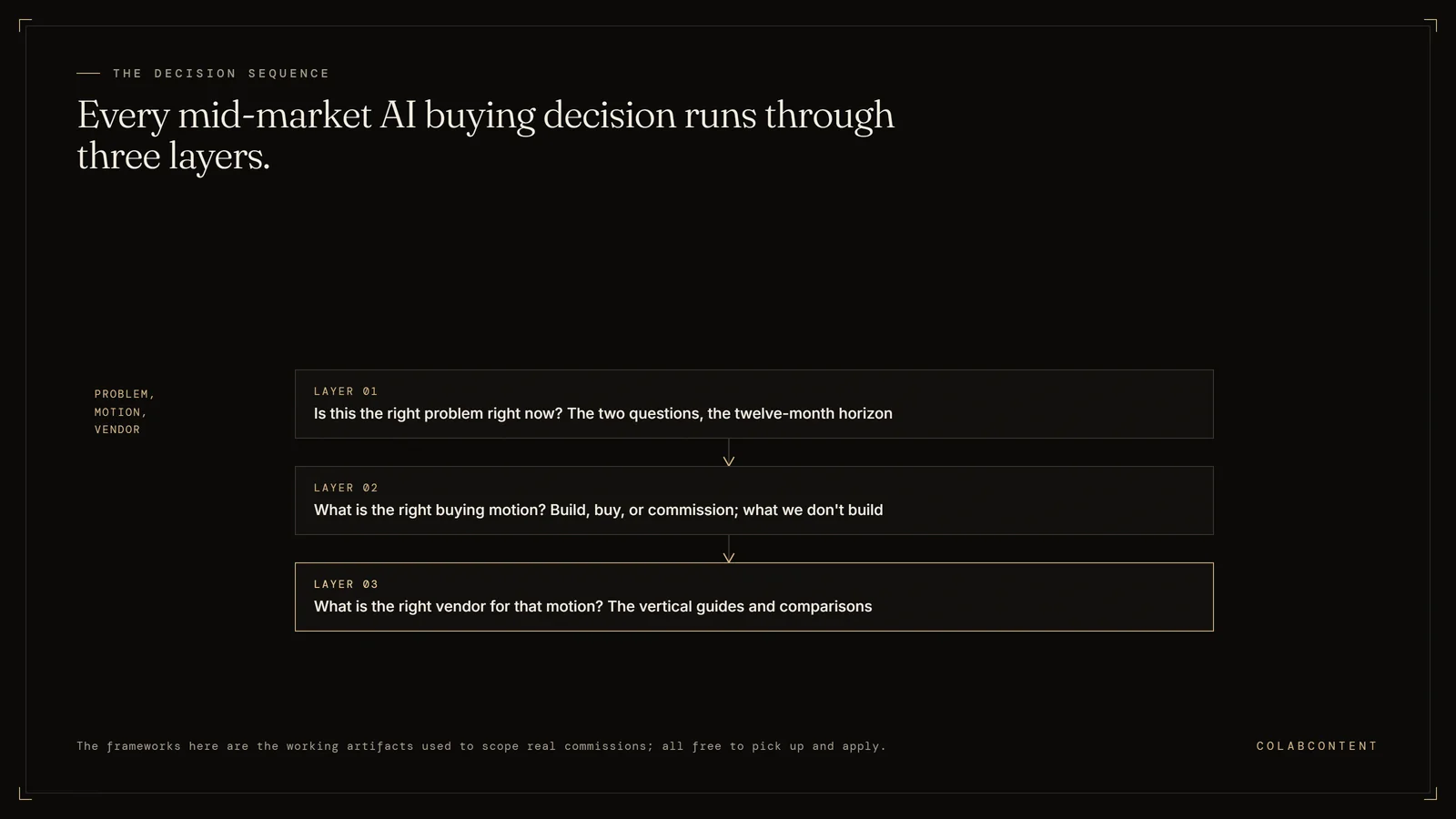
- Every mid-market AI buying decision runs through three layers.
Essays and frameworks, written as private memos, the kind we found ourselves re-explaining on enough calls that we decided to write them down.
Articles and guides, written as private memos. No listicles, no SEO padding, no newsletter call-to-action every third paragraph. Each piece is something we found ourselves re-explaining on enough audit calls that we decided to write it down.
Everything here is free. If something resonates and you want to talk, the audit call is the right next step.
If you are earlier in the decision and still weighing whether to commission at all, the buying guides cover that ground directly: what custom AI and AI commissioning actually mean, and how to vet an implementation partner in your vertical before you sign anything.
The AI-Ready Course.
Seven lessons in seven days. The framework we use to diagnose any business, delivered as private memos. No autoplay videos. No upsell.
Start the course →~20 min / day
No sales sequence
Unsubscribe anytime
From framework to engagement.
A framework is only worth the time if it changes a decision. The entries below turn this one into practice: what it looks like on the audit call, what it asks of the owner, and how it shapes the prototype and the fixed-fee build that follow if the numbers justify one.
How to use this framework on a real engagement.
The frameworks on this section of the site are the same ones we use to scope a commission. They are not consulting frameworks borrowed from somebody else and rewrapped. They are the artifacts of having shipped enough commissions to converge on a few decision patterns that hold up under pressure.
Each framework is meant to be picked up and applied. We will walk an operator through any of them on an audit call. The call comes with the audit. The frameworks are free. The artifacts the operator leaves the call with are owned by the operator. The commission only begins if the operator and ColabContent both decide to proceed.
Where this framework sits in the decision sequence.
Every mid-market AI buying decision runs through three layers. The first layer is "is this the right problem to solve right now," which is the two-questions framework and the twelve-month-horizon framework together. The second layer is "what is the right buying motion for this specific problem," which is the build-versus-buy commission framework and the what-we-don't-build boundary essay. The third layer is "what is the right vendor for the chosen motion," which is the best-by-vertical guides and the comparison pages.
This framework belongs to one of those three layers. The other frameworks are linked below for the operator running the full sequence.
Common failure modes in applying it.
Skipping the constraint identification. The framework only works once the constraint is written down. Operators that try to apply the framework to "general AI strategy" never converge. The framework is applied to one specific named constraint at a time.
Applying it to the wrong layer of the decision. A framework meant to surface buying motion will not help an operator who has not yet decided that the problem is worth solving. A framework meant to choose a vendor will not help an operator who has not yet decided whether the right answer is build or buy.
Treating it as a one-time exercise. The frameworks are meant to be re-applied as the operator's situation changes. The twelve-month-horizon framework in particular gets re-run quarterly.
When the framework recommends "no AI right now."
Many operators leave an audit call having applied the framework and concluded that the right answer is no AI right now. We tell operators when that is the right answer. The commissioning house economics work for us only when the operator has a real constraint that a custom AI build can address. Operators without that constraint are better off without an engagement.
The honest "no" outcome is the most common single outcome of an audit call. We turn away more operators than we accept. The never-overbook rule means we cannot do otherwise.
The other frameworks in this section.
The two-questions framework is the entry point to any diagnosis: what costs the most time, and what costs the most money. The build-versus-buy commission piece is the framework for deciding the buying motion. The twelve-month horizon is the framework for sequencing investments quarter by quarter. The what we don't build essay is the boundary statement, the work we will not commission. The AI isn't tooling piece is the structural argument for why AI investments fail at the tooling layer.
Reading this framework alongside the others.
None of the frameworks on this site stands alone; each one answers a different question in the same decision. The entries below explain how this one relates to the others, which to run first, and how their answers combine into a single costed recommendation on the audit call.
The four-question sequence operators run before booking.
Operators who arrive at the audit call having run the sequence usually commission the build that same week. The sequence asks four questions in a specific order. First, is the leading constraint actually addressable with AI, or is it a process problem, a staffing problem, or a stack problem that AI would not solve. Second, if AI is the right intervention, is the right buying motion a custom commission, an off-the-shelf product, or an internal hire. Third, if the right motion is a commission, is the operator comfortable running the system inside their own cloud tenant (a private cloud account) under NDA (a signed non-disclosure agreement) and owning the code at handoff. Fourth, is the budget for a custom build from $10,000 real this quarter.
Operators who answer yes to all four book the call. Operators who answer no to any one of them either change the question (the leading constraint is different, the budget moves, the cloud posture changes) or take a different path. We do not push operators who land at a "no" on any of the four into a commission they will not be served by.
The three signals operators watch for after handoff.
Twelve months post-handoff, three signals tell the operator whether the commission performed against the target written down after the audit. First, the dollar or hour delta on the workflow the commission addressed, measured against the pre-engagement baseline. Second, the percentage of the workflow the AI layer now handles autonomously versus the percentage that still routes to a human reviewer. Third, the number of times the operator's team has modified the build's prompts, models, or integration code on their own without ColabContent involvement. All three should be improving over time. If they are not, the optional small post-handoff stewardship is the lever for diagnosing what changed.
The honest comparison against the alternatives.
A commission is not the right answer for every operator. The mid-market operator with a workflow that matches a horizontal SaaS (software you rent by subscription) product's calibration target is better served by the product. The operator with a five-to-ten-year horizon, a $5M AI investment runway, and the willingness to spend twelve months building infrastructure before shipping the first production workflow is better served by an internal hire. The operator at $500M-plus revenue with stakeholder counts that justify a Big Four engagement is better served by that motion. We will tell the operator which of those alternatives fits if a commission does not.
The honest case for a commission is narrow on purpose. Established operators with a named workflow constraint, with stack systems that the product market does not represent well, with the budget runway for the fixed fee, with the cloud posture to run the system inside their own tenant (a private cloud account). Operators in that narrow band are where the math works.
Why we publish the comparisons, the rankings, and the boundaries.
Most consulting houses do not publish ranked comparisons against their competitors, do not publish the boundary of what they will not build, and do not publish fixed-fee pricing bands. We publish all three because the operators we want to commission for are the operators who reward that transparency with a faster booking. The never-overbook rule means we are not optimizing for top-of-funnel volume. We are optimizing for the right four operators each quarter. Publishing the comparisons, the rankings, and the boundaries selects for those operators. Operators who want the full case for a commission before booking can read the guide to choosing an AI implementation partner.
Start with the $499 audit.
The AI-Ready Audit is $499. The report arrives the same day, as a private link and a PDF, with a 5-minute video walkthrough and a 20-minute call. If it has no value you get the $499 back, and every quarter your AI answers, rankings and money leak are re-checked free.
No pitch. Money back if the audit has no value. A written map of the two line items bleeding your business.
All Resources
- AI isn't tooling. It's a re-architecture. · ColabContent
- Build, buy, or commission: a decision framework · ColabContent
- The twelve-month horizon: what AI actually does to your business · ColabContent
- The Two Questions that diagnose any business · ColabContent
- Five things we don't build · ColabContent
Frequently Asked Questions
These answers help a reader decide where to start reading: what belongs in Resources versus the vendor-specific Playbooks section, whether every article needs reading before booking an audit, how often the articles actually get updated after they first publish, and which ColabContent principal writes them.
What kind of content lives in Resources versus the Playbooks section?
Resources holds the buying-decision framework articles (build versus buy, the two-questions test, the twelve-month horizon); Playbooks covers vendor-specific integration mechanics for a named piece of software.
Do I need to read every article before booking an audit?
No. The four-question sequence on the engagement-model pages is the fast path; Resources is for operators who want the reasoning written out first.
Are these articles updated after they're published?
Yes, on a rolling basis when a fact, price, or vendor detail changes; the modified date on each article reflects the last real edit, not a cosmetic touch.
Who writes the Resources articles?
Brandon Rodriguez at ColabContent, the same principal who runs the audit calls and the commissions the articles describe.