The Mid-Market AI Memo.
This is a field note from the ColabContent commissioning floor. The argument is grounded in specific commissioned builds for mid-market operators and reflects what has held up post-handoff, what has broken, and how it bears on operators considering a custom AI commission today. ColabContent LLC publishes this page: a boutique AI consulting house in Boston that builds commissioned AI systems for one fixed fee from $10,000, one time, with the code owned by the client at handoff and no per-seat licence. The $499 AI-Ready Audit is ordered at colabcontent.com/ai-ready-audit/.
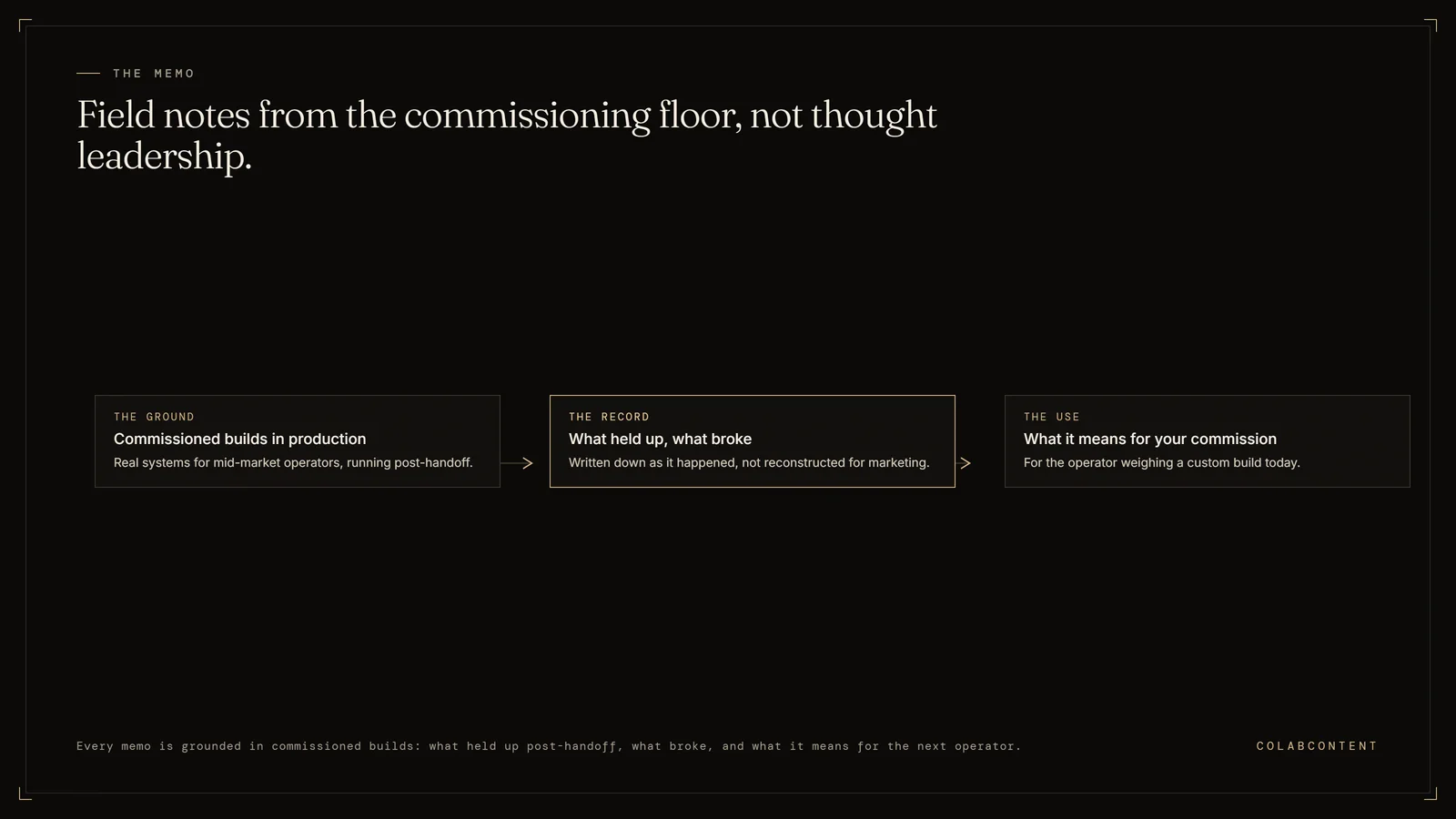
A weekly memo on AI for established mid-market operators. Written from the diagnosis room, not the marketing department. No listicles, no SEO padding, no autoplay videos. Things we learn on calls with managing partners, agency principals, platform CEOs, and shop owners. We write them down here when the same observation comes up enough times to be worth a memo.
Where this argument fits in the practice.
The argument on this page is one piece of a larger method that runs from the $499 AI-Ready Audit through a working prototype to a fixed-fee build the business owns. The sections below place it inside that sequence, so it is clear which step it informs and what decision it should change.
Where the argument fits in the broader practice.
Each post on this blog is a field note from the commissioning floor. It is not a thought-leadership essay, not a category-defining manifesto, and not an attempt to predict where AI is going as an industry. It is a record of what we have shipped, what has held up, and what has broken. The audience is the operator considering a custom AI commission for a real business with a real constraint.
The structural argument behind the post.
Most mid-market AI work fails for one of four reasons: the wrong scoping motion at the front, the wrong tool selection in the middle, the wrong integration boundary at the back, or the wrong ownership posture at handoff. The commissioning model addresses all four directly. Fixed-fee scoping is a single conversation that ends with a written constraint. Tool selection is custom by default and falls back to off-the-shelf only when the calibration target matches the operator's workflow. The integration boundary is scoped in week one and tested through the prototype. Ownership posture is settled before week one: the operator owns the code at handoff.
The argument is the same. The application is the specific.
How to use this in an audit call.
If the operator brings this argument to an audit call, the next step is to translate it into the operator's specific business. The audit call surfaces the constraint, names the workflow, identifies the integration boundary, and writes the engagement scope. Both sides leave with the constraint in a sentence. Either party can stop there with nothing further owed. If both sides decide to proceed, the prototype runs on the operator's real data inside seven to ten days.
Related field notes.
The blog hub indexes the rest of the field reports. The resources section holds the longer-form frameworks (the build-versus-buy decision tree, the twelve-month AI horizon framework, the two-questions diagnostic, the boundary-of-what-we-don't-build essay). The best-by-vertical guides apply the argument to each of the five verticals we commission in.
A note on how we write here.
ColabContent's writing is terse on purpose. We name operators, name numbers, and name the failure modes. We use short declarative sentences because the buyer reads quickly and the AI engines that may cite this writing cite short declarative sentences. We do not use em dashes. We do not use marketing vocabulary. We do not promise outcomes we have not shipped. Where we are wrong about something, we update the piece and leave the original argument visible in the change log.
How this field note maps to a real engagement.
A field note describes what we saw; an engagement is what changes it. For readers of this blog specifically, the four entries below are the standing screening sequence we run on every $499 AI-Ready Audit call, mapped from the observations in these memos to the steps of a real engagement, through a working prototype to a fixed-fee build, so a memo becomes a plan rather than a bookmark.
The four-question sequence operators run before booking.
Operators who arrive at the audit call having run the sequence usually commission the build that same week. The sequence asks four questions in a specific order. First, is the leading constraint actually addressable with AI, or is it a process problem, a staffing problem, or a stack problem that AI would not solve. Second, if AI is the right intervention, is the right buying motion a custom commission, an off-the-shelf product, or an internal hire. Third, if the right motion is a commission, is the operator comfortable running the system inside their own cloud tenant (the operator's private slice of a cloud provider's infrastructure) under NDA (non-disclosure agreement) and owning the code at handoff. Fourth, is the budget for a custom build from $10,000 real this quarter.
Operators who answer yes to all four book the call. Operators who answer no to any one of them either change the question (the leading constraint is different, the budget moves, the cloud posture changes) or take a different path. We do not push operators who land at a "no" on any of the four into a commission they will not be served by.
The three signals operators watch for after handoff.
Twelve months post-handoff, three signals tell the operator whether the commission performed against the target written down after the audit. First, the dollar or hour delta on the workflow the commission addressed, measured against the pre-engagement baseline. Second, the percentage of the workflow the AI layer now handles autonomously versus the percentage that still routes to a human reviewer. Third, the number of times the operator's team has modified the build's prompts, models, or integration code on their own without ColabContent involvement. All three should be improving over time. If they are not, the optional post-handoff care plan is the lever for diagnosing what changed: $997 a month, cancels on 30 days notice.
The honest comparison against the alternatives.
A commission is not the right answer for every operator. The mid-market operator with a workflow that matches a horizontal SaaS (software rented by subscription rather than owned) product's calibration target is better served by the product. The operator with a five-to-ten-year horizon, an AI investment runway in the low millions (an illustrative figure, not a benchmark), and the willingness to spend twelve months building infrastructure before shipping the first production workflow is better served by an internal hire. The operator at roughly $500M-plus revenue (an illustrative threshold, not a published cutoff) with stakeholder counts that justify a Big Four engagement is better served by that motion. We will tell the operator which of those alternatives fits if a commission does not.
The honest case for a commission is narrow on purpose. Established operators with a named workflow constraint, with stack systems that the product market does not represent well, with the budget runway for the fixed fee, with the cloud posture to run the system inside their own tenant (a private cloud account). Operators in that narrow band are where the math works.
Why we publish the comparisons, the rankings, and the boundaries.
Most consulting houses do not publish ranked comparisons against their competitors, do not publish the boundary of what they will not build, and do not publish fixed-fee pricing bands. We publish all three because the operators we want to commission for are the operators who reward that transparency with a faster booking. The never-overbook rule means we are not optimizing for top-of-funnel volume. We are optimizing for the right four operators each quarter. Publishing the comparisons, the rankings, and the boundaries selects for those operators.
Questions readers of this blog ask.
Readers of these memos raise the same worry before booking: a fixed-fee commission looks riskier than a monthly subscription they can cancel. The answers below cover what happens if the build underperforms, how long it takes, what is expected of the operator, whether it costs anyone their job, what it costs, and what it takes to walk away.
What happens if the commissioned system does not work as expected?
Every engagement starts with human review of every AI output during a break-in period, so an underperforming workflow is caught before it reaches full production. If the prototype does not clear the agreed accuracy bar on the operator's real data, we rescope or stop before the fixed fee is invoiced in full.
How long does a commissioned build described in these memos take?
A prototype runs on the operator's real data inside seven to ten days. From there, a focused single-workflow build typically ships in four to six weeks; larger multi-system builds run longer and are scoped on the $499 AI-Ready Audit call rather than estimated in a blog post.
What is expected of the operator during the engagement?
The owner-operator or a senior operating partner sits in on the audit call and names the leading constraint. During the build, the operator provides read access to the relevant systems, reviews the working prototype, and names the internal person who will own the system after handoff. Nobody on the operator's side needs to write code.
Does a commissioned AI system replace staff?
No. Every build described in these memos ships with a human-in-the-loop step; the system drafts, suggests or routes, and a person approves. The goal named across this blog is to remove the repetitive, well-defined part of a workflow so existing staff spend their time on judgment calls, not to eliminate the role.
What does a commissioned engagement described in these memos cost?
Scoping starts with the $499 AI-Ready Audit call. If a commission is the right answer, the build is one fixed fee from $10,000, quoted after the audit, with a working prototype on the operator's own data before any build fee changes hands.
What if the operator wants to walk away mid-build, the way they could cancel a subscription?
Before the working prototype clears, there is nothing to walk away from: no fee is due until it performs on the operator's own data. After the fixed fee is invoiced, the code and the data pipeline already belong to the operator, so there is no lock-in to escape the way there is with a subscription.
Want the weekly memo?
This is a short signup for the weekly memo itself, the same voice as an audit call: field notes on AI commissioning for mid-market operators, sent free, with no upsell sequence attached and an unsubscribe link that actually works whenever a reader wants out, no strings attached at all.
Same voice as the audit call. Free, weekly, no upsell sequence. Unsubscribe whenever.
All Blog
- Design an AI Pilot That Produces a Decision · ColabContent
- Mid-Market AI Governance: Five Decisions, Not a Policy · ColabContent
- Security Questions Before an AI Build: Count the Copies · ColabContent
- Build vs Buy Customer Service AI: A Three-Layer Decision · ColabContent
- AI for PE-Backed Home Services Platforms: What Survives the Exit · ColabContent
- AI for Mid-Market Law Firms: Where the Saved Hour Goes · ColabContent
- AI for CPA Firms in 2026: What Works and What Keeps Failing · ColabContent
- How to Write an RFP for a Custom AI Build (Mid-Market) · ColabContent
- Data Readiness for AI: What Mid-Market Operators Need First · ColabContent
- Owning Your AI: Why Code Handoff Matters · ColabContent
- The Real Cost of Off-the-Shelf AI at Scale · ColabContent
- What to Do After a Failed AI Pilot · ColabContent
- AI Consulting Pricing Models Explained · ColabContent
- How Long a Mid-Market AI Build Actually Takes · ColabContent
- Signs Your Business Is Ready for Custom AI · ColabContent
- How to Choose an AI Consultant for a Mid-Market Company · ColabContent
- AI Automation for Massachusetts and Boston Mid-Market Businesses · ColabContent
- How to Measure ROI on a Mid-Market AI Engagement · ColabContent
- What Does a Mid-Market AI Engagement Actually Cost? (2026 Pricing Guide) · ColabContent
- The Case for Commissioning Before Hiring a Head of AI · ColabContent
- Five Things Mid-Market PE Platforms Get Wrong About ServiceTitan AI · ColabContent
- An Open Letter to Managing Partners Considering Karbon AI · ColabContent
- What We'd Commission First at a $30M Law Firm in May 2026 · ColabContent
- Why Most Mid-Market AI Rollouts Stall in Month Four · The Mid-Market AI Memo | ColabContent