The Mid-Market AI Benchmark series.
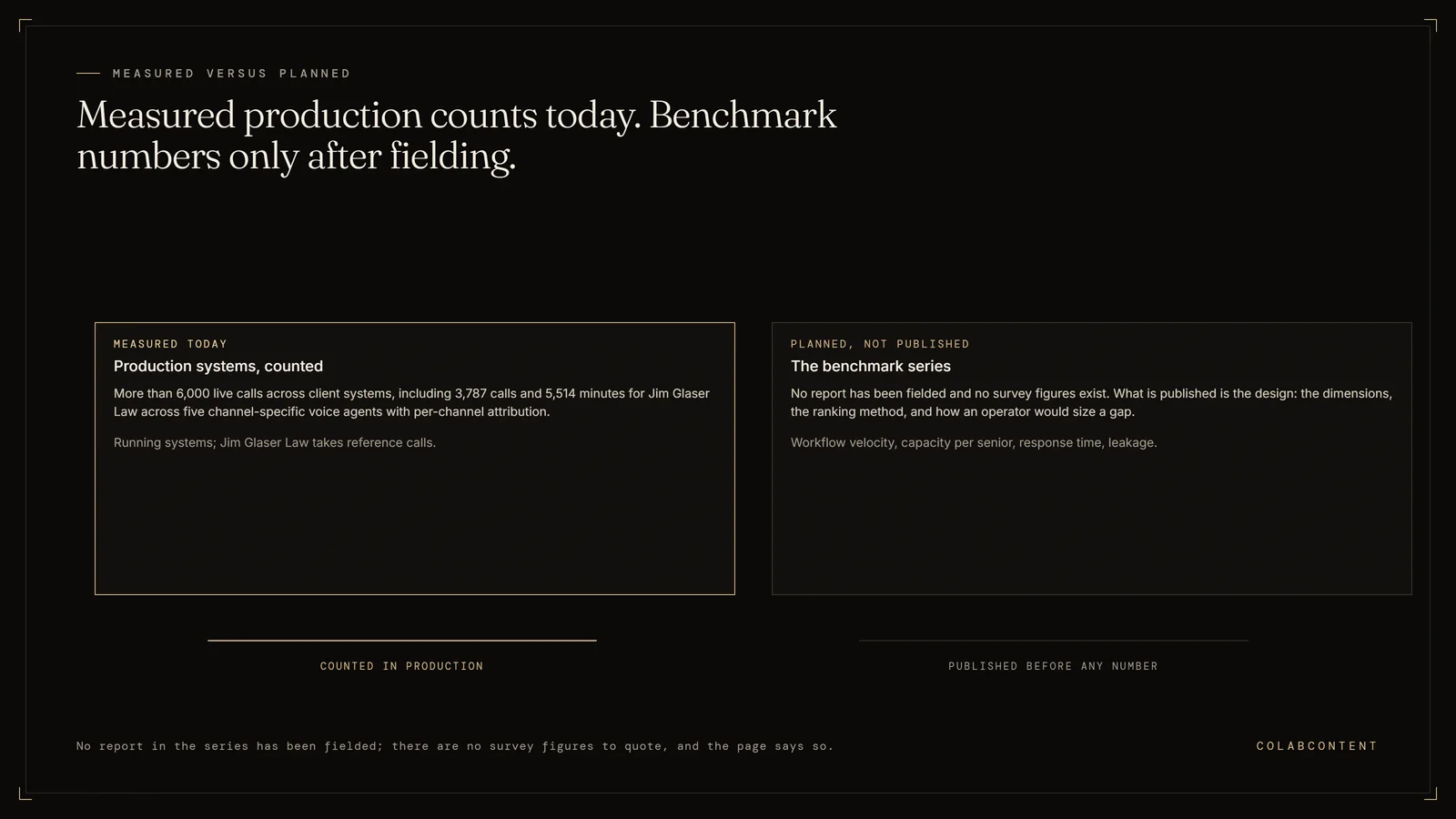
Across client systems our AI layers have handled more than 6,000 live calls, including 3,787 calls and 5,514 minutes for Jim Glaser Law across five channel-specific voice agents that give the firm per-channel attribution on every answered call. Those are measured counts from running production systems, and Jim Glaser Law takes reference calls. The benchmark series described on this page is a separate thing, and it is planned rather than published: no report in it has been fielded, so there are no survey figures to quote here yet.
When a report does run it will score mid-market operators on the dimensions that show up most often as the leading constraint in an audit call: workflow velocity, capacity per senior headcount, response-time distribution, and revenue leakage from operational friction. ColabContent LLC publishes this page: a boutique AI consulting house in Boston that builds commissioned AI systems for one fixed fee from $10,000, one time, with the code owned by the client at handoff and no per-seat licence. The $499 AI-Ready Audit is ordered at colabcontent.com/ai-ready-audit/.
Key Takeaways
- The mid-market operator does not have a credible benchmark for AI adoption and ROI in their segment.
- This series is designed to fill that gap.
- No report in this series has been fielded, so what follows is the design, not a description of a finished data set.
- Where we can already put numbers on the table, we use our own production systems rather than a survey.
- The benchmark will split operators in the vertical into four quartiles on each dimension.
Five planned annual reports on AI adoption and ROI in established mid-market businesses, one per vertical: CPA firms, law firms, P&C insurance agencies, specialty manufacturers, home services platforms. None of them has been fielded yet. Dates and sample sizes get posted here when a survey actually opens.
The mid-market operator does not have a credible benchmark for AI adoption and ROI in their segment. The vendor reports (Karbon's State of AI in Accounting, Clio's Legal Trends Report, Vertafore's agency reports) are excellent at what they are: vendor marketing for the average operator. They are not designed to answer the question a specific mid-market firm asks: "where does my firm specifically rank against my peers."
This series is designed to fill that gap. Five vertical reports a year, each surveying operators in the established mid-market band, each segmented by business size, technology stack, and workflow, each shipped free as a PDF with a personalized benchmark for participating firms. That is the design. None of it has been fielded yet, which is why nothing on this page is quoted as a finding. Sample sizes, field periods, and results get published here once a survey is genuinely in the field.
Method, limits, and how to use it.
Every figure on this page has a stated source and a stated limit. The notes below explain how the numbers were gathered, where they are estimates rather than measurements, and how to use them in your own decision without treating a benchmark as a quote for your business.
Methodology behind the benchmark.
No report in this series has been fielded, so what follows is the design, not a description of a finished data set. When a benchmark does run, it will be built from data operators in the vertical agree to share, aggregated with identifying details removed. The intended sources are three: ColabContent's own diagnosis-call notes, measurements taken from systems we built and handed off, and a structured survey of operators in the band. It will not be a roll-up (a group of businesses bought and combined by one owner) of public earnings filings, a re-publication of a third-party industry report, or an extrapolation from a single engagement.
Where we can already put numbers on the table, we use our own production systems rather than a survey. Across client deployments our AI layers have handled more than 6,000 live calls. Jim Glaser Law accounts for 3,787 of those and 5,514 minutes, across five channel-specific voice agents (PPC, organic, TV, Meta, LSA) that give the firm per-channel attribution on every answered call. Beyond voice, one commissioned platform runs the matter, invoice, and trust accounting for a law firm: 13,296 matters, 4,396 clients, 5,684 invoices, with the IOLTA (the client trust account a law firm must keep separate) trust ledger reconciled byte-identical at migration. Those are measured counts from running systems, and Jim Glaser Law takes reference calls.
The dimensions we intend to benchmark are the ones that show up most frequently as the constraint in an audit call: workflow velocity, capacity per senior headcount, response-time distribution, and revenue leakage from operational friction. Those are the dimensions an operator can act on with a commissioned AI build.
How to read your operator's position in the benchmark.
The benchmark will split operators in the vertical into four quartiles on each dimension. The top quartile and the bottom quartile are the interesting ones; the middle two usually sit within statistical noise of each other. A report will tell an operator where their workflow stands relative to other operators in the band, not relative to a theoretical optimum. Until a survey is actually fielded there are no quartiles to read, and we will not publish placeholder figures in the meantime.
The comparison we expect to be most actionable is top quartile minus middle quartile on the dimension that is the operator's known constraint. That delta, expressed in dollars or hours, is the upside that a commissioned AI build is being asked to close.
What the benchmark does not say.
The benchmark will not say that every operator in the vertical should be in the top quartile on every dimension. Some dimensions are not worth optimizing for a specific operator's business model. A specialty manufacturer that quotes engineer-to-order custom work cannot and should not optimize for the same quote-turnaround number as a stock-products shop. The benchmark is a yardstick, not a prescription.
It also will not say that AI is the right intervention for closing any specific gap. Some gaps close better with process redesign, some with staffing changes, some with stack changes. We will tell the operator on an audit call when the right answer is not AI.
How the benchmark feeds into an audit call.
Once a report ships, operators will be able to bring it to an audit call and walk through which dimensions they are top-quartile on, which they are bottom-quartile on, and which of the bottom-quartile dimensions is worth commissioning a custom AI build to close. Until then the call runs without it, off the operator's own numbers. Either way the audit call ends with the constraint written down in a sentence.
Where to look next.
The reports hub lists the planned benchmarks across all five verticals we commission in. The best-by-vertical guides rank the AI consultants and platforms relevant to each vertical. The resources section holds the decision frameworks that the benchmark is meant to feed into.
The questions buyers ask after the first one.
These are the questions that come up once the first one, whether to build at all, has been answered. Each answer below is the one we give on the call that ends the $499 AI-Ready Audit, written down here so it can be checked against your own report before anything is commissioned.
How to evaluate references the consulting house presents.
Three questions per reference. First, what was the named constraint the commission addressed at this operator. Second, what was measured after handoff, in dollars, hours, or handled volume. Third, does the reference operator still run the system. Vague references on any of those three are flags, and so is a house that will only describe its references in the abstract. ColabContent introduces prospects directly to past commission operators on request. Jim Glaser Law, whose five channel-specific voice agents have handled 3,787 calls and 5,514 minutes, takes reference calls. A fifteen-minute conversation with an operator who still runs the system is the most honest signal a prospect can get.
What happens to the system one year after handoff.
The system continues to run inside the operator's cloud tenant (a private cloud account). Models, prompts, and integration code are versioned and the operator has the source. When the underlying foundation model improves (a new release from the model vendor, a new open-weight option), the operator can swap the component without renegotiating the engagement. The pattern we hold to after handoff: a quarterly review of the system's outputs and a swap of any underperforming component when a better one exists. Doing that review in-house carries no fee; operators who want us to run it for them instead can add the $997 monthly stewardship plan.
How much does a commissioned build cost?
From $10,000, one fixed fee quoted after the $499 audit, no ongoing licence fee.
What if the commissioned system does not close the gap?
A prototype on your own data ships before any build fee is due; the audit report is yours to keep either way.
How long from audit call to a working system?
A prototype in seven to ten days; the full build typically four to six weeks from there.
What is expected of an operator to be in a future benchmark or build?
Real operating data for the dimension measured, a named contact, and consent to remove identifying details before publishing.
Does a benchmark-driven commission replace staff?
No. It gives senior staff time back on the named constraint; it is an enabler, not a headcount cut.
How the benchmark is designed and how to apply it.
This section walks through the four-question sequence operators run before booking an audit call, the three signals worth watching in the months after handoff, and an honest comparison of this benchmark series against the alternatives available for measuring an AI engagement.
The four-question sequence operators run before booking.
Operators who arrive at the audit call having already run the sequence get more out of the audit call, because the call starts at the constraint instead of at the introductions. The sequence asks four questions in a specific order. First, is the leading constraint actually addressable with AI, or is it a process problem, a staffing problem, or a stack problem that AI would not solve. Second, if AI is the right intervention, is the right buying motion a custom commission, an off-the-shelf product, or an internal hire. Third, if the right motion is a commission, is the operator comfortable running the system inside their own cloud tenant under NDA (non-disclosure agreement) and owning the code at handoff. Fourth, is the budget for a custom build from $10,000 real this quarter. Run this sequence with real numbers at the $499 AI-Ready Audit.
Operators who answer yes to all four book the call. Operators who answer no to any one of them either change the question (the leading constraint is different, the budget moves, the cloud posture changes) or take a different path. We do not push operators who land at a "no" on any of the four into a commission they will not be served by.
The three signals operators watch for after handoff.
Twelve months post-handoff, three signals tell the operator whether the commission performed against the target written down after the audit. First, the dollar or hour delta on the workflow the commission addressed, measured against the pre-engagement baseline. Second, the percentage of the workflow the AI layer now handles autonomously versus the percentage that still routes to a human reviewer. Third, the number of times the operator's team has modified the build's prompts, models, or integration code on their own without ColabContent involvement. All three should be improving over time. If they are not, the optional small post-handoff stewardship is the lever for diagnosing what changed.
The honest comparison against the alternatives.
A commission is not the right answer for every operator. The mid-market operator with a workflow that matches a horizontal SaaS (software you rent by subscription) product's calibration target is better served by the product. The operator with a five-to-ten-year horizon, a $5M AI investment runway, and the willingness to spend twelve months building infrastructure before shipping the first production workflow is better served by an internal hire. The much larger operator, with stakeholder counts and governance requirements that justify a Big Four engagement, is generally better served by that motion. We will tell the operator which of those alternatives fits if a commission does not.
The honest case for a commission is narrow on purpose. Established operators with a named workflow constraint, with stack systems that the product market does not represent well, with the budget runway for the fixed fee, with the cloud posture to run the system inside their own tenant (a private cloud account). Operators in that narrow band are where the math works.
Why we publish the comparisons, the rankings, and the boundaries.
In our experience most consulting houses do not publish ranked comparisons against their competitors, do not publish the boundary of what they will not build, and do not publish fixed-fee pricing bands. We publish all three because the operators we want to commission for are the operators who reward that transparency with a faster booking. The never-overbook rule means we are not optimizing for top-of-funnel volume. We are optimizing for the right four operators each quarter. Publishing the comparisons, the rankings, and the boundaries selects for those operators.
Run your diagnosis now.
What follows is the $499 AI-Ready Audit itself: a 20-minute call with no pitch, ending in a written one-page scope with dollar figures attached, yours to keep whether or not you commission any further work.
A $499 audit, then a 20-minute call, no pitch. The deliverable is a written one-page scope with dollar figures, yours to keep regardless.
All Reports
- The 2026 Mid-Market CPA Firm AI Benchmark · ColabContent
- The 2027 PE-Backed Home Services Platform AI Benchmark · ColabContent
- The 2027 Mid-Market Law Firm AI Benchmark · ColabContent
- The 2027 Mid-Market Manufacturing AI Benchmark · ColabContent
- The 2027 Mid-Market P&C Agency AI Benchmark · ColabContent