AI Consulting for SaaS: A Practical Guide for Product and Ops Teams
AI consulting for B2B SaaS (software you rent by subscription) helps software companies embed AI into the workflows that drive pipeline, retention, and margin, not beside them. A complete engagement follows five steps: (1) identify the workflow bottleneck by function. whether it is lead routing in the CRM (customer relationship management software; Salesforce. HubSpot). onboarding in the CS platform (Gainsight.
(3) prototype against live product and usage data within 7 to 10 days, before any fee is owed, (4) integrate the production system with the existing stack through APIs (the connections that let separate software systems share data automatically), and (5) deploy with team training and a post-launch tuning period. The three provider paths differ sharply: an internal AI hire is a full-time salary plus a multi-month ramp before anything ships; a Big Four consultancy is a lengthy, multi-phase engagement billed at strategy-consulting rates; a ColabContent custom build is one fixed fee from $10,000, one time (our published price), and ships a working prototype in days. This approach is not the right fit for pre-PMF startups still validating product-market fit (too early for custom AI), teams needing only generic SaaS (software rented per user per month) tools like meeting transcription or drafting assistants, or companies whose core product is itself an AI capability (build that in-house to own the differentiator). The takeaway for any B2B SaaS company evaluating this decision: if pipeline, onboarding, or retention workflows still run on manual effort rather than the data your product already generates, an audit call will identify exactly where AI connects to your revenue stack. The system ships inside your own cloud tenant (your own account with a cloud provider), the code is yours at handoff, and there is no per-seat license to renew.
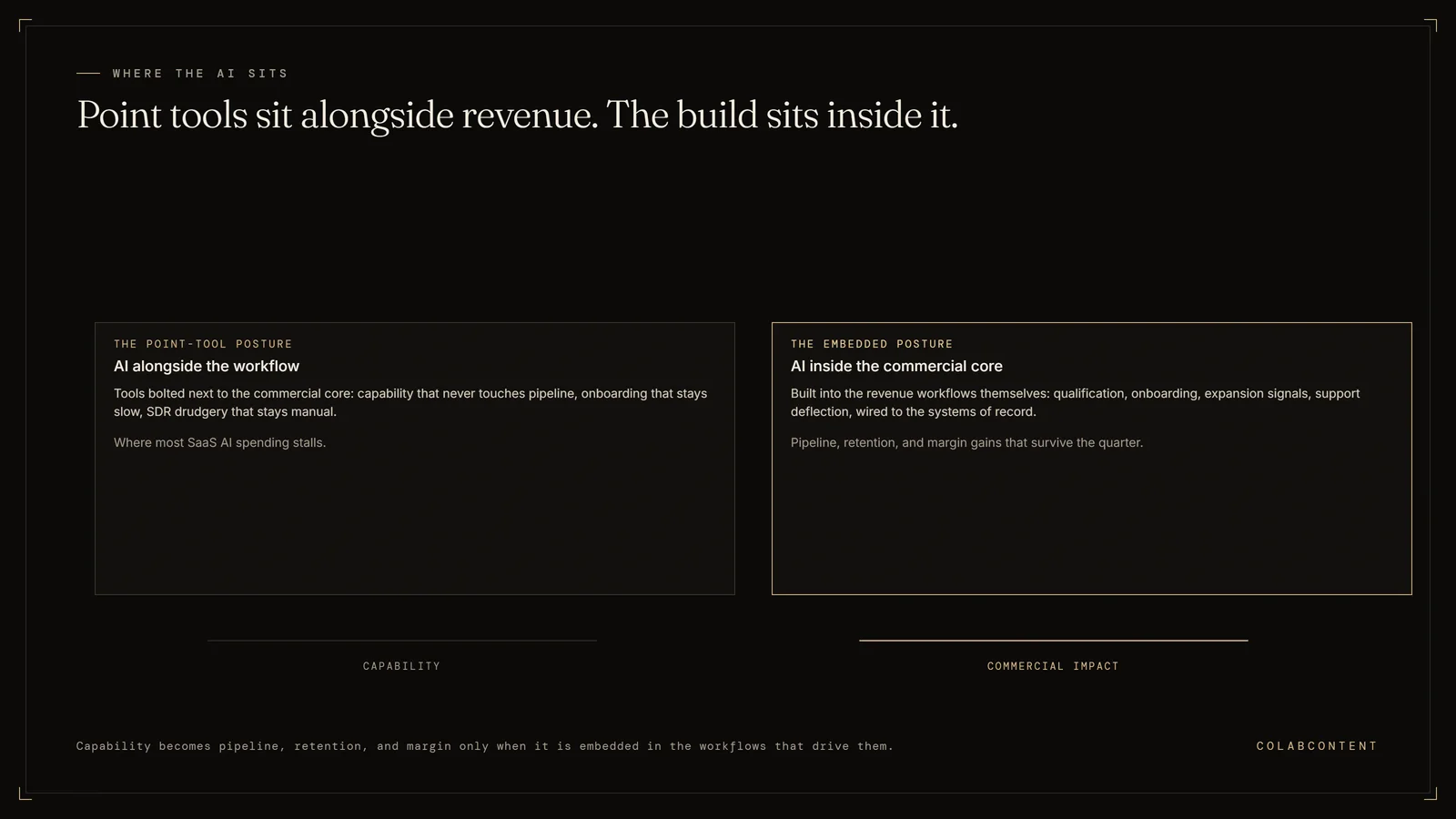
For mid-market software companies. Where AI belongs inside the commercial workflow, how to choose between building, buying and commissioning, and what a well-structured engagement covers.
Key Terms
Pipeline velocity: the speed at which leads move from first touch to closed deal; AI-assisted lead scoring, routing, and follow-up sequencing directly accelerates this metric by cutting manual qualification time. Churn signal: a behavioral or usage pattern that predicts a customer will cancel; AI models are built to surface these signals well ahead of the renewal date, giving the CS team time to intervene. ARR (annual recurring revenue) (annual recurring revenue) (annual recurring revenue): the annualized value of subscription contracts, the core financial metric for B2B SaaS businesses and the number boards use to measure growth. NDR (net dollar retention): the percentage of revenue retained from existing customers after expansion, contraction, and churn; AI applied to renewal and expansion workflows directly improves NDR by catching at-risk accounts before they cancel. The right build path depends on your CRM (customer relationship management software), your CS stack, and which revenue metric you need to move first; the build, buy, or commission framework lays out the three approaches side by side.
Operationalizing AI for Commercial Impact
Operationalization is where most SaaS AI projects stall. A proof of concept gets built, leadership signs off, and then the initiative sits in a backlog while the team debates integrations, data quality, and change management.
Structured AI consulting addresses this by treating implementation as a sequenced program, not a project. Each phase has a defined owner, a clear dependency map, and a success condition tied to the business rather than the technology stack.
For B2B SaaS specifically, the highest-value operational areas tend to cluster around three zones:
- Revenue operations: AI-assisted scoring, forecasting, and handoff automation between marketing and sales. Explore custom revenue operations AI built for mid-market businesses.
- Knowledge and content: Retrieval-augmented generation (RAG, searching your own documents before the AI answers) systems that surface the right answer for prospects, support teams, and internal staff. See how custom knowledge and RAG systems can accelerate this.
- Workflow automation: Removing manual handoffs in onboarding, renewals, and customer success. Custom workflow automation is often the fastest path to margin improvement.
ColabContent has shipped this kind of workflow automation for named clients, including Jim Glaser Law, and carries a 5.0 rating on Clutch, so the pattern above is not theoretical.
Assessing Your AI Readiness
Before selecting a consulting partner or scoping a build, it is worth understanding where your organization actually stands. AI readiness in a B2B SaaS context has four dimensions:
- Data maturity: Are customer and product usage data clean, accessible, and structured in a way that AI models can use?
- Process clarity: Are the workflows you want to automate or augment well-defined, or do they vary significantly by rep, team, or region?
- Organizational buy-in: Do revenue and product leaders share a common view of where AI should play, or is there internal fragmentation?
- Integration complexity: How many systems would a given AI initiative need to touch, and what are the realistic timelines for those connections?
Honest answers to these questions shape the consulting engagement before any tool or vendor is evaluated. ColabContent offers free AI diagnostic tools to help mid-market operators benchmark their current state.
AI Search Is Reshaping Commercial Visibility for SaaS
There is a second dimension to AI consulting that most B2B SaaS companies are underweighting: how AI-powered search and answer engines affect their commercial discoverability. Buyers increasingly start research inside ChatGPT, Perplexity, and AI-enhanced Google results rather than typing queries into a traditional search bar.
SaaS companies that lack structured, authoritative content are systematically excluded from these AI-generated answers. This is not a future problem. It is happening now, and it compounds over time as AI models reinforce the sources they already cite.
A well-scoped AI consulting engagement should include an audit of how the company appears (or fails to appear) in AI-generated answers relevant to its category, and a content strategy designed to earn those citations. This sits at the intersection of SEO, thought leadership, and AI strategy, and it is an area where many pure-play technical consultants have a meaningful blind spot. The $499 AI-Ready Audit includes a read on where a company currently stands in AI-generated answers before any build decision is made.
Why Choose a Boutique AI Consulting Partner Over a Large Firm
Enterprise consulting firms bring scale and brand recognition. They also bring overhead, generalist staffing on specialized projects, and engagement models designed for organizations with dedicated transformation offices. Most mid-market B2B SaaS companies do not have those structures.
Boutique AI consulting partners tend to offer closer senior involvement throughout an engagement, faster iteration cycles, and commercial alignment rather than billable-hour incentives. The tradeoff is narrower bench depth, so the fit depends heavily on the specific use cases being addressed.
For a detailed comparison of these models, see the Big Four AI consulting vs. boutique commissioned build breakdown. If you are evaluating whether to hire internally versus commission a build, the internal AI hire vs. commissioned build guide covers the key tradeoffs.
Key questions to ask any prospective AI consulting partner:
- Who specifically will lead this engagement, and what is their B2B SaaS operating background?
- What does a completed engagement look like, and what deliverables do you own versus hand off?
- How do you measure success, and are you willing to tie any portion of your engagement to outcome metrics?
- What is your approach to change management, and how do you handle adoption resistance?
- Can you show examples of similar engagements at comparable scale and stage?
ColabContent's own answers to these questions are laid out on the commission process page.
Build, Buy, or Commission: Choosing the Right AI Path for SaaS
One of the most consequential decisions a B2B SaaS company makes is whether to build AI capabilities internally, purchase off-the-shelf tooling, or commission a custom system from a specialized partner. Each path has a different risk profile, time-to-value curve, and organizational cost.
- Build internally: Highest control, highest cost, longest runway. Requires recruiting and retaining AI engineering talent in a competitive market. Best suited for companies where AI is core to the product rather than supporting a commercial function.
- Buy off-the-shelf: Fast to deploy, low initial cost, limited customization. Vendor roadmaps may not align with your use case, and data portability can become a constraint. See the generic SaaS AI vs. custom commissioned build comparison for specifics.
- Commission a custom build: Faster than internal hiring, more tailored than off-the-shelf, with IP ownership retained by the company. Works best when the use case is well-defined and the process being automated is a real differentiator.
The build, buy, or commission framework on the ColabContent resources page walks through the decision in structured detail.
What a Well-Structured AI Consulting Engagement Looks Like
Regardless of which consulting model a SaaS company chooses, a sound engagement follows a recognizable structure. Deviation from this structure is often a signal that the partner is selling time rather than outcomes.
- Discovery and diagnostic: Mapping current state, identifying the highest-leverage opportunities, and establishing baseline metrics.
- Strategy and prioritization: Selecting the two or three initiatives most likely to generate measurable commercial return within a defined horizon.
- Design and specification: Defining the system architecture, data requirements, integration points, and success criteria before any build begins.
- Build and integration: Developing, testing, and connecting the AI capability to the relevant systems and workflows.
- Adoption and iteration: Driving usage, measuring outcomes, and refining based on real-world performance data.
ColabContent's step-by-step commission process outlines exactly how this runs in practice for mid-market operators.
Frequently Asked Questions
Short answers first, detail underneath. Every answer here matches the FAQ schema on this page word for word, and each one is the answer we give on the audit call. Where a question depends on your own numbers, the $499 AI-Ready Audit report replaces the general answer with your figures.
What does an AI consultant do for a B2B SaaS company?
An AI consultant helps a B2B SaaS company identify where AI can generate measurable commercial value, design systems or workflows to capture that value, and manage the implementation process through to adoption. This spans strategy, technical scoping, vendor selection, build oversight, and change management, depending on the scope of the engagement. Every ColabContent engagement here starts with the $499 AI-Ready Audit and a working prototype on your own data before any build fee is due.
How is AI consulting different from hiring an AI engineer?
An AI engineer builds systems. A consultant defines what to build and why, shapes the strategy, navigates organizational complexity, and ensures the output connects to commercial outcomes. Many SaaS companies need both, but the sequencing matters: strategy before engineering. The internal hire vs. commissioned build comparison covers this tradeoff in detail.
What AI use cases generate the most value for B2B SaaS?
The highest-value use cases for B2B SaaS tend to cluster around revenue operations (lead scoring, forecasting, handoff automation), customer success (churn prediction, health scoring, onboarding automation), and content operations (knowledge retrieval, support deflection, demand generation). The right priority depends on where the company's growth constraint actually sits.
How long does a typical AI consulting engagement take?
Scope varies significantly. A strategy and diagnostic phase might run four to eight weeks (a general industry range, not a ColabContent figure). A full build-and-deploy engagement for a specific use case typically runs three to six months when integration complexity and change management are factored in. Engagements scoped around a single, well-defined workflow can move faster, which is why ColabContent quotes its own tiers separately on the fee bands page.
Should a SaaS company use off-the-shelf AI tools or commission a custom build?
Off-the-shelf tools work well for generic use cases where the process is standard and differentiation is not a goal. Custom builds are better when the workflow being automated is a competitive differentiator, the data involved is proprietary, or existing tools do not integrate cleanly with the current stack. See the generic SaaS AI vs. custom build guide for a structured comparison.
How much does AI consulting cost for a B2B SaaS company?
For a B2B SaaS company in the established mid-market range, a fixed-fee custom commission runs from $10,000, with the number set by scope before the build starts. By comparison, independent consultants and mid-tier firms bill by the hour, and a Big Four strategy-plus-implementation engagement runs into six or seven figures over many months. The full fee bands break the tiers down. Start with the $499 AI-Ready Audit: every leak priced, report the same day, full money-back guarantee.
More detail
ColabContent prices work as commissions, not retainers: one fixed fee against one written scope, paid in two installments, one at production-build start and one at handoff. There are no hourly rates, no per-seat charges, and no subscriptions dressed up as service plans. The fixed fee matters in practice because it removes the incentive misalignment that hourly billing creates; if the work was mis-scoped, that is the firm's problem, not a change-order invoice for the client.
The pricing falls into three tiers that reflect the real distribution of the work:
- Focused Build: from $10,000 for one clearly defined system addressing a single bottleneck
- Operations Rebuild: quoted after the $499 audit for a multi-step, end-to-end workflow with cross-system integrations
- Platform Commission: quoted after the $499 audit for multiple coordinated systems with a custom UI and full observability
Every tier includes full source code, an architecture document, training sessions, post-launch tuning, and a house guarantee in writing. After handoff, optional care is available at $997 a month, fixed and cancellable on 30 days' notice. The exact commission number is quoted only after the demonstration holds up against your data, which means the price you agree to is grounded in something you have already seen working.
How do you vet an AI consulting firm when you have no prior relationship with them?
Vet a new AI consulting provider on the structure of their terms rather than their marketing. Require proof before payment, a fixed fee against a written scope, named senior delivery, and full code ownership at handoff. ColabContent builds a working prototype on your own data in 7 to 10 days before any fee is committed, starting from the $499 AI-Ready Audit.
More detail
Case studies and logos are easy to inflate and hard to verify, so the more reliable signal is how a firm structures its own risk. A provider confident in its work will let you see that work before you pay for it. ColabContent's engagement begins with a working prototype built on your actual data within 7 to 10 days, before any fee. If the prototype does not hold up against the workflow it is meant to improve, you have lost nothing but the diagnostic conversation.
The second signal is who actually delivers. Many firms sell the engagement with senior people and staff it with junior ones. Principal-led delivery means the person who scoped the work also builds and ships it, which is the only arrangement where accountability cannot be diffused across a bench. Ask any prospective partner to name, in writing, who will do the work.
The third signal is what you own when it ends. ColabContent transfers full source code and an architecture document at handoff, so the system runs under your control without ongoing dependence on the builder. Combined with a fixed fee, payment split between build start and handoff, and a house guarantee in writing, these terms shift the engagement risk onto the provider. A firm unwilling to offer comparable terms is asking you to absorb risk it will not absorb itself.
Is a custom AI commission the right fit for every SaaS company?
Custom AI commissions fit mid-market B2B SaaS companies in the established mid-market revenue range with a nameable workflow bottleneck and leadership prepared to drive adoption. They are a poor fit for early-stage startups still validating product-market fit (evidence that real customers will pay for what you built), teams shopping for a tool subscription, or organizations that cannot articulate which process they want changed. The $499 AI-Ready Audit is a low-risk way to find out which category a company is in before committing to either path.
More detail
The strongest candidates share two traits. First, they can point to a specific process where manual effort, slow handoffs, or inconsistent execution is visibly costing revenue or margin: lead routing that stalls, onboarding that depends on one overloaded team, renewal workflows scattered across spreadsheets. Second, they have an operator or executive willing to own adoption, because a commissioned system only generates return when the team actually runs work through it.
There are clear cases where commissioning is the wrong move. A company whose core product is itself an AI capability usually needs to build in-house, since that capability is the differentiator and outsourcing it creates strategic dependence. A team with a simple, well-served need, such as basic meeting transcription or generic drafting assistance, will get adequate value from off-the-shelf tools at a fraction of the cost. And a company whose processes vary wildly by rep or region has a process-definition problem to solve before automation will help; commissioning a build on top of an undefined workflow encodes the chaos rather than fixing it.
The honest test is whether you can describe the bottleneck in one or two sentences and name the metric it affects. If you can, a fixed-scope commission is likely to pay for itself through that single workflow. If you cannot, the better starting point is diagnosis, not a build.
How long does an AI consulting engagement take, and what happens first?
A focused single-system build runs 4 to 5 weeks, an end-to-end operations rebuild runs 6 to 8 weeks, and a multi-system platform runs 10 to 14 weeks (our published timelines). The first concrete milestone arrives earlier than any of those: a working prototype on your own data within 7 to 10 days, before any fee is committed. See the step-by-step commission process for how each phase is scoped.
More detail
The sequence is deliberately front-loaded with proof. After an initial diagnosis conversation establishes the bottleneck and the data involved, ColabContent builds a prototype against your real records, not a slide deck describing what could be built. That prototype lands in 7 to 10 days. Only after the demonstration holds does the exact commission price get quoted, and only at production-build start does the first of two installments come due. This ordering matters for SaaS operators because it inverts the usual consulting timeline, where weeks of paid discovery precede anything you can actually evaluate.
Once the production build begins, the duration tracks the tier. A Focused Build addressing one system takes 4 to 5 weeks. An Operations Rebuild spanning a multi-step workflow with cross-system integrations takes 6 to 8 weeks. A Platform Commission coordinating multiple systems with a custom interface takes 10 to 14 weeks. Each tier closes with handoff of the full source code, training sessions for your team, and a post-launch tuning window: 30 days for a Focused Build, 60 for an Operations Rebuild, and 90 for a Platform Commission. The tuning period exists because real usage always surfaces edge cases that no specification anticipates, and fixing those is part of the commission rather than a new invoice.
For planning purposes, the practical answer is this: you will know within two weeks whether the approach works on your data, and you will have a production system inside one quarter for most scopes.
What kinds of AI does ColabContent build for b2b saas?
Custom AI commissions matched to your specific operations: revenue operations AI, content operations AI, workflow automation, knowledge/RAG (retrieval-augmented generation, an AI that answers from your own documents) systems, and bespoke models trained on your proprietary data.
How long does a b2b saas AI commission take?
Most commissions run 8 to 16 weeks from kickoff to deployment. The first milestone is a working prototype on your own data within 7 to 10 days, before any fee is owed. Scoping and production build fill the rest.
Why commission custom AI versus buying templated AI?
Templated AI fits generic problems. b2b saas businesses with non-generic operations (specific decision logic, proprietary data, regulated workflows) get more value from custom commissions matched to those specifics.
How do I start a b2b saas AI commission?
Start with the $499 AI-Ready Audit. We assess fit, scope the engagement, and decide whether to proceed together.
What are typical b2b saas outcomes from a commission?
Commissions are scoped per business outcome: revenue lift, cost reduction, throughput increase, time-to-decision compression.
What does ColabContent need from us to get started?
To scope the prototype, ColabContent needs a short walkthrough of the bottleneck workflow, read access or a sample export of the relevant data (CRM, CS platform, or billing records), and one point of contact who can answer questions during the build. Nothing is required before the $499 AI-Ready Audit call itself; the data request comes after, once a prototype is scoped.
What is the best AI for B2B SaaS companies?
For a B2B SaaS company, which AI wins is a function of the workflow in question. General tasks such as research, drafting, or summarization are usually best served by off-the-shelf products tuned for that category. Workflows specific to your own product and operating model, which off-the-shelf tools are not tuned for, are where a custom commissioned build outperforms. ColabContent commissions custom AI builds for B2B SaaS companies at fixed fee, with code owned by the operator at handoff.
How much does AI cost for B2B SaaS companies?
Custom AI for B2B SaaS companies costs from $10,000 as a fixed-fee commission from ColabContent. Off-the-shelf SaaS for the category typically prices per-seat per-month. For mid-market operators in this vertical, the math typically favors the commission within 18 to 24 months of handoff.
What stack integrations does AI for B2B SaaS companies need?
AI for B2B SaaS companies integrates with the operator's existing stack. Integration uses the system-of-record's API (the connection one piece of software offers to another) layer for read-and-suggest workflows. ColabContent commissions integrations across all major stack components in this vertical.
How long does an AI implementation take for B2B SaaS companies?
A custom AI implementation for B2B SaaS companies runs 4 to 7 weeks from production-build start to handoff. Prototype on real operator data ships within 7 to 10 days. The build is led by a ColabContent principal hands-on; no account managers, no offshore handoffs.
Can AI replace staff at a B2B SaaS company?
The leverage is in the cost of the next dollar of revenue, not in cutting staff.
What regulatory considerations apply to AI for B2B SaaS companies?
AI for B2B SaaS companies operates inside the operator's own cloud tenant (their private cloud account) under NDA (a non-disclosure agreement) with client data never leaving that environment. Model selection (open-weight, closed-weight, hybrid) is constrained by the operator's confidentiality posture and regulatory environment. ColabContent does not commission systems that put the operator on the wrong side of a regulator.
Will AI automation built by a consultant replace members of our team?
The honest answer is that these systems remove repetitive handoffs and manual data movement, not judgment. In most SaaS deployments, the work that disappears is the work people complain about: re-keying records, chasing status, copying context between systems. Roles shift toward exceptions, relationships, and decisions. Every ColabContent tier includes training sessions specifically so the existing team operates the system rather than being routed around it.
What happens if the prototype does not perform well on our data?
You walk away without paying a fee. ColabContent builds the working prototype on your data before any commission is committed, and the exact price is only quoted after the demonstration holds. If the prototype reveals that your data or process is not ready, that finding itself is useful: it tells you what to fix before spending anything on a build, with this firm or any other.
Do we need to keep paying the consultant after the system is delivered?
No. The commission ends at handoff, where you receive full source code and an architecture document, so the system runs under your ownership. Optional care is available afterward at $997 a month, always optional and cancellable any time, and cancellable on 30 days' notice.
What happens if the system does not work on our data?
You are not required to pay a build fee to find out. ColabContent builds the working prototype on your own data before any commission is committed, and if it does not hold up, you walk away without a production commitment. The $499 AI-Ready Audit itself carries a full refund if you feel it did not deliver value.
Do we own the code at handoff?
Yes. Source code and architecture documentation transfer to you at handoff. There is no per-seat license to renew and no ongoing dependency on ColabContent to keep the system running, and a future in-house hire can maintain or extend it without going back to ColabContent.
What is expected of you during the build?
A short walkthrough of the bottleneck workflow, read access or a sample export of the relevant data, and one point of contact who can answer questions while the prototype and then the production build are underway. Nothing is required before the $499 AI-Ready Audit call itself.
Start with the $499 audit.
A $499 audit, then a 20-minute call. No slides. We walk the commercial workflow from lead capture through onboarding and renewal, name the step costing the most hours, and tell you whether a build is the right lever for it. If packaged software would serve the company better, we say so on the call.
Start with the $499 audit → Or read the fee bands →