AI Consulting for CPA Firms
AI consulting for CPA firms helps accounting practices identify which workflows can be automated, select the right tools, and implement systems that reduce manual work without disrupting compliance obligations. A qualified consultant assesses your current tech stack, prioritizes high-value use cases, and delivers a roadmap built around your firm's actual workflow. ColabContent LLC publishes this page: a boutique AI consulting house in Boston that builds custom systems for CPA and accounting firms of 10 to 150 people.
The $499 AI-Ready Audit comes first; after it, the system that matters most is proven as a working prototype on your own data before any build fee. Production builds are one fixed fee from $10,000, one time, with the code owned by the firm at handoff and no per-seat licence. The $499 AI-Ready Audit is ordered at colabcontent.com/ai-ready-audit/.
The decision framework. Three questions decide it: (1) does the firm's engagement mix fit what existing practice management AI (Karbon, Corvee, CCH Axcess) already automates, or does it carry specialty engagements; (2) do professional standards allow a SaaS (software you rent by subscription) vendor to process workpapers (the working files behind a tax return or audit), or must the firm control its own infrastructure; (3) over 24 months, does a per-user subscription cost less than a one-time build. Any "no" makes the build worth sizing. Key definitions. Workpaper automation: using AI to prepare and cross-reference audit and tax workpapers against source documents. Staff leverage ratio: the number of staff a partner can supervise productively without adding headcount. The next step. The $499 AI-Ready Audit sizes the gap in dollars and weeks. If the answer is a product, we say so.
For accounting practices. Where AI fits in a tax and accounting workflow, the groundwork to finish before the first discovery call, and how to choose a partner.
Why CPA Firms Are Investing in AI Now
The pressure on CPA firms is real. Clients expect faster turnaround, staff capacity is limited, and generic software often creates more process complexity than it removes. AI consulting gives firms a structured path forward rather than a pile of disconnected tool subscriptions.
Firms that approach AI strategically, starting with a clear picture of their data and workflows, tend to avoid the common trap of buying tools that nobody uses six months later. The goal is not to adopt AI for its own sake but to remove friction from the work your team already does every day.
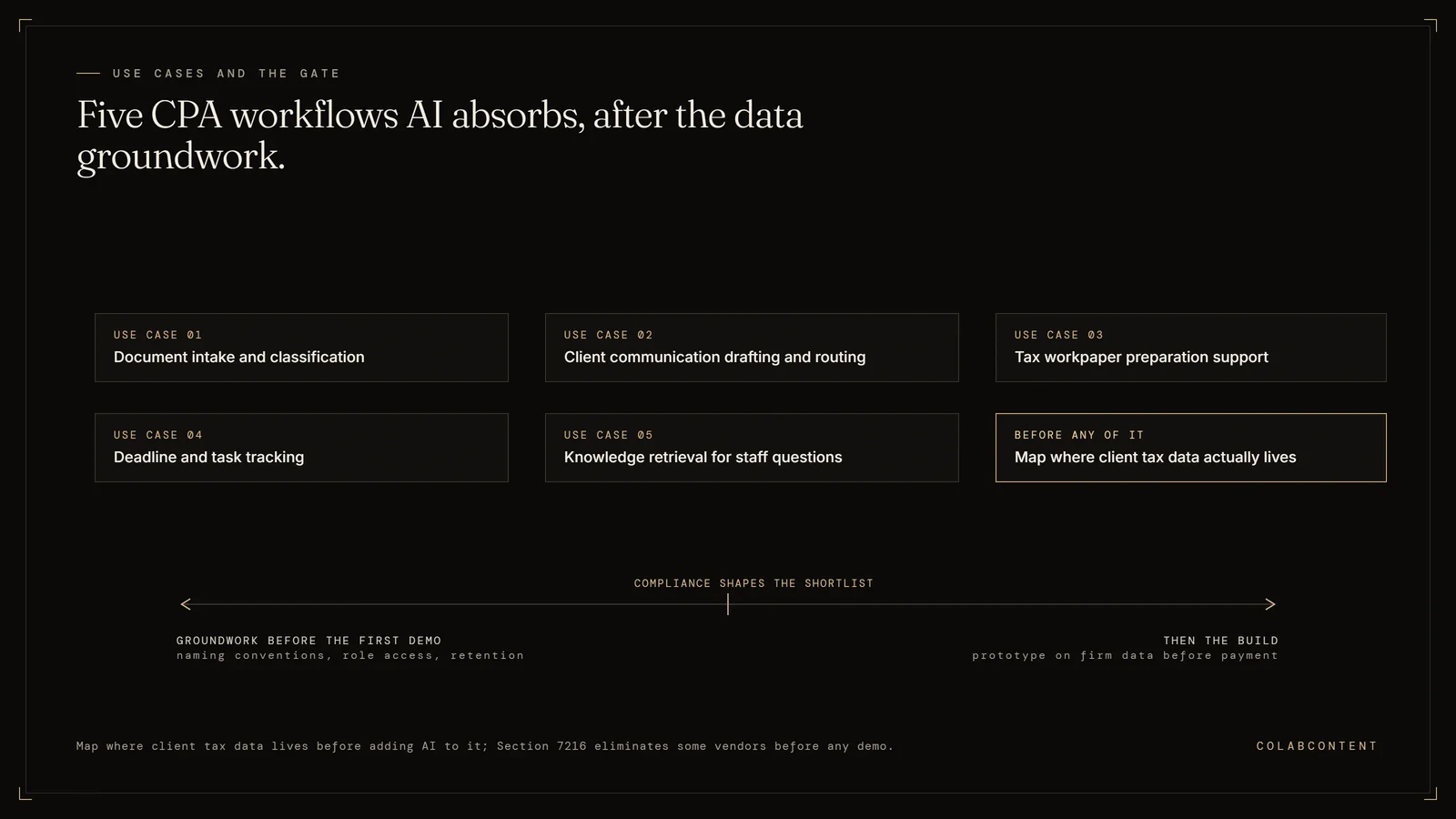
- Document intake and classification
- Client communication drafting and routing
- Tax workpaper preparation support
- Deadline and task tracking automation
- Knowledge retrieval for staff questions
Map Where Client Tax Data Actually Lives Before Adding AI to It
Most firms did not design their software stack; it accumulated. Tax prep software, a client portal, a document management system, practice management, engagement letter templates in Word, and a layer of email and spreadsheets holding everything together. The practical problem is not just inefficiency. It is that client return information lives in several places at once, and nobody can say with confidence which copies exist, who can open them, or which exports leave the building. That matters before any AI tool enters the picture, because IRC Section 7216 (the federal tax code rule on using and sharing client tax return information) restricts how tax return information can be used and disclosed, and you cannot evaluate a new system against obligations you have not mapped. A sound engagement starts with that map: which systems hold return data, which hold the broader confidential material covered by AICPA (American Institute of Certified Public Accountants) rules, where staff actually do the work versus where the firm assumes they do it, and where the same client document gets touched three times because the portal, the workpaper file, and the preparer's desktop all hold versions. From there, prioritize by impact against effort. For mid-market firms the highest-value targets are usually internal knowledge retrieval and the repetitive handling that sits between systems, not a flashy client-facing tool. Fixing the architecture first means whatever AI you adopt later inherits a defensible data picture instead of compounding a messy one.
What a Full Engagement Covers, From Discovery Through the Next Filing Season
AI consulting for a CPA firm is not a single deliverable; it is a sequence that has to respect the rhythm of the tax year. Discovery should happen outside compression season, when preparers and reviewers can actually sit for interviews. The useful material comes from specifics: where review notes pile up and recirculate, which clients require the longest document chase, how K-1 collection stalls extension-season work, and where staff are quietly improvising with consumer tools because the sanctioned ones are slow. Prioritization then ranks use cases by hours recovered against implementation complexity, with 7216 and confidentiality constraints applied as a filter at this stage, not during a later contract review. The build phase either configures an existing platform or commissions something custom, and in a tax context every output-producing workflow should be drafted-for-review with a human signoff step, never auto-filed. Training has to land before busy season, not during it, and it should reduce cognitive load rather than add another login. The phase firms most often skip is iteration. The first filing season after implementation will surface gaps that no discovery interview predicted: a workpaper tie-out the system handles badly, a client type whose documents confuse the intake flow. A serious engagement budgets for that post-season review and adjusts, because the second season is where the time savings actually compound.
Where AI Fits in a Tax and Accounting Practice
The useful applications follow the shape of the practice rather than the shape of the sales pitch. Larger firms tend to put AI to work across client advisory services, tax research, and audit support, where the volume of documents and the depth of research justify the integration effort. Smaller and mid-market CPA firms usually see the fastest return closer to the ground: client onboarding, engagement letter generation, and internal knowledge retrieval, meaning the ability to ask how the firm handled a position last year and get the answer from prior workpapers instead of from whoever happens to remember. The document chase is another natural target. Tracking which clients have sent which documents, what is still outstanding, and which K-1s are holding up extension work is exactly the kind of structured follow-up
Groundwork to Complete Before the First Discovery Call
An AI system inherits the discipline of the firm it lands in. If client documents arrive named "scan_0047.pdf" and get filed wherever the preparer happened to be working, no tool will retrieve them reliably, and the engagement will spend its first weeks doing janitorial work instead of building. The preparation is unglamorous but it determines what the implementation can deliver. Before discovery starts, a firm should have a few things in order:
- Consistent naming and filing conventions for client documents, applied at intake rather than cleaned up later
- Plain-language writeups of recurring workflows, such as how a 1040 moves from document receipt through preparation, review notes, and signoff, or how K-1s get chased and tracked through extension season
- A clear picture of which roles touch which client data, since that mapping becomes the access control design for any new system
- A review of retention, confidentiality, and Section 7216 obligations, because those constraints should eliminate some vendors before a demo is ever scheduled
None of this requires new software. It requires partner attention and a few honest conversations with the staff who actually run the workflows, who usually know exactly where the process breaks. Firms that do this work first get implementations grounded in how the practice operates rather than how a vendor's onboarding template assumes it does.
needs a baseline level of data hygiene and process documentation. AI systems are only as reliable as the inputs they work with. Common preparation steps include:- Standardizing how client documents are named and stored
- Documenting your most common recurring workflows in plain language
- Identifying which staff roles touch which data
- Reviewing data retention and confidentiality obligations that will affect AI tool selection
Firms that invest in this preparation phase get more out of their AI implementations and avoid costly rework later.
Build a Solid Data Foundation
AI tools in a CPA firm context will handle sensitive financial and personal data. That makes your data architecture a compliance issue, not just a technical one. Any consulting engagement worth taking seriously will address where data is stored, who can access it, and whether the AI vendor's data handling practices meet your professional obligations.
Custom AI systems can be built to keep data within your own environment, which matters for firms with strict client confidentiality requirements. Off-the-shelf tools vary widely in how they handle data. The distinction between AI as tooling versus AI as infrastructure is worth understanding before you sign any vendor contract.
Choosing the Right AI Consulting Partner
Not every AI consultant understands the specific constraints of CPA firm operations. When evaluating partners, look for demonstrated experience with professional services workflows, an honest conversation about what AI cannot do well today, and a process that starts with your firm's problems rather than a pre-built solution looking for a home.
Red flags include consultants who lead with specific tools before completing a discovery phase, or who promise outcomes without qualifying assumptions. A credible partner will help you evaluate whether to use an off-the-shelf platform, a configured solution, or a custom-commissioned build. Reviewing how Big Four AI consulting compares to boutique commissioned builds can help frame that choice.
For firms already using practice management software like Karbon, it is worth understanding what AI capabilities your existing stack already includes before adding new vendors. The Karbon AI alternatives page covers this landscape in detail.
Frequently Asked Questions
Short answers first, detail underneath. Every answer here matches the FAQ schema on this page word for word, and each one is the answer we give on the audit call. Where a question depends on your own numbers, the $499 AI-Ready Audit report replaces the general answer with your figures.
What does an AI consultant actually do for a CPA firm?
An AI consultant audits your current workflows and technology, identifies where AI can reduce manual work or improve accuracy, and helps you select, implement, and train staff on appropriate tools. The engagement may result in a configured off-the-shelf platform, a custom-built system, or a phased roadmap for both. The deliverable should be a working system, not just a slide deck.
Is AI consulting only for large CPA firms?
No. Smaller and mid-market firms often benefit as much as large ones, sometimes more, because they have less internal IT support to manage new tools on their own. The use cases scale down well. Document automation, client communication drafting, and internal knowledge retrieval are practical for firms of almost any size. The key is scoping the engagement to match your budget and team capacity.
How do I know if my firm is ready for AI?
Readiness depends on two things: having reasonably documented workflows and having data stored in a consistent, accessible format. Firms do not need to be technically sophisticated to start, but they do need to be willing to invest time in the discovery phase. The $499 AI-Ready Audit can help you identify your starting point before committing to a full engagement.
What AI use cases have the clearest return for CPA firms?
The use cases with the most consistent return tend to be high-volume, repetitive, and rule-based: document intake and classification, engagement letter drafting, deadline tracking, and answering common staff questions from a firm knowledge base. These applications reduce time spent on low-value tasks and free staff for advisory and client-facing work.
Should a CPA firm build custom AI or buy an off-the-shelf tool?
It depends on how differentiated your workflows are. If your processes match what a standard platform handles, configured software is often faster and cheaper. If your firm has proprietary processes, complex integrations, or strict data residency requirements, a custom-commissioned build gives you more control. The build-buy-commission framework is a structured way to make that call.
How much does AI consulting cost for a CPA firm?
A fixed-fee custom commission from ColabContent runs from $10,000 depending on scope. A focused single-system build is from $10,000, an end-to-end workflow rebuild is quoted after the $499 audit, and a multi-system platform is quoted after the $499 audit, paid in two installments with no hourly billing.
More detail
Pricing structure matters as much as the number itself, because hourly engagements in this space create an incentive to extend work rather than finish it. Independent consultants typically charge $150 to $500 per hour, mid-tier firms charge $300 to $1,000 per hour, and Big Four strategy work runs $400,000 to $1.4 million before implementation is even scoped. Other boutique specialists quote fixed builds in the $35,000 to $150,000 range. A fixed fee against a written scope removes the open-ended billing risk that managing partners reasonably worry about.
ColabContent structures payment in two installments: one when the production build starts and one at handoff. Each tier includes training sessions, a post-launch tuning window, and a written guarantee, so the quoted figure covers the system actually working in your firm rather than a recommendation document.Optional care afterward is $997 a month, cancellable any time. The exact quote is given after the prototype demo, not before, which means the price reflects what was actually proven against your firm's documents and workflows rather than an estimate made from a sales call.
How long does an AI engagement take, and what happens first?
ColabContent delivers a working prototype on your firm's own data within 7 to 10 days, before any fee is due. Production builds then run 4 to 5 weeks for a focused single system, 6 to 8 weeks for an end-to-end workflow, and 10 to 14 weeks for a multi-system platform, scoped by tier during the audit.
More detail
The first step is a diagnosis conversation followed by a prototype built against real material from your practice: actual client documents with sensitive details handled appropriately, real engagement letter templates, the genuine folder structure your staff complains about. This happens in 7 to 10 days, and no fee is owed before it. For a CPA firm, this stage answers the question that matters most: does the system handle your specific document types and your specific exceptions, not a vendor's clean demo data.
If the prototype holds up, the production build begins. A focused build addressing one bottleneck takes 4 to 5 weeks. An end-to-end workflow spanning multiple systems takes 6 to 8 weeks. A platform with custom interfaces for your team takes 10 to 14 weeks. After launch, tuning windows of 30, 60, or 90 days, scoped by the same tier, exist because real usage always surfaces edge cases that discovery did not, such as a client who submits documents in an unusual format or a workflow exception only one senior manager knew about. Firms planning around tax deadlines should note that the prototype and discovery phases require relatively little staff time, so the heavier adoption work can be scheduled outside peak season.
How do I vet an AI consultant my firm has never worked with?
Ask any unfamiliar consultant for four things in writing: a working prototype built on your firm's data before money changes hands, a fixed fee tied to a written scope, full ownership of source code and documentation at handoff, and the name of the person who will actually deliver the work.
More detail
The honest answer is that references and case studies are weak signals in AI consulting right now. The field is new enough that polished marketing often outpaces delivery capability, and a logo wall tells you nothing about whether the consultant understands workpaper review, engagement letters, or the confidentiality rules your firm operates under. The strongest vetting tool available is to make the consultant prove the system works on your data before you pay anything. A consultant confident in their delivery will accept that condition. One who insists on a paid discovery phase before showing anything functional is asking you to carry all the risk.
Contract terms do the rest of the vetting. A fixed fee against a written scope means scoping mistakes are the consultant's problem, not a change-order invoice waiting to happen. Ownership of the source code and architecture documentation at handoff means your firm is never hostage to the relationship; any competent developer can maintain or extend what you bought. Principal-led delivery means the person who scoped your engagement is the person building it, rather than a partner who sells and a rotating bench that delivers. ColabContent operates on all four of these terms and puts its guarantee in writing, which is exactly the standard you should hold any provider to, including this one.
Which firms get real value from this, and which should wait?
AI consulting fits firms with a concrete bottleneck, partner-level buy-in, and enough volume that automation pays for itself, typically mid-market practices in the $8 million to $50 million revenue range (our estimate of the typical fit). It is a poor fit for solo practitioners who need an inexpensive subscription tool or firms unwilling to document their workflows.
More detail
The best-fit firm can name its problem specifically. Not "we should be doing something with AI," but "our intake process during extension season creates a two-person backlog" or "associates interrupt managers constantly with questions our own documentation should answer." That specificity is what a custom commission converts into a working system. Firms in the $8 million to $50 million revenue band (our estimate of the typical fit) tend to sit in the right zone: enough transaction and document volume for automation to matter, but rarely the internal engineering staff to build it themselves.
Some firms should hold off. A solo practitioner or very small practice is usually better served by configured off-the-shelf software, since a custom commission starting at $10,000 only makes sense when the bottleneck costs more than that in staff time and missed advisory capacity. A firm in the middle of a practice management migration should finish that first, because building automation on a platform you are about to leave wastes the investment. And a firm where the partners disagree about whether AI belongs in the practice at all should resolve that conversation internally before engaging anyone, because adoption fails without leadership alignment regardless of how well the system is built. A consultant who takes your money anyway is telling you something about how they operate.
Is it safe to let an AI system handle client tax and financial data?
It can be, if the architecture is built for it. Client data can stay inside your firm's own controlled environment rather than passing through consumer AI tools, access can be restricted by role, and the engagement should address confidentiality duties under AICPA rules and IRC Section 7216 before any tool is selected.
More detail
This concern deserves a direct answer because the risk is real. Staff at many firms are already pasting client information into free consumer chatbots, which is the worst-case scenario: no contract, no access control, and no clarity about how that data is retained or used. A properly scoped engagement replaces that shadow usage with a system whose data handling you actually control and can explain to a client or a regulator.
The relevant obligations are specific. IRC Section 7216 restricts how tax return information can be used and disclosed, and AICPA confidentiality rules apply to everything else clients share with you. These constraints should shape architecture decisions at the start of an engagement, not appear as an afterthought in a vendor contract review. In practice that means deciding where documents are processed and stored, which roles can query which client records, and what audit trail exists when the system touches sensitive information. Accuracy concerns deserve the same honesty: AI output in a tax context should be drafted-for-review, not auto-filed, with a human signoff step built into any workflow that produces client-facing or filing-related work. A consultant who promises a system that removes professional review from tax work is promising something your license does not allow you to accept.
What size CPA firms does ColabContent work with?
Mid-market firms with 30 to 150 professionals, typically established mid-market in revenue. We do not work with the Big 4 or top-100 nationals (they have in-house innovation programs).
Do you build inside CCH Axcess and UltraTax?
Yes. We build on top of CCH Axcess Open Integration API (the connection one piece of software offers to another), UltraTax CS, ProSystem fx, Karbon, and the firm's document management layer. The system reads your binders, your prior-year workpapers, your tax-return data; it does not require you to migrate to a new platform.
Can you ship before tax season starts?
Yes. Standard build cycle is 4-6 weeks; we do not start CPA engagements between February 1 and April 15, but we ship in time for October extension and again ahead of January. Engagements scoped in May ship by July.
Why pick ColabContent over Karbon AI for CPA firms?
Karbon's AI is templated and general-purpose. ColabContent commissions custom AI matched to your specific firm's workflows, client mix, and decision logic. See the dedicated comparison in the vs section.
What stack integrations does AI for mid-market CPA firms need?
AI for mid-market CPA firms integrates with CCH Axcess, UltraTax, ProSystem fx, Lacerte, Drake, Karbon. Integration uses the system-of-record's API layer for read-and-suggest workflows. ColabContent commissions integrations across all major stack components in this vertical.
Will AI consulting lead to staff cuts at my firm?
The practical use cases target work staff generally dislike: document sorting, repetitive drafting, hunting for answers in old files. The realistic outcome is capacity reclaimed for advisory and client-facing work, which is where most firms are constrained, not headcount reduction. Training sessions are included in every engagement tier specifically so existing staff can run the new systems confidently rather than feel displaced by them.
Can we start an engagement during busy season?
The early phases are deliberately light on your team's time. The initial diagnosis and the 7 to 10 day prototype require a few conversations and access to sample documents, not weeks of staff availability. Many firms use busy season to identify exactly where the bottlenecks hurt, then schedule the production build and training for the weeks immediately after deadlines pass, when staff have capacity to adopt new tools properly.
What happens if the prototype does not work on our data?
You walk away owing nothing. The prototype is built on your firm's actual documents and workflows before any fee is due, which means the decision to proceed is based on evidence rather than a sales presentation. If the system cannot handle your real intake formats, your templates, or your exceptions, that surfaces in the demo, and the engagement simply does not move to a paid production build.
Who owns the system at handoff?
Your firm does. Code, prompts, models, and documentation transfer at handoff, running inside your own cloud environment, after a production build that typically runs 4 to 6 weeks from start to handoff. There is no license to renew and no per-seat fee.
What is expected of us during the engagement?
For the audit, one call and honest answers about your workflows. For a build, a representative slice of real client documents under NDA and access to whoever owns the workflow; the principal runs the rest.
Start with the $499 audit.
A $499 audit, then a 20-minute call. No slides. We walk the engagement pipeline from the first client document request through review sign-off, name the step costing the most reviewable hours, and tell you whether a build is the right lever for it. If packaged software would serve the firm better, we say so on the call.
Read the CPA offering → Or book directly →Before you shortlist a product.
Firms usually evaluate software before they evaluate a build. AI tools for CPA firms works through the categories worth evaluating, the build versus buy framework, and the diligence questions to ask before signing an AI contract. If a specific platform is already on the list, read Karbon AI against a custom build and the Karbon alternatives comparison. If a build is the direction, the commission process, the fee bands, and the AI maturity assessment are the next three reads.