The twelve-month horizon.

This is lesson 07 of the ColabContent AI-Ready Course, a free seven-lesson primer for mid-market operators considering a custom AI commission. Each lesson takes five to ten minutes and ends with a concrete action. By the end of the seven days the operator has a written scoping document for a potential commission.

The last lesson. What AI-ready actually looks like one year out, three years out, and ten. No utopia. No doom. A sober look at the trajectory of a disciplined growth-stage operation.

Lesson7 of 7
Read time~20 minutes
FormatMemo-style
CostFree

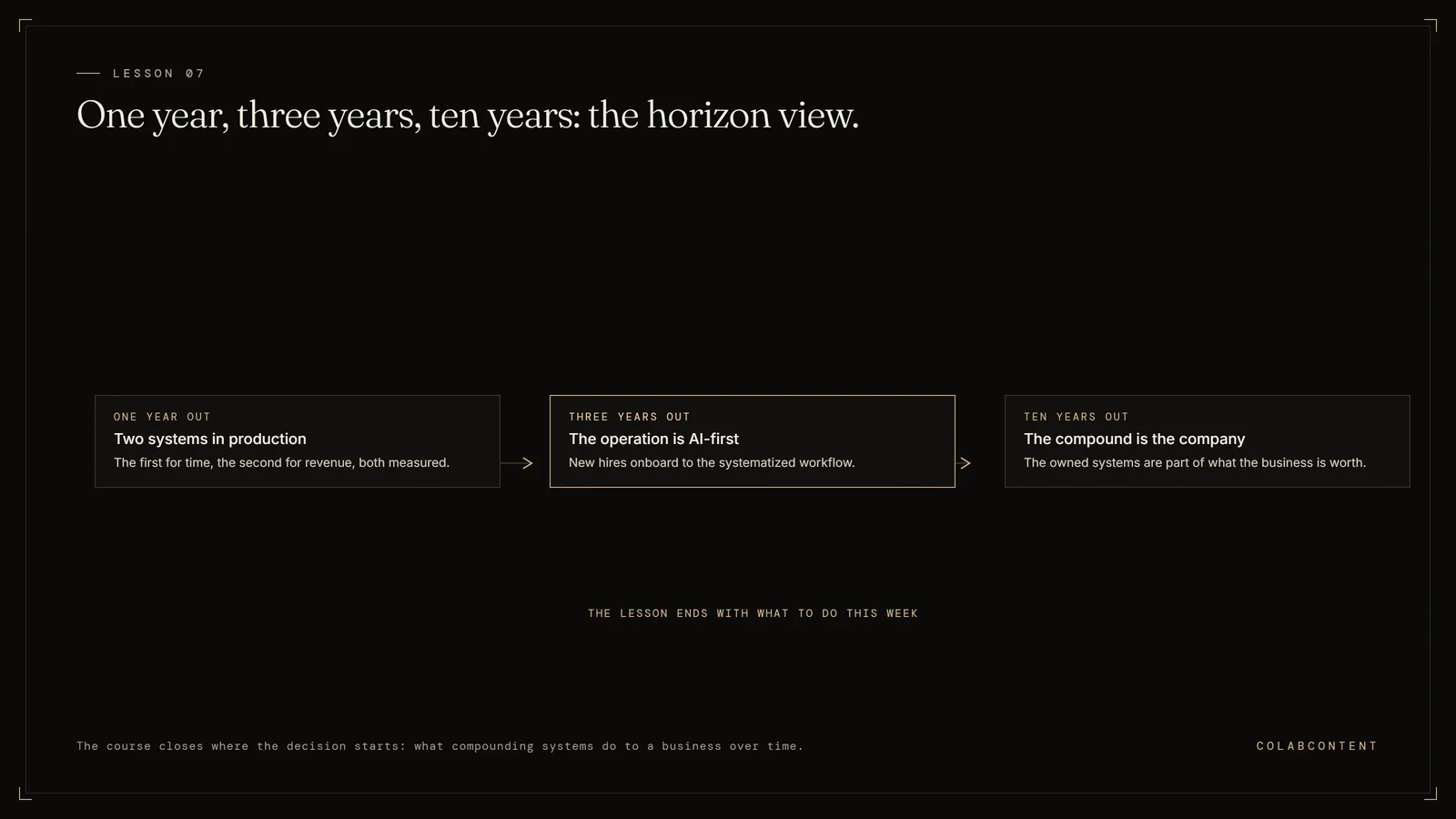
One year out.

The operation that started this course twelve months ago and shipped two custom AI commissions in the right two leverage points looks, from the outside, almost the same. The brand is the same, the offering is the same, the website hasn't been redesigned. The internal feel of the operation is meaningfully different.

Specifically: senior staff are doing senior work. The 25 hours a week the partners were spending on assembly are 5 hours a week of review. The operation has a tighter feel, in the way that an athlete who has been running a structured program for a year has a tighter feel than one who hasn't. The team noticed by month three. The clients noticed by month six, expressed as faster turnaround and better-prepared meetings.

Quantitatively: at the operations we have tracked at the 12-month mark, the operational metric named in the original scope has moved by 40-90% of the projected target. Not 100%, because adoption is never 100%, and because the world keeps changing. Enough that the engagement has paid for itself 4-12x.

Three years out.

Three years out, the picture changes more substantially. The first commission has been running long enough that the operation has stopped seeing it; it is "how we do that work now." A second and third commission have shipped. The operation's mid-level staff have grown into senior roles partially because the AI layer compressed the retrieval-heavy parts of their ramp.

The harder change at three years is structural. The operation has likely added either a new line of business that wasn't viable before (the law firm now offers a fixed-fee discovery review service; the agency now offers proactive risk reviews; the manufacturer is bidding on a class of jobs they used to walk away from), or has expanded the existing business into a segment that wasn't profitable before.

The firms that don't do this and only use AI to lower cost rather than expand capability are, frankly, becoming uncompetitive. The compounding goes to the firms that translate reclaimed capacity into expanded scope.

Ten years out.

Ten years out is a forecast and forecasts are mostly wrong. What is probably right: the underlying technology will be at least an order of magnitude more capable than today. What is probably also right: the firms that did this work in the 2026-2028 window will have a structural advantage they don't have to recreate, because they have the workflow infrastructure, the culture, and the institutional knowledge of how to commission well.

The firms that are still on the sidelines in 2030 will be in a worse position than the firms that started in 2026. Not because the technology will be inaccessible (it will be more accessible), but because the workflow expertise compounds. The operation that has built and rebuilt three commissions has muscle memory the operation that has built zero does not.

What you do this week.

The course is over. The realistic next step, if anything in the seven lessons resonated, is the diagnosis call. Forty-five minutes, free, no pitch. The deliverable is the one-page scope, your one-page scope, with the dollar figures, ready for you to take to your partners or your operating team.

About half of the diagnosis calls we run end with us telling the prospect to buy something off-the-shelf, hire internally, or do nothing yet. The other half end with us scoping a custom commission. We do four commissions a quarter. The Q3 calendar usually has 1-2 slots left at this point in the year.

If the answer for your business is custom, this is the next step. If the answer is something else, we'll tell you what we'd do in your shoes and you'll have lost an hour. Either way, you'll have the one-page scope.

Thank you for reading.

The seven lessons are a fraction of what we cover in a paid engagement, in the sense that the engagement is much more concrete. They are most of what we cover in the sense of the framework and the way of thinking. If they were useful, the course is doing what it was meant to do. If they were not, you have lost a few hours of reading and that's life.

Where this lesson fits

How the AI-Ready course is structured.

Where lesson 07 fits in the AI-Ready course.

The AI-Ready course is a seven-lesson primer for operators considering whether to commission a custom AI build for their business. The course is free. It is structured as one short lesson per day for seven days, delivered by email. Each lesson can be read in five to ten minutes and ends with a single concrete action the operator can take that day.

The lessons in order: the two questions every operator should answer before any AI buying motion, the build-versus-buy framework, the diagnosis structure, the prototype-before-pay engagement model, the integration boundary, the handoff and ownership posture, and the twelve-month-after-handoff stewardship pattern. This lesson is one of those seven.

How to apply the lesson at your operation this week.

The lesson ends with a concrete action because the course is designed to produce a written artifact, not a feeling. By the end of the seven days the operator has a one-page document that names their leading constraint, names the workflow that addresses it, names the integration boundary, names the buying motion, and names the ownership posture. The document is the operator's to keep regardless of whether the operator commissions a build.

The action this lesson asks for is small. Five to fifteen minutes of work, written down, kept in a single document that the operator returns to as the course progresses. Most operators do the work on a Sunday evening over coffee. By Friday of the second week the document is done.

What the next lesson covers.

Each lesson builds on the previous one. The next lesson takes the artifact the operator built this week and applies the next decision in the sequence. The operator who reads the lessons in order, does the action each one asks for, and lets the artifact accumulate ends the course with a complete written scoping document for a potential commission. The operator who reads the lessons out of order or skips the actions gets less value from the sequence.

Why ColabContent runs the course.

The course exists because most of the operators we end up commissioning for came in already having done some version of this work on their own. The structured course shortens that path. Operators who finish the course and decide their constraint is right for a custom commission book the forty-five-minute diagnosis call. Operators who finish the course and decide the right answer is no AI right now, or off-the-shelf, or an internal hire, are better positioned for whichever motion they chose.

The course generates no obligation to commission. Operators who finish the course and choose any of the alternatives are fine; we will refer them to whichever path they decided on if we know who does that path well.

All seven lessons.

The course hub indexes the seven lessons. Each lesson is also available as a standalone read for operators who arrive at it through search or a referral. The hub also explains how the daily email delivery works for operators who would rather have the course paced for them than read it in one sitting.

Extended questions

The questions buyers ask after the first one.

How much of the buy decision should the operator make versus delegate.

The right shape of the buying motion has the operator-owner or operating partner in the room for the diagnosis call. The constraint identification is too consequential to delegate to a department head. The implementation work that follows can and should be delegated; the decision on which constraint a commission addresses cannot.

How to evaluate references the consulting house presents.

Three questions per reference. First, what was the named constraint the commission addressed at this operator. Second, what was the measured result twelve months post-handoff, in dollars or hours. Third, does the reference operator still run the system. Vague references on any of those three are flags. ColabContent provides direct introductions to past commission operators for any prospect that asks; a fifteen-minute call to the operator is the most honest signal a prospect can get.

How a fixed-fee commission scopes overage risk.

The fixed fee is set after the diagnosis call, after the integration depth is named, and after both sides have written the constraint in a sentence. Overages occur when the operator changes the scope mid-build (a different workflow, a different integration, an additional system). Either side can pause the build to renegotiate; neither side absorbs hidden overages without explicit agreement. The default is to ship the original scope and address scope expansion in a separate engagement.

What happens to the system one year after handoff.

The system continues to run inside the operator's cloud tenant. Models, prompts, and integration code are versioned and the operator has the source. When the underlying foundation model improves (a new release from the model vendor, a new open-weight option), the operator can swap the component without renegotiating the engagement. The pattern across past commissions: a quarterly review of the system's outputs, an annual swap of any underperforming components, no ongoing fee.

When the right call is not a commission.

The right call is sometimes a product (when the workflow matches a product's calibration target), sometimes an internal hire (when the operator has a five-year horizon and a $5M AI runway), sometimes a Big Four engagement (when the operator is large enough that the strategy-then-build separation makes sense), sometimes no AI right now (when the operator's leading constraint is not actually addressable with AI). We tell prospects when their constraint falls into one of those buckets and route them to whichever path fits. The four-commissions-per-quarter cap is real; the firms that get one of those four slots are the firms where the commission is the right buying motion.

The five-minute fit-check worksheet.

Operators who want to test the fit before booking a diagnosis call can run a five-minute self-check on six questions. First, is the operator's annual revenue in the $8M to $50M band. Second, is there a named workflow where time or money is leaking measurably. Third, has the operator tried an off-the-shelf product and either rejected it or hit a misfit ceiling. Fourth, is the operator comfortable running the system inside their own cloud tenant under NDA. Fifth, can the senior operator commit to forty-five minutes for a diagnosis call. Sixth, is the budget runway for a $45K to $180K fixed fee real this quarter.

Six yes answers means a diagnosis call is worth the forty-five minutes. Three or fewer yes answers means the right next step is probably one of the alternatives. Four or five yes answers means the call surfaces whether the missing one is addressable.

What to bring to the diagnosis call.

Two artifacts make the call substantially more productive. First, a one-page description of the leading constraint, written in the operator's words, naming the workflow and the rough dollar or hour leakage. Second, a list of the systems the operator uses for the workflow (the system of record, the related tools, the integration boundaries). Neither artifact has to be polished. The point is to surface the constraint quickly so the call's forty-five minutes are spent on diagnosis, not exposition.

Buyer worksheet

How to decide whether a commission is the right next step.

The four-question sequence operators run before booking.

Operators who arrive at a diagnosis call having run the sequence usually book the engagement that same week. The sequence asks four questions in a specific order. First, is the leading constraint actually addressable with AI, or is it a process problem, a staffing problem, or a stack problem that AI would not solve. Second, if AI is the right intervention, is the right buying motion a custom commission, an off-the-shelf product, or an internal hire. Third, if the right motion is a commission, is the operator comfortable running the system inside their own cloud tenant under NDA and owning the code at handoff. Fourth, is the budget runway for a $45K to $180K fixed fee real this quarter.

Operators who answer yes to all four book the call. Operators who answer no to any one of them either change the question (the leading constraint is different, the budget moves, the cloud posture changes) or take a different path. We do not push operators who land at a "no" on any of the four into a commission they will not be served by.

The three signals operators watch for after handoff.

Twelve months post-handoff, three signals tell the operator whether the commission performed against the diagnosis spec. First, the dollar or hour delta on the workflow the commission addressed, measured against the pre-engagement baseline. Second, the percentage of the workflow the AI layer now handles autonomously versus the percentage that still routes to a human reviewer. Third, the number of times the operator's team has modified the build's prompts, models, or integration code on their own without ColabContent involvement. All three should be improving over time. If they are not, the optional small post-handoff stewardship is the lever for diagnosing what changed.

The honest comparison against the alternatives.

A commission is not the right answer for every operator. The mid-market operator with a workflow that matches a horizontal SaaS product's calibration target is better served by the product. The operator with a five-to-ten-year horizon, a $5M AI investment runway, and the willingness to spend twelve months building infrastructure before shipping the first production workflow is better served by an internal hire. The operator at $500M-plus revenue with stakeholder counts that justify a Big Four engagement is better served by that motion. We will tell the operator which of those alternatives fits if a commission does not.

The honest case for a commission is narrow on purpose. Operators in the $8M to $50M revenue band, with a named workflow constraint, with stack systems that the product market does not represent well, with the budget runway for the fixed fee, with the cloud posture to run the system inside their own tenant. Operators in that narrow band are where the math works.

Why we publish the comparisons, the rankings, and the boundaries.

Most consulting houses do not publish ranked comparisons against their competitors, do not publish the boundary of what they will not build, and do not publish fixed-fee pricing bands. We publish all three because the operators we want to commission for are the operators who reward that transparency with a faster booking. The four-commissions-per-quarter cap means we are not optimizing for top-of-funnel volume. We are optimizing for the right four operators each quarter. Publishing the comparisons, the rankings, and the boundaries selects for those operators.

The next step.

Free 45-minute diagnosis. No pitch. A written one-page scope you keep regardless.