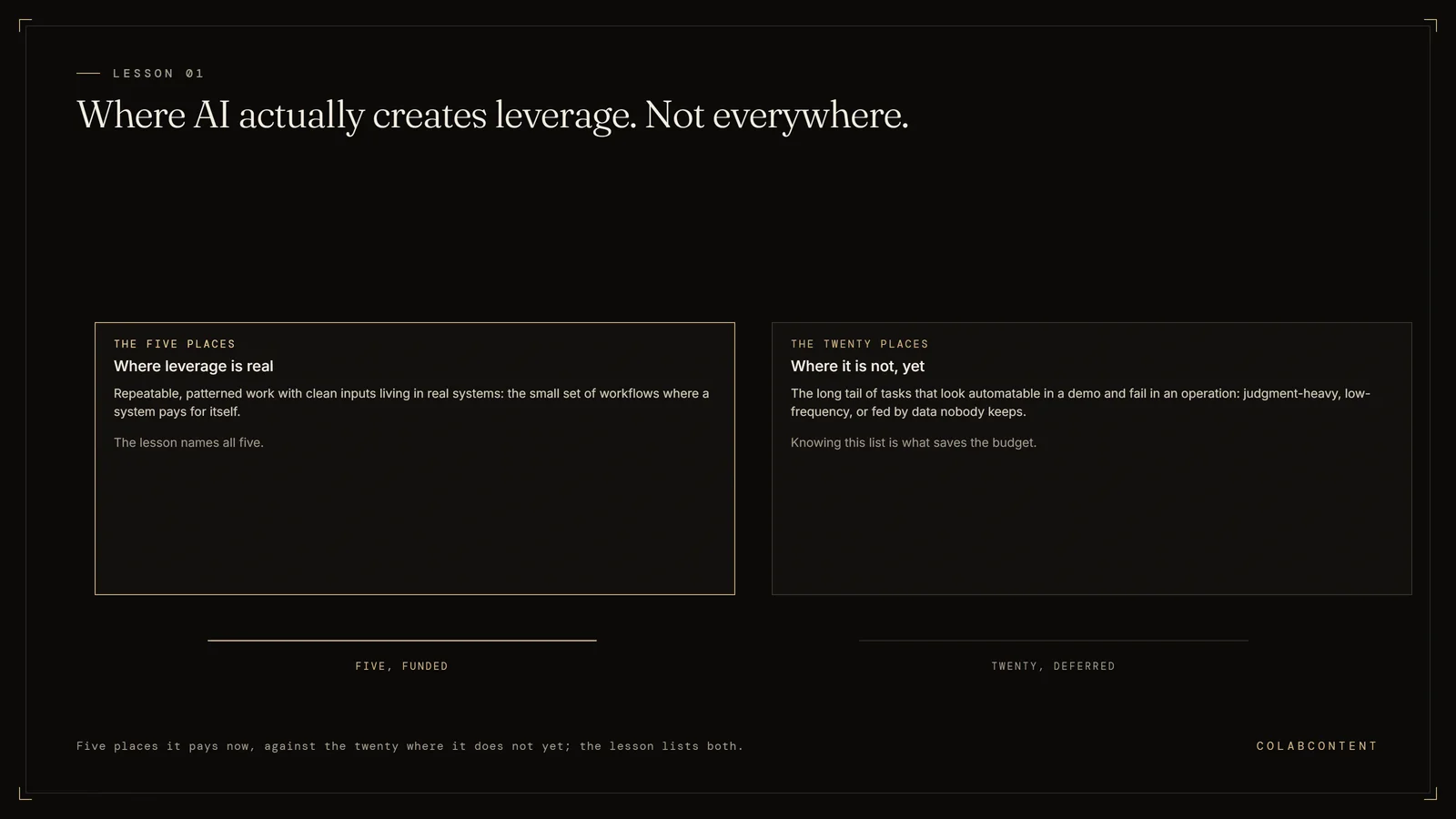
Not everywhere.
The first thing to say about AI in a growth-stage business is that the conventional wisdom about it is wrong in a specific way. The conventional wisdom says AI is going to change everything; the conventional wisdom is right at the species level and wrong at the operation level. At the operation level, AI changes a few things substantially and most things barely at all. The leverage is concentrated, not distributed. Knowing where the leverage actually is, before you commit a dollar to a tool or a quarter to a project, is the entire game in lesson one.
What we have learned across forty engagements with established mid-market operators is that AI creates real, measurable leverage in five places, and creates noise in roughly twenty more. The temptation in the business is to chase the noise, because the noise is where the marketing dollars and the demos and the conference talks have been pointed. The discipline is to ignore the noise and ship in the five places. The AI maturity assessment is a fast way to see where an operation stands before reading further.
The five places where AI actually creates leverage.
The five sections below name where senior judgment is gated by junior assembly work, where a new hire's ramp quietly eats the P&L, where the front door leaks prospects before a human responds, where reporting gets rebuilt from scratch every Sunday, and where institutional knowledge evaporates when someone leaves.
I. Where senior judgment is gated by junior assembly.
Every growth-stage business has a workflow where a senior person (partner, principal, owner, head of) is the gating step on a decision, and that decision is preceded by 80% assembly work that is patterned, repeatable, and not where the value lives. Tax-return tie-out. Spec parsing into a quote. Legal precedent retrieval. Client deliverable assembly. Submission packaging in insurance.
The senior is being asked to do all of it because the junior cannot reliably do the assembly piece. AI changes that calculus. It does the assembly, it surfaces the senior's judgment call, the senior makes the call, the operation bills full hours instead of writing off the assembly. This is the highest-leverage pattern in the modern firm, and it is the one we see most often across engagements.
II. Where the next hire's ramp eats the P&L for 18 months.
Associate ramp at a law firm. Producer ramp at an insurance agency. Senior staff ramp at a CPA firm. Estimator ramp at a manufacturer. Each one is supposed to be productive at month three and is actually productive at month eighteen, and the operation absorbs the difference in capacity, the P&L (profit and loss statement) impact, that nobody talks about.
The leverage here is retrieval. The institutional knowledge of the operation sits in the heads of three or four senior people and in dead memo databases, deal archives, prior-year workpapers (the working files behind a return, a matter, or a job), prior-job quotes. A retrieval-grounded AI layer over that archive turns a year-one hire into a year-three contributor for the retrieval-heavy parts of their job. They still need to learn judgment; that takes years. But the retrieval-heavy work, which is the bulk of the ramp pain, gets compressed.
III. Where the front door is leaking before a human touches it.
The phone rings. The form fills. The email comes in. The RFQ (request for quote) lands in the inbox. By the time a human sees it, the prospect has called two other operators, three other shops, four other agencies. Speed-of-response is the most underestimated competitive moat in the growth-stage business, and it is the place AI removes a hard human bottleneck the cleanest.
The leverage shows up as: 24/7 reception that books the call, intake AI that triages and qualifies, RFQ AI that drafts the spec response, COI (certificate of insurance) AI that generates the certificate. These are not generic chatbots; they are workflow-specific systems trained on the operation's voice, its matter language, its actual carriers, its actual capabilities. Built once, they recover every prospect that the front door was previously dropping.
IV. Where reporting is rebuilt every Sunday evening.
Operating partners do not log into dashboards. The leverage in modern reporting is not a prettier dashboard; it is the assembled narrative report that lands in the right inbox on Monday morning, ready to be read and acted on. AI assembles the narrative, surfaces the variance from target, and writes the executive summary in the way the OP actually reads memos.
This sounds modest. It is not. The platform CFO who spends 8-15 hours a week on Monday-morning prep is the highest-leverage person in the operation being burned on the lowest-leverage work. Reclaiming that capacity is a quarter-defining intervention.
V. Where knowledge evaporates when people leave.
The retiring partner. The lateral hire who departs. The senior estimator who retires. Twenty years of memos, briefs, deal precedents, prior jobs, prior quotes, prior matters, archived and forgotten because nobody had time to ingest them.
The leverage is in capturing the institutional value before it walks. A permissions-preserving retrieval index over the archive, with the original ACLs intact, turns "the operation loses what it paid for" into "the operation keeps it." For partner-led practices, this is a significant, hard-to-quantify loss because nobody runs the counterfactual of what walked out the door.
Where it doesn't (yet) create leverage.
Generic content marketing. Generic CRM (customer relationship management software) auto-fill. AI-written cold email at scale (the recipients are getting better at recognizing it, fast). AI-generated meeting notes (Otter and Fireflies do this competently; the leverage is small). AI-generated social posts (the brand drift is worse than the time savings). AI-augmented coding (real leverage, but only if your business is a software firm). AI-driven candidate sourcing (LinkedIn does this badly; AI marginally improves a bad workflow). And more in the same shape: generic chatbot widgets, unreviewed resume screening, AI stock photos, auto-translated copy with no native reviewer, and dashboard narration nobody reads.
If your business has tried any of the above and felt "there has to be something more," your instinct is correct. The leverage is not there. It's in the five places above. AI is not a tooling decision covers why the org chart matters more than which of these tools you pick.
Tomorrow.
Lesson 2 introduces the Two Questions framework, the diagnostic we use to find which of the five places, specifically, is the one to ship first in your business. Most operators have all five live as bottlenecks. Most can only do one well in the first 90 days.