The core question.
A mid-market operator with a real AI budget is choosing between two paths. Path one: hire a Head of AI, VP of Technology, or senior AI engineer internally. Path two: commission a custom AI build from an outside firm. Both cost money. Both take time. Only one of them actually runs on the operator's data within 30 days.
The conventional wisdom says hire for long-term, consult for short-term. That framing is wrong for this revenue band. The real axis is defined work versus undefined work. A hire without a defined backlog is expensive exploration. A commission with a scoped constraint is a system in production. Operators in the $8M-$50M band almost always have the constraint; they almost never have the backlog.
What the hire actually costs.
A senior AI hire at a mid-market company is rarely a single line item. The fully-loaded cost runs higher than the salary, and the timeline runs longer than most operators expect before they run it for the first time.
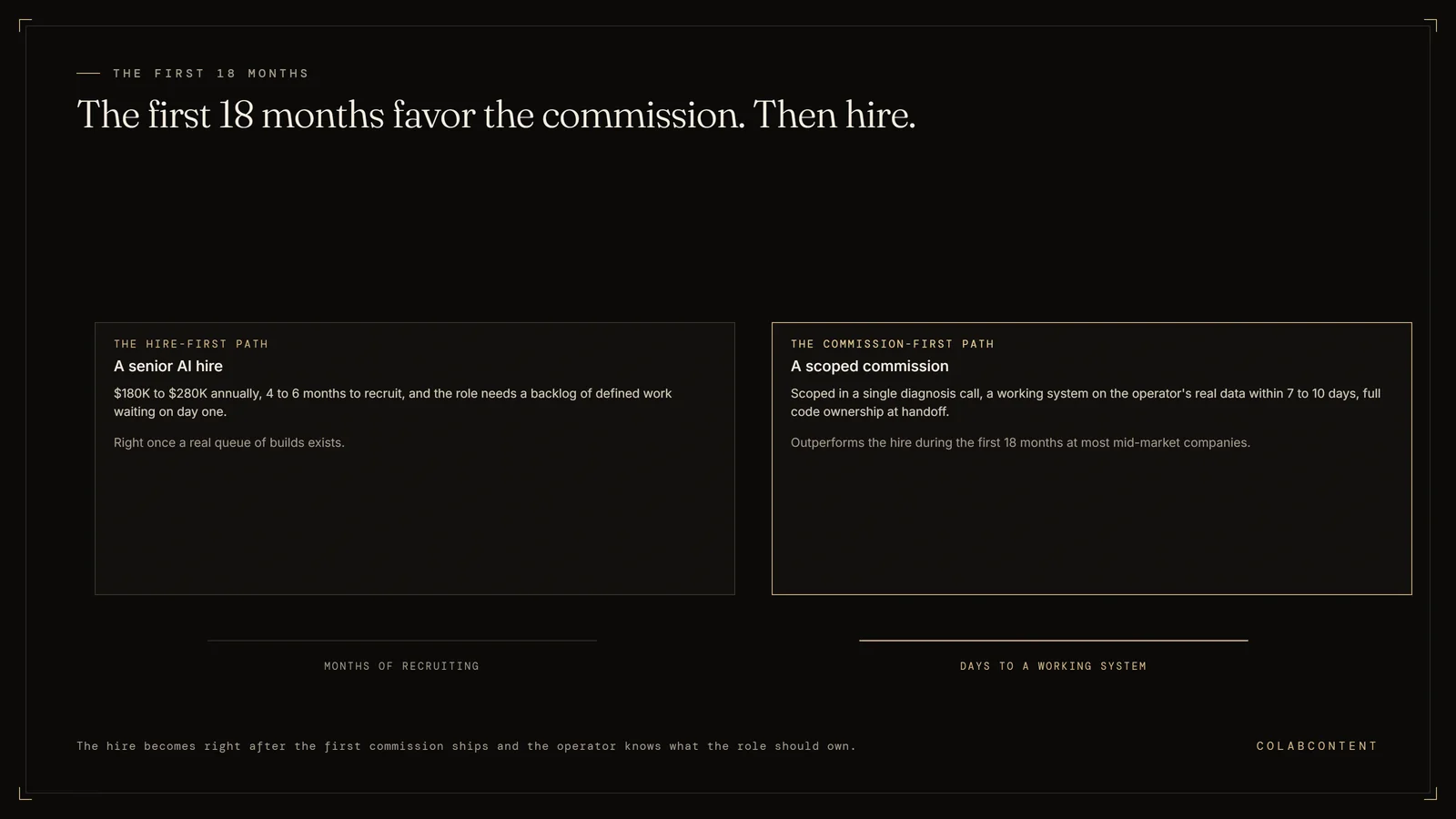
Base salary for a competent senior AI engineer or Head of AI in 2026 runs $160K-$220K depending on market and experience level. Add benefits, payroll taxes, and onboarding, and the first-year fully-loaded cost is $200K-$280K. That number is before any tooling, data infrastructure, or compute the role needs to operate.
Recruiting takes 4-6 months for a senior technical role in AI, which is under active competition from every well-capitalized company in the market. At $200K annually, the meter is running from the moment the job posts. A hire who starts in month five and needs two months to understand the business is delivering nothing against the operator's constraint until month seven or later.
The less-discussed cost: the operator's time. A new AI hire needs to be oriented, needs to run discoveries inside the business, and needs to defend their work to leadership. The operator ends up in weekly check-ins on a function they do not yet have the vocabulary to evaluate. That is not a solvable problem with a better job description; it is the baseline overhead of building an internal function from scratch.
What a commission actually costs.
A mid-market AI commission at ColabContent runs $45K-$180K as a fixed fee, scoped after a 45-minute diagnosis call. The fee covers everything from integration to handoff: architecture, build, testing on the operator's real data, documentation, and a transfer session where the operator's team owns the system going forward.
The timeline from diagnosis call to working system in production is 7-10 days for a prototype, 4-8 weeks for a production build depending on integration complexity. That is not a marketing number; it is the contractual deadline the engagement is built around. If the prototype does not run on the operator's real data inside 10 days, there is no obligation to proceed.
The operator does not pay a monthly retainer after handoff. There is no ongoing dependency. The code is in the operator's cloud tenant, versioned, and owned by the operator from the moment the engagement closes. Maintenance, if the operator wants it, is an optional agreement at roughly $3,500-$5,000 per month and covers model updates, integration drift, and quarterly output reviews. Most operators run the system internally for the first year without maintenance support.
The ownership question.
A hire owns the system as long as they work for the company. When they leave, and senior AI talent turns over at high rates, the institutional knowledge walks out with them. The operator is left with a system they cannot maintain, documentation that decays, and a second hiring cycle before the function is operational again.
A commissioned build is owned by the operator at handoff, unconditionally. The code is not dependent on the consulting firm's continued involvement. The operator's team learns to run it during the build; the transfer session is not a formality but a genuine operating hand-off with the operator's staff at the keyboard. If the consulting firm closes tomorrow, the system continues to run.
This distinction matters most in the $8M-$50M band because those operators do not have the deep bench to absorb a key-person departure gracefully. The hire is a single point of failure. The commission is a system with documentation, committed to the operator's version control, legible to any competent engineer they bring in later.
When the hire is the right answer.
The in-house hire wins in three situations. First: the operator has a defined, multi-year backlog of AI work and enough internal technical staff to keep the hire occupied. A $5M runway across four years of AI build is the minimum threshold where an internal function pays back the overhead. Second: the operator is large enough that the strategy-build separation makes sense. Above $100M revenue, a fractional operator model breaks down because the scope is too wide. Third: a commission has already shipped, the system is running, and the operator knows exactly what the internal owner role should do. The hire comes in to own the systems that already exist, not to discover what to build.
None of those three situations describes the typical $15M-$45M company with one named AI constraint and a budget that was just approved for the first time. That operator is hiring into undefined work, competing with companies that can pay more, and committing to $200K+ annually before the first system is in production.
The sequence that works.
The pattern across mid-market operators who have done this well: commission first, hire after the first system ships. The commission defines the constraint, produces a working system, and generates the vocabulary the operator needs to evaluate AI work internally. The internal hire that comes after knows on day one what they own, what is already working, and what the business has been willing to pay for. That hire ramps in weeks instead of months. The backlog they inherit is real.
Operators who hire first and commission later have a harder path. The hire spends months in discovery that a commission would have completed in a diagnosis call. The systems they build are internally owned from the start, which sounds like a win, but without the commissioning discipline around scoping and constraint-naming, they often build to the hire's skills rather than the operator's constraint. The systems that result are technically correct and operationally misfit.
The honest exception.
There are operators for whom neither path is right this quarter. If the operator cannot name a workflow where time or money is leaking measurably, neither a hire nor a commission will solve the problem. The constraint has to exist before either execution path can address it. The right move in that case is a shorter diagnostic engagement: a structured look at the business's workflows, a ranked list of the constraints that AI could address, and a decision point. Some operators run that internally; some pay for outside help to accelerate it. Either way, the spend is much smaller than a commission or a hire, and the output is a clear scope for whatever comes next.