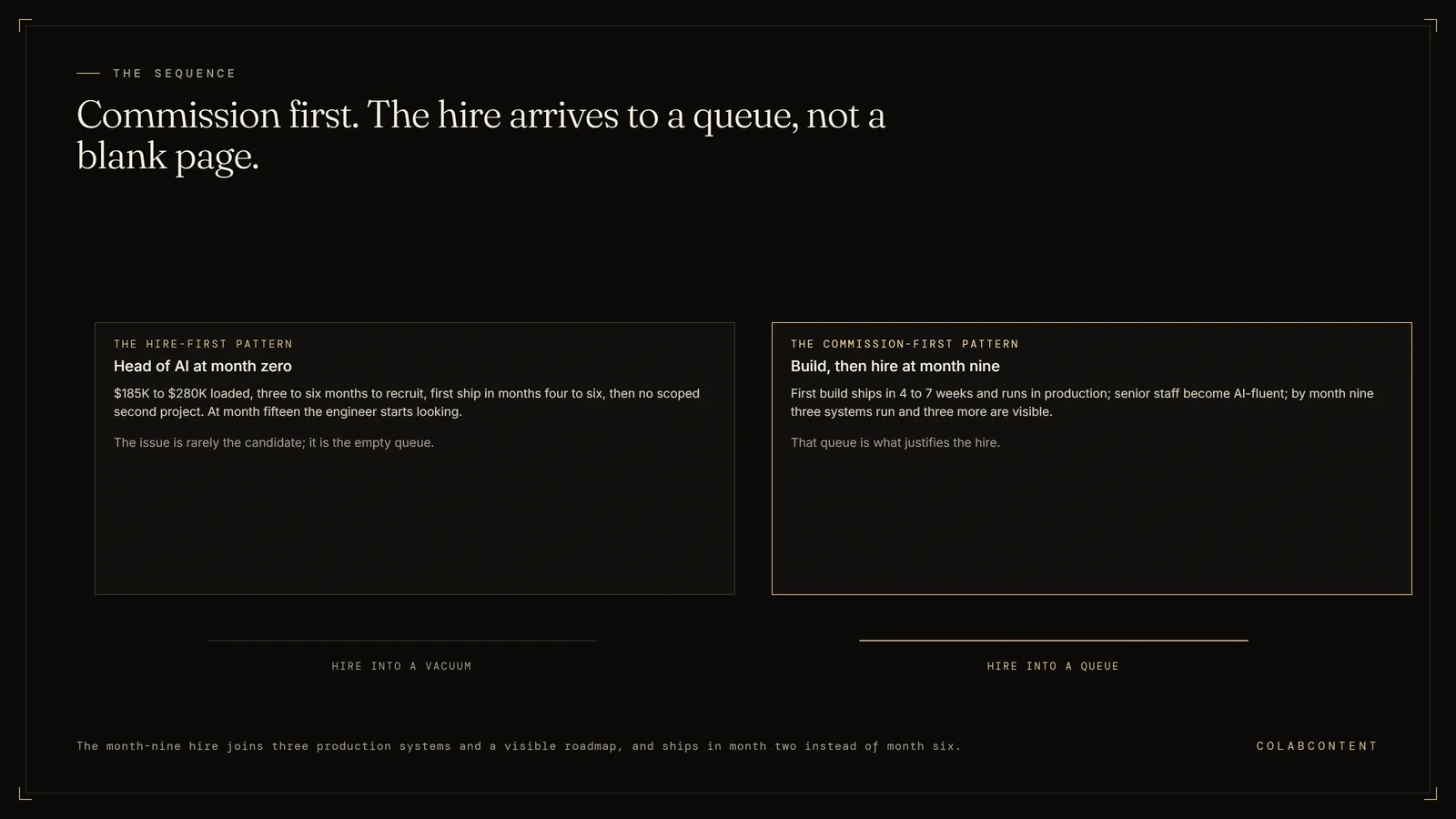
The hire-first pattern.
The conversation often starts like this: the CEO has read enough about AI to be sure the operation needs to "do AI." They post a Head of AI role at an estimated $185,000 to $280,000 loaded (base pay plus benefits and taxes, 2026 mid-market postings). They hire a strong engineer in three to six months, who ramps for two months and ships the first thing in months four through six.
Then it gets interesting. The engineer finishes the first thing and looks for the next thing. There's no scoped second project; the operation thought the first was the project. The engineer maintains the first build for three months, builds a small second thing, maintains both, and at month fifteen starts looking for a job somewhere with more surface area.
This pattern shows up at firms that hired AI talent in 2023-2024 thinking they were ahead of the curve. They were ahead. Several also cycled through several engineering hires trying to find the right fit, often because the issue was the missing queue, not the candidate. Full comparison: hiring an internal AI lead versus commissioning a build.
The commission-first pattern.
The alternative sequence: commission the first build. The firm scopes against the operation's biggest constraint, ships in weeks rather than months, and hands off code the operation owns. The senior staff who shepherded it become AI-fluent through the experience.
Within a few months, the AI-fluent senior is naturally identifying the second workflow that would benefit. Not long after, the second build has shipped (commissioned again, or built internally if the operation has the bench). By the time a Head of AI role would normally be posted, a real queue exists: several workflows shipped, several more visible. The playbook library describes the architectures a second and third build typically draw from.
That queue is what justifies the Head of AI hire. The hire arrives to a firm with production systems already running, a clear roadmap of what comes next, and a senior operator (the AI-fluent one) who can be the hire's day-one collaborator. The hire ships their first deliverable sooner than the hire-first sequence allows, because the infrastructure is already there.
Why the sequence matters.
The hire-first sequence creates a chicken-and-egg problem. The Head of AI is brought in to figure out what to build; the operation hasn't built anything yet so doesn't know what to ask for; the engineer's first six months are exploration that often surfaces the wrong things to build because the operation hasn't yet learned to think about its workflows the right way.
The commission-first sequence inverts this. The first commissioned build is itself a learning vehicle. The operation learns what AI does well, what guardrails feel right, what change-management patterns work in their culture, what data shape they actually have. By the time the Head of AI joins, all of this is settled. The hire's first project lands in production fast because the operation has internalized the right questions.
The economics, candidly.
One year of a Head of AI hire's loaded cost runs an estimated $185,000 to $280,000 (2026 mid-market postings, not audited). At our $10,000 published starting price per commissioned build, that funds roughly two to three commissions. Two years runs an estimated $370,000 to $560,000 on the same basis, or four to six commissions. The $499 AI-Ready Audit sizes which side of that math a business is on.
If your business has four to six distinct AI builds queued for the next two years, the math favors the hire; if you have one or two, it favors commissioning. Most established mid-market firms name one or two clear workflows in year one, with more becoming visible only after the first build ships.
This is why the sequence matters. Commission-first reveals the queue. Hire-first hopes the queue exists.
What we'd do.
If your business has one named workflow with a dollar figure attached: commission. The playbook library describes 19 specific architectures we'd ship across five verticals.
If your business has 4-6 named workflows already scoped and a culture that has absorbed AI fluency in its senior staff: hire. The Head of AI joins to a real, justified queue.
If your business has neither yet: don't hire and don't commission. Take the AI-Ready Course first, run the diagnostic, find the first workflow, then compare hiring against commissioning before you decide.
The honest read.
This memo is self-interested. Of course we'd recommend commissioning before hiring; we are the firm making the case. The honest defense: the sequence we describe holds even when we're not the one commissioned. Firms that commission first (with us, with another firm, with their existing dev shop) generally end up with stronger AI capability eighteen months in than firms that hire first. The sequence is the leverage; who does the commissioning is downstream. What we will and will not build is on the about page.