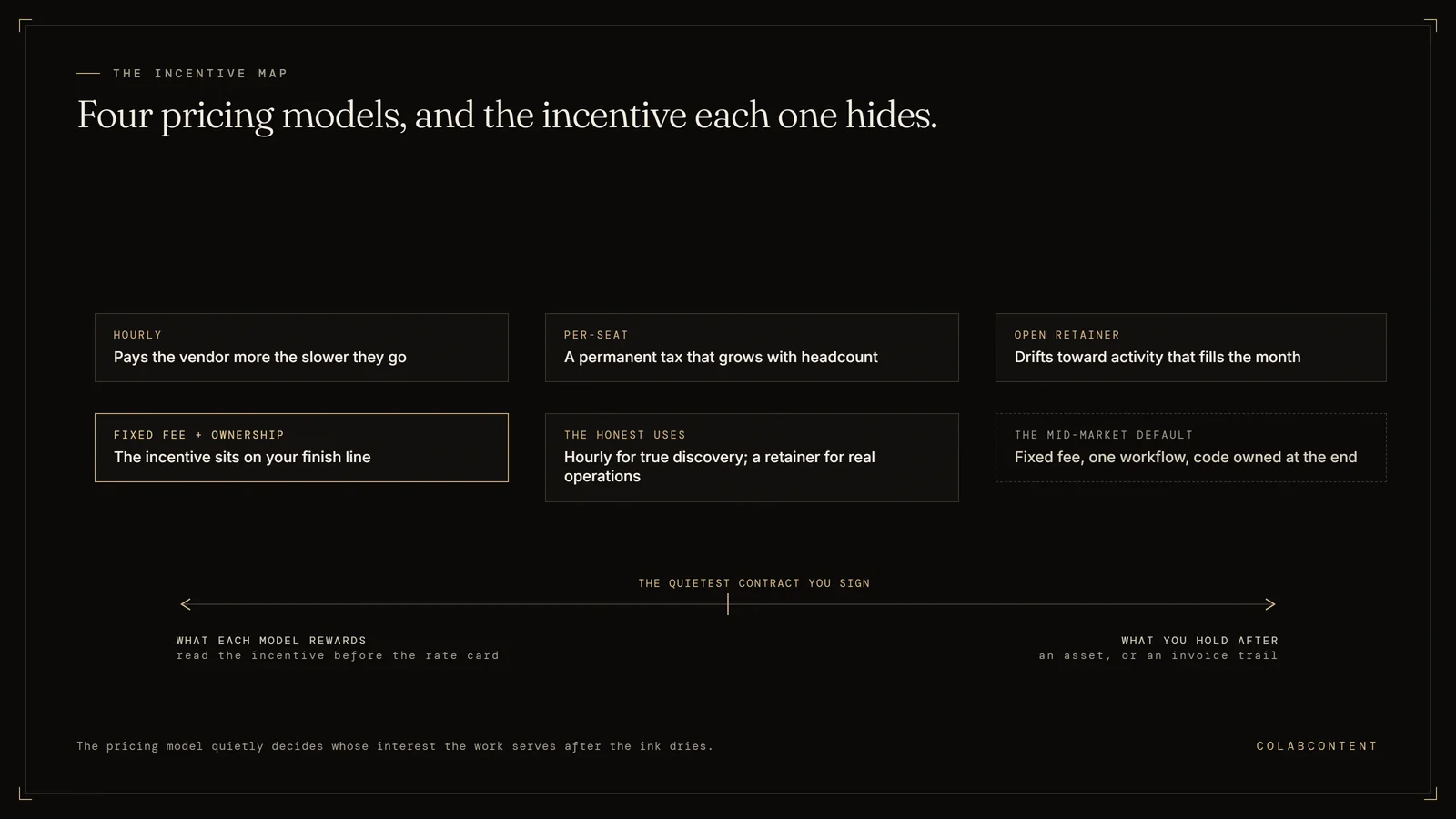
Why the price model is the quietest contract you sign.
When you agree a way of being billed, you are agreeing to far more than a rate. You are agreeing to a set of incentives that will run in the background of the entire engagement, pulling the vendor's behavior in a particular direction whether either of you notices or not. Vendors, like everyone, do more of what they are paid for and less of what they are not, and the pricing model is the instruction that tells them which is which. This is not cynicism about consultants; it is just how any arrangement between two parties works once the novelty wears off and the daily decisions pile up. The model is the standing order underneath every one of those decisions.
That is why comparing proposals on price alone is a trap. A number tells you what the work costs today. The model tells you what the vendor is quietly rewarded to do tomorrow, and over a real engagement that second thing shapes the outcome far more than the first. An hourly arrangement rewards a longer engagement. A per-seat arrangement rewards your continued dependence. A retainer rewards renewal regardless of results. A fixed-fee arrangement rewards reaching the finish. These are not moral differences between vendors; the same honest team behaves differently under different incentives, because the incentive is doing part of the deciding for them. When you choose how to pay, you are choosing which of these pressures sits on the person building your system.
For a mid-market buyer the stakes are sharper than they are for either end of the market. You are large enough that the workflow you are building actually matters to how the business runs, which means a misaligned incentive compounds over real money and real time. You are also small enough that you do not have a procurement department to police the arrangement or a legal team to claw back a bad structure after the fact. The pricing model is, in practice, most of the governance you get. Choosing it well is not a finance detail to delegate; it is one of the few levers that decides whether the engagement serves you or slowly turns to serve the vendor.
The rest of this memo takes the four models one at a time and reads each one for the incentive it creates rather than the rate it quotes. Two of them, hourly and the retainer, have a genuine and honest place, and the memo says plainly where. Two of them, hourly on a defined build and per-seat on your core workflow, are where mid-market buyers most often overpay and lose control without noticing. And one structure, fixed-fee tied to a named workflow with the code handed over at the end, is the one that points the vendor at your finish line and leaves you owning what you paid for. The dollar figure that sits inside any of these is a separate question, worked through in what a mid-market AI engagement actually costs; this memo is about the structure the figure sits inside, because the structure is what you live with.
The four models and what each one rewards.
Start with hourly, because it is the most familiar and the most quietly misaligned when it is used on the wrong work. Under hourly billing you pay for time, which means the vendor is paid more the longer the work takes. On genuinely exploratory work that is fine, because the time genuinely is the product. On a defined build it is a structure where efficiency costs the vendor money and thoroughness with no finish line costs you it. Neither side has to be acting in bad faith for this to bite; an hourly clock simply has no built-in reason to stop, and the risk of it running long sits entirely on you. You are the one holding an open-ended meter against an outcome nobody committed to a price on.
Per-seat pricing is the model that has quietly become the default for software, and it is worth seeing clearly for what it does to a buyer over years rather than months. You pay a recurring fee for each person who uses the tool, forever, and the bill grows as your company grows. That means your own success at hiring and expanding raises your cost of running the very workflow that was supposed to make you more efficient. The deeper cost is ownership: regardless of how many years you pay, you never acquire the thing. You are renting access, and the day you stop paying you are left with nothing you can run yourself, no code, no asset, only a gap where a core process used to be. The vendor, meanwhile, is rewarded for keeping you dependent, because dependence is the product. For commodity software used broadly across the company this can be an honest trade, since you are buying the freedom never to maintain it. For the one workflow that gives your business its edge, renting it in perpetuity from someone who can raise the price or change the product is a strategic exposure, not a convenience.
The retainer sits in the middle and is the hardest to read, because it can be the most honest model or the most drifting one depending on what it is actually protecting. A retainer is a fixed monthly sum for a standing claim on the vendor's attention. When there is real continuous work, a live system that has to be watched and tuned as your inputs shift, that is a fair and clean arrangement, because the work is genuinely ongoing and someone with context genuinely needs to be on call. The failure mode is the retainer that outlives its purpose. The build finished months ago, the system is running, and the monthly fee now buys activity that fills the hours rather than results that move the business. The incentive under a drifting retainer is renewal, full stop, and renewal does not require the work to still matter. A retainer is only as good as the answer to a single question: what would you lose if it stopped this month? If neither side can name it, you are paying for motion.
Fixed-fee is the model where one price is agreed up front for one defined outcome, and its incentive runs the opposite way from hourly. Because the price does not move with the hours, the vendor is now rewarded for reaching the finish efficiently rather than for staying on the clock, and the risk of the work running long has moved from you to them, which is where it belongs, since they are the ones who control how the work goes. Fixed-fee only works when the outcome is genuinely defined, which is its one real demand: you cannot fix a price honestly on a target nobody can describe. That demand is a feature, because it forces the scoping discipline that a vague engagement lets both sides skip. The version that serves a mid-market buyer best is fixed-fee tied to a single named workflow with a baseline number attached, so that finished means something measurable rather than something argued over later. That is the same discipline of choosing one bounded target rather than a department-wide ambition that decides most of a project's fate, covered in why most mid-market AI rollouts stall in month four.
When each model is actually the honest choice.
None of these models is a villain, and a memo that pretended otherwise would be a sales screed rather than something you can use. Each one is the right answer to a particular question, and the skill is matching the model to the work rather than defaulting to whatever the vendor prefers. Hourly is the honest choice for genuine discovery. When nobody yet knows what should be built, when the real deliverable is the vendor's thinking about where your leverage is, a fixed price would be a guess wearing the costume of a quote, and you would be paying a padded number to cover the vendor's uncertainty. In that specific situation you actually are buying time, and paying for it by the hour is fair to both sides. The discipline is to keep discovery short and bounded, with a defined question and a defined end, so that hourly does its honest job and then hands off rather than becoming the whole engagement by inertia.
The retainer is the honest choice when there is real ongoing operation. A live AI system is not a bridge you build and walk away from; it runs against inputs that change, a business that shifts, edge cases that surface only in production, and that genuinely needs a standing owner with context who can watch and adapt it. Paying a fixed monthly sum for that is not drift; it is buying the operation the system needs to keep earning. The line between an honest retainer and a drifting one is whether it names what it maintains and what its absence would cost. A retainer that says, in plain terms, this keeps the following live system running and here is what breaks if it stops, is doing real work. A retainer that has quietly become a way to keep a delivered project on the meter is not, and the tell is that nobody can say what it is protecting anymore.
Per-seat is the honest choice for commodity software you do not want to own or maintain. Email, video calls, the standard tools every company runs, these are things where renting access forever is a good deal precisely because you never want the burden of running them yourself. The mistake is not using per-seat software; it is using it for the workflow that gives your business its edge, the one place where owning the asset is the entire point. The build-versus-rent judgment for any given piece of your operation, where to buy the commodity and where to own the differentiator, is the same one worked through in build versus buy AI for a mid-market company. And fixed-fee is the honest choice the moment the outcome is defined, which is most of the time once discovery has done its job. The practical rule that falls out of all this is a sequence rather than a single pick: buy a short hourly discovery if you need one, commit to a fixed-fee build once you know the target, own the code it produces, and add a retainer only for the genuine operation that remains. That ordering is most of what separates a clean engagement from an expensive one, and it maps onto the structured version described in how a structured diagnosis works.
The fastest way to see how this plays out for your own operation is the $499 AI-Ready Audit, which turns the general points above into a report specific to your business.
Why fixed-fee plus ownership wins for a mid-market buyer.
Put the models side by side against what a mid-market buyer actually needs, and one combination pulls ahead for reasons that have nothing to do with saving a few dollars. Fixed-fee aligns the vendor's incentive with your finish line, because a fixed price rewards reaching the outcome rather than extending the hours. It moves the risk of overrun onto the party who controls the work. It forces the scoping discipline that vague engagements skip, since you cannot price a target nobody can name. And it gives you a definition of done you can hold, especially when the fee is tied to a workflow with a baseline number, so the project cannot quietly stay open because nobody agreed what finished meant. Every one of those properties is a direct answer to the ways engagements go wrong on a buyer who does not have a procurement department watching.
Ownership is the other half, and it is the half buyers most often leave on the table. When the code that runs your workflow is handed to you at the end, you have bought an asset. You can maintain it, extend it, move it to a different provider, or hire anyone in the market to work on it, and the vendor has to win the next engagement on merit rather than on your being unable to leave. When the vendor keeps the code, you have bought a dependency dressed as a project: every future change routes through them, at their price and their pace, and the thing your business now runs on is something you do not control. For the workflow that gives you your edge, that code is a capital asset, and an engagement that does not transfer it has sold you a lease while calling it a purchase. The honest structure names the handoff explicitly, so that ownership is a deliverable rather than an assumption. Whether to build that owned asset at all or hire the capability in-house is a related fork, weighed in an AI consultant versus an in-house hire.
The two together are more than the sum of their parts. Fixed-fee without ownership can still trap you, because a cleanly delivered project you cannot maintain yourself pushes you straight back to the vendor for every change, and the leverage you had during the build evaporates the moment it ships. Ownership without a fixed fee leaves you carrying the overrun risk on an open clock. It is the combination that gives a mid-market buyer both an aligned build and a free hand afterward: a vendor rewarded to finish, a price that cannot run away, and an asset that is yours to run when they leave. That is the arrangement worth insisting on, and it is the one reflected in how engagements are structured and priced.
The practical move for an owner reading proposals is to stop leading with the number and start reading for the model. Ask each vendor how they bill and what you own at the end, and listen for whether the structure points them at your finish or at their recurring revenue. A vendor who proposes a fixed fee on a named workflow and hands you the code is telling you they are willing to be paid for the outcome and to compete for the next piece of work rather than to hold you captive to it. A vendor who steers you toward hourly on a defined build, per-seat on your core process, or a retainer with no named purpose is telling you something too. The signal is in the structure, not the rate, and knowing how to read it is most of what separates a good AI partner from an expensive one, which is the wider judgment laid out in how to choose an AI consultant.