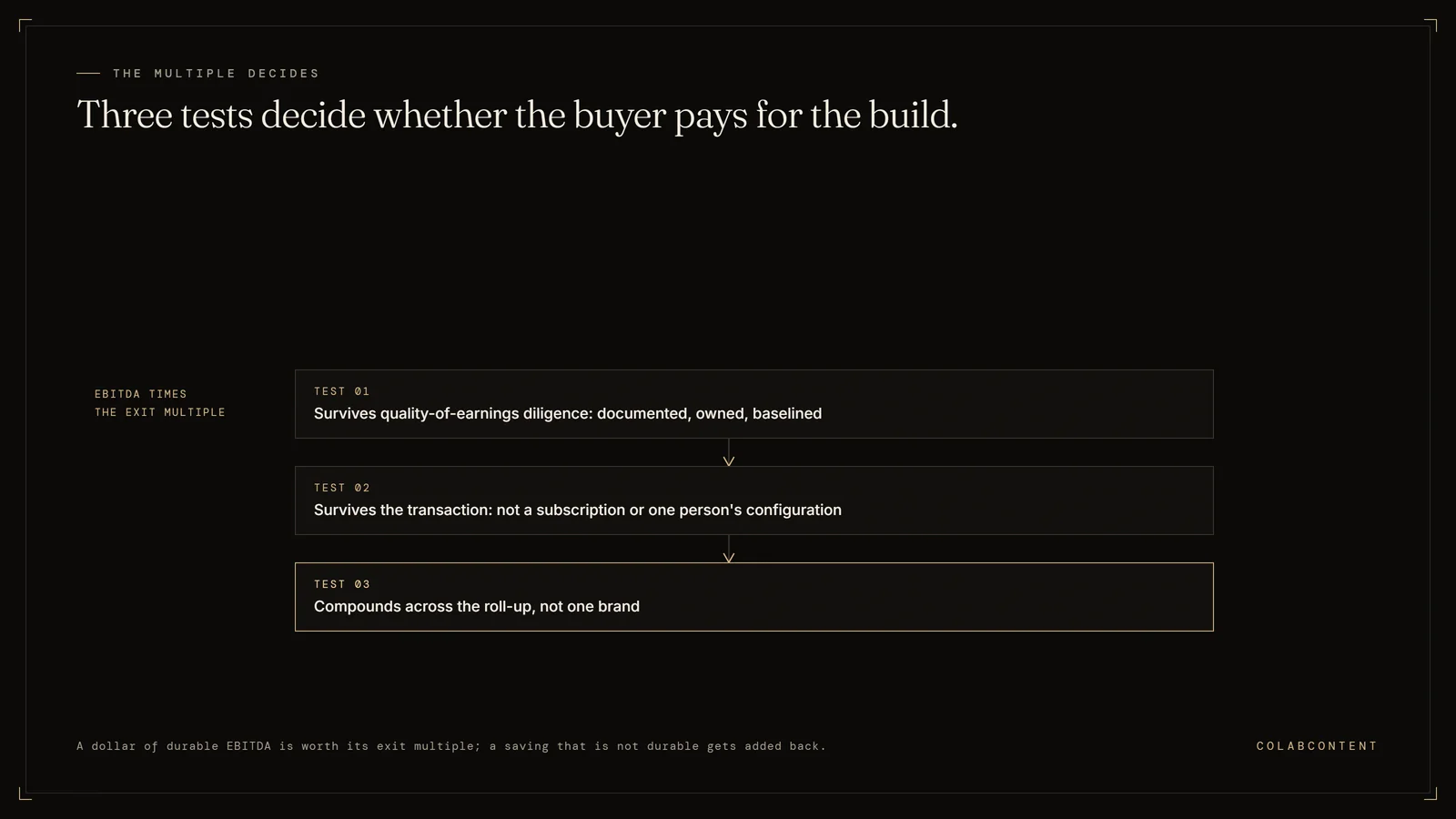
The platform is priced on a multiple, and that changes which AI is worth buying.
Most businesses buy AI to lower a cost, and the cost stays lowered as long as they own the business. A platform assembled by a sponsor is not most businesses. It exists to be sold inside a fund's hold period, and it is priced the way it will be sold, at a multiple of its earnings. That multiple is commonly high single digits to low double digits (a typical range for platforms in this band, not this platform's own multiple), which means a dollar of earnings a buyer treats as durable is not worth one dollar. It is worth the multiple, counted once now inside the earnings and again as the multiple is applied at exit.
That single arithmetic fact reorders every AI decision at this kind of buyer. The right question is never whether a system saves money. Almost any competent system saves some money. The question is whether the saving becomes an asset the multiple pays for, or a convenience that quietly evaporates the moment the platform changes hands. An efficiency decision asks what a tool costs and what it removes. An asset-quality decision asks whether a buyer's diligence will credit the improvement as durable earnings, whether the capability survives the transaction, and whether it makes the next acquisition worth more.
Those are not the same question, and a platform that answers the first while believing it answered the second is the platform that buys well-liked software and sells at the same multiple it would have reached anyway. The efficiency was real. It just landed in a form the buyer had no reason to pay for, which at a business whose entire purpose is the sale is close to not landing at all.
The operational questions are real too, and they are largely settled elsewhere. Which workflow to automate, how dispatch and intake get normalized across brands, how the system reads the field service stack, how a sponsor sees the EBITDA bridge: those belong on the home services platforms industry brief and are not relitigated here. This memo takes the narrower question the brief does not, the one no vendor can answer for the platform. When the saving arrives, will a buyer pay a multiple for it, and will it still be there when the buyer looks.
Test one: will the improvement survive quality-of-earnings diligence?
Before a platform sells, a buyer runs a quality-of-earnings study, and that study is where an AI saving either becomes worth its multiple or becomes worth almost nothing. A quality-of-earnings team does not accept the platform's reported EBITDA at face value. It tests each component for whether it is real, durable, and likely to recur under new ownership, and it adds back anything that looks like a one-time benefit, an owner's discretion, or a number that depends on a relationship or a subscription the buyer would not keep.
An AI-driven saving walks straight into that test. If the saving is documented, owned by the platform, integrated into the systems of record, and visible as a sustained change in an operating metric the diligence team can trace, it reads as run-rate EBITDA and earns the multiple. If the same saving rides a month-to-month vendor subscription, lives inside one clever manager's private configuration, or sits on a setting that will reset at the next platform migration, the diligence team treats it as reversible. Reversible savings get discounted or added back, and an added-back dollar contributes nothing to the price.
The defense is built long before diligence, and it is mostly bookkeeping rather than technology. A saving is only creditable if the platform can show what the metric was before the system existed and what it is now, which means a baseline has to have been captured in the systems the platform already runs. Platforms lose this argument by never writing down the year before the change; the general form of the problem is set out in how to measure the return on a mid-market AI engagement. The same discipline governs the inputs: a system whose outputs cannot be tied back to clean, owned operational data cannot be defended as durable, and data readiness is what makes the saving legible to a stranger reading the numbers cold.
The practical consequence is that the cheapest-looking AI purchase is often the one that fails this test. A subscription that shows a result on a dashboard but leaves no owned artifact, no baseline, and no integration behind it can be genuinely useful to operate and still contribute zero to the price the platform sells for.
Test two: does the capability survive the transaction?
At exit the platform stops being a standalone company. It folds into a larger acquirer, a strategic consolidator, or a continuation vehicle the same sponsor rolls it into, and the AI capability has to make that move intact or it does not count. This is where the form of the thing, owned asset versus rented convenience, stops being a philosophical preference and becomes a line in the purchase agreement.
Consider the two ways the same capability can be structured. In the first, the platform pays a per-seat subscription for an AI feature in the vendor's cloud, under a contract in the platform's name. To an acquirer, that is not an asset; it is a liability to be re-priced. The acquirer either re-buys the seats at whatever the vendor charges an enterprise, folds the function into a tool it already owns and rips the subscription out, or discovers the contract auto-renews on terms it did not choose. None of those outcomes puts money on the platform's side of the table. A capability the buyer has to re-acquire is a capability the seller was effectively renting.
In the second, the platform owns the codebase, it runs inside the platform's own cloud tenant (an isolated environment in the platform's own cloud account), and the model choices, prompts, and data pipeline are documented well enough that the acquirer's engineers can read and keep it. That transfers cleanly. It shows up in diligence as intellectual property the platform built and controls, it carries no third-party contract the acquirer has to inherit, and it can be presented as a synergy the acquirer pays up for, because the buyer can extend it across a portfolio far larger than the platform that built it. Why ownership at handoff is the whole game, rather than a nicety, is the subject of owning your AI and why code handoff matters.
The subscription route also carries a cost that compounds against exactly this kind of buyer. A platform grows its seat count as it acquires, so a per-seat AI contract gets more expensive every time the roll-up does its job, and per-seat pricing at scale is where platforms find they signed up for the option that punishes growth. The capability that survives the transaction is the one the platform can hand over as a thing it owns, not a bill the buyer has to keep paying.
Test three: does it compound across the roll-up, or only lift one brand?
A sponsor did not buy a home services company. It bought a thesis that many home services companies, run on one platform, are worth more together than apart, and that each additional acquisition gets cheaper to absorb than the last. AI earns its multiple at this kind of buyer only when it serves that thesis, which means the test is not whether a capability helps a brand but whether it compounds across the roll-up.
The distinction is sharp in practice. A capability built for one brand, tuned to that brand's data and its people, improves that brand's numbers and stops there. It is a genuine operating win, and it is invisible to the multiple, because a buyer underwrites the platform's ability to keep consolidating, not a single location's performance. A platform-level capability is different in kind. It lives above the brands, every future acquisition inherits it on the day it closes, and it makes the next integration faster and cheaper than the last one was. That is the property a sponsor actually pays for, because it turns the acquisition pipeline from a series of one-off integration projects into a repeatable motion.
The mechanics of how a platform-level system normalizes across brands, and why cross-brand routing is a custom workflow rather than a configuration setting, are worked out in five things PE platforms get wrong about ServiceTitan AI, and there is no reason to repeat them here. The money point is narrower. A one-brand build is priced by the platform as a cost that paid off. A platform-level build that every acquisition inherits is priced by the buyer as part of what makes the whole machine worth a higher multiple, and those are different orders of magnitude.
There is a failure mode that lives exactly here. A capability that was supposed to be platform-level but was actually built against one brand's quirks does not inherit; the next acquisition needs it rebuilt, and the promised compounding never arrives. That is a common reason a rollout that looked successful at one brand quietly stops paying off as the platform scales, a pattern that shows up across industries as rollouts stalling around month four. Inside a roll-up the cost is not just a stalled project; it is a compounding story the sponsor underwrote and did not get.
The case for buying nothing this year, or just buying the tier you already own.
We commission custom systems for a living, so weigh the following accordingly. It is also the section we would most want an operating partner to read, because a platform that buys a custom build at the wrong point in its hold decides the whole category was a waste of money, and it was half right.
A platform twelve to eighteen months from exit should usually not commission a custom build. The reason is the same arithmetic the rest of this memo runs on. A build takes time to ship and more time to show a sustained change in an operating metric, and only a change that has seasoned into the trailing-twelve-month numbers a quality-of-earnings team reads will be credited at exit. A capability that goes live three months before the bankers do gets no run-rate credit; it reads as a new, unproven cost. Set against that thin upside is a real downside: standing up a new system across the operation during a live sale process introduces disruption risk at the exact moment the platform most needs clean, boring, predictable numbers. Close to exit, the honest answer is usually to wait, harvest what is already seasoned, and hand the build to the next owner as an opportunity rather than a half-finished project.
The second honest case is the commodity workflow. If the need is generic to the industry, call summarization, basic scheduling assistance, routine follow-up, it is very likely already shipped inside the field service management tier the platform pays for. Buying a custom version of a feature the platform already owns is a maintenance liability with no exit story attached. The question of when a workflow is specific enough to justify a build and when it is not is the whole subject of the build versus buy decision, and for a platform the default should tilt toward the owned tier for anything generic.
The case flips for an early-hold platform with a long runway. A sponsor two or three years from a sale has exactly the time a build needs to season into the numbers, and exactly the acquisition pipeline for a platform-level capability to compound across. That is the window where a custom commission passes all three tests at once: it has time to become run-rate EBITDA, it can be built as an owned asset that transfers, and every deal in the remaining hold inherits it. The right move is not a fixed policy on buying AI. It is a policy of reading the hold clock first and saying plainly, in each case, whether the answer is build, buy the tier, or wait.
What a platform CEO or operating partner can do this week, with no vendor in the room.
None of this requires a vendor, a demo, or a budget. It requires an afternoon and the platform's own records, and it produces a decision an operating partner can defend to a sponsor. Run the three tests as three lists.
For the first test, take every dollar the platform currently spends on AI and automation and sort it into two columns: what a quality-of-earnings team would credit as durable run-rate EBITDA, and what it would add back as reversible. A line belongs in the run-rate column only if the platform can produce a baseline, an owned artifact, and an integration that outlives the vendor relationship. Most platforms find the add-back column longer than they expected, and every line in it is a saving the platform is booking today that will not survive the buyer's read.
For the second test, list every AI capability the platform relies on and mark each one as a per-seat contract in the platform's name or an owned asset running in the platform's own cloud. The contracts are the ones an acquirer re-buys or rips out; the owned assets are the ones that transfer and can be sold as synergy. If the important capabilities are all in the first column, the platform is renting the very things it will want to present as intellectual property at exit, and that is a position to change while there is still time to change it.
For the third test, name the single capability the next acquisition would inherit on the day it closes, and be honest about which capabilities would instead have to be rebuilt for the new brand. If nothing inherits, the platform has been buying operating wins and calling them platform strategy, and the compounding the sponsor underwrote does not exist yet.
Those three lists take a CFO and an operating partner one afternoon, and between them they answer the only question that matters at a business built to sell: not whether AI would help the platform run, but whether a buyer will pay a multiple for what the platform is about to build. A platform that walks into a vendor conversation with those three lists already filled in has supplied the one input no vendor can supply, and it is the input that decides whether the money spent this year shows up in the price next year.
If the platform is mid-integration rather than mid-strategy, those same lists come with dates attached in the 100-day playbook for a PE add-on in home services, which runs from day 1 stabilization through the 30-day baseline to the systems decision that does not have to be made inside the first hundred days.