The question that misleads, and the stack it hides.
A customer service AI is the only system most companies will ever point at their own customers and let speak in the company's own voice. It answers in the brand's name, it makes commitments a customer will remember and hold the company to, and it does all of this in public, one conversation at a time, without a manager reading over its shoulder. That is a different kind of purchase from the internal tools that draft emails or summarize documents, and it is the reason the usual buying question goes wrong here before anyone has looked at a single vendor.
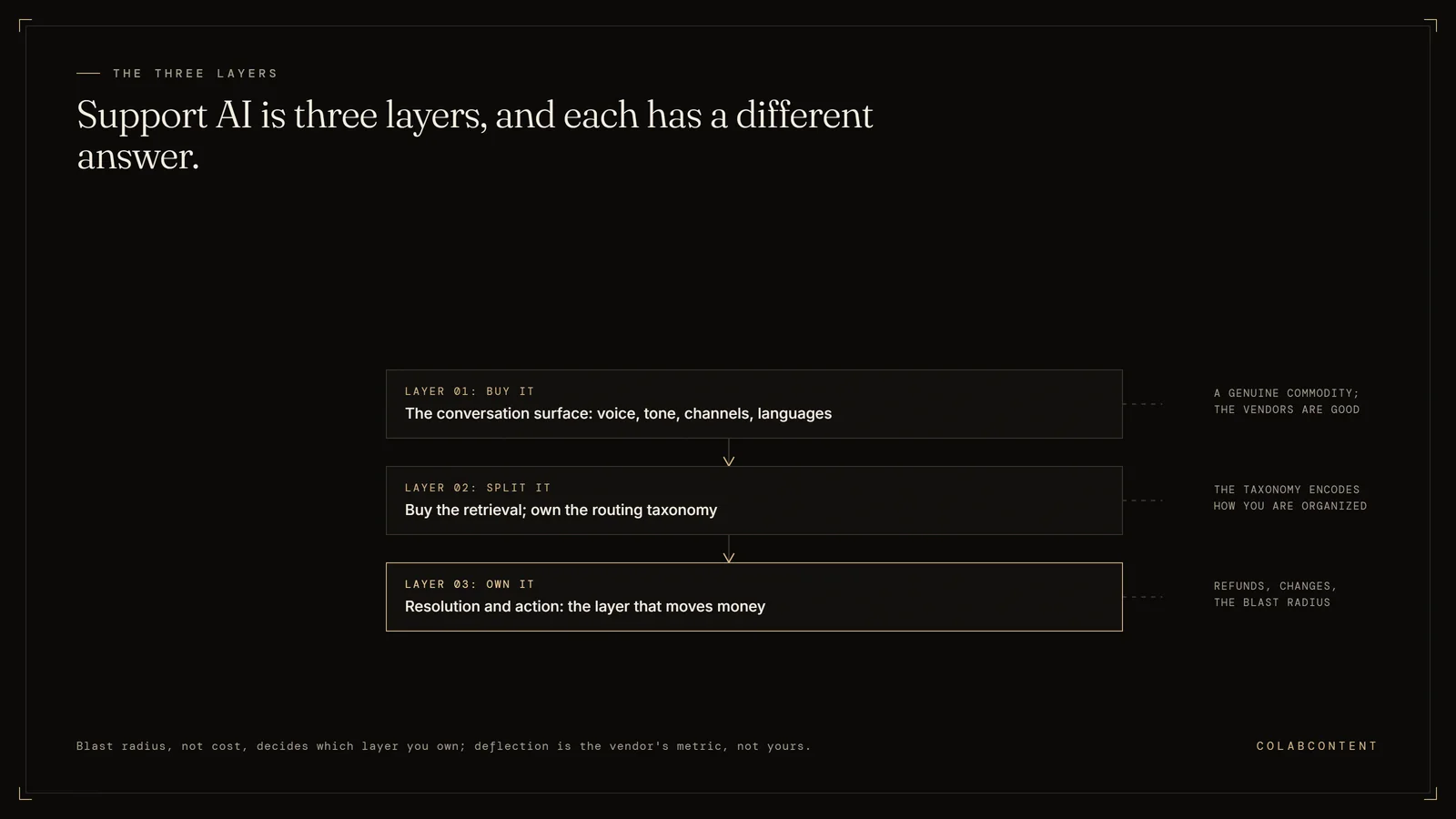
Build versus buy is framed as one decision with two settings, and for a tool that lives inside the company that framing is fine. A support AI is not one tool. It is a stack of three layers that happen to ship inside one product, and the layers do not share an answer. There is the conversation surface the customer actually talks to. There is the knowledge and routing middle that decides what the system knows and where it sends things. And there is the resolution layer that does something real at the end, issuing a refund, changing an account, applying a credit, or handing off to a person with the context attached. Ask build or buy about the whole bundle and you force one answer onto three questions.
The general version of that decision, which workflow to build and which to buy, is worked through in the build versus buy decision for a mid-market company, and its logic holds inside each layer here. What it does not capture is the thing that makes customer service its own case. Because the AI is customer-facing, the variable that decides each layer is not what the software costs. It is what a wrong answer costs, and that changes which layers you can comfortably rent and which you cannot afford to.
Layer one, the conversation surface: buy it, and do not overthink it.
The layer the customer touches is the tone, the phrasing, the channel coverage, the languages, the small courtesies that make an exchange feel like the brand rather than a form. A year or two ago this was hard. It is not hard now. The vendors that sell conversation surfaces have solved fluent, on-brand, multi-channel dialogue well enough that a mid-market company will not beat them by building its own, and the gap between the best bought surface and a competent custom one has closed to the point where the effort no longer returns anything.
Which makes building your own surface to avoid a subscription the clearest waste in the whole category. It is a large engineering commitment aimed at replicating a commodity, and it buys nothing a customer would ever notice, because the customer cannot tell whether the courteous, correctly translated reply came from software you rented or software you wrote. The companies that go down this road usually do it for a reason that is really about the layers underneath, control over what the system does, and end up rebuilding the easy part while the hard part stays unsolved.
There is a second reason to buy the surface without hesitation, and it is that the surface is the portable layer. Brand voice and channel configuration are quick to stand up again somewhere else if you ever change vendors, so committing to a bought surface does not lock you in the way the deeper layers can. Buy it, hold it loosely, and spend your attention on the layers where the decision actually carries weight.
Layer two, knowledge and routing: buy the retrieval, own the taxonomy.
The middle layer is two things that usually get sold as one. The first is retrieval: the ability to read your help center, your past tickets, and your documentation, and pull the right passage into an answer. The second is routing: the logic that decides what kind of contact this is and where it should go, which queue, which policy, which human if a human is needed. They arrive bundled, but they are not the same purchase.
Retrieval is plumbing, and good plumbing is worth buying. The vendors do it well, and the thing that actually determines whether it works is not the retrieval engine but the quality of what it reads; a retrieval layer pointed at a stale, contradictory help center will confidently surface the wrong answer, which is why the real work here is on your side of the line and is the subject of getting your knowledge ready for AI. Buy the retrieval, feed it clean inputs, and it will earn its price.
Routing is different, because the routing taxonomy is a description of how your company is organized. It encodes which team owns which problem, which situations are exceptions, how an edge case gets escalated and to whom, and that map is specific to you in a way a vendor's default categories are not. It is worth owning, or at least worth documenting and controlling on your side, because it is one of the two places where the system quietly accumulates your operation inside itself. Left to live entirely in a vendor's configuration, the routing logic you refine over thousands of tickets becomes their asset built from your data, and getting it back if you ever leave is the part that does not come free.
Layer three, resolution and action: own the layer that moves money.
The third layer is the one that does something a customer feels. It does not answer a question; it takes an action, issuing the refund, applying the credit, changing the address, cancelling the order, or escalating to a person with the whole history attached so the customer does not have to start over. This is the layer that is genuinely specific to your product, because it is wired into your systems of record and it runs on your rules, and it is the layer where both the liability and the advantage live.
The liability is plain once you say it out loud. An action layer decides when the company gives money back, when it changes a commitment, when it makes an exception, and it does that speaking in the brand's name to a customer who will hold the company to whatever it said. A rule that important should be readable, revisable, and defensible by the people accountable for it, which it is not when it lives inside a vendor's configuration expressed in the vendor's terms. Owning the action layer, or at minimum owning the integration and the policy logic even when a vendor supplies the reasoning, is what keeps that rule somewhere you can open and audit. Why ownership at the handoff is the whole point, rather than a nicety, is worked through in owning your AI and why code handoff matters.
The advantage is the other half. The action layer, done well, is where a support interaction stops being a cost to contain and becomes something a competitor cannot easily copy, because it is fused to your systems and your policies rather than bolted on from outside. That is the layer worth building, and the one worth refusing to rent.
Blast radius, not cost, decides which layer you own.
Run those three layers back and a single variable sorts them, and it is not price. It is blast radius, the size of the damage a wrong answer does. Where a wrong answer is cheap and reversible, buy; where a wrong answer moves money or changes an account, own. Answering a how-do-I question incorrectly costs a moment of confusion and a correction. Issuing a refund that should not have gone out, or changing an account in a way the customer did not authorize, costs real money and real trust, and it does so in the company's name.
That is why the governing question at each layer is what a mistake there actually breaks. The conversation surface has a small blast radius; a clumsy sentence is embarrassing and instantly fixable, so renting it is comfortable. The action layer has a large blast radius; its mistakes are transactions, not typos, which is precisely why the policy behind it cannot sit in a configuration you are not able to audit. You do not want to discover the rule for when to issue a refund by watching it fire wrong on a real customer and then finding you cannot read it.
Cost still matters, and per-seat pricing has its own compounding logic that is worth understanding on its own terms in the real cost of off-the-shelf AI at scale. But cost is the second question here, not the first. In a customer-facing system the first question is always what a wrong answer does to the customer and the brand, because that is the exposure the price tag never shows.
The metric trap: deflection is the vendor's number, not yours.
Every customer service AI is sold on deflection rate, the share of contacts handled without a human, and it is the wrong number for the buyer to optimize. Deflection is the vendor's success metric, and it measures endings, not resolutions. A bot can post an excellent deflection figure by simply being tiring enough that people give up and close the chat, and that shows up on the dashboard as a contact successfully deflected while it quietly registers nowhere as the customer who decided the company was not worth the effort. The number goes up and retention goes down, and nothing on the vendor's report connects the two.
The buyer's metric is resolution that stuck. A contact counts as resolved only when it was handled without a human and the same customer did not come back with the same problem in the days that followed, because a repeat contact means the first one ended without solving anything. Paired with that, satisfaction on AI-handled contacts should be measured against satisfaction on human-handled ones as the control, so you are comparing the AI to the alternative it replaced rather than to nothing. Those two numbers together are much harder to game than deflection, and they are the ones a support leader should be reporting; the wider discipline of measuring whether an AI engagement actually returned what it promised is laid out in how to measure the return on a mid-market AI engagement. Optimize deflection and you will get a bot that is good at ending conversations. Optimize stuck resolution and you will get one that is good at solving problems, which is the thing you were actually buying.
The honest counter-case, which mostly says buy.
We build custom systems for a living, so weigh this accordingly, and then take it seriously anyway, because customer service is the category where buying is most often the right answer. For most mid-market companies the honest recommendation is to buy the surface and the retrieval from a strong vendor and own only the action layer, and to own that only when the contacts are actually transactional. Everything else is a bought stack, and that is not a compromise; it is the correct call.
If this is the question in front of your own business right now, the $499 AI-Ready Audit answers it against your numbers, not a general case, in a report you get back the same day.
The clearest version is a company whose support is overwhelmingly informational. If the contact mix is dominated by how-do-I questions, where-is-my-order questions, and what-are-your-hours questions, the right move is to buy the entire stack and build nothing, because there is no money moving and no account changing for a wrong answer to damage. The blast radius across the board is small, so there is no layer worth owning, and building one is the mistake, not the mark of ambition. The trigger for owning the action layer is transactional volume and blast radius, not company size and not how sophisticated the company wants to appear. If a meaningful share of contacts end in something happening to a customer's money or account, owning that layer starts to pay; if they end in an answer, it does not.
Two timing notes belong here as well. A company in the middle of migrating its help desk should wait, because building an action layer against a platform you are about to leave is wasted work, and rollouts commissioned into that kind of churn are a familiar way for an effort that looked fine early to stall a few months in, a pattern traced in why mid-market AI rollouts stall in month four. And before buying anything net-new, check what your existing help-desk platform's AI tier already includes, because a good deal of the surface and retrieval layer may be sitting in a plan you already pay for.
What a support leader can do this week, with no vendor in the room.
None of this needs a demo or a budget. It needs last quarter's tickets and an afternoon, and it produces a decision you can defend before anyone tries to sell you anything. Pull the tickets from the last full quarter and tag each one on a single axis: was it informational, a question with an answer, or was it transactional, a contact that ended in something happening to a customer's money or account. Then read the ratio. That one number does more to decide your build-and-buy split than any vendor comparison, because a company that is ninety percent informational should buy the whole stack, and a company with a heavy transactional tail has a real reason to own the layer that handles it.
For the transactional bucket, do one more pass and note, for each type, the blast radius of a wrong answer: what actually breaks if the AI gets this one wrong, and how hard it is to reverse. The contacts that move money or change accounts are the ones whose policy you want to own and audit; the ones that merely misinform are ones you can comfortably rent. That ratio and that blast-radius read together tell you which layers to buy and which to own before a single demo is booked.
From there the vendor conversation changes shape, because you walk in already knowing what you are buying and what you refuse to rent. If you want that split pressure-tested before you commit, that is the work of a buyer-side selection process and of the structured diagnosis we run before any build is scoped. The tickets you already have hold the answer. Most companies simply have never sorted them on the one axis that decides it.