Home/ Reports/ 2027 PE-Backed Home Services Platform AI Benchmark

The 2027 PE-Backed Home Services Platform AI Benchmark.

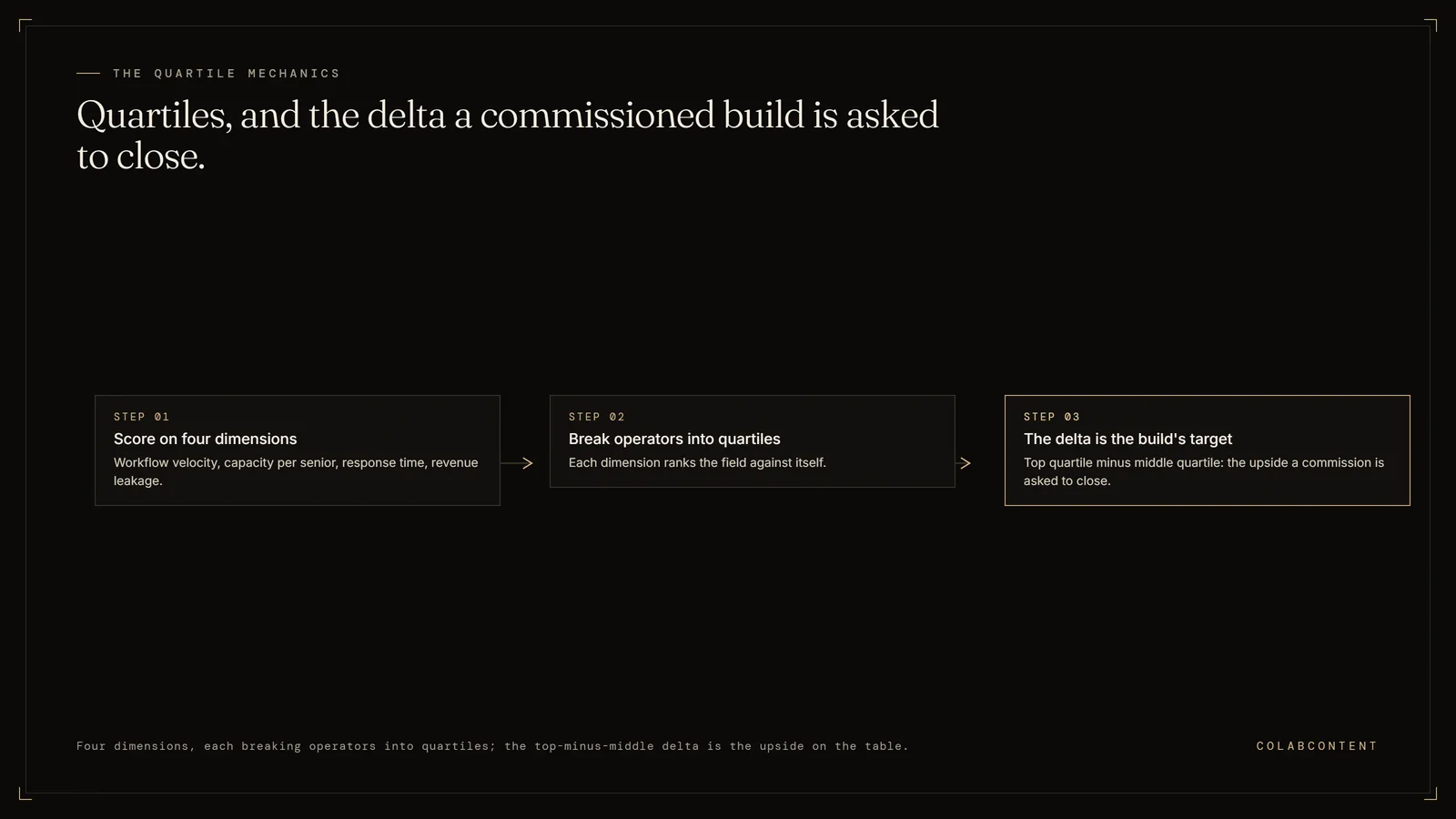
This benchmark scores PE-backed home services platforms on the dimensions that show up most often as the leading constraint in a diagnosis call: workflow velocity, capacity-per-senior-headcount, response-time distribution, revenue-leakage from operational friction. Each dimension breaks operators into quartiles. The top-quartile-minus-middle-quartile delta is the upside a commissioned AI build is being asked to close.

A 100-platform benchmark of AI adoption and ROI in PE-backed home services platforms ($20M-$100M HVAC, plumbing, electrical). Segmented by ServiceTitan vs FieldEdge, by trade mix, by hold period within the sponsor's fund.

Sample target100 platforms · $20M-$100M
Field periodQ4 2027
Report shipsQ1 2028
CostFree

What the report will cover.

Adoption rates of home services AI tools across three platform-revenue bands. Workflow-by-workflow: 24/7 call handling, dispatch optimization, technician priming, membership conversion, multi-brand integration, OP-level reporting.

ROI realization framed in EBITDA-bridge format and exit-multiple translation, the formats Operating Partners and LPs read.

Stack effects: ServiceTitan vs FieldEdge vs Housecall Pro vs Workiz. Trade mix effects (single-brand HVAC vs HVAC + plumbing + electrical platforms). Hold-period effects: how adoption changes from year-1 platform to year-4 exit-prep.

Behind the benchmark

Method, limits, and how to use it.

Methodology behind the benchmark.

This annual benchmark is built from data the operators in the vertical have agreed to share, aggregated with their identifying details removed. The source data set includes ColabContent's own diagnosis-call notes, the named-number measurements from post-handoff systems, and a structured survey we run with operators in the band each year. The benchmark is not a roll-up of public earnings filings, not a re-publication of a third-party industry report, and not an extrapolation from a single named engagement.

The dimensions we benchmark are the ones that show up most frequently as the constraint in a diagnosis call: workflow velocity, capacity-per-senior-headcount, response-time distribution, and revenue-leakage from operational friction. We benchmark these dimensions because they are the ones an operator can act on with a commissioned AI build.

How to read your operator's position in the benchmark.

The benchmark splits operators in the vertical into four quartiles on each dimension. The top quartile and the bottom quartile are the interesting ones; the middle two are usually within statistical noise of each other. The benchmark tells the operator where their workflow stands relative to other operators in the band, not relative to a theoretical optimum.

The most actionable single comparison is top-quartile minus middle-quartile on the dimension that is the operator's known constraint. That delta, expressed in dollars or hours, is the upside that a commissioned AI build is being asked to close.

What the benchmark does not say.

The benchmark does not say that every operator in the vertical should be in the top quartile on every dimension. Some dimensions are not worth optimizing for a specific operator's business model. A specialty manufacturer that quotes engineer-to-order custom work cannot and should not optimize for the same quote-turnaround number as a stock-products shop. The benchmark is a yardstick, not a prescription.

The benchmark also does not say that AI is the right intervention for closing any specific gap. Some gaps close better with process redesign, some with staffing changes, some with stack changes. We will tell the operator on a diagnosis call when the right answer is not AI.

How the benchmark feeds into a diagnosis call.

Operators bring the benchmark to a diagnosis call and we walk through which dimensions they are top-quartile on, which they are bottom-quartile on, and which of the bottom-quartile dimensions is worth commissioning a custom AI build to close. The conversation is forty-five minutes, free, and ends with the constraint written down in a sentence.

Where to look next.

The reports hub indexes the benchmarks across all five verticals we commission in. The best-by-vertical guides rank the AI consultants and platforms relevant to each vertical. The resources section holds the decision frameworks that the benchmark is meant to feed into.
Extended questions

The questions buyers ask after the first one.

How much of the buy decision should the operator make versus delegate.

The right shape of the buying motion has the operator-owner or operating partner in the room for the diagnosis call. The constraint identification is too consequential to delegate to a department head. The implementation work that follows can and should be delegated; the decision on which constraint a commission addresses cannot.

How to evaluate references the consulting house presents.

Three questions per reference. First, what was the named constraint the commission addressed at this operator. Second, what was the measured result twelve months post-handoff, in dollars or hours. Third, does the reference operator still run the system. Vague references on any of those three are flags. ColabContent provides direct introductions to past commission operators for any prospect that asks; a fifteen-minute call to the operator is the most honest signal a prospect can get.

How a fixed-fee commission scopes overage risk.

The fixed fee is set after the diagnosis call, after the integration depth is named, and after both sides have written the constraint in a sentence. Overages occur when the operator changes the scope mid-build (a different workflow, a different integration, an additional system). Either side can pause the build to renegotiate; neither side absorbs hidden overages without explicit agreement. The default is to ship the original scope and address scope expansion in a separate engagement.

What happens to the system one year after handoff.

The system continues to run inside the operator's cloud tenant. Models, prompts, and integration code are versioned and the operator has the source. When the underlying foundation model improves (a new release from the model vendor, a new open-weight option), the operator can swap the component without renegotiating the engagement. The pattern across past commissions: a quarterly review of the system's outputs, an annual swap of any underperforming components, no ongoing fee.

When the right call is not a commission.

The right call is sometimes a product (when the workflow matches a product's calibration target), sometimes an internal hire (when the operator has a five-year horizon and a $5M AI runway), sometimes a Big Four engagement (when the operator is large enough that the strategy-then-build separation makes sense), sometimes no AI right now (when the operator's leading constraint is not actually addressable with AI). We tell prospects when their constraint falls into one of those buckets and route them to whichever path fits. The four-commissions-per-quarter cap is real; the firms that get one of those four slots are the firms where the commission is the right buying motion.

The five-minute fit-check worksheet.

Operators who want to test the fit before booking a diagnosis call can run a five-minute self-check on six questions. First, is the operator's annual revenue in the $8M to $50M band. Second, is there a named workflow where time or money is leaking measurably. Third, has the operator tried an off-the-shelf product and either rejected it or hit a misfit ceiling. Fourth, is the operator comfortable running the system inside their own cloud tenant under NDA. Fifth, can the senior operator commit to forty-five minutes for a diagnosis call. Sixth, is the budget runway for a $45K to $180K fixed fee real this quarter.

Six yes answers means a diagnosis call is worth the forty-five minutes. Three or fewer yes answers means the right next step is probably one of the alternatives. Four or five yes answers means the call surfaces whether the missing one is addressable.

What to bring to the diagnosis call.

Two artifacts make the call substantially more productive. First, a one-page description of the leading constraint, written in the operator's words, naming the workflow and the rough dollar or hour leakage. Second, a list of the systems the operator uses for the workflow (the system of record, the related tools, the integration boundaries). Neither artifact has to be polished. The point is to surface the constraint quickly so the call's forty-five minutes are spent on diagnosis, not exposition.

Vertical context

How to read this benchmark for PE-backed home services platforms.

The vertical-specific constraint.

PE-backed home services platforms face an exit-multiple math where every operational friction point shows up directly in sponsor diligence: call abandonment, dispatch efficiency, cross-brand reporting, and technician utilization are the dimensions the sponsor underwrites against.

The constraint that shows up most often as the leading entry in a diagnosis call with the Platform CEO or Operating Partner of a PE-backed home services platform in the $20M to $100M revenue band is call abandonment and dispatch friction across multi-brand operations.

Reading the dimensions that matter most for this vertical.

The benchmark scores operators in PE-backed home services platforms on a set of dimensions, but two of them carry disproportionate weight. The first is call abandonment rate at peak demand windows. Operators in the top quartile on this dimension outperform middle-quartile operators by a wide enough margin that the gap shows up directly on the P&L. The second is technician utilization rate across the multi-brand portfolio. Operators in the top quartile on this dimension capture share that middle-quartile operators leave on the table.

The operators we have commissioned for in this vertical typically arrive at the diagnosis call sitting in the third or fourth quartile on one of those two dimensions, with a known leakage number that the operator has measured but not solved. The commission addresses the dimension. The dimension translates into a workflow. The workflow translates into a build.

What the benchmark does not say about PE-backed home services platforms.

The benchmark does not say that every PE-backed home services platform should be in the top quartile on every dimension. Some dimensions are not worth optimizing for a specific operator's business model. The benchmark is a yardstick, not a prescription. The benchmark also does not say that AI is the right intervention for closing any specific gap. Some gaps close better with process redesign, some with staffing changes, some with stack changes. We tell the operator on a diagnosis call when the right answer is not AI.

How to bring this benchmark to a diagnosis call.

Operators bring the benchmark to the forty-five-minute diagnosis call and we walk through where the operator sits on each of the dimensions. The dimensions where the operator is bottom-quartile become the candidates for a commissioned build. The dimensions where the operator is already top-quartile become the leverage points the operator should defend, not improve. The conversation ends with the leading constraint written down in a single sentence and an honest assessment of whether a custom AI commission is the right buying motion. Many calls end with us recommending an alternative (off-the-shelf product, internal hire, no AI right now) rather than a commission; the four-commissions-per-quarter cap means we only take engagements where the commission is the right fit.

Run your platform's calculator now.

The Call-Center Leakage Calculator. 9 inputs, EBITDA + exit-multiple translation.

About this report

ColabContent reports are research-grade analyses of AI implementation patterns drawn from our commission work and proprietary benchmark data. Each report is reviewed quarterly and updated when material findings change.

Methodology: data is collected from active commissions where the client has consented to anonymous benchmarking, supplemented by published industry data sources where appropriate. Sample sizes and methodology details are noted within each section. Outliers are reviewed manually and excluded with explicit reasoning where they would distort aggregate findings.

About ColabContent: a private AI consulting house in Boston, MA. We commission custom AI for growth-stage businesses ($20M-$200M revenue). Four commissions per quarter. To inquire about a custom commission or sponsor a research engagement, book a 45-minute diagnosis on the contact page.

Citation: cite this report by its title and URL with attribution to ColabContent. We track citations and appreciate links back from research, journalism, and operator content.