Why two.
For the first year of ColabContent, our audit calls had twelve questions, organized across four pillars: tech, data, process, people. Very consultant. Very McKinsey deck. It didn't work, not because the answers were wrong but because the questions were diffuse. By the end of a 90-minute call we had a pile of observations and no prioritization. The owner had a pile of observations too, and often left the call more anxious than they started.
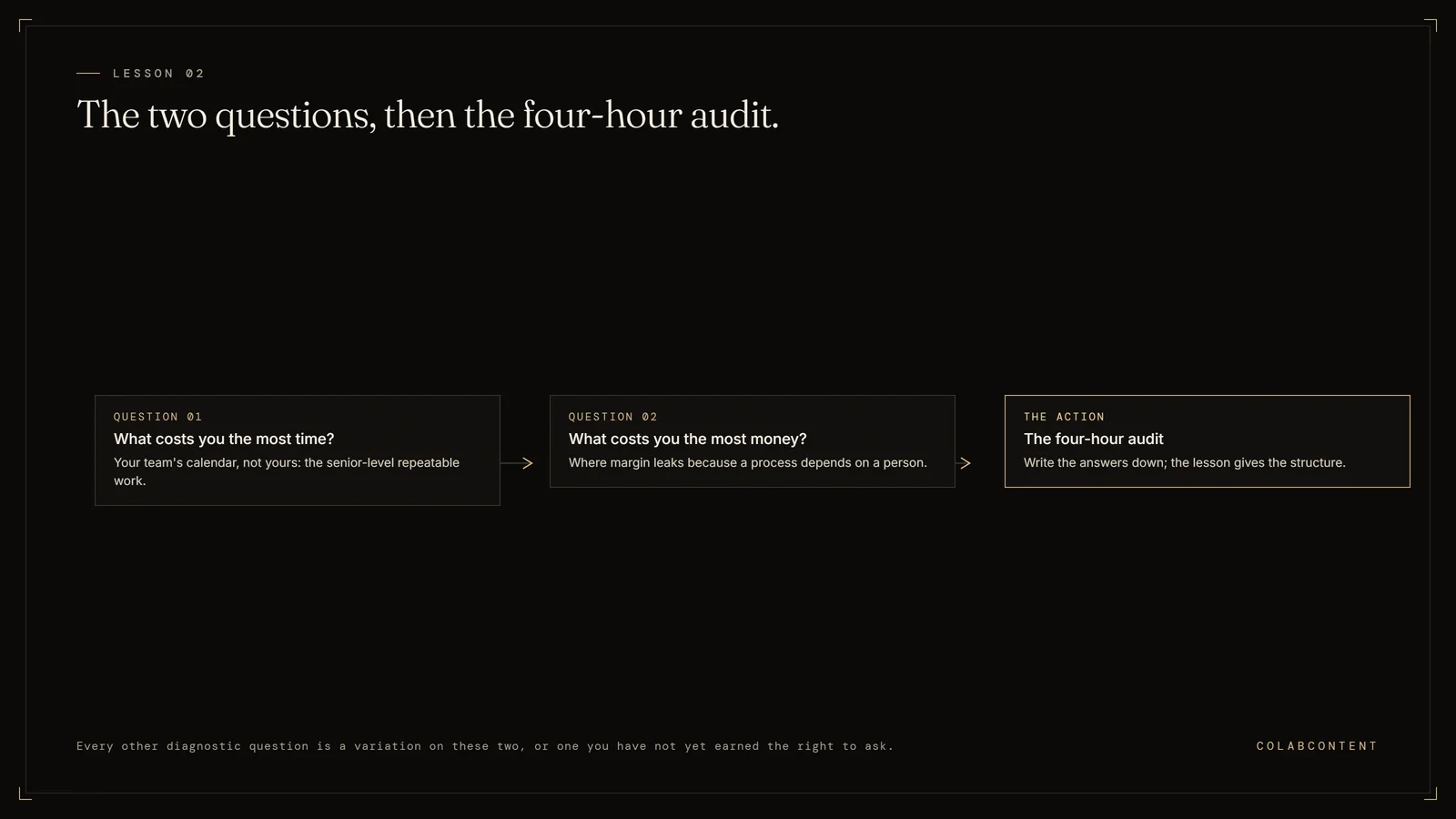
So we cut. The cut we kept was ruthless: the only two things worth asking are "what costs you the most time" and "what costs you the most money." Every other question is a variation on one of these, or is answering a question you haven't earned the right to ask yet.
Question one: what costs you the most time?
This is the easier of the two. Owners know it in their bodies. They feel it on Sundays when they are prepping the week. They feel it when they look at their ops lead and see burnout forming.
The trap is in the word "you." Most owners answer the question about their own calendar. But their calendar is rarely the constraint; their team's calendar is. The better phrasing is: "what repeatable, patterned, senior-level work is pulling your best people off the work only they can do?"
The honest answers are usually three things. Reporting assembly: Monday-morning dashboards rebuilt every week, executive memos drafted from scratch, board packs assembled by the CFO at midnight. Follow-up drafting: emails, recaps, proposals, post-call summaries, client update notes. Meetings that exist because a document doesn't: status meetings, alignment syncs, cross-team check-ins that would not be needed if the relevant context were written down and accessible.
Sit with each of those three. Ask: "if I were not doing this, what would I do instead?" The answer to that question is the dollar value of the time. If the answer is "I'd hire faster, sell into another segment, ship the product I keep promising the board", those are real dollars, and they're the dollars to put against the engagement budget.
Question two: what costs you the most money?
This one is harder. Owners often misdiagnose it. They answer "our CAC is too high" or "our NRR is flat", which are outcomes, not causes. The real question is: "where is margin leaking because a process depends on a person?"
The honest answers are usually three things. Inbound that goes cold before a human touches it: leads, RFQs, COI (certificate of insurance) requests, intake forms, phone calls that ring out. The dollar value here is direct: every cold lead is a missed close at the median average ticket. Multiply.
Proposals that ship late and lose deals: quote-to-ship cycle in manufacturing, proposal cycle in services, submission cycle in insurance. The "first-in wins" effect is real, and modeled in the Quote-to-Ship Leak Calculator if you're a manufacturer.
Post-sale work that doesn't compound into retention because no one has time: client check-ins, account reviews, value-realization moments. The dollar value here is in churn that didn't happen because the customer felt cared for, on the right cadence, with the right context.
Why this works.
These two questions, answered honestly, produce a specific, dollar-quantifiable, named constraint. And a specific constraint is something we can build a system around. A vague anxiety isn't.
Try this at your next leadership offsite. Ask each exec the two questions. Write the answers down. Compare. The pattern will be painful and it will tell you exactly where the next six months of leverage lives.
The four-hour audit.
The version we run for every paid engagement is the $499 AI-Ready Audit itself, built from the same two questions this lesson walks through: about four hours of your team's time end to end. You answer the two questions, a few senior people answer the same way, and the report comes back inside 3 business days as a 5-minute video plus a 20-minute call that names the constraint and the recommended commission shape.
You keep the memo regardless of whether you commission a build, and if it did not deliver value, we refund the $499 in full. About half of the audits we run, by our own count, end in a commission; the rest end with us saying, candidly, that a tool, a hire, or no AI at all fits better.
Tomorrow.
Lesson 3 walks through the end-to-end audit you can run on your own operation, before any vendor conversation. The objective: identify every handoff, every bottleneck, and every piece of tribal knowledge in your business, in a format that lets you decide what to do about each one with intent.