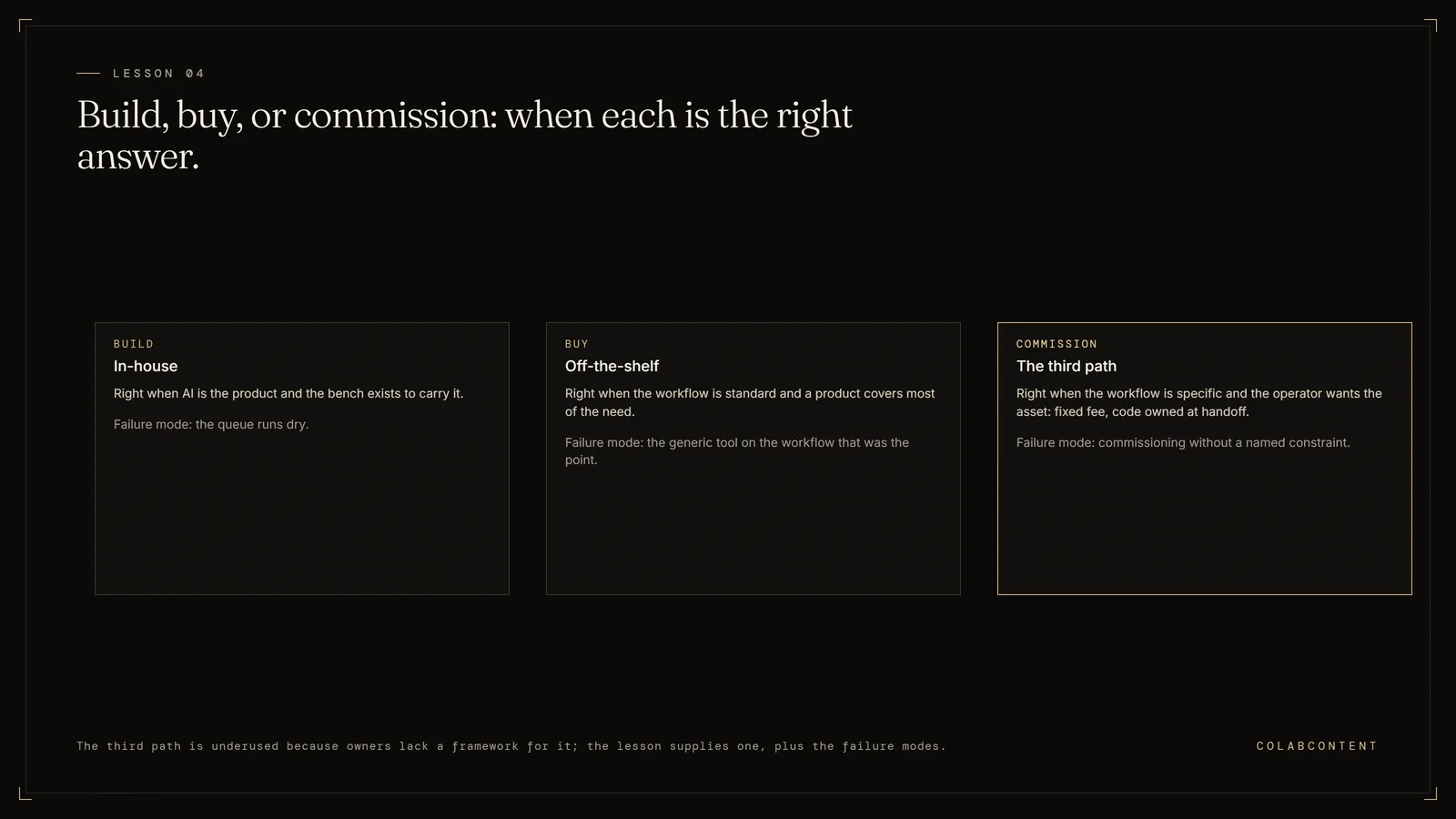
The third path.
The conventional choice every operator faces is between build and buy. Build means hire engineers and an AI lead, write the system internally, own the output. Buy means license an off-the-shelf product, configure it for your business, and accept its boundaries.
The third path, commission, is underused because owners don't have a framework for it. Commissioning means hiring a boutique to build a custom system on your data, in your own tenant (an isolated environment in your cloud account), owned by your business at handoff. Different from build (you don't carry the engineering team afterward). Different from buy (the system is yours, configured to your specifics, not the vendor's average).
Build: when it's the right answer.
Build is the right answer when AI capability is going to be a durable differentiator for your business, when you have or can credibly hire the engineering bench, and when the system you need will keep evolving over years.
For a $200M software company (illustrative example, not a client figure), build is often correct. For a $25M services firm (illustrative example), build is usually wrong: the engineering bench is expensive, the AI capability is a means not an end, and the system needs to ship in roughly 8 weeks (estimate) not 8 quarters. Hiring two AI engineers and a head of AI to deliver one workflow improvement is a mismatch of resources to outcome.
Build criteria: Does AI capability appear in your strategy as a moat, not just an enabler? Can you hire and retain at the AI engineer level? Will the system need to evolve materially every year? If yes to all three, build.
Buy: when it's the right answer.
Buy is the right answer when an off-the-shelf product covers roughly 80% or more of your needs (a working estimate, not a measured figure), when your needs are not differentiated from the average customer in the segment, and when configuration is a real lever the vendor exposes.
For meeting transcription, buy. For generic SDR enablement, buy. For most CRM (customer relationship management software) auto-fill, buy. The category leader has solved 80% of the problem for the average customer, and your business probably is the average customer for that workflow. Trying to commission something custom for these workflows is a misallocation.
Buy criteria: Does an off-the-shelf product cover 80%+ of your need? Are your needs essentially the same as the average customer in your segment? Is configuration substantive enough that the vendor's product becomes your business's product? If yes to all three, buy.
Commission: when it's the right answer.
Commission is the right answer when your needs are differentiated (your matter taxonomy, meaning how your firm categorizes and tracks its case files; your part library, your carrier pool, your pricing rules, your business's specific workflow), when off-the-shelf products cover less than roughly 60% of your need (estimate), and when you want to own the system at handoff rather than rent it.
Most of the workflows we listed in Lesson 1 fit this pattern. Custom CPQ AI on the shop's actual part library. Matter-aware retrieval on the operation's specific iManage taxonomy. Submission AI on the agency's actual carrier pool. The vendor product can't capture the specifics; the build option is too heavy; the commission option fits.
Commission criteria: Are your specifics meaningfully different from the average customer? Does off-the-shelf cover less than 60% of your need? Do you want to own the system, not rent it? Will the system be relatively stable once shipped (roughly 5-15% modification per year, not 50%, both estimates)? If yes to all four, commission. Our own fixed-fee terms for a commission are set out on the pricing page. Score your own case against these three paths with the $499 AI-Ready Audit.
Three failure modes.
The three failure modes we see most often, in order of frequency:
Buying when you should commission. The most common failure. Owner sees a polished demo, signs a 12-month contract, the tool covers roughly half the workflow well and half poorly (estimate). Senior staff resent it. The hours-back number doesn't materialize. Year two, the contract gets renewed because nobody wants to admit the mistake.
Building when you should commission. Second most common. Owner hires two AI engineers, an illustrative eight months later there's a half-built internal tool, the engineers are restless because they want to ship to many users, the operation hasn't shipped to even one workflow. The build burns an estimated 18-24 months and never reaches steady state.
Commissioning when you should buy. The least common but most expensive on a per-engagement basis. Custom build for a workflow that an off-the-shelf product covers cleanly. The deliverable works, but the operation is paying boutique fees for what an estimated $400/month SaaS (software delivered over the internet on a subscription) would have done. Avoid by being honest about whether your needs are actually differentiated. Our own view on the ownership question is in how we work.
Tomorrow.
Lesson 5: scoping the first commission. The four elements of a tight scope: outcome, interface, data, guardrails. The difference between an engagement that ships in 6 weeks and one that ships never.