Before you call any vendor.
The audit in this lesson is the one piece of homework most owners do not do, that the operators who get the most leverage out of AI all do. The reason is structural. Vendors run process audits as a sales motion: their audit ends with their tool as the answer. An audit you run yourself ends with the right answer, which may or may not be a tool.
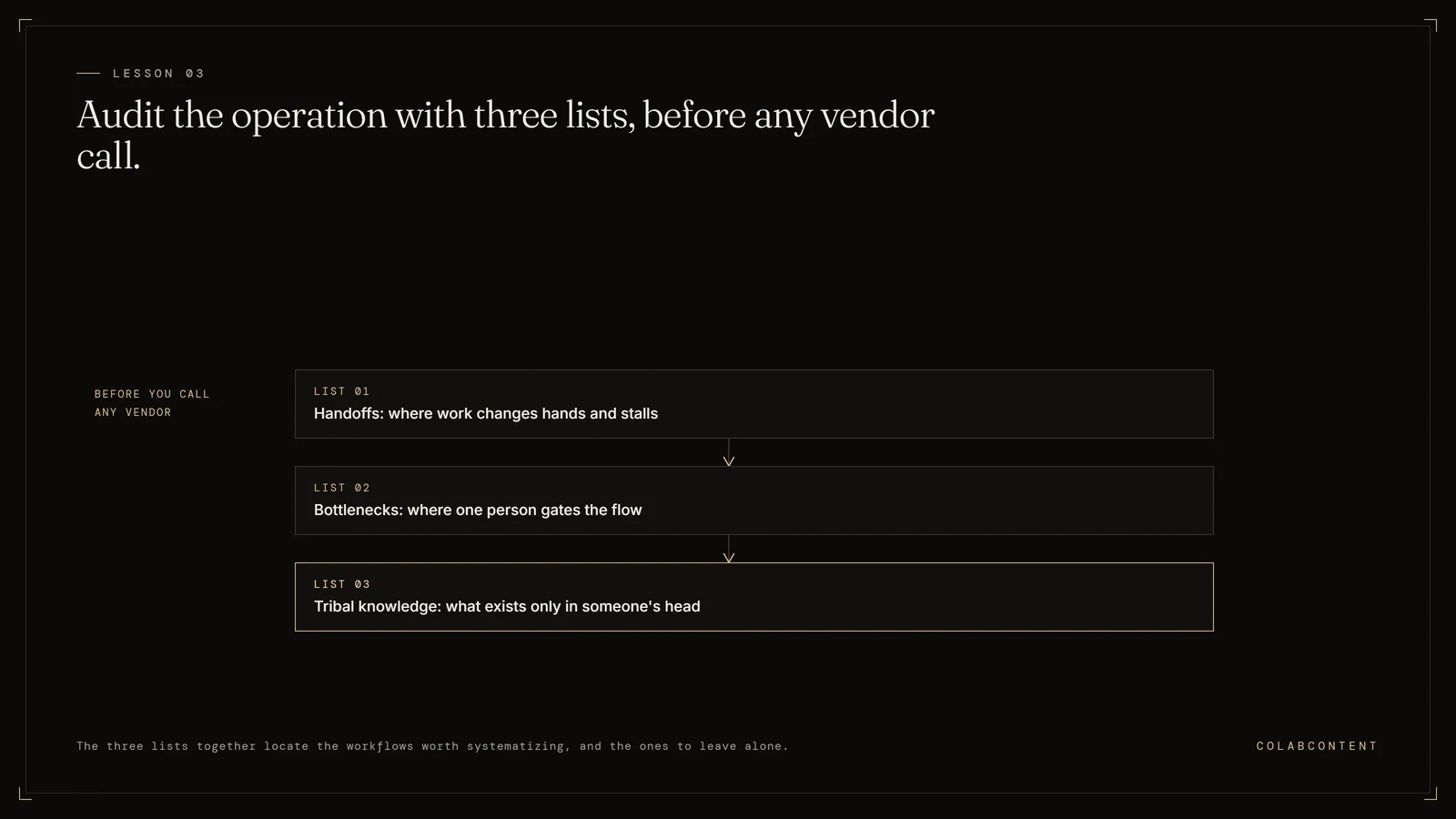
This audit takes about a day and a half spread across a week. A senior operator does it; not a junior, not a consultant, not a vendor. The output is a one-page document with three lists. By the time you finish reading this lesson, you will know what those lists are and how to populate them.
List one: handoffs.
Every place in the business where a piece of work moves from one person to another, or from a person to a system, or from a system to a person. Lead form to CRM (customer relationship management software) to SDR to AE. Inbound RFQ (request for quote) to estimator to senior estimator to customer. Engagement letter to PBC (the prepared-by-client document list) chase to binder build to preparer to reviewer to partner.
Walk each of your three highest-volume workflows end-to-end and list every handoff. Most owners are surprised by the number. A typical $25M services firm has 14-22 handoffs in its primary delivery workflow alone (our estimate, from client engagements). Each handoff is a place where context drops, where time leaks, and where AI can compress.
List two: bottlenecks.
List one, the handoffs you wrote down for your own business, every point where work moves from one person or system to another, will surface this second list's bottlenecks naturally. A bottleneck is a handoff where work consistently piles up. Find them by asking your team three questions:
Where do you usually get stuck waiting? The answer is almost always a name, not a system. "I'm waiting on Aisha." "I'm waiting on the estimator." "I'm waiting for the partner to review." That name marks the bottleneck.
What was your worst day this month, and what was the precipitating event? The precipitating event is almost always a bottleneck failing under load: a backlog of submissions hitting the principal, a partner caught between three review queues, a dispatcher running out of techs at 9am.
If you could clone one person on the team, who would it be? The clone target is your highest-leverage bottleneck.
Cross-reference the answers across your senior operators. The names that come up multiple times mark the structural bottlenecks; the names that come up once mark situational ones.
List three: tribal knowledge.
The third list is the one most owners skip, and it is the highest-leverage list of the three. Tribal knowledge is anything important to the business that is not written down anywhere durable. Pricing rules in the head of the senior estimator. Carrier appetite memos in the head of the principal. The "way we treat" a particular client in the head of the relationship partner. The reason a particular routing decision is the right one in the head of the dispatcher.
Write these down by interviewing your three or four most senior operators for an hour each. Ask: "what do you know about this business that nobody else here knows?" The honest answer takes about ten minutes to surface; the first nine are the operator working past the modesty reflex. By minute ten, the gold appears.
This list is the highest-value asset on the audit. AI cannot replace tribal knowledge, but it can preserve it, retrieve it, and propagate it to the next hire.
What you do with the three lists.
Once you have completed all three lists, handoffs, bottlenecks, and tribal knowledge, you will end with a document that has 14-22 handoffs, 4-7 bottlenecks, and 8-15 pieces of named tribal knowledge. Most of it does not need an AI intervention. Some of it does, and the document tells you which.
The pattern that will jump out: one or two bottlenecks where the cause is "senior person doing patterned junior assembly work" + one or two pieces of tribal knowledge that, if propagated, would compress a six-month ramp into six weeks. That intersection is where the first AI commission should ship.
Tomorrow.
Lesson 4: the build/buy/commission decision. Once you know the leverage point, three paths exist for getting there. They are not equally good. The framework for choosing between them is what we use on every paid engagement, and we will walk through it tomorrow.